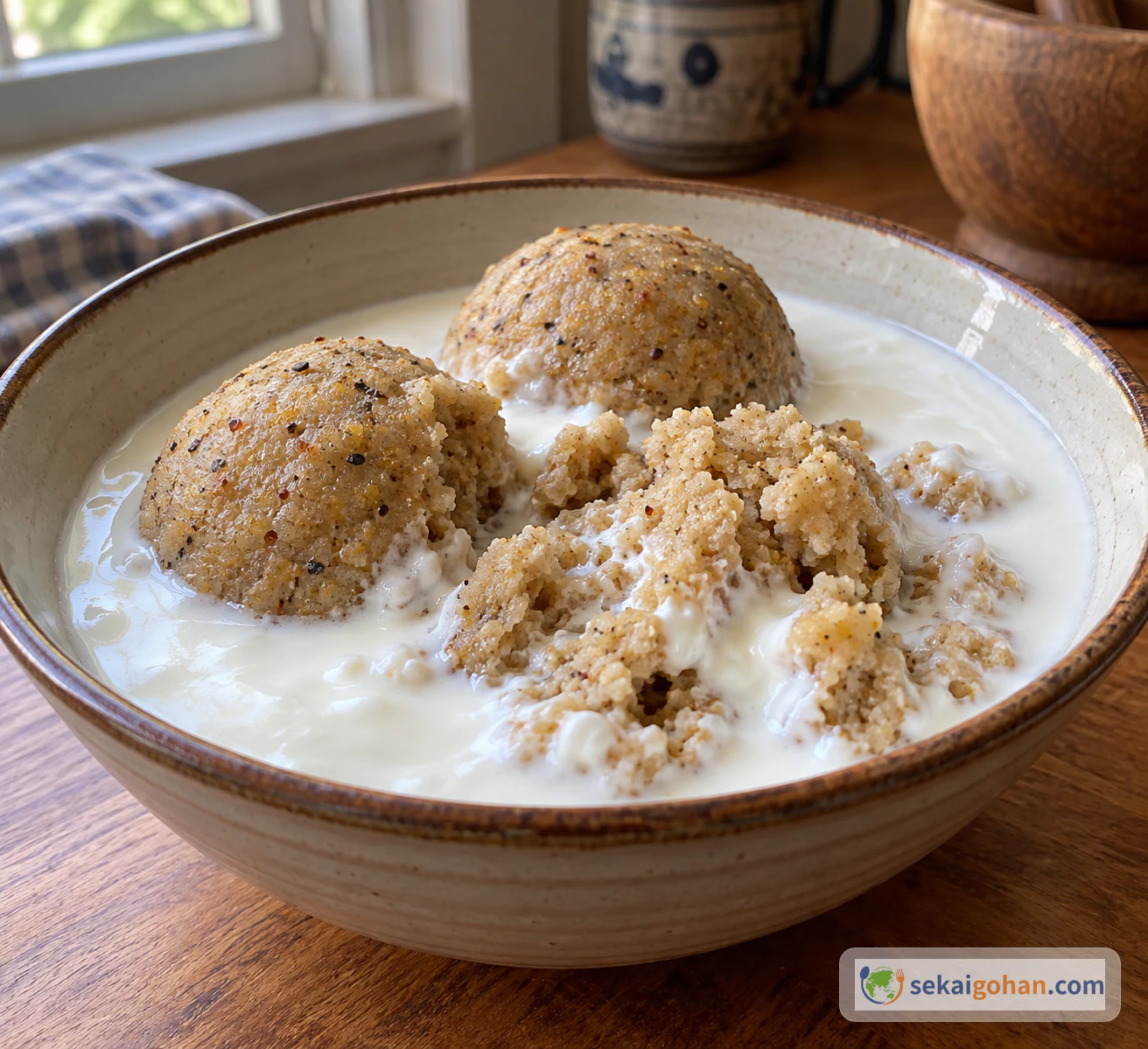
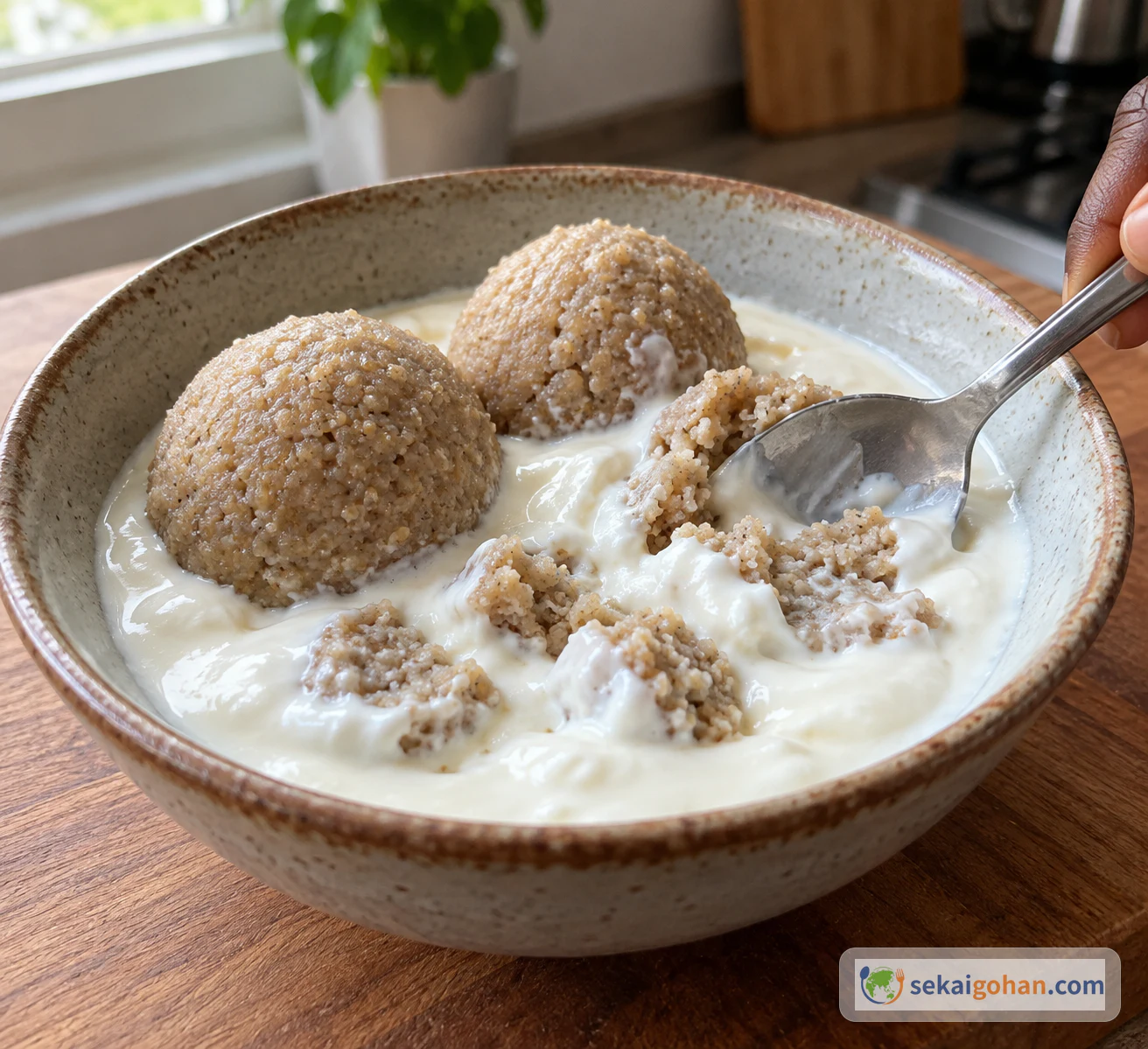
Fura da Nono: Rolled Grain Meets Cool, Tangy Milk
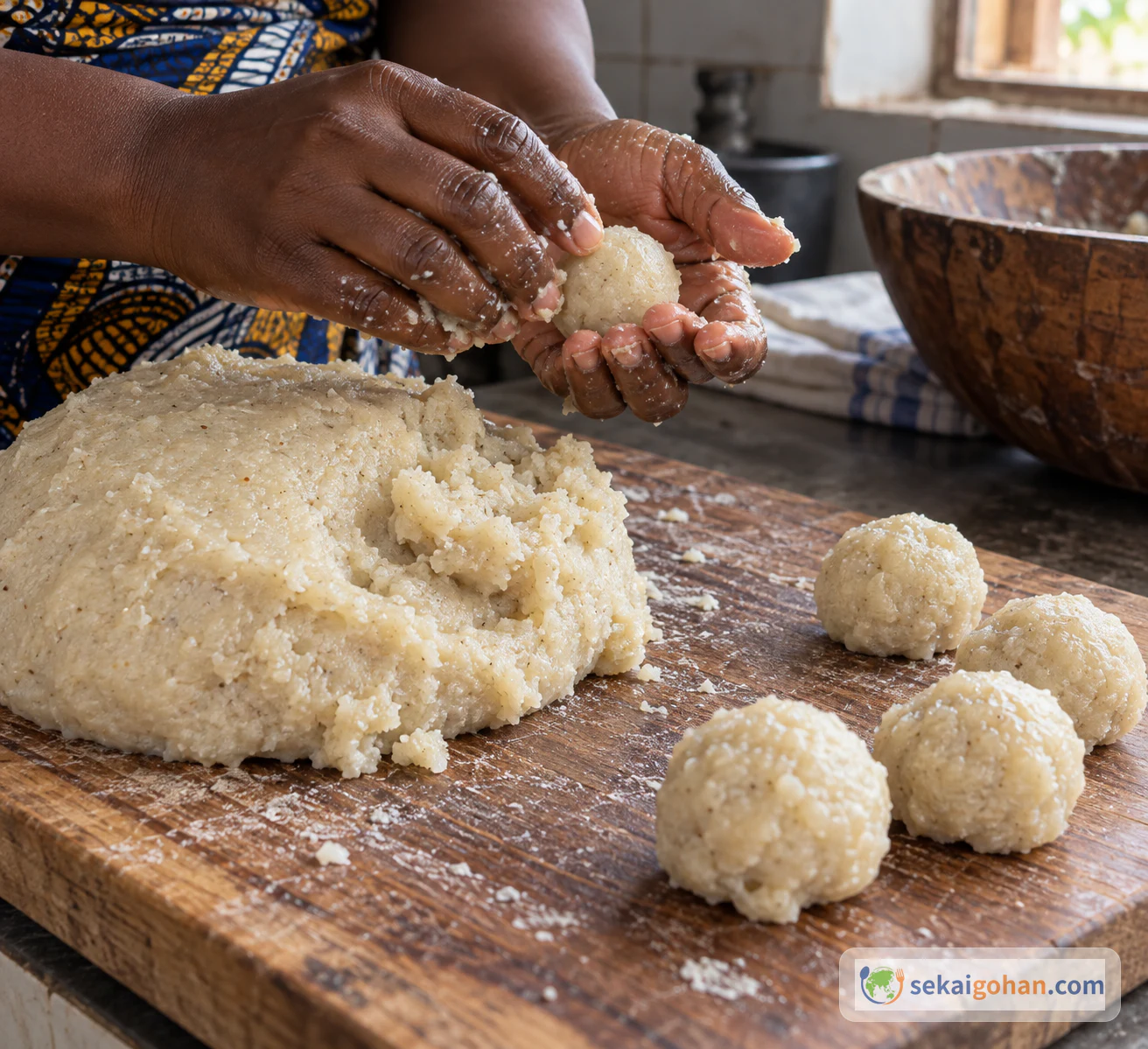
Dry millet flour becomes a smooth, elastic dough through boiling and pounding. It is then rolled again and crushed into cold, tangy dairy. Keep some pieces of grain visible rather than blending everything into a liquid.
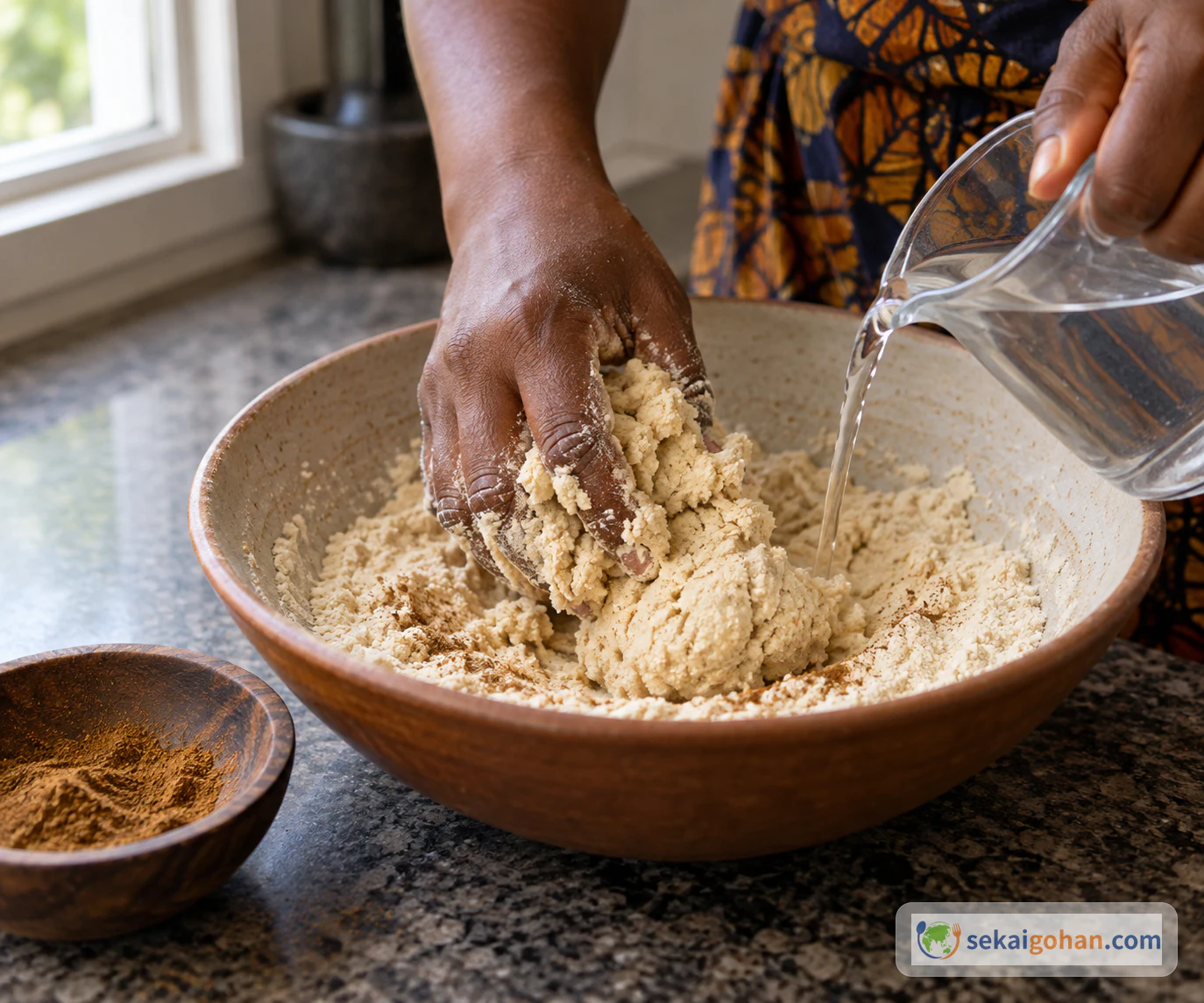
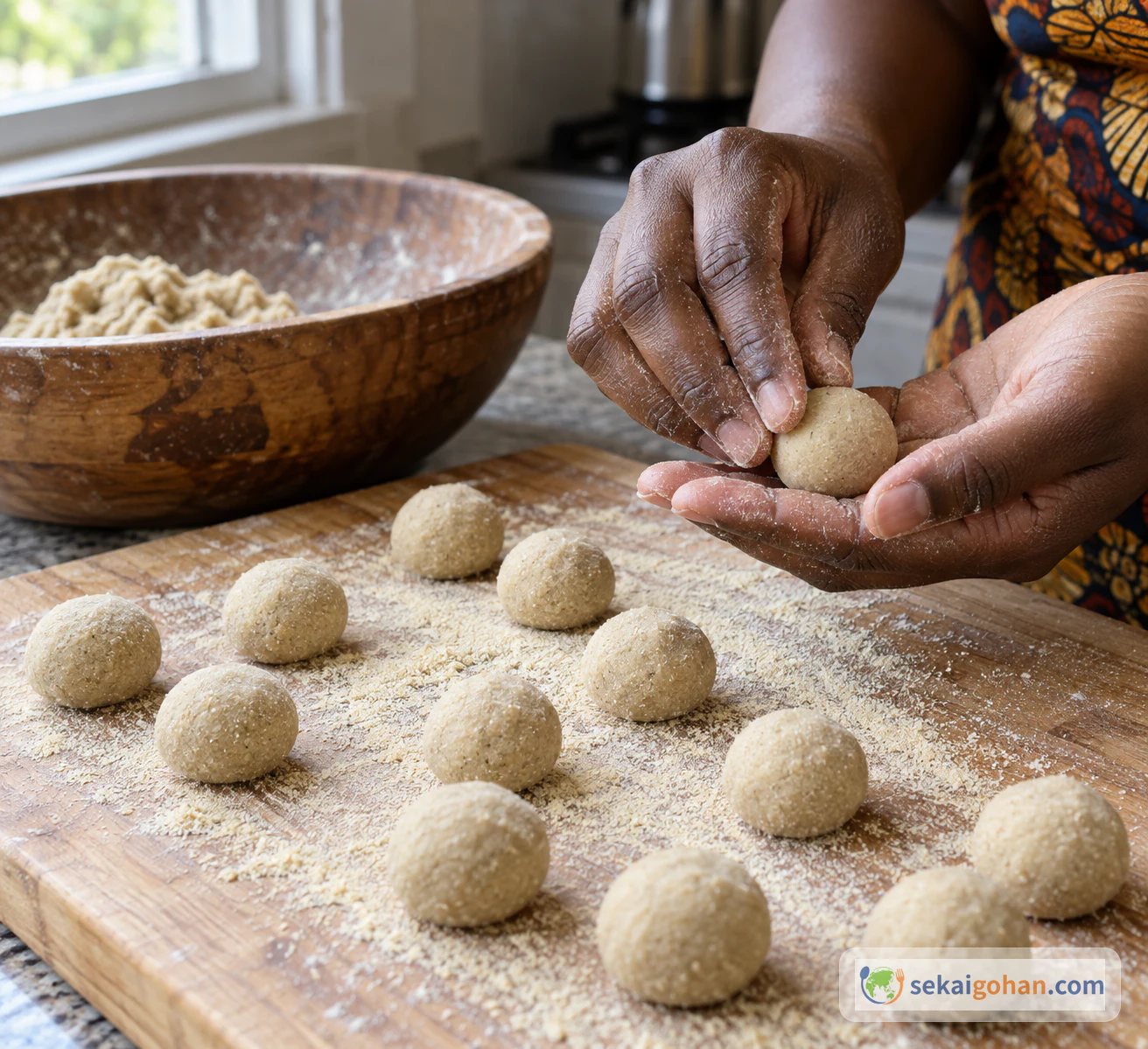
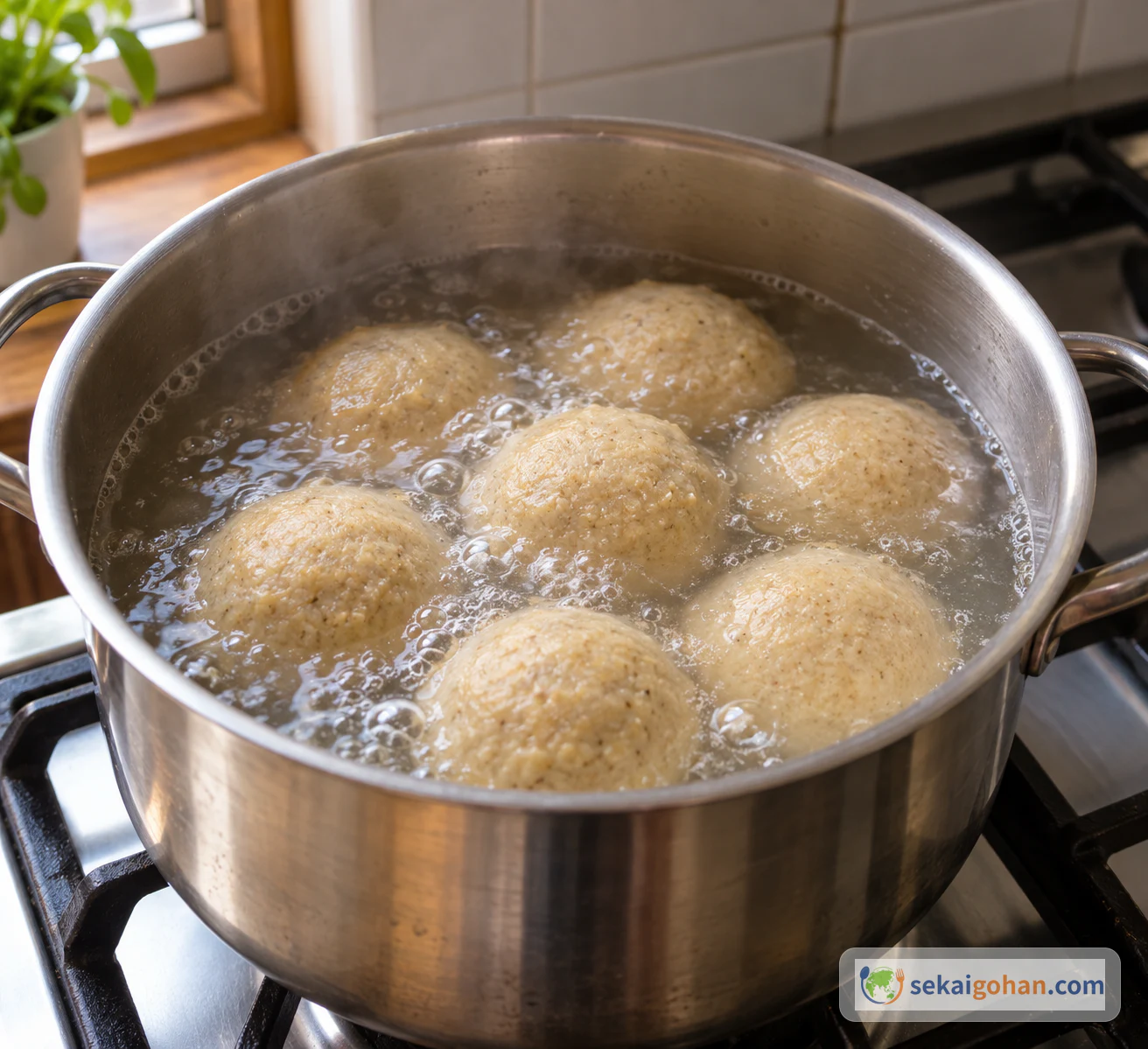
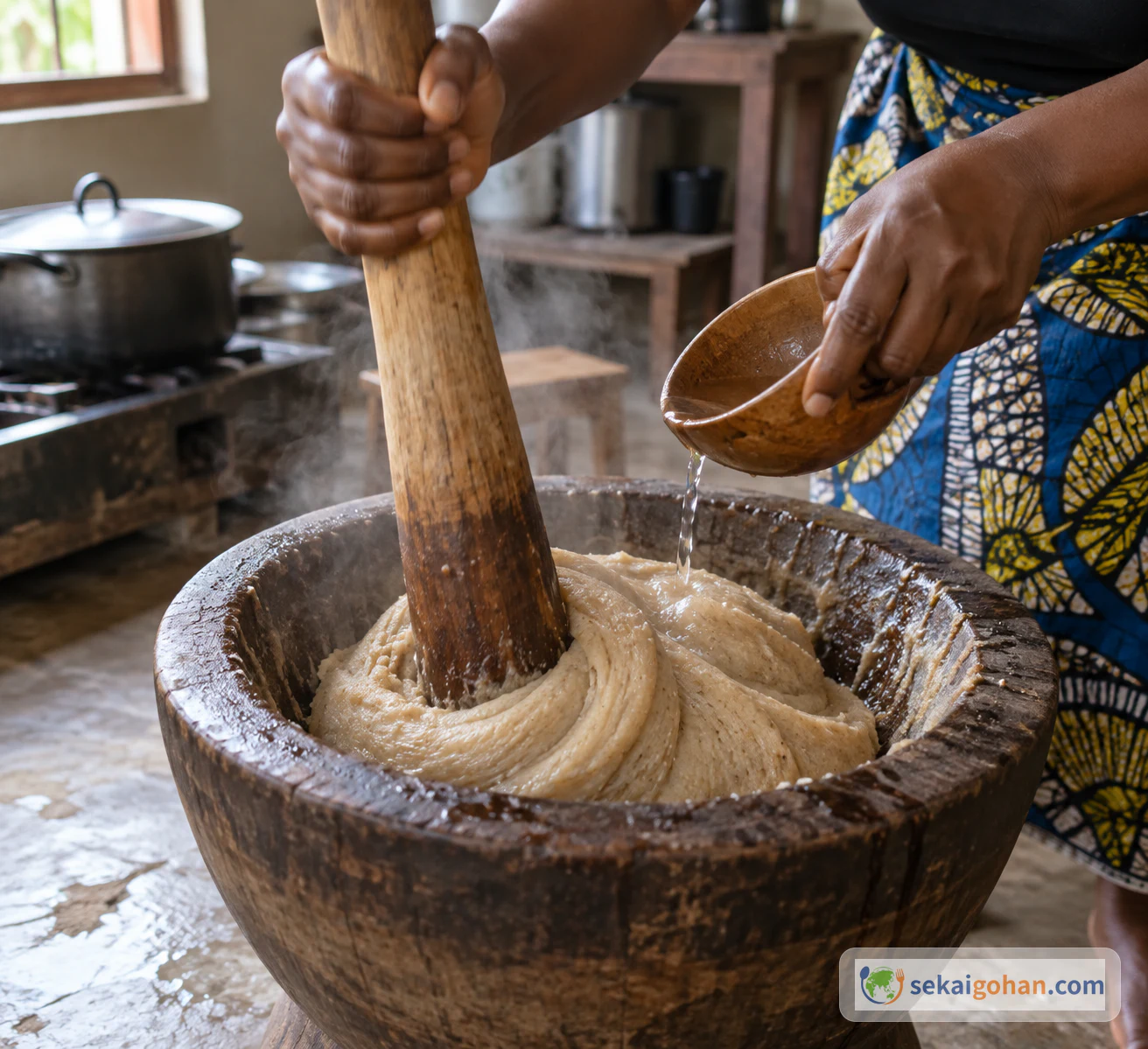
Spiced millet flour is moistened and pressed into small balls, then boiled and pounded while still hot until it comes together as one cohesive mass. That mass is rolled again into small balls, which finally meet cold, sour dairy in a single bowl. The name uses two Fulani words. Fura is the ball of spiced ground millet, and nono is milk fermented from cow's milk. Together, the name translates as "millet and milk."
The dish is tied to Fulani producers in Nigeria and to the north of the country. In northern states, yoghurt has replaced nono for many consumers, so fura da yoghurt is a common version. Fura is a Nigerian snack made by hand: mix, shape, boil, pound and reshape. You can explore more of the country's food on our Nigeria page.
The amounts come from lab formulas, scaled for a home kitchen. Those formulas used dehulled flour, so your flour will behave differently. Adjust the water by the feel of the dough.
How the amounts were chosen
The working formula comes from two studies of fura. One uses 500 g pearl millet flour, 10 g ginger and 2.5 g cloves, hydrated with 50–60% (w/v) water for 1 hour. The other uses 100 g flour, 2 g ginger and 0.5 g cloves with 67 ml water, and adds hot water during pounding. Tests centred on 20 ml of pounding water, with optimum values of 21–25 ml.
The amounts below are scaled up from the studies. The 50–60% figure gives 250–300 ml, and five times 67 ml gives 335 ml. Five times the pounding values gives 100–125 ml. Best resting times ranged from roughly 53 minutes to 1.36 hours in one study, depending on the texture measured. Longer rests were tested only for texture, not for safety, so rest for 1 hour.
Ball size, boiling time, pounded texture and the amount of dairy follow a traditional Nigerian recipe, which uses 4 cups sifted millet or sorghum flour, 2 teaspoons hot spices, 6 cups water and 2 cups nono, yoghurt or sour milk. The recipe does not say how the 6 cups of water are split between dough, boiling and pounding, or name the spices. The figures here are for comparison only.
Ginger and cloves together come to more than 2 teaspoons, though the two spice mixes are not the same. The cup in that recipe is not defined. One cup of millet flour weighs 119 g, so 4 cups comes to about 476 g, close to 500 g. That is why this batch uses 2 cups of dairy.
Ingredients for 500 g of Flour
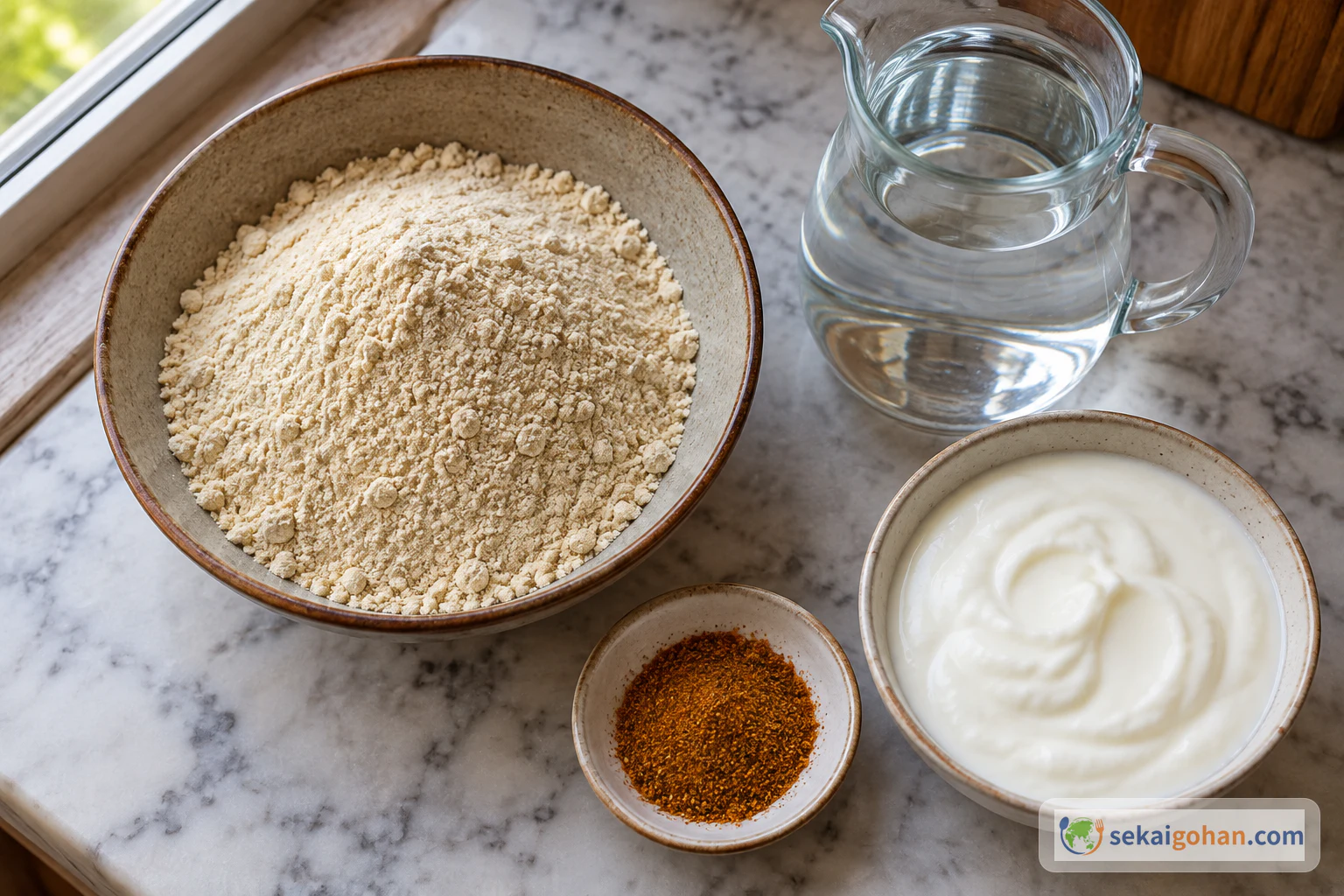
For a smaller batch, use these amounts for each 100 g of flour: 2 g ginger, 0.5 g cloves, 50–67 ml dough water and 20–25 ml pounding water. Add yoghurt as needed.
This dish contains milk. A milk-free plant-based yoghurt is a separate alternative, not the same dish.
Equipment
- Kitchen scale, since the cloves are measured in 2.5 g
- Mixing bowl with a lid or cover
- Pot for boiling
- Mortar and pestle, or a sturdy bowl and masher
- Frying pan, only if you plan to dust a board with dry-toasted flour
- Food thermometer (optional)
Choosing Flour, Dairy and Spices
Flour. Pearl millet flour, sold as bajra flour or bajra atta, is the starting point. The formulas use dehulled, sieved flour. Bajra atta is made from whole pearl millet, so its color and water absorption differ. Bajra atta sold in Japan comes in packs such as 500 g. Kibi flour, the Japanese millet, is a different species from pearl millet. You can use it as a substitute, but it isn't the same ingredient, so the water will need adjusting.
Dairy. Choose store-bought, pasteurized plain yoghurt without sugar. It is not the same as Fulani nono: its thickness, sourness and fermented aroma all differ.
Spices. Use ginger and cloves; dried chili powder is optional. If you want less spice, you can use less.
Method: Boil, Pound and Roll Again
The water depends on your flour, so each step gives both an amount and the texture to look for. Trust the texture when the two disagree.
Raw flour. Germs in flour are killed only when it is baked or cooked. Keep raw flour away from ready-to-eat foods.
Heat check. The 75°C guide comes from Japanese food-hygiene guidance for catering and large-scale cooking. It is a general guide rather than a standard written for fura or home kitchens.
Dairy. Use pasteurized milk and dairy. Refrigerate at or below 40°F (4°C), and leave it at room temperature for no more than 2 hours, or 1 hour above 90°F (32°C).
Leftovers. Cool and refrigerate fura soon, and eat it the same day. At room temperature, fura lasts one day. In tests, the bacteria count of untreated fura rose more than 10-fold after 48 hours.
When the Dough Misbehaves
| What you see | Likely reason | What to do |
|---|---|---|
| The dough crumbles when squeezed | Not enough water yet | Add water a little at a time, up to 335 ml in all |
| The dough is too wet to shape | Water went in too quickly, or your flour absorbs less | Next time, add the water in smaller amounts and test often |
| The center of a ball isn't hot | The boil dropped, or the balls are too large | Return to a boil and check again; keep the balls to 2–3 cm |
| The center is hot but white | The inside can stay white after boiling | Don't judge by color alone; check the heat, then pound while hot |
| The pounded dough won't come together | Too little hot water, or the balls have cooled | Keep pounding and add hot water a little at a time |
| It is too spicy | Spice is mixed in from step 1 | Next time, reduce the spice or leave out the chili |
Meaningful Variations
- Yoghurt in place of nono. This is the version given here. It is a different food from nono, with a thicker texture and a different sourness.
- Sorghum flour (guinea corn). Sorghum is an alternative grain. Treat it as a separate version rather than mixing it with millet.
- Fura on its own. Fura is also served alone, which eats quite differently from fura crushed into dairy.
- A soybean meal version. Some recipes add soybean meal and corn flour. No quantities for those ingredients are given here.
- A little sugar. Some versions serve fura with sugar. If you like it sweeter, add sugar to taste at the table.
- Milk-free. Plant-based yoghurt avoids milk, but it is a separate alternative and not the regional dish.
Millet and Milk in Nigeria
In some northern Nigerian states, fura is a staple for the Fulani and Hausa peoples, with millet as the most important grain. Fulani women have produced and sold nono, and in the north, yoghurt has taken its place for many consumers.
Published recipes vary widely. One includes soybean meal, dried pepper, cloves, dried ginger and corn flour, with 2 litres of boiling water, about 20 minutes of cooking and 1 litre of yoghurt or nono. Another makes 6 servings with 6 cups of millet, fresh ginger, cloves, optional dried pepper and an unstated amount of water. Compared with the traditional recipe above, they show there is no single authentic formula.
Several published versions finish the balls with a dusting of flour. This recipe rolls them by hand instead, since raw flour is not cooked again. Food-safety concerns have also been reported. Fura da nono and fura da yoghurt sold in Abuja were found to have microbial contamination, and handling and environmental hygiene are the risks. The results cover the vendors sampled.
Frequently Asked Questions
What is fura da nono?
It is a Nigerian dish of balls made from spiced millet or sorghum flour, known as fura, eaten with the fermented milk nono. A yoghurt version also exists.
Can I make it with ordinary yoghurt?
Yes. Plain store-bought yoghurt is not traditional nono, and its thickness and sourness differ.
How many people does this serve?
This batch uses 500 g of flour, and each finished ball weighs 25–30 g.
Which spices should I use?
Use 10 g ginger and 2.5 g cloves for 500 g flour, with chili as an option.
Why are the amounts different?
The traditional recipe does not say how its 6 cups of water are divided or which spices it means. The studies give amounts for each stage, so this recipe uses those for the working formula and keeps the traditional figures for comparison.
How do I adjust the water?
The formulas come from lab research using different flour, so adjust the water by the state of the dough.
Should I ferment my own milk at room temperature?
No. Don't ferment your own milk at room temperature. Use store-bought pasteurized dairy instead.
Sources
- Food and Agriculture Organization of the United Nations (FAO), "Sorghum and millets in human nutrition: Fura (Nigeria)." Classification as a snack, ball size, boiling time, pounding and reshaping, serving options, dairy amount and the comparison formula. https://www.fao.org/4/T0818E/T0818E0K.HTM
- N. C. J. Anyanwu, "Microbiological and comparative analysis of indigenous and semi-industrial fermented milk drinks (Fura da Nono and Fura da Yoghurt) sold in Nigeria's capital," International Journal of Bioassays. The dish's name, its Fulani connection, nono and yoghurt versions, and contamination concerns in samples sold in Abuja. https://www.ijbio.com/articles/microbiological-and-comparative-analysis-of-indigenous-and-semiindustrial-fermented-milk-drinks-fura-da-nono-and-fura-da.pdf
- The Sun Nigeria, "Fura Da Nono." An alternative recipe used for comparison only. https://thesun.ng/fura-da-nono/
- U.S. Centers for Disease Control and Prevention, "Raw Milk | Food Safety." Pasteurized dairy, refrigeration and time at room temperature. https://www.cdc.gov/food-safety/foods/raw-milk.html
- Jideani, Oloruntoba & Jideani, "Optimization of Fura Production Using Response Surface Methodology," International Journal of Food Properties, 2010. The 100 g formula, dough and pounding water, resting and cooking tests, final ball weight, and the white interior observed after boiling. https://www.tandfonline.com/doi/full/10.1080/10942910802331496
- Sogunle, Ismaila & Adebayo, "Nutritional composition, microbial and sensory properties of fura treated with Aframomum danielli," FUDMA Journal of Agriculture and Agricultural Technology, 2022. The 500 g formula, water range, 1-hour hydration, 30-minute boil and shelf-life caution. https://doi.org/10.33003/jaat.2023.0802.24
- Jideani, Nkama, Agbo & Jideani, "Survey of fura production in some northern states of Nigeria," Plant Foods for Human Nutrition, 2001 (abstract). Fura as a staple for the Fulani and Hausa, millet as the main grain, and ginger as the most important spice. https://europepmc.org/article/MED/11213166
- Lydia Enyidiya Eke, "Fura Da Nono deserves a place in Nigeria's UNESCO Culinary Heritage story," BusinessDay, 2026. Ginger, cloves and optional dried pepper, gradual addition of water, and its recipe for comparison. https://businessday.ng/life/article/fura-da-nono-deserves-a-place-in-nigerias-unesco-culinary-heritage-story/
- USDA FoodData Central, "Millet flour (FDC ID 172023)." The weight of 1 cup of millet flour, used as a scale check. https://api.nal.usda.gov/fdc/v1/food/172023
- U.S. Centers for Disease Control and Prevention, "Raw Flour and Dough." Raw flour and dough handling. https://www.cdc.gov/foodsafety/communication/no-raw-dough.html
- Ministry of Health, Labour and Welfare (Japan), food-hygiene material on preventing food poisoning in meal service, 2010. The general guide of at least 1 minute at 75°C in the center. https://www.mhlw.go.jp/shingi/2010/03/dl/s0331-10a-011.pdf
- Ambika Japan, "(Ambika) Bajra Atta 500g." An example of whole pearl millet flour listed for sale in Japan. https://shop.ambikajapan.com/products/ambika-bajra-atta-millet-powder-500g