Wiener Schnitzel: Thin Veal, a Fine Crumb Coat and a Squeeze of Lemon
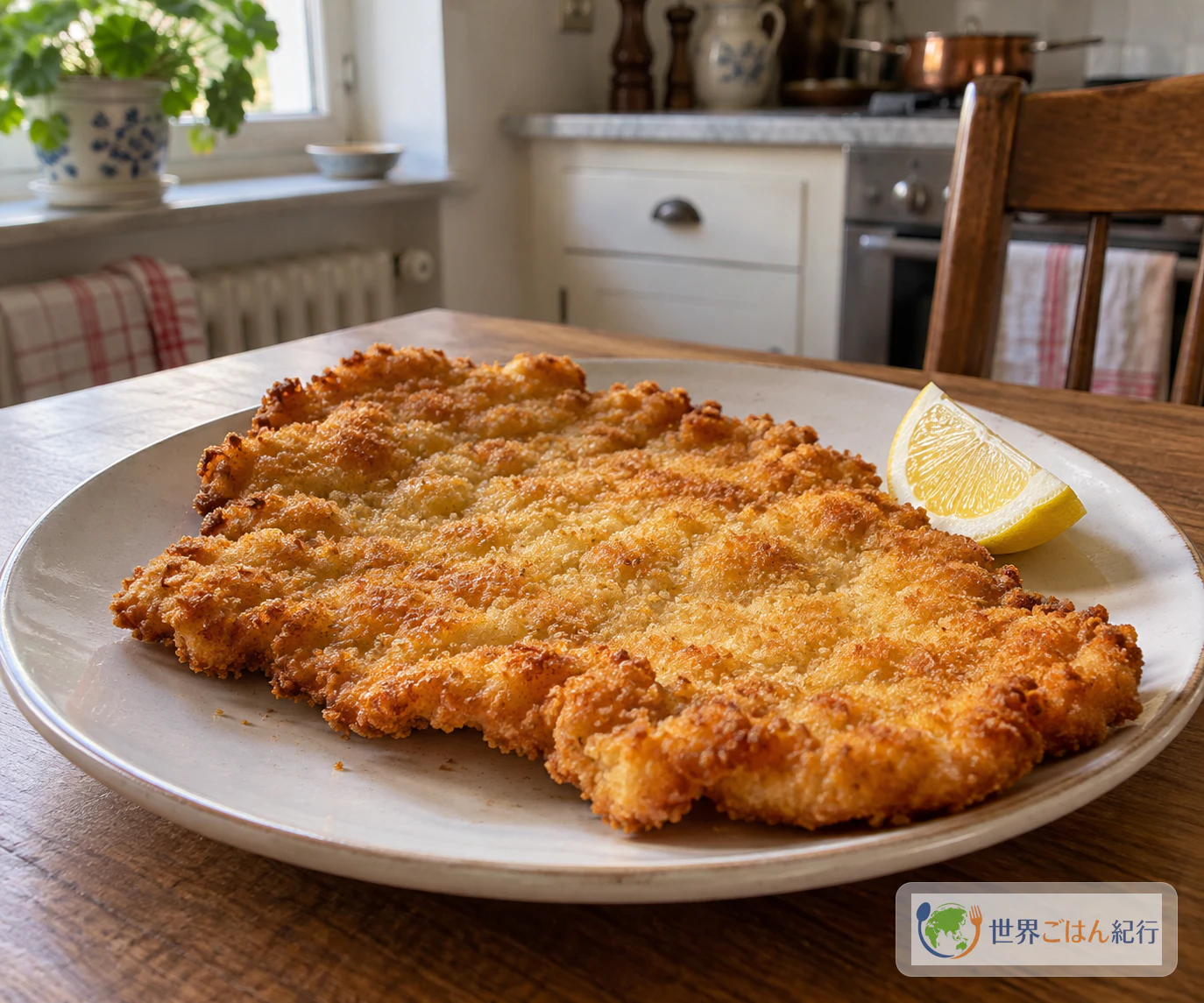
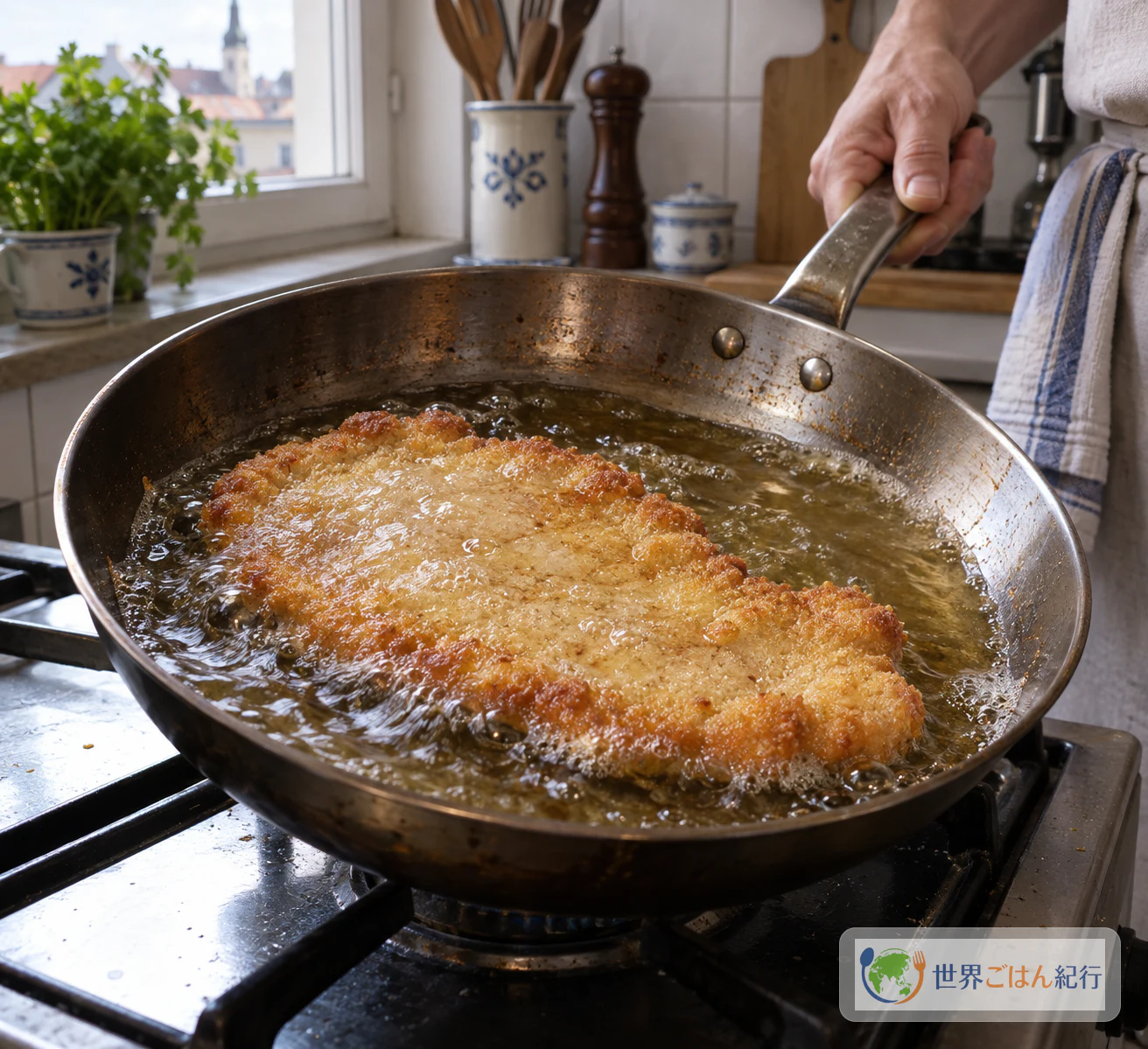
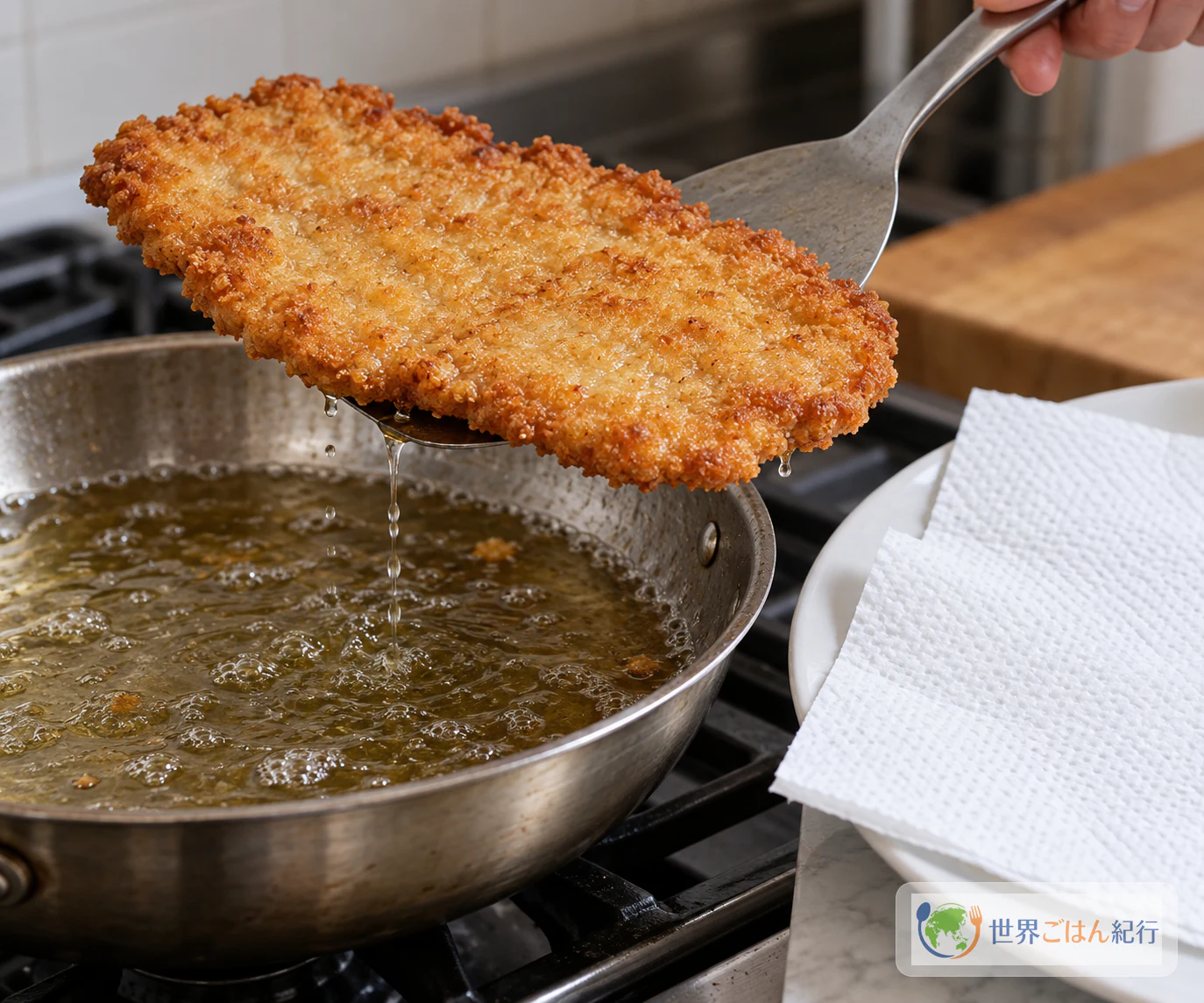
Veal pounded thin and even, a light coat of flour, egg and fine breadcrumbs, and enough hot fat around the cutlet for it to fry golden. Lemon is the only thing it needs on the plate.
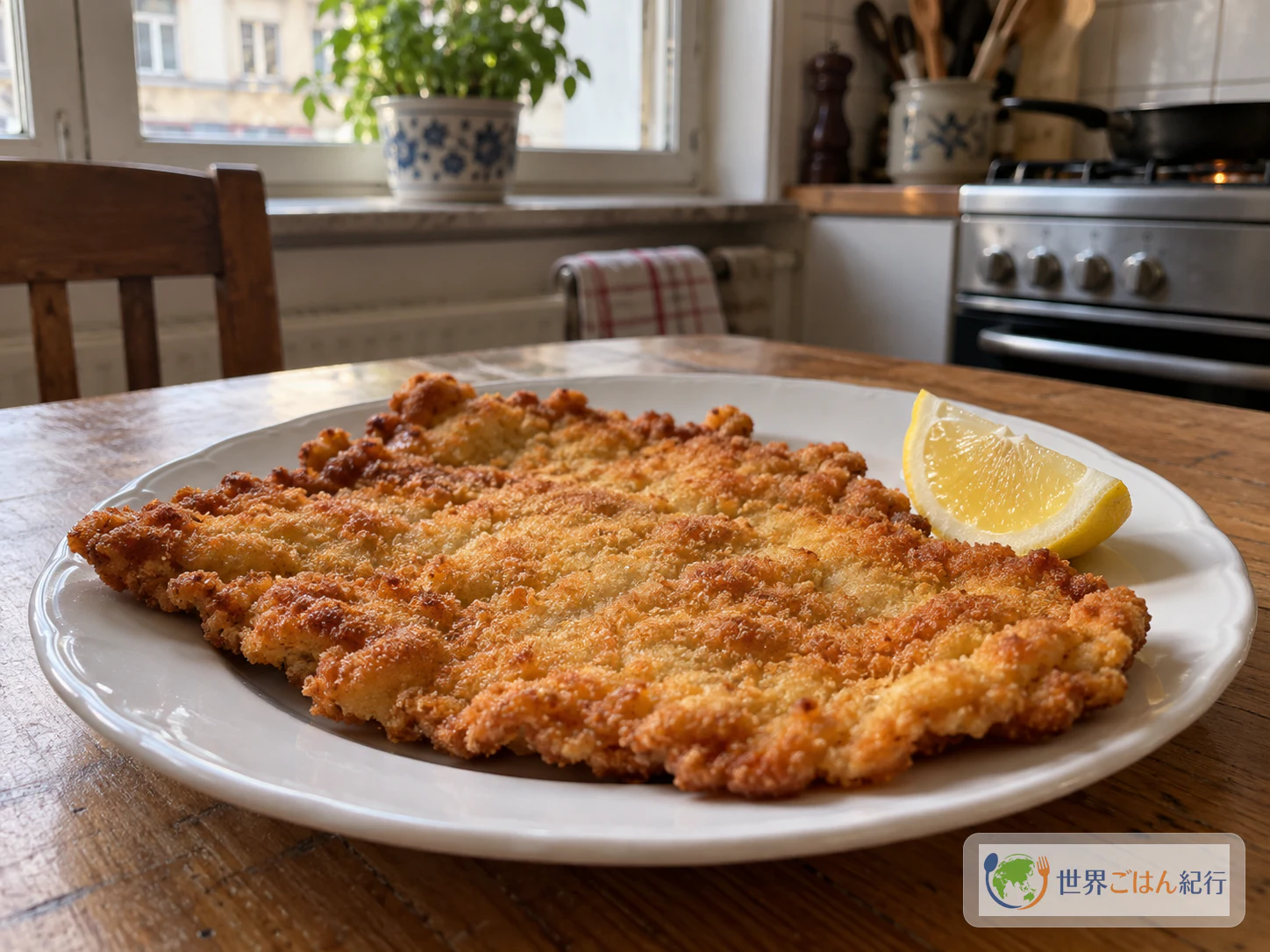
A broad, thin cutlet with a fine, golden crumb coat, set on a plain plate with a wedge of lemon to squeeze over it just before eating: that is Wiener Schnitzel. Austria's Federal Ministry of Agriculture lists it among the country's traditional foods, gives Vienna as its region, and describes it as veal coated in flour, beaten egg and breadcrumbs, in that order, then fried in fat.
In English it is easy to call this simply a "Viennese cutlet," but that name hides the most important detail: the meat. In Austria, the dish called Wiener Schnitzel is made from veal. A schnitzel made from pork is named differently, so it helps to settle the meat first and the method second.
The recipe below follows the ministry's own version for four people. For more dishes from the same country, see Austria.
How the Dish and Its Name Took Shape in Vienna
The ministry separates two records: one for the fried dish, one for the name. It cites an early record of "Gebackene Schnitzeln" (fried schnitzels) from 1798, and a cookbook record of the name "Wiener Schnitzel" from 1831. The first points to breaded, fried cutlets already existing; the second is when the name we use today appears in print. They are not the same event.
You will often hear that Field Marshal Radetzky brought the recipe back to Vienna from Milan, linking it to the Italian cotoletta alla milanese. The ministry treats this as a later legend rather than history, noting among other things that Viennese cooking already had fried dishes before then. Austria Tourism also presents the Radetzky story as a legend. A similar ingredient list and coating on both sides of the Alps does not, on its own, prove that one dish came from the other.
The ministry also records the habit of serving lemon with the schnitzel, citing a description in a cookbook from 1913.
Same family, different names
| Dish | Meat | Coating | How it relates |
|---|---|---|---|
| Wiener Schnitzel | Veal | Flour, egg, breadcrumbs | The dish in this recipe |
| Schnitzel Wiener Art / Wiener Schnitzel vom Schwein | Pork | Flour, egg, breadcrumbs | Under Austria's food code, a pork version is named this way rather than plain "Wiener Schnitzel" |
| Pariser Schnitzel | Veal | Flour and egg only, no breadcrumbs | A different dish because the coating is different |
Ingredients (Serves 4)
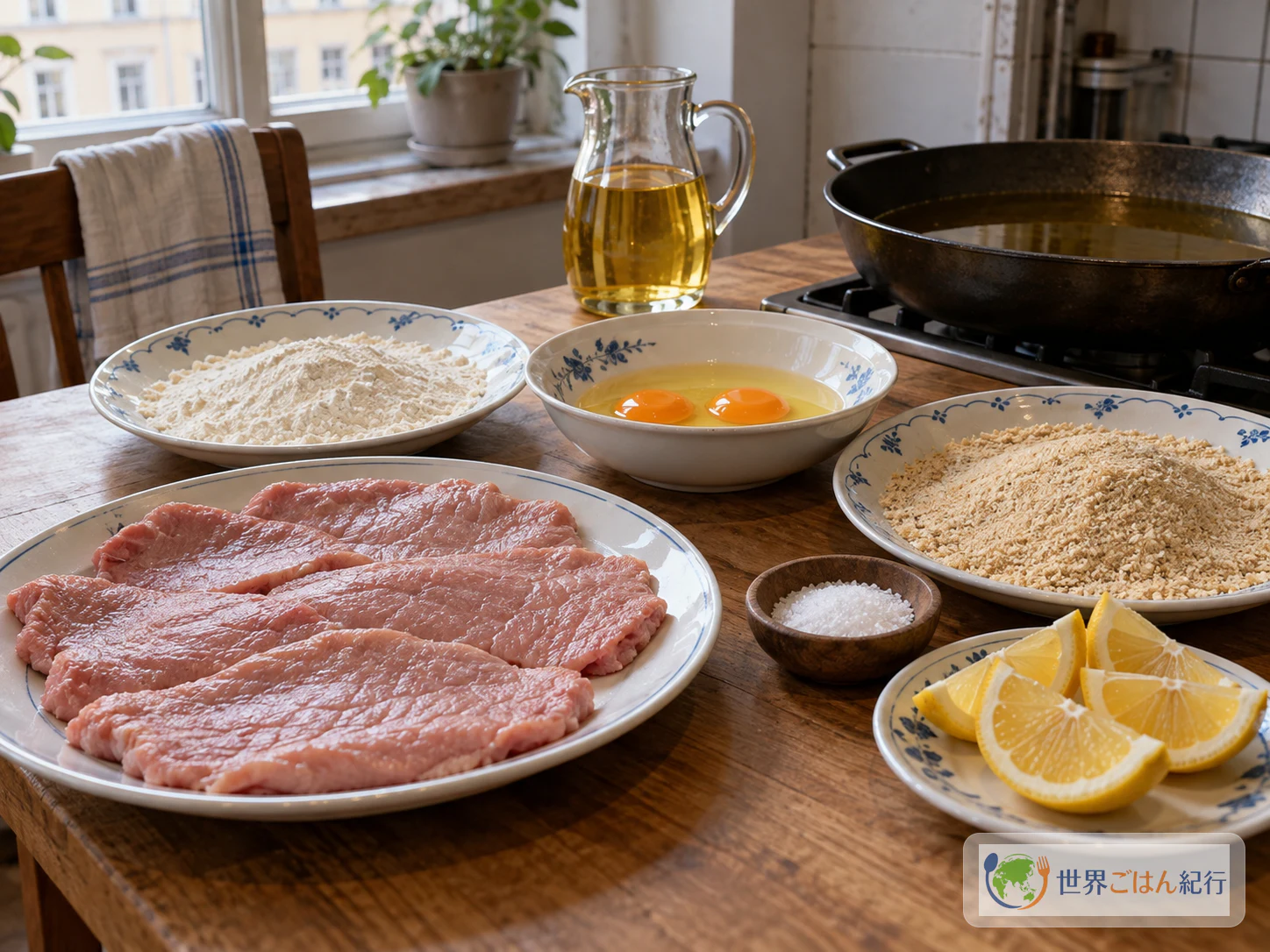
These amounts follow the Austrian ministry's recipe for four. The source gives no weights for the flour, breadcrumbs or fat, so they are listed as "as needed" here. Those amounts are what you set out on plates or in the pan, not what ends up on or in the finished schnitzel.
Choosing and Substituting Ingredients
Veal cut. The source names leg cuts such as Frikandeau or Schale/Kaiserteil as options, and the ministry's material also mentions the Nuss. Butchers outside Austria label cuts differently, so the simplest approach is to ask for veal leg cut for schnitzel or cutlets. The 600 g in the recipe is the trimmed weight.
Flour. The source calls for glattes Mehl, a smooth, fine-textured wheat flour. Ordinary soft wheat flour is used here as a home substitute; it is not an exact match in specification.
Breadcrumbs. Semmelbrösel are traditionally made by finely grinding stale Kaiser rolls (Kaisersemmel). Fine dry breadcrumbs from a supermarket are the closest everyday choice. Coarse, fresh breadcrumbs change the grain of the crust.
Fat. The source allows clarified butter (Butterschmalz) or oil. This recipe uses a neutral vegetable oil throughout. Clarified butter is the other option given by the source; plain butter is not the same thing as clarified butter, so don't treat it as an equal swap.
Pork. If veal is hard to find, you can make the same preparation with pork, but in Austria that is a Schnitzel Wiener Art, not a Wiener Schnitzel. The flavor and the name both change.
This dish contains wheat (flour, breadcrumbs) and egg, and milk if you fry in clarified butter. Check the labels on breadcrumbs, oil and any processed products, and keep cross-contact in mind if you are cooking for someone with an allergy. The flour, egg and breadcrumbs that raw meat has touched must not go onto the finished schnitzel. Keep raw meat, its board and its plates apart from cooked food.
Equipment
- Cutting board and sharp knife
- Plastic wrap or food-safe sheets
- Meat mallet
- 3 shallow plates (flour, egg, breadcrumbs)
- Fork for beating the eggs
- A wide pan deep enough to hold 2–3 cm of oil safely
- Meat fork for turning
- Broad spatula for lifting out
- Plate lined with kitchen paper
- Probe thermometer suited to thin foods
Method: Thin, Coated, Fried in Plenty of Fat
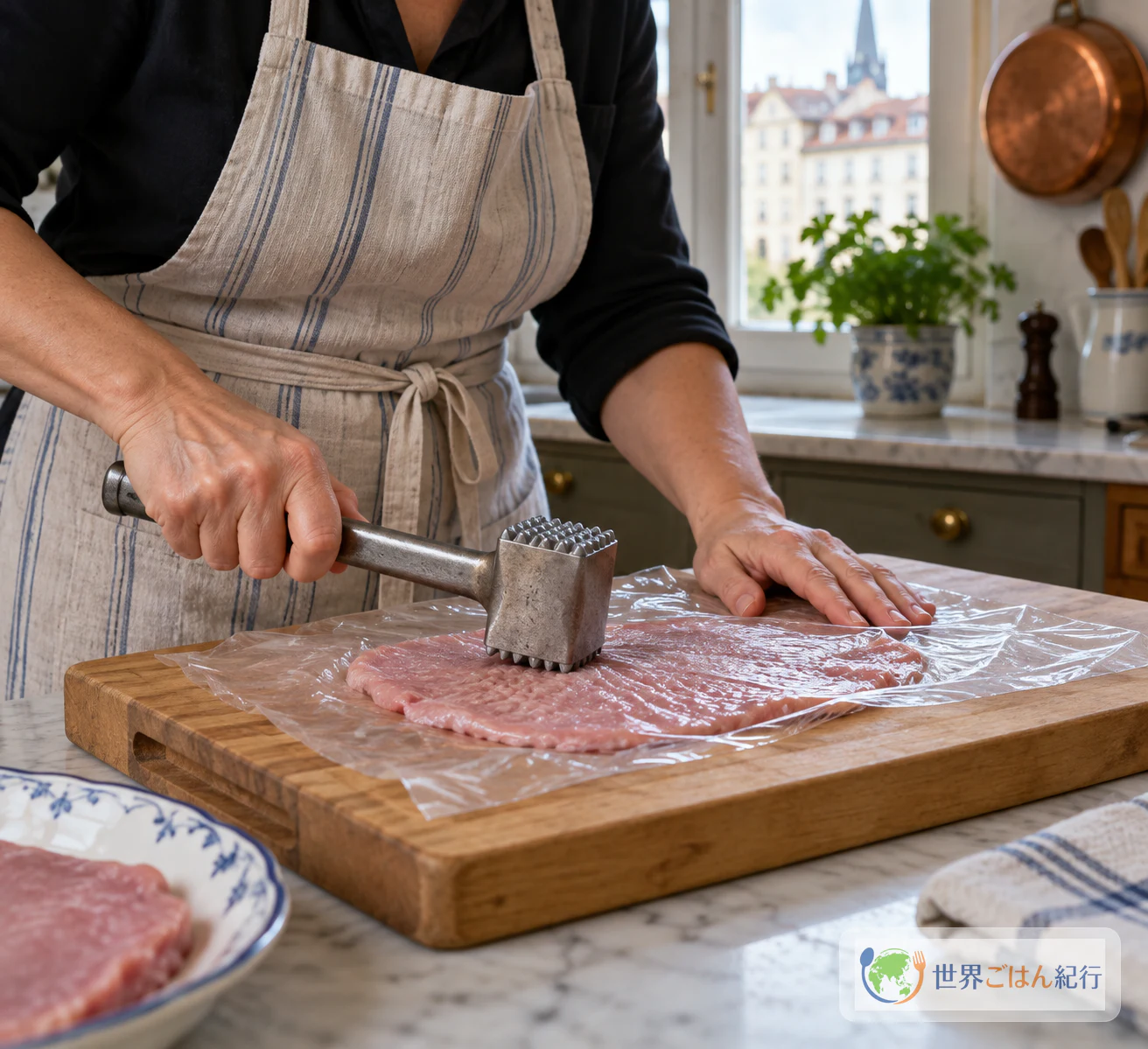
The source gives no oil temperature or frying time. Watch the color of the crust as it fries, and use a thermometer, not color, to check that the meat is cooked through.
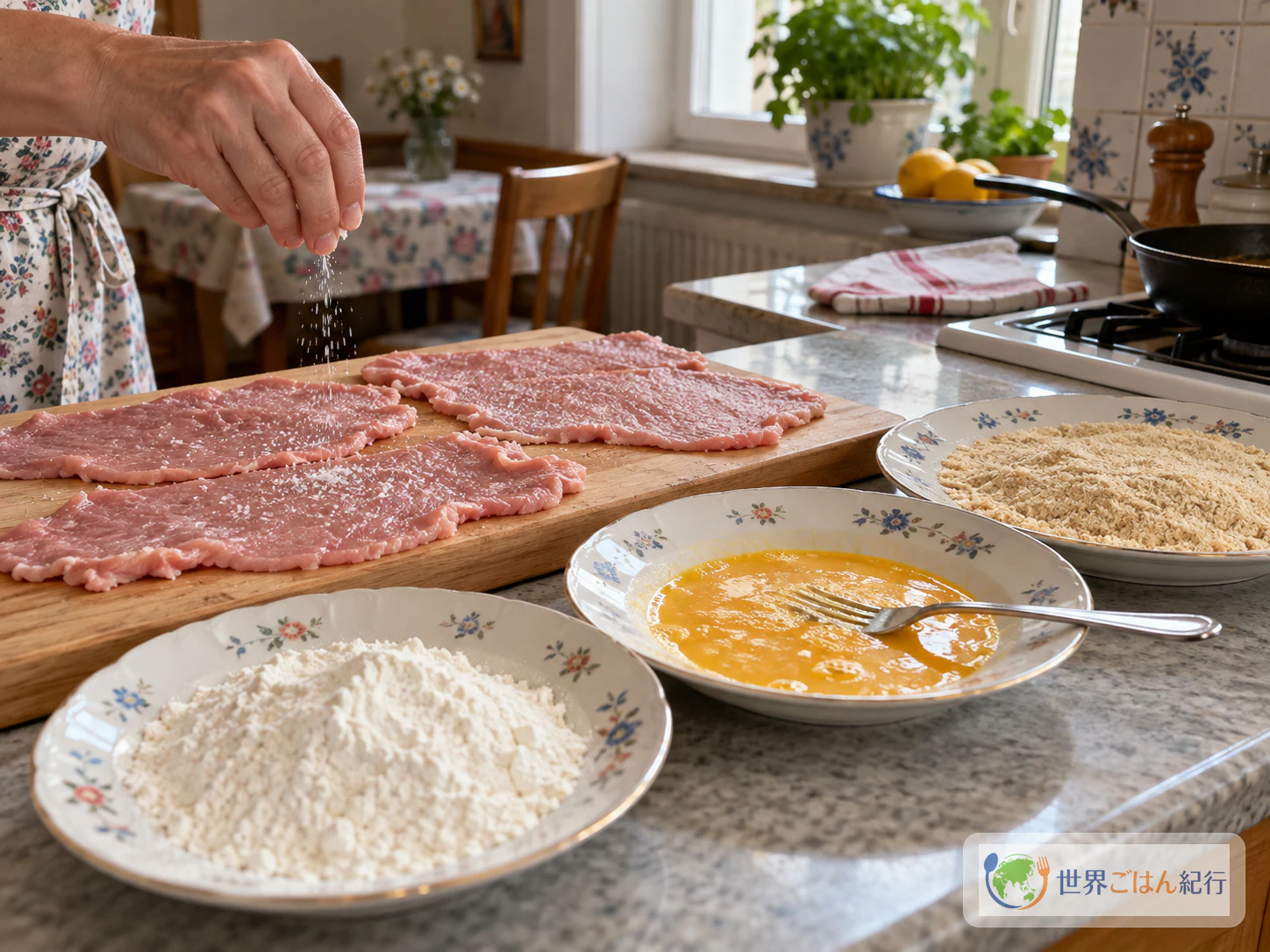
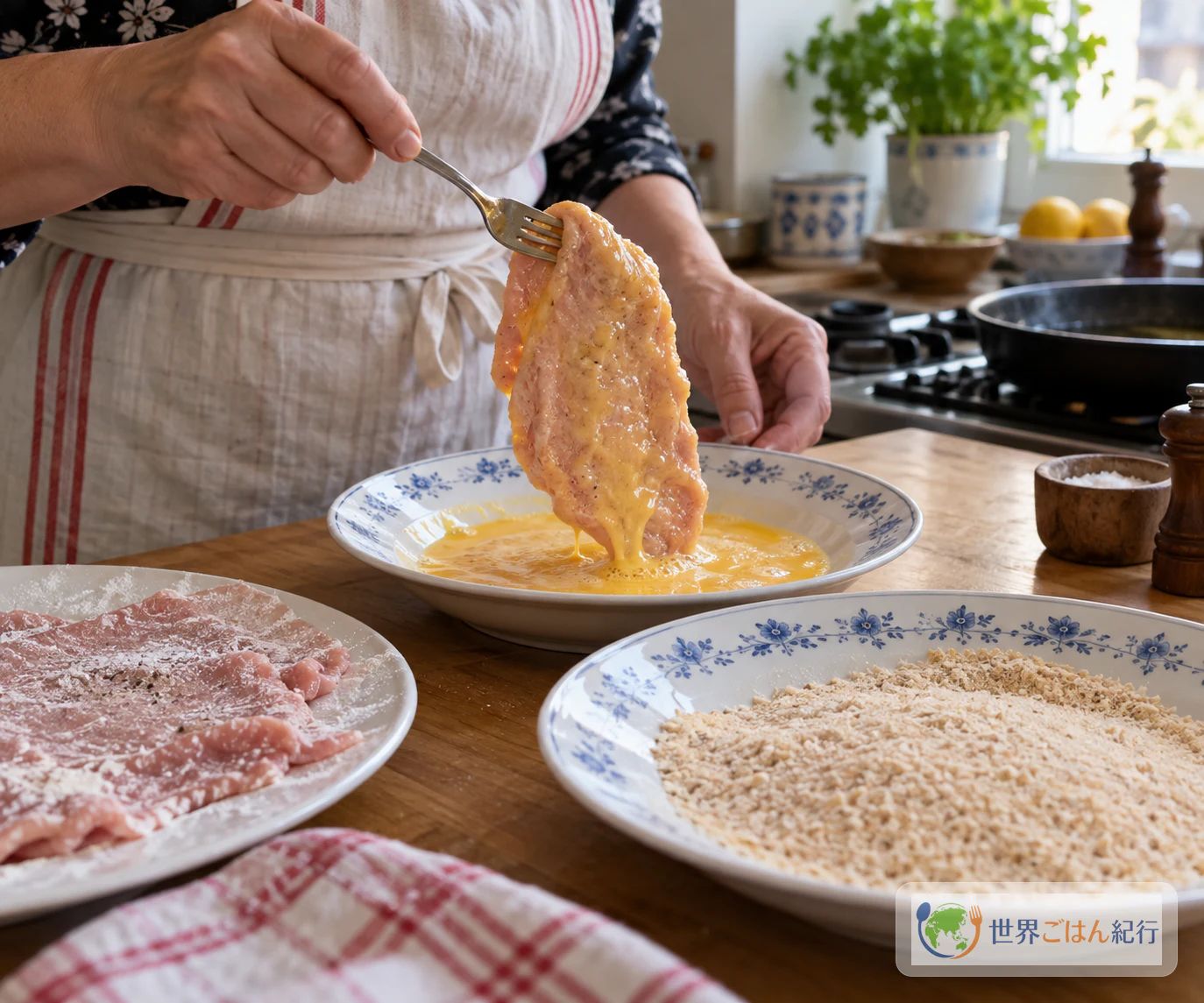
Set out the three plates in order before the meat is salted, so the coating goes on without pauses.
Fixing Common Problems
| Problem | Likely cause | What to do |
|---|---|---|
| The cutlet curls in the pan | Sinew at the edges was left uncut | Make shallow cuts into the edge sinew before pounding, without cutting through the meat |
| The meat turns out tough | It was pounded too hard or for too long | Pound gently and stop once the cutlet is evenly about 6 mm |
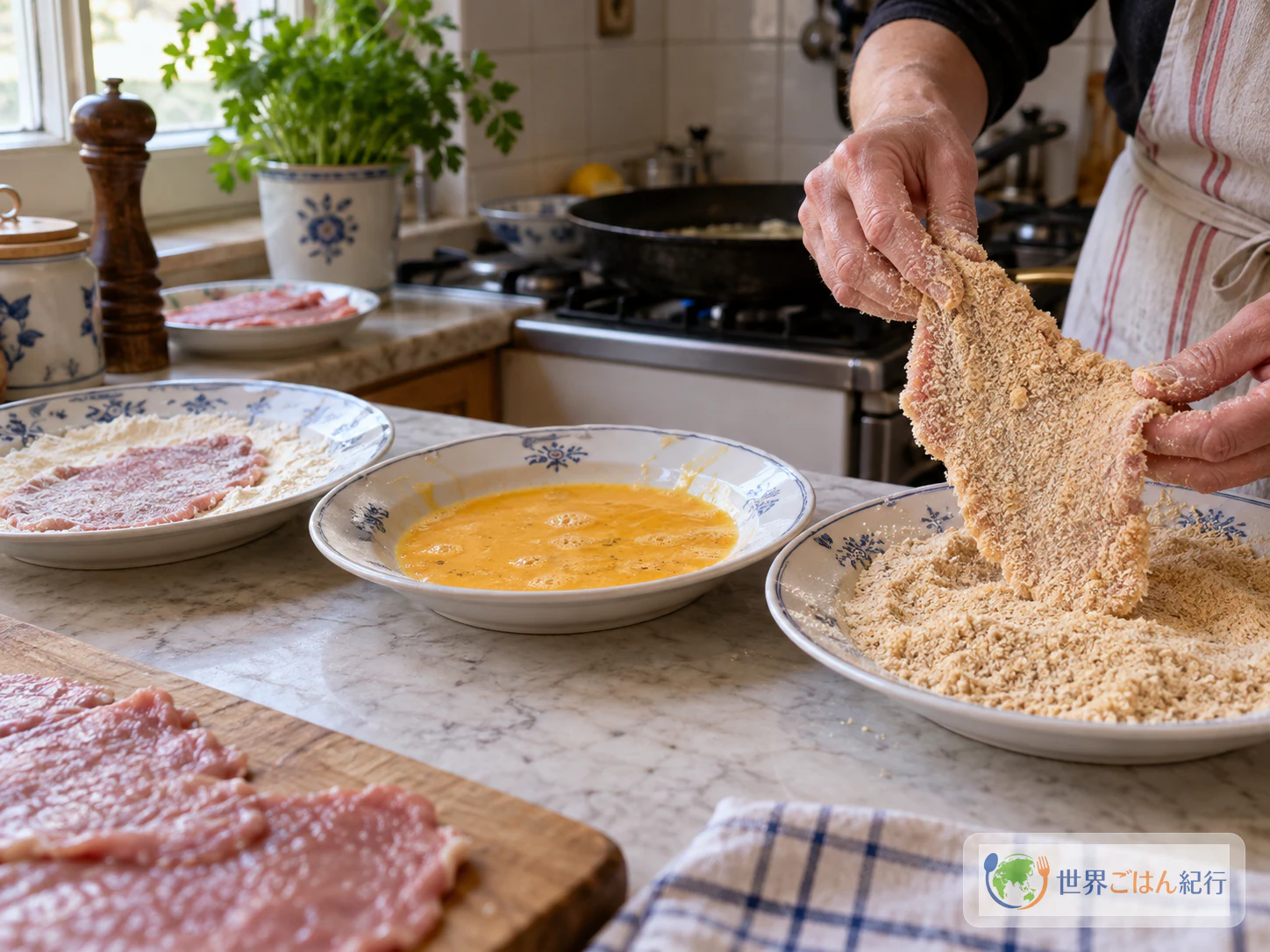
| The coating is thick and heavy | Too much flour, or loose crumbs left on | Shake off excess flour before the egg, and loose crumbs after the breadcrumbs |
| The crust browns before the meat is cooked, or the meat seems underdone | Heat and frying time vary with the pan and the stove; the source gives no figures | Don't rely on color. Check the center with a thermometer against the 75°C for 1 minute household guideline |
| The cutlet doesn't sit in the oil | The oil is too shallow, or the pan is crowded | Keep about 2–3 cm of oil and fry fewer pieces at a time |
Variations
With clarified butter. The source offers clarified butter (Butterschmalz) as the alternative to oil. Use it at the same depth of about 2–3 cm. Note that it adds milk to the allergen list.
Pork, the "Wiener Art" way. Using pork with the same flour, egg and breadcrumb coating is a common home option, but call it Schnitzel Wiener Art rather than Wiener Schnitzel, as Austria's food code does. Its flavor differs from veal.
Not a variation: Pariser Schnitzel. Leaving out the breadcrumbs and frying the veal in flour and egg alone makes a Pariser Schnitzel, a separate dish.
Lemon and Side Dishes
Lemon is part of the recipe itself. The Vienna Tourist Board also mentions parsley as a garnish and suggests parsley potatoes or various salads alongside. These are serving choices rather than ingredients of the recipe above, so choose them freely, or serve the schnitzel with lemon alone.
The source gives no storage time, and the crust's quality after storing is not guaranteed. If you keep leftovers, follow general household guidance: divide them into shallow containers, cool them quickly and refrigerate, and reheat until the center reaches 75°C or higher.
Frequently Asked Questions
Is a pork schnitzel also a Wiener Schnitzel?
Not under Austria's food code. Wiener Schnitzel is made from veal; a pork version is called Schnitzel Wiener Art or Wiener Schnitzel vom Schwein.
Which cut of veal should I buy?
Leg cuts such as Frikandeau, Schale/Kaiserteil or Nuss. Since cut names differ from country to country, ask the butcher for veal leg for cutlets or schnitzel.
Did the dish come from Milan?
The story that Radetzky brought it from Milan is treated as a legend by the Austrian ministry. What the records show is a "Gebackene Schnitzeln" in 1798 and the name "Wiener Schnitzel" in a cookbook in 1831.
How long should I fry it, and at what temperature?
The source does not specify either. Fry until golden on both sides, and check that the center has reached 75°C for at least 1 minute with a thermometer, following general household food-safety guidance.
What should I serve with it?
Lemon, always. The Vienna Tourist Board suggests parsley potatoes or salads as accompaniments.
Sources
- Federal Ministry of Agriculture, Forestry, Climate and Environmental Protection, Regions and Water Management (Austria), "Wiener Schnitzel." The main source for the recipe (600 g trimmed veal, 2 eggs, salt, flour, Semmelbrösel, clarified butter or oil, lemon, for 4), the usual thickness of about 6 mm, the flour–egg–breadcrumb order, the 2–3 cm fat depth, the dish's registration as a traditional food of Vienna, the 1798 and 1831 records, the Radetzky legend, and the naming of pork versions. No weights are given for flour, breadcrumbs or fat, and no frying time or temperature. https://www.bmluk.gv.at/themen/lebensmittel/trad-lebensmittel/speisen/wiener_schnitzel.html
- Vienna Tourist Board (WienTourismus), "The Wiener Schnitzel." Used for the dish as a Viennese veal cutlet and for serving suggestions: lemon, parsley, parsley potatoes and salads. Its recipe, from The New Sacher Cookbook, uses different amounts and is not combined with the main recipe. https://www.wien.info/en/dine-drink/viennese-cuisine/recipes/meat-fish/schnitzel-357484
- Austria Tourism, "Recipe: Original Wiener Schnitzel." Used for the recognition of Wiener Schnitzel as a veal dish and its presentation of the Radetzky story as a legend. Its recipe and its description of crumb handling are not used here. https://www.austria.info/en-us/recipes/wiener-schnitzel/
- Ministry of Health, Labour and Welfare (Japan), "Preventing Food Poisoning at Home" (家庭での食中毒予防). Used for general household guidance: heating the center to 75°C for at least 1 minute, preventing cross-contamination, and cooling leftovers quickly in shallow portions and reheating to 75°C or higher. It is not a source for schnitzel frying times, oil temperature or storage periods. https://www.mhlw.go.jp/stf/seisakunitsuite/bunya/kenkou_iryou/shokuhin/syokuchu/01_00008.html
- USDA Food Safety and Inspection Service / U.S. Government Publishing Office, "Kitchen Thermometers." Used for measuring thin foods by inserting the thermometer from the side so the sensing area sits in the center, the difference between thermometer types, following the manufacturer's instructions, and checking more than one piece. https://www.govinfo.gov/content/pkg/GOVPUB-A110-PURL-gpo22020/pdf/GOVPUB-A110-PURL-gpo22020.pdf