Pizza Quattro Formaggi: Four Names on the Menu, More Than One Lineup
Four cheeses, each with its own job: one that melts gently, one blue and assertive, one creamy, and one aged and savory. Keep the four portions equal, and judge the bake by the rim and the underside rather than by the clock alone.
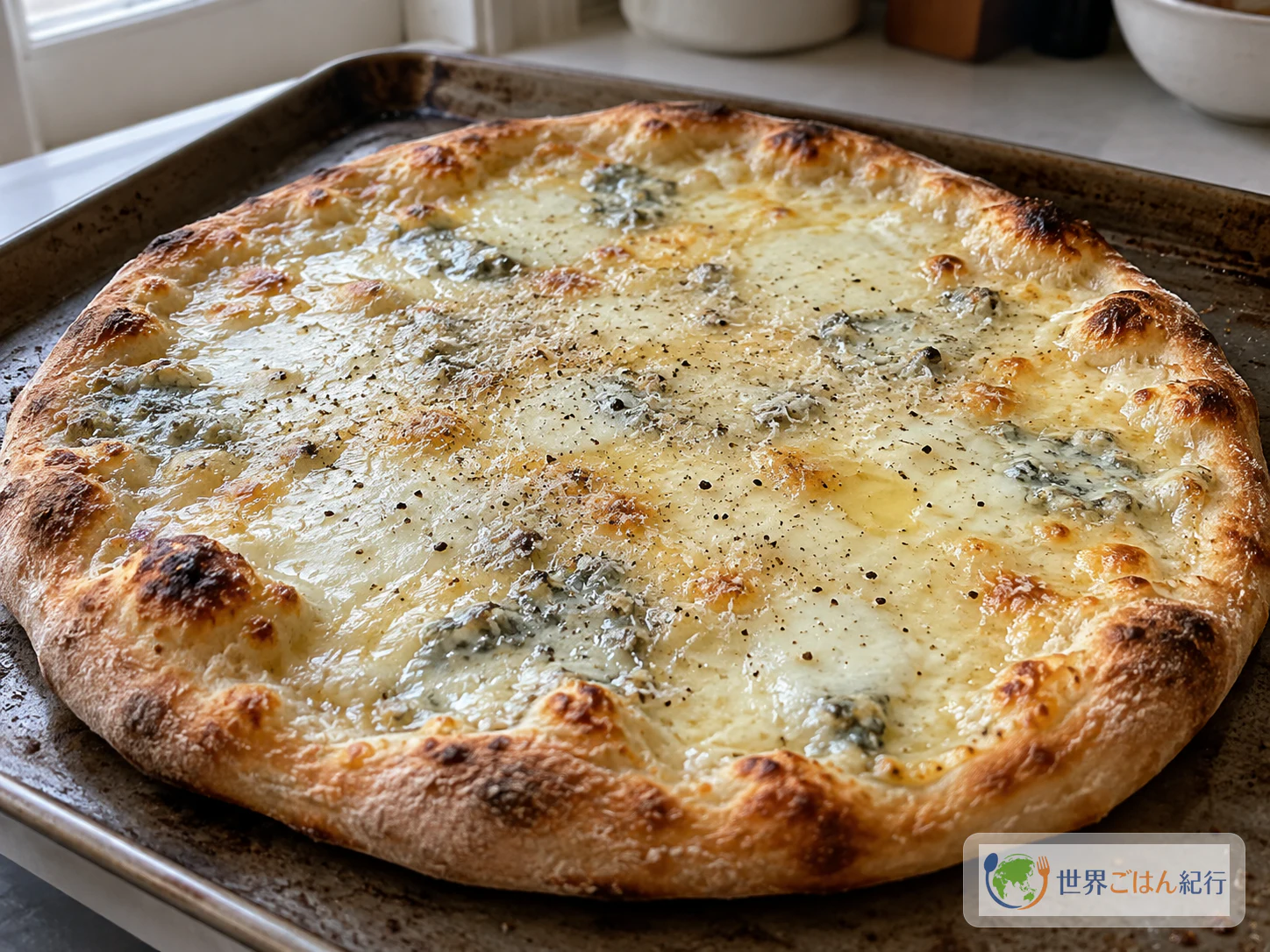
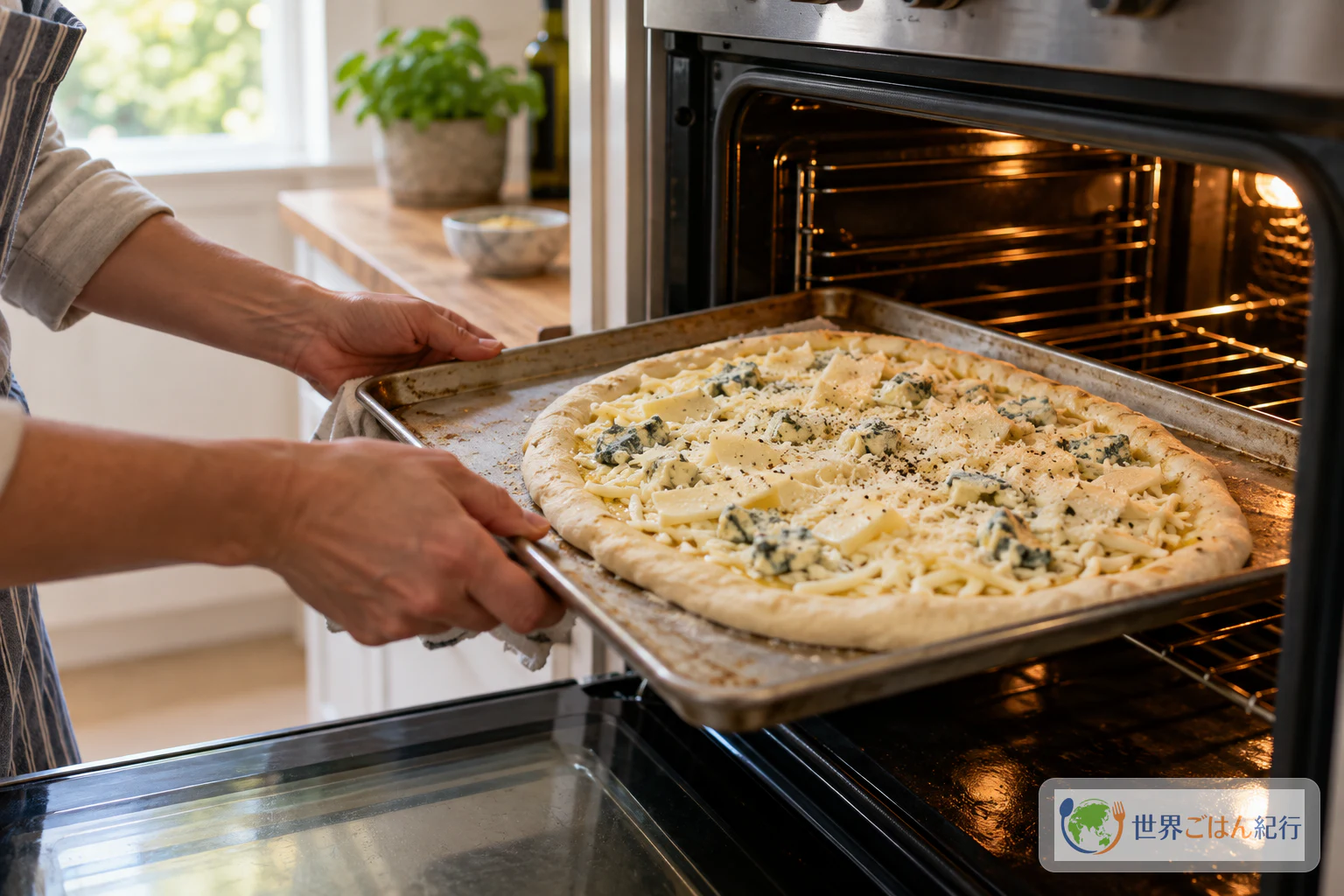
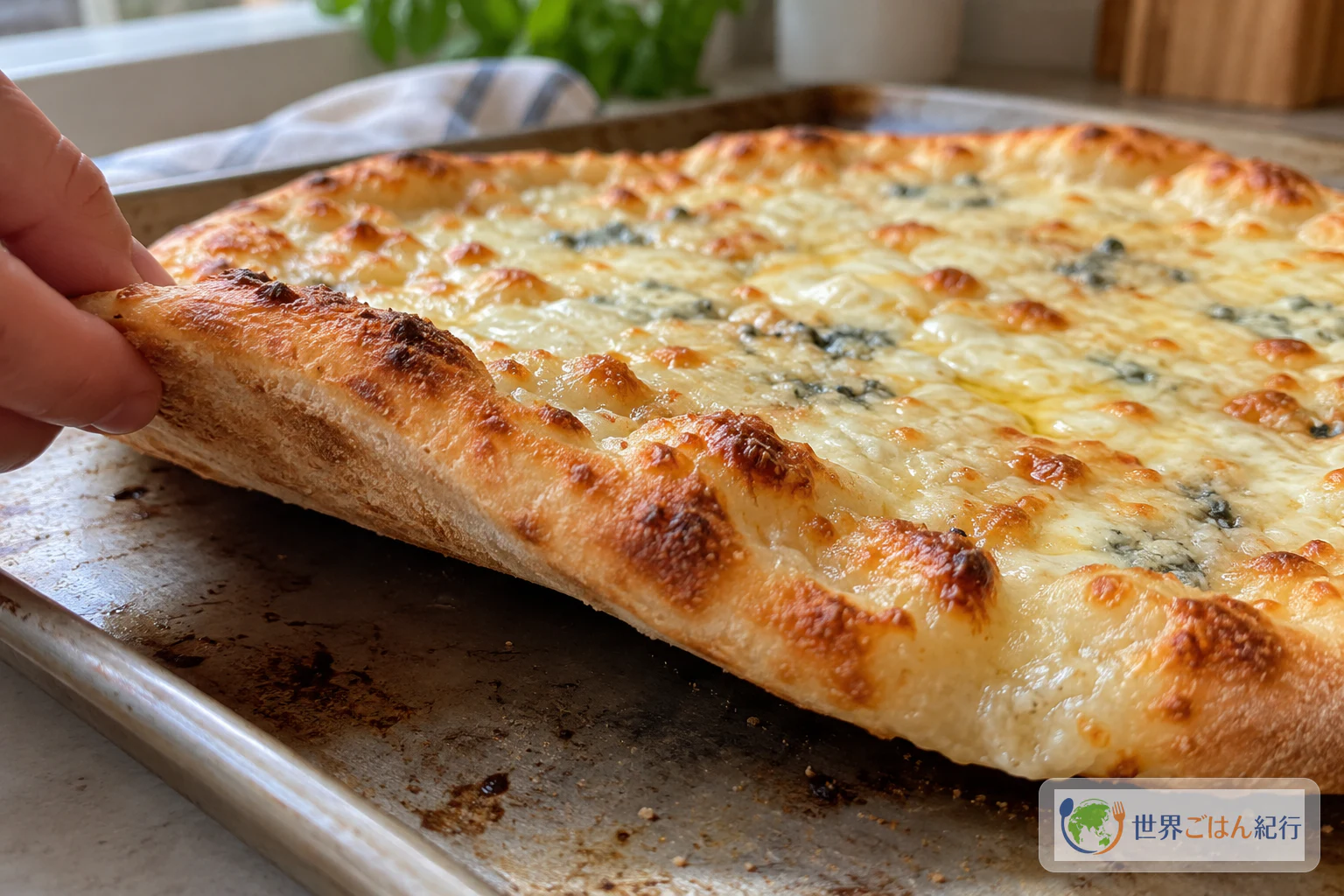
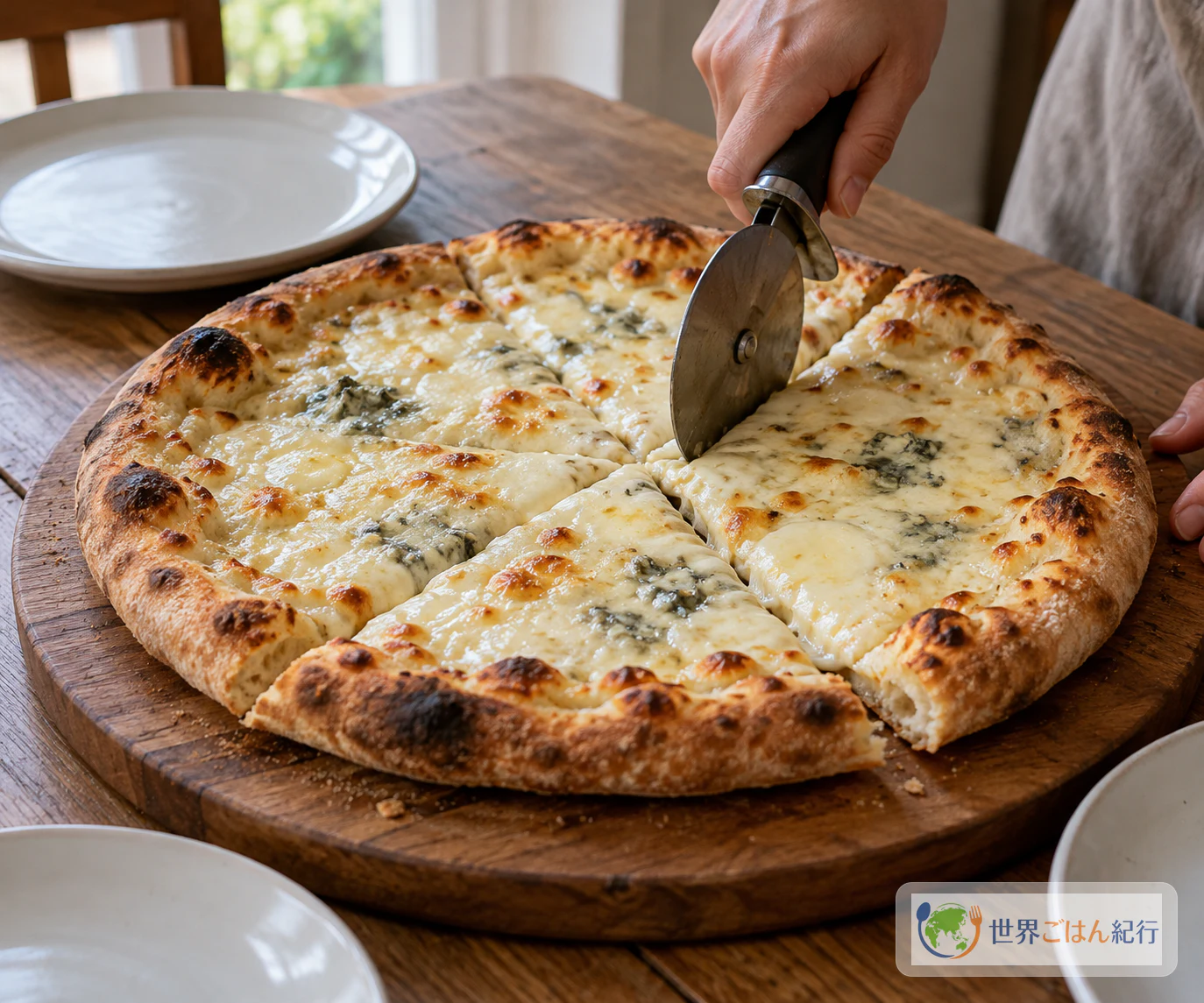
As the pizza bakes, the cheese on top begins to bubble, the rim takes on color, and the sharp scent of blue cheese meets the toasty aroma of an aged, grated cheese. Pizza quattro formaggi is the pizza whose name simply means "four cheeses": quattro is four, and formaggi is the plural of formaggio, cheese.
That name tells you how many cheeses go on, but not which ones. The lineup changes from recipe to recipe and from menu to menu, so the first question most cooks face is a shopping one: which four do I actually buy? This article follows one clear, reproducible recipe for a single white pizza (no tomato), from the Italian recipe site Piccole Ricette, which gives exact amounts for the dough and all four cheeses. The other choices you'll meet are explained alongside it, so you can see where the recipe ends and where your own adjustments begin.
What Pizza Quattro Formaggi Is: A Menu Name, Not a Fixed Standard
Quattro formaggi is a widely known name for a pizza topping, found on restaurant menus and in cookbooks. The Treccani encyclopedia's Italian-language magazine discusses Quattro formaggi, together with Quattro stagioni, as a dish name that appears on menus and in recipe books, in contrast to a trademark or a fixed product name. It also notes the wide range of pizza names built around a number. That tells us how the name is used; it does not tell us who invented the pizza, when, or where, and the sources consulted here do not establish a protected specification that fixes the four cheeses.
The recipes themselves confirm the range. The author of the Piccole Ricette recipe explains that the combination of cheeses varies with the region and with what is available, and gives gorgonzola, mozzarella (or fior di latte), fontina and a grana-type cheese as one example, with gorgonzola as a regular member of the lineup. A different home recipe on a GialloZafferano blog makes a red version instead: tomato underneath, topped with mozzarella, a blue cheese, Bavarian Emmental and an aged cheese. Same name, different pizza.
So rather than hunting for the one "real" set of four, this article organizes the cheeses by the role each plays on the pizza: a mild cheese that melts well, a fragrant blue, a creamy cheese like fontina, and an aged cheese. That grouping is a practical way to compare and choose, not an official Italian classification.
Ingredients for One Pizza: Dough and Four Cheeses at 50g Each
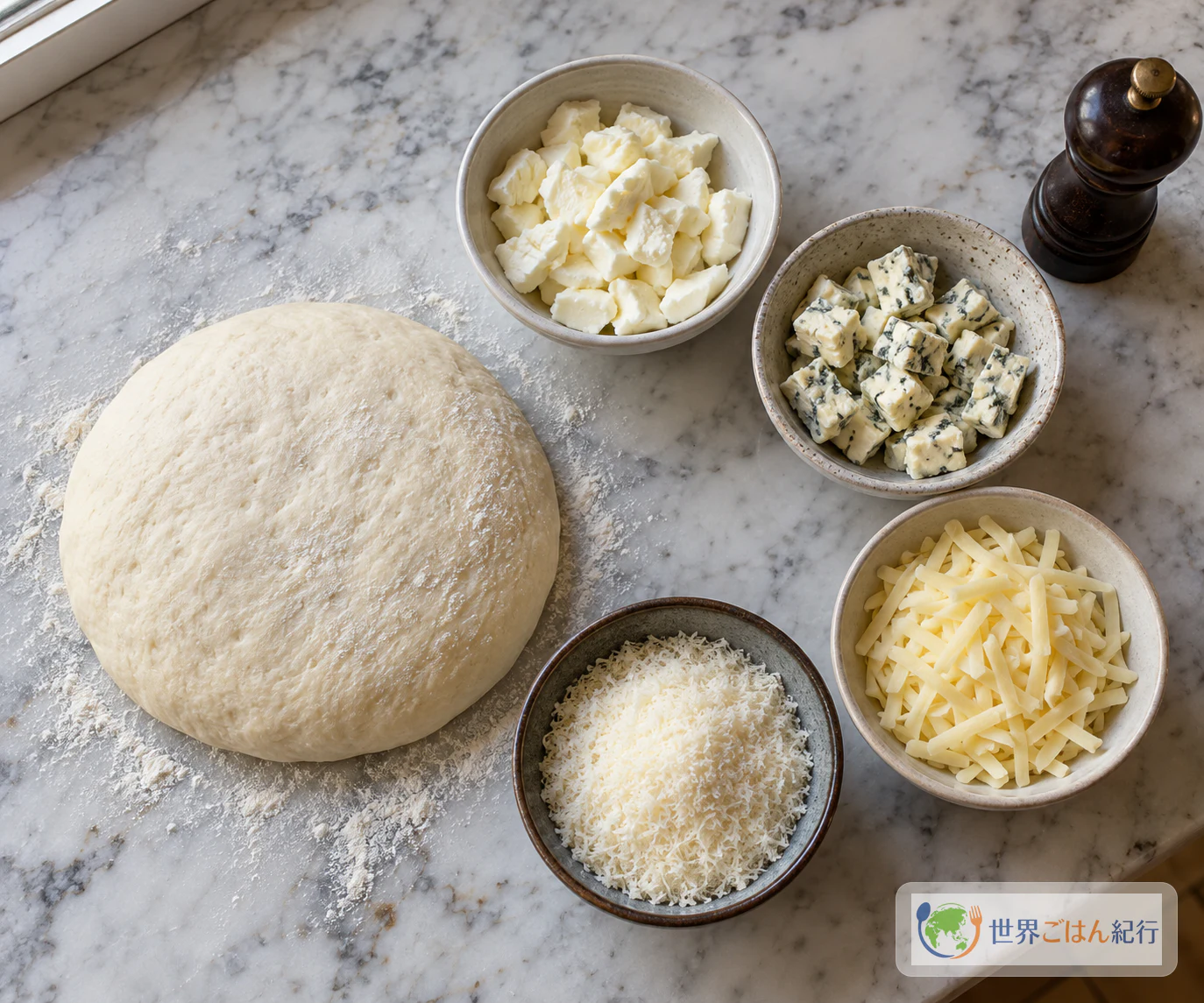
These are the amounts for one pizza from the Piccole Ricette recipe. The recipe calls for 230–250g of prepared pizza dough; this article uses 240g as an editorial choice within that range. It means risen, unbaked dough, not a pre-baked crust or a frozen finished pizza. The source recipe leaves the dough itself to a separate recipe, so this article does not supply a flour, water or yeast formula. If you buy dough, follow the instructions on its own package.
There is no tomato, oil or salt in this recipe, so none are added here.
Wheat is in the pizza dough and milk is in all four cheeses. Ingredients and allergen labeling vary by product, so check the packaging of the dough and each cheese. This recipe makes no claim to suit any particular dietary restriction.
Choosing the Four Cheeses: Balance, Not Four Equal Shouts
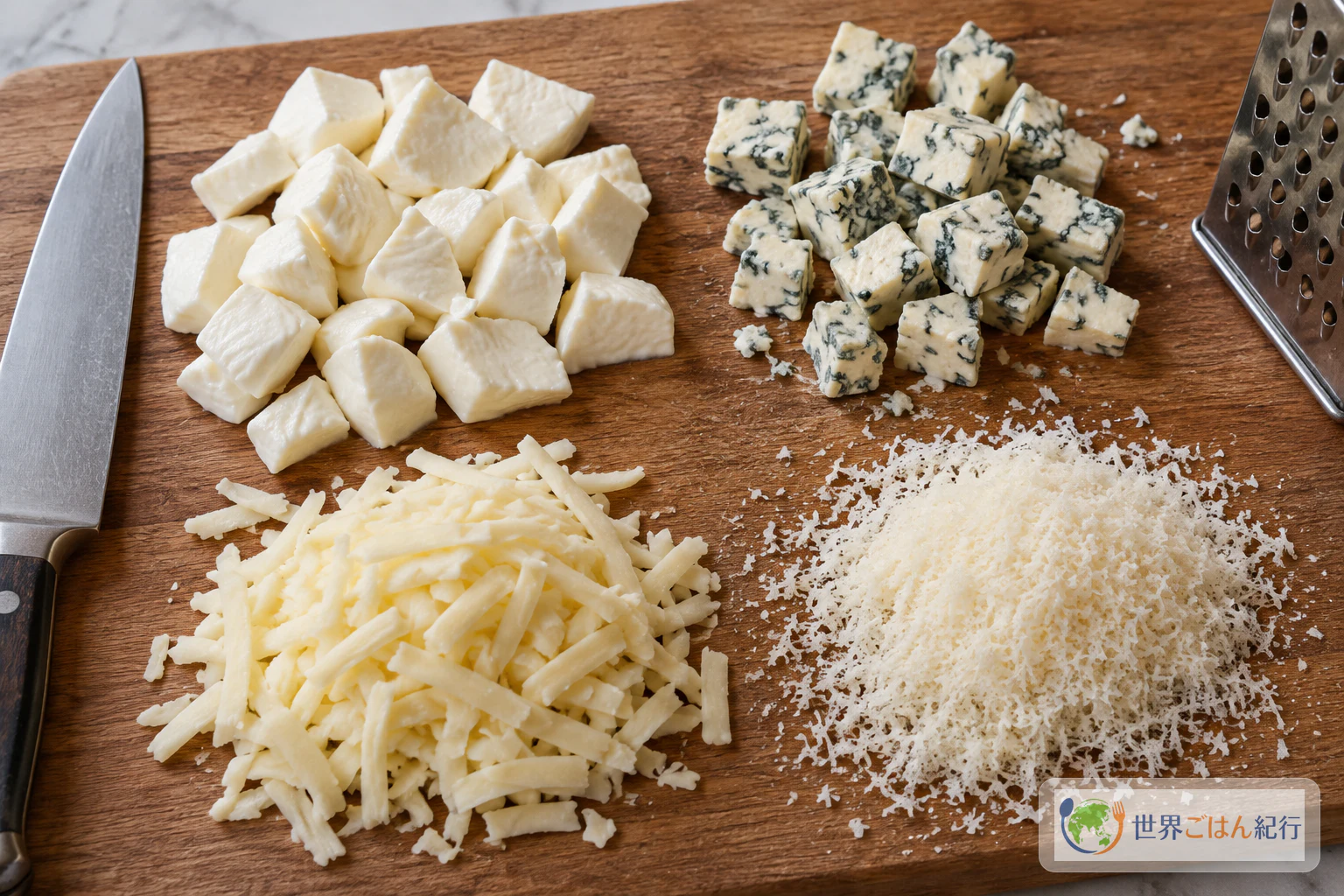
The four cheeses are not meant to be equally loud. Mozzarella melts into a mild base; gorgonzola brings a blue-cheese scent and salt; fontina adds roundness and melts easily; and Grana Padano contributes the concentrated savoriness of an aged cheese and browns on the surface. These four cheeses, with black pepper, are what the source recipe specifies. Grana Padano and Parmigiano Reggiano are both named in the recipe as either-or choices.
Gorgonzola is sold in milder, creamier styles (dolce) and sharper, stronger styles (piccante), and the recipe author accepts either; neither is "the" required one. If you're unsure, the label is the place to look: dolce will be gentler, piccante more pronounced.
"Any four cheeses will do" is not quite the right lesson. When you shop, check three things: whether a blue cheese like gorgonzola is in the lineup, whether you're stacking a very strong blue on top of a very salty aged cheese, and whether there's still enough of a good melting cheese to hold the pizza together.
When you can't find something
Fontina may be harder to find in some shops than the other three. The recipe author suggests Asiago as an alternative; it is a reasonable stand-in, but it will not taste or melt exactly the same. Likewise, the author suggests fior di latte in place of mozzarella. Helpful search terms are simply the cheese names, such as "fontina cheese," "gorgonzola dolce" and "Grana Padano," and "refrigerated pizza dough" for the base.
Equipment
- Oven with a grill (top heating) function
- Baking tray, or a pizza stone if your oven and the stone's instructions allow it (check how it fits and where it sits in the oven)
- Kitchen scale, for weighing the dough and the cheeses
- Knife and cutting board
- Grater for coarse and fine grating
- Pepper mill
- Pizza cutter or large knife, and a heat-resistant board or surface for serving
- Oven thermometer (optional, if you want to know your oven's actual temperature)
Method: Prepare, Shape, Top, Bake, Serve
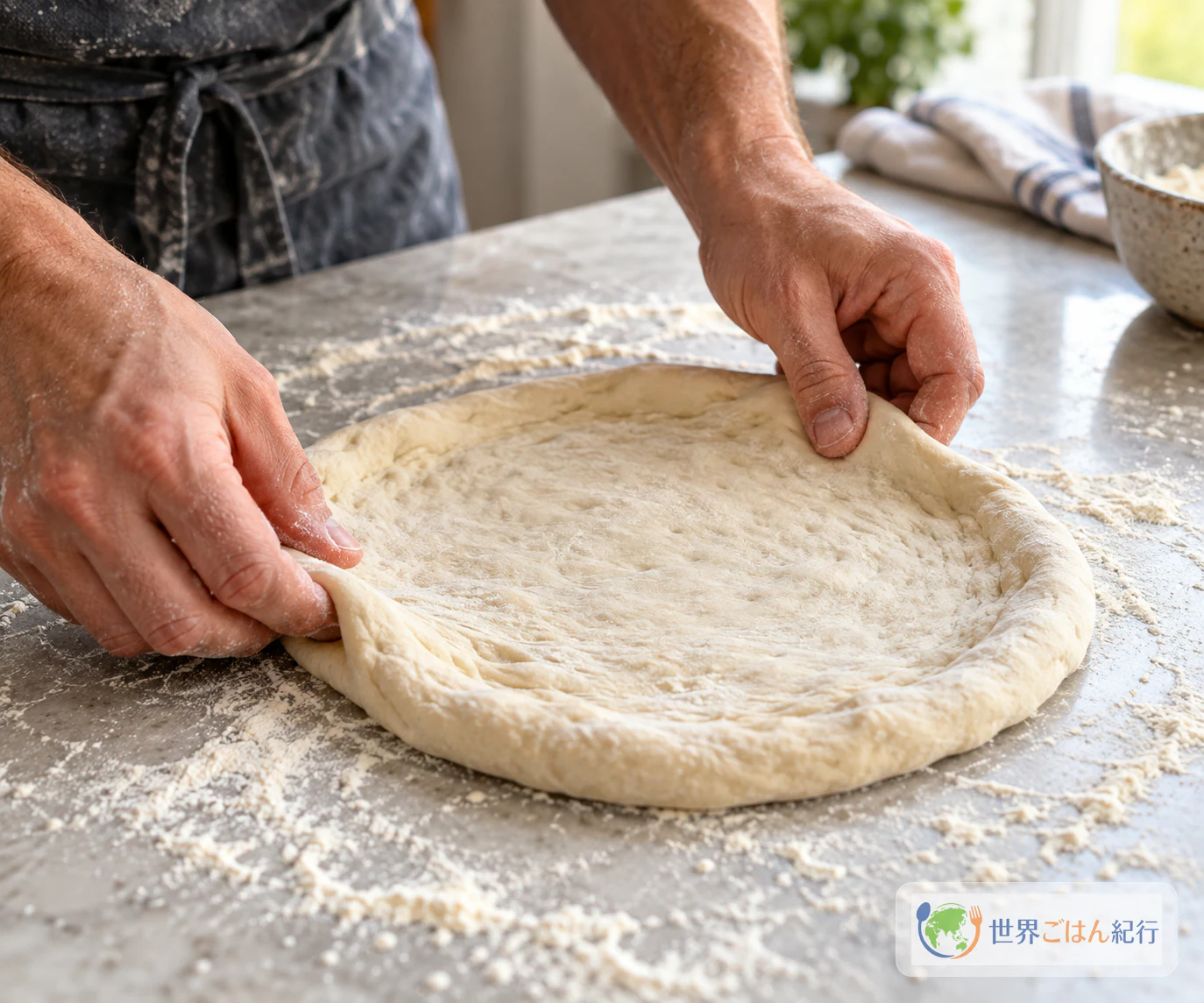
Start preheating the oven to 250°C in good time, following your oven's manual, so it is fully hot when the pizza is ready. If you use bought dough, follow its package directions on how to handle it before shaping.
The baking time below comes from the source recipe and is a guide. Home ovens differ, so the real signal that the pizza is done is a colored rim and a dry, baked underside.
Avoiding Mistakes in a Home Oven
When the top colors first, resist the urge to follow the clock. Look at both the surface and the underside; the source recipe's cues, a colored rim and a dry base, are the ones that matter. Shelf position and grill use differ by oven, so your oven's manual is the best guide there.
| Problem | Likely cause | What to do |
|---|---|---|
| Watery cheese | Moisture in the mozzarella, the thickness of the dough, or baking conditions | The source recipe doesn't call for draining. If your mozzarella is packed in liquid, patting off the surface moisture is a home-kitchen suggestion, not part of the original method |
| Top burns but the bottom is pale | Strong grill heat in your oven | Check both the rim and the underside. Follow your oven's manual on shelf position, and don't keep baking just to reach the time |
| Tastes too heavy or salty | A very strong gorgonzola, or a strong blue plus a very salty aged cheese | Choose a milder gorgonzola style rather than cutting its amount at first. Keep 50g each for the first pizza and change one thing next time |
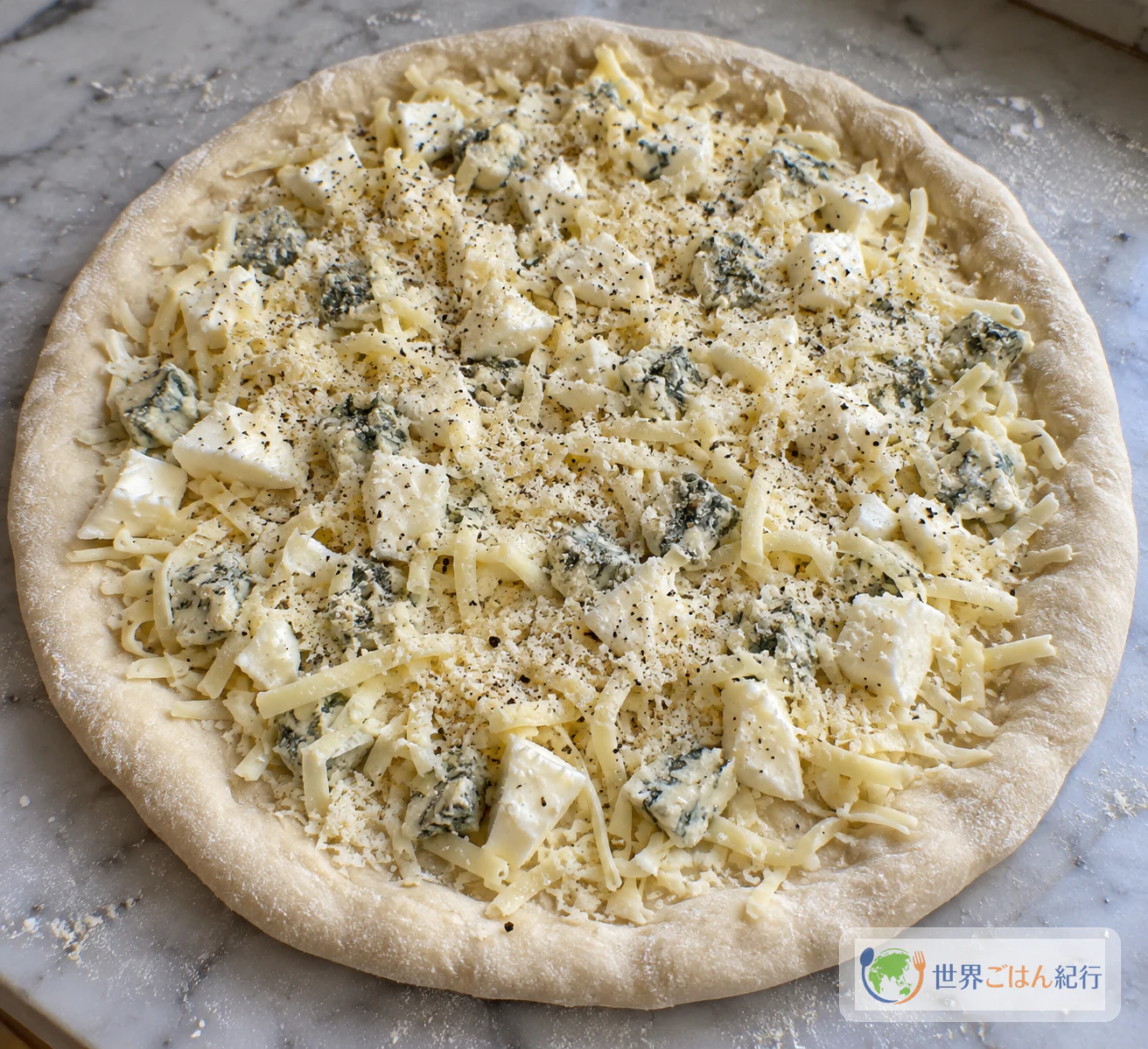
| You can't tell the four cheeses apart | Uneven sizes or scattering change what each bite holds | Spread them evenly across the base and keep the blue cheese from clumping |
For a first pizza, make it as written. Changing the blue cheese or a substitute one at a time afterward makes it much easier to tell what each change does.
Variations: Swapping Cheeses and the Red Version
- Fontina to Asiago. The recipe author's own suggestion when fontina is hard to find. It is a substitution for availability; expect a different flavor and melt.
- Grana Padano to Parmigiano Reggiano. Named in the recipe as an either-or choice. Use 50g of one, not both, so the pizza stays at four cheeses.
- Mozzarella to fior di latte. Also the author's suggestion. Fior di latte is a fresh cow's-milk cheese in the mozzarella style; keep the 50g.
- A gentler blue. Choose a milder style of gorgonzola, such as dolce, over a sharper piccante. The author accepts both, so this is a matter of taste, not a formal substitution.
- A red version with tomato. The GialloZafferano blog recipe uses tomato with mozzarella, a blue cheese, Emmental and an aged cheese, with its own amounts for four servings and its own baking conditions (230°C for 30 minutes). It's a different recipe; if you want to make it, follow that recipe directly rather than adding tomato to this one.
The Name and Its Range
Within Italian cooking, this pizza is best understood through its name. Quattro formaggi works as a menu category, a way of saying "a pizza of four cheeses," rather than as a single fixed recipe. That's why the lineup can shift by region, by shop and by what's on hand, and why a white version and a red version can carry the same name.
The sources here don't establish a birthplace, a date or an inventor, and they don't tie the pizza to a particular region's traditions or festivals, so this article doesn't either. What they do show is enough to cook from: a clear one-pizza recipe, the author's own suggestions for swaps, and evidence that other cooks build the four differently.
Frequently Asked Questions
The four cheeses can vary, but the bake can't be guessed: whatever you choose, look for a colored rim and a dry underside before you take it out.
Are the four cheeses fixed?
No single official lineup could be confirmed. The name is used on menus and in cookbooks, and the combination varies by region, availability and recipe. This article follows one recipe's choice: mozzarella, gorgonzola, fontina and Grana Padano.
Does it have tomato sauce?
There are white versions without tomato and red versions with it. This article makes the white version from Piccole Ricette. The red one is a separate recipe with different amounts and baking conditions.
What if I can't find fontina?
The recipe author suggests Asiago. It won't taste exactly the same, so think of it as a close alternative rather than an identical swap.
Does it always take 15 minutes?
Fifteen minutes at 250°C with the grill is the source recipe's guide. Preheating, the thickness of the dough and your own oven all change the time, so check that the rim has colored and the underside is dry, with no raw dough inside.
Can I keep leftovers?
The recipe is meant to be eaten as soon as it's baked. Storage times and reheating conditions aren't covered by these sources, so this article doesn't give them.
In Short
Pizza quattro formaggi isn't about guessing the one correct set of four; it's about combining four cheeses that each play a different part. Make your first pizza with the recipe's 50g of each, then change one cheese at a time and taste the difference.
Sources
- Piccole Ricette (ValentinaPiccoleRicette), "Pizza ai quattro formaggi." The main recipe: ingredients and amounts for one pizza, the different cuts of each cheese, black pepper before baking, baking at 250°C with the grill for about 15 minutes, doneness cues of a colored rim and a dry underside, and serving immediately; also the author's note that cheese combinations vary and the suggested alternatives (Asiago for fontina, fior di latte for mozzarella, Grana Padano or Parmigiano Reggiano). https://www.piccolericette.net/piccolericette/recipe/pizza-ai-quattro-formaggi/
- Istituto della Enciclopedia Italiana Treccani, "L'elemento numerico nei marchi e nelle insegne." Quattro formaggi as a widely known pizza name that appears on menus and in cookbooks, discussed as a dish name rather than a trademark, alongside other number-based pizza names. Not a source on the dish's origin. https://www.treccani.it/magazine/lingua_italiana/articoli/parole/2025_11_12_Par_Nomi145_Caffarelli.html
- Le ricette di Maria Grazia (GialloZafferano blog), "Pizza ai quattro Formaggi." A separate home recipe for a red version with tomato, mozzarella, blue cheese, Bavarian Emmental and an aged cheese, baked at 230°C for 30 minutes; used only as an example of the range under the same name. https://blog.giallozafferano.it/lericettedimariagrazia/pizza-formaggi/