Swiss Cheese Fondue: One Pot of Melted Cheese, Bread on Long Forks
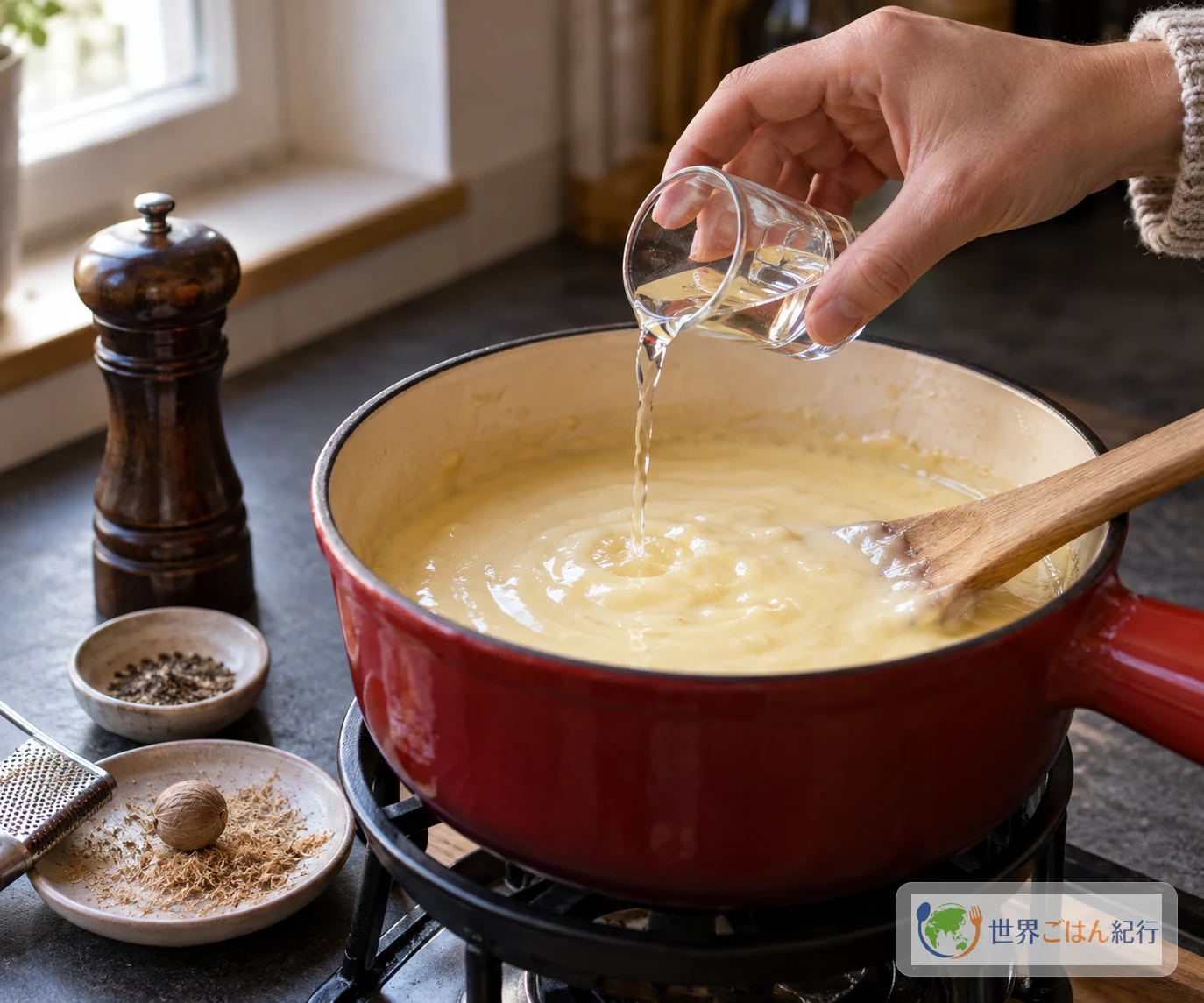
A fondue cheese mix melted with white wine, lemon juice and cornstarch, brought to a boil while stirring, then kept barely simmering in the middle of the table. Everyone spears a cube of bread, dips it, and keeps the pot moving.
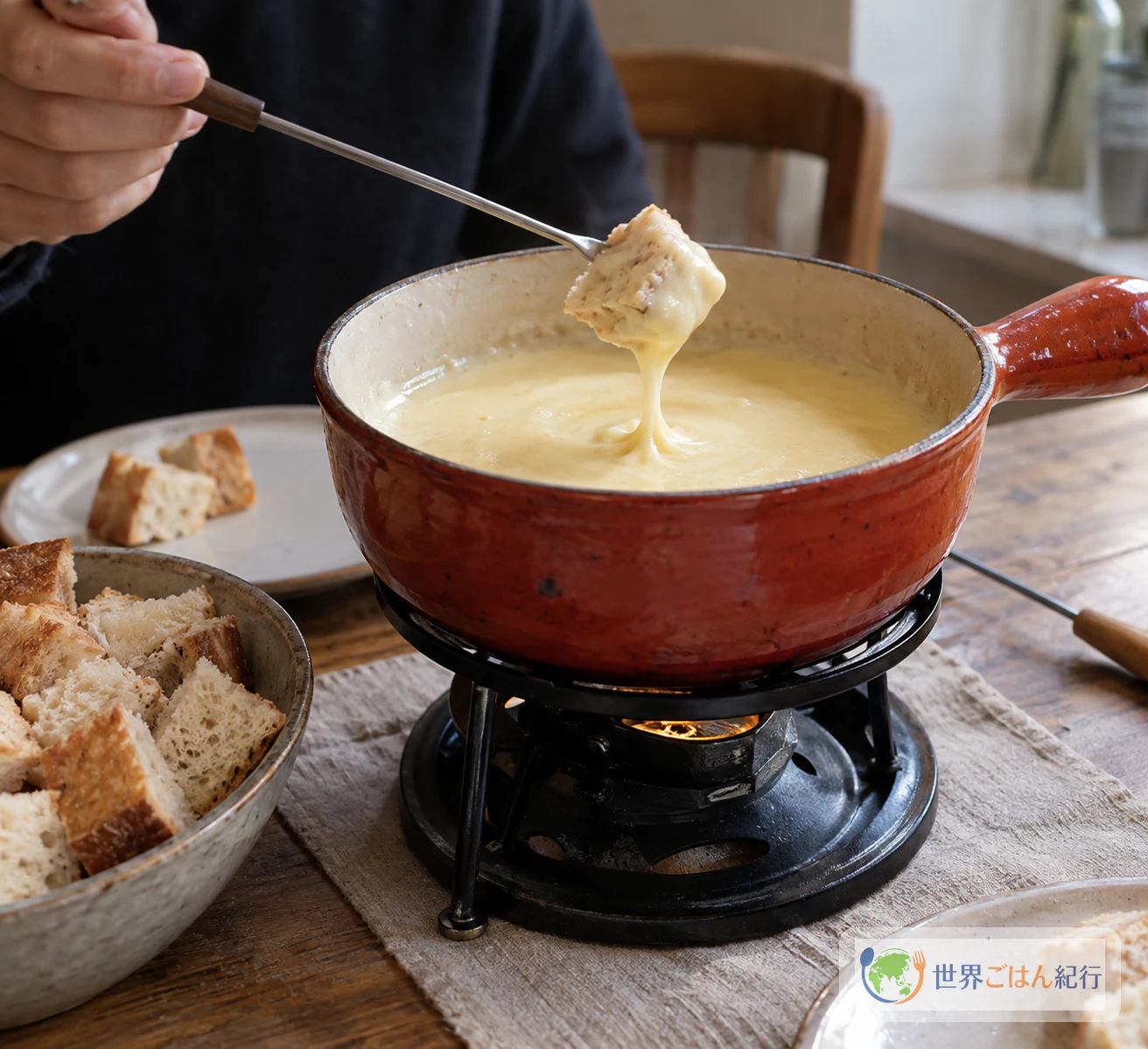
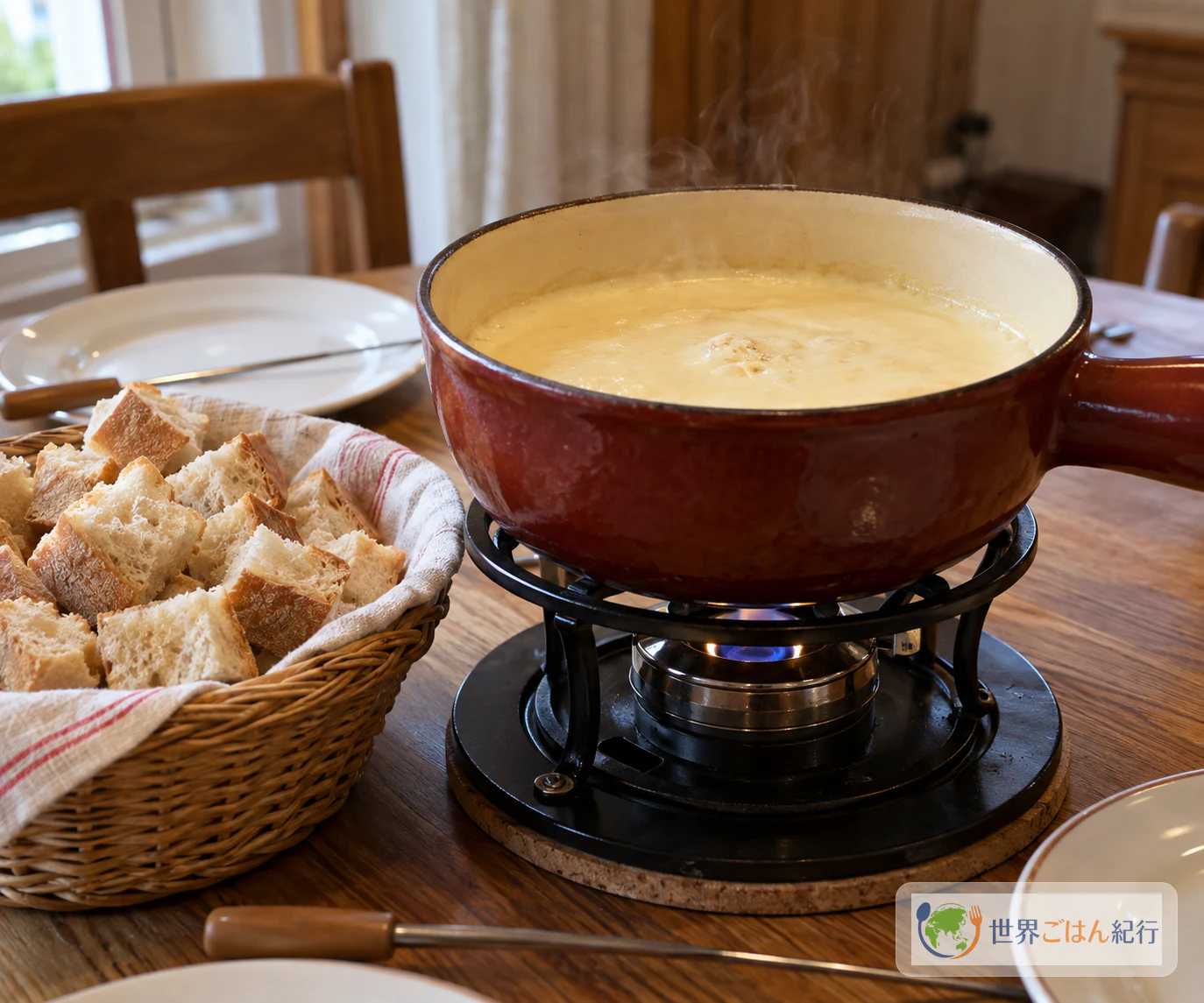
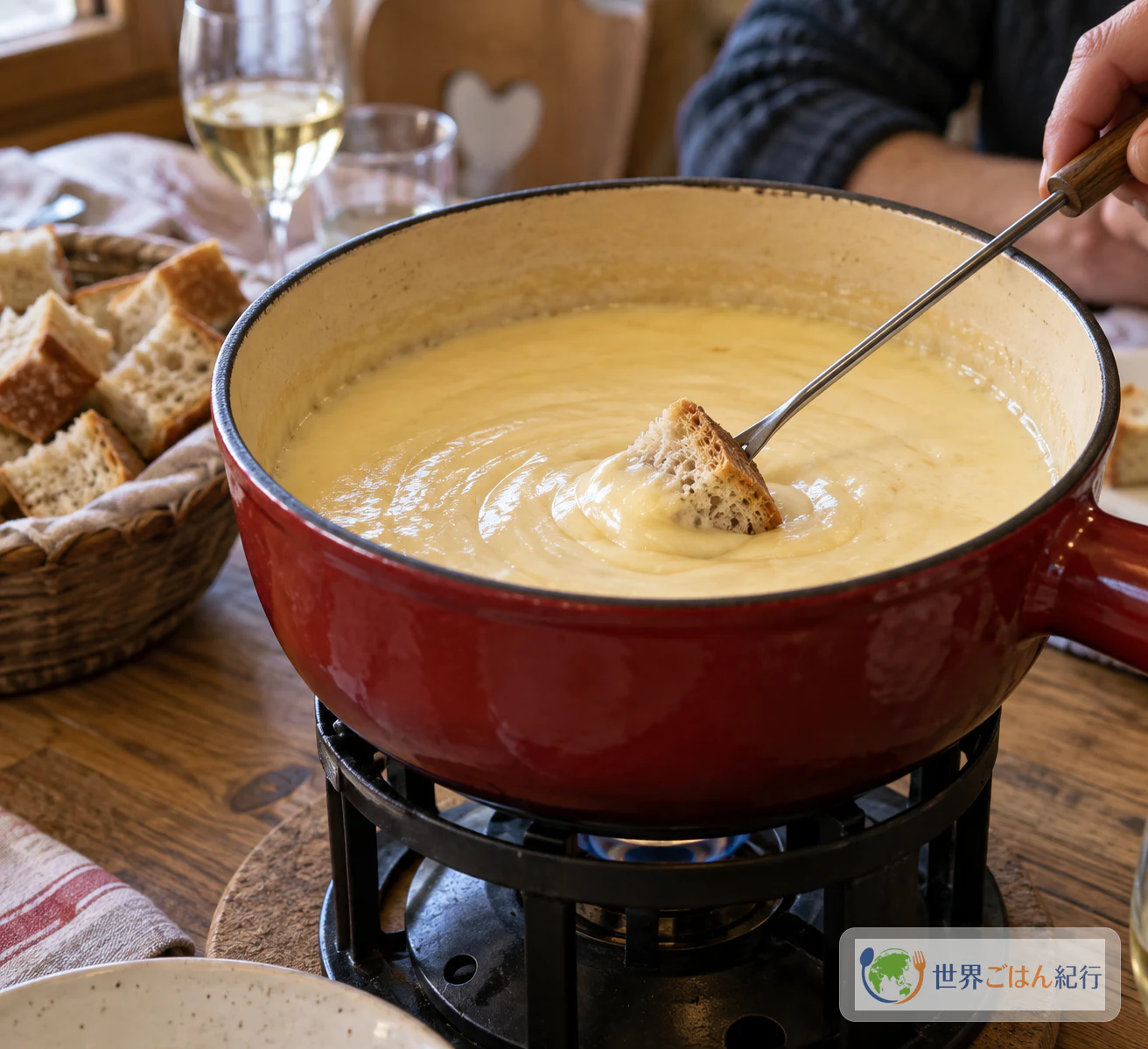
In the middle of the table sits a caquelon, a fondue pot, over a small burner. The cheese inside is pale gold and smooth. Each person spears a cube of bread on a long fork, dips it into the pot, and stirs as they go. Switzerland Tourism describes cheese fondue in exactly these terms: melted cheese served in a caquelon and eaten with bread cubes.
The name "cheese fondue" gets used for many melted-cheese dishes, so to be clear: this is the Swiss dish in which bread is dipped into a pot of melted cheese kept warm at the table. In German it is called Käsefondue, or simply Fondue; in French-speaking Switzerland, fondue au fromage.
The recipe here follows Swissmilk's "Fondue klassisch," a general version for four people built on a fondue cheese mix. Swissmilk lists it at 15 minutes. That is the publisher's own figure, not a measured guarantee for every kitchen. For more dishes from the same country, see the recipes from Switzerland.
One Dish, Many Cheeses: Classic Fondue and Moitié-Moitié
Swiss cheese fondue is not one fixed formula. Swissmilk's teaching material on Swiss classics notes that there are many creations, varying with the cheeses used, while the shared core is cooking in a caquelon and dipping bread.
The best-known regional type is moitié-moitié, "half and half." Switzerland Tourism describes it as a creamy specialty of French-speaking Switzerland, around Fribourg and Vaud, made with half Gruyère and half Vacherin. Swissmilk's teaching material presents a Fribourg moitié-moitié as its own recipe, with half Gruyère and half Vacherin Fribourgeois, its own amounts, and water or non-alcoholic cider as the liquid.
The classic recipe in this article is a different recipe. It calls for 800 g of a fondue cheese mix and names moitié-moitié or a cheesemonger's blend only as examples of what that mix can be. It does not set a cheese ratio, so this article does not turn it into a fixed Gruyère-and-Vacherin split.
| Fondue klassisch (this recipe) | Fribourg moitié-moitié | |
|---|---|---|
| Cheese | A grated fondue cheese mix; the ratio is not specified | Half Gruyère, half Vacherin Fribourgeois |
| Liquid | White wine with lemon juice, plus kirsch | Water or non-alcoholic cider |
| How to use this table | Follow the amounts below as one recipe | Treat as a separate recipe with its own amounts; don't mix the two |
Ingredients: Classic Cheese Fondue for 4
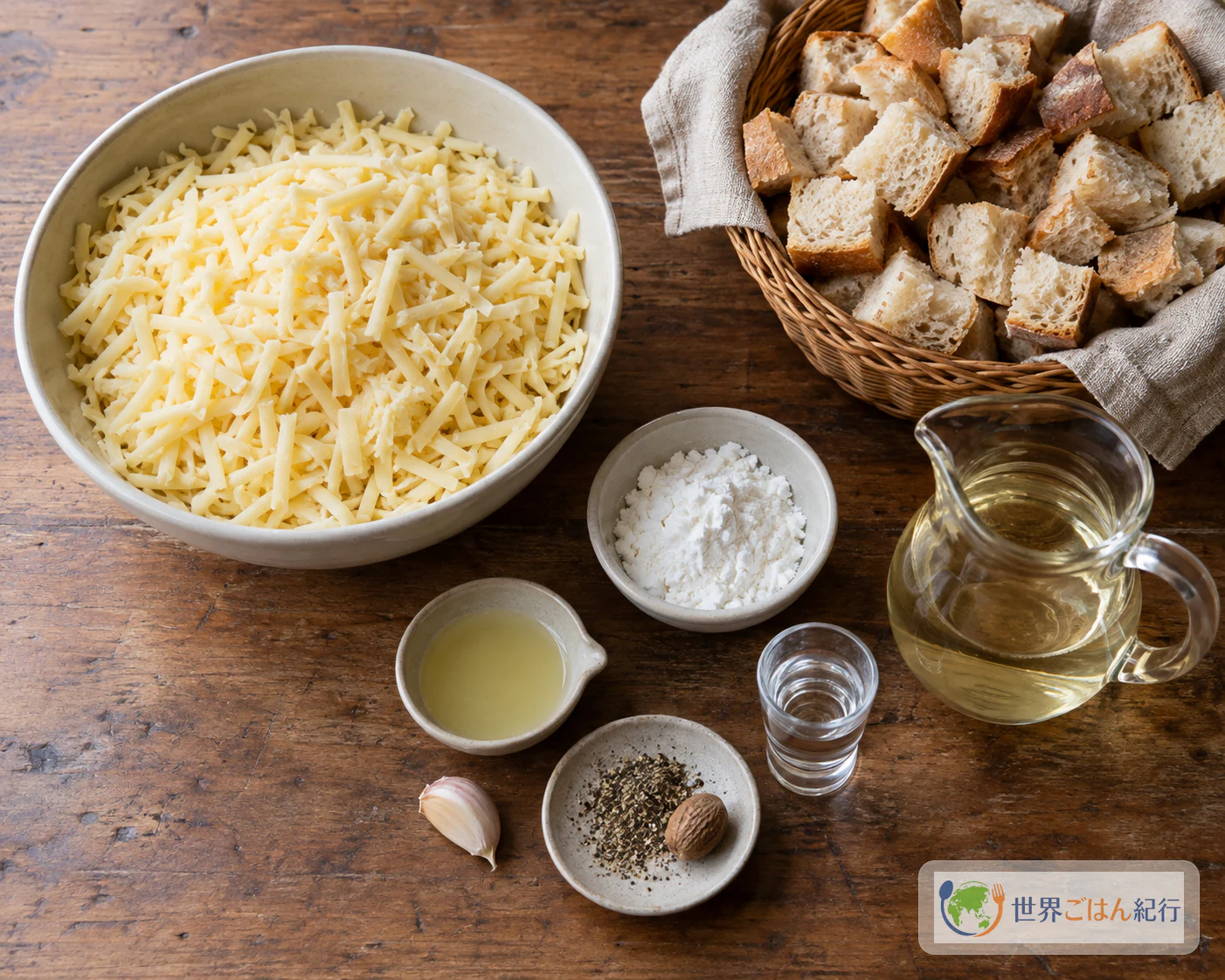
These are Swissmilk's amounts for 4 servings, with the original German names in parentheses. Where the recipe gives a range (garlic 1–2 cloves, bread 600–800 g), one home-cooking choice from inside that range is shown, with the source range alongside. The original units are kept: 3.5 dl of wine is 350 ml, and the small glass of kirsch is about 2.4 cl, or about 24 ml.
Equipment
- Caquelon (fondue pot)
- Rechaud (tabletop burner) suited to your caquelon
- Long fondue forks, one per person
- Grater, if your cheese is not already grated
- A wide bowl for mixing the cheese and cornstarch
- A wooden spoon for stirring
Use a tabletop burner made to fit your pot, and follow the manufacturer's instructions for both the caquelon and the burner.
Choosing the Cheese, Bread and an Alcohol-Free Option
Cheese. The recipe asks for 800 g of a fondue cheese mix and does not break it down further. The practical route outside Switzerland is to buy a blend sold for fondue, or to ask at a cheese counter for a mix suited to melting, and weigh out 800 g in total at home. If the blend you find happens to be half Gruyère and half Vacherin, that is one of the recipe's own examples; but you don't need to build that ratio yourself, and this recipe doesn't require it.
Bread. The recipe says only "bread cubes" and does not name a type. The photos here use plain wheat bread cut into cubes, as one example.
Cornstarch. The recipe's Maisstärke is cornstarch, measured in teaspoons. This article uses a 5 ml teaspoon as an editorial measuring convention; the source does not state that capacity. It is not given in grams, and none is given here.
This dish contains milk (cheese) and, with ordinary bread, wheat. Check the ingredient labels of the cheese blend and the bread you buy.
Swissmilk's classic recipe itself says that when eating with children, you can replace the white wine with alcohol-free apple cider or apple juice and leave out the spirit. Make that a separate version: use either the wine and kirsch, or the alcohol-free swap, not both together. Heating the fondue should not be taken to mean the alcohol in the main version has disappeared, so if anyone at the table needs to avoid alcohol, make the alcohol-free version from the start.
Method: From Caquelon to Table
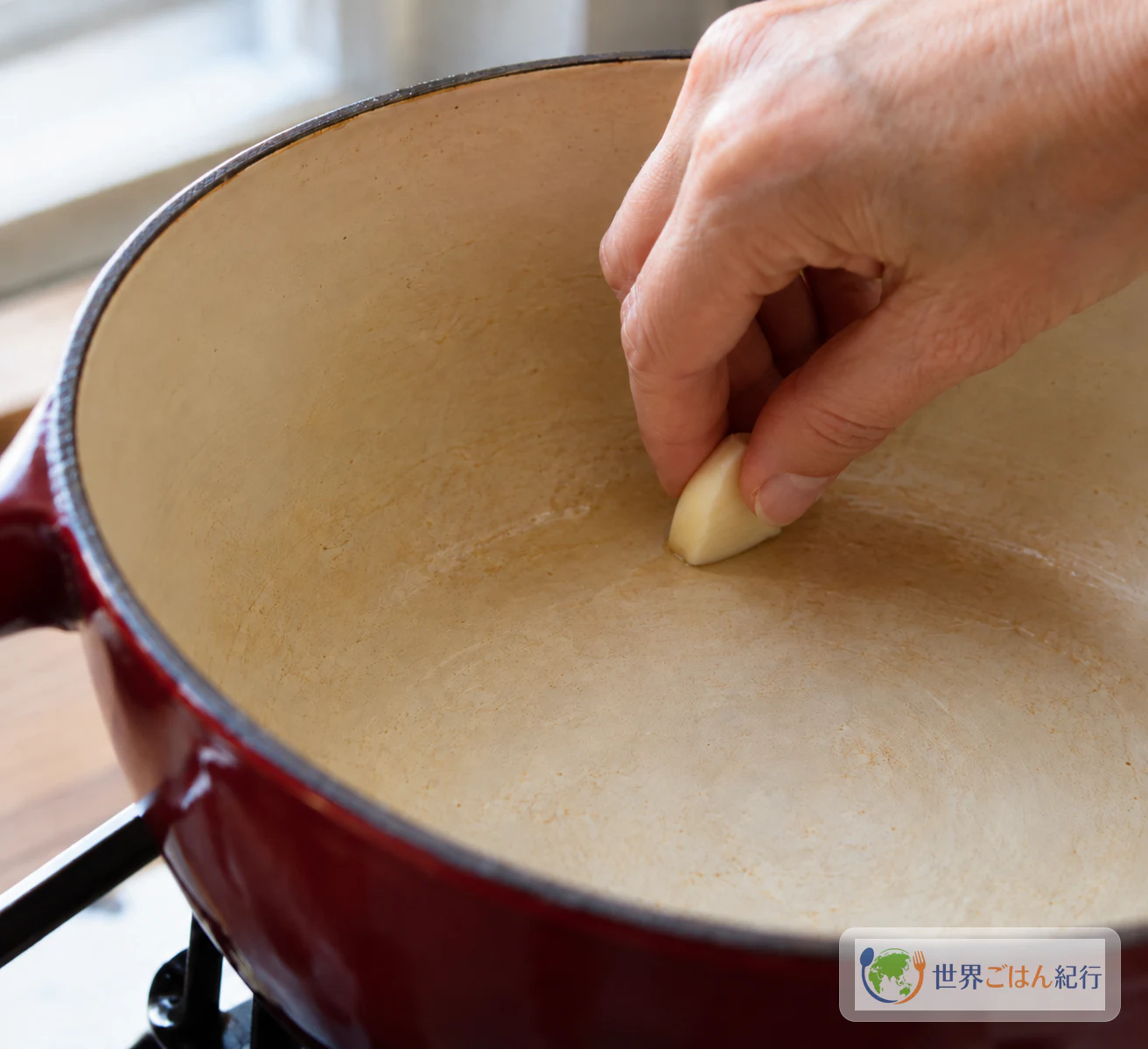
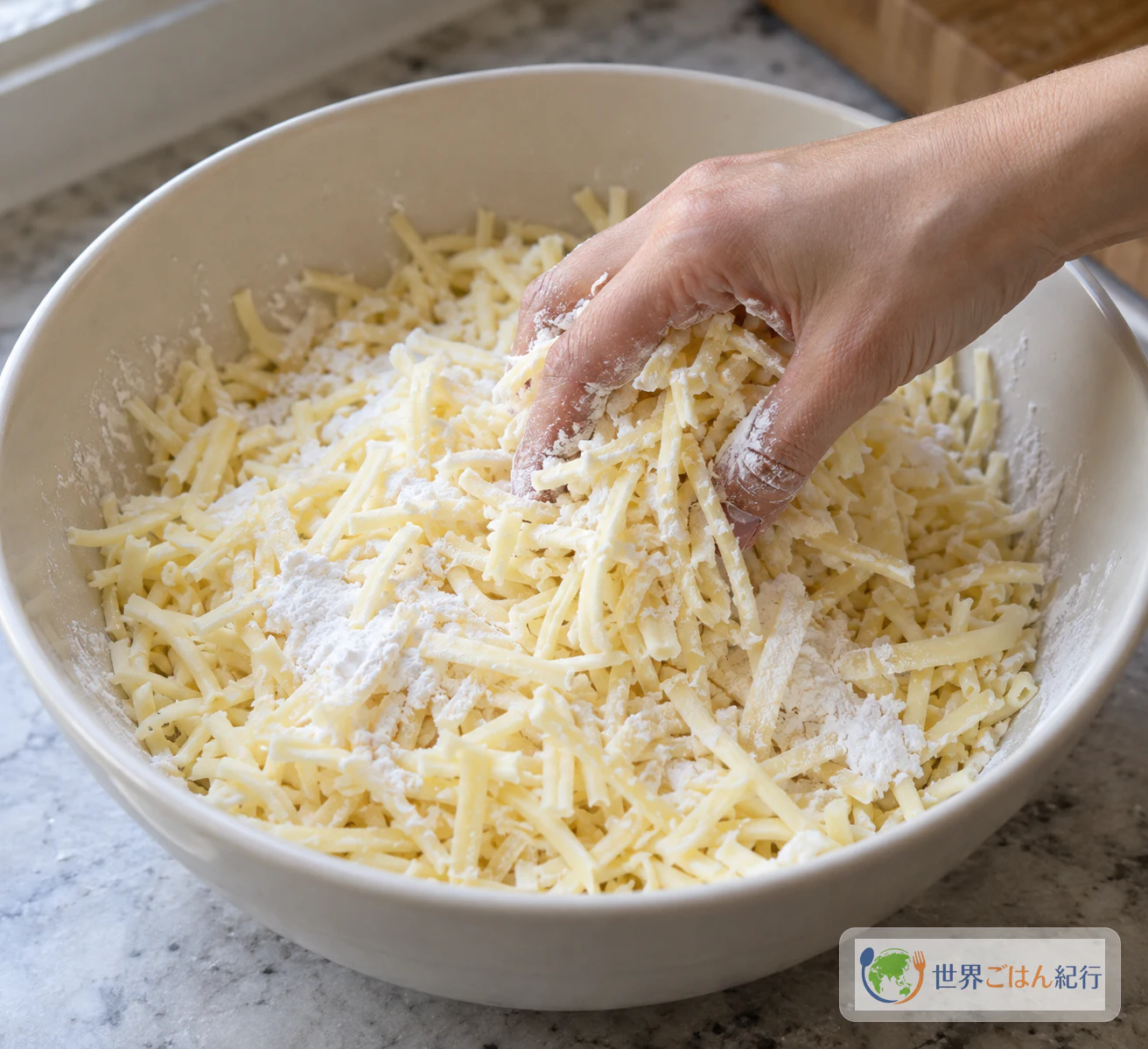
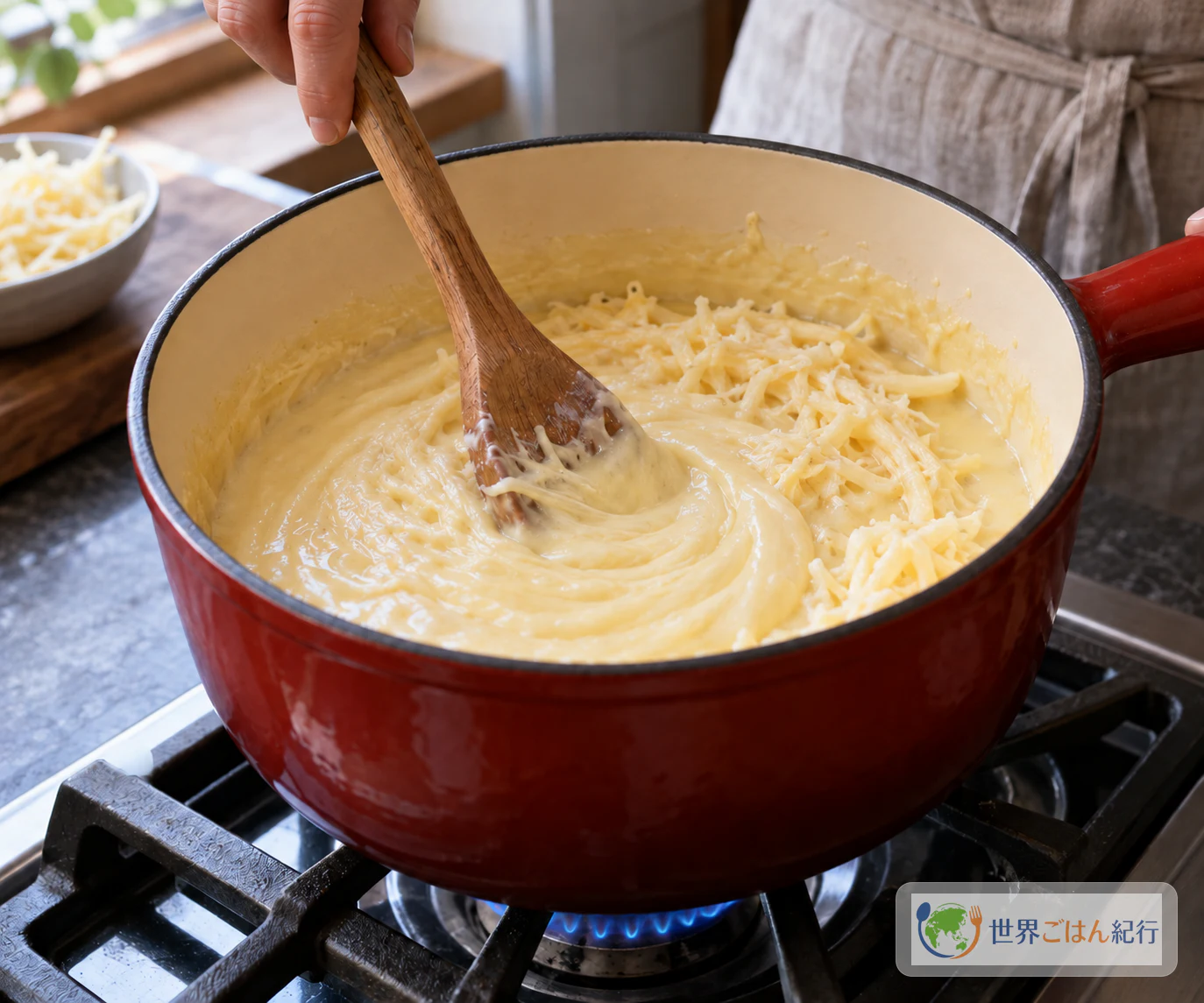
Swissmilk writes the method as two short paragraphs. Below, it is divided into six steps so you can follow it at the stove; the order and the amounts are the recipe's own.
Keeping It Smooth: What the Recipe Relies On
The classic recipe does not give temperatures or rescue tricks. What it does give is a sequence and an instruction to stir, and that is what to check first if the fondue isn't behaving.
| Point to check | What the recipe says | What to look at |
|---|---|---|
| Starch and cheese | Mix the grated cheese with the cornstarch first | Was the starch spread through the dry cheese before the wine went in (step 2)? |
| Heating | Bring to a boil with the wine and lemon juice while stirring vigorously | Was the pot stirred continuously on the way to the boil (step 3)? |
| Order of the kirsch | Add it after the cheese has come to a boil | Did the kirsch go in at step 4, not at the start? |
| At the table | Serve it simmering and start stirring immediately | Is the burner keeping a gentle simmer, and is the pot being stirred as people dip (steps 5–6)? |
These checkpoints come straight from the recipe's order. They aren't a promise of a particular texture, and this article doesn't offer temperatures or fixes beyond them.
Variations Within the Sources
- Alcohol-free for children. As Swissmilk describes it: alcohol-free apple cider or apple juice in place of the wine, and no spirit. Use it as its own version, not alongside the wine and kirsch.
- Moitié-moitié. For the Fribourg half-Gruyère, half-Vacherin Fribourgeois fondue, follow a recipe written for it, such as the one in Swissmilk's teaching material. It has its own amounts and liquid, so don't fold it into this one.
- Potatoes instead of bread. Betty Bossi's separate Käsefondue recipe suggests boiled potatoes can be served in place of bread. That belongs to their recipe; the classic version here is served with bread cubes.
Leftovers
The sources don't give a storage period for leftover fondue or say whether it returns to the same smooth texture when reheated, and this article doesn't claim either. For general handling, Japan's Ministry of Health, Labour and Welfare advises home cooks to divide leftovers into shallow containers, cool them quickly and refrigerate them, and when reheating, to heat thoroughly with 75°C or higher as a guide. That is general household food-safety guidance, not a fondue-specific test.
Frequently Asked Questions
How is this different from moitié-moitié?
Moitié-moitié is a regional type from French-speaking Switzerland made with half Gruyère and half Vacherin. This classic recipe uses a fondue cheese mix with no set ratio, and names moitié-moitié only as one example of a suitable mix. They are separate recipes with separate amounts.
What cheese should I buy outside Switzerland?
Look for a blend sold for fondue, or ask at a cheese counter for a melting mix suited to fondue, and weigh out 800 g in total. The recipe does not specify which cheeses or in what proportion, so no single blend is the correct one.
What kind of bread should I use?
The recipe calls only for bread cubes, 600–800 g for four, without naming a type. Plain wheat bread cut into cubes is the example shown here.
Can I make it without alcohol?
Yes. Swissmilk's recipe says that for children, the wine can be replaced with alcohol-free apple cider or apple juice and the spirit left out. Choose that version from the start rather than mixing it with the wine and kirsch.
Can I serve something other than bread?
Betty Bossi's separate recipe mentions boiled potatoes in place of bread. In the classic Swissmilk version, bread cubes are what goes into the pot.
Does it really take 15 minutes?
Swissmilk lists 15 minutes for this recipe. Treat it as the publisher's estimate; your own time will depend on your stove, pot and grating.
Sources
- Swissmilk, "Fondue klassisch." The adopted recipe for 4 servings: all ingredients and amounts, the method sequence, the stated 15 minutes, and the alcohol-free option for children. https://www.swissmilk.ch/de/rezepte-kochideen/rezepte/LM200701_32/fondue-klassisch/
- Swissmilk, "Schweizer Klassiker: Freiburger Fondue moitié-moitié." The many variations of Swiss cheese fondue, the shared caquelon and bread-dipping tradition, and Fribourg moitié-moitié as a separate recipe with half Gruyère and half Vacherin Fribourgeois. https://api.swissmilk.ch/wp-content/uploads/2019/06/lehrmittel-phasenrezepte-ch-klassiker-lehrmittel-hw-146307-de.pdf
- Switzerland Tourism, "This is Swiss cuisine." Cheese fondue as melted cheese with bread cubes served in a caquelon, and moitié-moitié as a creamy French-speaking Swiss specialty. https://www.myswitzerland.com/en-ca/planning/about-switzerland/custom-and-tradition/typical-food/
- Betty Bossi, "Käsefondue." An independent Swiss recipe with the same garlic, wine, lemon juice and stirring pattern, and the suggestion of boiled potatoes in place of bread. https://www.bettybossi.ch/de/rezepte/rezept/kasefondue-10009741/
- Ministry of Health, Labour and Welfare (Japan), "家庭での食中毒予防" (Preventing food poisoning at home). General household guidance on cooling leftovers quickly in shallow portions and reheating to 75°C or higher as a guide; not specific to fondue. https://www.mhlw.go.jp/stf/seisakunitsuite/bunya/kenkou_iryou/shokuhin/syokuchu/01_00008.html