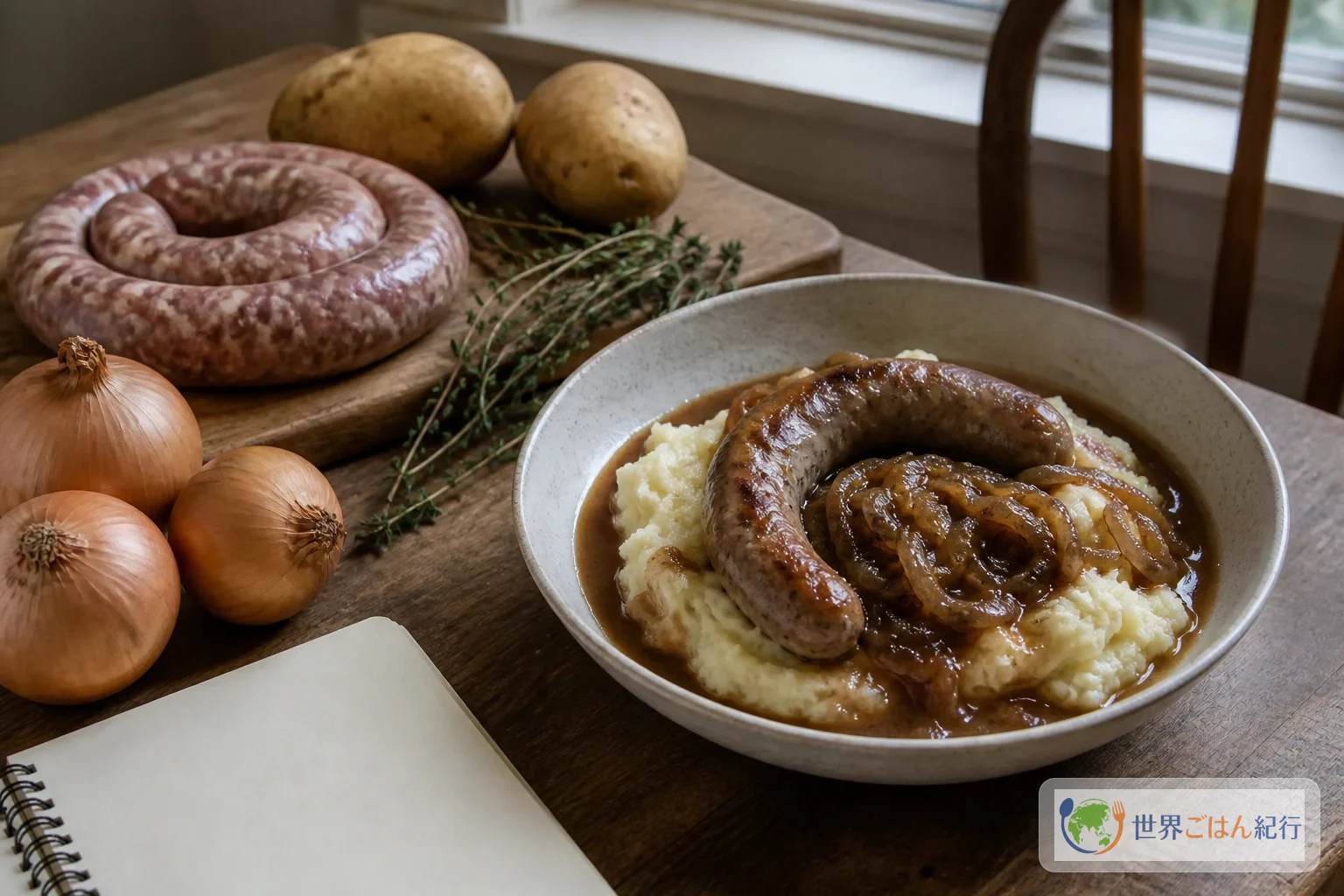
In the pan the sausage skins crackle softly, and the rendered fat drops to the bottom. The onions that soak up that fat slowly change from white rings to pale amber, and finally, joined by beef stock, become a dark brown gravy. In the center of the plate is steaming mashed potato. Lay the browned sausages on top, spoon over the onion sauce, and salt, fat, acidity and the sweetness of potato come together as one.
Bangers and mash is a classic of Britain and Ireland that combines sausages, mashed potatoes and onion gravy. "Bangers" is the informal British word for sausages, and there is no single fixed kind used in the dish. Still, the plain character of a pub plate comes from using coarse fresh pork sausages, not overcooking them, and not overworking the mash.
What trips people up at home is less any special technique than three boundaries. The sausages must be cooked through to the center without splitting the skins; the potatoes must be mashed without leaving water in them; and the onions must give up their sweetness without scorching. Even without a sausage carrying a place name, hold these three and you keep the British flavor axis in one plate.
A plate that begins with browned skins and onion steam

Order this dish in Britain and what arrives is not a plate covered in garnish but grilled sausages, a heap of mash and plenty of gravy. Food Network presents it as both a home dish and something on pub menus. It fits easily either as a warm plate after work or as a family dinner ladled from the pot.
The gravy is not a sauce made separately from the sausages. The pan where you browned them holds meat fat and browned bits. Add onion, flour, vinegar, red wine and beef stock in turn, and the unburned brown film at the bottom dissolves into a sauce carrying the flavor of the meat. It is less washing-up than frying the onions in a separate pan, and it connects the flavors more easily.
The mash, on the other hand, need not be a smooth purée. Articles on how the British eat it explain that a dense, rustic mash suits the dish better than a fine, even one. Stop while small bits of potato remain, and the gravy runs into the hollows and catches the juices of the sausage.
Compare it with the already published British fish and chips (in Japanese) and there is an interesting difference. For the fish dish, vinegar is added at the end to keep the batter light, whereas in bangers and mash vinegar goes into the onion gravy to give an outline to the whole fat-carrying sauce. Even within the same British "potato and acidity," the place of the vinegar differs.
The Cumberland spiral: origin and flavor axis

Among the sausages used for bangers, the one whose regional name is most firmly tied to its shape is Cumberland sausage. According to UK government protected-name documents and the Japanese Ministry of Agriculture, Forestry and Fisheries' geographical-indication documents, traditional Cumberland sausage is a long spiral pork sausage made in the Cumbria region. It is noted for being sold by weight as one continuous length rather than divided into links, and for its coarse texture and visible flecks of spice.
The name is not just a description of shape. The British specification requires a larger mincer plate hole to keep the meat coarse, and prohibits emulsifying it in a bowl chopper. The meat content is set at 80% or more, and spices such as white and black pepper, thyme, sage, nutmeg, mace and cayenne are permitted in combinations that each butcher may vary. So what stars in the mouth is not a sweet sauce but pork fat and the aroma of pepper.
The historical relationship with Cumberland also offers clues to today's flavor. The first documented example in the protected-name materials is from 1911, though local tradition holds that the method came with German miners in the 16th century. A recipe going back to the 1850s survives, as does a record that the sausage was once hung with ham and bacon to semi-dry. That black pepper, nutmeg and other spices came in through the trade of the port of Whitehaven in the 18th century is also part of why Cumbrian sausage is spiced more than elsewhere. Tradition and record must be kept apart, but we can see that preservation, a coarse cut of meat and spices delivered from the port made a character that is more than just the spiral shape.
If you cannot get a fully protected-name product, choose the flavor axis over matching the shape. A thick, coarsely ground fresh sausage where pork is the star and herbs and pepper are visible gets close even if it is an ordinary pork sausage. Choose a Lincolnshire-style one in which sage comes forward and the pepper bite is milder. Smoked kielbasa, cheese-filled, sweet teriyaki-flavored and chili-hot sausages can be delicious, but they easily hide the onion gravy and mash, so they are not suited for a first plate.
Ingredients (serves 4)

The quantities take the basic British home-recipe structure of 8 sausages, onions, beef stock and 1 kg of potatoes and fit it to a home pot for four. Because the saltiness of sausages and stock varies, don't put in all the salt in the table at the start; adjust it by tasting at the end.
The rusk in sausages, the flour and the stock may contain wheat, soy and dairy. The mash uses milk, butter and mustard, so anyone who reacts to dairy, soy, wheat or mustard should check the labels on the sausages and seasonings one by one. To avoid gluten, choose gluten-free-labeled sausages, rice flour and stock, and do not share tongs or cutting boards.
If you are looking for a seasoning to add a British-style heat, first try the whole-grain or Dijon mustard you already have. It differs from the straight-line heat of English mustard, but Dijon cuts pork fat with acidity and heat and can be mixed into the mash in small amounts. It is worth buying more only if you plan to use a jar on sausages, roast meat and sandwiches too. If you will use just 10 g for this dish, use the mustard at home and don't buy any.
When mashing 1 kg of potatoes at once, a masher with a coarse grid is easier to handle than a fork. But for simply mashing potatoes, a fork or wooden spoon will do. If you make mash or bean purées more than once a week, or want to get an even result quickly while leaving some texture, consider a dedicated one. If you will make it once, or have little storage space, you needn't buy one.
Do not use the plate or tongs that held raw sausages to serve. Check that the center temperature after cooking is at least 71°C. If you don't have a thermometer, cut the thickest one and check that the center is not cold and red; if in doubt, heat it a little more over low heat. If the oil smokes, turn off the heat and let the pan cool without moving it. Water in oil is dangerous, so do not drop wet ingredients in.
Method: brown, mash, and loosen the bottom of the pan
If you run the sausages, onions and potatoes at the same time, everything is warm at plating. The order is: potatoes into the pot first, sausages browned and onions sautéed while you wait. Lower the heat only when making the gravy, so that you dissolve the brown savory film stuck on the pan into the stock, not a burned bottom.
When things go wrong, fix it in the pan

Don't dismiss a failure with a single cause; look at the sausages, the potatoes and the sauce separately. If a skin splits but the sausage is cooked through the center, it is edible, but the fat runs out and it dries more easily. If the mash has turned gluey, it can't be fully restored, so switch direction: make more gravy and eat it together with the sauce.
| Problem | Likely cause | How to fix it on the spot |
|---|---|---|
| Sausage skin splits | Heat too high, pricked, or the temperature rose suddenly | Lower the heat and cover 1 minute. If the center is under 71°C, heat 2 minutes at a time and cover the split with gravy |
| Surface browned but the center is raw | Heat too high for the thickness, taken out early | Warm 3 to 5 minutes in the gravy over low heat and recheck the center temperature |
| Mash is heavy like paste | Took on too much water, cold milk, overworked | Stop mixing and add 15 ml warmed milk and 10 g butter. It won't return to fluffy, so serve a little extra gravy |
| Mash is crumbly | Potatoes lost too much water, too little milk | Add 60–70°C milk 15 ml at a time and bring it together by pressing alone |
| Gravy is thin | Under-reduced, stock added all at once | Take out the sausages and reduce 2 to 3 minutes over medium heat. If too salty, don't reduce; add unsalted hot water 15 ml at a time |
| Gravy is lumpy | Flour not blended into the fat, stock added suddenly | Whisk over low heat and add stock 30 ml at a time. If it doesn't recover, strain through a fine sieve |
| Onions are bitter | Blackened, or the bottom scraped hard | Remove the black parts and move only the brown onions to a new pan. If bitterness has spread through, start over |
Pricking sausages with a skewer or fork lets the juices out and makes the skins shrink. Rolled over lowish heat, they keep the fat inside without splitting the skin. When it won't brown, before raising the heat, first check whether you have crowded the pan.
Cumberland, Lincolnshire, Ireland: comparing regional differences on the plate

Even with the same bangers and mash, differences of place show in the sausage's aroma and what goes into the mash. There is no strict nationwide recipe, so the table below is a guide for telling the regional dishes apart at home.
| Region or type | Aroma and shape | To approximate it at home |
|---|---|---|
| Cumbria / Cumberland | Strong with pepper and herbs, coarse, a long spiral. Protected-name product is made in Cumbria | A thick, coarse pork sausage with a little black pepper. Cook without splitting the skin, even when cut into pieces |
| Lincolnshire | Pork sausage in which sage comes forward, with herbs coming before the pepper compared with Cumberland | Choose a fresh sausage with sage and go easy on the pepper in the gravy |
| English pub style | Centered on pork sausage, mash and onion gravy. Peas or cabbage are served differently by place and household | Boil frozen peas separately and don't dilute the gravy's flavor |
| Leaning Irish | Sausage and mash with the colcannon idea of mixing in cabbage or kale | Don't mix into all of the mash; combine only 200 g boiled cabbage |
If you think of Cumberland as a dish where you eat the sausage's own aroma, and Lincolnshire as one built around the green fragrance of sage, shopping decisions go faster. Irish-leaning colcannon, as Food Network describes it, is a form in which cooked cabbage or kale is mixed into the mash. Simply serving greens on the same plate is fine, but mixing them into the potatoes changes the side dish itself that receives the sausage's fat.
For plating, following articles on how the British eat it, use a flat large plate or a broad shallow bowl. Put the mash in the center, line the sausages on top and run the gravy around, and the sauce is visible before you cut. There is also the way of mopping up the sauce with bread, but at home, simply having hot plates and enough spoons ready brings the table together.
Five variations to widen the table

Once you have made the basic plate, changing only one place, the mash, the gravy or the greens, keeps the dish's skeleton better than changing the type of sausage drastically.
1. Mustard mash
Mix 10–15 g Dijon or whole-grain mustard into the mash for four. The acidity connects to the fat the sausages were cooked in, so even with less gravy the flavor doesn't blur. Even if you want more heat, don't put in more than 1 tbsp from the start; increase by 5 g.
2. Cabbage, colcannon-style
Cut 200 g cabbage into 1 cm strips, boil 3 to 4 minutes in boiling water, squeeze it firmly and mix it into the mash. Leftover water loosens the mash, so after draining, cool it until you can touch it and then press out the water. It lets you enjoy an Irish direction, but leave the coarse pepper aroma of Cumberland as it is.
3. Cider onion gravy
Replace the 100 ml red wine with 100 ml dry cider and reduce the red wine vinegar to 10 ml. The apple aroma lifts the sweetness of the onions, so don't add sugar from the start; reduce and then taste. If avoiding alcohol, replace it with 100 ml beef stock rather than apple juice, and add no sweetness.
4. Red cabbage served on the side
Shred 200 g red cabbage and simmer it over low heat for 15 minutes with 15 ml apple cider vinegar, 50 ml water and 1 g salt. When tender, serve only a small amount beside the sausages and mash. The sweet-sour side cuts the fat, but mixed into the gravy it changes the aroma of the brown sauce, so keep it on a separate plate to be safe.
5. A meatless weekday version
Use plant-based sausages and vegetable stock and make the onion gravy by the same steps. Cooking times differ by product, so give priority to the center temperature and the label, and don't apply the same time as meat bangers. This is not a reproduction of the British pork sausage, but a meal that keeps the combination of mash and gravy.
Storage and eating it again the next day

The finished plate is at its best when the sausage skin, the density of the mash and the gravy's viscosity line up. To keep leftovers, move the sausages and gravy, and the mash, to separate shallow containers, and let them cool with the lids slightly ajar so steam doesn't collect. Don't leave them at room temperature long; refrigerate within 2 hours of cooking. Treat refrigerated food as good for up to 3 days, and don't eat it if there is an odor, a dry surface or a bulging container.
To reheat, add 15 ml beef stock or hot water to the gravy and warm it over low heat. Mix 15 ml milk into the mash, cover and microwave it one portion at a time, breaking it up once partway. Return the sausages to the gravy and warm them over low heat, heating everything through to at least 74°C. FoodSafety.gov gives 71°C at the center for ground meat and sausage and 74°C for reheating leftovers. Even without a thermometer, check that steam rises through to the center and no cold spot remains.
If freezing, separate the sausages and gravy first, and freeze the mash only if you can accept a change in texture. Mash tends to separate water after thawing, so rather than that, it is easier to warm it the next morning with added milk, without kneading, and fry it with leftover cabbage into a different dish.
FAQ

Can't I make it if I can't buy Cumberland sausage?
You can. Choose a thick, coarse fresh pork sausage in which pepper and herbs are the star, and the dish's flavor axis holds. You cannot reproduce the spiral shape, the manufacture in Cumbria or the conditions of a protected name, but bangers and mash is not a dish that uses only one specific kind. With thin sausages, start at 5 to 7 minutes of cooking and adjust by center temperature.
Does pricking the sausages cook them faster?
Not necessarily. Fat and juices run out of the holes and the surface dries more easily. Rolling them over medium-low heat and using a lid for just 1 minute on thick ones keeps the skins better. If the center is under 71°C, don't prick them; keep heating over low heat in the gravy.
Can I make the gravy without red wine?
Yes. Replace the red wine with 100 ml beef stock and start with 10 ml red wine vinegar. After reducing, taste the acidity and add 5 ml at a time if needed. Replacing it with only apple juice makes the sweetness come first, so if you use it, choose dry cider, and if avoiding alcohol, prefer beef stock.
How do I keep the potatoes from turning gluey?
Cut floury potatoes large, and when boiled let the steam escape for 2 minutes. After adding warmed milk and butter, once the pressing with the masher is done, don't knead repeatedly with a spatula. After it has turned gluey it won't fully recover, so add a little milk and butter to loosen the mouthfeel and eat it with extra gravy.
Can I mix cabbage into the mash?
Yes. Boil 200 g cabbage in 1 cm strips for 3 to 4 minutes, squeeze out the water firmly, and mix it into part of the mash for four. It makes it Irish colcannon-style, but leftover water loosens the mash. Rather than mixing it into all of it, try just one portion first and it is easier to see the balance with the sausages and gravy.
How long does it keep?
Treat refrigerated food as good for up to 3 days, stored with the sausages, gravy and mash separate. When eating it again, heat it to the center, confirming at least 71°C for the sausages and at least 74°C for the whole dish reheated as leftovers. Do not eat anything left long at room temperature or changed in smell or appearance, even after reheating.
Sources
- GOV.UK, "Traditional Cumberland sausage" (accessed and checked 31 August 2026, JST)
- UK government, "Protected food name: Traditional cumberland sausage" PDF (accessed and checked 31 August 2026, JST)
- Ministry of Agriculture, Forestry and Fisheries of Japan, "Notice of designation (designation No. 146)" (accessed and checked 31 August 2026, JST)
- BBC Good Food, "Bangers and mash with onion gravy" (accessed and checked 31 August 2026, JST)
- The Guardian, "How to eat: bangers and mash" (accessed and checked 31 August 2026, JST)
- Food Network, "What Are Bangers and Mash?" (accessed and checked 31 August 2026, JST)
- FoodSafety.gov, "Cook to a Safe Minimum Internal Temperature" (accessed and checked 31 August 2026, JST)
- FoodSafety.gov, "4 Steps to Food Safety" (accessed and checked 31 August 2026, JST)