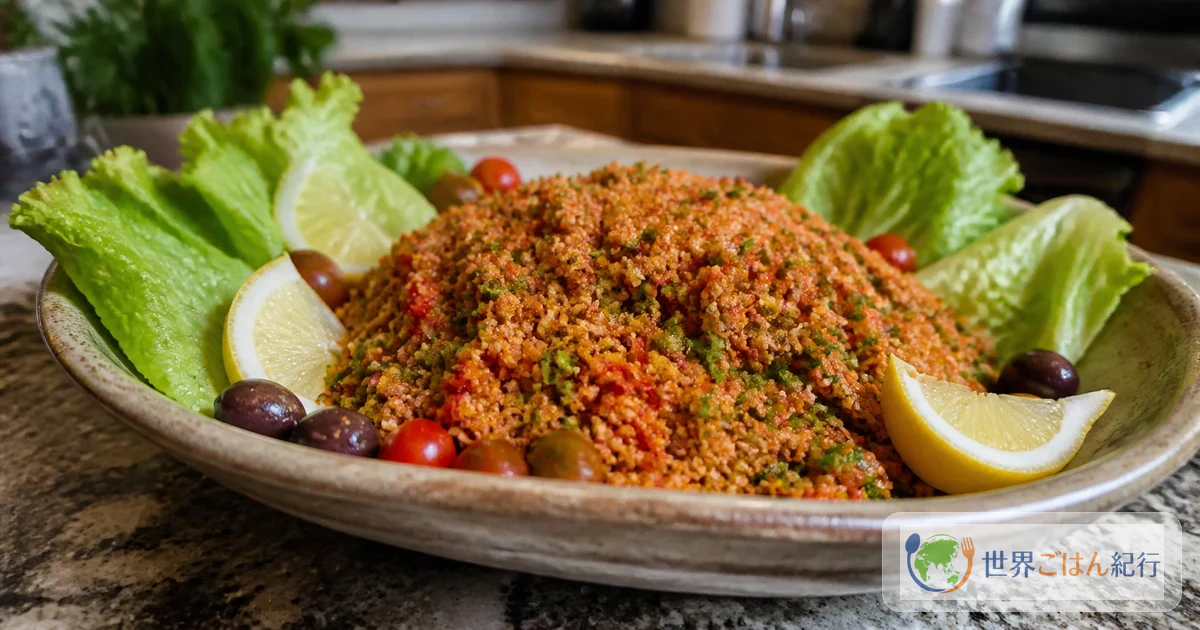
The golden rice of the pearl island
Bahrain is a small island nation in the Persian Gulf. It once prospered on natural pearls and today runs on finance and oil. Centuries of spices carried along trade routes are written into its cooking, and the dish that sums them up best is machboos (Machboos / Machbūs / مچبوس).
Among the rice dishes of Middle Eastern cooking (in Japanese), machboos stands out for its distinctly Gulf character: golden basmati rice cooked together with chicken (or lamb, or fish) and Gulf spices. The spices include loomi (dried lime), cardamom, cinnamon and cloves. Take a bite and the cool scent of cardamom comes first. Then the tartness of dried lime spreads slowly, and rice that has soaked up the chicken's savoriness falls apart on your tongue.
India has biryani, Iran has polow, Saudi Arabia has kabsa: every country around the Persian Gulf has its own rice dish. What sets machboos apart is the sour edge of dried lime (loomi) and a spice blend that varies from household to household. In Bahrain it is an essential dish for family gatherings and for days when guests are coming.
The Arabic word makbous (مكبوس) comes from the root k-b-s (ك-ب-س), meaning "to press in" or "to pack," and in Gulf pronunciation it becomes machboos (مچبوس). The name describes rice cooked as if packed with meat and spices. Besides Bahrain, it is widely eaten across the Gulf states, including Kuwait, Qatar and the UAE, and the spice mix and method vary from country to country and from family to family.
Spiced rice dishes exist all over the world, from Uzbek plov (in Japanese) to Indian biryani (in Japanese), but machboos has a flavor all its own, built on the dried limes and bezar spices of the Gulf. This article explains in detail how to reproduce the traditional method faithfully with ingredients you can find for a home kitchen.
Ingredients (serves 4)
Whole spices (cardamom, cloves, cinnamon and so on) lose their aroma quickly once they've been open for more than 6 months. The fragrance of machboos depends directly on the quality of the spices, so use whole spices that are as fresh as possible. Ground spices (turmeric, cumin and so on) fade even faster, so small packs are the way to go. Always store spices airtight in a cool, dark place.

Soak basmati for at least 30 minutes, and up to 1 hour if you have time. Too short and the grains stay hard in the center; too long and they tend to break up as they cook.
In Bahrain, the crust that forms on the bottom of the pot is called "hakaka" (Hakeka) and is treasured as the best part. Once the rice is cooked, heat it over low heat for another 3–5 minutes and a crackly crust will form. Many rice cultures prize the crispy bottom of the pot, and the Gulf is no exception.
Cooking tips
Dried lime (loomi) isn't a "secret ingredient" in machboos; it's the star spice. Cracking it lightly with the flat of a knife lets the dried pulp inside dissolve into the broth, spreading a citrusy sourness and a complex, almost smoked flavor. If 2 isn't enough for you, use 3. Don't forget to fish the dried limes out of the rice after cooking. Bite into a whole one and its intense sourness will catch you off guard.
Soak saffron in warm water (about 60°C / 140°F) for at least 10 minutes before using it. Crumble it lightly with your fingertips first; even a small amount then gives plenty of color and aroma.
Three keys to fluffy basmati: first, soak for at least 30 minutes; second, use 1.2–1.3 times as much liquid as rice by volume (in this recipe, 600 ml broth for 400 g rice); third, fluff it with a fork once cooked (don't press it down with a rice paddle). It needs the opposite treatment from sticky short-grain rice.
Machboos chicken is known for its "brown, simmer, broil" method: two stages, or strictly speaking three. The first browning locks in flavor, the simmer lets the spices soak in, and the final broil crisps the skin. That extra effort is what gives you "crisp outside, juicy inside." You can skip the final broil if you're short on time, but the dish won't be quite as complete.
Variations
Fish machboos (machboos samak)
Use 4 fillets of white fish (sea bass, sea bream and so on) in place of the chicken. In the Gulf, fish machboos made with fish such as hamour (a kind of grouper) is also popular. Don't simmer the fish; rub it with the spices, grill it and set it on top of the cooked rice.
Lamb machboos (machboos laham)
Use 600 g bone-in lamb in place of the chicken. Lamb needs longer simmering than chicken, so extend the simmer in step 4 to 40 minutes. If the meat still isn't tender, add water and simmer 10 minutes at a time until it is.
Shrimp machboos (machboos rubyan)
Use 12 large shrimp in place of the chicken. Shrimp cook through after just 5 minutes sautéed with the spices, which cuts the cooking time considerably. Make the broth with water and chicken bouillon powder, and lay the shrimp on the rice 5 minutes before it finishes cooking so they steam without turning tough.
Biryani-style machboos
Change step 5 to "layered" cooking. Put half the rice in the bottom of the pot, the chicken and broth in the middle and the rest of the rice on top, then drizzle saffron water over the top and cook over low heat for 25 minutes. This "hybrid" borrows the technique of South Asian biryani (in Japanese): the top and bottom layers end up with different intensities of flavor, so you get two tastes from one dish.
Vegetarian machboos
Use chickpeas (one 400 g can) and 2 eggplants in place of the chicken. Slice the eggplants into 1 cm rounds, grill them, and cook them into the rice along with the chickpeas. Without the meat broth, increasing the dried limes to 3 keeps the flavor from tasting flat.
Background
A flavor shaped by Gulf trade routes
Bahrain's food culture reflects its geography. Sitting in the middle of the Persian Gulf, Bahrain has been a trading hub since the days of ancient Dilmun. Through contact with the Indian subcontinent and Persia, dishes of rice and spices took root on Gulf tables and came together with the sourness of dried limes, made in places across the Gulf such as Oman.
Machboos is often compared with South Asian biryani and Saudi kabsa. All of them pair meat with rice, but they differ in method, ingredients, heat and presentation; Gulf machboos stands out for the clear sourness of loomi.
Dried lime: the soul of Gulf cooking
Dried lime (loomi), which defines the flavor of machboos, is a foundational spice across Persian Gulf cooking. Loomi is often linked to an Arabic word meaning "Roman," but Oman's lime groves are a major source. Fresh limes are boiled in salt water and then dried in the desert sun for several weeks, becoming a unique seasoning that concentrates citrus sourness and a smoky, almost smoked depth.
When using them whole, poke a few holes with a skewer or fork, or crack them lightly, before adding them to the pot so the liquid gets inside and the aroma comes out. Ground loomi loses its aroma quickly, so buy whole limes when you can.
Friday machboos
Many families in Bahrain make machboos for Friday lunch. Friday is the day of congregational prayer in Islam, and families gather around a large platter.
As with Turkish dolma (in Japanese) and Lebanese hummus (in Japanese), in Middle Eastern food culture the act of a family sharing one platter is valued as much as the food itself.
Machboos and pearl diving
The name Bahrain means "two seas" in Arabic. Until the first half of the 20th century, Bahrain's economy relied heavily on harvesting natural pearls. The fact that there are versions of machboos made with fish and shrimp reflects an island that has always lived with the sea.
Dakoos: machboos's faithful companion
When you eat machboos in Bahrain, there's always a bowl of dakoos (Dagoos / Daqus) on the table, a spicy tomato-based sauce. Ripe tomatoes are blended into a paste with garlic, green chiles and cumin; you could call it Bahrain's salsa.
Dakoos is very simple to make. Peel 3 ripe tomatoes (blanch them briefly to slip off the skins), chop them roughly, and pulse them in a food processor with 2 garlic cloves, 1 green chile, 1/2 tsp cumin and a little salt into a coarse paste. Heat 1 tbsp vegetable oil in a pot, add the paste and simmer over medium heat for 10 minutes, until the liquid cooks off and it thickens. Spooned over machboos rice, the sour heat of dakoos brings the aroma of the spices forward even more.
Bezar blends: every family's secret
Every Gulf household has its own spice blend (a mix called baharat or bezar). Most are built around cardamom, cinnamon, cloves and black pepper, with additions such as cumin, coriander, fennel or nutmeg, and they differ a little from family to family.
Machboos and kabsa: similar, but not the same
The dish most often confused with machboos is Saudi Arabia's kabsa. Both are spiced rice topped with meat, but there is a real difference between them.
In short, machboos tends to lead with the sourness of loomi, while kabsa leads with tomato and the aroma of baharat. That said, both vary widely from home to home and restaurant to restaurant, and the line between them isn't a sharp one.
Modern Bahrain and its food scene
The capital, Manama, has plenty of restaurants serving Gulf cooking, and you can easily eat machboos out. Still, what appears on the family table on Friday is machboos cooked with that household's own blend.
Nutrition (per serving, 1 of 4)
| Nutrient | Amount |
|---|---|
| Calories | 650 kcal |
| Protein | 42 g |
| Fat | 22 g |
| Carbohydrates | 72 g |
| Fiber | 4 g |
| Sodium | 780 mg |
Most of the calories come from the carbohydrates in the basmati rice and the protein in the chicken. To cut back on salt, reduce the salt in the broth by 1/2 tsp and let people add dakoos or salt at the table.
More dishes to make with it
- How to make fesenjan (in Japanese) - Uses ingredients and aromas from the same region.
- How to store hummus (in Japanese) - Uses ingredients and aromas from the same region.
Frequently asked questions
Here are the questions we hear most often from people making machboos for the first time, from finding the spices to cooking the rice.
Q1. What if I can't get all the bezar spices?
At minimum, cardamom, cinnamon and turmeric will give you the backbone of machboos. Saffron, also used in Iranian tahchin (in Japanese), can be left out. Adding turmeric to store-bought garam masala gets you fairly close in flavor, too. Dried lime, however, is the core of machboos, so even if you skip everything else, get dried limes.
Q2. My basmati rice turns out mushy
There are three likely causes. First, too much liquid (600 ml broth for 400 g rice is right). Second, soaking too long (more than 2 hours and the grains tend to break). Third, stirring too much after cooking (just fluff it gently with a fork). And never lift the lid and let the steam escape.
Q3. What's the difference between machboos and biryani?
The biggest difference is the method. Machboos is cooked all together (the rice and spiced sauce cook in one pot), while biryani is layered (parboiled rice and the other components are layered and steamed). The spices differ as well: machboos centers on dried lime and bezar, biryani on garam masala and kewra water.
Q4. Do I really need the rose water?
It's still delicious without it. Some Gulf machboos recipes finish the rice with rose water or saffron, and adding it brings a lovely floral note. Look for food-grade rose water at import grocers or online. It's strongly scented, so start with 1 tsp the first time.
Q5. How do I enjoy leftover machboos the next day?
Machboos is still very good the next day, but the rice tends to stick together. Melt 1 tbsp ghee or butter in a skillet and warm the rice as if you were stir-frying it. Let the surface crisp up like hakaka and it can taste even better than the day before. Turning it into a fried-rice-style dish is a Bahraini home cook's trick too.
Related spiced rice dishes
If machboos has caught your interest, try spiced rice dishes from other regions too. The same "spices plus rice" turns into a completely different dish when the culture changes.
- Plov (in Japanese) — Uzbekistan's national dish. Central Asian spiced rice made rich with lamb fat and carrots
- Biryani (in Japanese) — South Asia's art of layered rice. The opposite approach to machboos
- Koshari (in Japanese) — Egypt's national dish. An inventive combination of rice, lentils and macaroni
- Mansaf (in Japanese) — Jordan's festive dish. A Bedouin feast cooked with a yogurt sauce
Sources

Recipes and methods
- The Food Dictator. (2016). "The Hirshon Bahraini Chicken Machboos – مكبوس البحرين." https://www.thefooddictator.com/hirshon-bahraini-chicken-machboos-%D9%85%D9%83%D8%A8%D9%88%D8%B3-%D8%A7%D9%84%D8%A8%D8%AD%D8%B1%D9%8A%D9%86/ — Machboos as Bahrain's national dish, how loomi is used, comparison with biryani and kabsa (checked October 22, 2026)
- Gulf News. "Bahraini Chicken Machboos or spiced chicken rice." https://gulfnews.com/food/cooking-cuisines/bahraini-chicken-machboos-or-spiced-chicken-rice-1.1637743627120 — Chicken machboos made with a Bahraini spice mix (checked October 22, 2026)
Culture and history
- Wikipedia. "Kabsa." https://en.wikipedia.org/wiki/Kabsa — The names makbous/machboos and the root k-b-s, its place in the Gulf, serving it with dakoos (checked October 22, 2026)
- Wikipedia. "Dried lime." https://en.wikipedia.org/wiki/Dried_lime — How dried limes are made and used in Gulf cooking (checked October 22, 2026)
- Heine, P. (2018). The Culinary Crescent: A History of Middle Eastern Cuisine. Gingko Library. https://gingko.org.uk/the-culinary-crescent/ — A comprehensive history of Middle Eastern cuisine