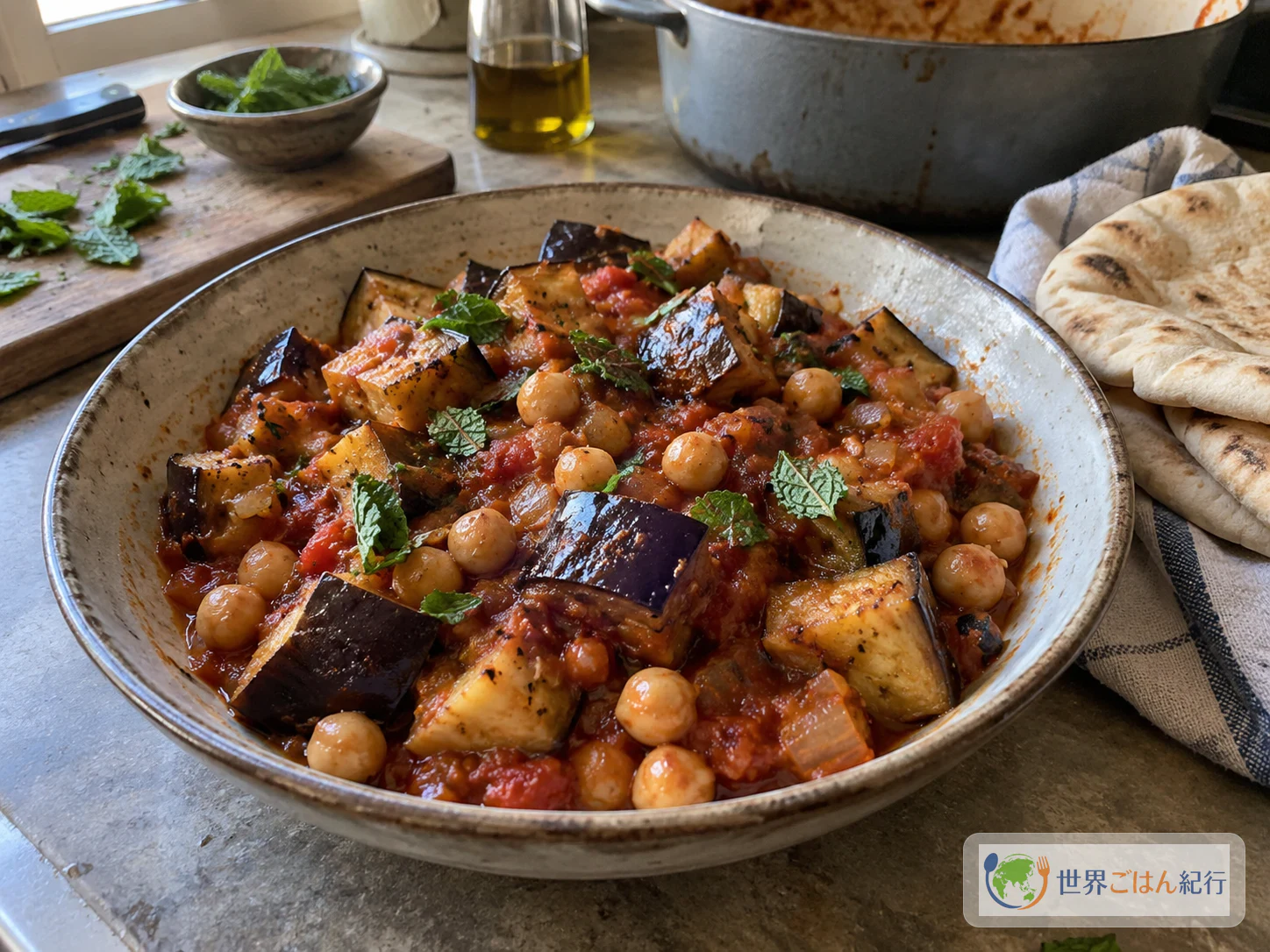
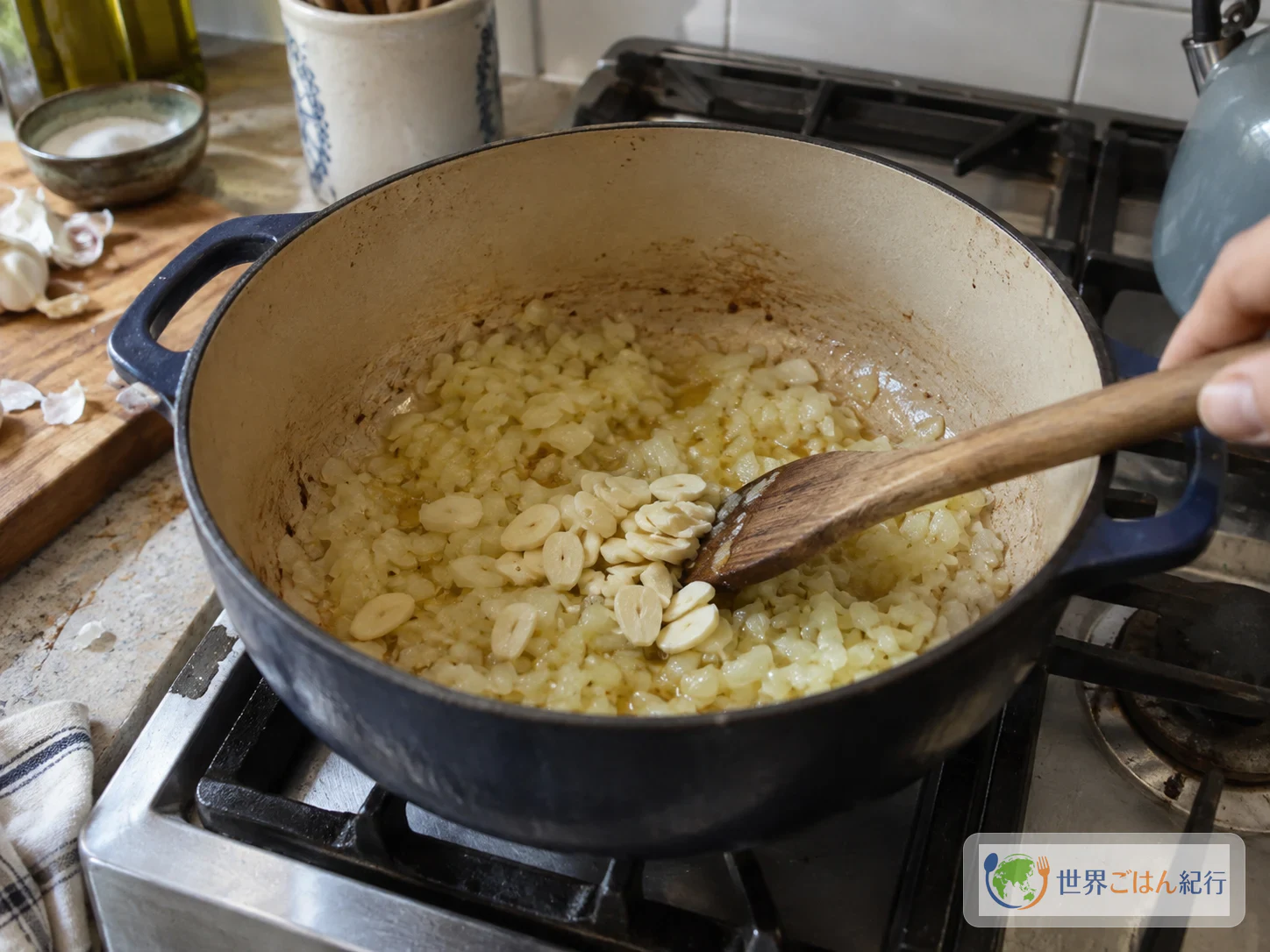
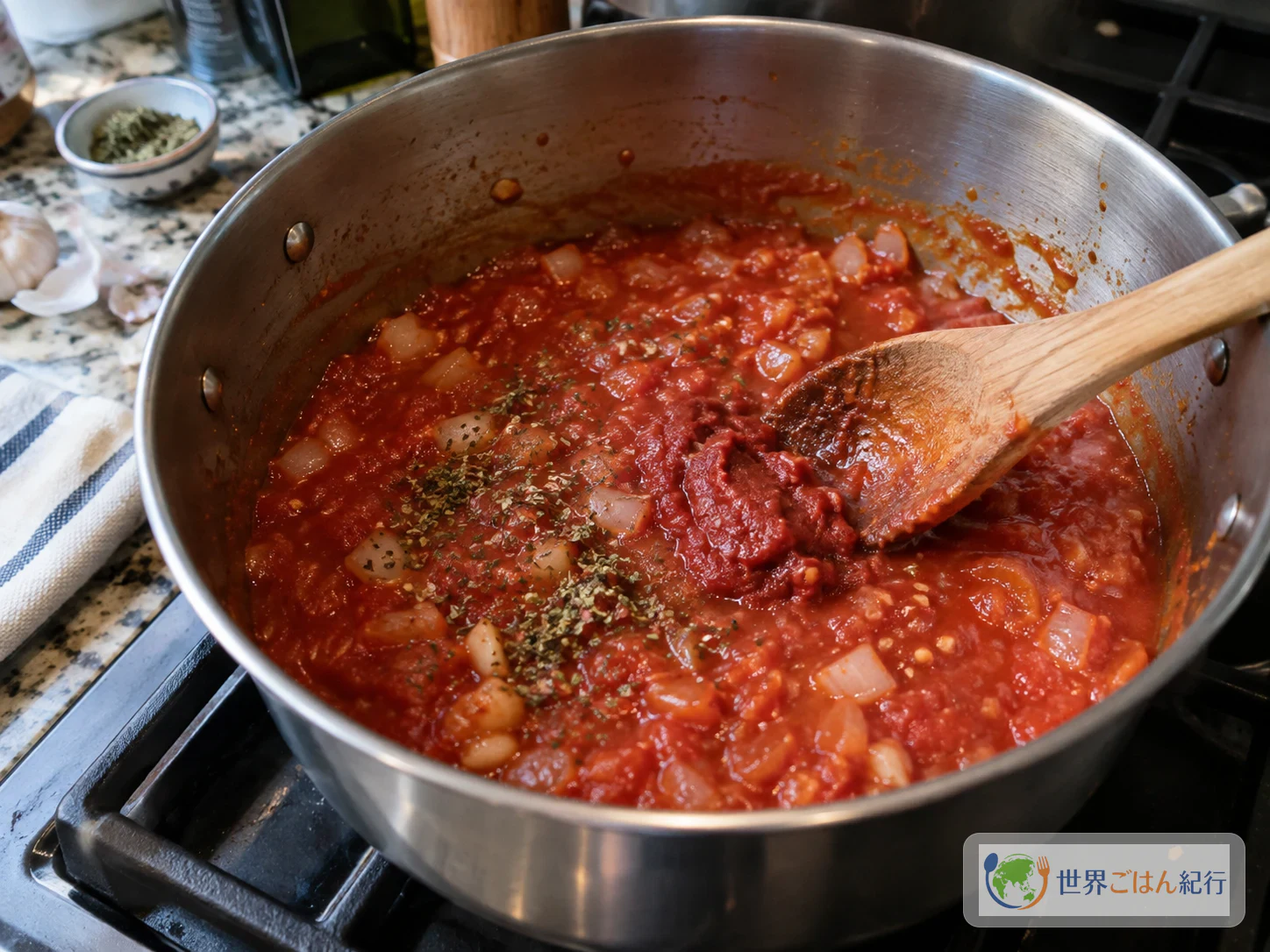
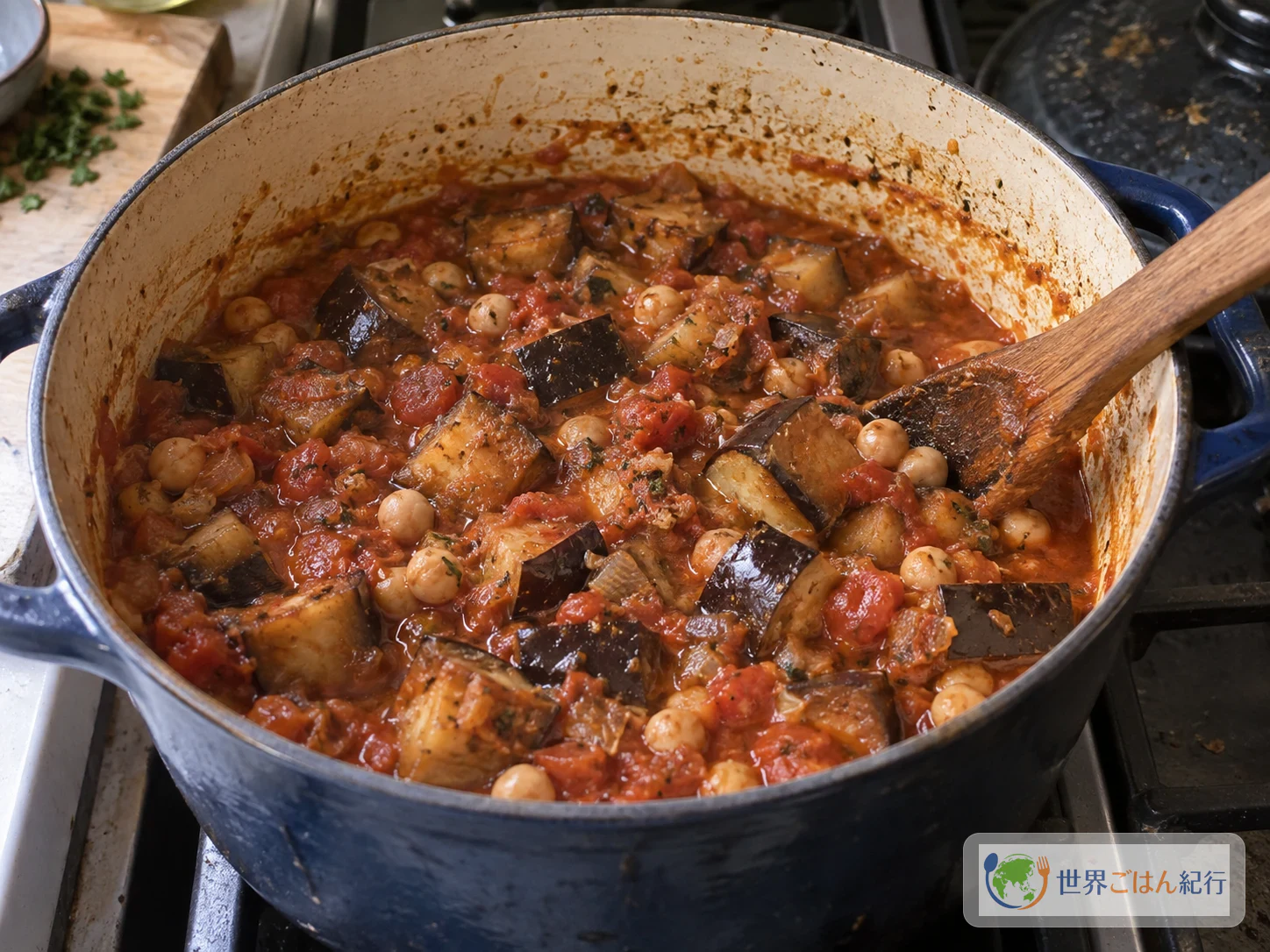
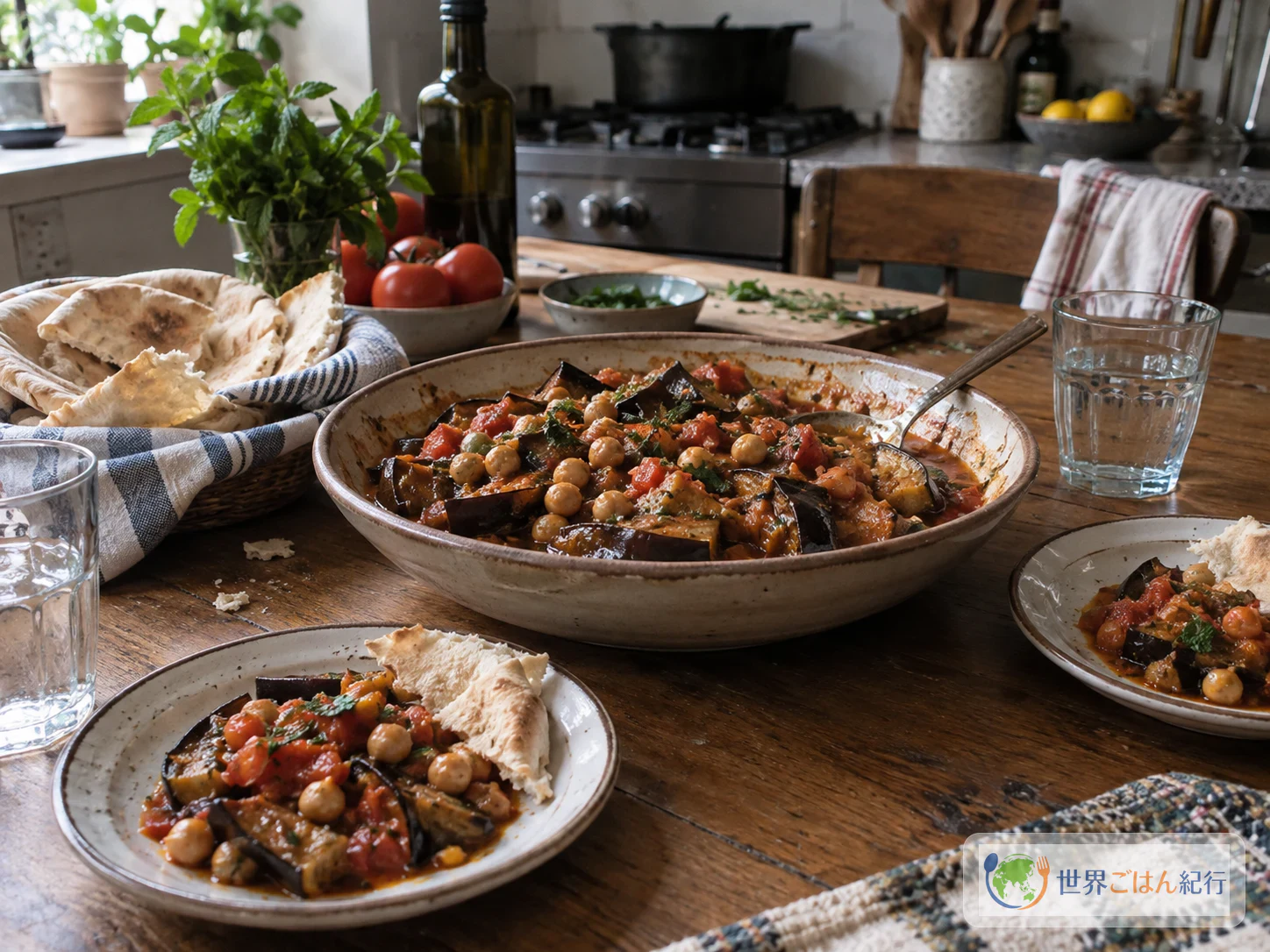
Tear off a piece of pita with your hand and scoop up soft eggplant sunk in red tomato sauce, along with a few round chickpeas. Maghmour begins with that gesture, one often pictured at a Lebanese table. It is a plant-based stew built on eggplant, chickpeas and tomato, loved as a stew you scoop up with bread.
It is also called Lebanese moussaka, but the result is entirely different from the usual Greek dish of meat and béchamel layered and baked. This article gives a version adjusted for home cooks: roasting the eggplant first, and with canned chickpeas it is done in about 60 minutes. Soaking and pre-boiling dried beans are not included in that time. It uses no beef or dairy, and is a dish for enjoying the softness of the eggplant, the whole chickpeas and a garlicky sauce.
At the Lebanese table, moussaka is scooped up with bread
Maghmour is presented as one of the mezze and is eaten with pita. It is a plate of mezze: a starter shared among several people, or, with bread alongside, a meal in itself. A tomato sauce with garlic and onion is combined with eggplant and chickpeas that were cooked first. A bite of eggplant alone and a bite with chickpeas added differ in texture. With no rice to cook and no meat to prepare, it is easy to bring to any kitchen: a single pot and bread set the table.
There is a story about the labor of beans that is handed down in home kitchens. Lebanese cook Hadia Zebib describes, as a method passed on from her mother and grandmother, peeling the skins from soaked chickpeas before using them. But this is Hadia's household method, not a rule common across all of Lebanon. The same author also accepts canned chickpeas when time is short. Take the trouble to peel, or borrow the convenience of the can: everyday cooking offers many choices in between.
It is a dish with a range of serving temperatures: warm, near room temperature, or cold from the refrigerator. It can also be a cold starter, but that doesn't mean the pot can sit at room temperature for long. Storage is covered in a later section. Making tomato a sauce for an eggplant and bean dish rather than a meat sauce is what gives this dish its character.
In parts of Lebanon the name maghmour is used, and it is also written Lebanese Moussaka. Even under the same name "moussaka," dishes around the Mediterranean take many forms. The Greek version is a dish of eggplant and a meat sauce layered with béchamel and baked, whereas maghmour is a pot dish in which eggplant and beans are stewed in tomato sauce, and the structure is entirely different. Because the exact place and era of origin and the order in which it spread from country to country cannot be confirmed, I don't assert them here. Nor can the etymology of the name be told as settled history.
Differences between households show in how the eggplant is cooked and scented
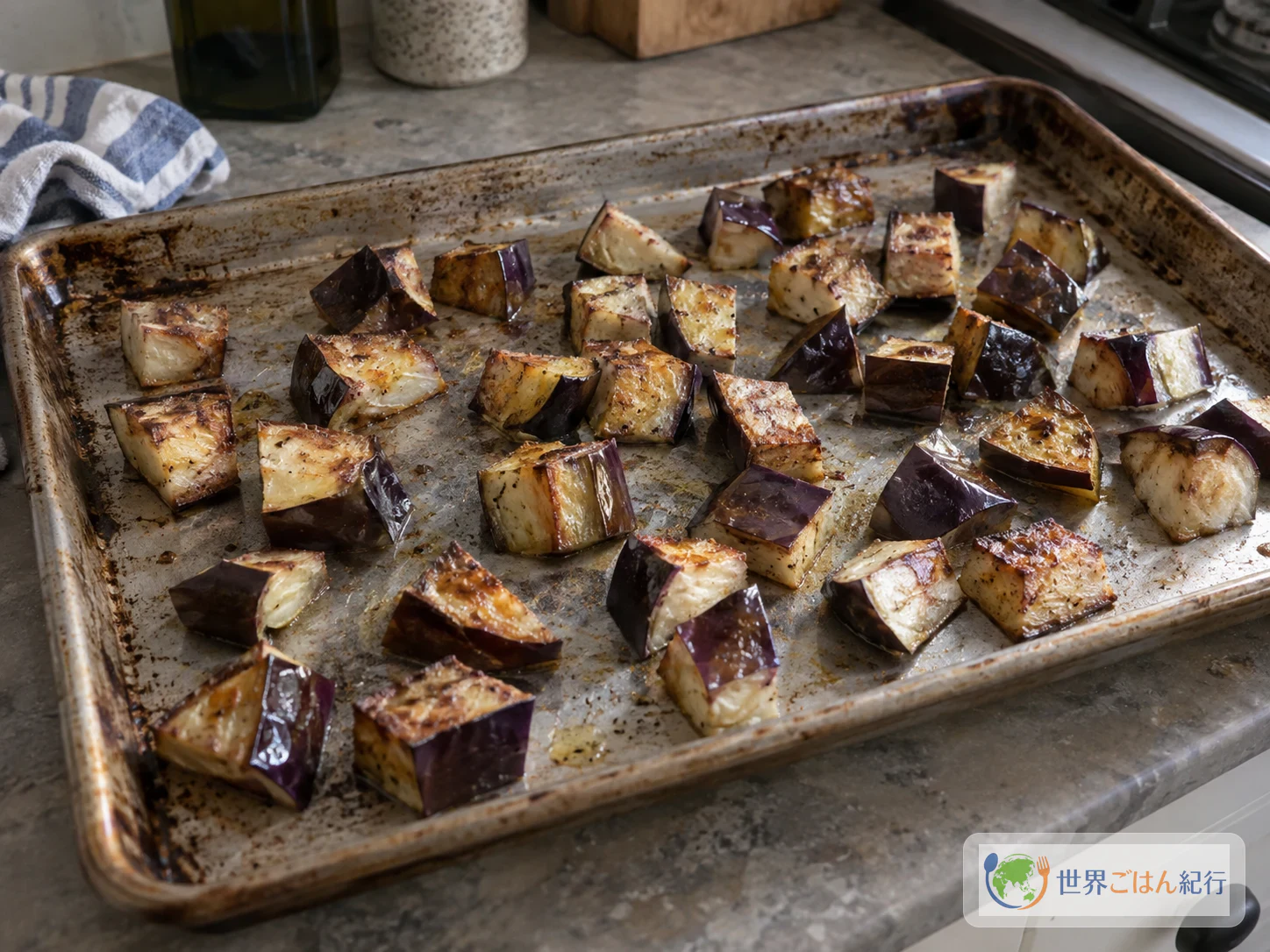
How eggplant is handled differs from household to household. There is a method of frying it first and then stewing, and others that bake it in the oven or an air fryer to keep the amount of oil manageable. When roasting, coat the surface with oil, spread it in one layer and bring up the color. There is also an easy variation of putting raw eggplant straight into the sauce, but it won't have the same toasty browning. Although there are households that fry and households that roast, no source draws a clear line between frying and roasting by region, so I avoid classifying it as a difference between countries or cities.
There is no single right answer to how it is scented either. Hadia's household recipe includes dried mint, whereas Simply Lebanese's recipe centers on onion, garlic, tomato and black pepper, and mint is not among its ingredients. Masala Herb's one-pot variation lists za'atar and pomegranate molasses as optional ingredients, but these cannot be treated as the traditional blend across all of Lebanon. At home, first try the basic eggplant, beans and tomato. After that, mint is a household choice, and one option is to add 1 tsp dried mint. It can be made without mint, and it is not a dish you cannot make unless you have a particular spice.
In maghmour the chickpeas keep their shape. Unlike hummus, they aren't meant to be mashed smooth, so there is no need to cook them down. Canned chickpeas should be soft enough to crush with a finger, but still hold as grains in the pot. The difference from dishes that mash the same beans lies in the finished texture and how it is eaten.
| Item compared | Basic maghmour | Options in a home kitchen |
|---|---|---|
| Eggplant | Fried first, or roasted, then into the sauce | Roast at 200°C (400°F) for about 25 to 30 minutes |
| Chickpeas | Dried beans pre-boiled, or canned | Drain canned and use 250 g |
| Aroma | Garlic, and dried mint in some households | Start with 1 tsp mint; it can be made without |
| Sauce | Tomato and onion, tomato paste | Chop fresh tomatoes; if substituting, unsalted canned tomatoes |
| Serving temperature | Warm, near room temperature, or chilled | Store a cold dish in the refrigerator and take out only what you will eat |
Ingredients (serves 4)
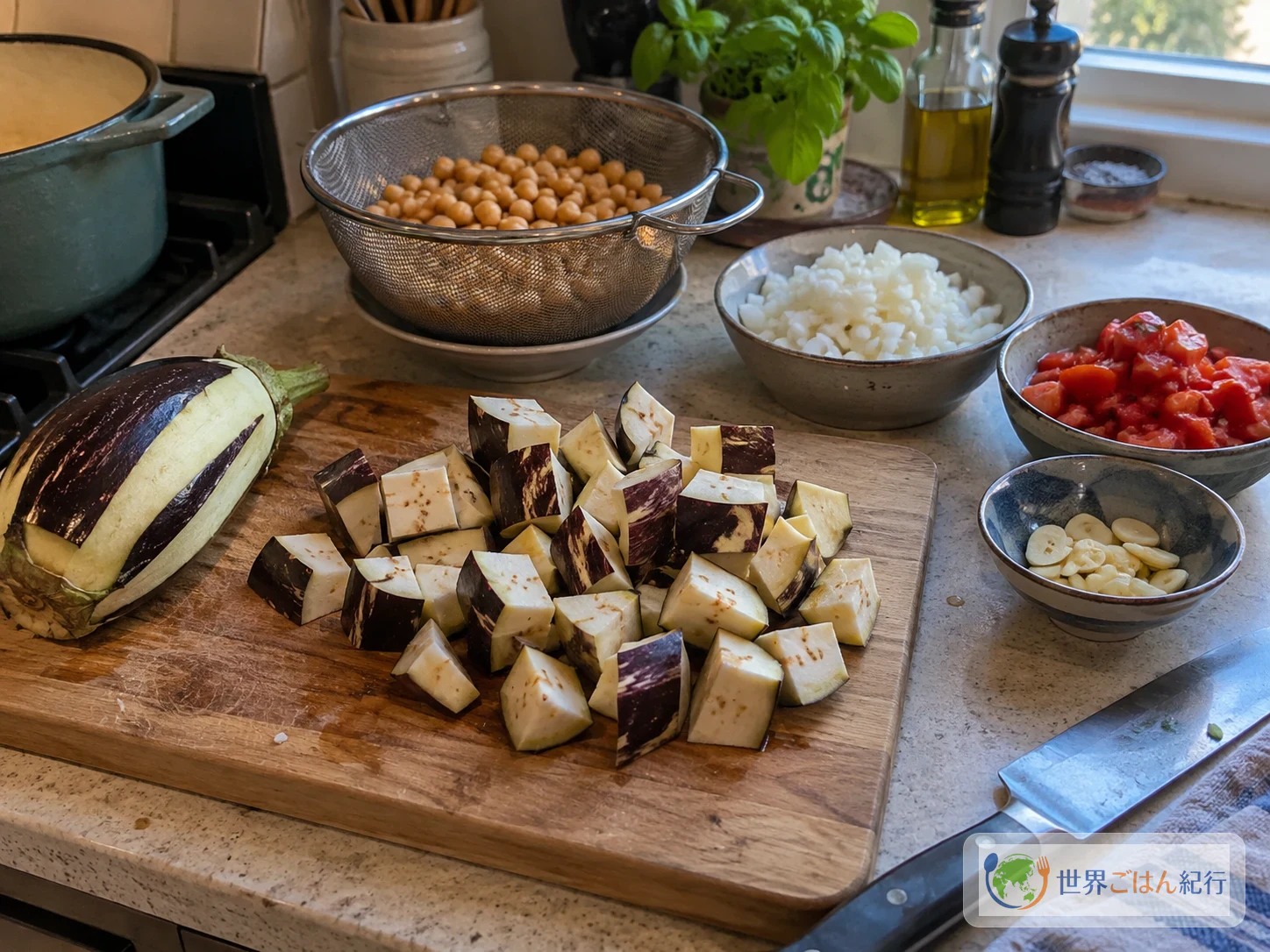
This is the amount for 4 people with bread alongside. For a starter, you can increase the number of people and share it out. The 250 g of chickpeas is the weight after draining, not 250 g of dried beans. Measure 250 g after draining. For the eggplant, measure so that even small varieties add up to about 500 g in total. Don't substitute by the number of eggplants alone.
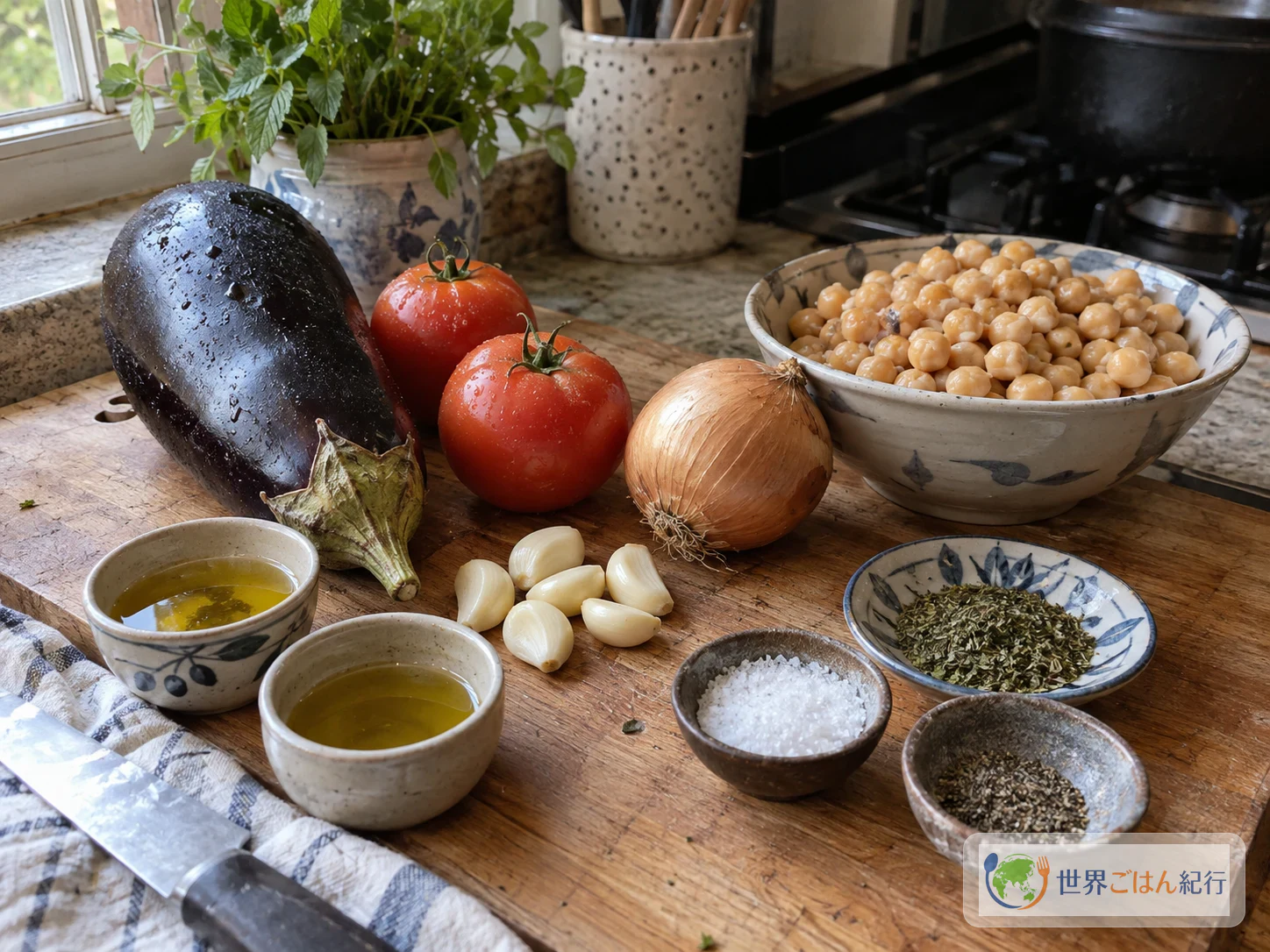
To finish in about 60 minutes on the day, canned chickpeas are the easy choice. Check the ingredients and the salt on the label before draining. With dried chickpeas, starting from about 100 g is a guide, but the weight after soaking is not fixed, so measure 250 g after pre-boiling. Soak dried beans as the package instructs and pre-boil them thoroughly, so that the beans are soft first before they go into the stew. Do not finish dried beans by cooking them directly in the tomato sauce. The soaking and pre-boiling time are not included in the stated cooking time.
When shopping, only choosing the chickpeas takes a little thought. Compare the convenience of canned with the ability to adjust the amount with dried. If you can't find them at a supermarket, you can search online by the generic name. Garlic, onion, eggplant, tomato and the oil you normally use can be had on an ordinary shopping trip. You don't need a special pot. For dried mint, choose leaves meant for cooking, and don't substitute sweetened drinks or mint flavoring.
Method
Plan on about 15 minutes of prep and 45 minutes of cooking, about 60 minutes in all. It varies with oven preheating and equipment. Preheat the oven to 200°C (400°F) and make the sauce while the eggplant roasts, so the sauce and the eggplant are cooked in parallel. Until the eggplant is done, you can wait while the beans simmer in the sauce. Roast the eggplant until the center is soft, add it right before finishing, and don't stir hard.
Each eggplant differs in moisture and how it is cut, and the oven time changes with that. Look not only at the browning but at how a skewer goes in. If the outside is browned but the center is firm, don't add more color; cover with aluminum foil and keep heating. If the center is softened in the roasting, there is no worry about overcooking it in the final pot.
If you use 300 g unsalted canned tomatoes with their juice instead of fresh, reducing the first water to 180 ml is a home-cook's guide. After that, add water as you watch the state of the pot. Fresh tomatoes and canned ones do not have the same moisture. Also, 45 g of ketchup with sugar or spices is not a substitute for 45 g unsalted tomato paste.
Getting the aroma and texture close in a home kitchen
The slender eggplants commonly sold in Japan will also work for this dish. Match the weight and leave the skin in stripes, and the soft flesh is easier to handle. Peeling all the skin makes it softer in the mouth, but it falls apart more easily when mixed at the end. If a thick skin bothers you, widen the peeled area. Rather than fixating on the count or a rare variety, value the cooked flesh and the shape you keep.
For dried mint, rub the leaves between your fingers and add them to the sauce. Starting with 1 tsp to add aroma is a modest home starting amount, not a nationwide standard. If using fresh mint, one idea is to add about 5 to 6 chopped leaves at the end. Don't swap it by equal weight with dried mint. Without mint, leave it out and make it on the flavor of garlic and tomato. Replacing it with basil makes a dish with a different aroma. Do not put mint flavoring, sweetened tea or toothpaste-type products into the food.
The basic blend uses 60 ml oil for the eggplant and 60 ml for the sauce. It is not a blend with separate frying oil. If you want to cut the oil, there is a home-cook idea of trying 30 ml for the eggplant and 30 ml for the sauce, lining the baking sheet with parchment. The browning of the surface and the moist feel of the oil will differ from the basic recipe, and it can't be said to give the same result or the same nutrition values. For sticking on the bottom of the pot, lower the heat and add a little water. Do not keep pouring oil on raw eggplant afterward.
Bring bread, and one dish widens into a meal
Warm the pita, tear it, and eat it by scooping up the eggplant and beans together. It is not a soup you just drink the liquid of. If you have no pita, one home idea is to serve baguette or your usual bread. It can also go with steamed rice, though that is not the same as the local way of eating. To aim for a full meal from one dish, serve a staple alongside; as a starter, divide it into small portions.
You can extend to other dishes that use the same beans and eggplant. Sending leftover beans or eggplant into another dish: if you want the beans as a smooth dip, hummus is the next dish; if you want another taste of eggplant, baba ghanoush.
- How to make hummus, smoothly mashed chickpeas (in Japanese)
- How to make baba ghanoush with roasted eggplant (in Japanese)
Five variations to suit your taste
| What you want to change | Home-cook variation | Difference from the basic recipe |
|---|---|---|
| Use less oil | 30 ml each for the eggplant and the sauce | The moist feel of the oil and the browning change |
| Add aroma | Add 1 tsp dried mint | The scent of mint overlays the garlic and tomato |
| Finish with fresh herbs | Chop 5 to 6 fresh mint leaves and add at the end | The aroma comes out differently from simmered dried mint |
| Make it a little hot | Add 1/4 tsp chili flakes to the sauce | Adds heat; leave out for children, etc. |
| No tomatoes on hand | Start with 300 g unsalted canned tomatoes and 180 ml first water | Reduce while watching the moisture, add water if needed |
Storage and reheating
Even when you eat it as a cold starter, after cooking divide it into shallow, clean containers and refrigerate quickly in shallow containers. Don't leave cooked food out unrefrigerated for more than 2 hours, and in an environment above 32°C (90°F), refrigerate within 1 hour. The guide is a refrigerator at 4°C (40°F) or below and a freezer at -18°C (0°F) or below. Leaving the pot in the kitchen overnight to let the flavors meld is not recommended.
| Storage method | Guide | Handling before eating |
|---|---|---|
| Refrigerator (4°C / 40°F or below) | General guide for vegetable stews is 3 to 4 days; at home, eat it up early | Take out only what you will eat with a clean utensil |
| Freezer (-18°C / 0°F or below) | Quality guide for vegetable stews is 2 to 3 months | Thaw in the refrigerator; eggplant tends to fall apart after thawing |
| Serving as a cold starter | Take it from the refrigerator just before eating | Don't leave it out on the table for a long time |
When reheating, in a microwave stir partway, and heat thoroughly so that the center reaches 74°C (165°F) or higher. Make sure the whole container heats evenly. In a pot, take only the amount you will eat, and there is a home idea of warming it over low heat while adding 1 to 2 tbsp water at a time to a sauce that has stiffened. Turn it over widely so the eggplant isn't crushed. Don't judge the safety of storage by appearance or smell alone.
People with a legume allergy should not use chickpeas. Individual allergies to ingredients other than beans also need attention. Pita contains wheat. Check the ingredients and allergen labeling of store-bought bread, canned beans and tomato paste. That it is a plant-based stew doesn't mean that no one has an allergy to it.
Common failures and questions
What if the eggplant falls apart?
Eggplant cut too small or stewed too long falls apart easily and won't return to its original cubes. Don't stir any more; turn off the heat. Served as a dish to scoop up with bread together with the sauce, it is still good to eat. Next time, cut the eggplant to about 3 cm (1 1/4 in), roast it, and combine the eggplant last, putting it in the sauce for only the last 5 to 7 minutes.
Why are the beans still hard?
Dried beans are not finished by soaking alone. They must be pre-boiled until soft in the center before they go into the tomato sauce. Before adding them, split one and check the center. Follow the product's soaking and heating instructions first. The time also varies with the age of the beans and so on. Start with canned beans and you can skip the pre-boiling. They don't need to be cooked until completely mashed, as for hummus.
What if it is watery or has a lot of oil?
If watery, take off the lid and reduce over low heat for 3 to 5 minutes. The guide is that when a spatula is drawn across the bottom the liquid returns slowly. If a lot of oil floats on top, turn off the heat, let it settle a little and spoon off just the surface. Adding water doesn't reduce the oil. Fix the water and the oil separately is the knack. Next time there is the idea of cutting the oil to 30 ml each, but the taste and texture will change.
What if I have no oven?
As a home alternative, divide the 60 ml of eggplant oil over several batches and pan-roast the eggplant in a skillet over medium heat without overlapping. Plan on 10 to 15 minutes per batch, turning, and check both the browning and the softness that a skewer goes through. It varies with the size and the skillet. If the center is firm, cover and cook a few more minutes over low heat. The order of adding the roasted eggplant to the sauce is the same. Because of the batches, the total cooking time lengthens. You don't need to buy a new appliance.
Can I add meat or cheese?
The basic dish is a plant-based stew of eggplant, chickpeas and tomato. Adding meat or cheese cannot be presented as a common local blend. It becomes something different from this dish, which keeps the texture of the beans and eggplant. If you want a layered bake of meat and béchamel, a Greek moussaka recipe is your next dish.
Nutrition guide
The values are approximations from the ingredients, calculated from ingredient values in the Standard Tables of Food Composition in Japan (8th revision), 2023 supplement, and are not an analysis of the finished dish. For the whole batch: about 1618 kcal, protein 36.3 g, fat 115.5 g, carbohydrate 130.3 g, fiber 49.4 g. Per serving when divided in four: about 405 kcal, protein 9.1 g, fat 28.9 g, carbohydrate 32.6 g, fiber 12.4 g.
The calculation used edible-portion weights, assumed unsalted boiled chickpeas, and took each 60 ml of oil as about 54 g. It assumes that all of the oil is eaten, it does not include the optional mint or chili or the small amount of black pepper, and please add the staple separately. Values change with the labeling of the products you use, the oil left on the baking sheet, and changes in amounts. If you halve the oil, both the texture and the values change.
Sources
- Hadia’s Lebanese Cuisine — Best Authentic Lebanese Moussaka (Maghmour Recipe) — Checked the household method of peeling the beans, dried mint, pre-roasting the eggplant and the name. Accessed and checked 8 October 2026.
- Simply Lebanese — Maghmour (Lebanese Moussaka) — Checked the mezze and bread way of eating, the method of boiling the beans first, and the step of combining the eggplant last. Accessed and checked 8 October 2026.
- Masala Herb — Lebanese Moussaka Stew (Maghmour) — Checked the one-pot home variation and examples of optional spices. Accessed and checked 8 October 2026.
- FoodSafety.gov — Cold Food Storage Chart — Checked the general guide to refrigerator and freezer temperatures and storage times for vegetable stews. Accessed and checked 8 October 2026.
- FoodSafety.gov — 4 Steps to Food Safety — Checked dividing for cooling, refrigerating within 2 hours, refrigerating within 1 hour in hot environments, and the microwave heating temperature. Accessed and checked 8 October 2026.
- MEXT Standard Tables of Food Composition database — Chickpeas — Used for the nutrition calculation of the ingredients. Accessed and checked 8 October 2026.
- MEXT Standard Tables of Food Composition database — Onion — Used for the nutrition calculation of the ingredients. Accessed and checked 8 October 2026.
- MEXT Standard Tables of Food Composition database — Tomato — Used for the nutrition calculation of the ingredients. Accessed and checked 8 October 2026.
- MEXT Standard Tables of Food Composition database — Garlic — Used for the nutrition calculation of the ingredients. Accessed and checked 8 October 2026.
- MEXT Standard Tables of Food Composition database — Olive oil — Used for the nutrition calculation of the ingredients. Accessed and checked 8 October 2026.
- MEXT Standard Tables of Food Composition database — Tomato paste — Used for the nutrition calculation of the ingredients. Accessed and checked 8 October 2026.
- MEXT Standard Tables of Food Composition database — Canola oil — Used for the nutrition calculation of the ingredients. Accessed and checked 8 October 2026.
- MEXT Standard Tables of Food Composition database — Eggplant — Used for the nutrition calculation of the ingredients. Accessed and checked 8 October 2026.