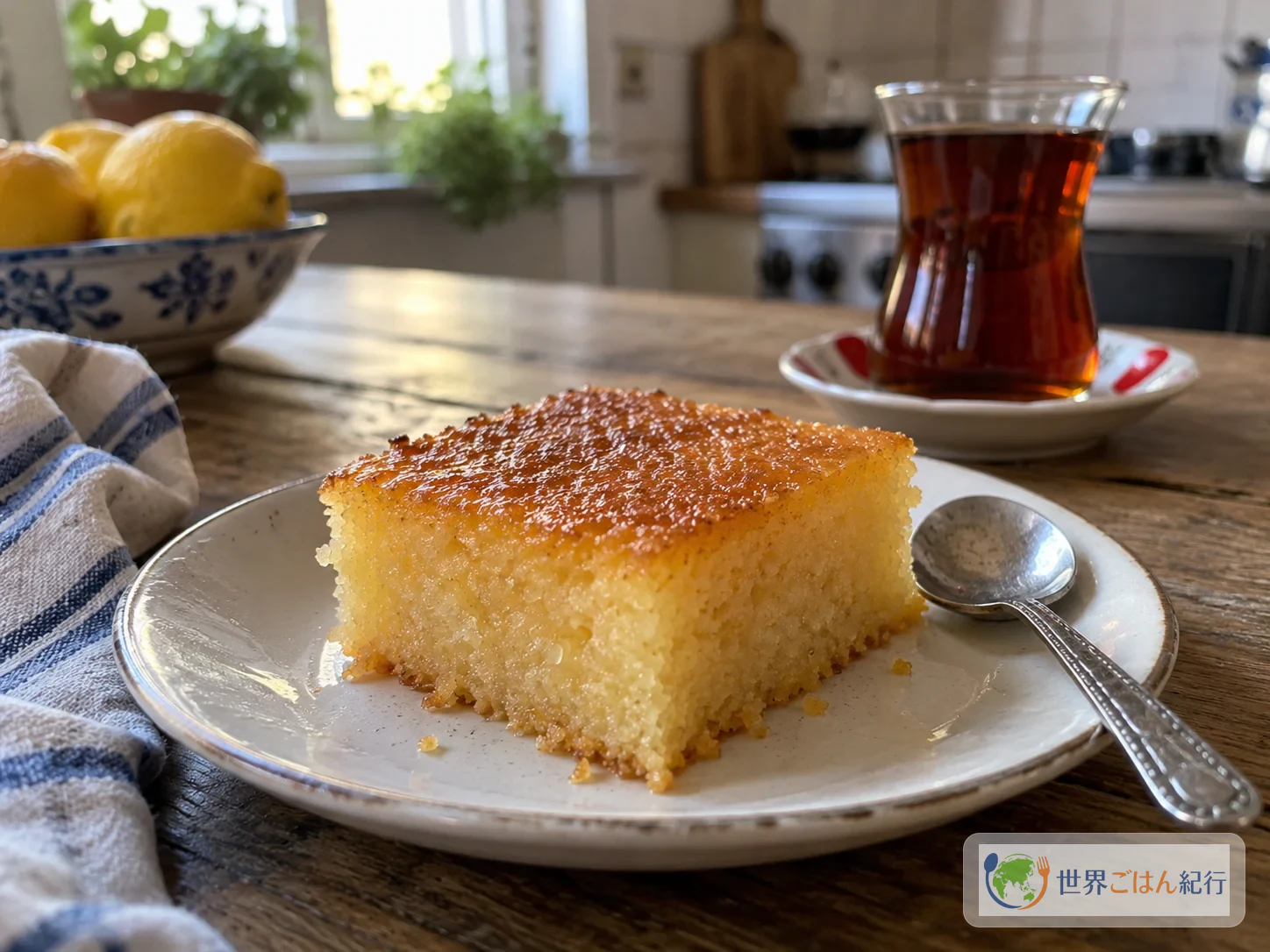
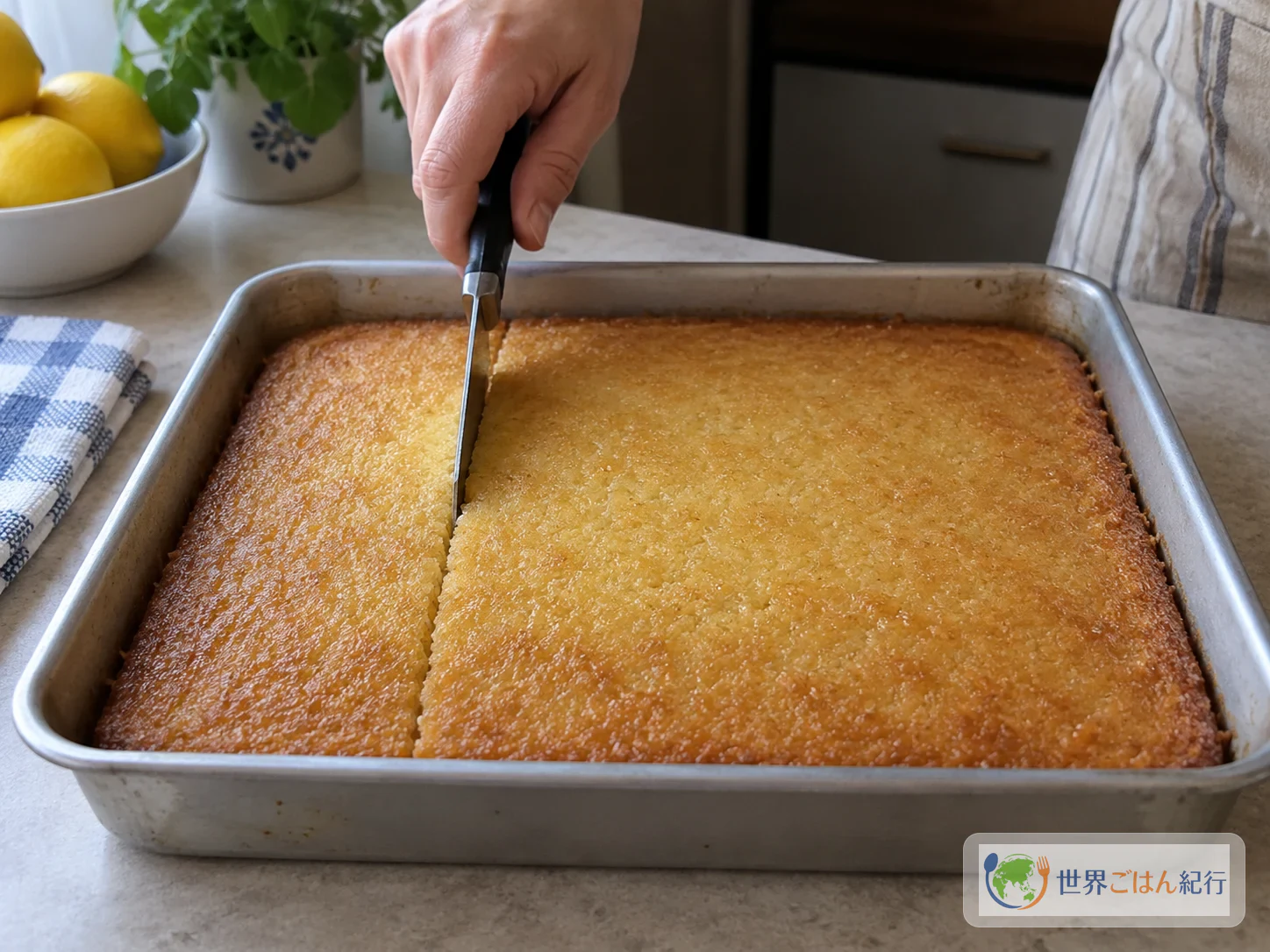
An afternoon in Turkey: a small tulip glass of steaming tea (çay) and a plate of cake with a golden top. Slide a knife in, and syrup slowly seeps from the yellow, slightly grainy crumb. Some people pair it with Turkish coffee instead. What fills your mouth on the first bite is the moist sweetness of a cake soaked in lemon syrup.
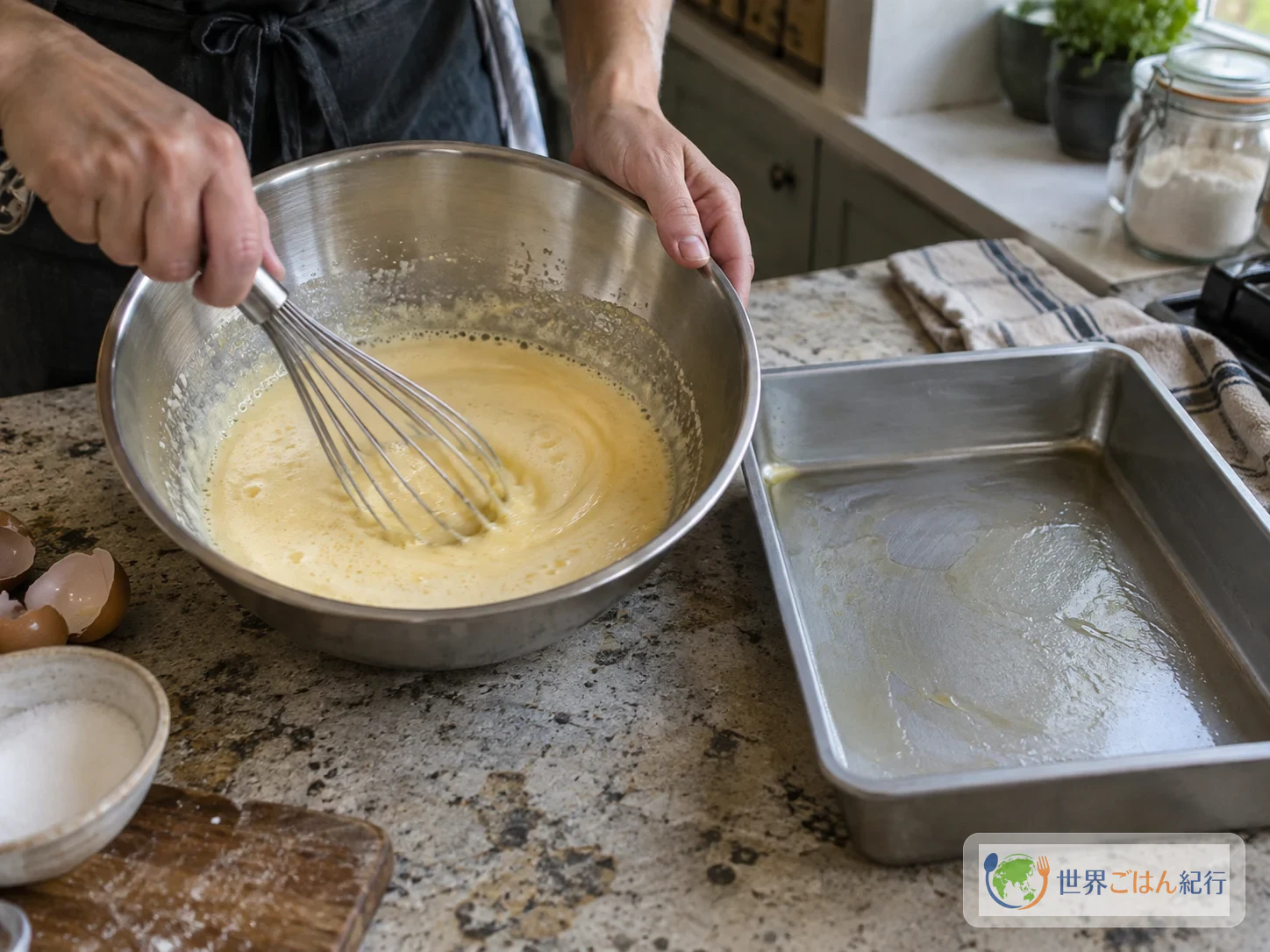
This cake is revani. It's a syrup-soaked dessert built on semolina, and the batter here also includes eggs and plain unsweetened yogurt. It isn't a cake you frost; it's only finished once it has absorbed syrup after baking. The keys are the texture of the semolina and the temperature of the syrup, and ordinary cake flour alone won't give you the same crumb. Warm cake, cooled syrup is the logic of this dessert. In a home kitchen, you'll need one shallow, ovenproof 20 × 27 cm (about 8 × 11 inch) pan without a removable bottom. It makes 12 pieces; baking takes 25–30 minutes, and even with about an hour for soaking and cooling, the whole thing takes about 2 hours 5 minutes.
From the Turkish table to a syrup cake that crosses borders
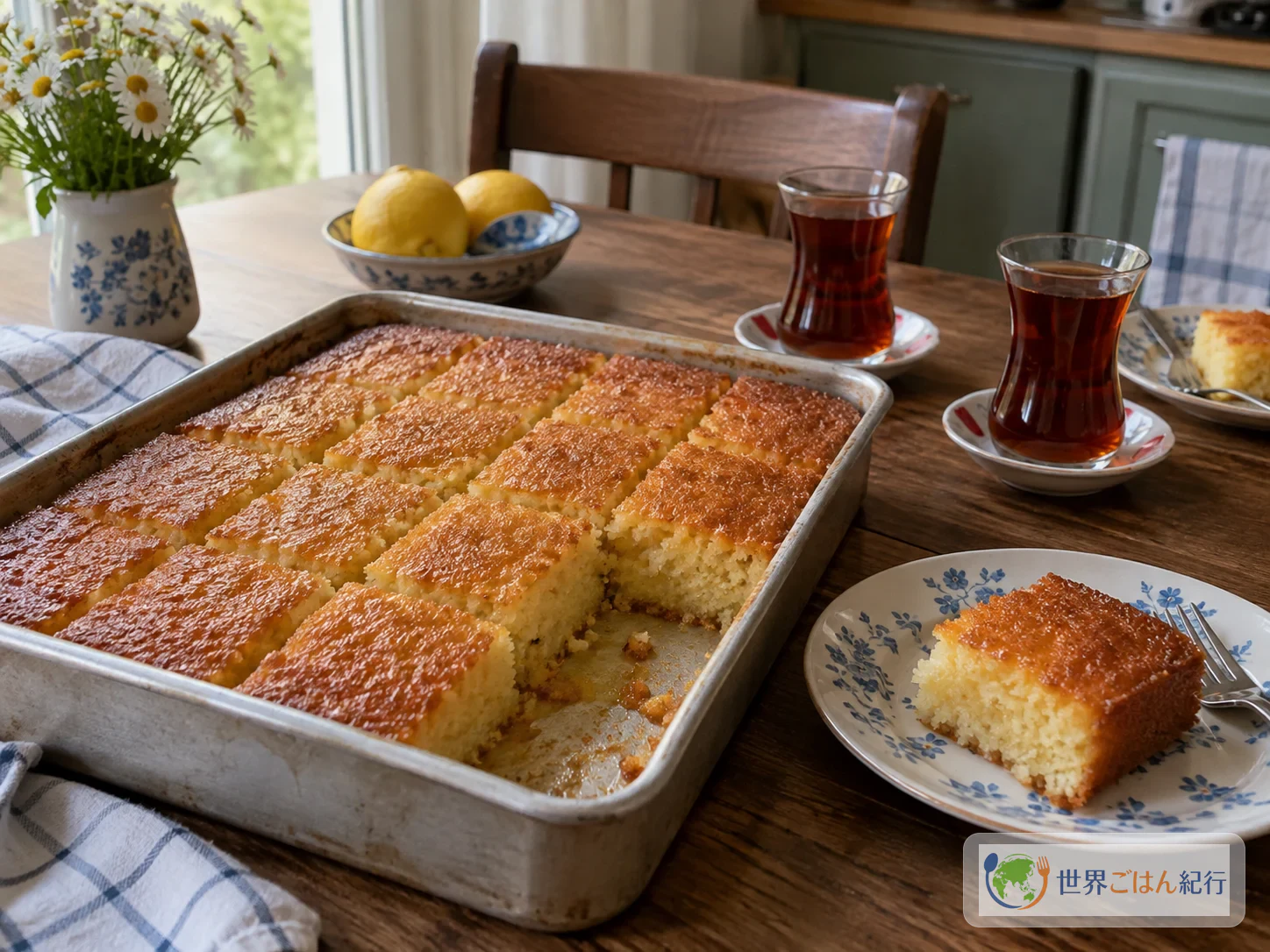
Turkey has a whole family of desserts in which a baked cake or pastry is soaked with syrup, and revani is one of them. It's baked in a single pan, cut into squares or diamonds and served on plates. The work and the cut surface are completely different from baklava, which stacks many thin sheets of pastry. As a syrup cake you cut and share, it shows up at afternoon tea at home and on the plate after a meal. It's eaten during Ramadan too, but it isn't a seasonal sweet reserved for that time.
Semolina, which keeps a fine grain, and the lift from the eggs form the framework, and the yogurt adds a gentle tang. That crumb is sturdy enough to take in a sweet liquid.
There are several explanations for the name. It's often described as a dessert loved since the Ottoman era, but neither the year of its origin nor its inventor could be established from the sources used here. Turkish cookbook author Ozlem Warren mentions a story that links the name to the conquest of Yerevan. Cooking Gorgeous adds another theory, that the name comes from the 16th-century poet Revânî. There's no need to choose; it's enough to know that two stories exist. In the kitchen, the aromas that change from home to home and the regional differences are the more interesting story.
Greece has a dessert called ravani or revani, too, and it's known as a specialty of Veria in the north. Cooking Gorgeous compares the Turkish style, which uses yogurt, with a Greek style that often leaves it out. On the other hand, the published recipe from the Greek food site 30 days of Greek food does include yogurt. So you can't decide whether there's yogurt based on the country alone. The differences are in the recipe, not the country, and they vary from family to family and recipe to recipe. It would also be hasty to assume that the Greek version always uses honey and the Turkish version always uses a floral aroma. Even within Turkey, some households use lemon and others orange, and the fat and the semolina grind vary as well. This recipe uses lemon and oil.
Egypt's basbousa also pairs semolina with syrup. This revani, however, is made with whipped eggs. Many basbousa recipes contain no eggs, and the texture differs from the rise of an egg-based revani (that's not to say basbousa is egg-free in every region). Rather than thinking of them as one dessert with two names, enjoy baking both and comparing the whipping, the grain and the aroma.
Besides lemon, some revani recipes are scented with orange zest, rose water or orange blossom water. Ground pistachios or coconut are sometimes scattered on top, but they're optional. The basic version here uses only lemon, with no nuts, floral water or coconut. Read the variations below separately from the base recipe.
The first thing to think about when shopping is the semolina. Semolina is made from durum wheat, and some of what's sold is labeled for pasta. Check the grind in the product description. In Turkish it's called irmik, which is a useful word when you're looking for it. For this home recipe, aim for something around a medium grind. Ozlem Warren's recipe uses coarse semolina and Cooking Gorgeous uses medium, so the grind alone doesn't decide whether it's authentic. A fine grind gives a smoother mouthfeel, while a coarse one gives a more pronounced grain. A different grind isn't something you make up for by extending the baking time. Check the semolina grind before you choose. Eggs, plain yogurt, sugar, lemons and cake flour are all ordinary supermarket items. For semolina, compare the options at baking-supply stores, Middle Eastern or Mediterranean grocers, or online.
Ingredients (12 pieces)
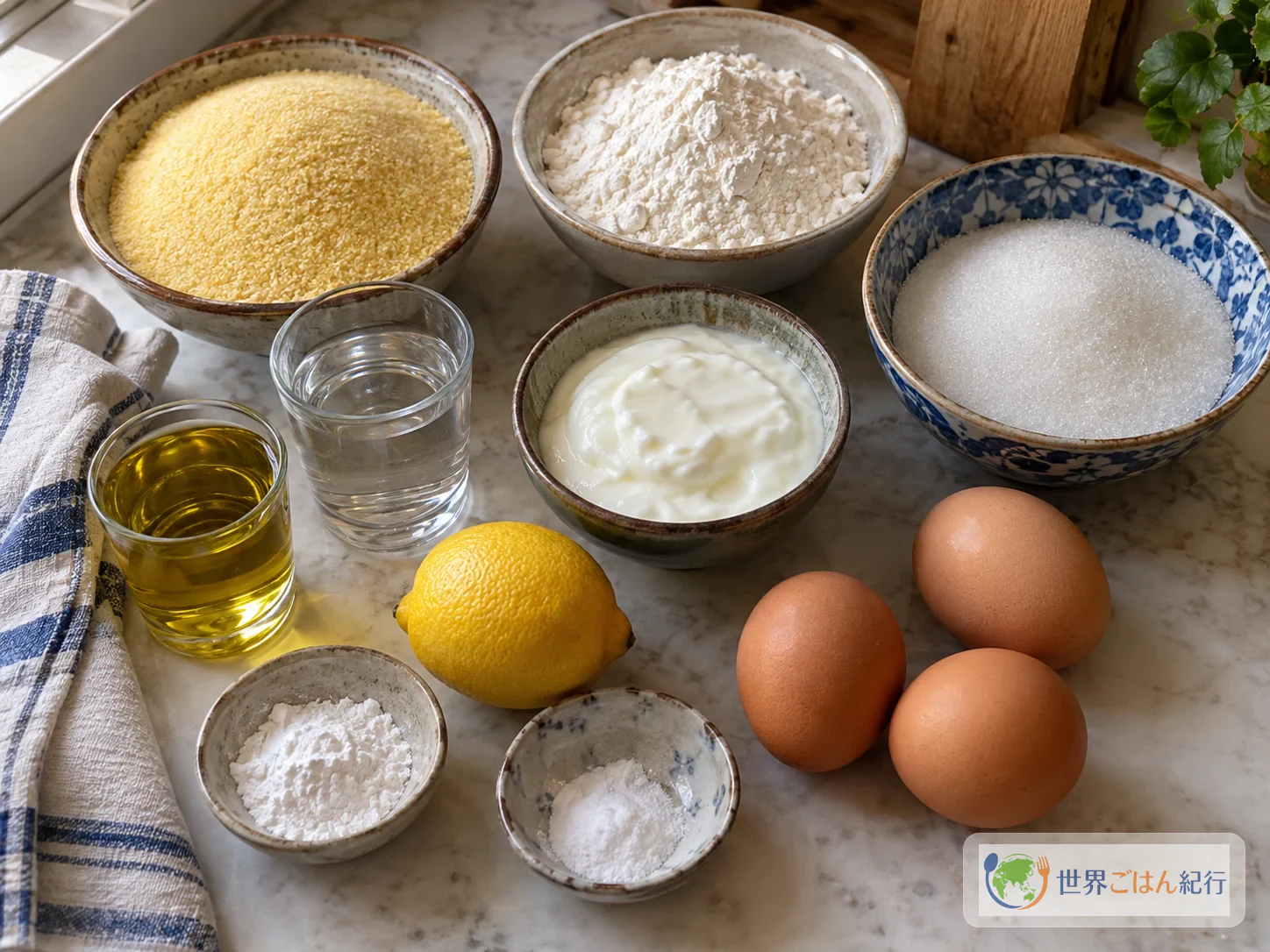
You'll need one ovenproof 20 × 27 cm pan, at least 4 cm (about 1 1/2 inches) deep, without a removable bottom. It yields about 12 pieces. Because cold syrup goes onto a hot pan, a metal pan is easiest to handle. The proportions have been adjusted for home baking. Split the granulated sugar into 200 g for the batter and 300 g for the syrup, and the oil into 30 ml for the batter and 30 ml for the pan. Keep the batter and syrup portions separate as you weigh everything out. The 25 g of cake flour is a weight conversion of the 3 tablespoons in the original recipe. Don't mix the oil and yogurt amounts with figures from other recipes. Timing: about 20 minutes to prepare the batter, about 15 minutes to cook the syrup, about 30 minutes to bake and about 1 hour to cool at the end.
Semolina is the only specialty ingredient you need. It gives the cake a grain you won't get from a sponge made with cake flour alone. Look for it under its generic name and check the grind, the intended use and the wheat labeling. One more point: for the plain unsweetened yogurt, don't pick a strained one. The moisture and thickness would change, so make it as written in the table first.
Semolina and cake flour contain wheat, the eggs are an egg allergen and the yogurt contains milk. This cake is not gluten-free. If you add pistachios or ice cream in the variations, check those allergen labels as well. Pans with removable bottoms tend to leak syrup, so choose a metal pan with a fixed bottom. Follow the manufacturer's instructions for your ovenproof pan's maximum temperature and handling.
If you bake the same batter in a 20 cm (8 inch) square pan, the smaller area makes the cake thicker. It won't necessarily bake through to the center in the same time. If you use a different pan, don't force a fixed time; decide on extra baking by whether a skewer inserted in the center comes out with wet batter. Use only pans without removable bottoms, and don't fill to the top; leave about half the height free.
Method
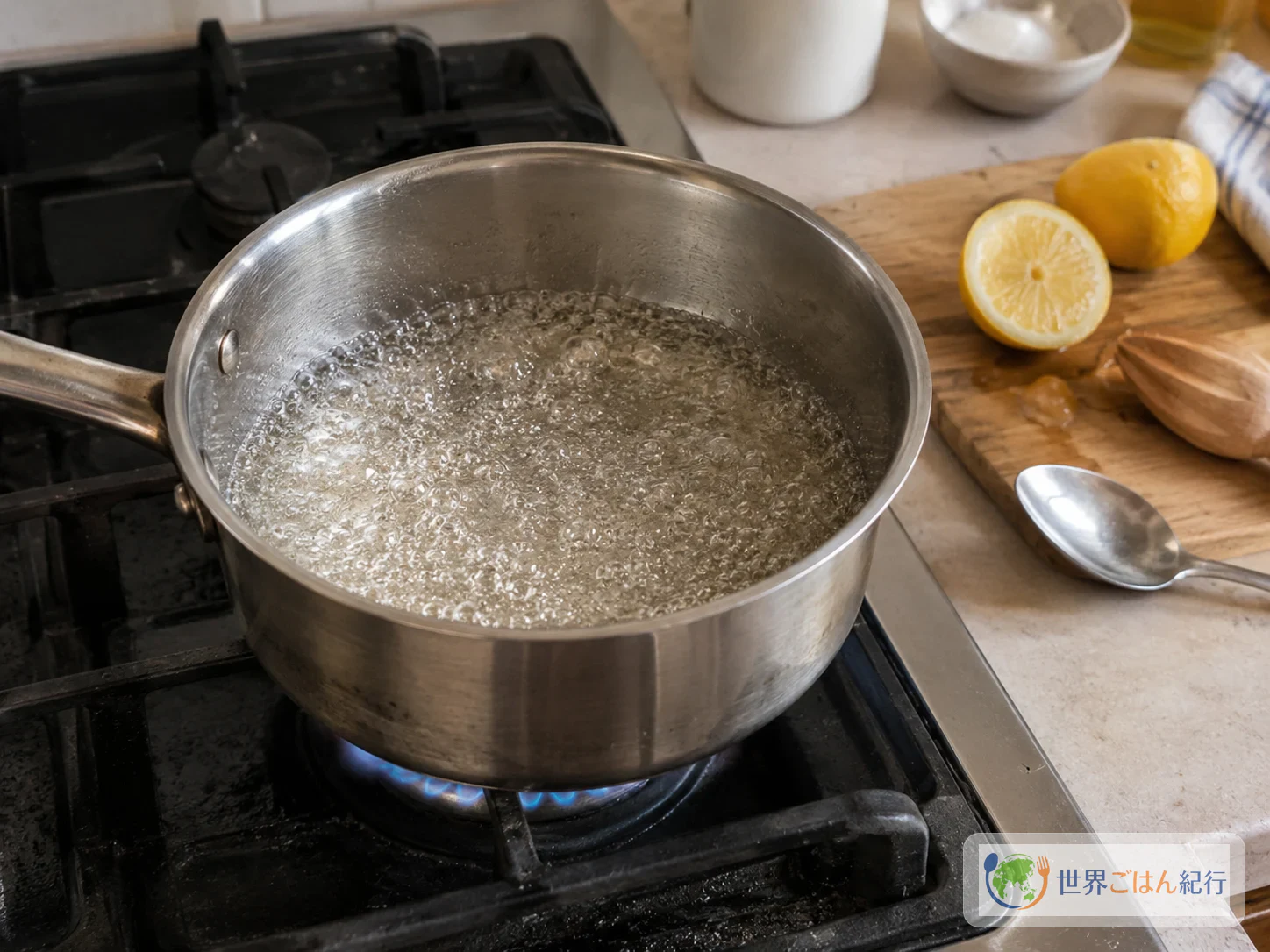
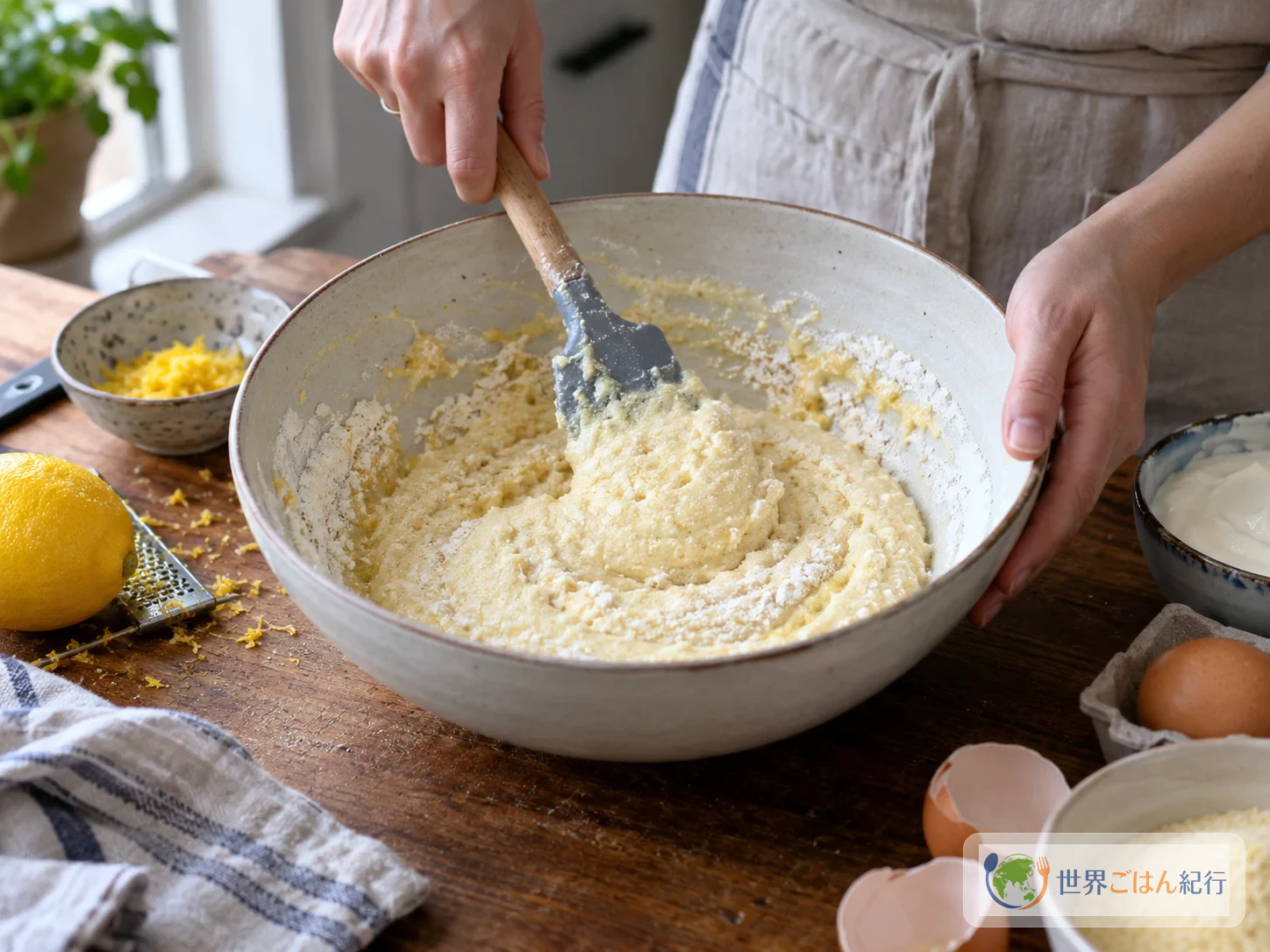
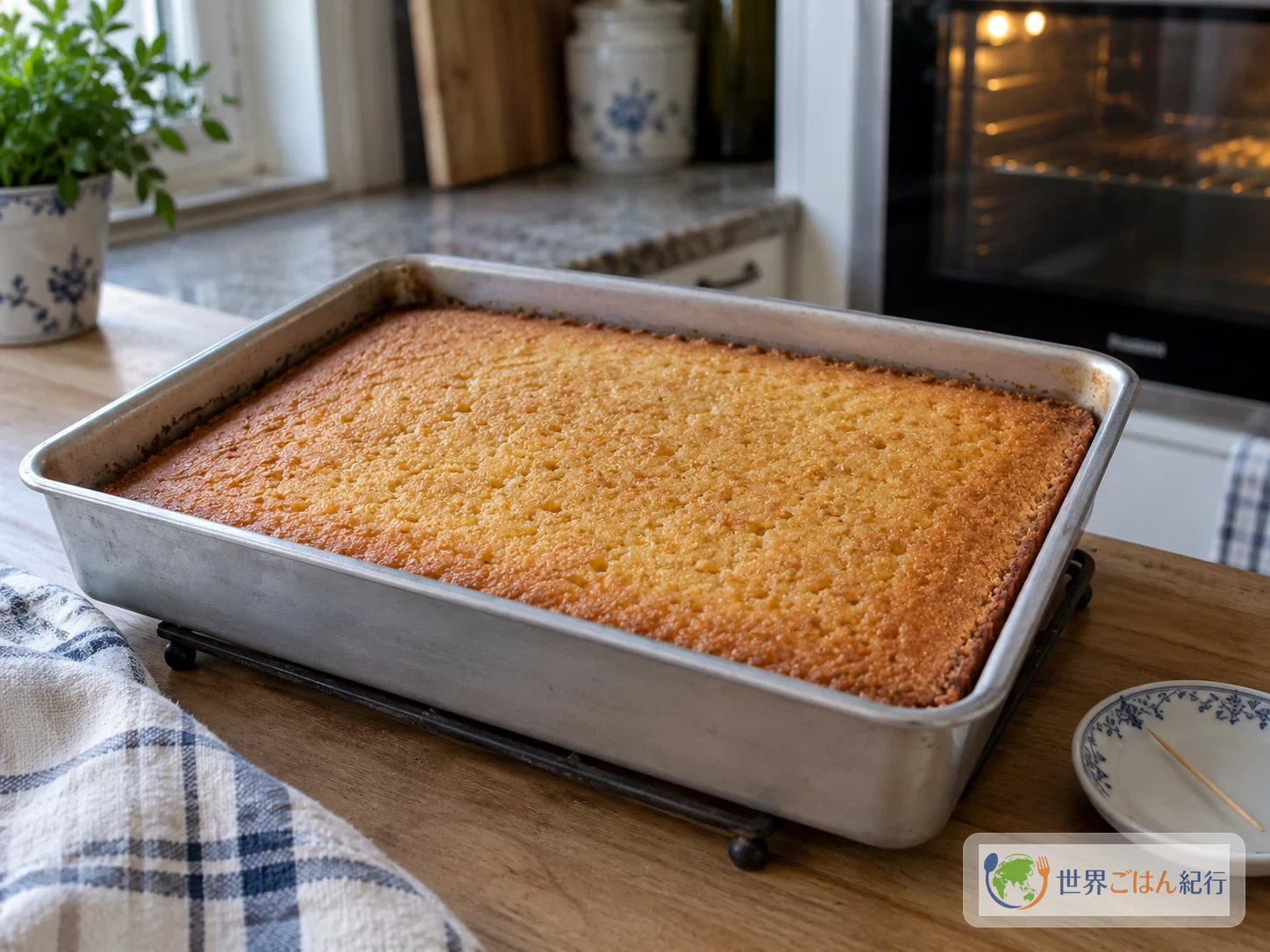
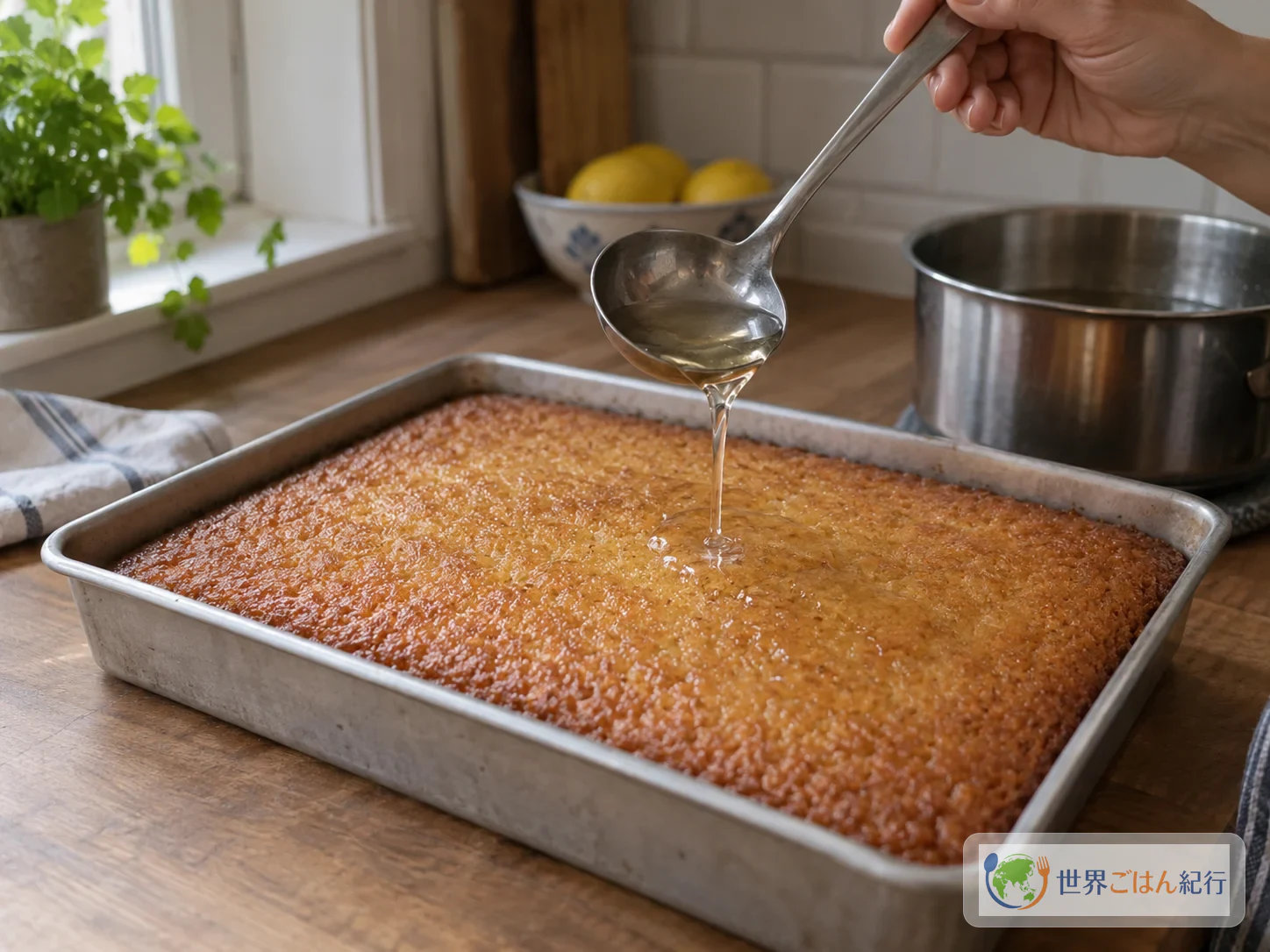
The key to the order is making the syrup first. While it simmers, prepare and bake the batter. Cooling the syrup first keeps you from the mistake of combining hot cake with hot syrup. Preheat the oven to 180°C (350°F) and bake on the middle rack. Browning and how fast the center cooks vary by oven, so keep an eye on it as it bakes.
Look for different things before and after baking. If raw batter remains in the center, don't hide it with syrup; bake it longer at the baking stage. If the baked cake is just dry, you can adjust it by how much syrup it absorbs. Syrup won't fix an underbaked cake. As for the temperature difference, don't fix it to one exact temperature; aim for warm cake and cooled syrup.
Even if you're worried about the sweetness, start with the base recipe and see how the syrup is absorbed. It's a sweet dessert, so one option is to cut smaller pieces and serve them with an unsweetened drink. If you cut the syrup drastically, you lose moisture along with the sweetness, and the cake dries out more easily. There's no guarantee that a different recipe with much less sugar will work. If you change the sweetness, expect the absorption and texture to change too.
Tell sogginess from dryness before you cut
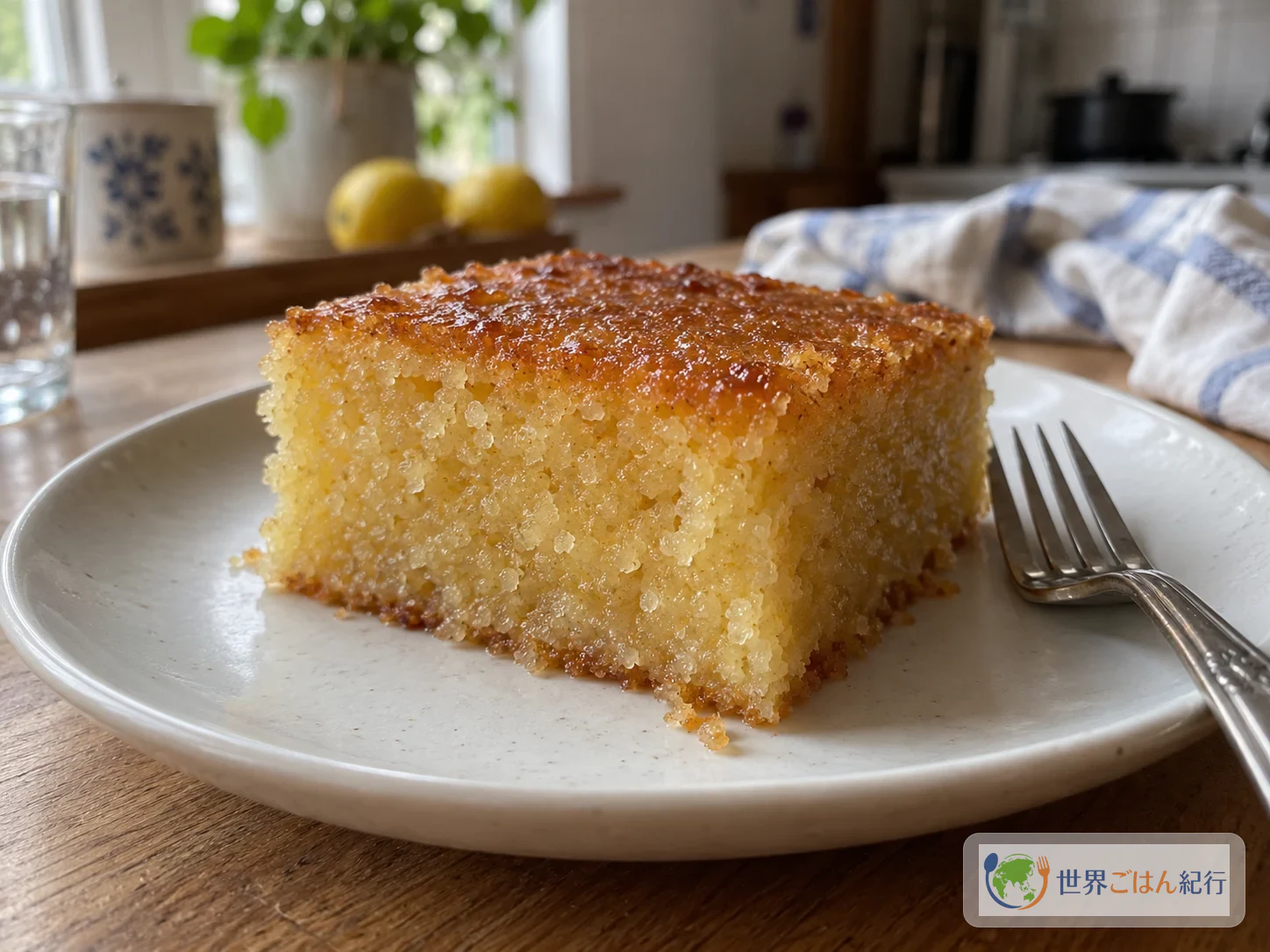
What you're aiming for is a top with a slight sheen and a crumb that's moist yet holds a square shape. Grains gently coming apart is different from the cake collapsing in liquid. Check the crumb after it cools: let it cool completely, then examine one piece. Don't call it a failure based only on how it looks right after the syrup goes on; wait for it to be absorbed. But don't wait at room temperature beyond the storage time limits.
| What happened | Possible cause | How to fix it / what to change next time |
|---|---|---|
| Syrup left at the bottom | Poured all at once, didn't wait long enough, wrong pan size | Stop adding. Let it settle in the refrigerator, and when serving, don't spoon the extra liquid onto plates |
| Cake is sticky and falls apart | Combined while both were hot, center not baked | Refrigerate and see if it firms up. If underbaked, don't eat it as is; next time check with a skewer while baking |
| Center dry, only edges sweet | Syrup poured only on the edges, overbaked | Add the reserved syrup a little at a time to dry areas. Don't pour plain water on it |
| Floury lumps | Flour not evenly mixed | Can't be remixed after baking. Next time combine the dry ingredients before adding them |
| Only the top browns darkly | Strong top heat, deep pan so the center heats slowly | Cover with foil during baking and check the center |
If the baked cake is a little dry, add some of the leftover syrup from this batch to the dry areas 1 tsp (5 ml) at a time, wait a few minutes and check. This is a guideline for home adjustment. Add it a little at a time. Adding a lot of liquid after the cake has already absorbed all the syrup makes only the outside soggy, and avoid pouring plain water on it. Sweetness can't cover up a burnt taste, floury lumps or obvious underbaking. Don't force yourself to treat a cake like that as edible.
Frequently asked questions
Can I replace the semolina with cake flour only? If you replace all of it, both the grain and the way it absorbs syrup change, and it won't be the same revani. Finely ground durum semolina leans toward a finer texture, but even though both come from wheat, it isn't the same as cake flour. Check the ingredients and grind on the package.
Should I strain the yogurt? The 225 g in the base recipe is regular plain unsweetened yogurt; no straining needed. Substituting the same weight of strained yogurt changes the moisture content. Don't add water or milk by guesswork; just use regular yogurt.
Is it spicy or floral? The base recipe contains no chile and no floral flavorings. The aromas are lemon and a little vanilla. Floral versions exist, but not every region's revani has that scent. If you don't care for floral notes, the basic lemon version is for you.
Can I make it the day before for guests? Once the syrup has soaked in, refrigerate it and it's ready for the next day's table. Carrying it around or leaving it out at room temperature for a long time on display is a different situation. Take out only what you'll eat and keep the rest refrigerated.
Serving with tea, and saving some for tomorrow
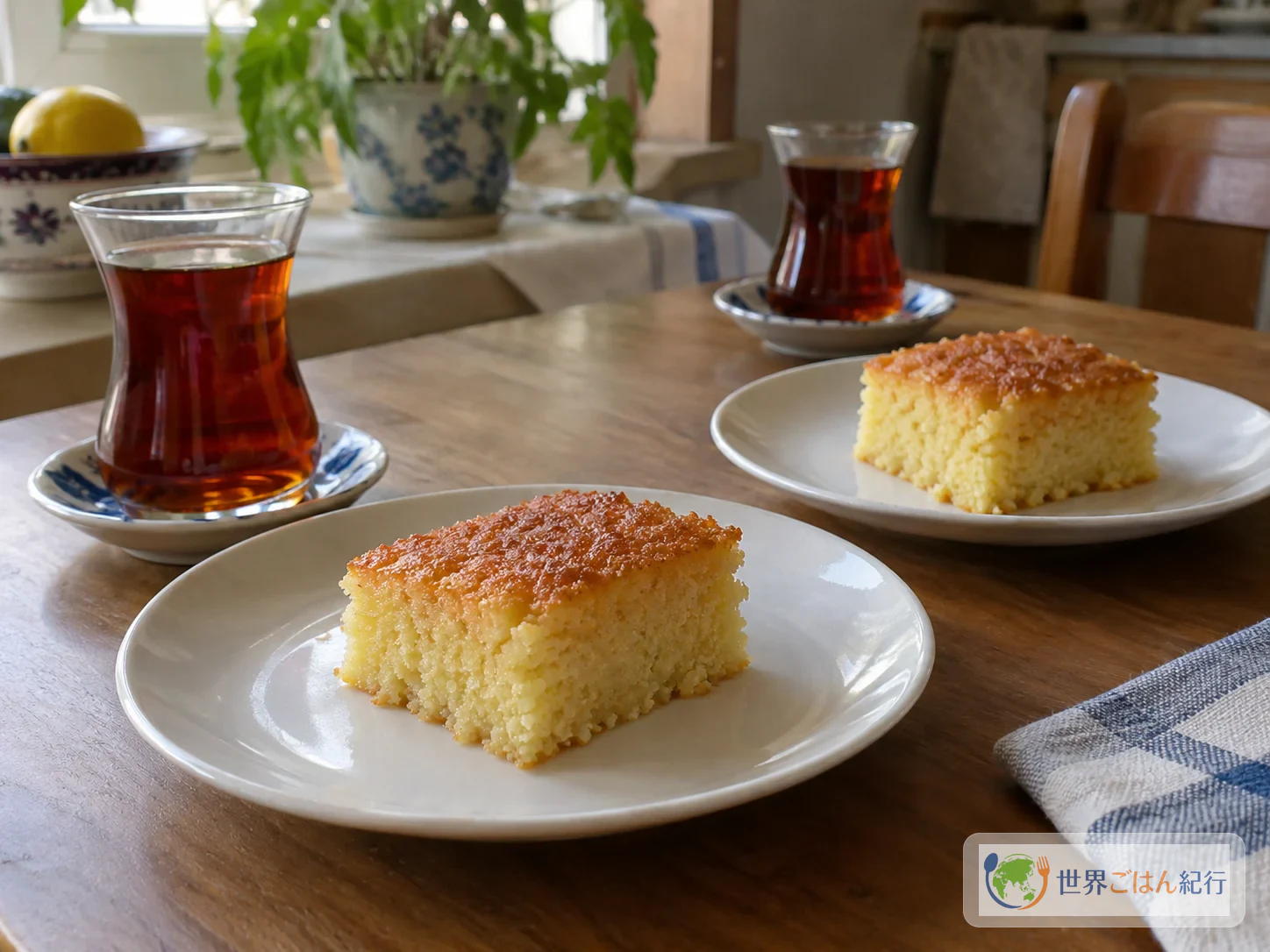
In Turkey it's eaten with tea or Turkish coffee. At home, we recommend pairing it with an unsweetened drink; unsweetened tea or coffee works well. The cake is already soaked with plenty of syrup, so start by cutting small pieces. Hold back from pouring lots of extra syrup on the plate. The base version is nut-free. Adding ice cream or toppings brings in extra sweetness and extra allergens.
Five variations with different aromas
The table below lists home-style suggestions to try once you've mastered the basic lemon version. They aren't recipes that represent particular regions. Keep the amount of syrup and sugar fixed and change one thing at a time, so the difference from the original texture is easy to see. If you use rose water or orange blossom water, use only food-grade products, never cosmetic ones.
| Variation | What and how much to change | Difference from the base |
|---|---|---|
| Orange zest | Swap the 3 g lemon zest for 3 g orange zest. Keep the lemon juice | Keeps the acidity but changes the zest aroma |
| Pistachio topping | Chop 12 g unsalted pistachios and scatter over after cutting | Adds green color and crunch. Check nut labeling |
| Coconut topping | Scatter 12 g unsweetened desiccated coconut over after cutting | Adds flavor on top without changing the cake |
| Rose scent | Start with 1 ml food-grade rose water in the cooled syrup. Follow the label's dosage | Adds a floral note while keeping the lemon. Use even less of strong products |
| With ice cream | Add 20 g vanilla ice cream to each piece just before eating | Adds coolness and dairy flavor. Don't store it with the leftover cake |
Leftover semolina can go into another Turkish sweet. İrmik helvası isn't a baked cake; it's made by toasting the semolina. If you want to know another texture of syrup dessert, try baklava with its thin layers of pastry. The links below answer two questions: what to do with leftover semolina, and how syrup desserts compare.
- İrmik helvası, made by toasting semolina (in Japanese)
- Turkish baklava with thin layers of pastry (in Japanese)
Storage and making ahead
Once the syrup has soaked in, refrigerating it is the safe default. Put it in a clean, covered container and keep your refrigerator at 4°C (40°F) or below. As a home guideline, it keeps 2–3 days in the refrigerator, or 2 weeks in the freezer with each piece wrapped individually. Treat these as short guidelines that put quality first, not a guaranteed shelf life. To freeze, seal it once it has cooled, and thaw overnight in the refrigerator. Don't take it in and out repeatedly.
Under the U.S. Food and Drug Administration (FDA) guidance for perishable foods in general, food should sit at room temperature for no more than 2 hours, or 1 hour when it's above 32°C (90°F). Refrigerators should be at 4°C (40°F) or below. This recipe uses eggs and dairy and gains moisture after baking, so we don't recommend long-term storage at room temperature. Count the time spent soaking in the syrup as time at room temperature. In a hot kitchen, don't wait at room temperature until it's completely cool; once it's cool enough to handle, move it to the refrigerator in its shallow pan. Throw it away if you see mold or notice an off smell. You can't judge safety by looks or smell alone. Don't taste an underbaked cake.
Nutrition estimate
One piece, from the base ingredients divided into 12, is roughly 270 kcal, 4 g protein, 5 g fat and 54 g carbohydrate. It's a calculated estimate that varies with how much sugar and syrup remains, how much pan oil stays behind and how you cut it. Nuts, coconut and ice cream aren't included. These aren't measured values, and they make no health claims.
Sources
- Ozlem’s Turkish Table — Revani; A deliciously moist, Semolina Cake in Syrup — Recipe by Turkish cookbook author Ozlem Warren. Consulted for the base proportions, pan, lemon aroma and pairing with tea. Published October 1, 2013. Accessed and checked October 7, 2026.
- Cooking Gorgeous — Revani - Turkish Semolina Cake — Recipe by Ayla Clulee. Checked for medium-grind semolina, the temperature contrast, the order of soaking and cutting, and differences between recipes. Updated September 10, 2026. Accessed and checked October 7, 2026.
- 30 days of Greek food — Greek Semolina Cake - Revani — Consulted for the Greek name, the Veria context, a recipe with yogurt, and differences in citrus and aroma. Updated May 6, 2026. Accessed and checked October 7, 2026.
- FDA — Are You Storing Food Safely? — Checked for room-temperature time limits for perishable foods, refrigerator temperature, and the fact that safety can't be judged by appearance alone. General food-safety guidance, not a storage test specific to revani. Accessed and checked October 7, 2026.
- FDA — Have Food Allergies? Read the Label — Consulted for wheat, egg, milk and tree-nut allergy cautions and for checking ingredient labels. Accessed and checked October 7, 2026.