Açaí na Tigela: A Cold, Thick Spoonful of Deep Purple
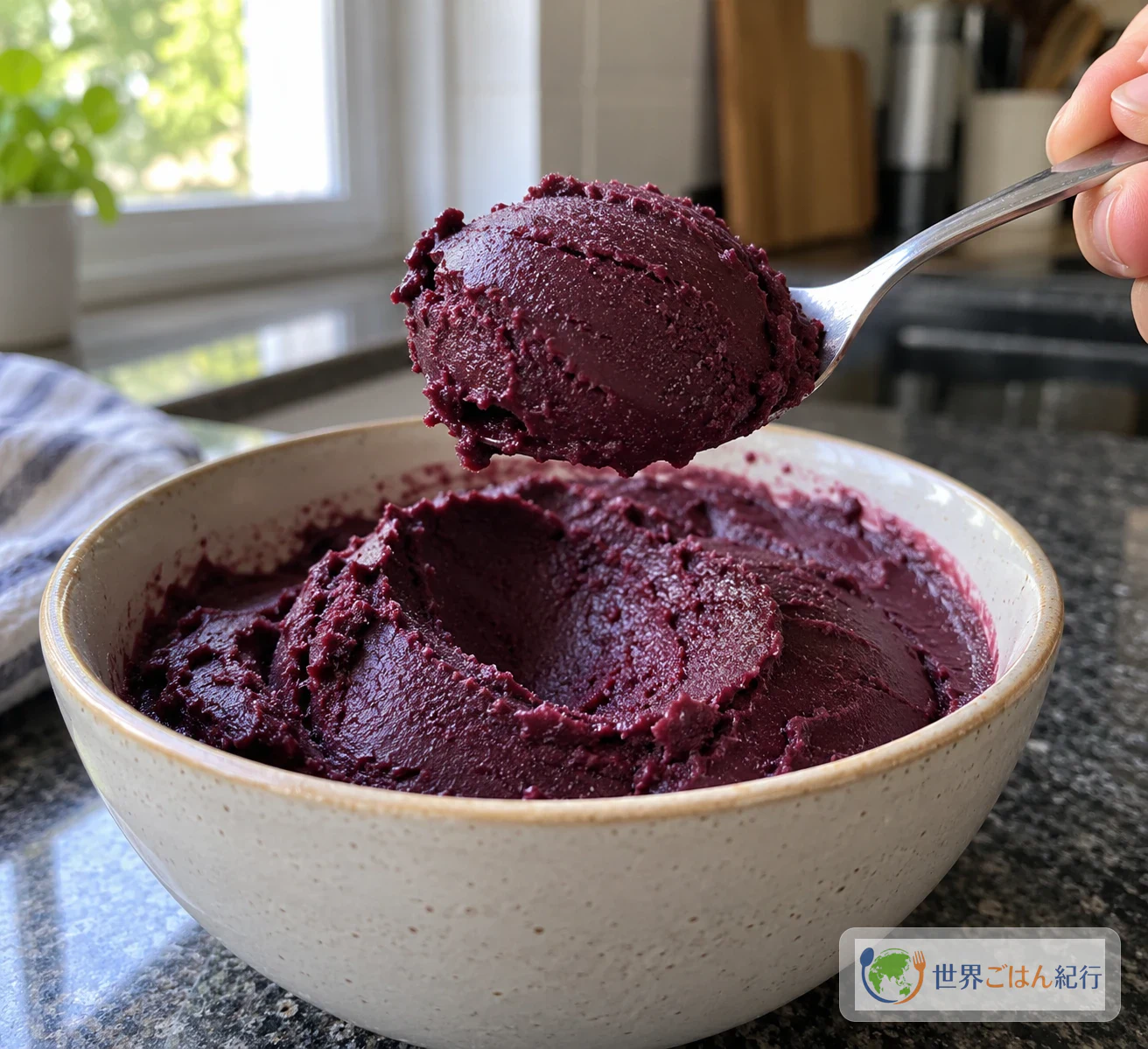
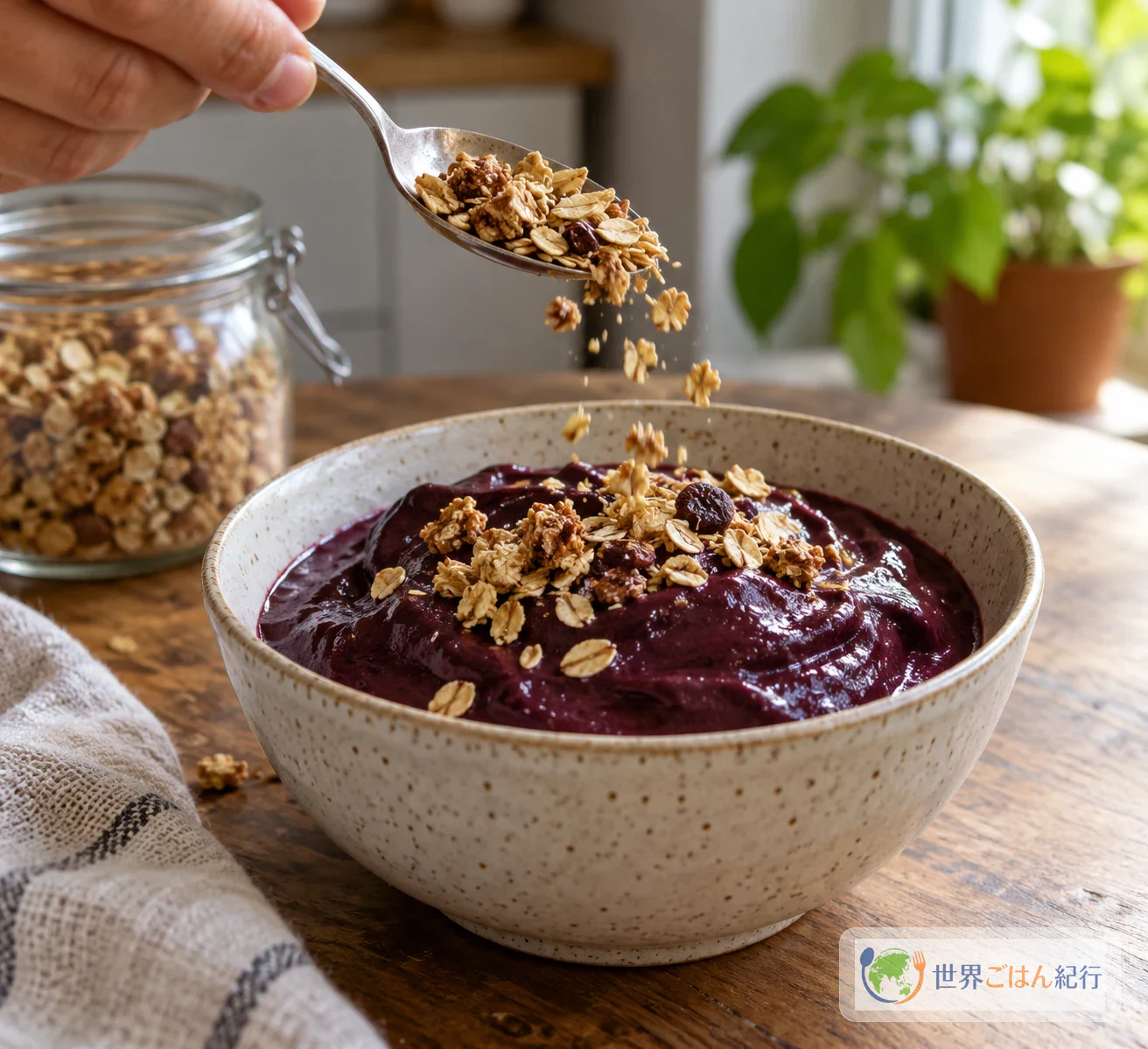
The bowl should be cold, dense and smooth enough to hold the shape of a spoon. Start from a labeled, commercially processed frozen açaí pulp and check its sweetness before you add anything. A crunchy topping goes on just before serving.
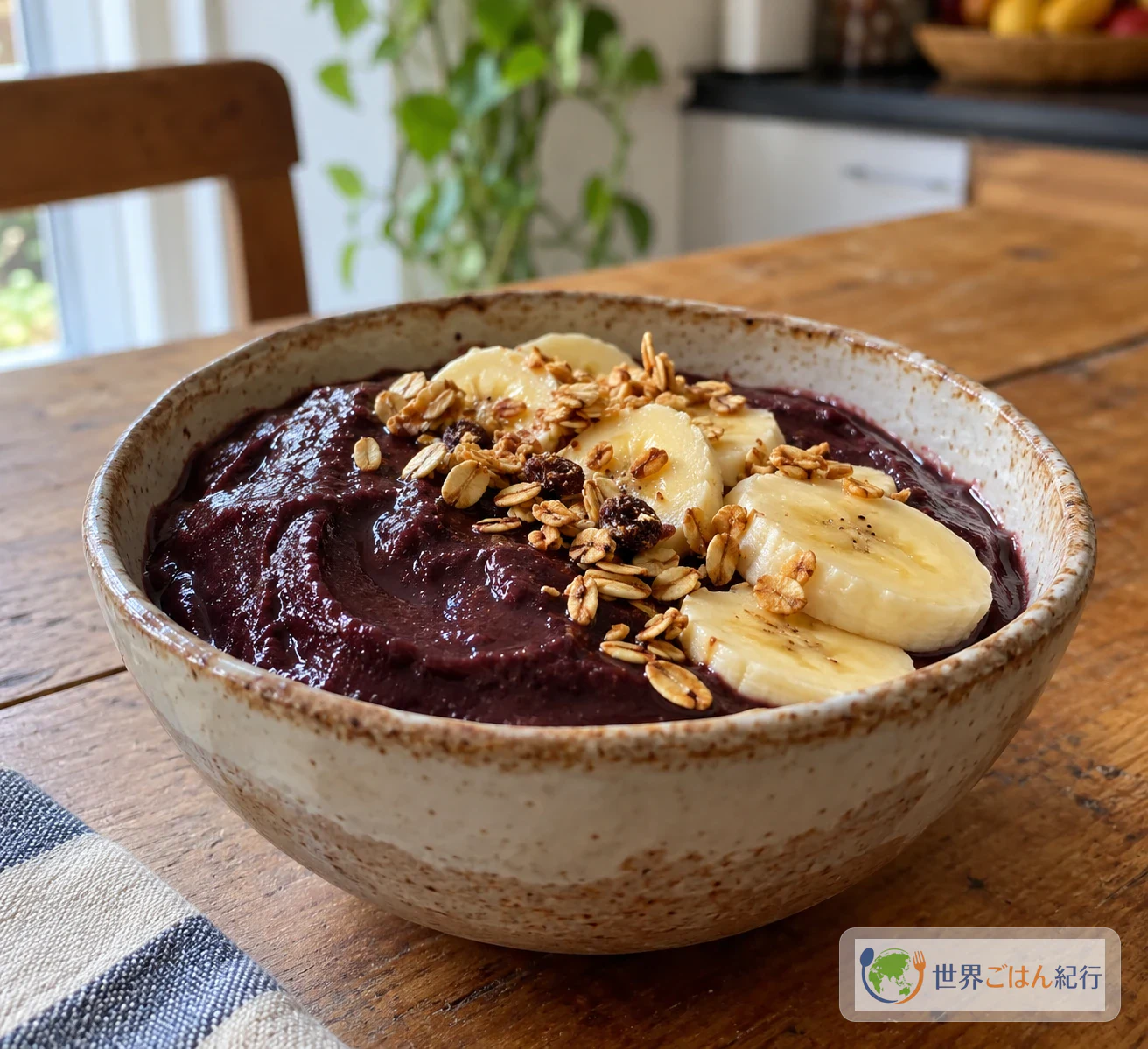
A good spoonful of açaí na tigela feels heavy: a cold, deep-purple cream that sits on the spoon instead of running off it. Granola scattered on top stays dry and crisp for the first few bites. The flavor is fruity and earthy, softened by banana and sweetened with guaraná syrup and brown sugar. That is the sweet frozen bowl many people know today as the açaí bowl.
The same dark purple açaí also appears on a very different table. In the Amazon river estuary and around the state of Pará, research and public health sources describe thick açaí eaten with cassava flour (farinha) next to fried fish, shrimp or meat, as part of a meal. Those are two ways of using one food, and neither is the "real" one. This article gives you a recipe for the sweet bowl and, in its own section, explains the Pará table so the two are not mixed up.
In Portuguese the dish is açaí na tigela, "açaí in the bowl." In English it is usually called an açaí bowl. Searching for the Portuguese name along with "polpa" (pulp) makes it easier to find Brazilian recipes and products.
What Açaí na Tigela Is: Frozen Açaí Pulp Made into a Thick Bowl
Açaí na tigela is frozen açaí pulp blended into a thick, cold cream and eaten from a bowl. Brazil's National Institute of Industrial Property (INPI) includes it in its 2026 product classification list as a creamy sorbet based on frozen açaí pulp and guaraná syrup. That list classifies products for trademarks. It doesn't set a standard recipe, but it does show how the dish is commonly understood: frozen pulp plus guaraná syrup.
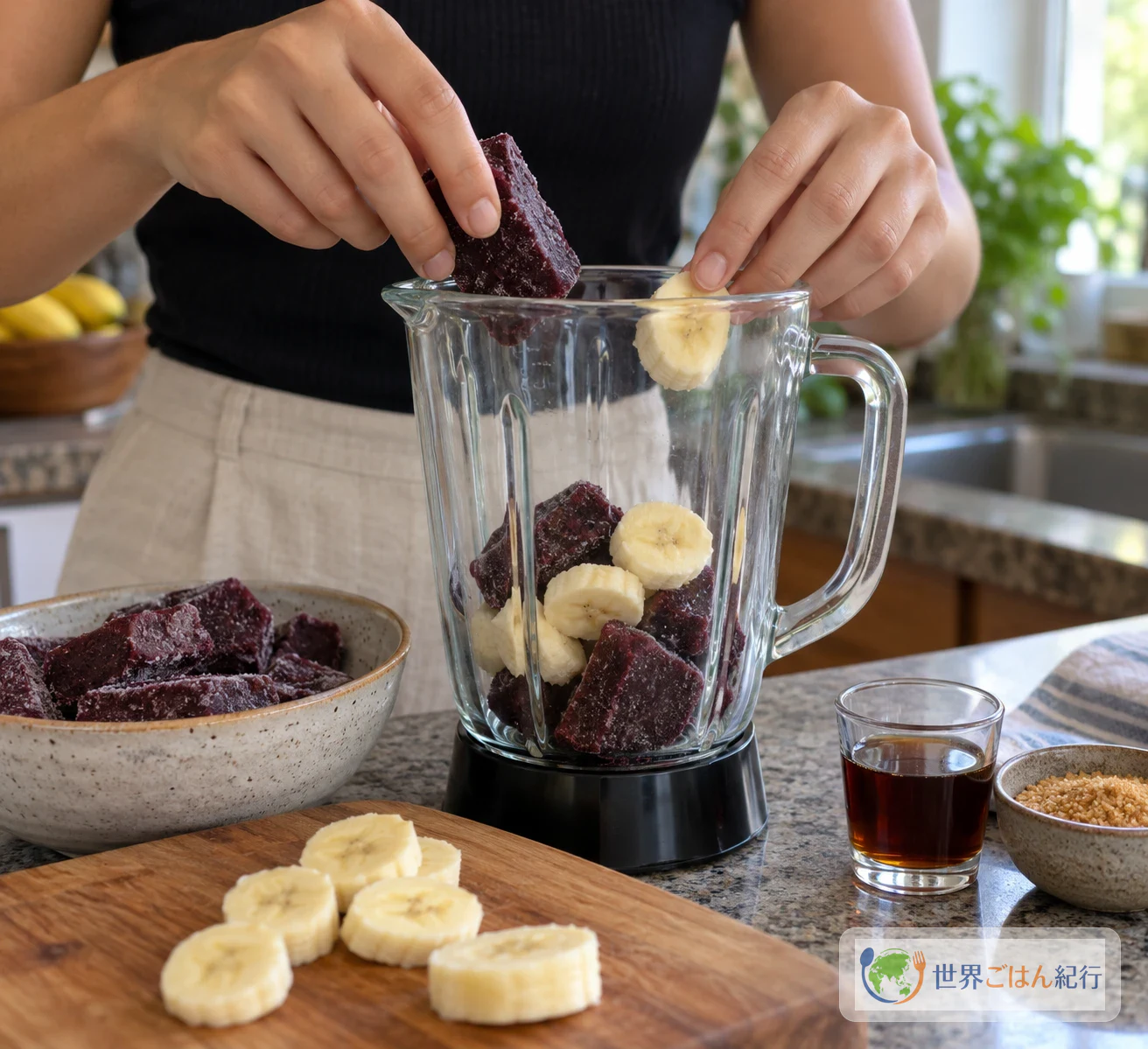
Published Brazilian recipes vary a lot in the details. The recipe used here is one user-submitted recipe on TudoGostoso. It blends 500g frozen pulp, 2 bananas, 4 tbsp guaraná syrup and 3 tbsp brown sugar, and lists 6 servings and 10 minutes. A Receitas Globo recipe works at a much larger scale and is sweeter in proportion: 1kg pulp, 500ml guaraná syrup, 5–6 bananas, for 11 servings, finished with granola and banana. A recipe from the Brazilian blog Na Cozinha da Helo skips guaraná and uses 4 tbsp honey with 500g pulp and 2 ripe bananas, divided into 4 bowls.
These are separate recipes with different sweetness ratios. This article follows only the TudoGostoso amounts. It doesn't average the three into a "standard" formula. The other two appear only in the variations.
In Pará, Açaí Sits Beside Fish and Farinha
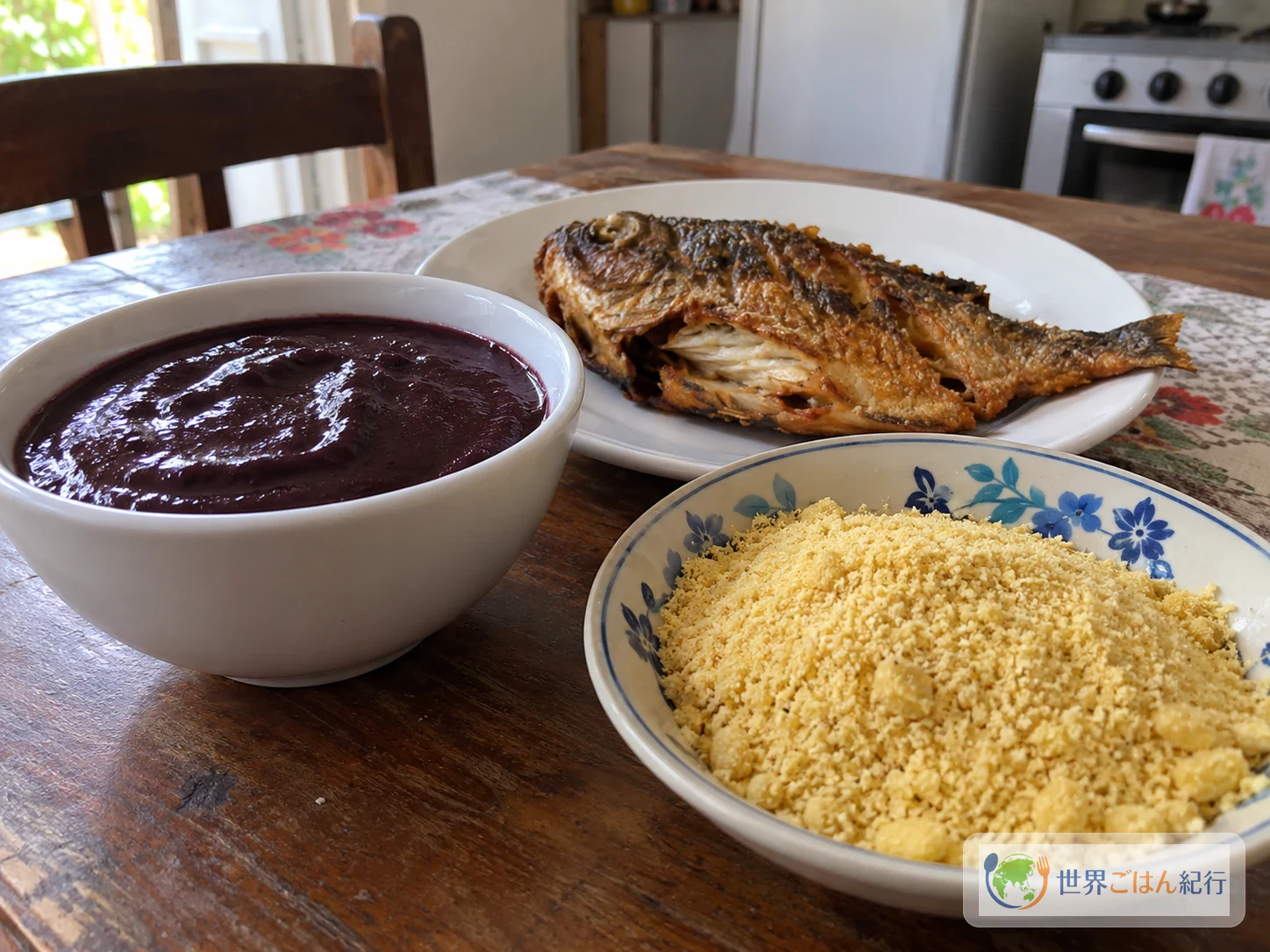
The açaí palm grows wild in the Amazon region, especially in the wetlands and floodplains of the river estuary. A 2001 Embrapa Amazônia Oriental study of açaí harvesters on the estuary islands of Pará records açaí juice mixed with cassava flour and eaten with fried fish, shrimp or carne de sol (salt-cured beef). A research article in Acta Amazonica draws on earlier studies to describe the regional açaí juice, called vinho de açaí there. In this context "vinho" is the name for the açaí drink, not an alcoholic wine. The article says it is eaten with cassava flour or tapioca flour and with fish or salted shrimp. That is how the name appears in these studies, and it doesn't mean everyone uses it today.
More recent sources describe the same pairing. The municipal health department of Ananindeua, in Pará, describes açaí eaten with fish, shrimp and flour as a staple-like eating habit in the state. An educational article from the University of São Paulo's School of Public Health frames açaí, fish and manioc flour together as a cultural food practice of Pará. These describe a pattern. They don't set a rule that every household follows the same way.
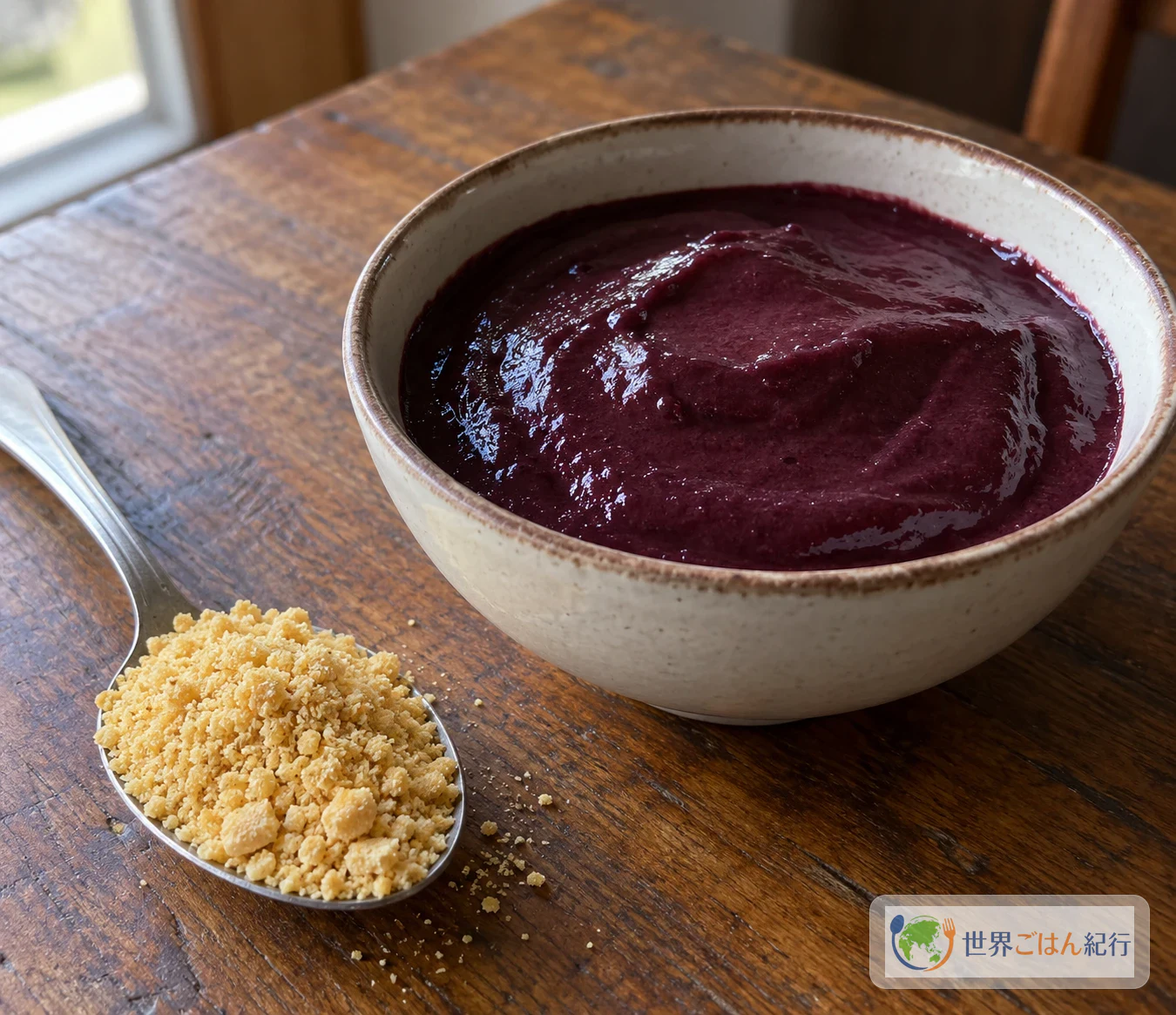
On this table the açaí is usually not the sweet, banana-blended cream of the bowl recipe. It is thick açaí served with coarse flour and savory food. The flour names are worth keeping straight. Farinha de mandioca (cassava/manioc flour), farinha d'água and the granular farinha de tapioca from Pará are distinct products with their own names. None of them should be assumed to be the same as the fine tapioca starch, tapioca flour or tapioca pearls sold in ordinary supermarkets abroad. If you want to try this way of eating, look for the Portuguese product names and treat them as different ingredients.
Pará's state rural extension agency, EMATER-Pará, publishes a cookbook with several açaí dishes. One is mingau de açaí, a porridge made with rice or farinha d'água cooked until soft before the açaí is added. That is a separate dish, not a version of açaí na tigela, but it shows how açaí shows up in many forms on regional tables.
Açaí is also tied to the land and its producers. Brazil's Ministry of Integration and Regional Development describes a "Rota do Açaí" (Açaí Route) that covers the whole chain: production, harvest, processing, industrialization and sales. It also involves family farming, traditional knowledge and local communities in Pará and Amapá. The state's official tourism portal, Visit Pará, lists traditional açaí among the local foods of the capital. The 2001 Embrapa study also noted that, at the time, frozen-pulp açaí drinks had spread to Brazil's South and Southeast. That widening market is the backdrop for the frozen sweet bowl. None of these sources names one founder, date or single place where the sweet bowl began, so this article doesn't name one either.
Ingredients and Equipment
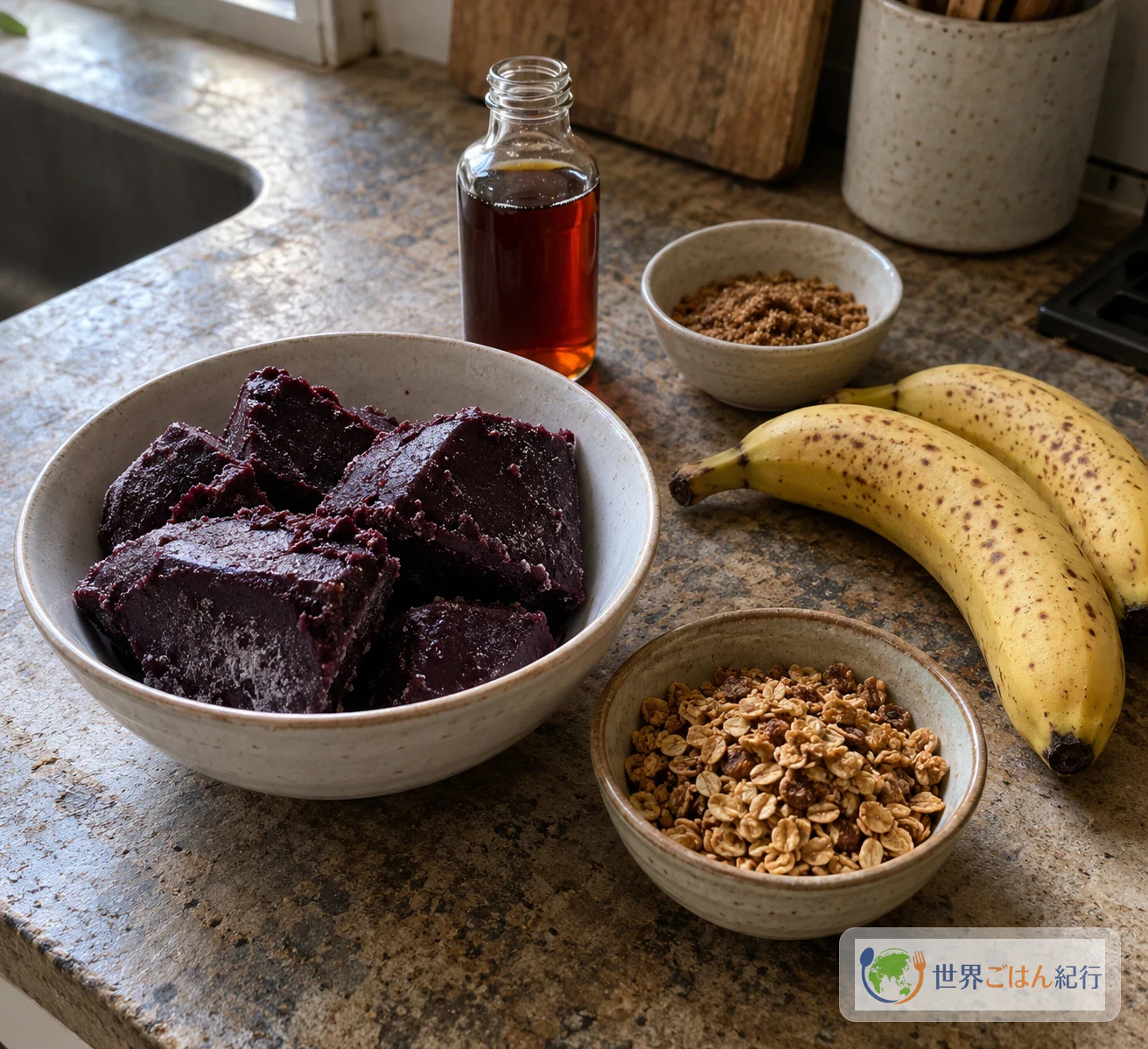
Check the frozen pulp first. Some frozen açaí pulps are sold unsweetened, and others already contain sugar or guaraná. This recipe adds its own sweetness, so it assumes an unsweetened commercial frozen açaí pulp sold as food. If your pack is already sweetened, don't add the full syrup and sugar on top. Read the label and treat it as a different mix.
These amounts make 6 servings and take 10 minutes, which suits small snack-size bowls. They are not a tested household yield or a universal formula, and the same amounts won't suit every product.
US conversion (approximate): 500g is about 1.1 lb.
- A blender whose manual says it can handle frozen ingredients, and a jar size suited to this amount
- 6 small bowls
- Measuring spoons and a silicone spatula
Never put a spoon, spatula or any other tool into the jar while the blender is running. If it jams, stop it and switch it off before you touch the contents. Follow your blender's manual for frozen ingredients and maximum capacity.
How to Make Açaí na Tigela
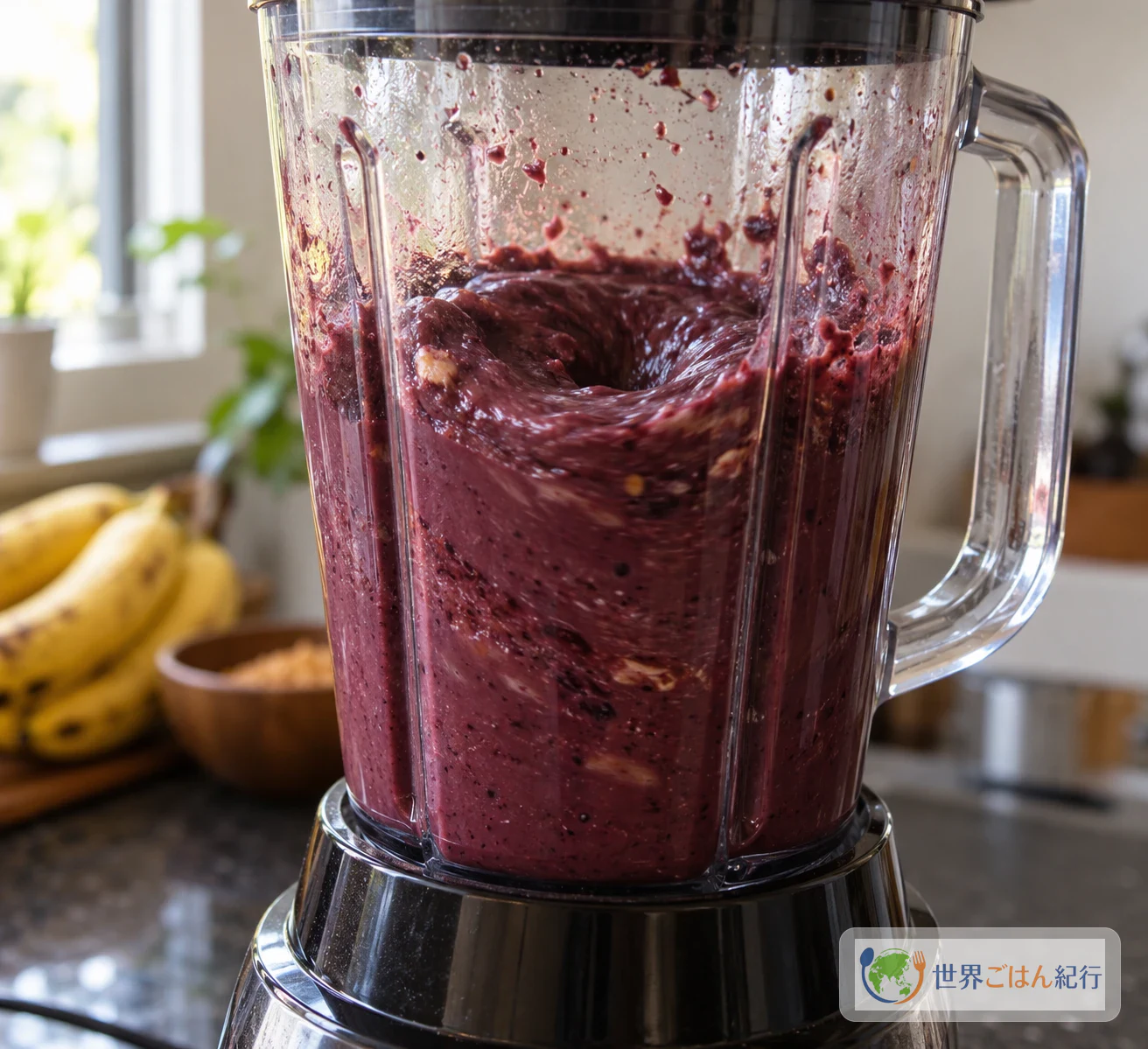
Allow 10 minutes. That doesn't count the time to get the pulp ready as the package directs, differences between blenders, or any extra chilling. No cooking or heat is involved.
Judge each stage by texture, not by the clock. Blenders and pulps differ too much for a fixed number of seconds or minutes to mean much.
Fixing Thickness, Sweetness and Blender Trouble
Most problems with this bowl come from the product or the equipment, not from technique. Read the label and the blender manual before you change the recipe.
| Problem | Likely cause | What to do |
|---|---|---|
| Watery or soupy | The pulp had thawed, or you used a sweetened or liquid-style product | Check the label and try again with unsweetened frozen pulp. Don't add water or milk to fix it. Chilling won't necessarily bring back the right texture |
| Blender won't turn | The frozen pieces are too large, or the amount doesn't suit the blender | Stop and switch it off before you touch anything. Work in smaller batches as your manual allows. Never put tools in while it runs |
| Too sweet | The pulp or syrup already contained sugar | Check both labels. The recipe's amounts are one example and won't suit every product |
| Not cold enough | The ingredients thawed, or serving took too long | Set out the bowls and toppings before blending and serve right away. Chill further only if needed |
Liquid, banana and sweetener all change the bowl. Extra liquid thins it, and extra banana or sweetener can cover the açaí's own flavor. If you want the açaí to come through, don't increase them, and don't mix in ratios from a different recipe.
Five Ways to Vary the Bowl, and One Separate Table
The first four are changes to the sweet bowl. The fifth is a separate way of eating açaí from Pará, not a flavor variation of the dessert.
- Guaraná syrup and brown sugar (the main recipe). This is the TudoGostoso combination used above. It is one published example, not a regional standard.
- Banana and honey. Na Cozinha da Helo uses 500g pulp, 2 ripe bananas and 4 tbsp honey, divided into 4 bowls. The author also writes about telling this sweet bowl apart from the way açaí is eaten in Pará, from a visit to Belém. Treat the honey version as its own recipe. It is not an equal swap for guaraná syrup and won't taste the same.
- Granola for crunch. Granola is the most common topping in these recipes. Brands differ, so check the label for wheat, nuts and other allergens. The hero bowl also shows a few banana slices on top, as in the Receitas Globo serving style. Those slices are extra and not part of the main recipe's amounts.
- Pará farinha de tapioca or cashews. Na Cozinha da Helo offers 4 tbsp granular farinha de tapioca from Pará, or 2 tbsp cashew nuts, as topping options for its 4 bowls. Farinha de tapioca is not the same as the tapioca starch or tapioca pearls sold in ordinary supermarkets, so look for the Portuguese name.
- The Pará table: thick açaí with farinha and fish. In Pará, thick açaí can be eaten with cassava flour beside fried fish, shrimp or meat, as described in the section above. To try it, don't sweeten the açaí or add bowl toppings. Serve the açaí with farinha de mandioca and a savory dish. Fish, meat and mealtimes vary, and no single combination is the rule.
Storage, Hygiene and Allergies
Serve the bowl as soon as it's blended. The sources give no storage time for blended açaí, so this article doesn't suggest one. For the frozen pulp, follow the storage and thawing directions on the package.
Food-safety and medical sources from Pará stress that hygiene during harvesting, transport and processing matters. The Ananindeua municipal health department notes that poor hygiene at these stages can contaminate the food. A 2026 article from the Federal University of Pará's hospital complex warns that açaí processed in unsanitary conditions can transmit Chagas disease orally, and it emphasizes hygienic processing. At home, use a labeled, commercially processed frozen açaí pulp sold as food and follow its instructions. This recipe doesn't cover making pulp from raw açaí fruit at home. Being frozen does not by itself make a product safe.
Granola and other toppings may contain wheat, nuts or other allergens, so read the labels. If you swap toppings or sweeteners for allergy reasons, expect a different flavor and texture, because those substitutes haven't been tested in this recipe.
Frequently Asked Questions
Is açaí in Pará also eaten as a sweet bowl?
Sweet açaí bowls are widely known in Brazil. In Pará, though, sources also describe thick açaí eaten with cassava flour beside fish, shrimp or meat as part of a meal. That isn't a topping change on the dessert. It's a different way of eating açaí, and practices vary from household to household.
Can I use sweetened açaí pulp?
You can, but don't follow this recipe's amounts as written. The guaraná syrup and brown sugar here assume unsweetened pulp. With a sweetened product, read the label, cut back the added sweetness and treat the result as a different mix.
Can I replace guaraná syrup with honey?
Another Brazilian recipe uses honey (4 tbsp with 500g pulp and 2 bananas, for 4 bowls). That is a separate recipe, not a one-for-one swap, and the flavor won't match the guaraná version.
Should I add water or milk to help it blend?
Don't add liquid as a first fix. Check whether the pulp has thawed or is a liquid-style product, and whether your blender is suited to frozen ingredients and this amount. Stop the blender, switch it off, and then free the mixture or blend in smaller batches. The sources give no amount of added liquid, so this article doesn't suggest one.
How many days will leftovers keep?
The sources don't give a reliable storage time for blended açaí, so this article doesn't give one. Make only what you will eat, serve it right away, and follow the frozen pulp's own label for storage.
For more dishes from the same country, see recipes from Brazil.
Sources
- Instituto Nacional da Propriedade Industrial (INPI), Brazil, "Lista Auxiliar de Produtos — janeiro de 2026." Product classification list describing açaí na tigela as a creamy sorbet based on frozen açaí pulp and guaraná syrup; it doesn't define a single recipe. https://www.gov.br/inpi/pt-br/servicos/marcas/classificacao-marcas/Lista_auxiliar_PRODUTOS_janeiro_2026.pdf
- TudoGostoso, "Açaí na Tigela" (user-submitted recipe). Source of the main recipe's amounts (500g frozen pulp, 2 bananas, 4 tbsp guaraná syrup, 3 tbsp brown sugar), the listed 6 servings and 10 minutes, blending method, optional freezing and granola topping. https://www.tudogostoso.com.br/receita/128353-acai-na-tigela.html
- Na Cozinha da Helo, "Tigela de açaí com banana." Separate honey-based recipe and topping options (cashews, Pará farinha de tapioca, granola), and the author's distinction between the sweet bowl and the Pará way of eating. https://www.nacozinhadahelo.com.br/receitas/acai-com-banana
- Receitas Globo, "Açaí na Tigela." A separate recipe example with different proportions, finished with granola and banana. https://receitas.globo.com/tipos-de-prato/doces-e-sobremesas/acai-na-tigela-4d515cc552e0b252bc00f7b5.ghtml
- Embrapa Amazônia Oriental, "Caracterização Socioeconômica dos Extratores de Açaí nas Ilhas do Estuário do Rio Amazonas no Estado do Pará" (2001). The açaí palm's estuary and floodplain habitat; açaí juice eaten with cassava flour, fried fish, shrimp and carne de sol; the spread of frozen-pulp drinks to Brazil's South and Southeast at the time. https://www.infoteca.cnptia.embrapa.br/bitstream/doc/348258/1/Boletim200143.PDF
- Acta Amazonica / INPA, "Composição química do suco de açaí." The regional name vinho de açaí and, from earlier studies, the custom of eating it with cassava or tapioca flour, fish and salted shrimp. https://acta.inpa.gov.br/fasciculos/41-4/BODY/v41n4a11.html
- Secretaria Municipal de Saúde de Ananindeua, "Ação da Vigilância em Saúde assegura boas práticas na manipulação do açaí em Ananindeua." Açaí eaten with fish, shrimp and flour as a staple-like habit in Pará; contamination risk when harvest, transport and processing hygiene is poor. https://www.ananindeua.pa.gov.br/sesau/noticia/9307/acao-da-vigilancia-em-saude-assegura-boas-praticas-na-manipulacao-do-acai-em-ananindeua
- Complexo Hospitalar Universitário da UFPA / EBSERH, "Hospital Barros Barreto alerta para avanço da doença de Chagas e reforça cuidados com consumo de açaí" (2026). Possible oral transmission through açaí processed under poor hygiene, and the importance of hygienic processing. https://www.gov.br/hubrasil/pt-br/hospitais-universitarios/regiao-norte/chu-ufpa/comunicacao/noticias/2026/hospital-barros-barreto-alerta-para-avanco-da-doenca-de-chagas-e-reforca-cuidados-com-consumo-de-acai
- Sustentarea, Faculdade de Saúde Pública da Universidade de São Paulo, "Farinha de mandioca, peixe e açaí: a relação entre cultura e sustentabilidade." Açaí, fish and manioc flour as a cultural food practice in Pará. https://sustentarea.fsp.usp.br/2024/06/09/farinha-de-mandioca-peixe-e-acai-a-relacao-entre-cultura-e-sustentabilidade/
- Ministério da Integração e do Desenvolvimento Regional, Brazil, "Rota do Açaí." The açaí production chain from harvest to sales, and the role of family farming, traditional knowledge and communities in Pará and Amapá. https://www.gov.br/mdr/pt-br/assuntos/desenvolvimento-regional/rotas-de-integracao-nacional/rota-do-acai-1
- Visit Pará, official tourism portal of the State of Pará. Traditional açaí presented among the local foods of the state capital. https://www.visitpara.com.br/en/home-en/
- EMATER-Pará, "Receitas." A state rural extension cookbook that includes mingau de açaí, a separate porridge made with rice or farinha d'água. https://www.emater.pa.gov.br/storage/app/uploads/public/648/b08/cc5/648b08cc57c7b271116889.pdf