
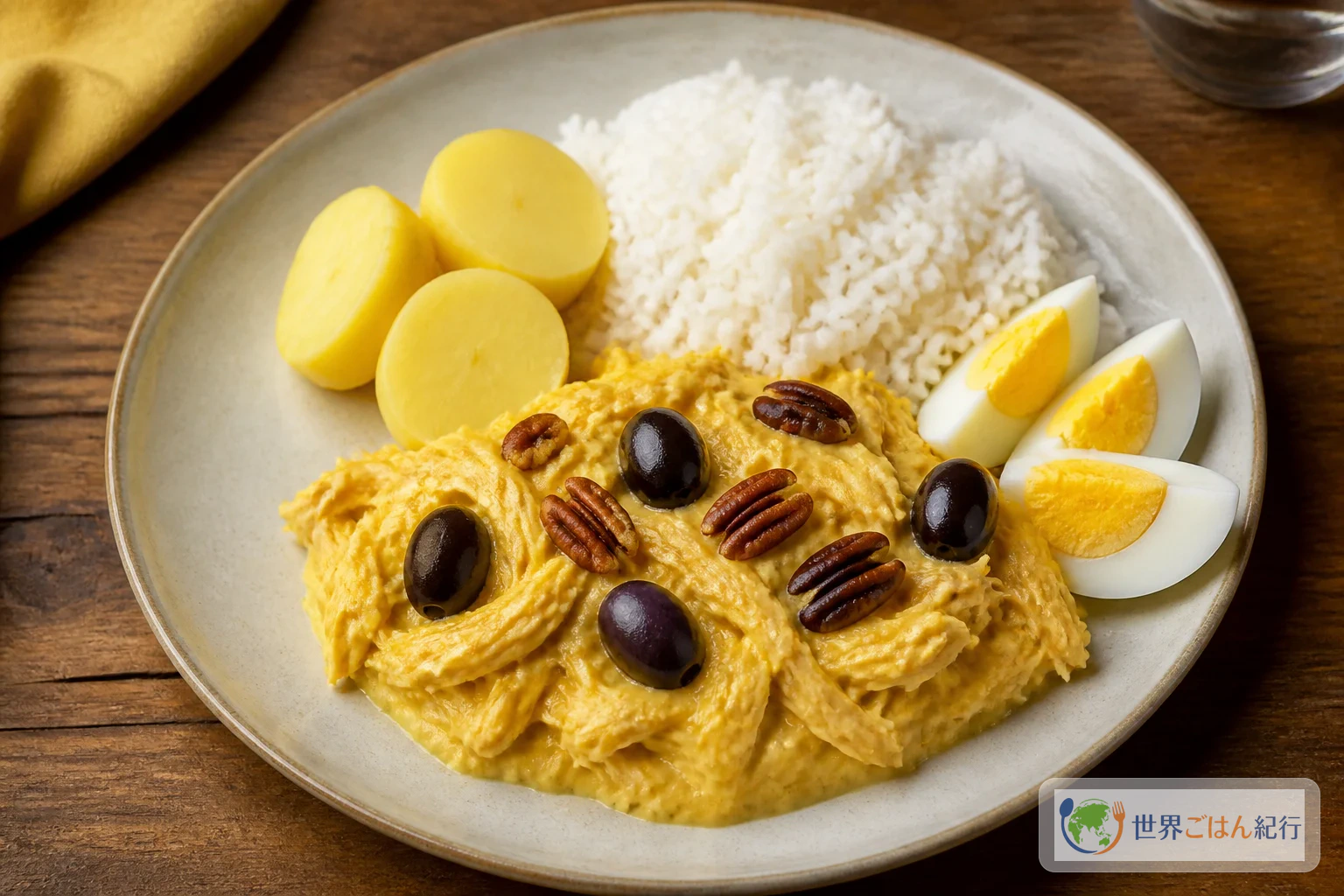
Lift the lid and the chicken broth gives off the scent of onion and bay leaf. In another pan, the yellow oil of ají amarillo has passed into the onion, and the milk soaking the bread is slowly turning into sauce.
Ají de gallina is a Peruvian dish of shredded chicken simmered with yellow chili, bread, milk and nuts. It is not a dish that only turns up the heat; within the roundness of the chicken broth and bread, it keeps the fruity aroma of ají amarillo.
What is easy to get wrong at home is how to substitute for the chili, how to thicken the sauce, and when to stop cooking the chicken. In this recipe, chicken breast is shredded while still moist, and the bread is softened in broth and milk before being blended into a smooth sauce. Plate rice and potatoes together, and add boiled egg, black olives and pecans, and you get a dish close to the Peruvian table.
A yellow stew where bread holds the chicken broth
The finished ají de gallina is not a soupy stew like curry. Scooped with a spoon it clings thickly to the chicken, and once on the plate it spreads slowly.
Here the bread is not an ingredient that asserts its own flavor; it is the base of the thickness, holding the chicken broth and milk. Cook onion, garlic and ají amarillo in oil, then combine with the softened bread and pecans, and you get a smooth sauce without any flour. Because grated hard cheese goes in at the end, do not salt too much from the start, so the saltiness and richness do not become strong all at once.
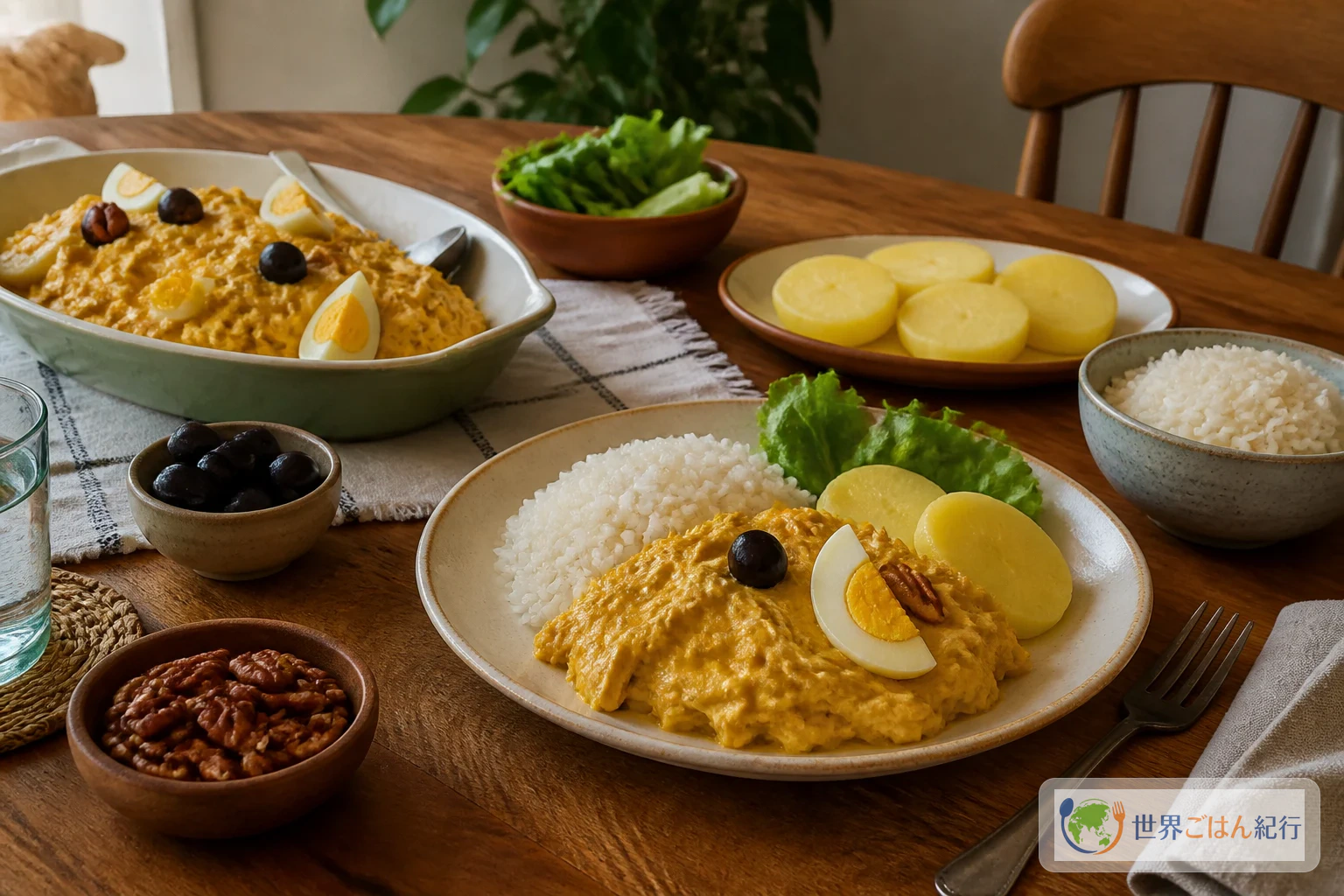
On the plate go warm rice and boiled potatoes. With yellow sauce, white rice, yellow potato, black olives, and egg in white and yellow side by side, the combination of colors, as well as the taste, creates the impression of the dish.
Ají means chili pepper and gallina means hen. Today's home recipes widely use chicken, but the old name remains in the title of the dish.
Decide the axis of flavor first: the Peruvian table and the home kitchen
In the official Peruvian recipe, the chicken is simmered with aromatics and the cooking liquid is used for the sauce. Because bread soaked in milk or broth is added to onion and ají amarillo that have been sautéed, it does not become a spicy sauce that is merely chili.
Ají amarillo brings heat, yellow color and a fruit-like aroma all together. If you swap it for chili flakes alone because it is hard to find, you can add heat but the color and aroma do not remain. If a first-time cook wants less heat, reducing the amount of paste and adding a little yellow bell pepper keeps the direction of the dish better.
To stay closer to the local method, do not overcook the chicken breast, build the thickness with the amount of bread, and finish the accompaniments separately. For ease at home, the chicken breast is set at 600 g. Switching to chicken thigh adds fat and springiness and holds up better to simmering, but the sauce becomes somewhat heavier.
If you want to see in advance how to substitute for ají amarillo, see how to substitute for ají amarillo. Compared with papa a la huancaína, a Peruvian starter that uses the same yellow chili, you can see that this is a warm stew of chicken broth and bread rather than a cold cheese sauce.
Ingredients (serves 4)
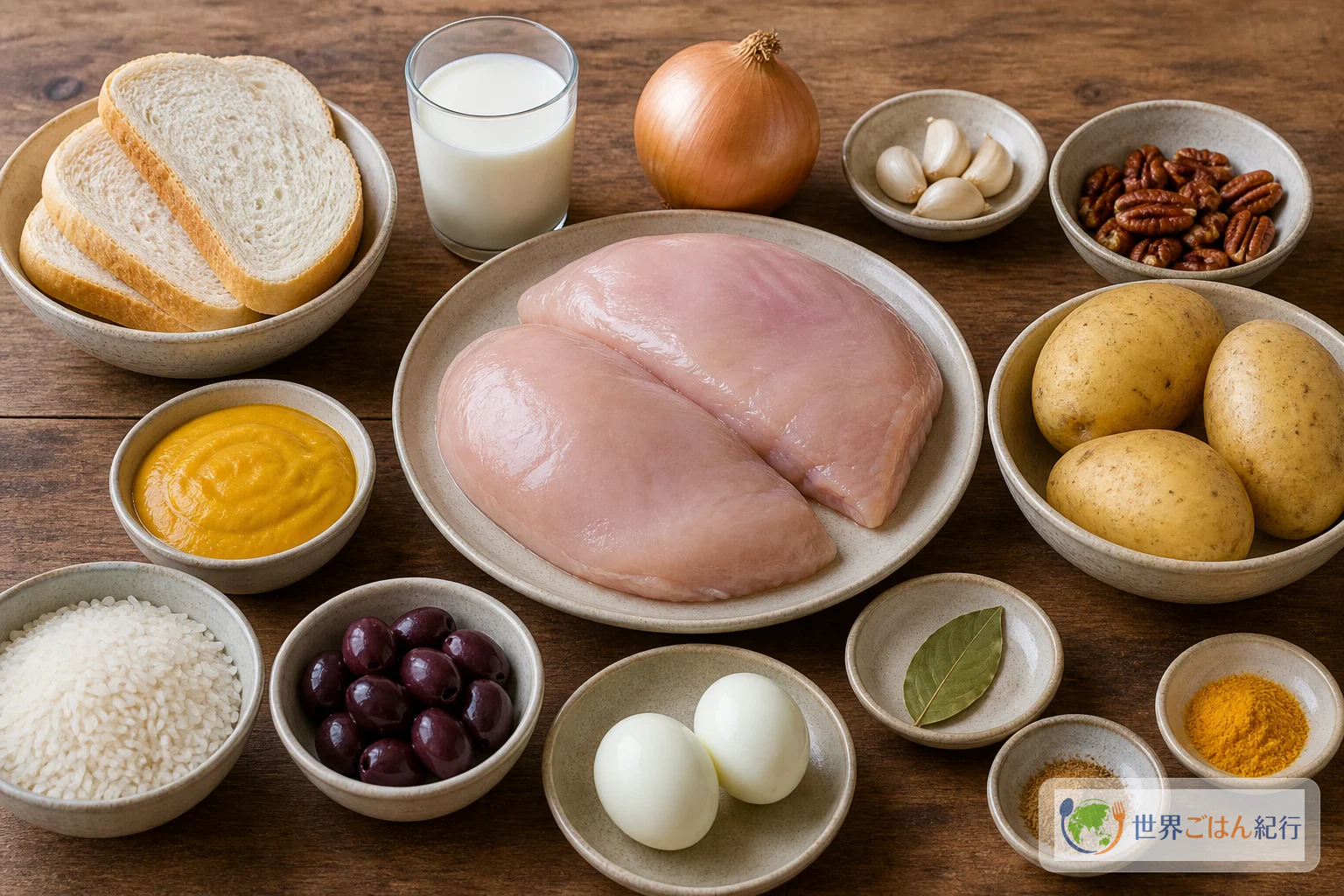
This dish uses milk, bread, chicken, nuts and cheese. If you have allergies to wheat, dairy, eggs or nuts, check the ingredient labels of any substitutes. Ají amarillo paste also differs in ingredients from product to product, so check the salt as well as the heat.
One option is to roast 80 g yellow bell pepper, peel it, and make up the heat with a little habanero powder or red chili. But this is a substitute that approximates the color and heat; it does not match the fruity aroma or the dried-chili flavor of ají amarillo. Starting with only 30 g of paste, checking the heat and aroma, and then adding the rest is also a safe approach.
To get a uniform sauce, make the bread and pecans fine and blend them together with the liquid. If you have no blender or food processor, you can soak the bread longer and mash it with a fork, but the texture becomes a little coarser. If you already have an immersion blender, there is no need to buy a new tool just for capacity.
Method: keep the broth, and make the thickness with bread
1. Simmer the chicken with the aromatics
duration: 25 min
Put 800 ml water, the chicken breast, 100 g onion cut into quarters, carrot and celery cut into 2 cm pieces, the crushed garlic and the bay leaf in a pot. Warm over medium heat until small bubbles rise from the edge of the pot, and when it boils, lower to low heat. Set the lid slightly ajar and cook for 18 to 22 minutes, until the thickest part of the chicken is cooked through.
Take it out when the internal temperature is 74°C or higher, the cut face is not the translucent color of raw meat, it springs back when pressed, and the meat shreds easily when pressed with chopsticks. Lifting out the chicken first prevents the breast from continuing to cook in the broth. Strain the cooking liquid and reserve 400 ml for the sauce. Keep the rest of the broth in reserve for adjusting the thickness.
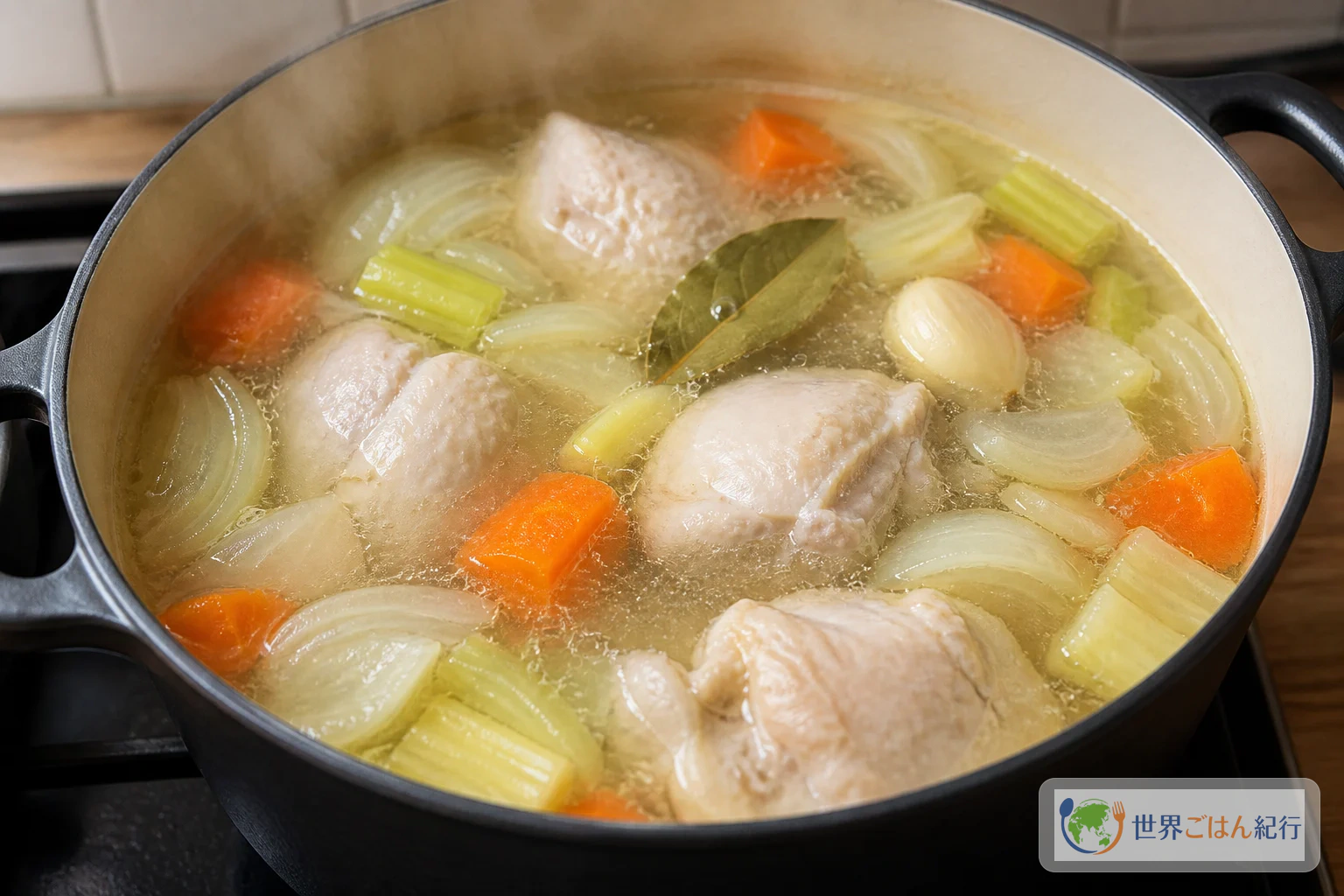
If you keep it at a hard boil, the surface of the chicken breast tightens and the broth turns cloudy. It is enough to skim only the foam on the surface that bothers you.
2. Soak the bread and shred the chicken
duration: 10 min
Tear 100 g of bread without the crusts and put it in a liquid made of 200 ml milk and 100 ml warm cooking liquid. Leave it 10 minutes, until no core remains when pressed with a finger.
Let the chicken cool until you can touch it, and shred it thinly along the grain. If large chunks remain, they combine less well with the sauce, so a guide is a length that falls when you lift it with chopsticks.
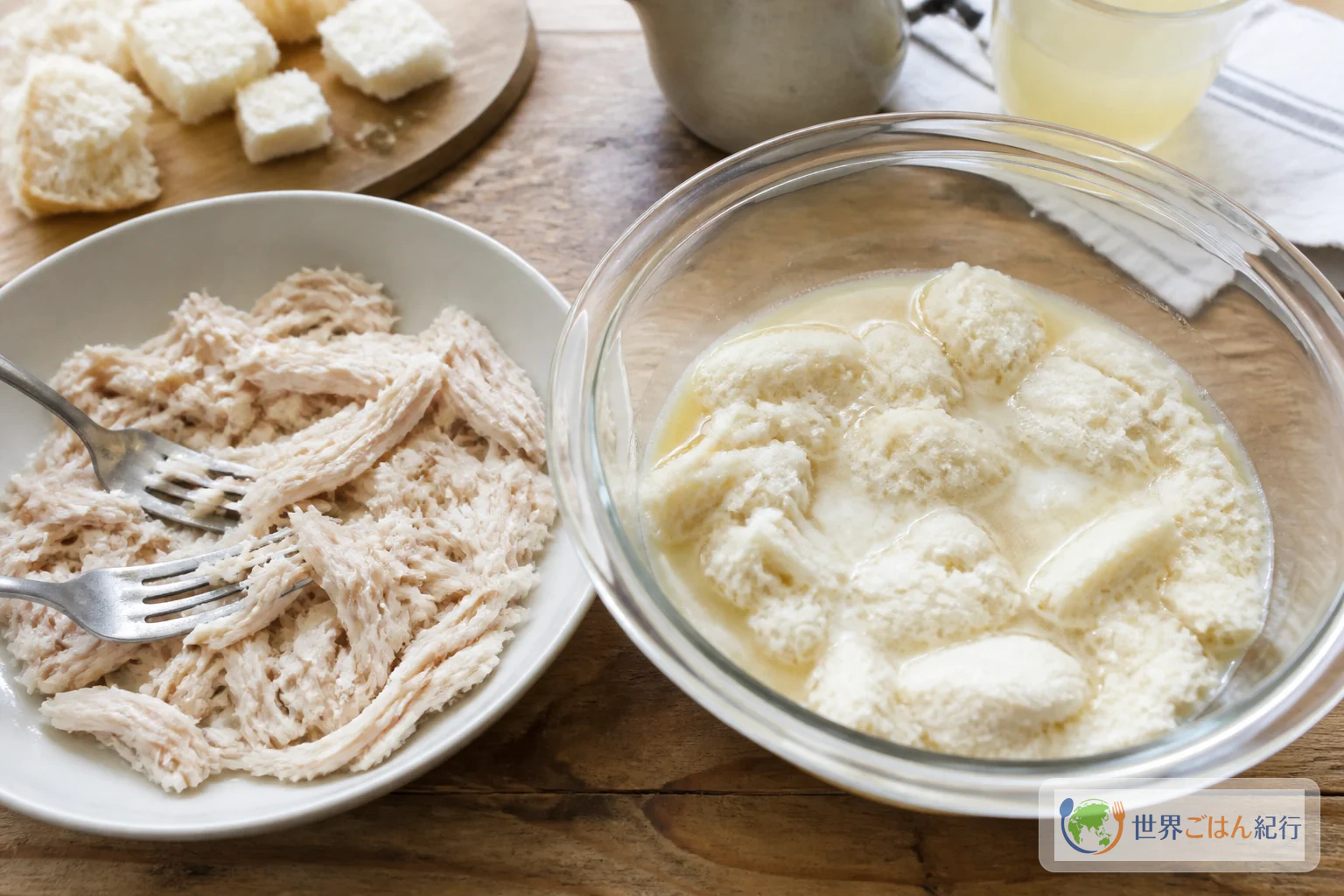
If the liquid for soaking the bread is boiling hot, the milk tends to separate. Keep the cooking liquid just warm, and once the bread has absorbed the moisture, use the rest of the liquid too.
3. Sauté the onion and ají amarillo
duration: 15 min
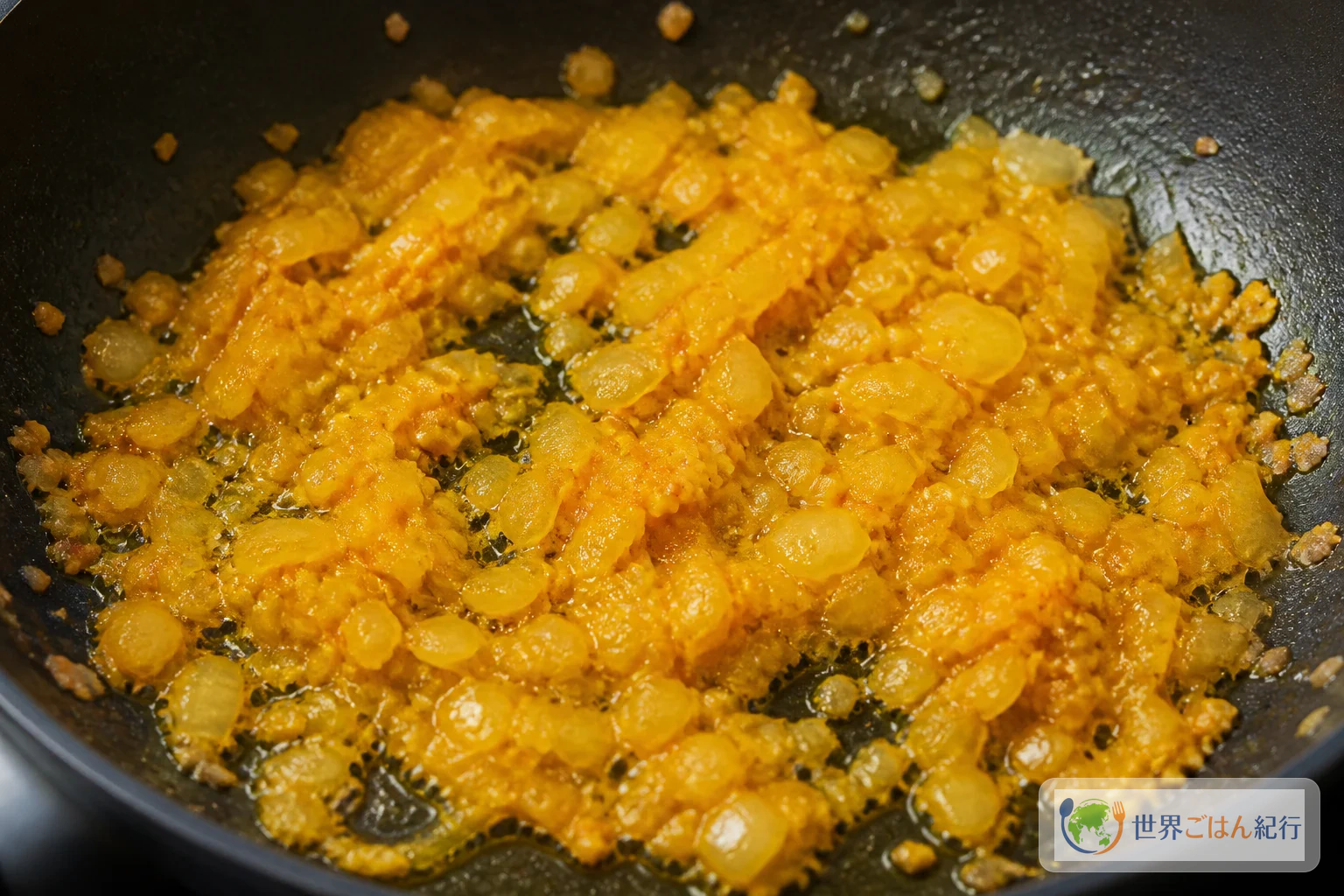
Put 30 ml oil and 200 g onion in a pan and cook over medium-low heat for 7 to 10 minutes. Cooking until translucent and slightly collapsed at the edges brings out the sweetness of the sauce. Add 2 cloves garlic and cook 2 minutes, then add the ají amarillo paste, cumin and turmeric.
Cook another 4 to 5 minutes, stirring with a spatula. When you drag the spatula across the bottom and a line of oil remains, the corners of the onion have almost disappeared, and the paste has blended into the oil and turned from yellow to orange, the raw green smell has weakened. Burnt chili leaves a lingering bitterness, so lower the heat if the bottom of the pan seems about to dry out.
4. Blend the bread and aromatics until smooth
duration: 3 min
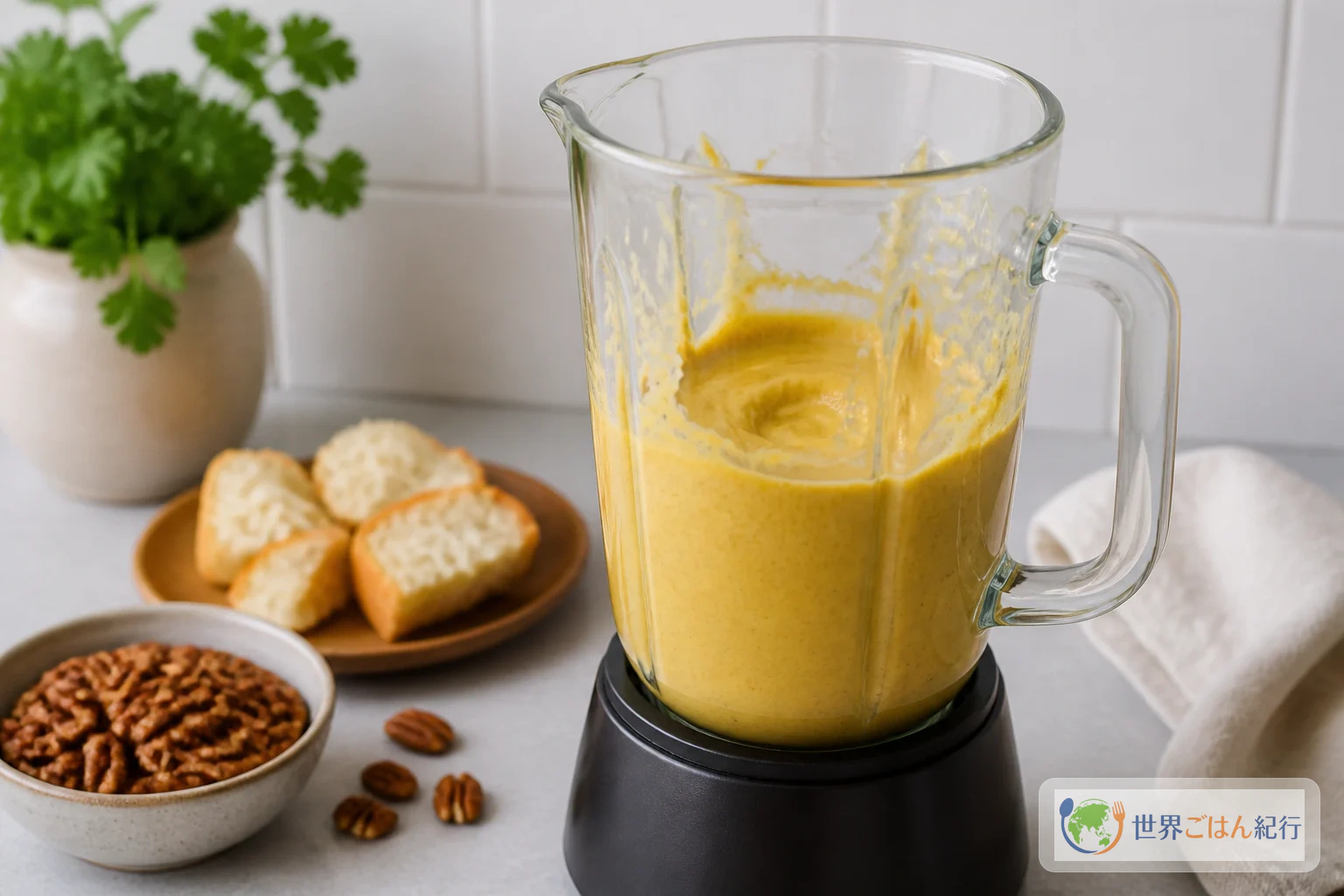
Put the sautéed mixture, the soaked bread, 30 g pecans and 150 ml cooking liquid into the blender. With the heat off, let the hot mixture cool a little before closing the lid. Blending hot in a closed container makes the steam expand. Blend in 30-second bursts, scraping down the sides with a spatula, until no grains can be seen.
It is enough when the sauce falls slowly from a tilted spoon in a thin ribbon. If it is too heavy, add the reserved cooking liquid 20 ml at a time.
Without a blender, soak the bread for about 20 minutes, chop the pecans finely with a knife, and then mash with a mortar or a fork. It will not become completely creamy, but as a home dish you can also finish it leaving some grains.
5. Simmer the sauce and return the chicken
duration: 15 min
Return the sauce to the pan and add the remaining 100 ml milk and 150 ml cooking liquid a little at a time. Cook over low heat for 8 to 10 minutes, stirring as if stroking the bottom. When the track left by the spatula remains for 2 to 3 seconds and the sauce slowly closes back in, the bread is holding the broth.
Add 30 g grated hard cheese and taste for salt and black pepper. Return the shredded chicken and warm it over low heat for 5 minutes. If you boil hard after adding the chicken, the fibers tighten and the aroma of the milk is more likely to be lost.
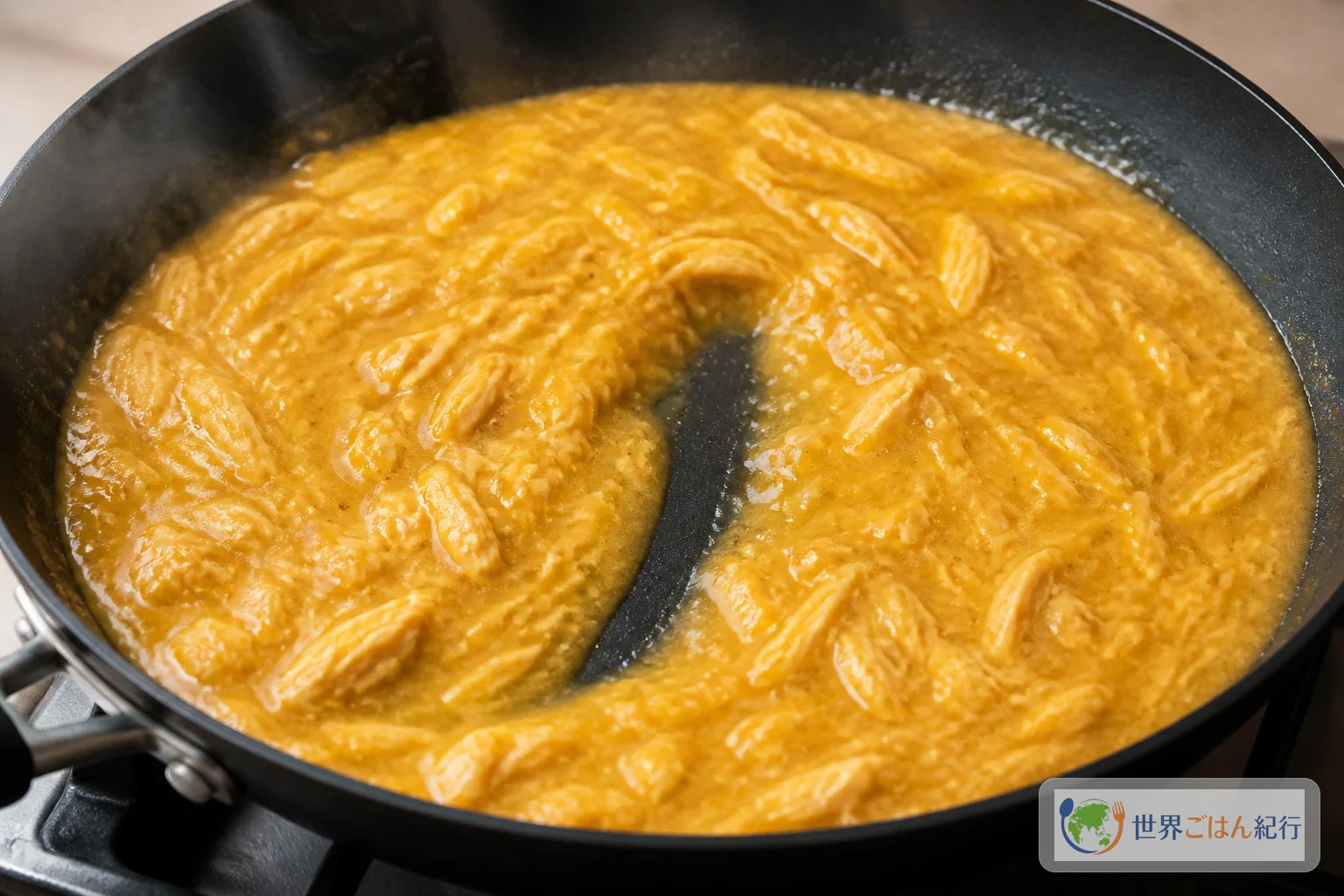
If it has reduced too much, add 50 ml of the reserved cooking liquid and rewarm over low heat. If on the other hand it is loose, cook without the lid for just 2 to 3 minutes. Bread holds more liquid as it cools, so a sauce that is a little loose in the pot will be just right at serving.
6. Plate with the potatoes and accompaniments
duration: 15 min
Peel the potatoes, cut into 2 cm thick rounds, and boil in water just covering them for 12 to 15 minutes. When a bamboo skewer goes into the center without resistance, drain in a colander. Put rice on one side of the plate, arrange the potatoes, and spoon plenty of ají de gallina over.
Cut the boiled eggs into quarters and add them with the black olives. If you keep back a little of the pecans, scattering them at the end makes the toastiness stand out against the smooth sauce.
Tips for adjusting smoothness and heat
Do not decide the heat by the amount of paste alone
Ají amarillo differs in heat and saltiness from product to product. If you are uneasy about putting in 60 g from the start, use 30 g at the sautéing stage and add the rest little by little after simmering the sauce. However, paste added later has a weaker cooked aroma, so if aroma matters, sautéing the whole amount is better.
Thickness comes from the bread, richness is restored with broth
More bread makes the sauce firmer, but also makes the bread flavor stronger. When it has become firm, first add chicken broth 20 to 50 ml at a time rather than milk, which thins it without increasing the saltiness. Adjust the salt and grated cheese at the end only if the taste seems thin.
Under-cooking stays in the aroma
If you add liquid right after adding the ají amarillo, the green aroma comes forward. The guide is to add the bread after the oil has turned yellow and the onion and paste have become one. If you have burnt it, do not stir in the black bits from the bottom; move only the top part to another pan and continue.
Recovering chicken that has gone hard
If you overcooked the breast and it has gone hard, shred it finely along the grain and add 50 ml chicken broth to the sauce. Warm it over low heat for 3 minutes, turn off the heat, cover and leave for 5 minutes, and the moisture of the sauce goes back into the meat. Adding only water and continuing to cook thins the taste, so use broth.
Cook the chicken through to the center, and when reheating, heat until the whole dish is thoroughly hot. When eating make-ahead portions, check that the internal temperature reaches 74°C.
Where it comes from: from a sweet dish to a yellow-chili plate
The origin of ají de gallina is less a straight line from one kitchen than a history in which several food cultures overlapped. WIPO's material on Peruvian food culture describes the fusion of 16th-century Quechua and Spanish cooking and a relation to manjar blanco, a Spanish sweet.
The early dish is explained as close to a sweet, rich cream using chicken breast, rice, almonds and sugar. Then ají amarillo was added, and by around 1839 it was being recorded as a lightly salty dish. This account is a summary of research material, and does not mean that today's home cooking keeps to one fixed recipe.
That is why there is a range in the amount of bread, the type of nut and the cut of chicken. When cooking it elsewhere too, keeping the axis of softening bread in broth and milk, rather than replacing the bread with flour or cream to make a different stew, connects the dish's history and its texture.
Regional differences and the table: known in Lima, eaten across Peru
Ají de gallina is sometimes introduced as a dish of Lima, but the WIPO material cannot say it is a dish of one region only and summarizes it as part of the diet across Peru. Differences in the chicken, potatoes, chilies and dairy used in markets and homes of each region show up in the strength of the dish and its accompaniments.
If you think of regional differences only as differences in heat, you see the range of the dish too narrowly. The impression also changes with whether you combine dried ají mirasol with the ají amarillo, whether you use pecans, walnuts or almonds, and in what ratio you plate rice and potatoes. Versions using a hen rather than a chicken, and home variations extending to fish or vegetables, are also described.
Potatoes also differ between the yellow and white varieties commonly eaten in Peru. Choose a waxy variety that holds its shape for a clean form, or a floury variety for a fluffy mouthfeel. Either way, it is important to cut them 2 cm thick as a base to receive the sauce, and not to make the boiled potatoes watery.
What changes when you substitute ingredients
1. From chicken breast to chicken thigh
Breast is lighter eaten with the sauce and lets the aroma of the chicken broth show. Thigh has fat, so even if warmed a little longer it does not easily harden, and the dish becomes richer. But if simmered with the skin on, fat floats up, so remove the skin or let it cool and take off the fat from the surface.
2. From paste to fresh yellow chili
If you can get fresh ají amarillo, adjust the seeds and pith, mince it and sauté it with the onion. It has a lot of water, so rather than replacing 60 g of paste with the same weight, reduce the broth while watching the moisture of the sauce. Using rehydrated dried ají mirasol adds a dry depth to the aroma.
3. From white bread to salted crackers
Crackers absorb liquid faster than bread and make the sauce set more easily. Rather than putting in all 60 g from the start, mix in half and check the thickness. If using salted crackers, cut the 7 g of salt in the ingredient table to half or less and decide after adding the cheese.
4. From pecans to walnuts or almonds
Pecans have a sweet toastiness and soft fat that round out the sauce. Walnuts bring a slight astringency, so dry-roasting them lightly before use balances the aroma. Almonds are hard, so blend longer or chop finely before adding.
5. From milk to evaporated milk
Evaporated milk has less water than milk and gives a richer finish. Swapping the same amount tends to make it firm, so the first time use evaporated milk for only 150 ml of the 200 ml of milk and adjust the rest with cooking liquid.
6. From chicken to fish or vegetables
There are also versions that swap in white fish, tuna or mushrooms. Fish falls apart if simmered long in chicken broth, so add it at the end after the sauce is finished. Enjoy this as another development using the flavor axis of ají de gallina, and do not use the same cooking time as for the chicken recipe.
Storage and reheating
Once the sauce and chicken have cooled slightly, move them to a shallow storage container. Eat refrigerated portions within 2 to 3 days; if freezing, divide only the sauce and chicken into single servings and use within about 1 month. Keeping the rice, potatoes, eggs and olives separate prevents their texture from breaking down after thawing.
Refrigerated sauce firms up as the bread holds more liquid. Move it to a pot, add 30 to 50 ml chicken broth or milk, and warm over low heat, stirring. Thaw frozen portions in the refrigerator before warming, and check that the whole dish is hot and has reached 74°C at the center. If using a microwave, heat one portion at a time with the lid slightly ajar and stir once partway.
FAQ
Is ají de gallina a very spicy dish?
It depends on the type and amount of paste. For less heat, start with 30 g and add yellow bell pepper to make up the color and sweetness. If you substitute chili flakes alone, heat comes out but the aroma of ají amarillo cannot be reproduced.
Does the chicken breast get dry?
Do not keep it boiling, and take it out early once the internal temperature reaches 74°C. After returning it to the sauce, warm it for only 5 minutes over low heat; the trick is not to simmer it for a long time. Switching to chicken thigh gives a texture better suited to simmering.
Can I make it without a blender?
Yes. Soak the bread longer, chop the pecans finely, then mash with a mortar or fork. It is less smooth, but becomes a homey sauce with a few grains of bread remaining.
What if the sauce is too firm?
Add chicken broth 20 to 50 ml at a time and stir while warming over low heat. It firms up again as it cools, so adjust by looking not only at the thickness just before it goes to the table but also at how it spreads after plating.
Is there a substitute for ají amarillo paste?
There is a substitute using yellow bell pepper and a little hot chili. To check the direction of the flavor, see the mix in how to substitute for ají amarillo. The point is not only adding heat but how to make up the yellow color and fruity aroma.
What if I want to avoid dairy or wheat?
Bread can be swapped for wheat-free bread or crackers, and milk for unsweetened plant-based milk. However, the finish changes with the sweetness and aroma of the plant milk and how much the bread absorbs. Leaving out the grated cheese lowers saltiness and richness, so check the ingredients and salt of substitutes and adjust little by little.
Peruvian dishes to cook alongside
If you want to try the aroma of yellow chili in another texture, papa a la huancaína, with cold potatoes under a cheese sauce, is a good fit. When you cannot find ají amarillo nearby, how to make a substitute sauce lets you check the difference in aroma and heat. To add more Peruvian dishes that go with rice, lomo saltado, which stir-fries beef and tomato with the scent of soy sauce, is also a candidate.
Sources
- Ají de Gallina | Peru Travel (English) - Checked the ingredients, how the chicken is cooked, the sauce using bread and milk, and the serving. Accessed and checked 23 August 2026
- Analysis of the Economic, Social and Cultural Impact of the Peruvian Gastronomy (WIPO, English PDF) - Checked its presentation as a dish of Lima and its place across Peru, the fusion of Quechua and Spanish cooking, its relation to manjar blanco, and the history of ají amarillo. Accessed and checked 23 August 2026
- Aji de Gallina (SkyKitchen Peruvian Cooking Classes, English PDF) - Checked the cooking time of the chicken, the step of soaking bread in milk and broth, ají amarillo and ají mirasol, nuts, and the fish variation. Accessed and checked 23 August 2026
- Aji de gallina recipe (Great British Chefs, English) - Checked the thickness of the sauce, the chicken and accompaniments, and the cooking note that the flavor settles by the next day. Accessed and checked 23 August 2026
- Safe Minimum Internal Temperatures (FoodSafety.gov, English) - Checked the internal temperature of 74°C (165°F) for chicken and for reheating. Accessed and checked 23 August 2026
- Conoce la historia del legendario ají de gallina (Marca Perú, Spanish) - Cross-checked the history of the dish's name, its relation to sweet manjar blanco, its turn to a salty dish around 1839, and modern plating. Accessed and checked 23 August 2026


