


The Story of the Ají Amarillo Substitute: When One Small Yellow Jar Stops Your Shopping
You set out to make Peruvian food and, in the supermarket aisle, one ingredient stops your hand. Beef, onion, tomato, and lime are all there. But the ají amarillo in the recipe is not. Jarred paste can be found online some days, but when you want to cook dinner tonight you can't wait for an imported ingredient.
Ají amarillo is the chile that makes the "yellow heat" of Peruvian cooking. The name means "yellow chile," though when ripe it is closer to orange than yellow. It is not only hot; it has a fruitiness reminiscent of mango or passion fruit, and it goes into the tiger's milk of ceviche (in Japanese), the stir-fry sauce of lomo saltado, and the yellow cream of papa a la huancaína.
But aiming for an exact copy in a home kitchen is tiring. What matters is not claiming "it's the same as the real thing" but deciding what to protect and what to change. The skeleton of ají amarillo is a bright yellow color, fruity sweetness, medium heat, and a slightly green aroma. Build that from yellow bell pepper, a little chile, turmeric, and lime, and the taste of a Peruvian food day gets much closer.
In this article we make a substitute sauce for days you can't get ají amarillo paste. The star is yellow bell pepper. On top of it go chile for heat, turmeric to support the color, and garlic and lime to wake up the aroma. It covers everything from shopping to storage, including using it as a paste in stir-fries and as a yellow sauce combined with mayonnaise or cheese.

This is not an article denying real ají amarillo. If you can get jarred paste, using it comes closest. This is a substitute guide for the days you can't find it nearby, for building "Peruvian-style yellow heat" for a home kitchen from yellow bell pepper and chile.
First, Know This: Ají Amarillo Is Not Only Heat
If you replace ají amarillo with chile flakes or hot sauce, both the color and the aroma of the dish go off. You can add heat, but the round yellowness of Peruvian cooking disappears. The Spruce Eats introduces ají amarillo as an essential chile in Peruvian cooking and puts its heat at about 30,000–50,000 SHU. That is fairly hot, but not as wild as a habanero.

Peru Delights explains that Peruvian households and cooks make ají amarillo into a paste for huancaína, ají de gallina, causa, and more. The basic method is to boil fresh or frozen chiles, peel them, remove the seeds and veins, and purée until smooth. To tone down the heat, it also describes changing the boiling water several times.
What this process shows is that ají amarillo paste is not "concentrated heat" but the color and aroma of the flesh, made smooth. So even in a substitute, don't rely on chile powder alone; use the flesh of yellow bell pepper. Yellow bell pepper isn't hot, but it can handle the yellow, the sweetness, and the body. Add the heat separately with another chile. Dividing the work this way makes it easy to adjust at home.
| Role of ají amarillo | Ingredient covering it in the substitute | Watch for |
|---|---|---|
| Yellow to orange color | Yellow bell pepper, a little turmeric | Too much turmeric turns it curry-like |
| Fruity sweetness | Yellow bell pepper, a little raw cane sugar | Too much sugar moves it toward sweet chili |
| Medium heat | Yellow chile, a little habanero, cayenne | For family meals, add more later |
| Green aroma | Fresh chile, garlic, lime | Tube garlic gives a flat aroma |
| Body of the paste | Roasted yellow bell pepper, oil | Too much water dilutes the dish |
What is close to irreplaceable is the fruity aroma specific to ají amarillo. Yellow bell pepper and chile can get you quite near, but it will not be completely the same. So this article gives priority to a landing point on the dish side: a sauce that doesn't fall apart when used in lomo saltado or ceviche.
Fresh ají amarillo is hard to find in many places, so jarred or frozen paste is the realistic first purchase. Once the substitute sauce has shown you the direction of the flavor, buy real paste once and compare; the difference in fruitiness and aroma becomes clear.
Substitute Ingredients: Build on Yellow Bell Pepper
The first thing to look for when shopping is not a rare chile but yellow bell pepper. It isn't hot, but heating brings out sweetness, and blended it makes the body of a yellow paste. Adding a small amount of hot chile keeps the heat from being sharp and makes it easy to use as a sauce.

Order of Substitution
| What you have | Direction it approaches | Suits |
|---|---|---|
| Yellow bell pepper + yellow chile | Color, fleshiness, natural heat | Ceviche, huancaína, chicken sauce |
| Yellow bell pepper + a little habanero | Fruitiness and strong heat | Lomo saltado for heat lovers, grilled fish |
| Yellow bell pepper + cayenne | Easy to buy, easy to adjust heat | Stir-fries, a stopgap paste |
| Yellow bell pepper + green chile | Aroma comes through, color a bit dull | Chicken, vegetable dips |
| Turmeric + chile flakes only | Color and heat, but no fruitiness | The bare minimum on a day with nothing else |
Korean chile or gochujang looks handy for color and heat alone, but the direction of flavor changes. Korean chile flakes have a sweet aroma and can be used in small amounts. Gochujang is strongly sweet and fermented, leaning to Korean rather than Peruvian cooking. Doubanjiang is the same, with the fermented aroma of broad-bean paste coming through strongly.
A yellow chile is ideal if you can find it, but supermarkets will more likely have red chiles. In that case, use only a little red chile and leave the color to the yellow bell pepper and turmeric. Start turmeric at 1/8 tsp. If you increase it because the color is short, you get the aroma of curry powder rather than Peruvian cooking.
When you handle habanero or fresh chiles, use disposable gloves if you can. Touching your eyes or lips after cutting them stings badly. If the heat stays on your hands, wash with soap, rub in a little oil, and wash again; it comes off more easily.
Days to Buy the Real Thing, Days the Substitute Is Enough
If you can buy real ají amarillo, it is closer. Fudging it flattens the aroma of Peruvian cooking. But it isn't worth postponing dinner while you wait for a jar. Separating dishes the substitute suits from those where you should buy the real thing reduces hesitation when shopping.

| Dish you want to make | Is the substitute enough? | Reason |
|---|---|---|
| Lomo saltado | Enough | Soy sauce, vinegar, beef, and tomato have strong aromas. The yellow heat sits in the background at 1–2 tbsp |
| Ceviche | Enough in small amounts | Fish and lime are the stars. Starting from 1 tsp, it supports color and aroma |
| Papa a la huancaína | Real recommended | The yellow sauce itself is the star. With a substitute, the sweetness of the bell pepper comes forward |
| Ají de gallina | Real recommended | Ají amarillo supports the aroma of the chicken cream, so the fruity difference shows |
| Chicken marinade, grilled corn | Substitute is plenty | Combined with dairy, lime, and oil, it is easy to adjust for home |
For a first time, the easy route is to make the substitute sauce, use it in lomo saltado, and try the rest mixed into mayonnaise or yogurt. If you then feel "I want more fruitiness," next time real paste is worth buying. Conversely, if you want something milder for the family, the bell pepper substitute can be easier to handle.
Ají amarillo paste is strongly aromatic and not a seasoning you finish in one go after opening. Choose a small jar or frozen product at first, and freeze leftovers in an ice cube tray so you can use it little by little in ceviche, lomo saltado, and chicken marinades.
Ingredients (makes about 8 servings)
This amount fills one small jar. For lomo saltado, use 1–2 tbsp for four servings; for the tiger's milk of ceviche, 1–2 tsp; for a yellow dip sauce, about 2 tbsp. Make it mild at first and add chile just before eating, which is easier to adjust for a family.

If you handle heat well, use 2 yellow chiles or 1/4 habanero. For a family meal, start with 1 chile. Real ají amarillo is medium-hot or more, but with a substitute it is safer to design it so you can "add later."
Ingredients and Tools for This Sauce
Only if you can't find yellow chiles or ají amarillo paste nearby should you look online. Buy the yellow bell pepper and lime at the supermarket, and look online only for the paste or storage containers, which wastes the least.
How to Make It: Roast, Bring Out the Sweetness, Add Acidity Last
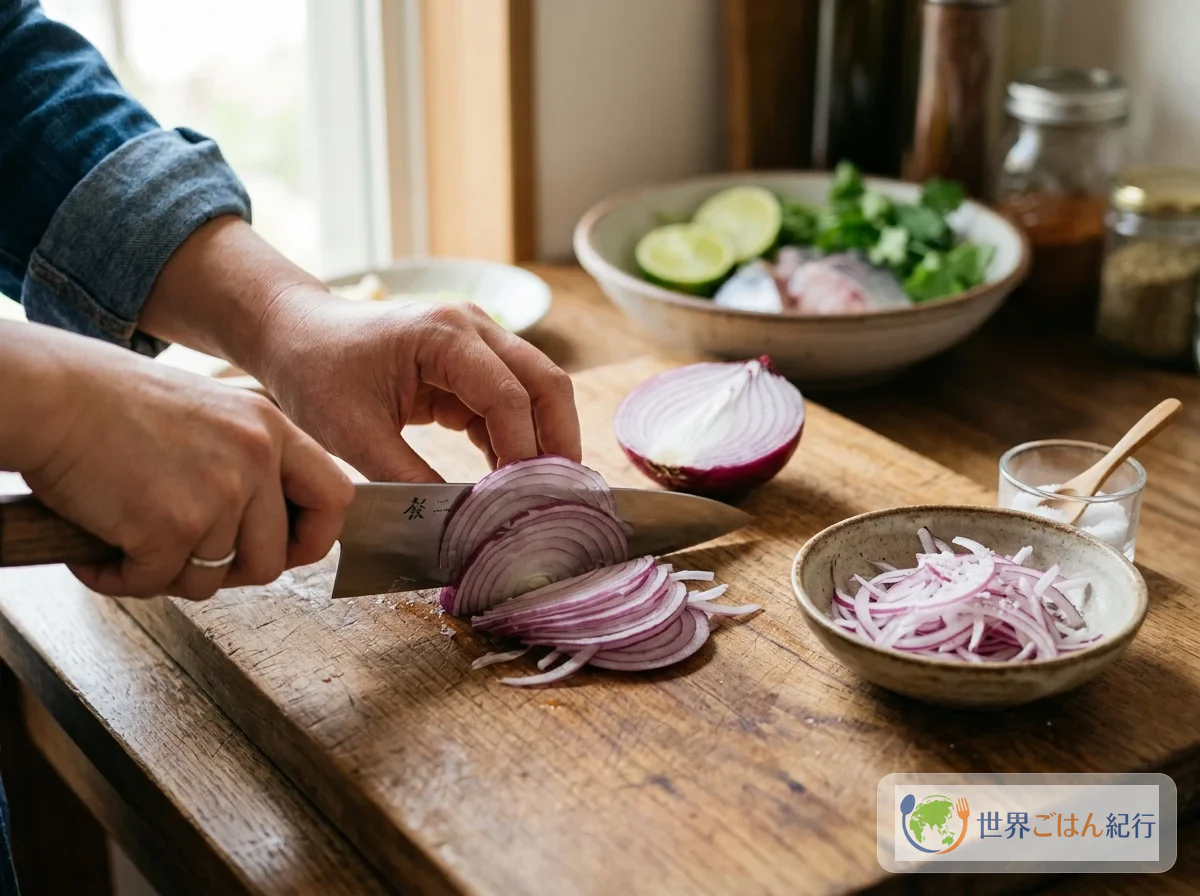
For the ají amarillo substitute sauce, lightly cooking the yellow bell pepper and onion holds together better than blending everything raw. We want to keep a little of the raw green aroma, so there's no need to char it black. Brown the surface, drive off moisture, and bring out the sweetness.
With real ají amarillo paste, peeling the boiled chiles is a common step. With the yellow bell pepper substitute, skins are fine if you have a home blender. Peel after roasting only if smoothness matters most to you.
Adjusting the Flavor by Use
Even for the same "ají amarillo substitute," adjustments differ depending on whether you use it in ceviche, lomo saltado, or a huancaína-style cream. Make the basic paste first, divide it up, and adjust per dish, and you are less likely to fail.

For Ceviche
In ceviche, it matters not to make the heat too strong. So as not to erase the delicate aromas of white fish, lime, and onion, start with 1 tsp of the basic paste for the tiger's milk of two servings. Even if you want more yellow, go no higher than 2 tsp. If you want more heat, it looks cleaner to finish with a few thin slices of chile rather than more paste.
For Lomo Saltado
Lomo saltado needs body that doesn't lose to beef, soy sauce, vinegar, and tomato. For four servings, add 1–2 tbsp of the basic paste when you sauté the onion and garlic. The lomo saltado recipe uses 2 tbsp of ají amarillo paste, but substitutes are often milder, so you may taste and go up to 2 tbsp.
For a Huancaína-Style Sauce
Blend 2 tbsp of the basic paste, 40 g cream cheese, 3 tbsp milk or unsweetened soy milk, 2 crackers, and a little salt, and you have a home version of a huancaína-style sauce. Authentic papa a la huancaína is a cream sauce of yellow chile, white cheese, crackers, milk, and more. Poured over potatoes, hard-boiled egg, and lettuce, it makes a very fun entry point to Peruvian food.
For Less Heat
Leave out the chile and make it with just 2 yellow bell peppers, 1/8 tsp turmeric, lime, and garlic. The heat nearly disappears, but the base of color and aroma stays. For a table with children, make it this way and let adults add cayenne or habanero powder on the plate.
Mixing In Real Paste
If you have a little jarred ají amarillo paste left, mixing in 1–2 tsp to the basic paste brings back a good deal of the aroma. Combining substitute and real is not cheating. In fact, the bell pepper rounds out the heat and saltiness of an imported product, which suits a home kitchen.
Using It in Ceviche, Lomo Saltado, and Chicken
The substitute sauce isn't "made and done"; its value is decided by how it goes into a dish. Ají amarillo can be used as a hot sauce at the edge of the plate, as the aromatic base of a stir-fry, or as a cream combined with dairy.

| Dish | Amount | When to add | A word |
|---|---|---|---|
| Ceviche, 2 servings | 1–2 tsp | Mixed into the tiger's milk | Too much hides the taste of the fish |
| Lomo saltado, 4 servings | 1–2 tbsp | When sautéing onion and garlic | Wake up the aroma in oil |
| Chicken thigh marinade | 2 tbsp | Mix with yogurt and lime, 30 minutes | Wipe the surface lightly before grilling to reduce burning |
| Huancaína-style sauce | 2 tbsp | Blend with dairy and crackers | Goes with potatoes and hard-boiled egg |
| Mayo sauce | 2 tsp | Mix with 3 tbsp mayonnaise | Good for french fries and grilled corn |
| Soups and stews | 1 tbsp | Sauté with onion | Becomes the base of color and aroma |
In ceviche, make the acidity stronger. Blend 1 tsp of the basic paste, 2 tbsp lime juice, salt, cilantro, and a few trimmings of white fish into a yellowish tiger's milk. Combine it just before eating so the aroma of the lime doesn't fly off.

In lomo saltado, the aroma comes out better if you fry the paste in oil for about 30 seconds and then combine it with the beef and tomatoes, rather than mixing it in at the end as it is. Soy sauce can taste rounder than Peruvian sillao, so a slightly stronger hand with red wine vinegar or rice vinegar gives it a more South American outline.
For chicken, mix 2 tbsp of the basic paste, 3 tbsp yogurt, 1 tbsp lime, and 1/2 tsp salt, and marinate 2 chicken thighs for only 30 minutes. Marinate too long and the acid tightens the surface of the meat, so for a weeknight dinner 30 minutes is plenty. Wiping the paste lightly off the surface before cooking reduces burning.
Pastes of the ají amarillo type round out in aroma when briefly heated with oil. This move works in lomo saltado, soups, and chicken sauces. Only for raw dishes like ceviche, mix in a small amount without heating.
Failures: Fixing the Curry Taste, Wateriness, and Excess Heat
The most common failure with the ají amarillo substitute is adding too much turmeric and getting a curry taste. You want it yellow, but turmeric is strong in aroma as well as color. Color from yellow bell pepper, heat from chile, turmeric as a supplement. Keep to this order and the flavor wanders less.

| Symptom | Cause | Fix |
|---|---|---|
| Tastes like curry | Too much turmeric | Roast and add another yellow bell pepper. Strengthen the lime a little |
| Watery | Moisture from the bell pepper, too much added water | Cook in a small pot over low heat to drive off moisture |
| Too hot | Too much habanero or too many seeds | Dilute with roasted yellow bell pepper, yogurt, or mayonnaise |
| Bitter | Burnt garlic, chile, or skin | If heavily burnt, start over. If slight, add a little sugar and lime |
| Pale color | Too little yellow bell pepper or oil | Add yellow bell pepper. Turmeric only up to 1/8 tsp |
| Doesn't feel Peruvian | Weak fruitiness and acidity | Adjust with lime, a little raw cane sugar, and a little garlic |
When it is watery, the cause is often water added in the blender. If it won't turn, add oil, lime, or rice vinegar a little at a time instead of water. Since it is a paste for use in dishes, a consistency where it falls off a spoon rather than flowing like liquid is easiest to handle.
When it is too hot, you can't take the chile out. Add another roasted yellow bell pepper, or mix it with dairy in the huancaína style. Paste too hot for ceviche is safer sent to lomo saltado or chicken marinade rather than fish.
Chile heat can't be reversed by simply diluting it the way you can with salt. Make it milder at first and let adults add habanero powder or cayenne on their own plates. Especially at tables with children, older people, or anyone sensitive to heat, make low heat the default.
Storage and Making Ahead: About 4 Days Refrigerated, 1 Month Frozen
This substitute sauce is cooked, but it has not been sterilized or acidity-controlled like a commercial product. Put it in a clean container and use it up within about 3–4 days in the refrigerator. Peru Delights describes freezing real ají amarillo paste in an ice cube tray, and freezing a home substitute in portions is handy too.

| Storage method | Guide | Suited to |
|---|---|---|
| Refrigerated | 3–4 days | Lomo saltado, chicken, mayo sauce |
| Frozen | About 1 month | Freeze 1 tbsp at a time and use in stir-fries |
| Sauce mixed with dairy | Day of to next day | Potatoes, hard-boiled egg, french fries |
| Room temperature | Not allowed | Put only what you will serve in a small dish |
For a storage container, a glass container scalded with boiling water and dried is easy to use. Closing it hot lets condensation drip in, so let it cool before closing the lid. Use a clean spoon each time, and don't return a spoon that has touched meat or fish to the container.
To freeze, wrap in 1 tbsp portions in an ice cube tray or plastic wrap. It separates a little after thawing, but that is fine for stir-fries. For raw dishes like ceviche, freshly made smells better than frozen.
Mixing in cream cheese, milk, or mayonnaise shortens the keeping time. Store only the basic paste, and combine it with dairy in the needed amount on the day you eat, for stable flavor and hygiene.
Background: Peruvian Cooking Is Connected by "Yellow Heat"
Looking across Peruvian cooking, ají amarillo is used less as a mere chile than as a thread connecting dishes: the leche de tigre of ceviche, the cream of ají de gallina, papa a la huancaína, the sauce of lomo saltado. The dishes differ in form, but the yellow heat moves them toward "the taste of Peru."

Peru Delights explains that much Peruvian cooking rests on the "aderezo," a base of onion, garlic, and chile paste fried together. Like an Italian soffritto, aromatics are sweated in oil, then ají amarillo, ají panca, coriander, and others are added to make the aroma of soups, stews, and sauces.
This way of thinking is easy to apply in any home kitchen. Rather than making an unusual dish from zero each time, make a small batch of yellow paste and use it one day for stir-fried beef, another day for a chicken sauce, and another for a potato dip. Then Peruvian cooking is not a one-off event but a tool that stays in your refrigerator.
As the overview of South American cuisine (in Japanese) also notes, South American food builds the table not only from meat and fish stars but from sauces, sides, rice, beans, and tubers. The ají amarillo substitute sauce is a small part within that, in charge of "color" and "heat."
What we want to protect in a home kitchen is not an imitation that passes for the real thing. It is understanding the balance of yellow color, fruitiness, heat, and acidity that ají amarillo has, and seeing how close you can get with what you can find. With that judgment, Peruvian cooking suddenly becomes easier to make.
South American Dishes to Cook Next for Better Understanding
The ají amarillo substitute sauce has more uses if you see it as part of South America's sauces and sides rather than learning it alone. Having entered through Peruvian cooking, branch sideways to sauces that brighten meat, flours that support beans, and sour side dishes, and the seasoning in your refrigerator won't be a one-time purchase. Links without a locale prefix lead to the Japanese articles.
| Article to read next | Why it connects |
|---|---|
| Peruvian cuisine overview | Places ají amarillo, ceviche, and chifa |
| South American cuisine overview | See combinations of sauce, meat, beans, and tubers across regions |
| Ceviche | Shows the feel of using a little yellow heat in tiger's milk |
| Lomo saltado | Shows how soy sauce, vinegar, and chile fuse in South America |
| Chimichurri | Easy to compare as an acidic sauce that supports meat |
| Empanada | Applies to pairing wheat dough with a hot sauce |
| Locro | Close in idea to adding chile oil to a bean-and-tuber stew |
| Churrasco | Lets you feel the role of a sauce served with grilled meat |
| Vinagrete | Shows the idea of lightening meat with acidity and vegetables |
| Farofa | Shows the idea of a side that catches the meat juices |
| Feijoada | Shows bean dishes paired with heat and acidity |
| Salteña | Connects to Andean spice use and filled pastries |
| Pastel de choclo | Compare how corn sweetness pairs with heat |
| Bandeja paisa | Close in idea to composing meat, beans, rice, and sauce on one plate |
| Ropa vieja | Compare layering aromatics and acidity on stewed meat |
| Encebollado | See the combination of fish, onion, and acidity in another region |
| Griot | A reference for pairing citrus and heat with pork |
| Jerk chicken | Close in idea to supporting chile heat with aroma and sweetness |
| Mole poblano | Read as an example of chile as the skeleton of a sauce, not just heat |
| Mofongo | See how tubers, oil, and garlic pair with a hot sauce |
| Chivito | Compare where to put sauce and acidity with a meat dish |
| Arepas | An application: serving a hot sauce with corn dough |
| Ackee and saltfish | Compare chile and seafood aroma used at breakfast |
| Doubles | Close in idea to serving chutney and hot sauce with street food |
Frequently Asked Questions
The ají amarillo substitute is a seasoning where the use is more confusing than the ingredient names. Here we sort out whether to buy or make it, and how much to put in which dish.

Q1. Where can I buy ají amarillo paste?
You can sometimes find it at Latin American grocery stores, international food stores, and online. Search for "ají amarillo," "aji amarillo paste," or "pasta de ají amarillo." Where there are shops that handle South American food, frozen products may also turn up.
Q2. Can I substitute with yellow bell pepper alone?
You get color and sweetness, but heat and aroma are lacking. In a household that avoids spicy food, yellow bell pepper alone can be used, but for a Peruvian feel add a little chile, garlic, and lime.
Q3. Will more turmeric make it yellow?
It becomes yellow, but with the aroma of curry. Keep turmeric to 1/8 tsp, and at most 1/4 tsp. Leaving the color to the yellow bell pepper gets closer to the mood of Peruvian cooking.
Q4. How much should I put in ceviche?
Start with 1 tsp for the tiger's milk of two servings. If you want more yellow, go up to about 2 tsp. In ceviche, fish and lime are the stars; too much hot paste erases the quality of the fish.
Q5. Can I make it for kids?
Yes. Leave out the chile and make it with just yellow bell pepper, a little garlic, lime, and salt. Adults add cayenne or habanero powder on their own plates. It is easier to adjust at the table if you don't make the whole pot hot from the start.
Q6. Can I use gochujang or doubanjiang?
As a stopgap, yes, but the flavor changes a lot. Gochujang is sweet fermented paste and doubanjiang has the fermented aroma of broad-bean paste, so the result leans Korean or Chinese rather than Peruvian. If you use them, keep to about 1 tsp and restore the direction with yellow bell pepper and lime.
Q7. My stored sauce separated. Can I still use it?
If the oil and water have only separated a little in the refrigerator, stir with a clean spoon and use it. If there are bubbles, sliminess, an off smell, or mold, discard it without eating. Sauces mixed with dairy spoil easily, so finish them from the day of to the next day.
Summary: Think of Yellow, Fruitiness, and Heat Separately
Even on a day without ají amarillo, you don't have to give up on Peruvian cooking. Make color and sweetness with yellow bell pepper, add heat with chile, turmeric only a little. Raise the aroma with lime at the end, and you have a yellow substitute sauce usable in lomo saltado and ceviche.

If you can get real ají amarillo paste, do compare them once. There is a fruity aroma the substitute can't produce. But having made the substitute, you begin to see the taste of Peruvian cooking not as a "mysterious imported ingredient" but as a combination of color, aroma, heat, and acidity.
Start by making just one small jar of the basic paste, and use 1 tbsp in lomo saltado and 1 tsp in ceviche (in Japanese). Mix the rest into mayonnaise for potatoes or grilled corn. Just having a yellow sauce in the refrigerator makes a Peruvian food day much easier to start.
Sources
For handling ají amarillo, making paste, the guide to its heat, and the idea of the Peruvian aderezo, we consulted English-language explanations of Peruvian cooking and recast the amounts so they can be reproduced in a home kitchen.
- Peru Delights, "How to Make Aji Amarillo Paste." https://perudelights.com/how-to-make-aji-amarillo-paste/
- Peru Delights, "Aji Amarillo - The Aroma And Flavor of Heat." https://perudelights.com/aji-amarillo-the-aroma-and-flavor-of-heat/
- Peru Delights, "The Most Basic Recipe Of All: Aderezo." https://perudelights.com/the-most-basic-recipe-of-all-aderezo/
- The Spruce Eats, "Aji Amarillo: Peruvian Yellow Chili Pepper." https://www.thespruceeats.com/aji-amarillo-peruvian-yellow-chile-pepper-3029288
- Eat Peru, "Aji Amarillo Sauce Recipe." https://www.eatperu.com/aji-amarillo-sauce-recipe/
- How to make ceviche (in Japanese)
- How to make lomo saltado


