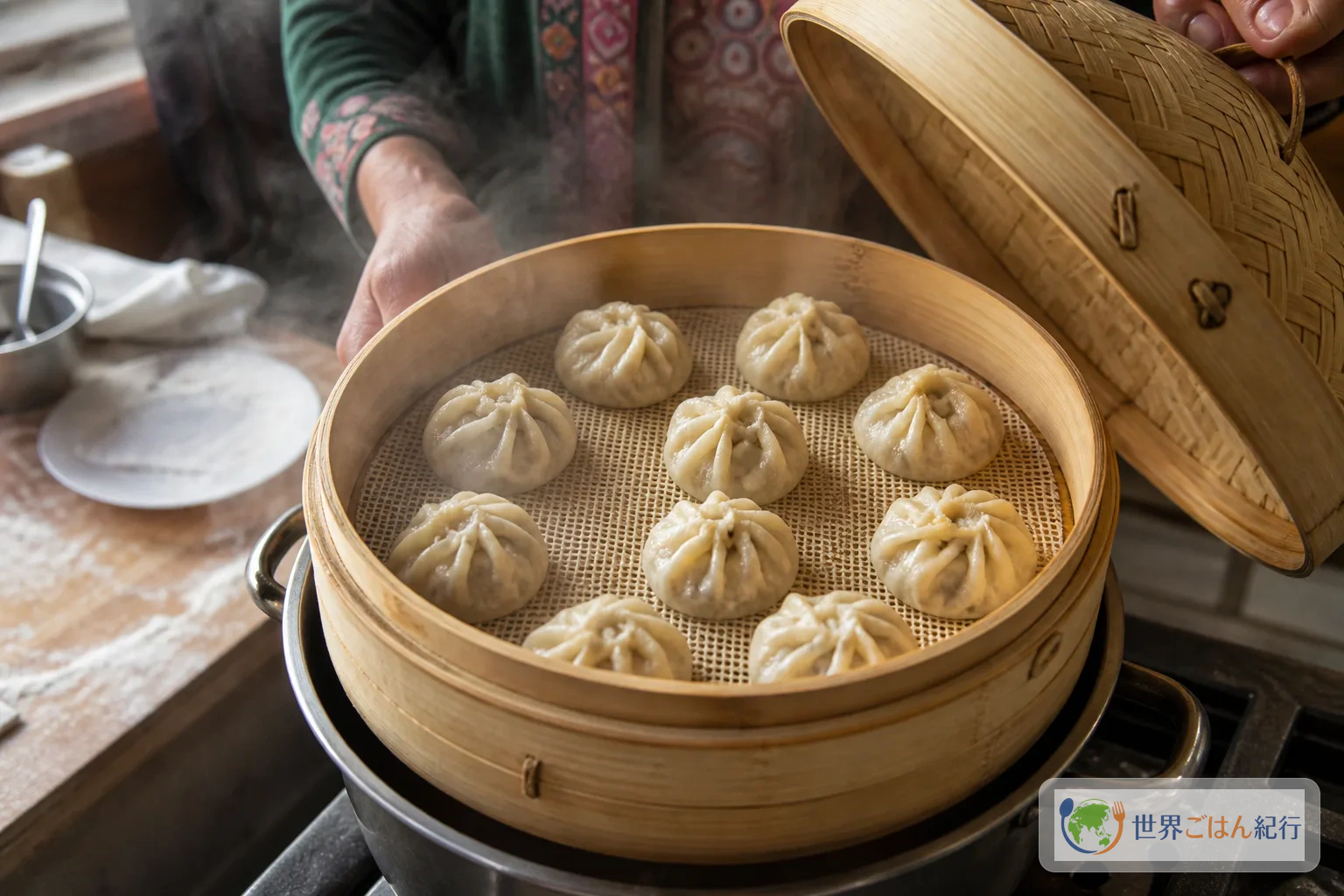
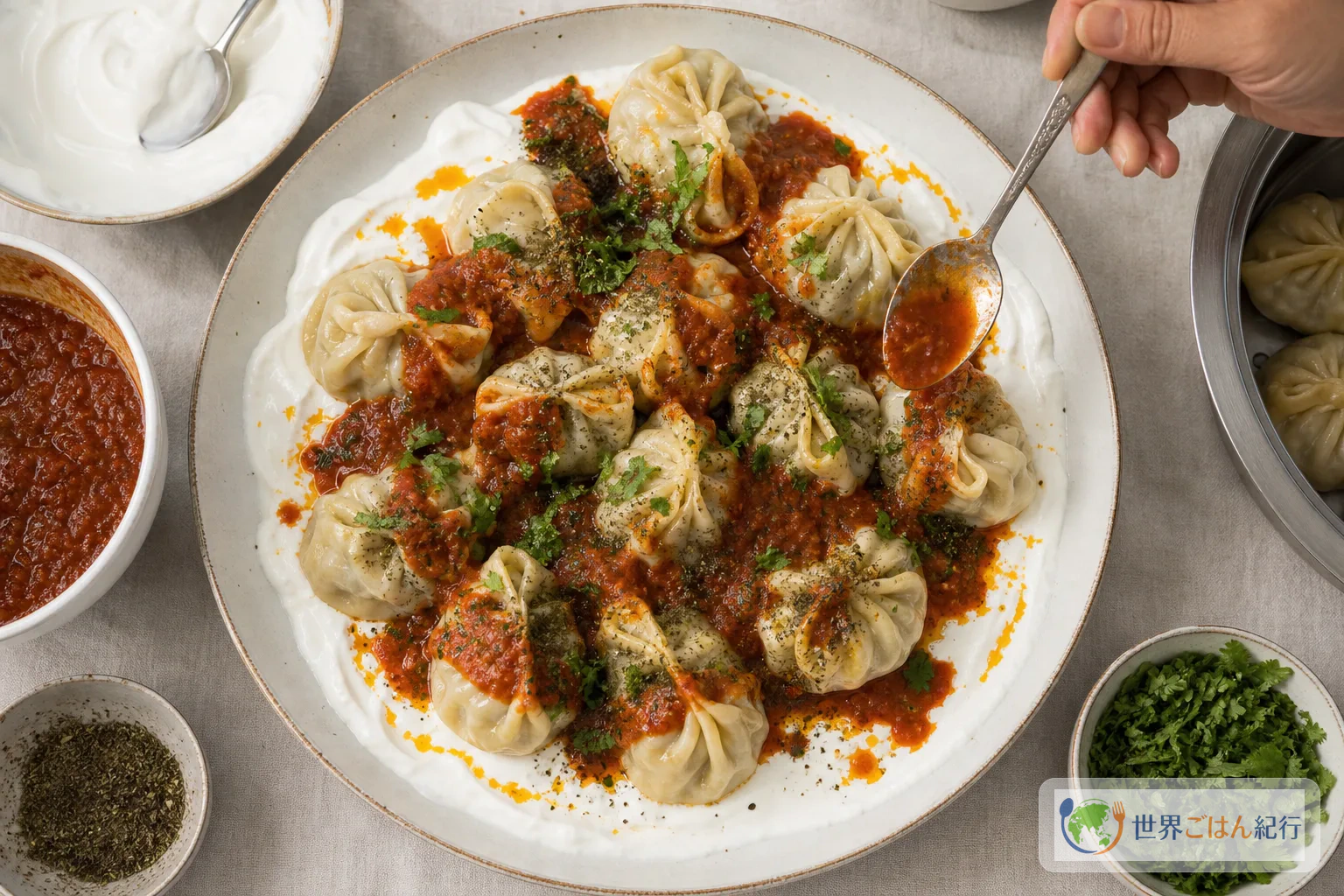
After the steam, a plate of mantu
When you lift the dumplings out of the steamer, the smell of the dough comes first.
Then the sweet scent of onion, the dry aroma of cumin and the cool of garlic yogurt catch up.
Mantu, also written mantoo, are Afghan steamed dumplings.
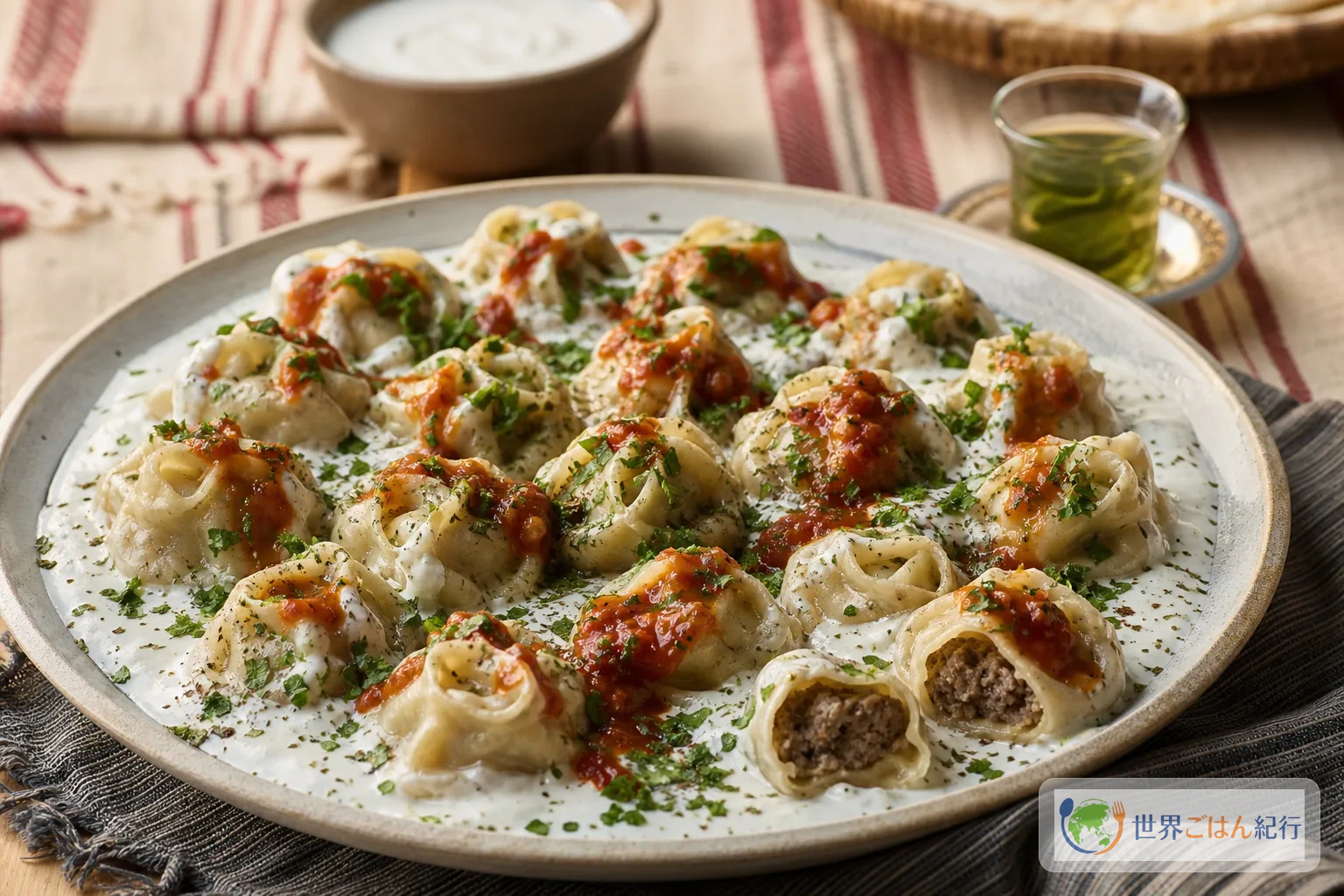
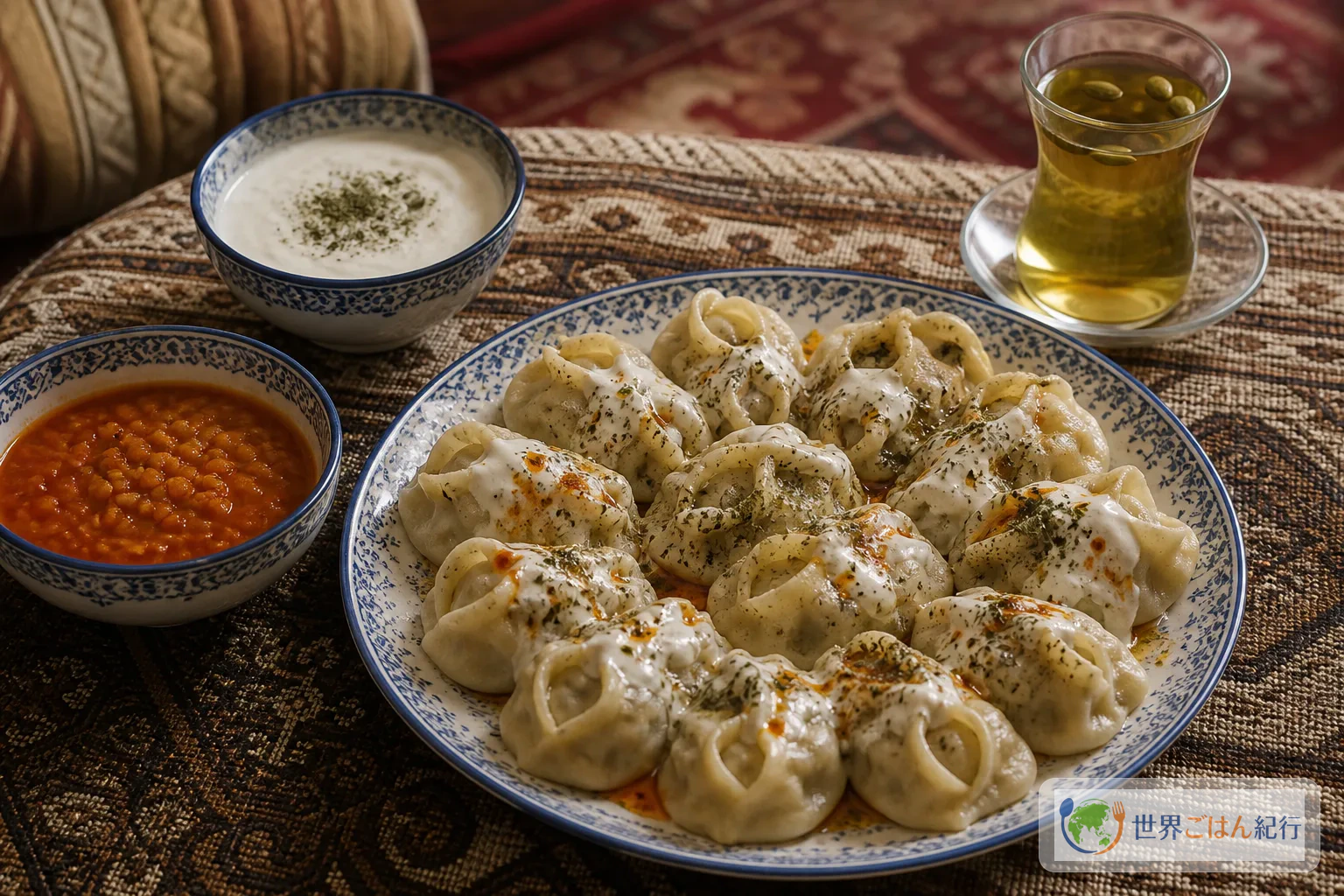
Lamb or beef, onion and spices are wrapped in thin dough, and the steamed dumplings are topped with yogurt sauce and a tomato-based sauce.
Small spoonfuls of red sauce sit on the white sauce, and a scatter of dried mint or cilantro finishes it, so even though these are meat dumplings, the first thing you notice is not the meat.
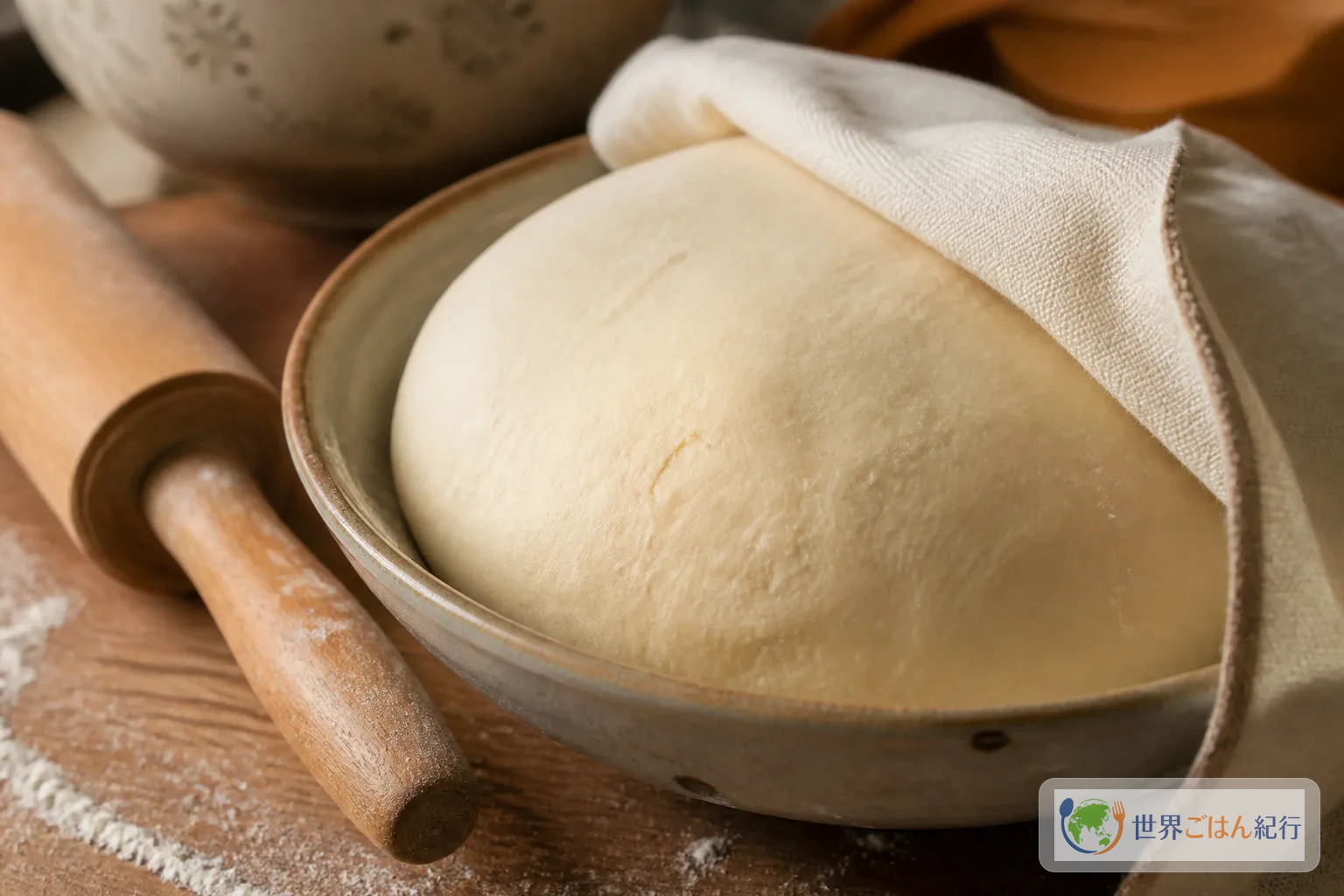
What is hard in a home kitchen is not gathering unusual spices but keeping the wrappers from getting thick.
If water from the onion stays in the filling, the dough is thick and the steam is weak, the dumpling is heavy at the center even once steamed.
Conversely, roll the dough to about 1.5 mm, use a modest amount of filling and make the sauce thick, and you get a lighter bite than any boiled dumpling.
This recipe is built around raw meat wrapped and steamed at home.
It also keeps a branch that uses store-bought wonton wrappers, so you can make it even on days when you are not up for making dough on a first attempt.
In English you will see Mantu, Mantoo and Afghan dumplings. This article uses "mantu" throughout.
How mantu sit on an Afghan table
If you think of mantu as a single serving on a small plate, the dish looks a little different.
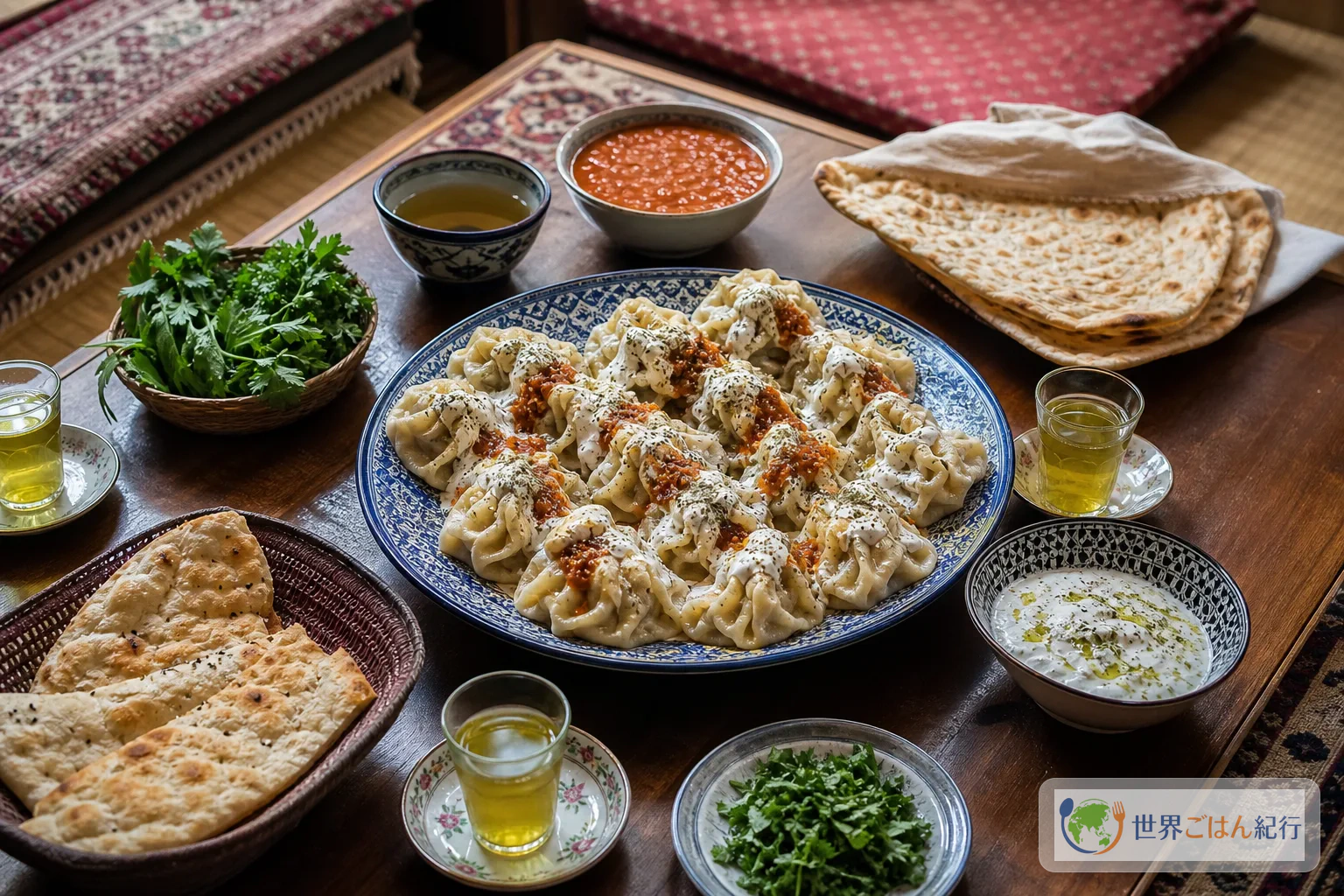
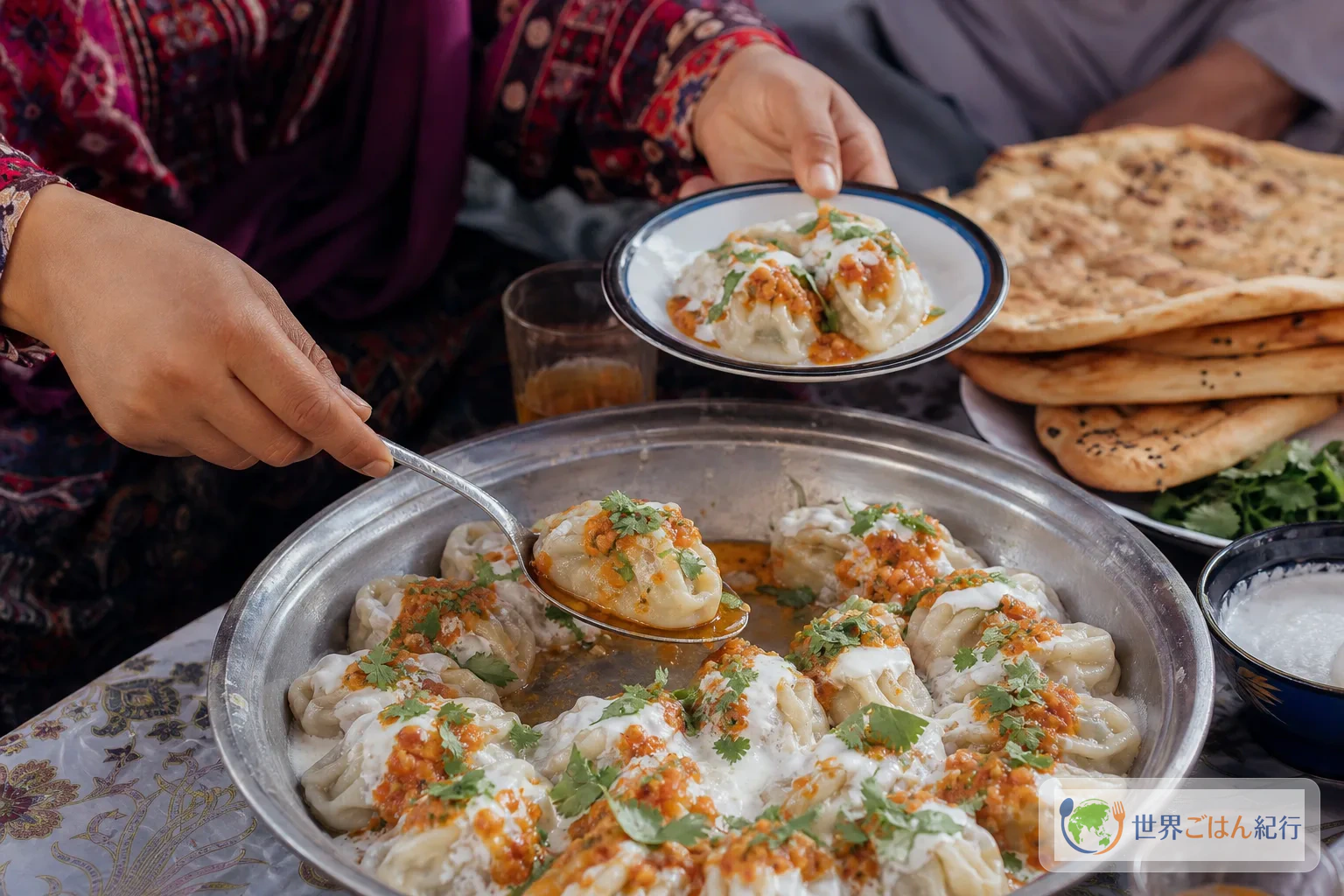
In Afghanistan the traditional meal is a large dish shared out around a low table.
Afghanaid's cultural explainer describes the hospitality of serving guests food and tea, and the custom of gathering around a low table set with cushions.
The country sits at the junction of Central Asia, South Asia and the Middle East, so ingredients and seasoning vary by region. Mantu too change from household to household in the meat and the sauce combination, and plates with lentils sit alongside plates built mainly on tomato sauce.
A meal is not a course of dishes brought out one by one; rice, meat, yogurt, bread and more are set out on the same table.
Mantu take effort.
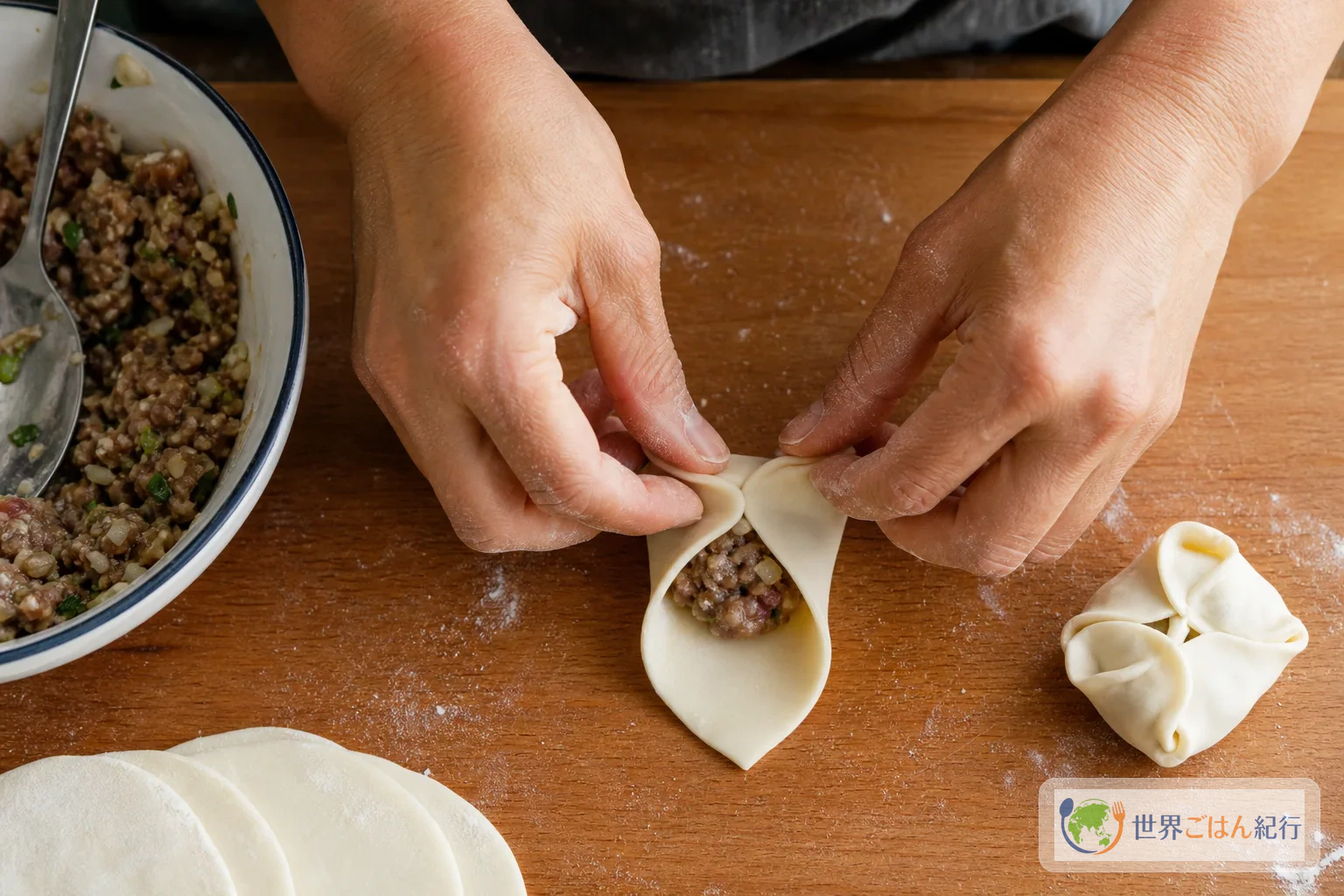
You knead dough, chop onions, cut squares, fold each one, and use the steamer in several batches.
For that reason, rather than a dish to rush for one person on a weekday, it is sometimes presented as something several people fold together on a day off or when guests come.
World Vision Afghanistan's cooking booklet also presents mantu as a dish for special occasions, pairing the meat dumplings with yogurt and a lentil sauce.
That said, there is no single fixed form for the sauce.
The Afghanaid recipe uses tomato puree and yogurt, the Afghan Cooks recipe uses tomato sauce and yogurt, and the World Vision Afghanistan booklet combines lentils with tomato paste.
Depending on the beans used at home, whether there is meat, and the thickness of the yogurt, the same dish name gives a different look on the plate.
The related dish ashak wraps leeks and other herbs and is topped with a meat sauce.
Mantu wrap meat and onion inside, so the aroma of the filling comes after you bite through the steam-soaked wrapper.
They resemble Nepal's momo and Central Asian manti in shape, but layering white yogurt and a red bean sauce on one plate is the clue that brings mantu back to the Afghan table.
| Dish | Filling | Cooking | What distinguishes it on the plate |
|---|---|---|---|
| Mantu | Lamb or beef, onion | Steamed | Garlic yogurt, tomato and bean sauce |
| Ashak | Leeks, scallions and other herbs | Mostly boiled in recipes | Yogurt and meat sauce |
| Nepali momo | Meat or vegetable | Steamed | Tomato or sesame dipping sauce |
Knowing this difference keeps you from drifting too far toward a boiled dumpling.
Rather than seasoning the dumpling itself heavily, the dish layers wrapper, meat, cold yogurt and warm bean sauce in a single bite.
The flavor axis to protect in a home kitchen
To recreate mantu with ordinary ingredients, rather than adding more spices, get three conditions right.
The first is a thin wrapper.
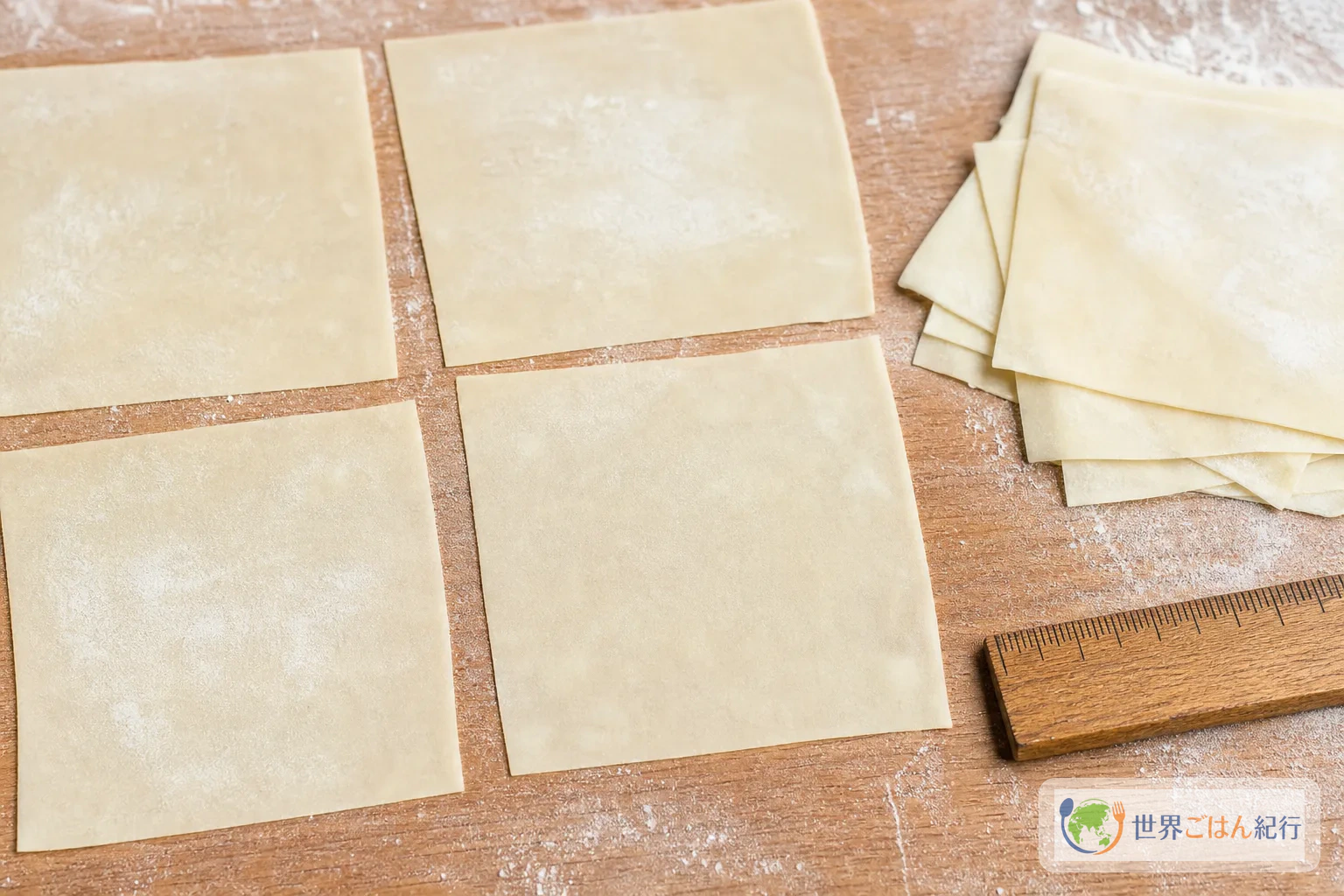
The Afghanaid recipe rolls the dough to about 1.5 mm, cuts it into 10 cm squares and puts the filling on them.
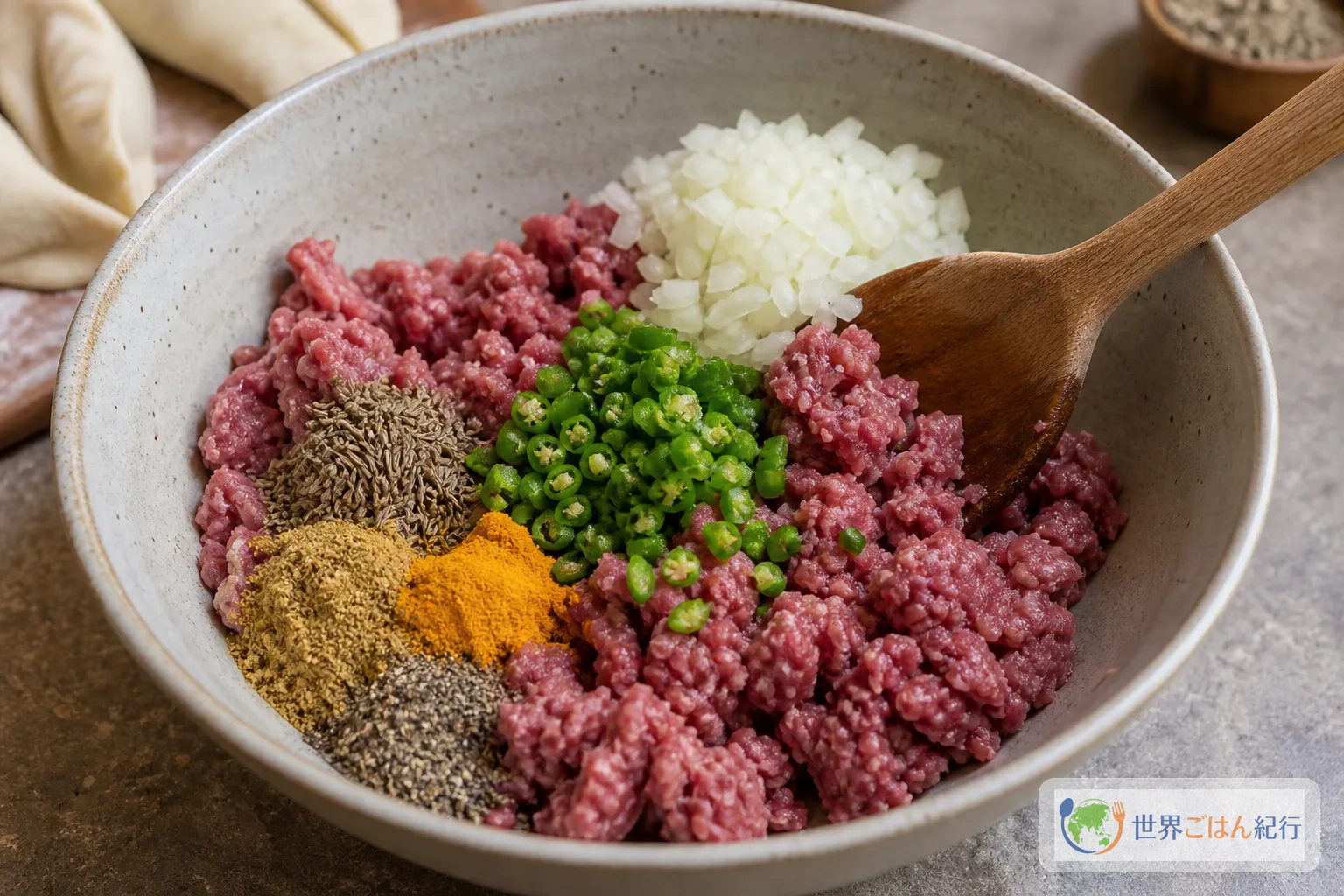
The second is not chopping the onion too fine, and keeping water from running out of the filling.
The third is not letting the sauce become a puddle.
Treat white yogurt as the base of the plate and the red bean sauce as spots of flavor, and the wrapper of the steamed dumpling does not soak up too much liquid.
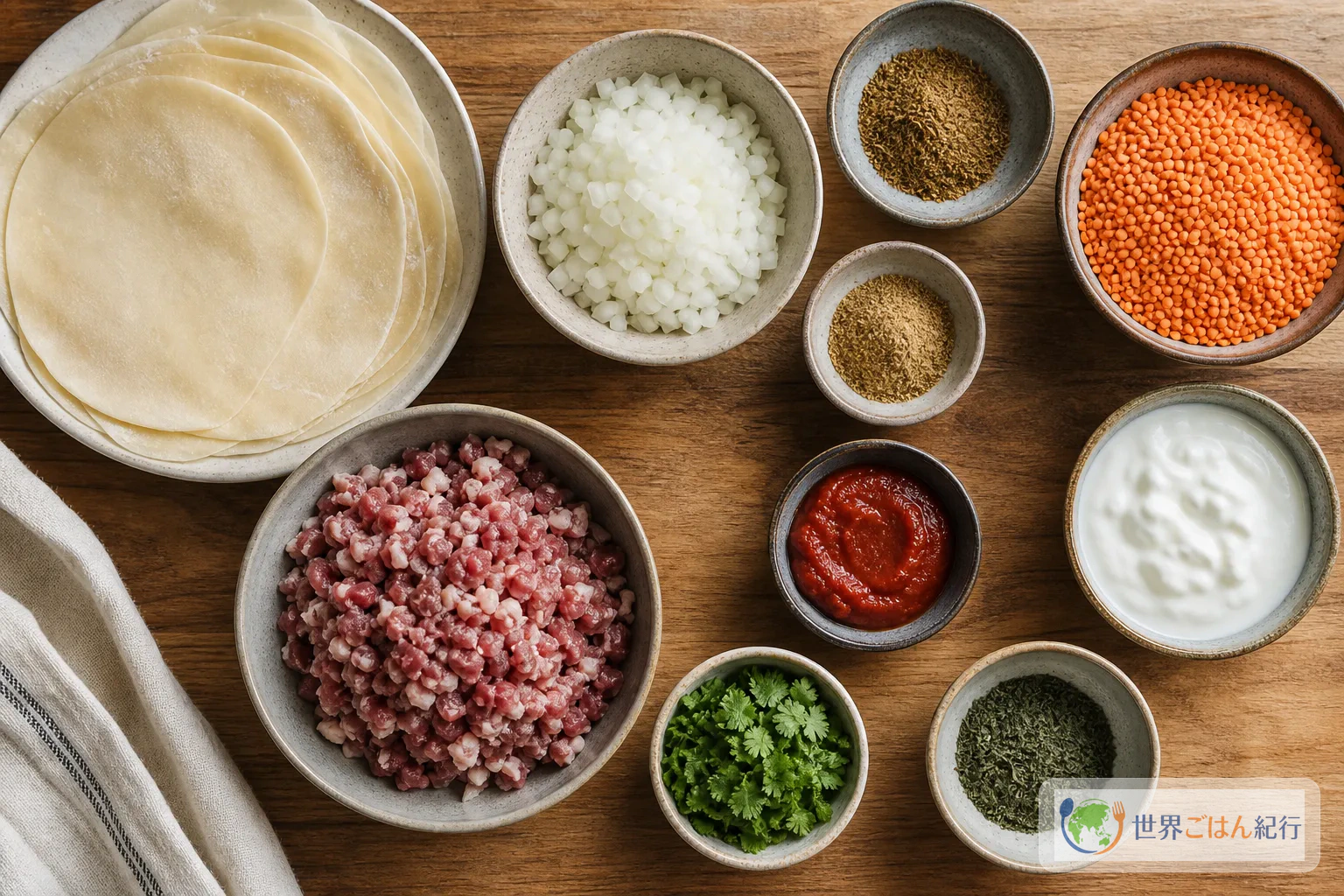
The aroma centers on cumin, coriander and black pepper.
Chili is used not for heat but just enough to tighten the sweetness of the meat.
The Afghan Cooks recipe adds cumin, coriander and black pepper to ground meat and onion.
There is no need to fry several spices in oil the way you would for a curry.
Mixing the powders straight into the filling rounds out the aroma in the steam and ties in with the acidity of the yogurt.
If you use store-bought dumpling wrappers, do not assume they are the same as the local hand-rolled dough.
Afghan Cooks itself explains that wonton wrappers can be used when you are short on time.
Buying wrappers and folding them is less a simplification into something else than a choice that leaves you time to make the filling and the sauces.
Ingredients (serves 4)
It is easier to work if you measure the wrappers, filling and the two sauces separately.
Plan on 32 dumplings, 8 per plate.
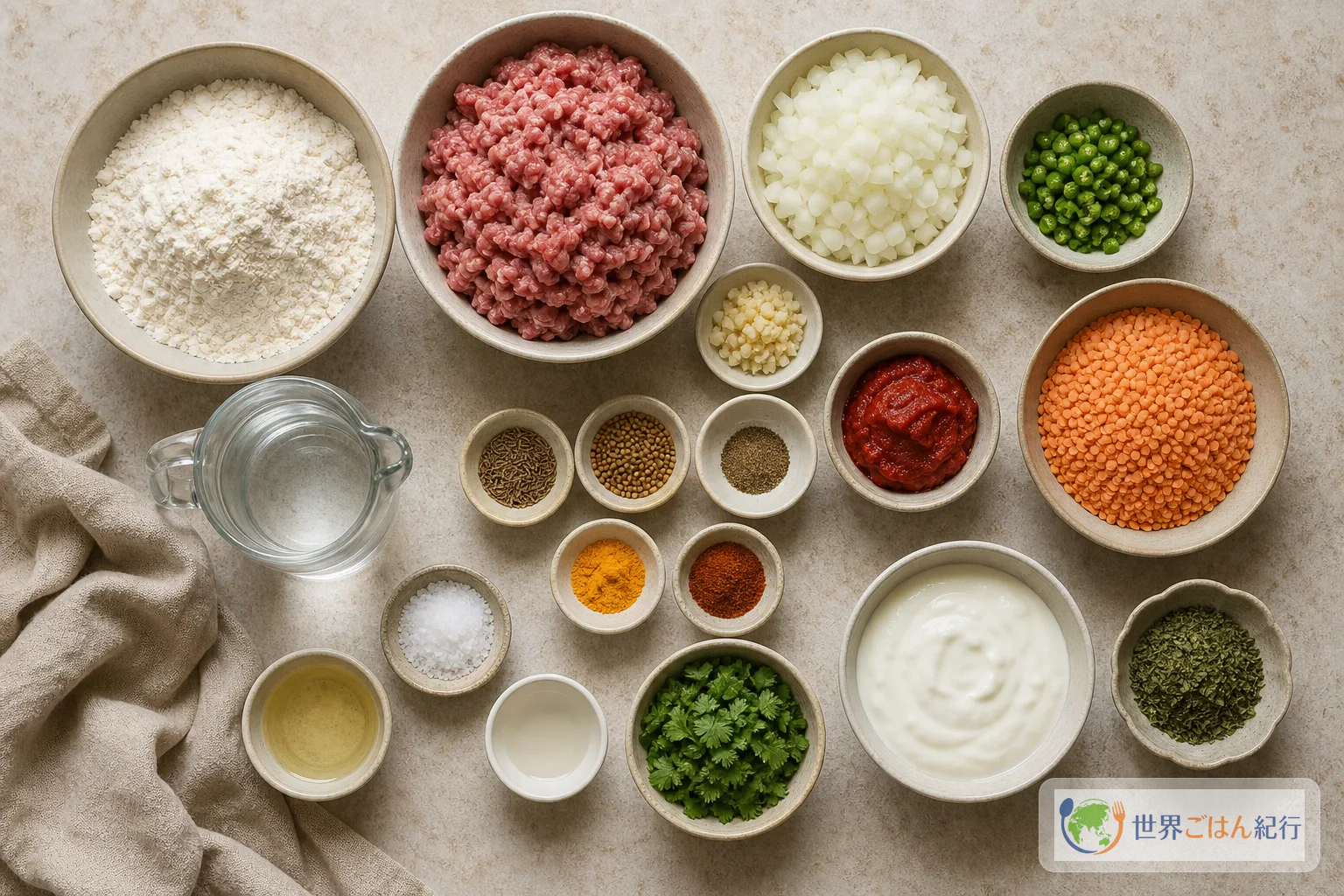
This dish uses wheat, dairy, and lamb or beef. Yogurt is a dairy product. Also check the labels of store-bought wrappers, tomato paste and spices. Cook dumplings with ground meat all the way through; Japan's Ministry of Health, Labour and Welfare gives a guideline of at least 1 minute at 75°C at the center.
Method (32 dumplings)
Because you wrap a raw filling, make the sauces first and finish the plating preparations while the dumplings steam.
If you have no bamboo steamer, a steamer set that fits in a pot, with its lid, will do.
Equipment: use what you have
If you are trying mantu just once, no special equipment is needed.
Set a metal steamer insert in a large pot and fold a kitchen towel under the lid so condensation does not drip onto the dumplings.
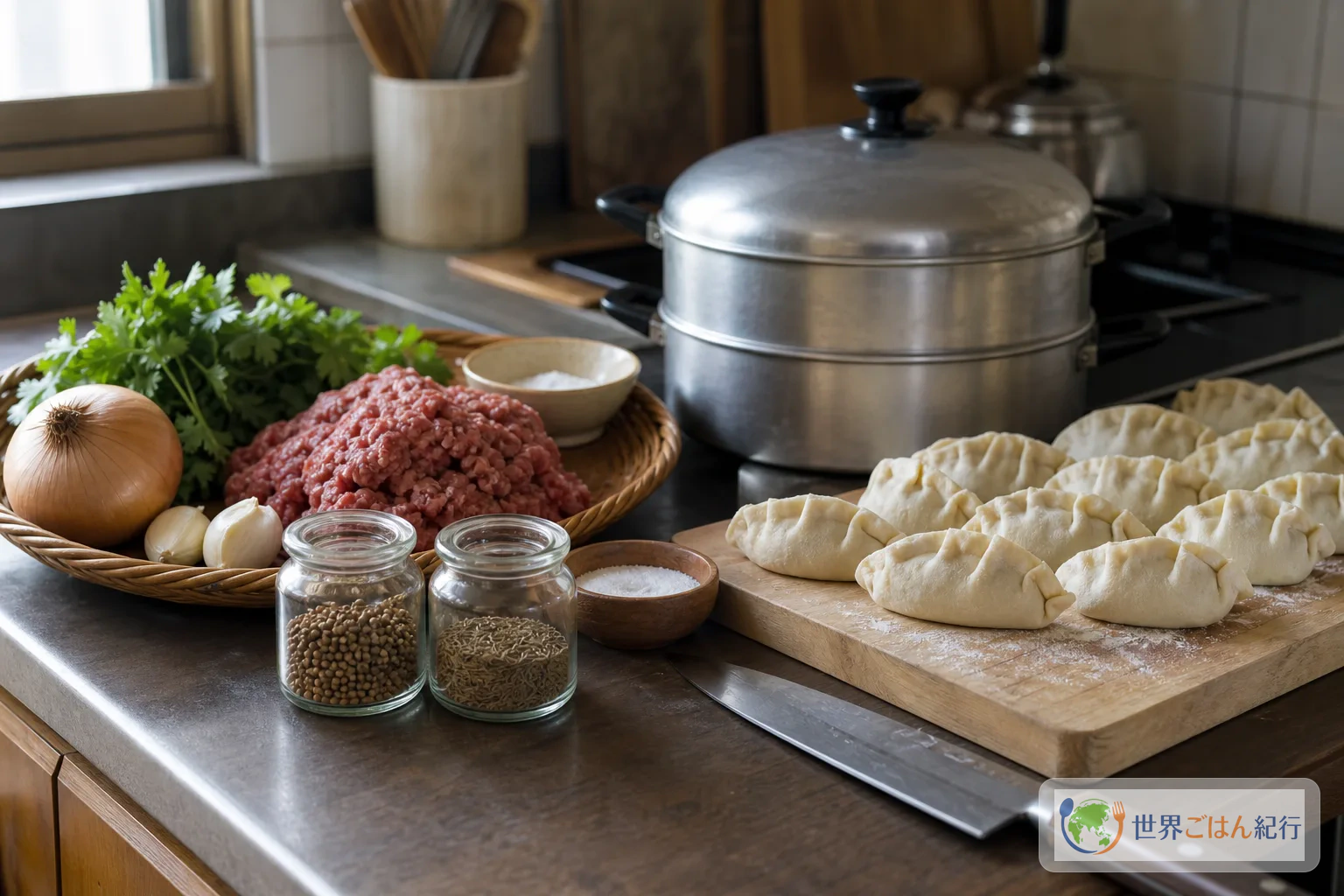
However, if the steamer trays are narrow, 32 dumplings go in several batches and the first plate gets cold.
If you choose a bamboo steamer, check for one about 24 cm across with several tiers and a lid that closes firmly.
Chopping two onions with a knife takes only a few minutes.
A food processor can be skipped by anyone making just the first batch of 32.
If you make mantu, ashak and momo in a row, or fold a double batch, it saves the time of chopping the onions in several rounds.
If you have no room for a big machine or do not mind knife work, leaving it out keeps the kitchen tidier.
Where to go back when a wrapper tears
When a wrapper tears, adding more filling to make up for it only tears the next one.
Look first at the edge of the wrapper.
If filling touched the edge, wipe the moisture from just that spot and reduce the filling to a scant teaspoon.
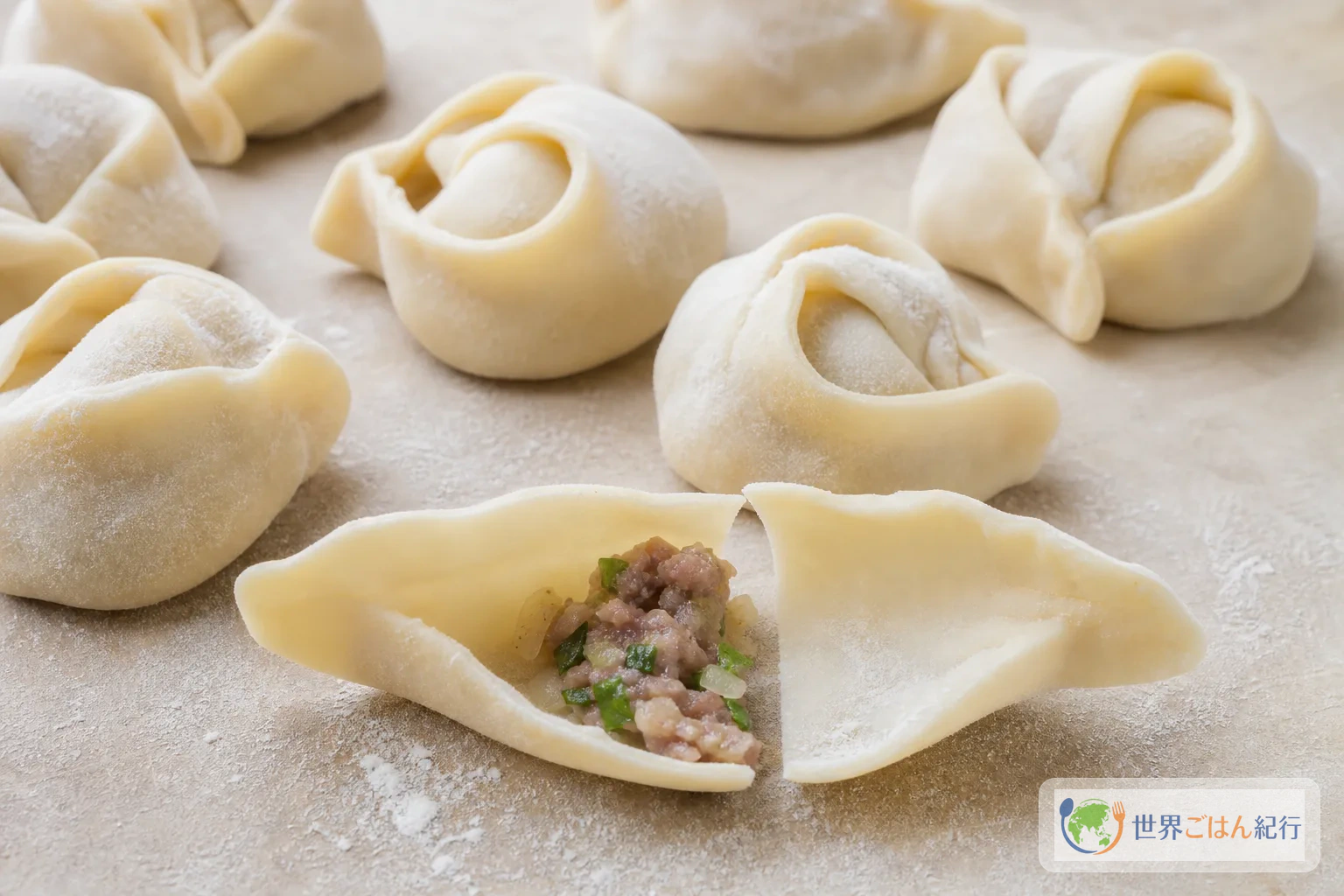
Next look at the steamer.
If you cover it before the water has boiled, the dough absorbs moisture and the wrappers stay white and thick.
On the other hand, if the boil is too violent the trays shake and the dumplings knock into each other.
Keep a medium-high heat where steam escapes steadily from the gaps around the lid, and open the lid as little as possible.
If the bean sauce is loose, simmer it over low heat for 5 minutes before you move the mantu to the plate.
If the yogurt runs, drain it for just 10 minutes in a tea strainer lined with paper towel.
If you drain too much and it becomes a stiff dip, it will not cling to the wrapper and only the white sauce is left on the plate.
If the center of the meat is red, do not eat it, however good it looks.
Japan's Ministry of Health, Labour and Welfare gives a guideline of heating dishes made with ground meat to 75°C at the center for at least 1 minute.
Even if you do not use a thermometer, cut one open and check that the color has changed all the way to the center and the juices are not red.
Storage and eating it the next day
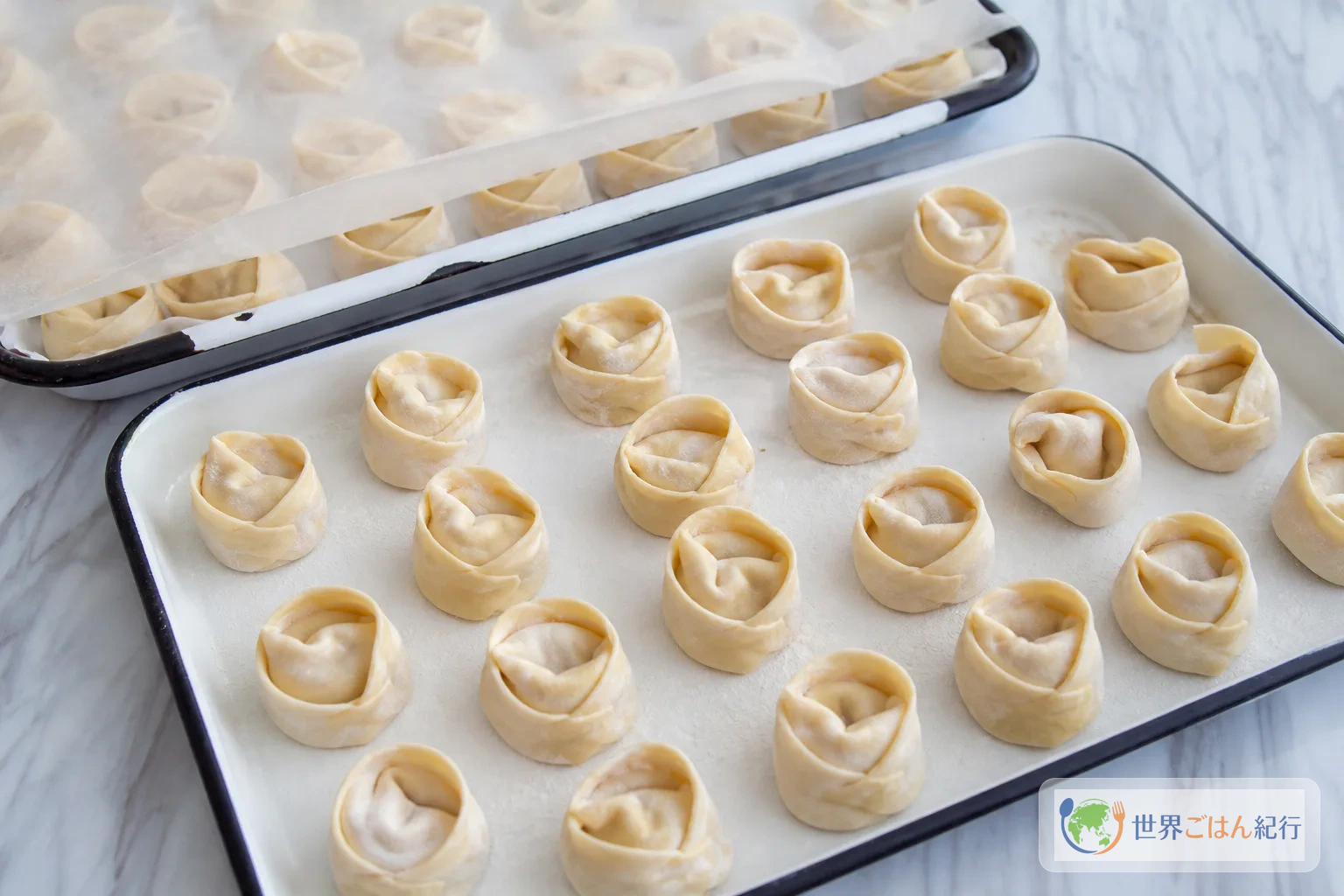
Mantu folded but not yet steamed can be frozen.
Arrange them on a tray lined with parchment so they do not touch each other and freeze for about 2 hours.
Once firm, move them to a freezer bag, write the date and use them up within about 2 weeks.
Do not thaw frozen ones; extend the steaming by about 10 minutes and check the center.
Steamed dumplings, before the sauce goes on, keep in the refrigerator until the next day.
Put the yogurt and bean sauce in separate containers, arrange only the dumplings on a heatproof plate, sprinkle with 2 tsp water, cover loosely with plastic wrap and microwave at 600 W for 1 minute 30 seconds to 2 minutes.
Warm the bean sauce in a small pot over low heat, adding 1 tsp water at a time to loosen it.
The next day the wrappers are a little softer, so rather than pouring on plenty of sauce, it is easier to eat with a thin layer of yogurt and the bean sauce set in the center.
If you do not use meat, the filling can be replaced with lentils, chopped mushrooms and onion.
Because the bean sauce overlaps with the filling, mash the lentils for the filling coarsely and add 1/2 tsp more cumin to give it definition.
Frequently asked questions
Depending on whether you buy the wrappers or make them, and whether you wrap the meat raw or cook it first, the working time changes a great deal.
Q1. Can I use dumpling wrappers or wonton wrappers?
Yes.
With large dumpling wrappers, reduce the filling to a scant teaspoon and draw the four corners to the center.
Wonton wrappers are thin and steam up light, but tear easily, so use about 8 g of filling.
When using store-bought wrappers, the most important thing is not to let them dry out as you work.
Q2. I do not like lamb. Can I use beef?
Ground beef is fine.
Lean red meat alone makes the filling dry, so choose ground beef with around 15% fat; it holds together with the sweetness of the onion.
If you switch to ground chicken, it tends to turn hard if oversteamed, so cut the wrappers slightly smaller and stop as soon as the center is cooked through.
Q3. Can I cook the meat first and then wrap it?
You can, but the steaming time gets shorter.
Afghan Cooks says that cooking the meat first cuts the steaming time to 3 to 4 minutes, while also noting that wrapping a raw filling is traditional.
Cooking first suits days when you prioritize safety checks on a first attempt or working time.
Cool the meat before wrapping so heat does not reach the dough.
Q4. What if the yogurt is too sour?
Thin Greek yogurt with 2 tbsp water and add salt a little at a time.
Before adding sugar, check whether you have added too much white wine vinegar to the bean sauce.
Mantu is not a dish where only the white sauce is made sweet, so do not erase the sourness entirely; leave enough to cut the weight of the meat and beans.
Q5. Can I make it without a bamboo steamer?
You can if you have a metal steamer that fits in a pot.
Lightly oil the tray the dumplings sit on, and fold a kitchen towel between the lid and the pot so condensation from the inside of the lid does not drip.
Fold the ends of the towel inward so they do not touch the flame, and add boiling water partway through so the pot does not run dry.
Q6. How spicy should it be to taste Afghan?
More chili is not what makes mantu what they are.
Let the aroma of cumin and coriander, the sweetness of the onion and the sourness of the yogurt come first, and let the chili arrive lightly from behind.
When you want more heat, adding a little to each plate of bean sauce is easier for a family to adjust than increasing the filling as a whole.
Deciding what to buy and what to skip
On the day you make mantu, what is worth buying is not what you would also use in everyday dumplings, but what changes the flavor axis toward Afghanistan.
Just a little cumin and coriander in the filling points toward a meat dumpling without soy sauce or sesame oil.
A food processor can be skipped if you make 32 only once.
Decide by whether you will ever fold a double batch, and whether you want to cut down the work of chopping onions.
Even if you start with a steamer you already have, store-bought thin wrappers and ground meat from nearby, none of the dish's judgment is lost.
If you want to go all the way to hand-rolled dough, lamb and a scatter of dried mint, check the labels of cumin and coriander before you buy.
If you only want to try it once, buy the wrappers, get the spices in small packets and add no equipment.
Once you have decided that, mantu is no longer a dish you cannot make for lack of authentic ingredients, but a steamed dumpling whose center of flavor you can choose yourself.
Sources
The dish structure, the local table, the name and the cooking judgments in this article were cross-checked against the following sources.
- Mantu Afghan Dumpling Recipe, Afghanaid (published 2019, updated 2025. Ingredients, dough thickness, folding, steaming time)
- What is culture like in Afghanistan?, Afghanaid (published 2019, updated 2025. Hospitality, communal meals, regional culture)
- Mantu Recipe, Afghan Cooks (published 2022. Spice blend, steaming a raw filling, the store-bought wonton wrapper branch)
- Nourishing Peace cookbook, World Vision Afghanistan (2025. Mantu for special occasions, structure of the lentil sauce)
- Afghan Culture, Embassy of Afghanistan in Jakarta (hospitality at meals, substitutions in ingredients and household differences)
- Q&A on heating conditions for meat, Ministry of Health, Labour and Welfare (Japan) (heating guideline for meat including ground meat)