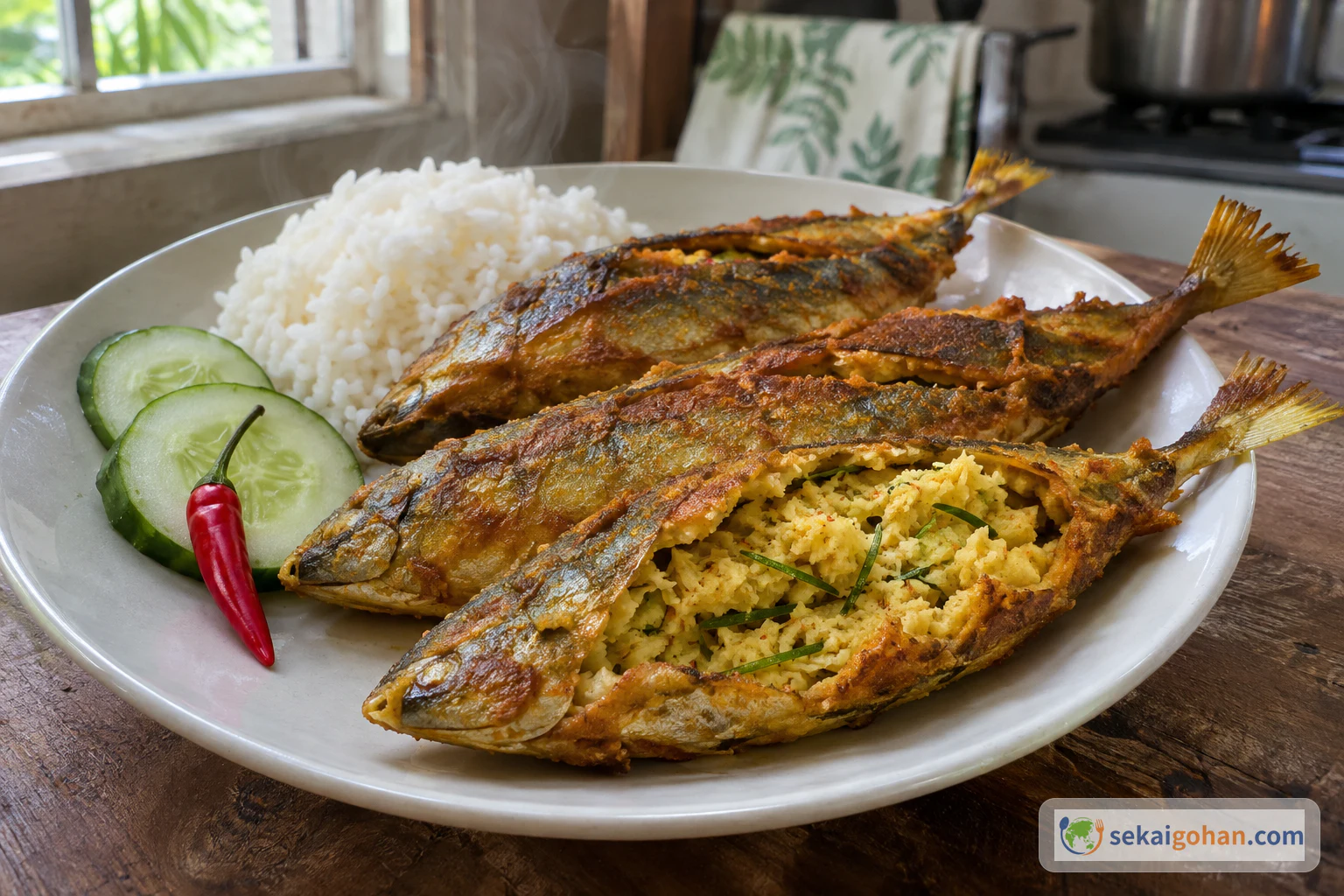
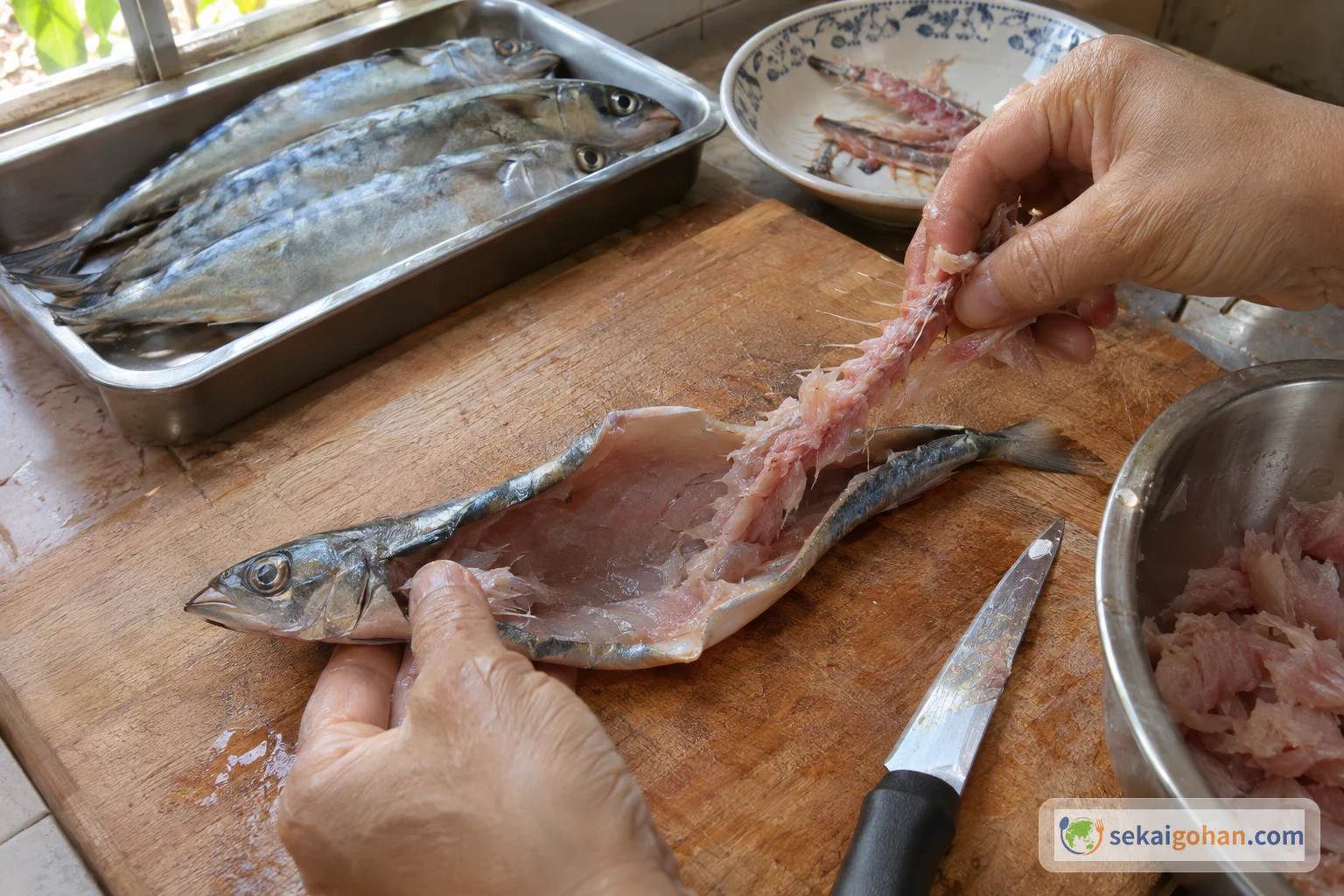
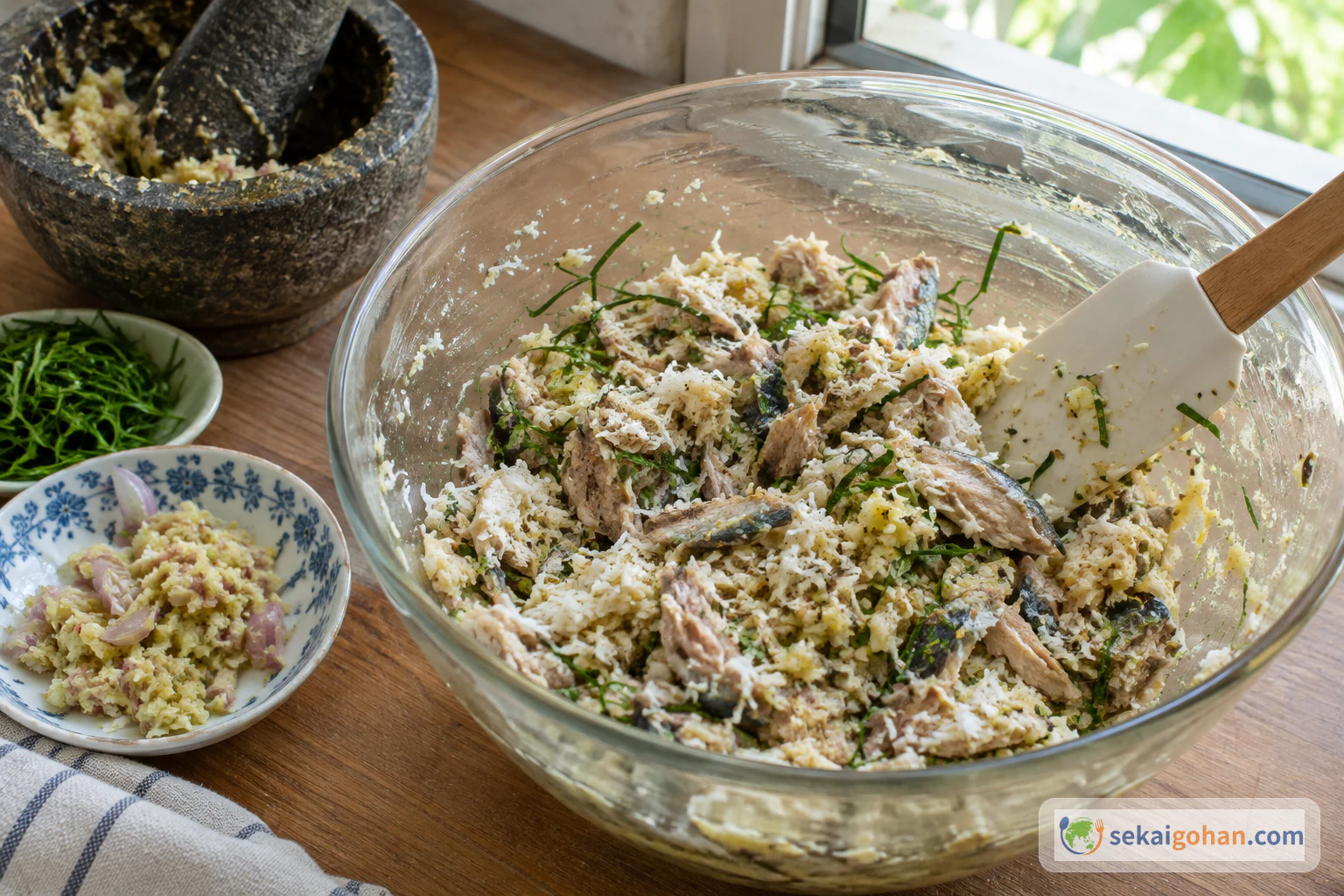
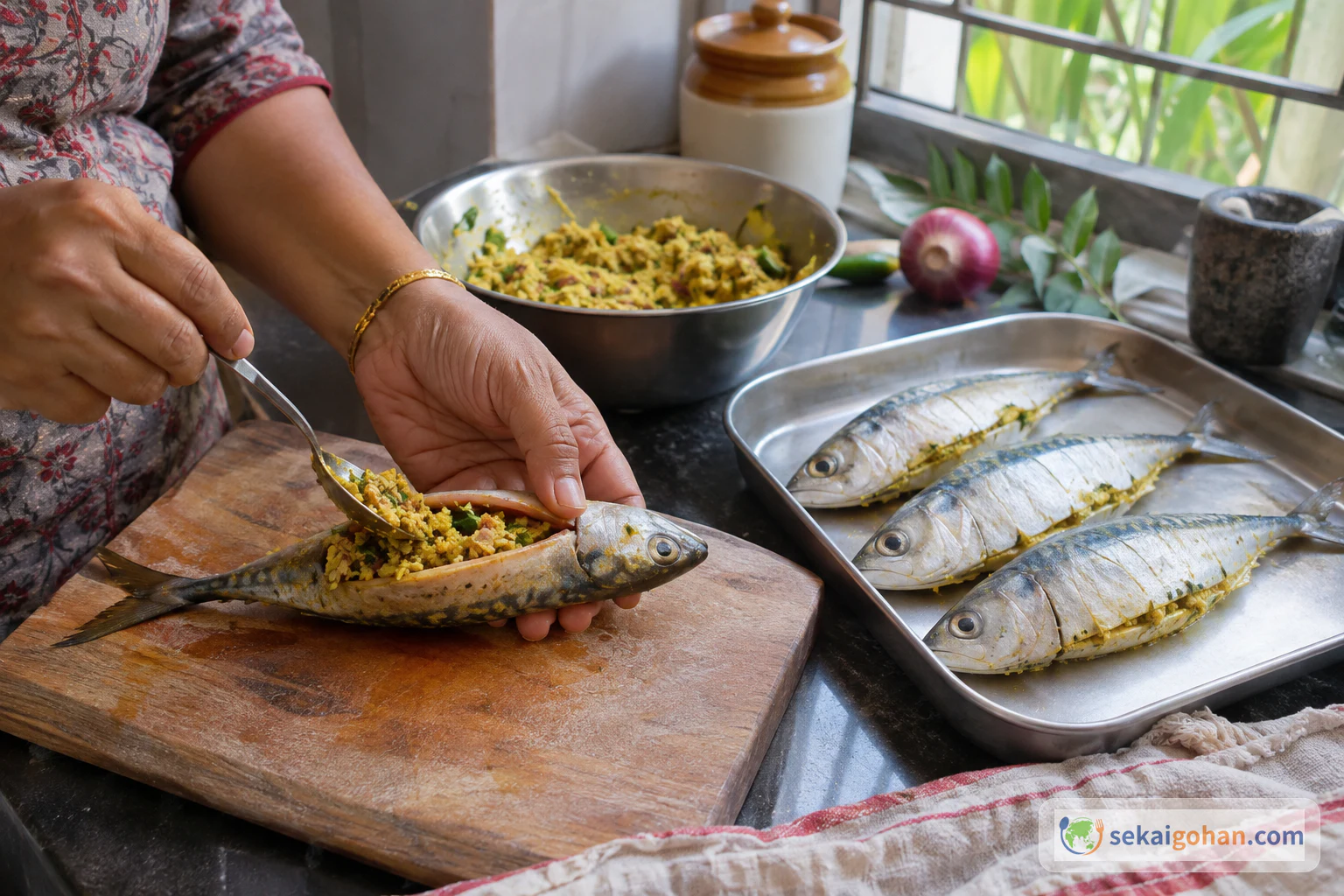
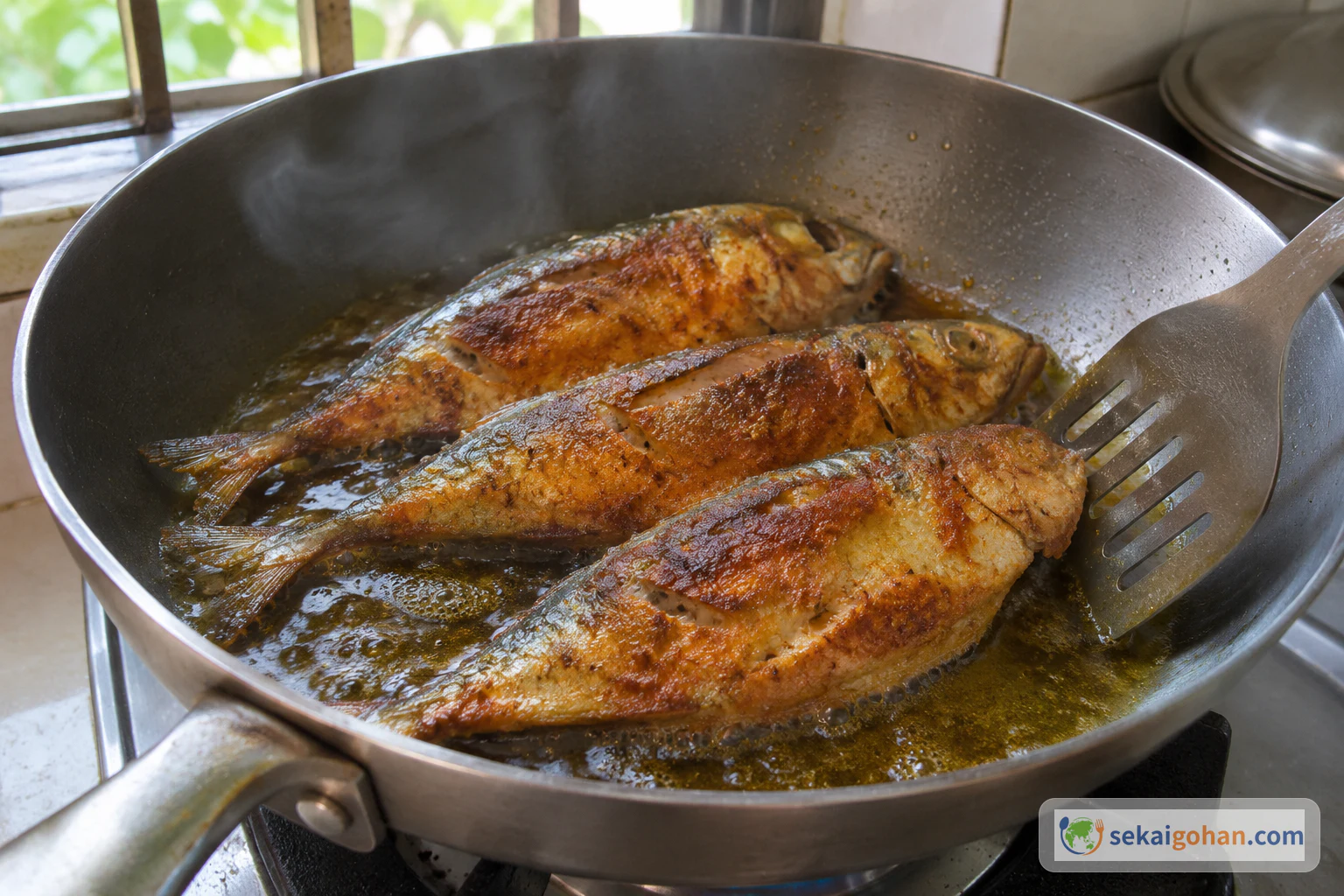
The knife goes in along the back of the mackerel, and the backbone comes away in your fingers. What is left is an empty, fish-shaped pocket of skin, head and tail still on. The flesh you scraped out returns pounded with lemongrass, shallot, black pepper, grated coconut and slivers of laksa leaf. Then the whole fish goes into hot oil until the skin turns crisp and golden.
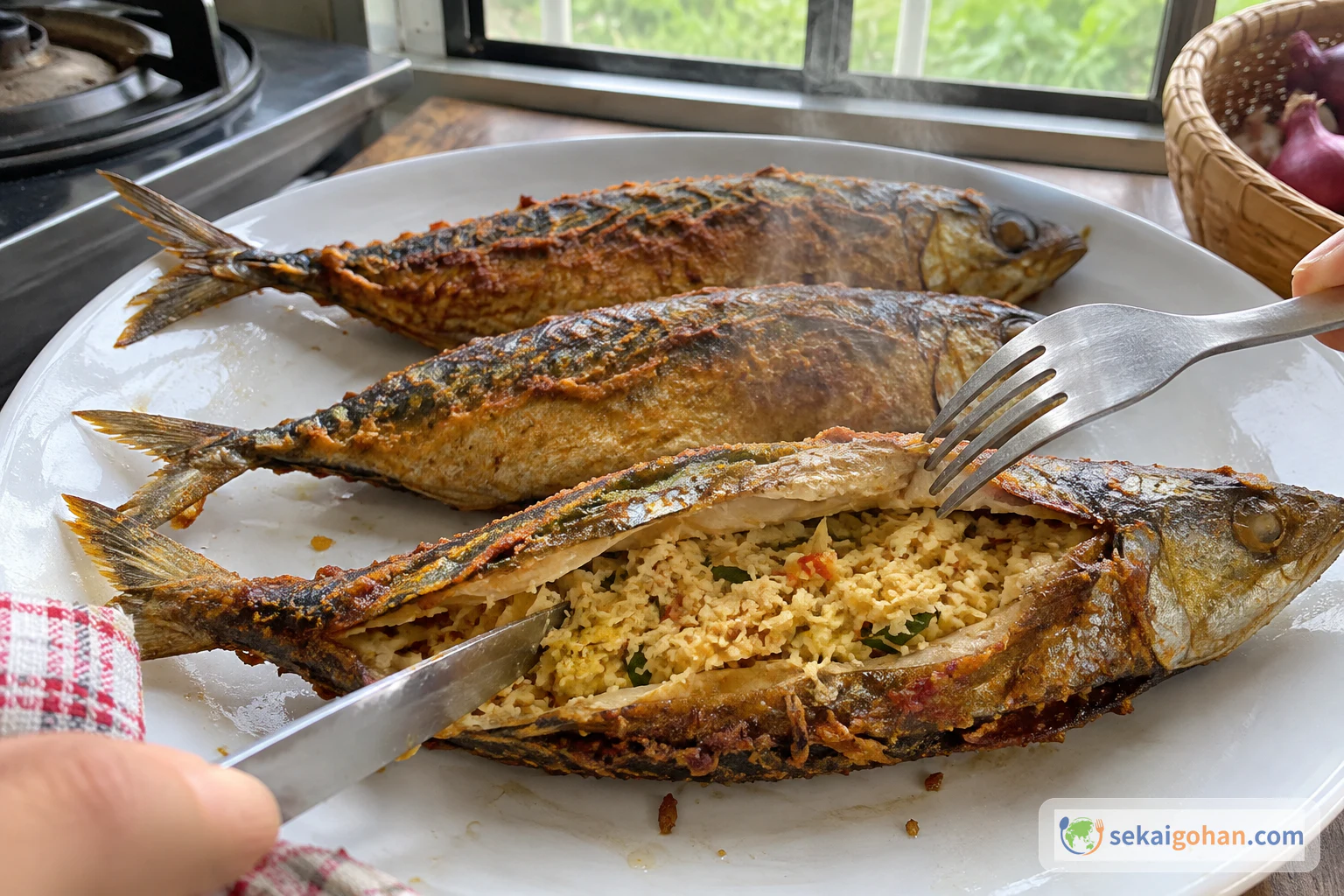
At the table someone breaks a fish open with a fork, and the steam carries coconut and lemongrass with it. There are no bones to pick out, only a moist, pale filling inside a crackling skin. Solok ikan is a Malaysian side dish, one fish per person, served beside rice.
A Whole Fish With Nothing Left to Pick Out
What makes solok ikan is its structure. The fish is both the filling and the container. Every bone is removed, the flesh is pounded with aromatics, and the skin is packed again and shaped back into a fish, so what reaches the table looks whole and eats like a fishcake. The fish of choice is ikan kembong, the Indian mackerel (Rastrelliger kanagurta), a small fish of the Indo-West Pacific usually about 25 cm long and at most around 35 cm.
Households season it in different ways. One line keeps the filling clean and herbal, with lemongrass, shallot, black pepper and laksa leaf, and that is the version on this page. Another goes sweet, sour and hot with dried chilies, palm sugar, shrimp paste and tamarind, and sometimes uses scad (ikan selar) in place of mackerel. Frying is common to both. Which state the dish belongs to is not settled, and it is cooked as a Malaysian dish rather than one region's specialty.
Recognized as national heritage
On 7 January 2025, Malaysia declared solok ikan a heritage object under the National Heritage Act 2005, in the side-dish (lauk-pauk) category of its official list. The same list has several of its stuffed relatives: ikan cencaru sumbat (stuffed hardtail scad), solok lada (stuffed chilies) and sotong sumbat (stuffed squid). Sumbat means "to stuff", and the list shows that filling one food with another is a whole family of Malaysian side dishes.
In standard Malay, solok has a sense of a gift of food brought to people holding a wedding feast or similar gathering. How that meaning connects to the dish's name is not settled. The image of a fish prepared to be carried to someone else's table fits the dish well.
Solok ikan, solok lada and otak-otak
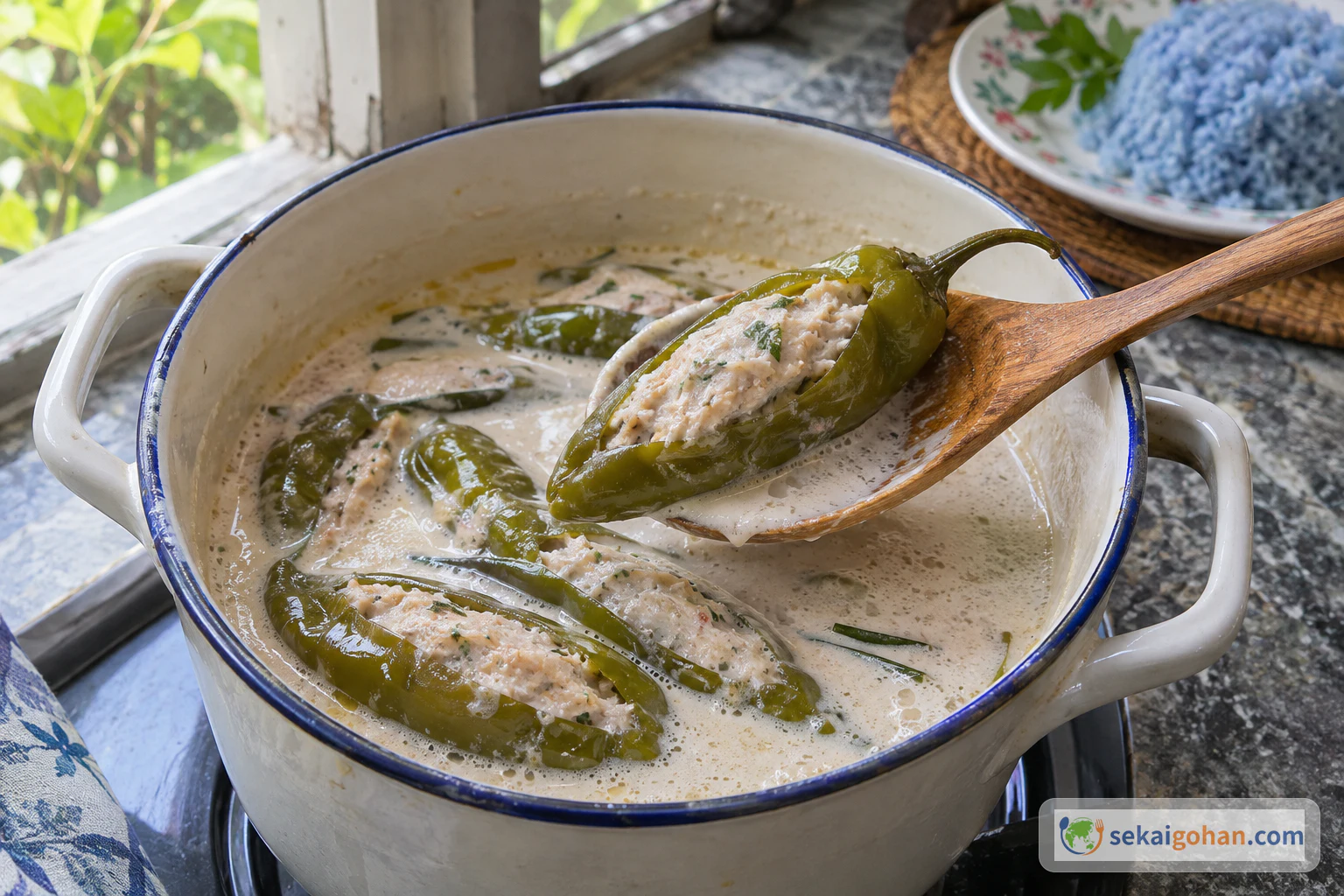
The names around this dish overlap, and the dishes are easy to confuse. In Malaysia, satar, otak-otak, solok ikan, solok lada, hormok and tod man pla are known as related fish dishes, each distinct from the others. The casing and the heat are what set them apart.
| Dish | Casing | Cooking |
|---|---|---|
| Solok ikan | The fish's own skin, head and tail intact | Fried |
| Solok lada | Large green or red chilies | Simmered gently in coconut milk until cooked and almost dry |
| Otak-otak | Banana leaf around a fish paste | Grilled or steamed |
| Hormok | Leaf around a fish mixture | Steamed |
Solok lada is a Kelantan dish, and in Kelantan nasi kerabu is incomplete without it. That pairing belongs to the chilies, not to the fish. In English, "fish solok" sometimes names a chili or capsicum filled with fish and coconut and boiled in coconut milk, which is closer to solok lada. When you shop or search, look for the whole fish fried in its own skin. For more Malaysian dishes, see the Malaysia country page.
Ingredients (serves 4)
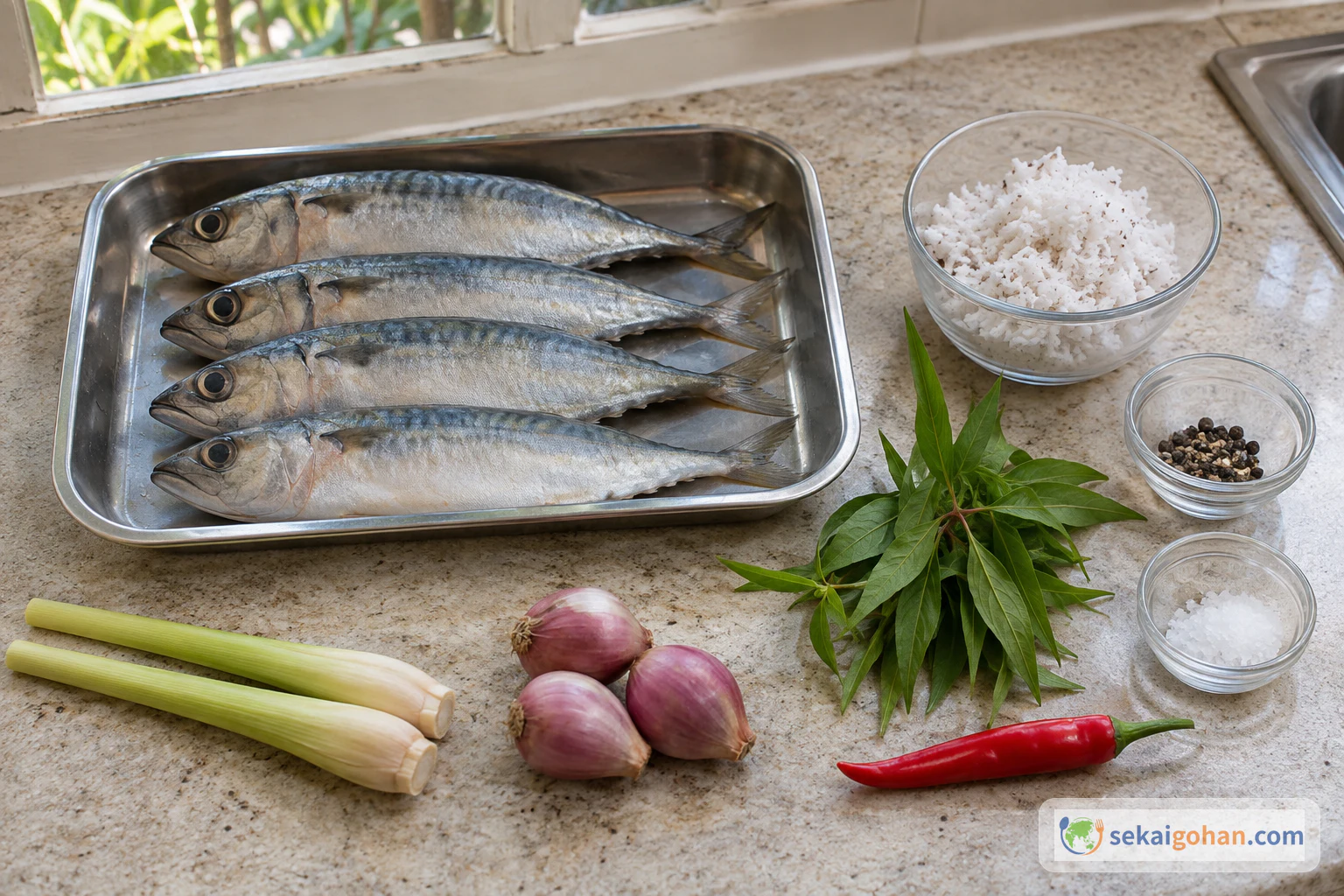
This dish contains fish and coconut. The sweet-spicy variation below adds belacan, a shrimp paste, so it also contains crustaceans.
Equipment
- Small sharp knife and cutting board
- Mortar and pestle, or a food processor
- Mixing bowl
- Saucepan or deep frying pan for shallow frying
- Slotted turner
- Kitchen paper
- Toothpicks (optional, to pin the seam)
Choosing and Substituting
Three things decide whether it tastes like solok ikan. The fish must be whole and fully boned, the filling must be fish, coconut and laksa leaf, and the skin must be fried crisp. Everything else bends.
| Ingredient | What to buy abroad | What it changes |
|---|---|---|
| Ikan kembong | Small mackerel of about 7–10 oz (200–300 g) each, or horse mackerel | Mackerel tastes richer and stronger; horse mackerel is lighter and opens easily |
| Fresh grated coconut | Frozen unsweetened grated coconut from an Asian grocer or online | Close to fresh. Desiccated coconut has no moisture and changes both texture and aroma |
| Lemongrass | Fresh or frozen stalks from an Asian grocer | Without it, a little lemon zest brings citrus, but the centre of the aroma shifts |
| Laksa leaves | Fresh or frozen Vietnamese coriander from an Asian grocer | Leave them out, or use a little shiso; the scent becomes a different one |
| Shallots | Red onion, or a little ordinary onion | Sweetness holds; the aroma is plainer |
Buy the coconut frozen and grated, not dried. It is the one swap where the texture of the filling depends on the product. Fish, onion, pepper, salt, oil, cucumber and red chili all come from an ordinary supermarket. Ask for the freshest fish at the counter, because the skin of a tired fish tears when you bone it.
Choose fish with firm, shiny skin and leave the belly uncut. An intact belly is the hinge that holds the filling, and a fish gutted through the belly is much harder to stuff.
Method
The work happens in three blocks. First the fish are opened and emptied one at a time, and this is the slow, careful part. Then the filling is pounded, mixed and seasoned while the skins wait on a plate. Last comes the frying, where you watch the pan and take your time to cook the filling right through.
When It Goes Wrong
| What you see | Why | What to do |
|---|---|---|
| The skin splits in the oil | Overfilled, or the cut along the back is short and the filling is forced in | Cut cleanly from head to tail and fill to four-fifths. Pin any tear with a toothpick |
| The skin is brown but the centre is raw | The filling is packed thick, or the oil is too hot and cooks only the outside | Spread the filling evenly along the fish. Fry on lower heat, and give it more time on gentle heat at the end |
| The fish is dry | Fried too long | The coconut keeps the filling moist; take the fish out as soon as the centre is opaque |
| The flavour is flat | Too little salt or aroma in the filling | Taste a cooked spoonful before stuffing and season then |
| Oil spits hard | Water on the skin | Dry each fish just before it goes into the pan |
Serving, Variations and Storage
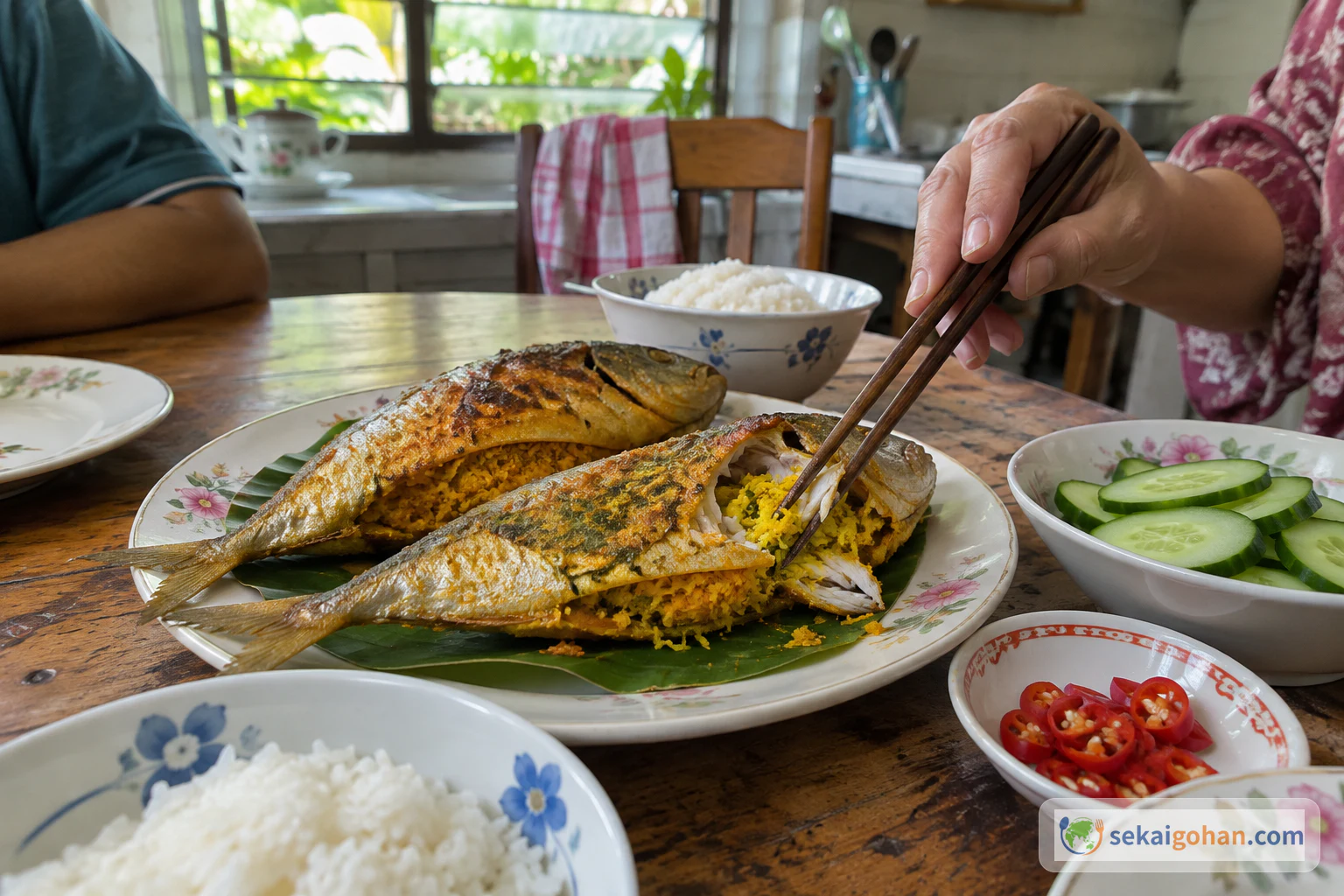
At the table
Serve one fish per person beside a bowl of steamed white rice, with sliced cucumber for freshness and a small dish of sliced red chili for anyone who wants heat. Break the fish open at the table and eat the crisp skin together with the filling; there are no bones to stop for. It sits easily among other side dishes in a Malay meal.
Variations
- Sweet and spicy filling. Grind 10 dried chilies, 8 shallots, a ¾-inch (2 cm) piece of ginger, 2½ oz (70 g) palm sugar (gula melaka) and 1¾ oz (50 g) belacan into a paste with 3 tbsp thick tamarind. Mix with fish flesh and 9 oz (250 g) grated coconut, season with salt and sugar, stuff, and deep-fry in about 2 cups (500 ml) hot oil. This version uses four ikan selar together with 1 lb 2 oz (500 g) of fish flesh, and how the two amounts are meant to fit is not settled. The result is darker, sweet-sour and hot, and the belacan adds crustacean shellfish.
- Scad instead of mackerel. Ikan selar, or horse mackerel abroad, gives a lighter, leaner fish that opens easily along the back.
- Mild or hot. Leave out the chili for a filling that is all lemongrass, pepper and coconut, or add more sliced chili for a sharp edge.
Storage
Let leftover fish cool, then cover and refrigerate. Reheat in a frying pan or in the oven until hot all through. The microwave alone softens the skin and loses its crispness.
Frequently asked questions
Do I need a banana leaf?
No. The fish's own skin is the casing, and the fish goes straight into the oil. Banana leaf belongs to otak-otak, where a fish paste is wrapped and grilled or steamed.
Can I use fillets instead of whole fish?
The whole skin, with its head and tail, is what holds the filling and shapes the dish. With fillets the filling has nothing to hold it and the result becomes a fishcake. Ask the fishmonger for whole, ungutted small mackerel and do the boning yourself.
Is solok ikan spicy?
The basic filling is warm from black pepper and fragrant from lemongrass, with no strong heat. The sliced chili is optional, so you set the heat yourself. The sweet-spicy variation with dried chilies is the hot one.
Mortar or food processor?
A mortar gives the best aroma, because pounding draws the oils out of the lemongrass and shallot into the coconut. A food processor works if you pulse briefly and stop while the mixture is still coarse. Mix the fish in by hand so it keeps some texture.