
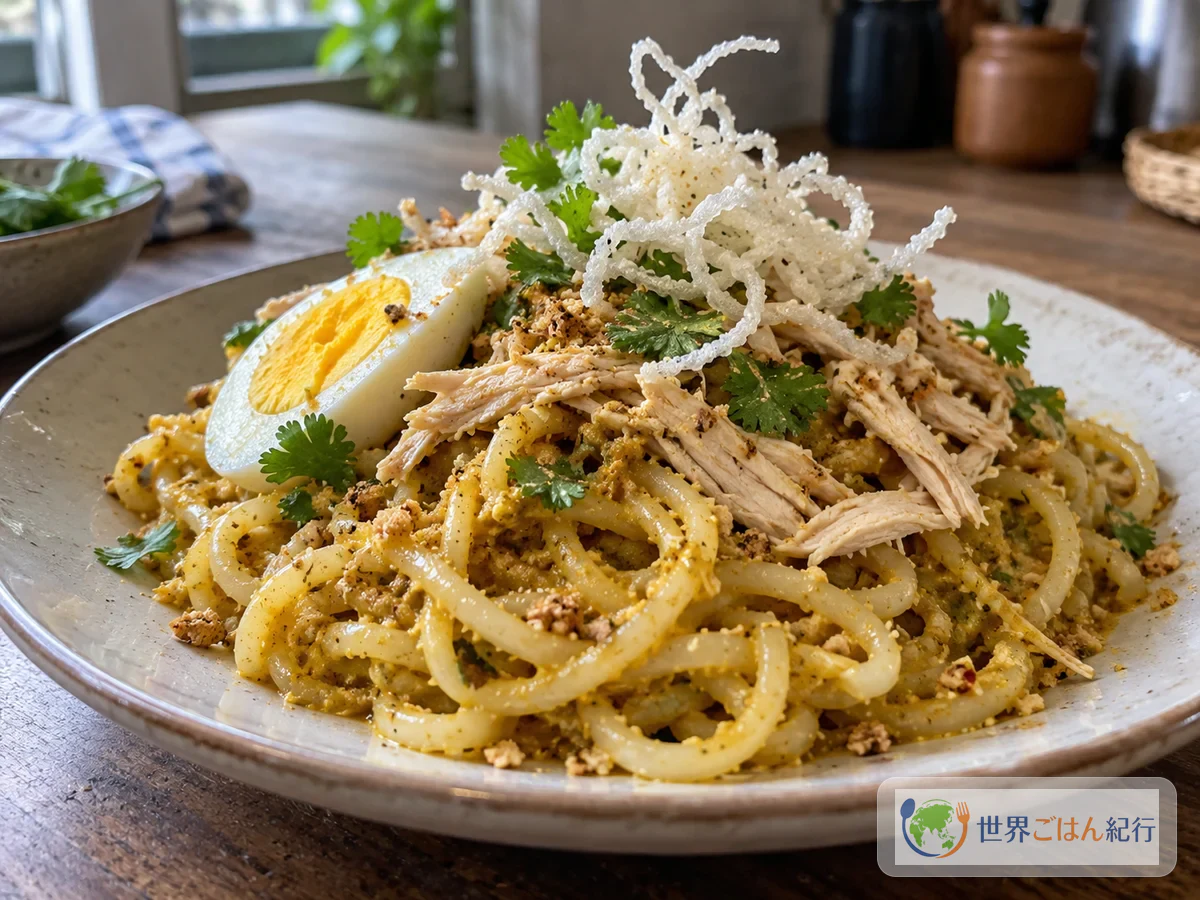
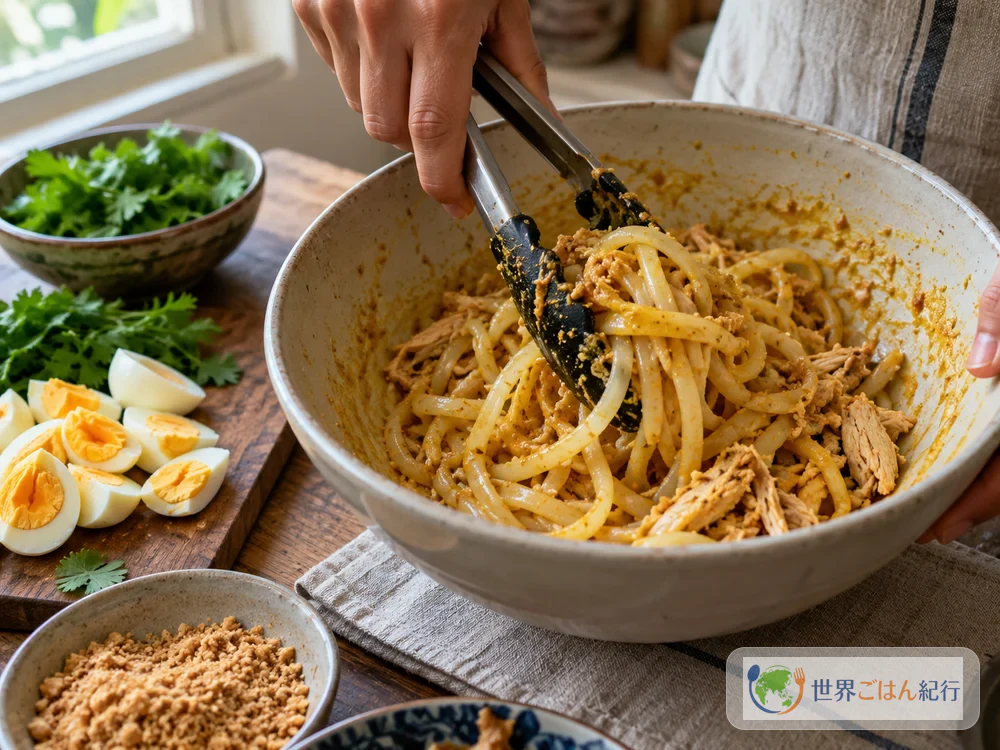
Morning in Mandalay. On the tables of street stalls, baskets heaped with thick white noodles line up. When you order, the seller takes a handful of noodles onto a plate, drizzles a loop of glistening yellow chicken oil, sprinkles on a powder like roasted soybean flour, squeezes in lime, and tosses it all quickly with bare hands. Beside it comes a small steaming bowl of soup. This is the dry noodle dish that represents the morning in central Myanmar, nan gyi thoke.
A morning noodle from Mandalay named after a thread of gold
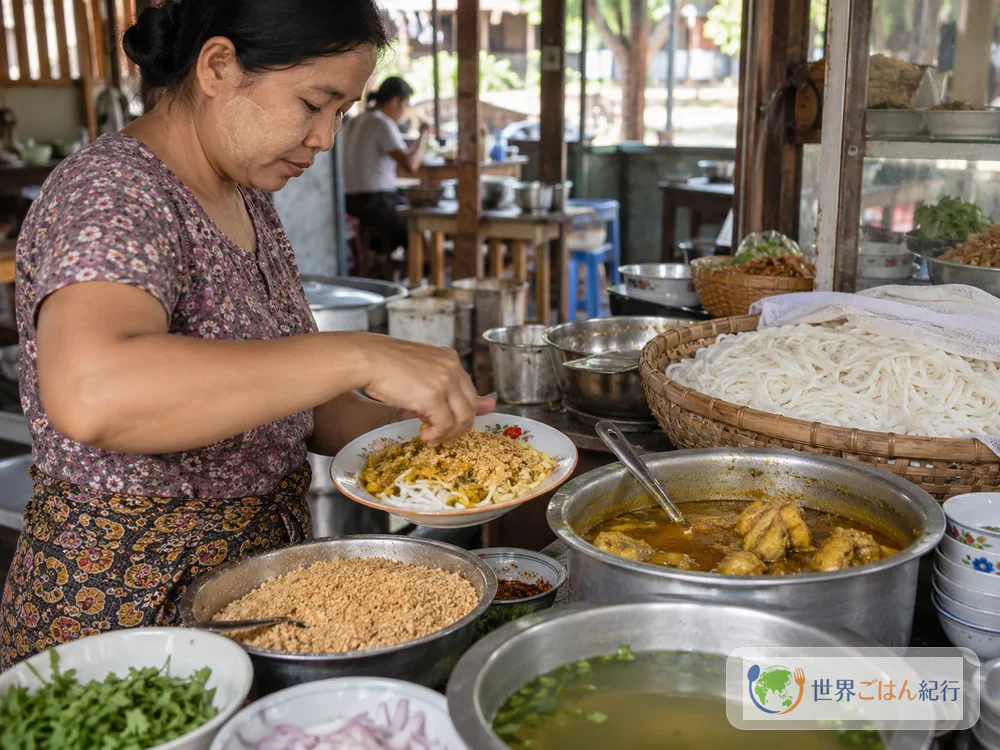
In Burmese it is written နန်းကြီးသုပ်. "Nan gyi" means "thick thread," the round, thick rice noodle. The word "nan" is said to come from the process in which a goldsmith draws gold out into a fine thread. The "thoke" at the end means a tossed salad, and Myanmar has many dishes named "-thoke," such as the tea-leaf salad laphet thoke and tofu salad. So the name means exactly what the dish is: a toss of thick rice noodles.
It was born at street stalls in Mandalay, Myanmar's second city, and is still regarded as a taste that symbolizes the city. It is a standard breakfast, but is also eaten at lunch and as a snack, and is served at stalls as well as at set-location eateries, restaurants and tea shops. The name varies by region: in southern Myanmar (Lower Burma) it is often called "nan gyi thoke," and in the central and northern areas "mondi thoke." In Yangon, the largest city, a slightly thinner medium-thick noodle is usually used, and some places serve it under the name "Mandalay mondi."
In Mandalay some places let you choose the thickness of the noodle: the thickest "nan gyi," the medium "nan lat" and the thin "nan the." Even the same toss turns into something quite different in how the oil and flour cling when the noodle changes.
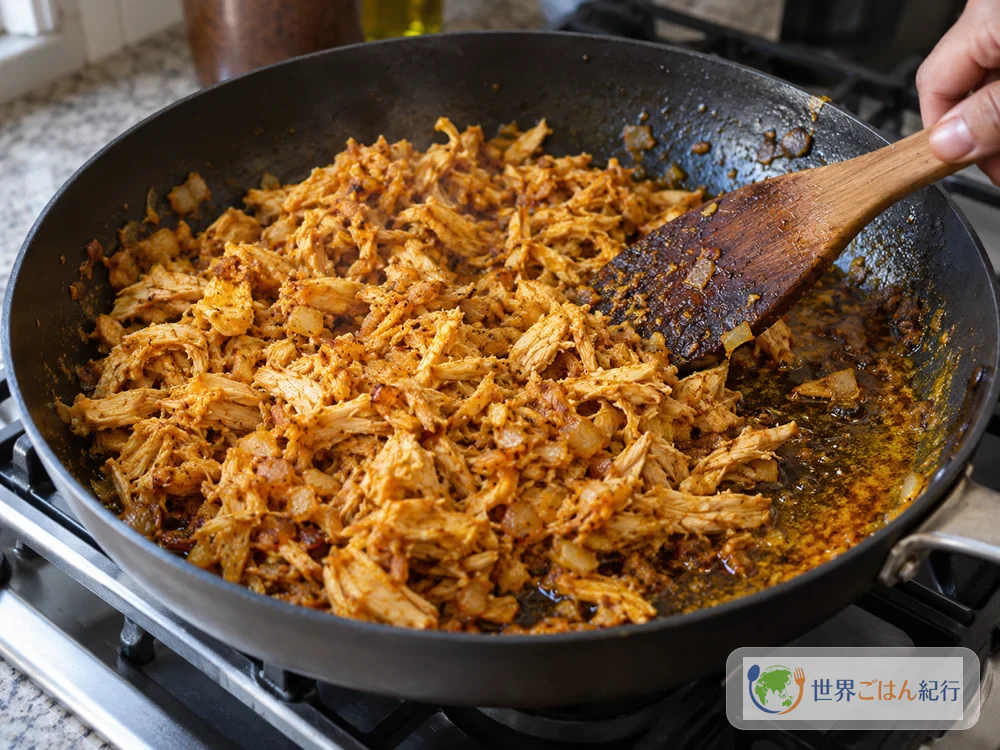
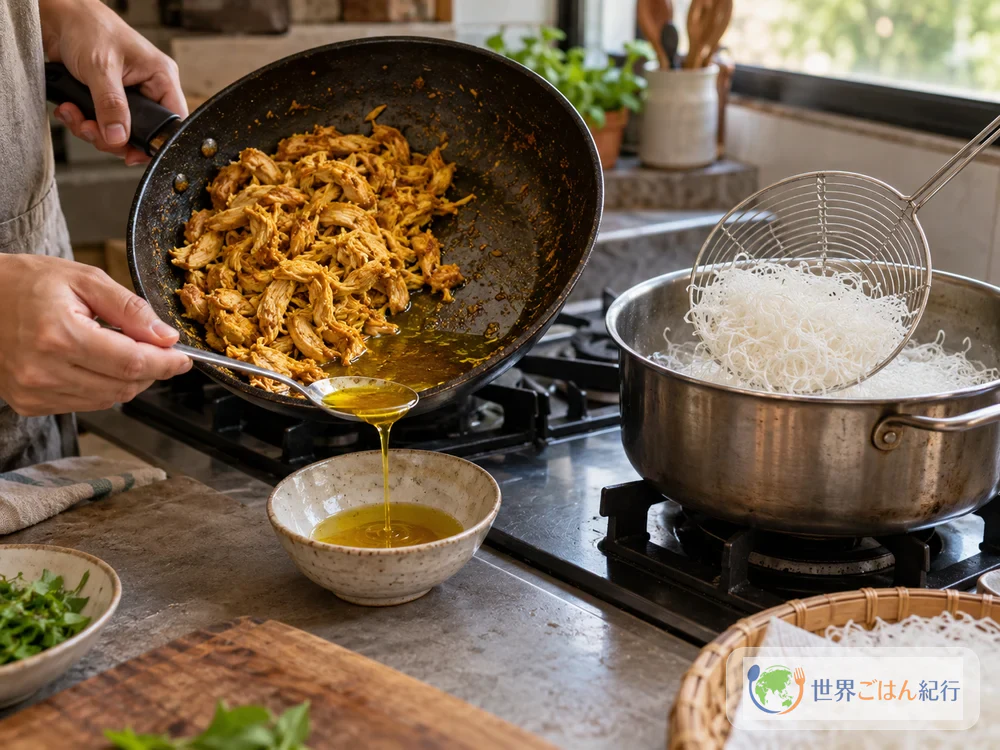
The Burmese recipe site Burmalicious notes that this dish was born in the central dry zone known as a producer of pulses. It makes sense that one of the stars of the tossed noodles is toasted chickpea flour. The same site also writes that the star is not the chicken but the oil that has taken on the aroma of the curry. The chicken is shredded and added only in a small amount. The oil, dyed yellow by turmeric and paprika, coats the noodles, the chickpea flour adds toasty flavor and body, and lime and fish sauce tighten the flavor.
What to know when making it in a home kitchen
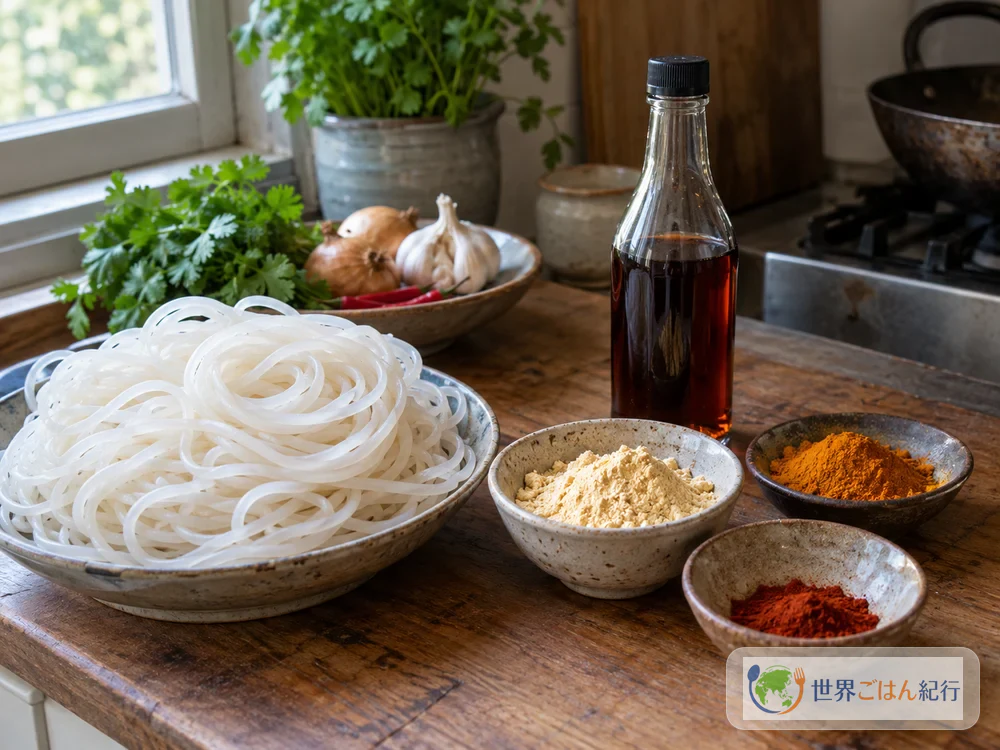
The hardest part is the noodle. Mandalay's noodle is a round, thick noodle made by fermenting rice-flour dough, and the characteristic is that it is soft and smooth yet doesn't turn mushy when tossed with a strong dressing. The same noodle is almost impossible to get abroad. The closest is the thick, round rice noodle sold for Vietnam's bún bò Huế, found at Asian grocers and online. The Burmalicious recipe also says you can make it with udon if you can't get it. Made with frozen udon it has a chewy spring and a more substantial finish than rice noodles.
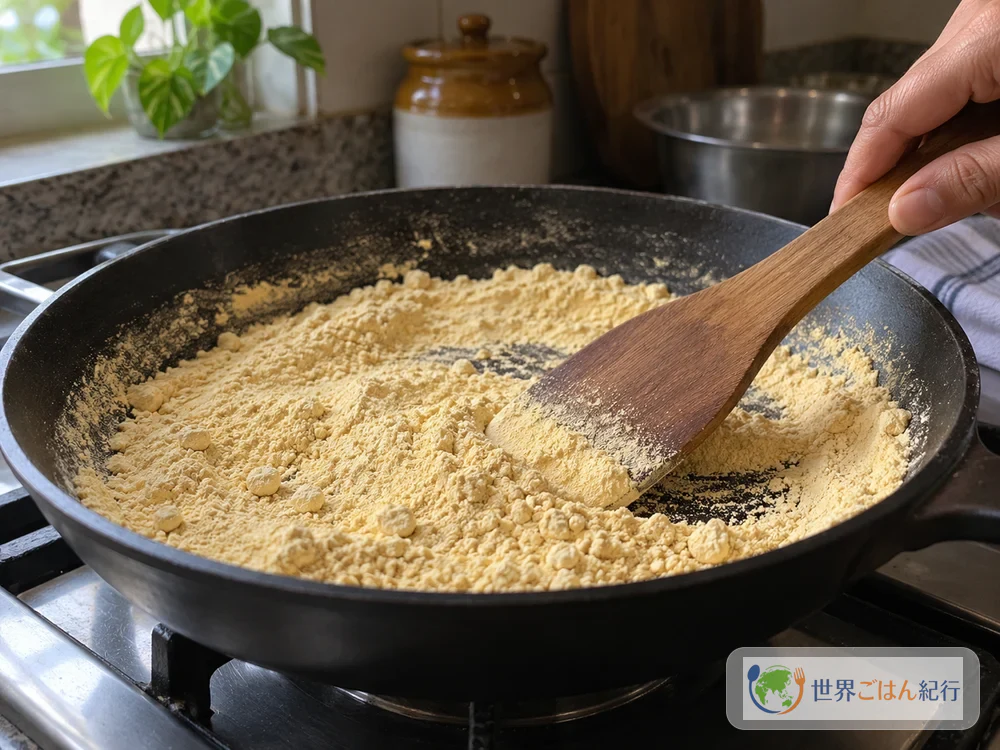
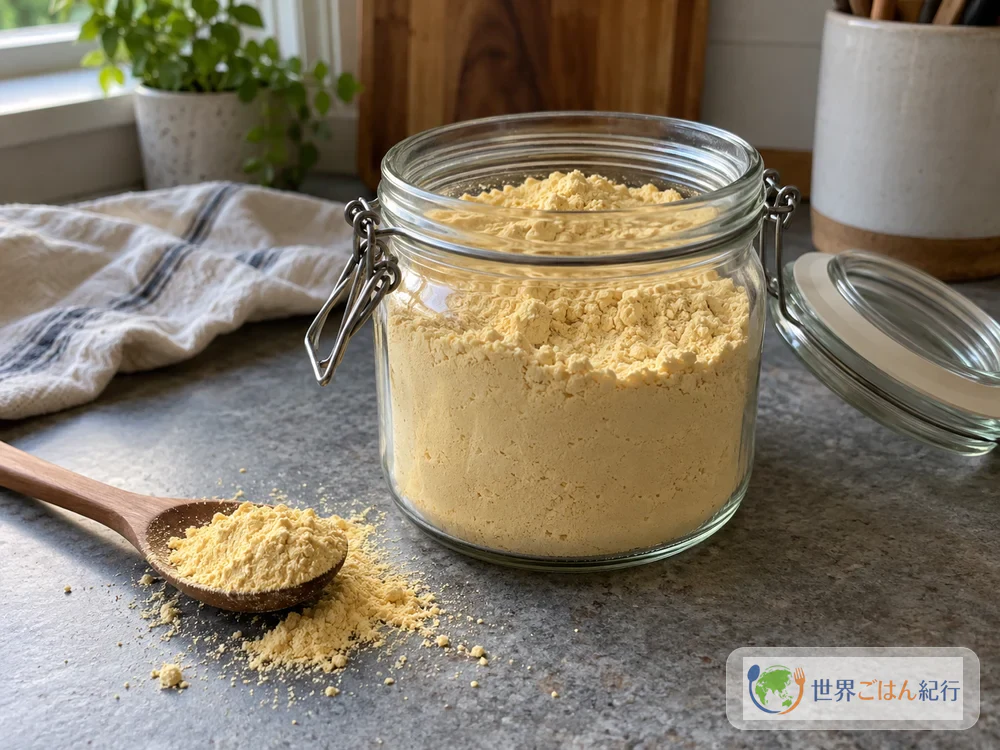
Chickpea flour is the flour called besan in India. It is available at Indian grocers, baking-supply shops and online. If you toast it slowly without oil, it becomes a toasty flour similar to roasted soybean flour. It's some work, but skipping it almost removes what makes this dish itself, so do prepare it.
You can toast a larger amount of chickpea flour at once and store it. Cool it completely and keep it in an airtight jar, and next time all you need to prepare is the chicken curry. Besides the tossed noodles, it can also be sprinkled over salads and soups.
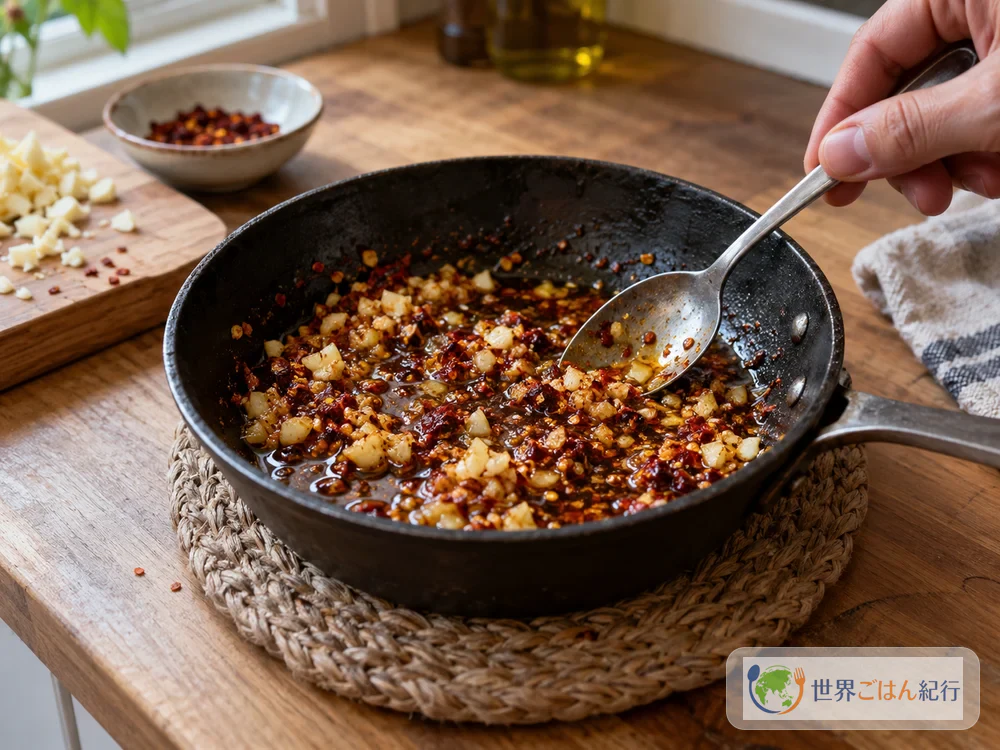
Turmeric, paprika powder and fish sauce can all be found in the spice aisle of a supermarket. Use mild paprika powder, in the role of providing color. Adjust the heat afterward with the garlic-chili oil.
Ingredients (serves 5)
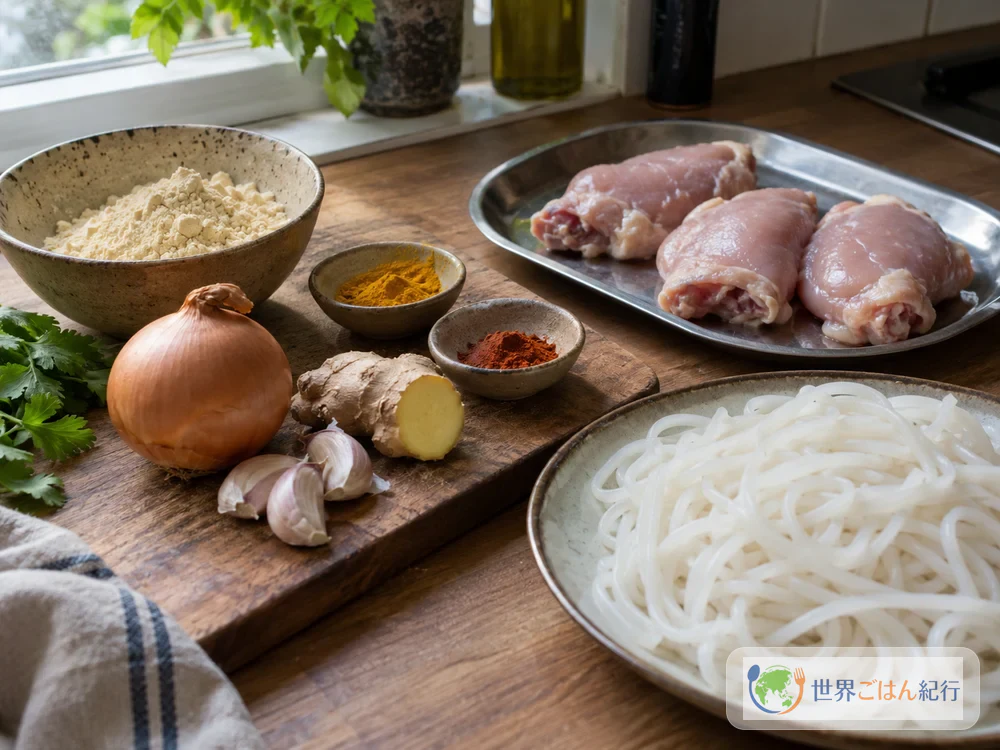
The amounts are based on the Burmalicious recipe (serves 5 to 6). The chicken curry oil is blended for home cooking, divided equally among 5 plates.
This dish contains fish (fish sauce, fish balls), egg and pulses (chickpea). If made with udon, it also contains wheat. The garlic-chili oil is quite hot, so for children and people who dislike heat, have each person add a very small amount to their own plate.
How to make nan gyi thoke
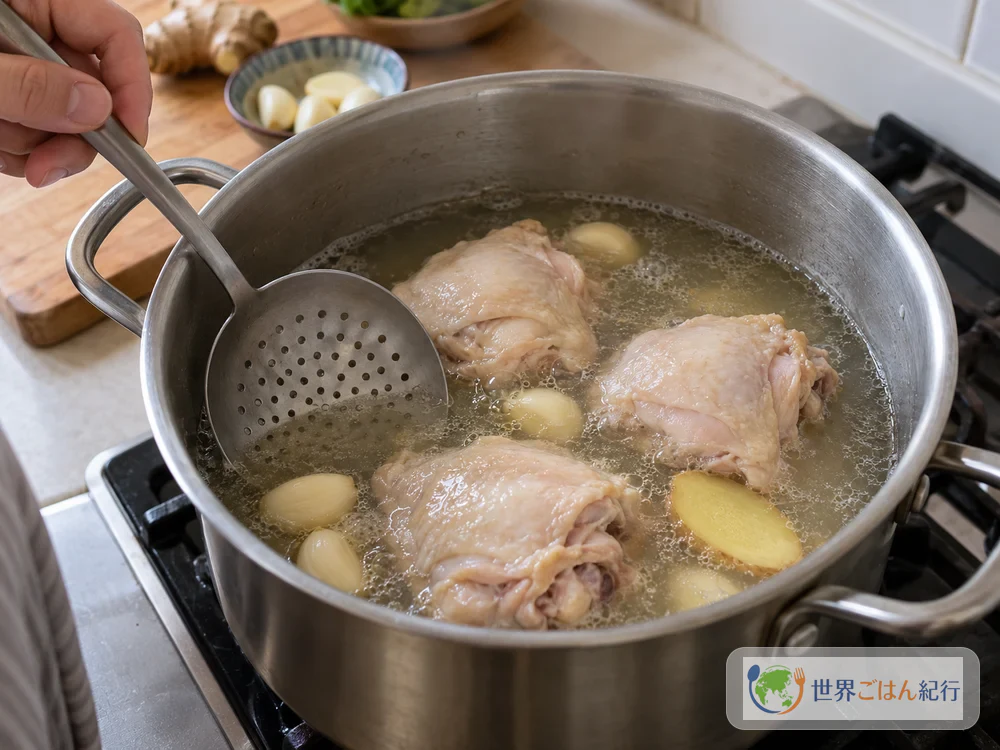
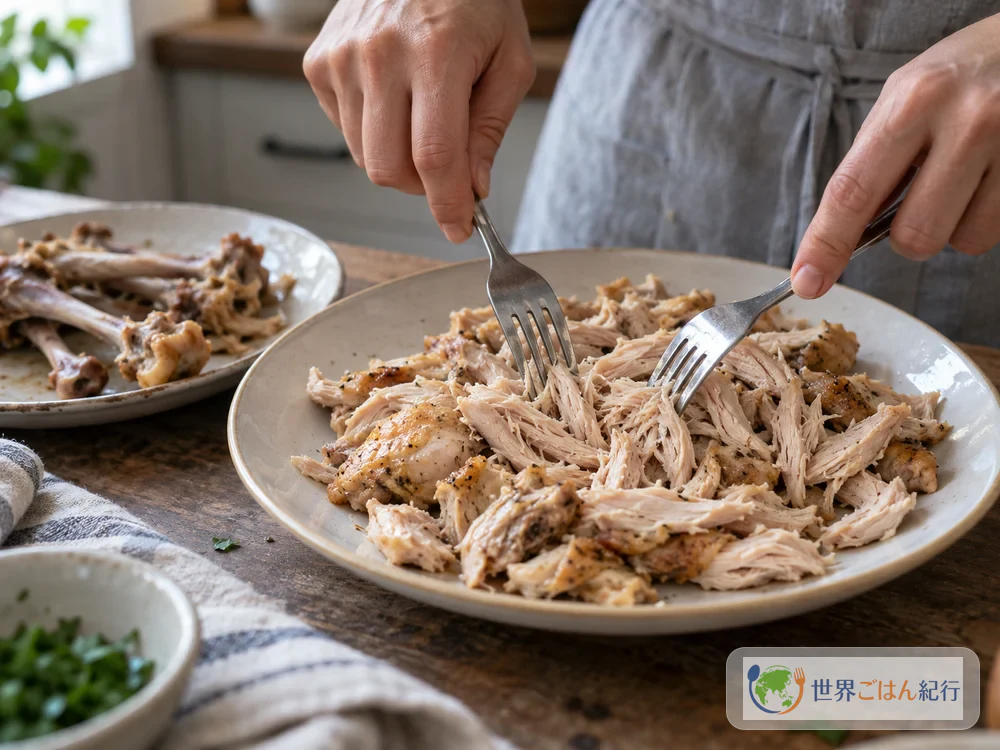
While the chicken poaches for 45 minutes to 1 hour, prepare the toasted flour and garlic-chili oil and the work goes efficiently. About 2 hours total is the guide.
When making the fried noodles, dried noodles puff up hugely in an instant. Add only a pinch at a time, and keep the oil to no more than half the depth of the pot. Don't take your eyes off the pot while frying, and turn off the heat immediately if it smokes.
If it still tastes floury when tossing, add the chicken curry oil 1 tsp at a time. If instead it is oily and heavy, a little more lime juice lightens the mouthfeel. The balance of oil, flour and acid is most reliably set by tasting plate by plate.
With soup and sides, it becomes a morning plate
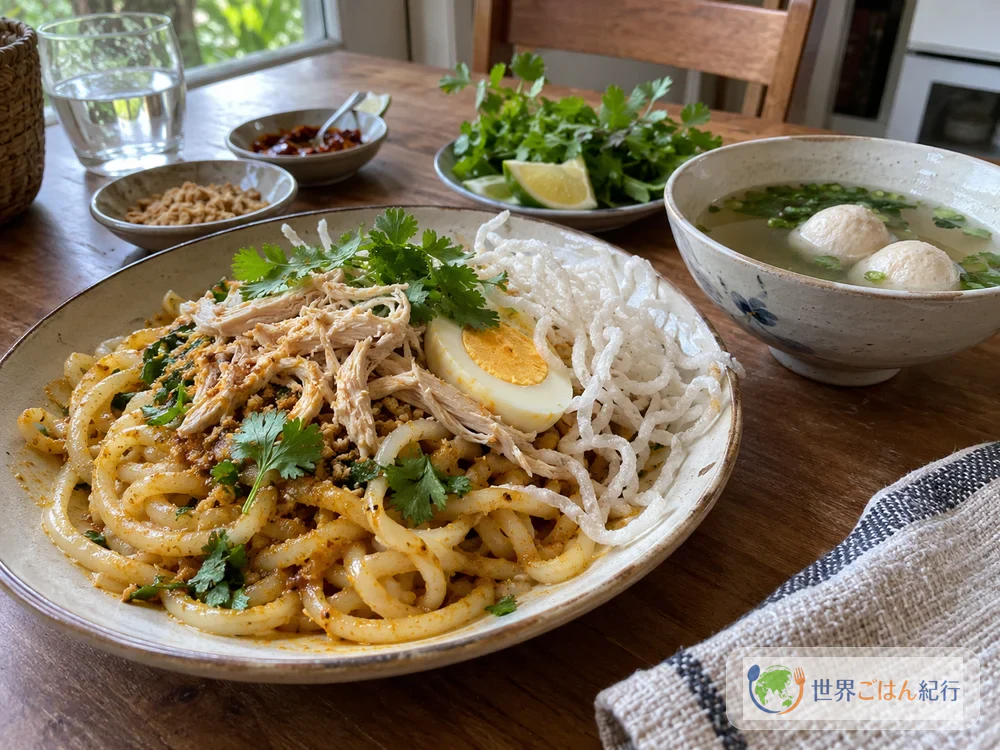
Nan gyi thoke comes with a small bowl of clear soup. Add water to the chicken poaching liquid to make about 750 ml and bring to a boil over medium heat. Add the fish balls and simmer for 3 to 5 minutes until they float and are cooked through, then sprinkle with scallions and white pepper. Sipping the soup between bites of noodles lightens a mouth weighed down by oil and flour.
At street stalls in Mandalay and Yangon, some places serve it with bean fritters, fried fish-paste chips, thin slices of raw onion or shallot, and bean sprouts. They also sometimes float pickled mustard greens in the soup. At home, thin slices of store-bought fish cake add fish savoriness. A little pickled mustard greens in the soup brings it closer to the local sourness.
Mandalay also has a type called "kyar-taung mondi" that uses a whole fish rather than chicken and is served with a clear soup. Even within the same city, there are several combinations of noodle and topping.
If you are making other Burmese noodle dishes, compare it with the national dish mohinga, which eats rice noodles in catfish broth; ohn no khao swe, which pairs wheat noodles with a coconut milk soup; and the Shan State Shan noodles (in Japanese), tossed with a tomato and pork sauce. Even with the same rice noodle, the construction of flavor changes entirely from region to region.
Variations
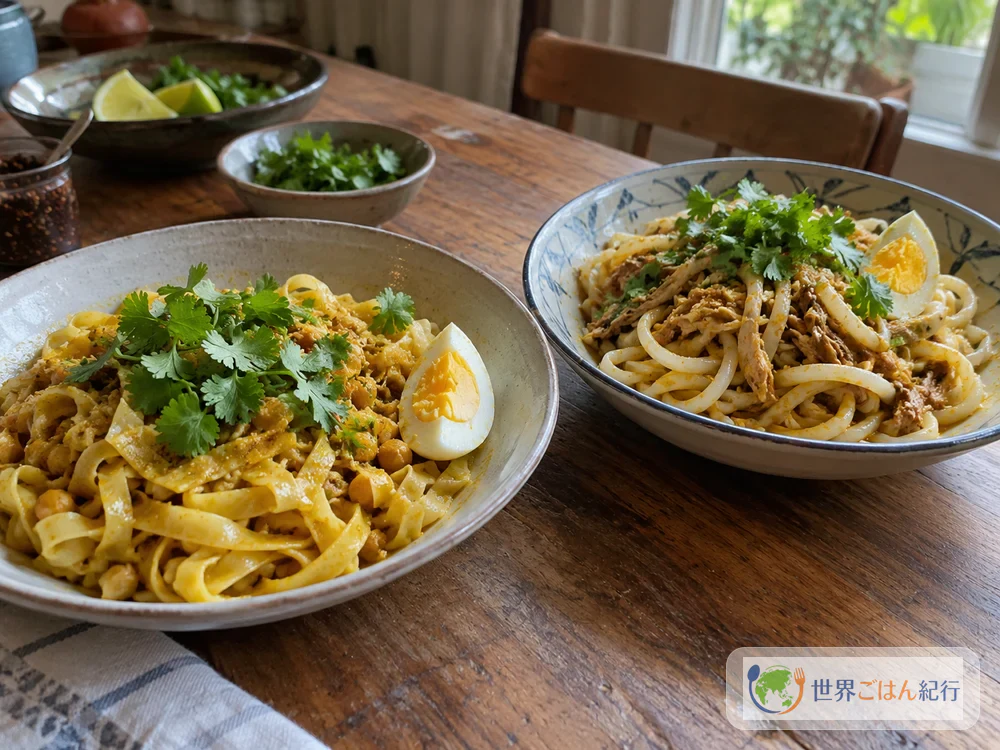
It is also made with pork instead of chicken. Simmer a block of pork leg with the same aromatics until tender, shred it finely, and make the curry oil by the same steps. In Myanmar there are also tossed noodles that use flat pasta in place of thick rice noodles; boil dried fettuccine or tagliatelle and toss with the same oil and flour for a plate with a chewy bite.
If you want heat, mix in about 1 tsp garlic-chili oil as you toss. For a meatless version, leave out the chicken and toss only with the aromatic oil, made by adding turmeric and paprika to the oil in which you've stir-fried onion and garlic. If you season with salt and soy sauce in place of fish sauce, it becomes a plate without seafood as well.
Frequently asked questions
What if I can't get chickpea flour?
Substituting roasted soybean flour (kinako) gets close in toastiness and in how it clings. However, kinako has the sweet aroma of soy, which tastes different from the mild toastiness of chickpea flour. If you use kinako, there is no need to toast it. Try starting with 1 tbsp.
Is it all right for the noodles to be cold?
Locally, room-temperature noodles are generally tossed with warm curry oil. If the rinsed noodles seem too cold, pour boiling water over them quickly and drain, and the oil won't set but will blend in.
How long does the chicken curry oil keep?
Refrigerate it in an airtight container with the chicken and use it up by the next day. When reheating, heat it in a skillet until hot throughout. Toasted chickpea flour keeps at room temperature if cooled completely and put in an airtight jar, but the aroma fades once it picks up moisture, so use it soon.
Can I make the garlic-chili oil ahead?
Put it in a clean jar and refrigerate it, taking portions with a clean spoon. Do not leave oil containing garlic at room temperature. If there is any change in smell or color, don't use it.
Sources
- Burmalicious, "Nan Gyi Thoke – Thick Rice Noodle Salad." Accessed and checked October 22, 2026. https://www.theburmalicious.com/blog/burmese-thick-rice-noodle-salad
- Wikipedia, "Nan gyi thoke." Accessed and checked October 22, 2026. https://en.wikipedia.org/wiki/Nan_gyi_thoke
- Seasia.co, Muhammad Robith Faizi, "Nan Gyi Thoke: Myanmar's Version of Spaghetti Made with Rice," published August 4, 2026. Accessed and checked October 22, 2026. https://seasia.co/2026/08/04/nan-gyi-thoke-myanmars-version-of-spaghetti-made-with-rice



