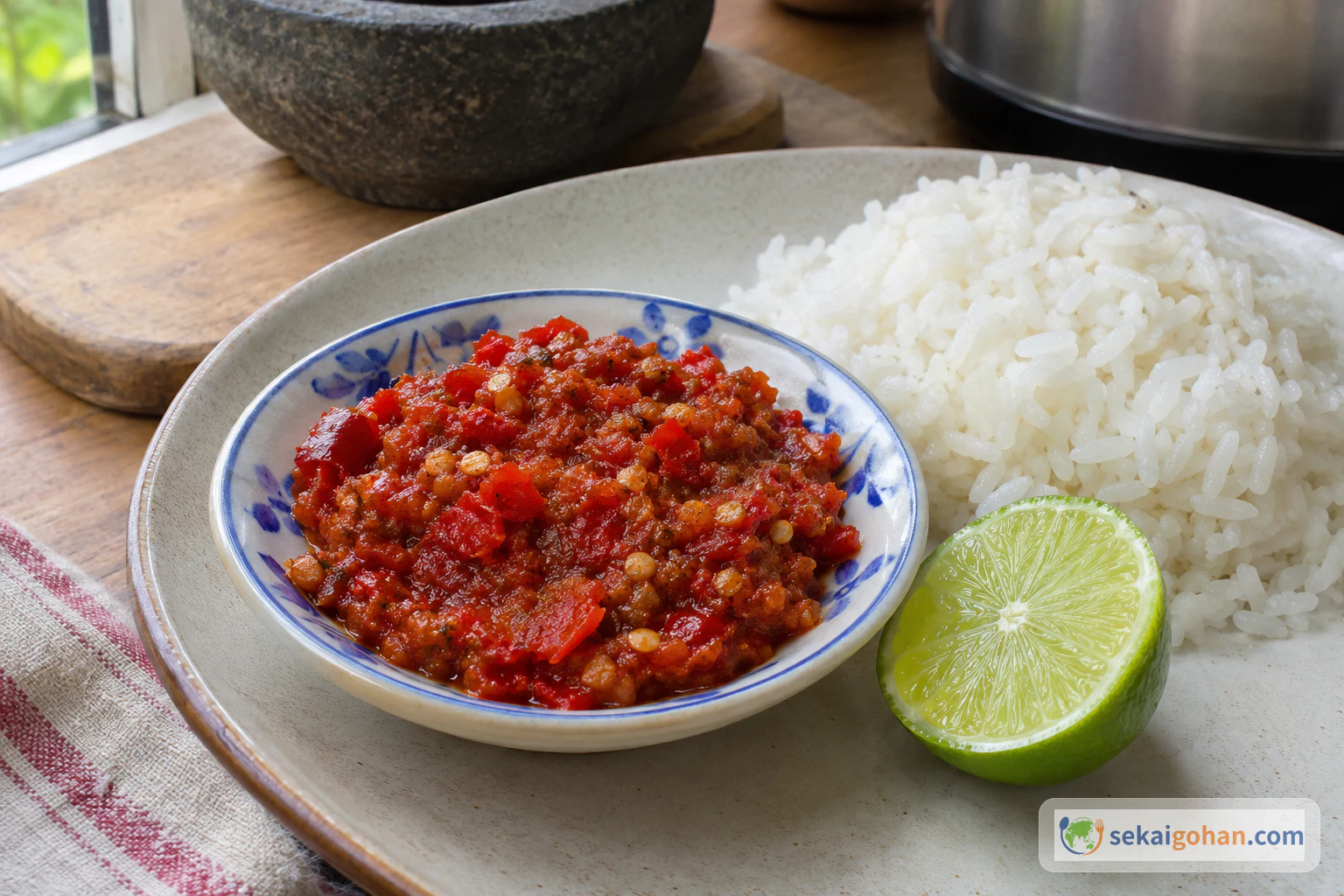
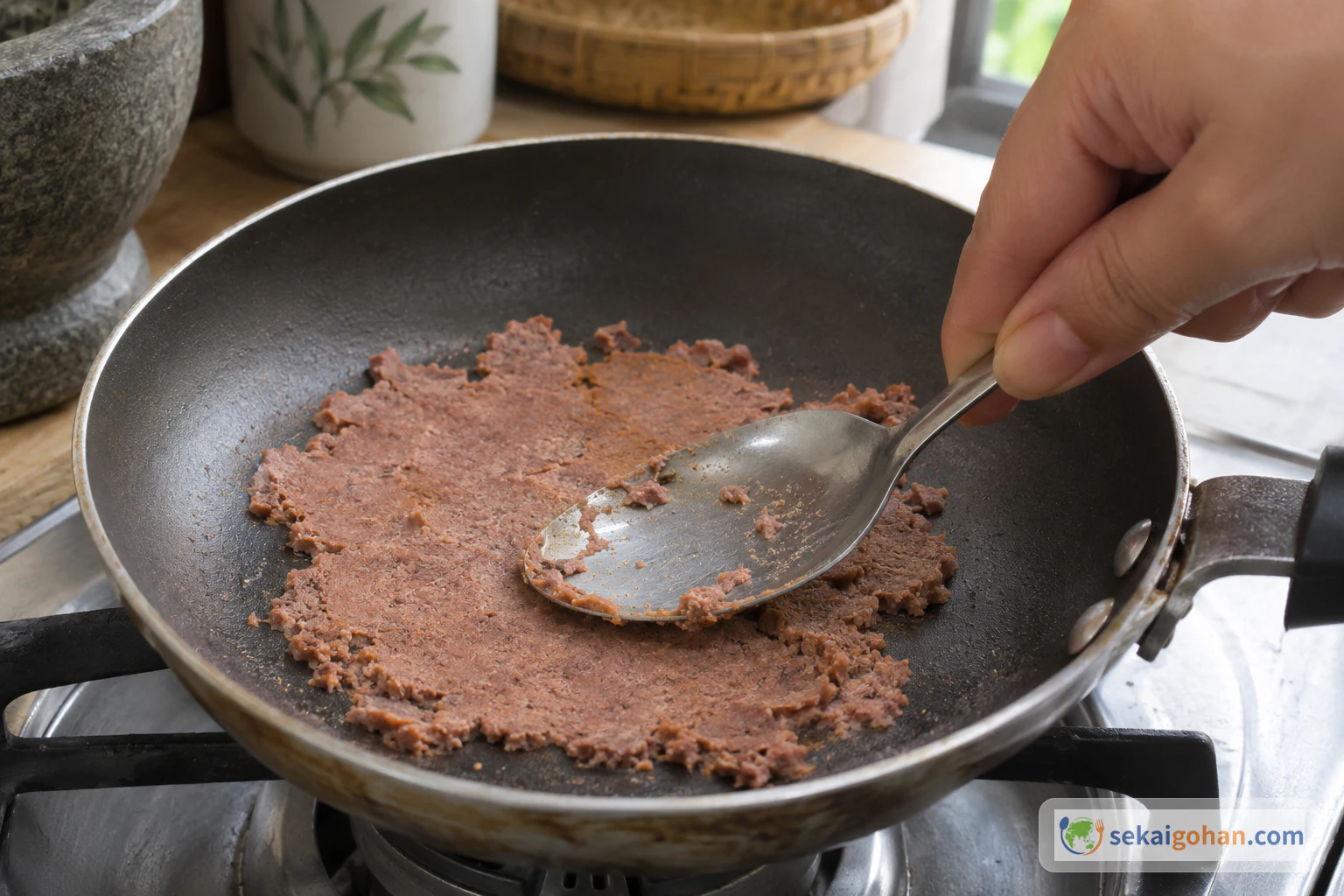
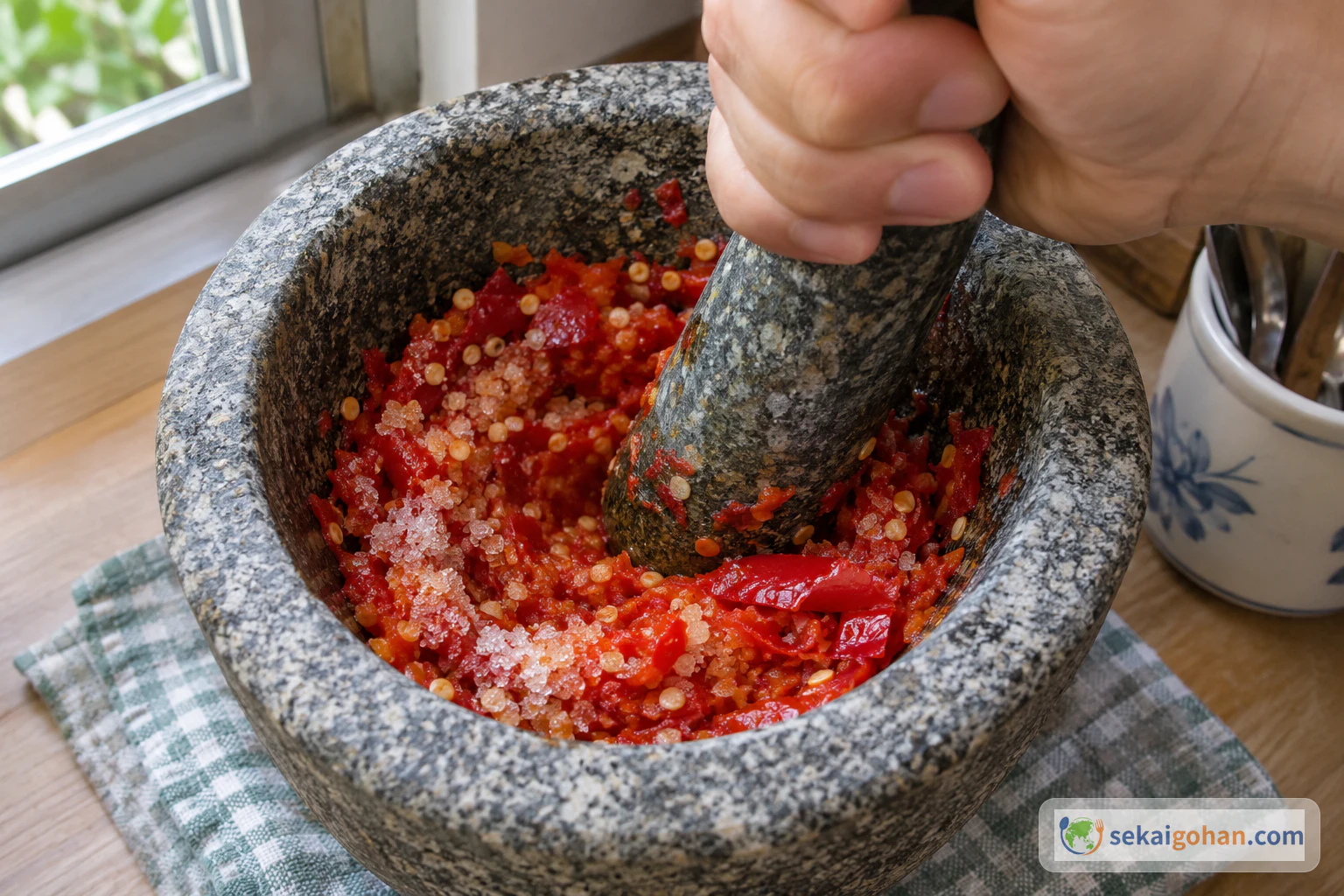
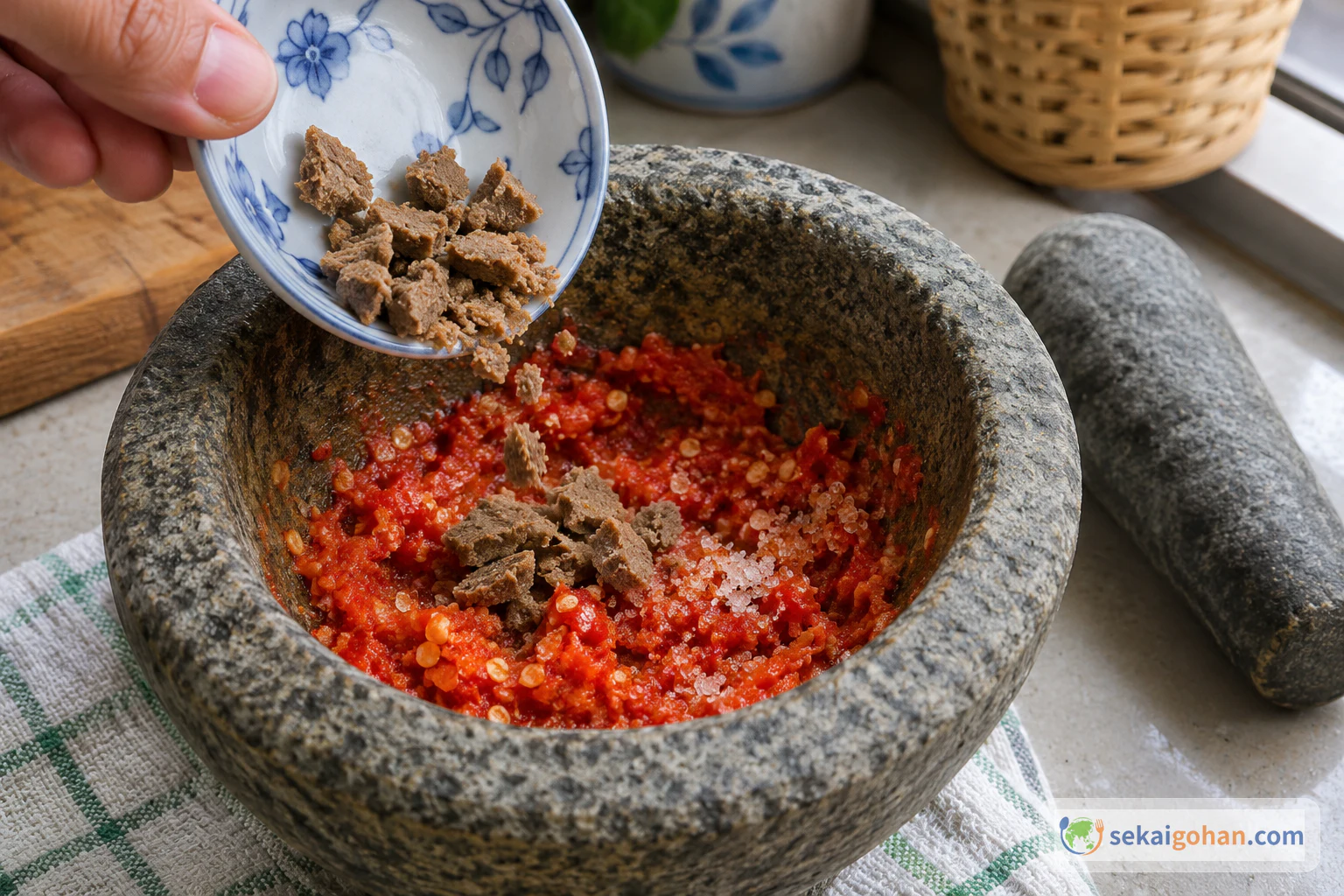
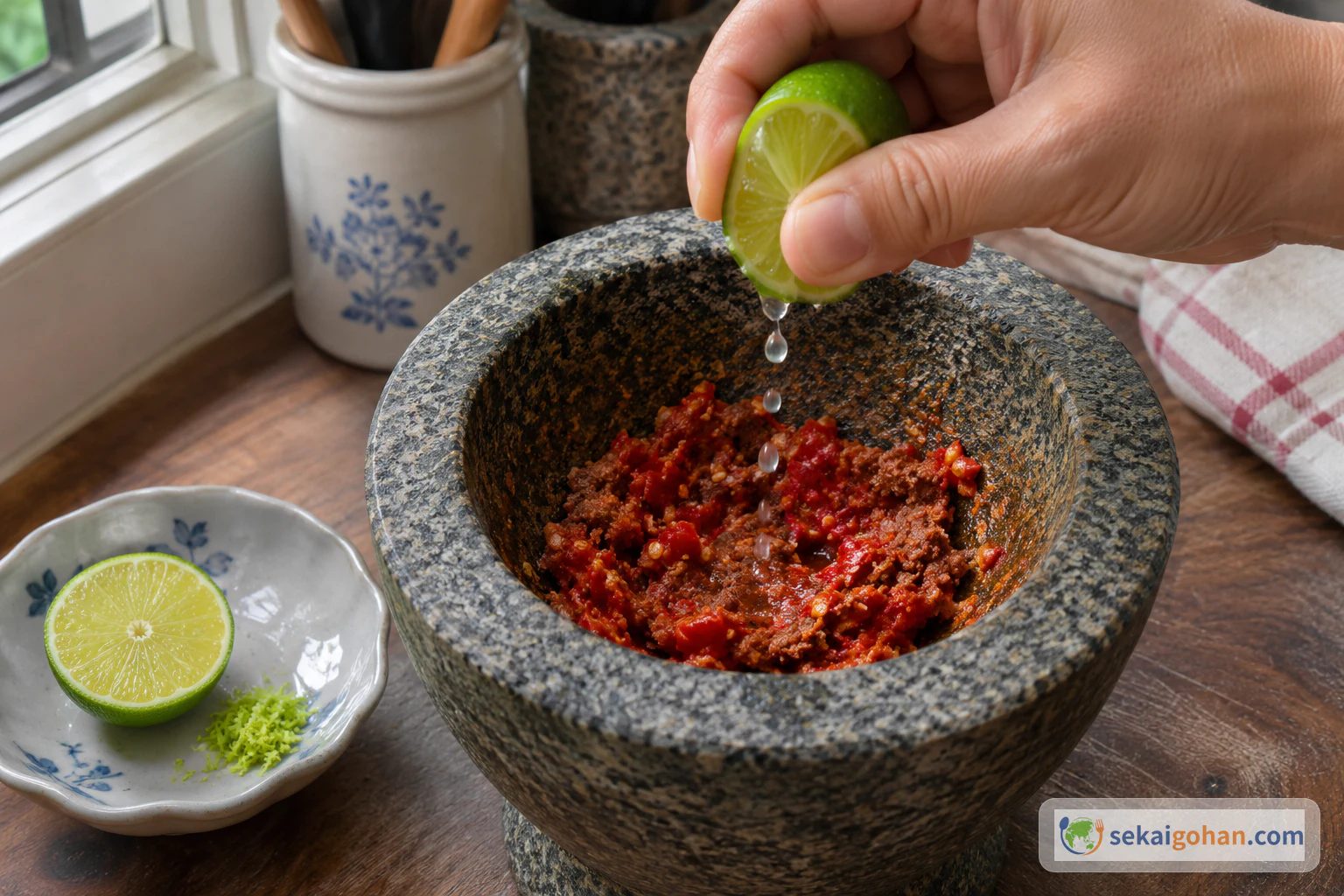
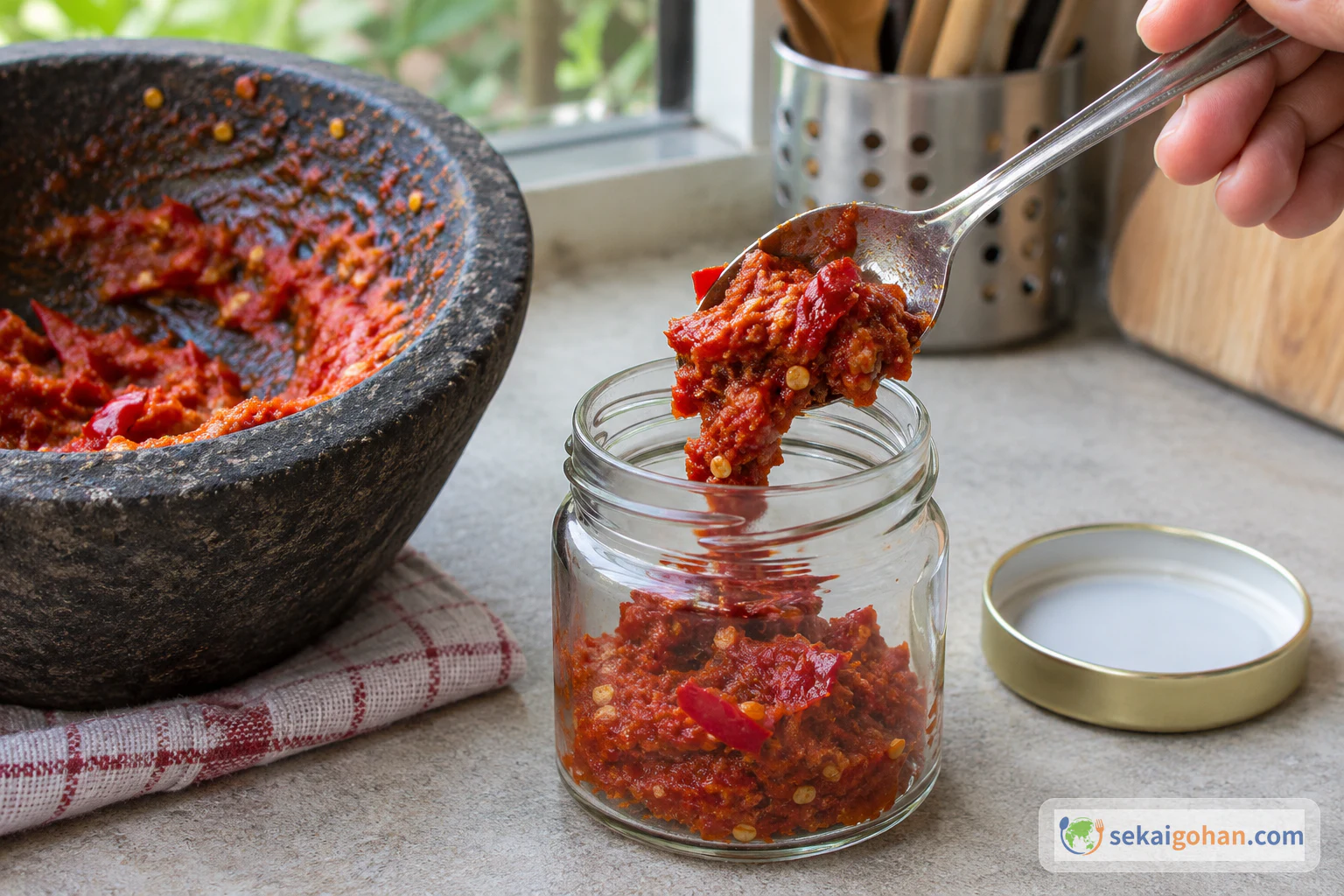
A spoonful of dark belacan goes into a small dry pan, and the back of a spoon presses it as thin as it will go. Some of it clings to the spoon and gets scraped back in. On low heat the sharp fermented smell starts to turn toward roasted shrimp, and that change decides whether the jar tastes homemade or bought. Sambal belacan is the everyday chilli relish of Malay homes in Singapore and Malaysia: fresh red chillies pounded coarse with that roasted shrimp paste, a little sugar and salt, and lime squeezed over at the end. It hits hot, salty and sour at once, with a deep shrimp savouriness under the heat and a pungent finish, and it sits next to plain rice at the table.
One Name, Many Jars
Ask for sambal across Singapore and you get a different jar depending on whose kitchen you are in. Sambal is a spicy relish that works as both an ingredient and a side dish in Chinese, Malay, Peranakan and Eurasian cooking, here and in neighbouring Malaysia and Indonesia. Most start from fresh chillies, shrimp paste, lime juice, sugar and salt, and then each community pulls it its own way. Malay-style sambals bring in coconut shavings and dried shrimp. Sambal tumis is cooked and leaves a sweet aftertaste from gula melaka, the dark palm sugar. Chinese-style sambal leans on chillies, garlic, ginger and lime, and Peranakan kitchens make one with pork alongside shrimp. Even the sambal tossed through rojak and the one beside nasi lemak differ in taste, texture and job.
The one to make first is sambal belacan, the plainest and most used of the Malay sambals. It is raw. No oil, no frying, no simmering. The only thing that meets the heat is the belacan itself, and everything else is pounded and finished with lime.
From the Portuguese chilli to a heritage listing
The word sambal is traced to Javanese and Sundanese, but the chilli at its centre is a relative newcomer. Chillies are New World plants, carried into Southeast Asia from the Americas by the Portuguese in the early 16th century. In Singapore, sambal-making shows up in writing as early as 1879, and the sambal then was eaten alongside bread and butter.
The traditional tool is the batu lesung, a stone mortar and pestle, with water added a little at a time until the paste reaches the texture the cook wants. Bought jars have cut down how often households make sambal from scratch, yet hawker stalls, restaurants and home cooks keep pounding it the old way, and the skill passes down through families and through cooking schools. That passing-on is what was recognised when the making and use of sambal was added in March 2022 to Singapore's national inventory of intangible cultural heritage, as entry ICH-99. One Teochew cook pounds shallots, garlic, dried and fresh chillies, then adds kaffir lime leaves, ginger and galangal. She owns a food processor and still asks her grandchildren to learn on the stone mortar, as a rite of passage.
Other jars that share the name
Quantities shift from house to house even within sambal belacan. Another Singapore household pounds five long red chillies with three small green or red Thai chillies, belacan about the size of a 20-cent coin, a tiny bit of sugar, and finishes with one lime or limau kasturi. That is a different balance from the jar below, and the two are best kept apart rather than blended.
The chilli sauce served with Singapore chicken rice is a separate preparation altogether: red chillies blended with garlic, lime and chicken stock, then chilled, with no belacan in it. Bali's sambal matah is raw too, but it is built on shallots and lemongrass. Indonesia's close cousin of this jar is sambal terasi, and Thailand's is nam prik kapi.
All three words point to fermented shrimp paste. Belacan is the Malay name used in Singapore and Malaysia, terasi is the Indonesian one, and kapi is Thai. Brands differ in saltiness and in how strongly they are fermented, so the jars made from them taste related rather than identical.
Ingredients (serves 8)
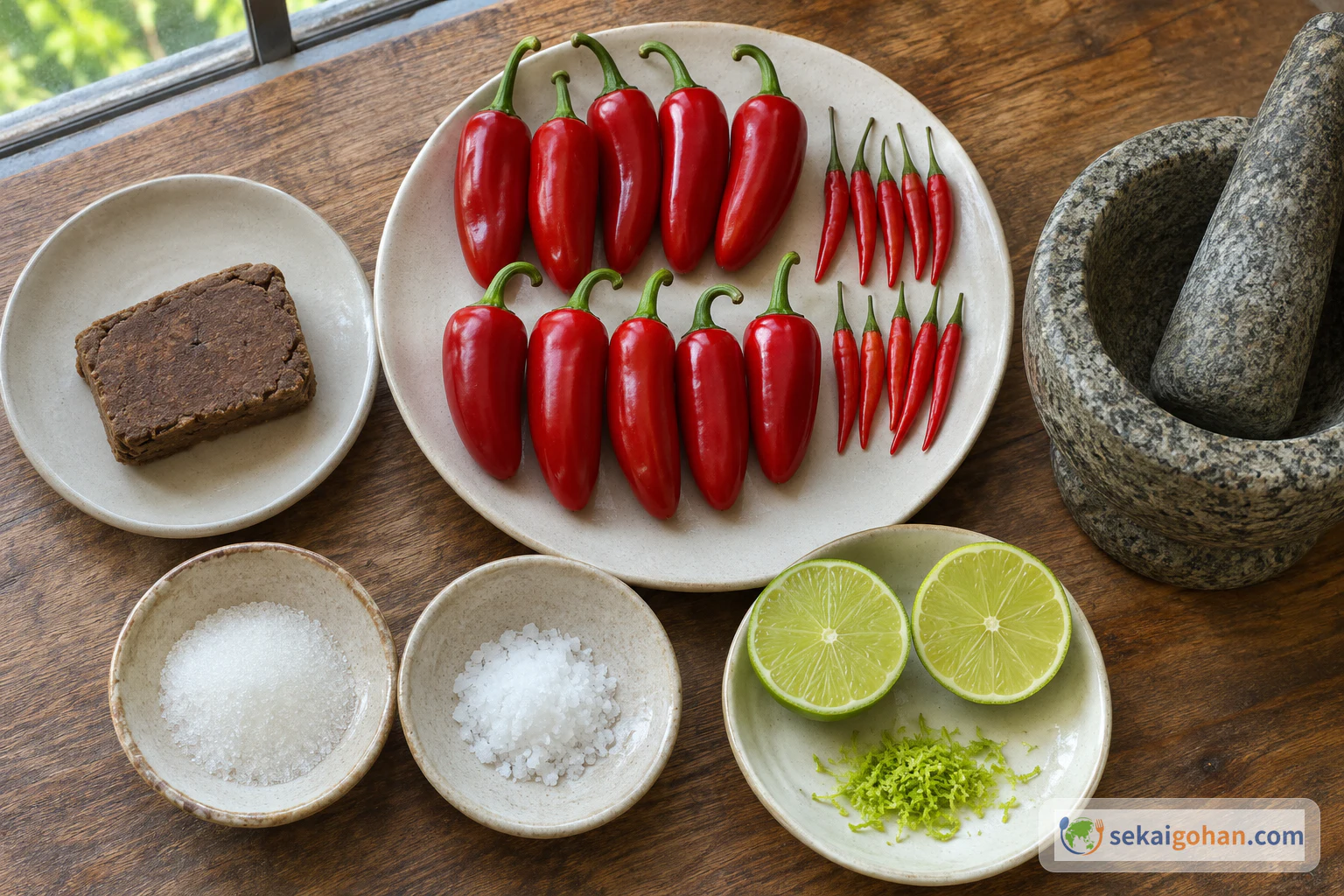
Sambal belacan takes far more shrimp paste than a cooked dish does. In taste tests, sambal belacan needed up to 18 percent belacan, while a sour fish curry like asam pedas was at its best with 0.45 percent (a research figure, not a measure for this jar). Cut the belacan and the jar turns into plain chilli heat.
Belacan is made from shrimp, a crustacean. Anyone with a shellfish or seafood allergy should avoid this sambal. Additives in commercial belacan vary by product, so read the ingredient label on the block or tub before you buy.
Equipment
- Small frying pan
- Metal spoon (for pressing the belacan)
- Small dish (for the roasted belacan)
- Stone mortar and pestle, ideally granite, or a small food chopper
- Zester or fine grater (if using the zest)
- Small clean glass jar with a lid
Buying Belacan, Chillies and Lime
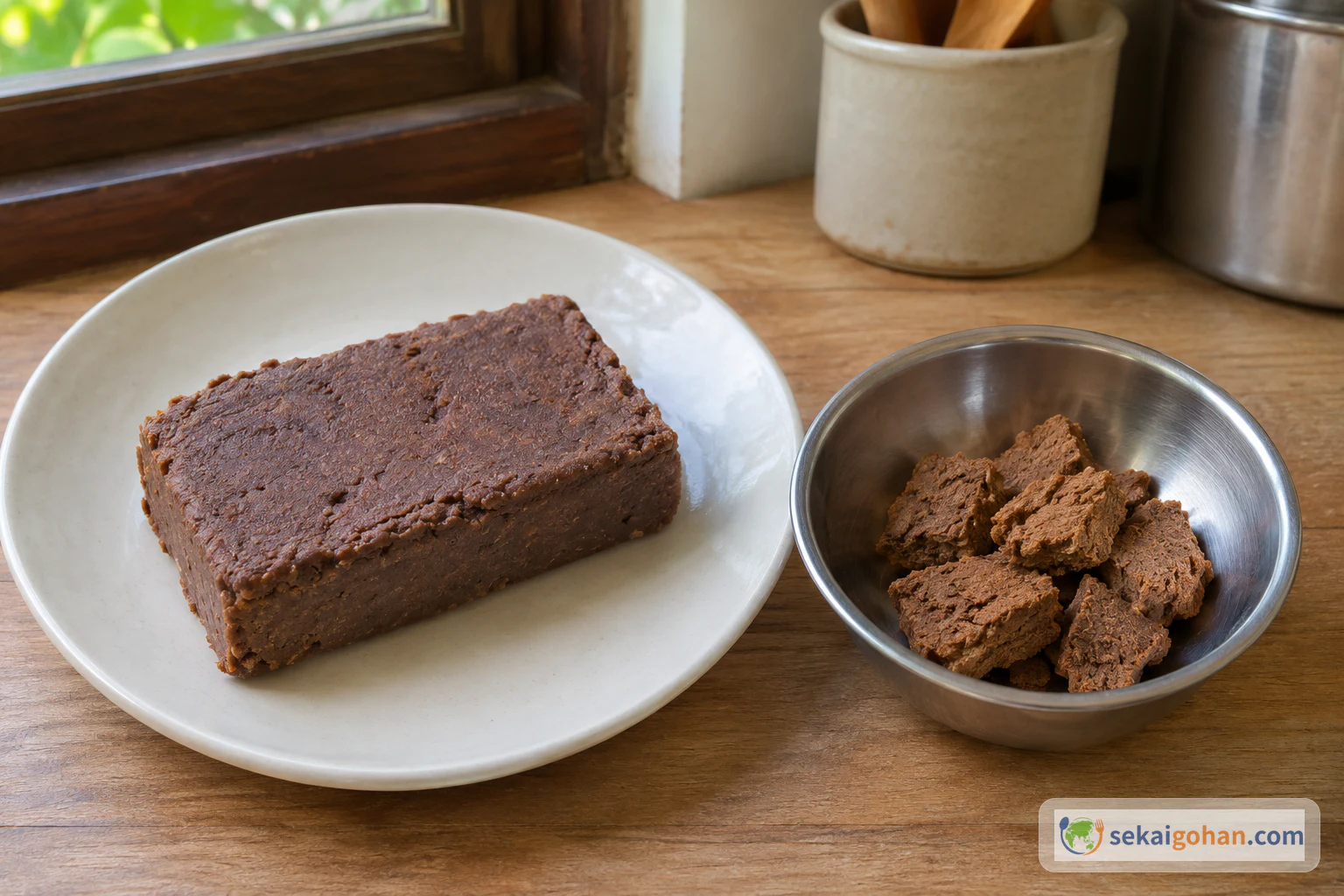
Belacan is the one ingredient with no stand-in outside its own family. Look for it at Asian grocers or online, sold as a pressed block or as a paste. It is a block of fermented shrimp and salt, and the Malaysian food standard sets it at no less than 15 percent salt and no less than 25 percent protein, which is why a single tablespoon seasons the whole jar. Its savouriness comes from free glutamate, about 5000 mg per 100 g, and from 5'-nucleotides. Spray-dried powdered belacan shows the lowest nucleotide level of all forms, 0.85 µg/g, likely because drying destroys them. Choose a block or paste over powder. Thai kapi and Indonesian terasi belong to the same family and can stand in, but each brand differs in saltiness and in how strong the fermentation is.
Red jalapeños can be hard to find. Plump fresh red chillies from an Asian grocer take their place: the jalapeño's job is mild, fleshy body and colour, while bird's eye chillies bring a small, sharp sting. Swap one for the other at the same count and the heat changes, so match the role rather than the number. Bird's eye chillies are sometimes sold frozen at Asian grocers.
For acid, a Persian-type lime is the choice, with calamansi as the alternative. Lemon shifts the aroma toward a different sauce, and vinegar alone tastes harsh against the chilli.
| Keep for the local taste | What happens if you swap it |
|---|---|
| Belacan | Dried shrimp and fish sauce move the jar toward a different, cooked-style sambal |
| Fresh red chillies | Dried chillies alone change the aroma completely |
| Lime | Lemon changes the fragrance; vinegar turns sharp |
Method
The whole job turns on the belacan. Get the belacan into the pan first. The roasting is the only time on the stove; everything after is pounding, which takes longer by hand than in a chopper and gives a coarser, more varied texture.
Put everything in a small food chopper at once and pulse to a smooth-ish mix, or stop early and keep it coarse. The chopper gives a finer, more uniform paste than the stone mortar, which leaves shards of skin and seed as part of the texture.
When It Goes Wrong
| What you see | Why | What to do |
|---|---|---|
| Bitter taste | The belacan scorched | It cannot be fixed in the jar. Next time keep the heat low and turn the belacan halfway. If a batch blackens in the pan, discard it and roast fresh |
| Dark, blackish colour | Roasting heat too high | Start the pan on medium-low and drop to low as soon as the belacan is flat |
| Too hot | The bird's eye chillies dominate | Sugar only makes it sweet, not milder. Next time use fewer bird's eye chillies and keep the jalapeños for body |
| Too salty | Belacan salt plus the added pinch | Salt cannot be taken back out. Next time keep the pinch very small, especially with a salty brand |
| Grains that crunch like salt | Belacan pounded too briefly | Pound again until no hard bits remain |
| Dry and crumbly | Chillies under-pounded | Pound longer; the chillies release their own moisture as they break down |
Serving, Variations and Storage
At the table
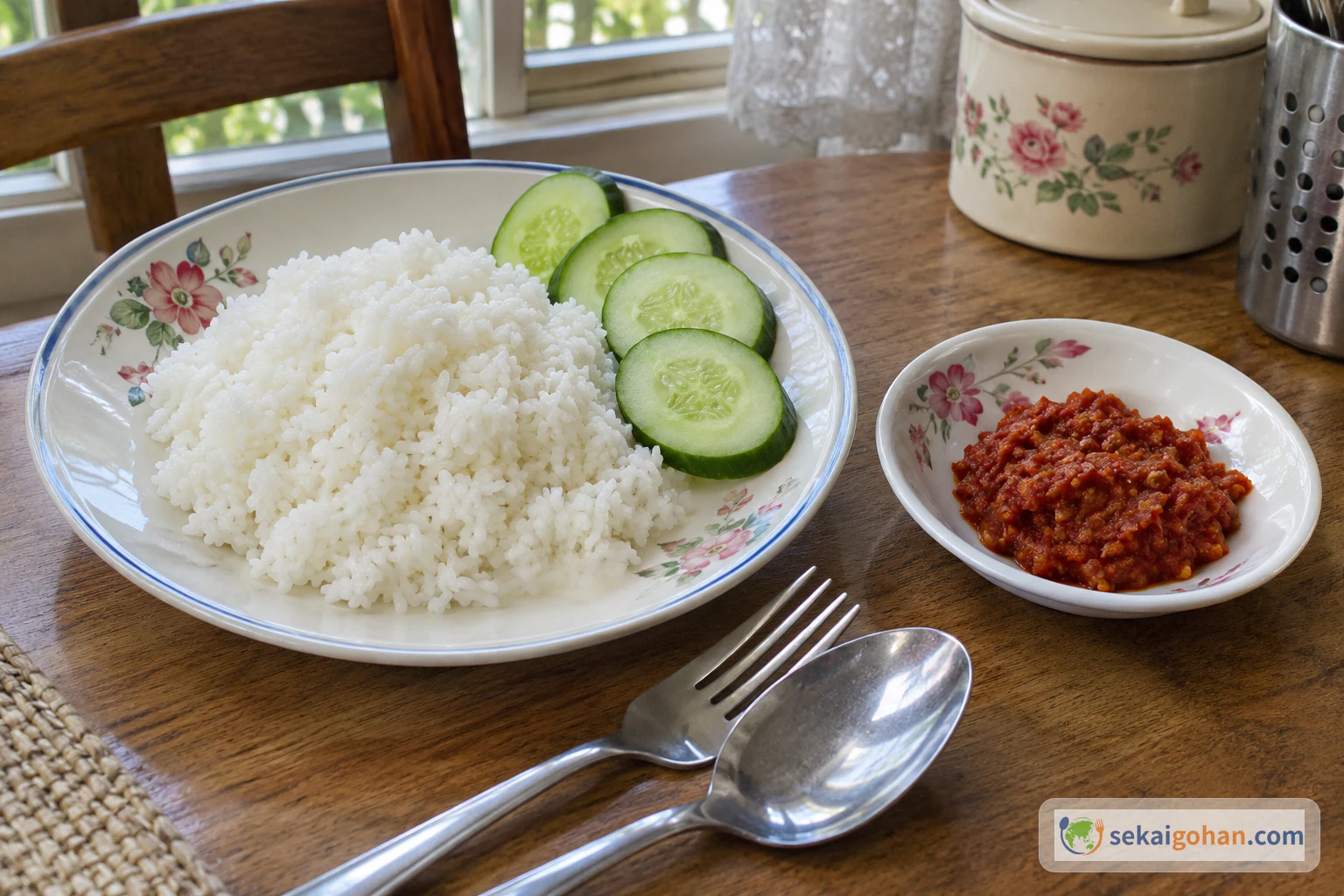
In Malay homes in Singapore and Malaysia, sambal belacan is eaten with rice: a small spoonful at the edge of the plate, mixed into each mouthful as you go. It also goes alongside nasi lemak, char kway teow and laksa, and it works as a dip for raw vegetables. Cucumber slices beside the rice give a cool, crisp break between the heat.
Variations
- Lime zest in or out. With the zest, the aroma lifts and the citrus reads clearly over the shrimp. Without it, the lime is only sour.
- A few small green chillies. Some households pound green chillies in with the red. The colour darkens toward red-green and the smell turns sharper and greener.
- One more teaspoon of belacan. The savouriness and saltiness come forward. Leave out the pinch of salt when you do this.
- No sugar. The heat comes straight through with nothing to soften it. This moves the jar further from the sweet, cooked sambal tumis.
Storage and who should go carefully
Keep the sambal in a clean jar in the refrigerator and use it within 5 days. After that it starts turning slimy; if the texture or smell has changed, throw it out. Take portions with a clean, dry spoon and do not put a used spoon back in the jar. The sambal is eaten cold and is not reheated.
The belacan is roasted, but the finished sambal is never cooked. As protein breaks down during fermentation, belacan can build up biogenic amines such as histamine, which can cause reactions in sensitive people. Its high salt level puts belacan among the higher-risk fermented foods, though eating it in moderate amounts is regarded as safe, so use it as a condiment, a spoonful at a time. For foods made with raw seafood, people with weakened immune systems are generally advised to avoid them: older adults, pregnant women, infants and children, and anyone who is ill. That precaution is written for raw marinated seafood rather than for sambal belacan itself. No pregnancy-specific official advice on belacan has been found, so anyone pregnant or with a weakened immune system should ask their doctor before eating it.
Frequently Asked Questions
Can I use terasi or kapi instead of belacan?
Yes. Both are fermented shrimp paste from the same family, so roast them in the pan as you would belacan before pounding. Brands differ in how salty and how strongly fermented they are, so taste the finished paste before deciding whether it needs the pinch of salt.
How do I make it less hot?
Cut back the bird's eye chillies first; they carry the sharp sting. Keep the jalapeños, since they give the sambal its body and colour, and the jar thins out without them. Adding more sugar only makes a sweeter hot sambal.
Is this the same sambal served with nasi goreng?
It belongs to the same family but is a different jar. The Indonesian counterpart of sambal belacan is sambal terasi, and many sambals served with rice dishes are cooked in oil and sweeter. Sambal belacan stays raw, sour with lime and sharp with fresh chilli.
Can children eat it?
Twenty fresh chillies make this a fiercely hot jar, far beyond what most children enjoy. The paste is also uncooked and built on fermented shrimp, which is why the general precaution for raw-seafood foods includes infants and children. Keep it for the adults' plates.
Can I make a half batch?
Make the full jar. Halving it leaves half a pinch of salt and half a teaspoon of sugar to judge, and the balance of the paste drifts. The full batch already fills only a small jar.