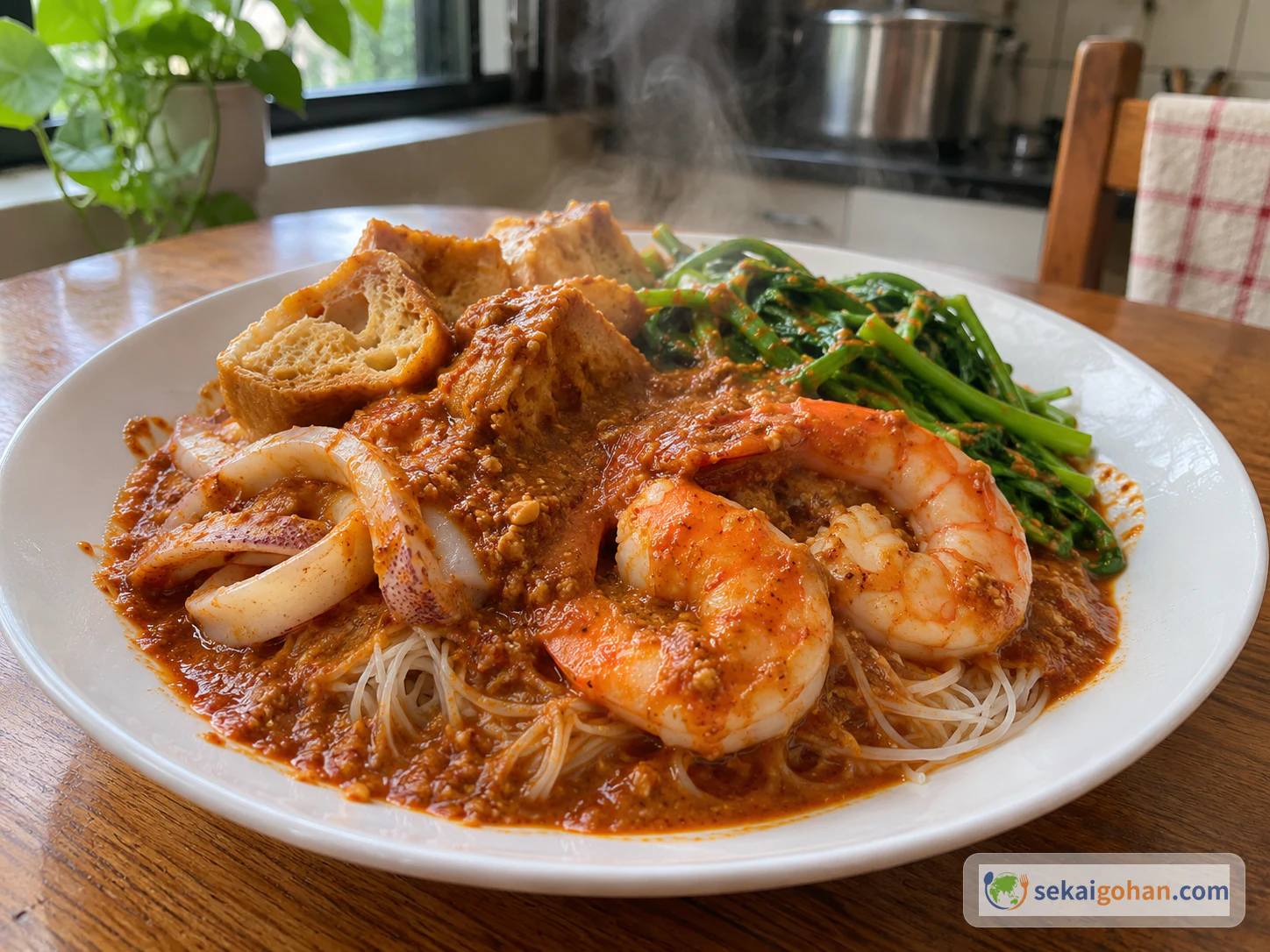
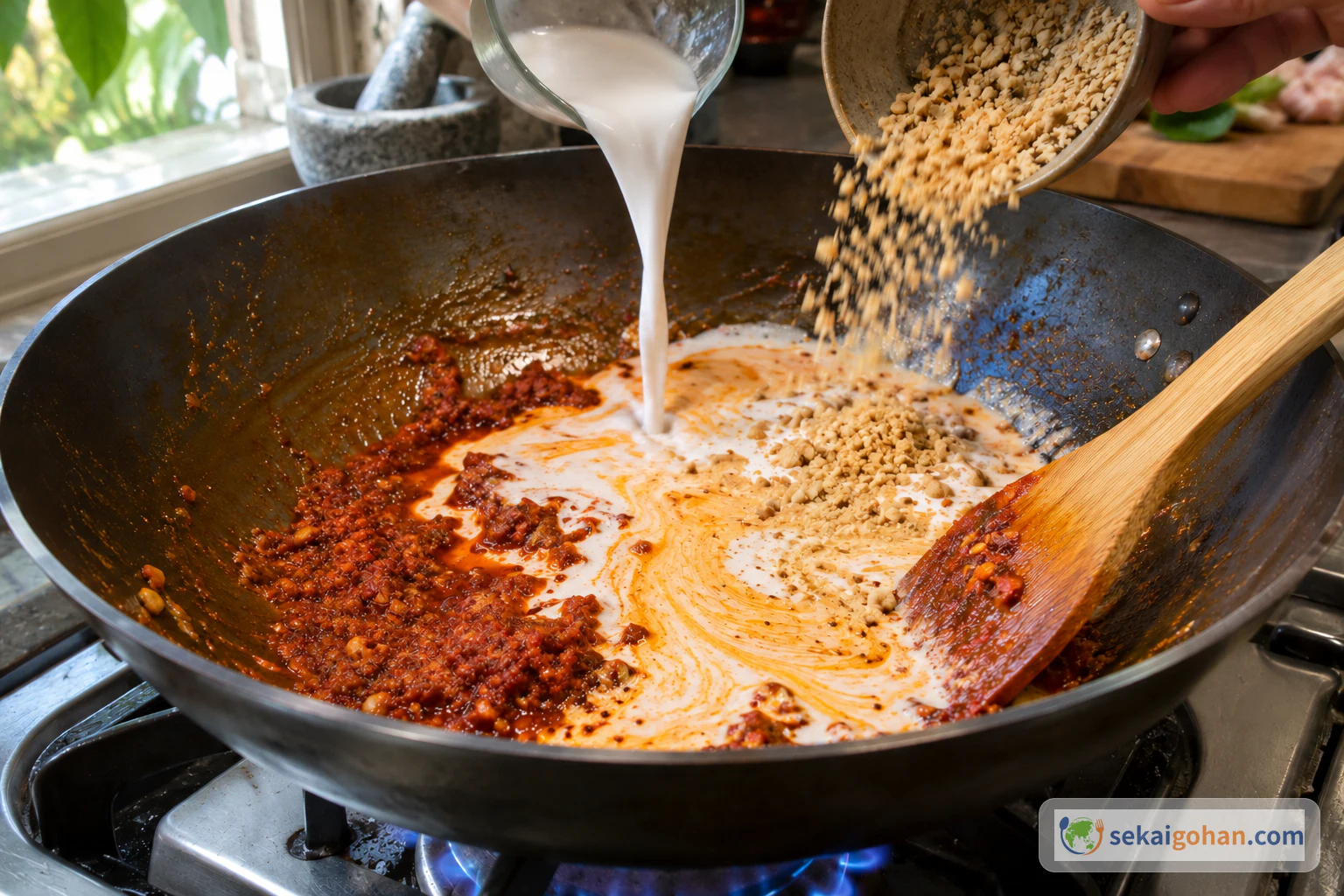
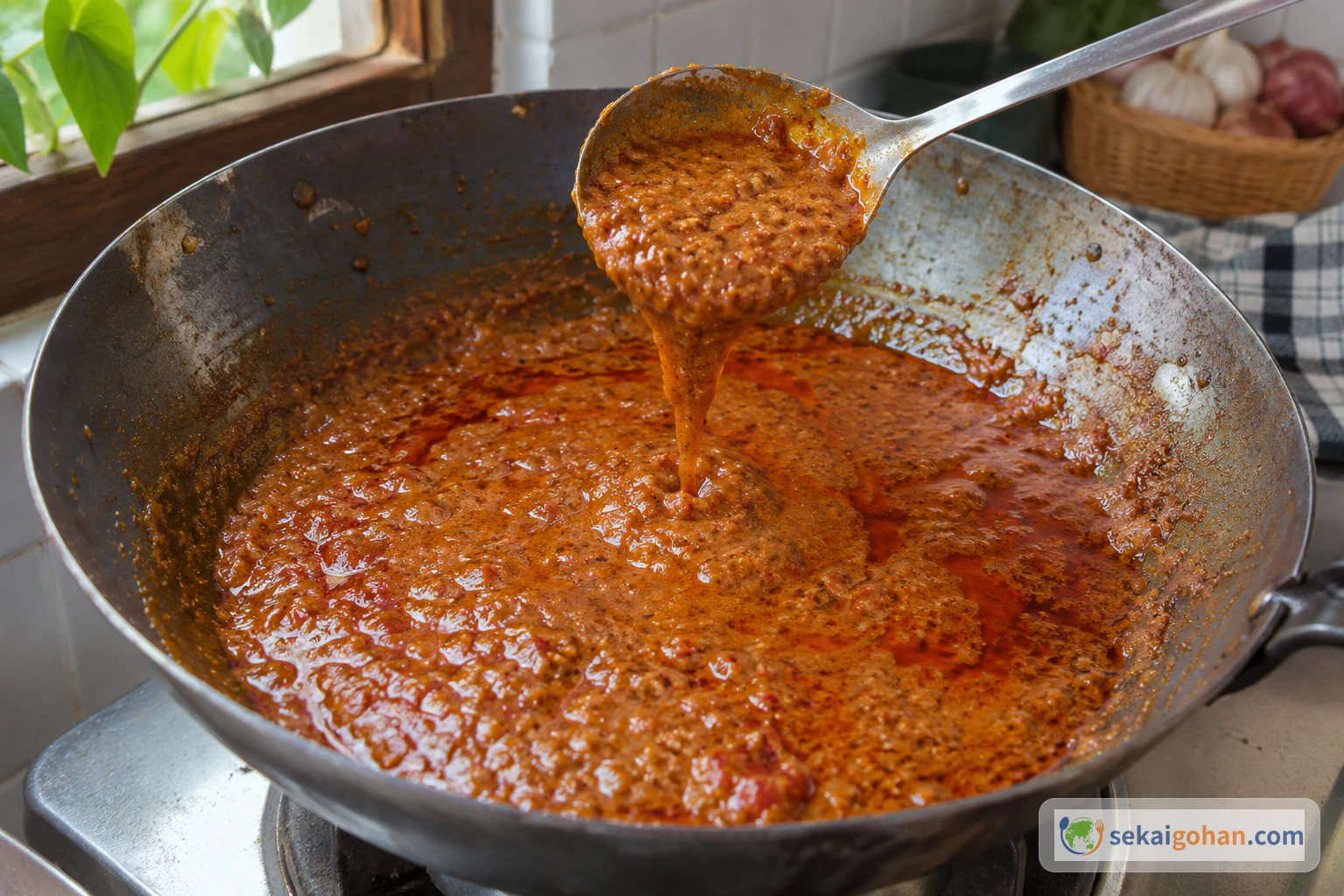
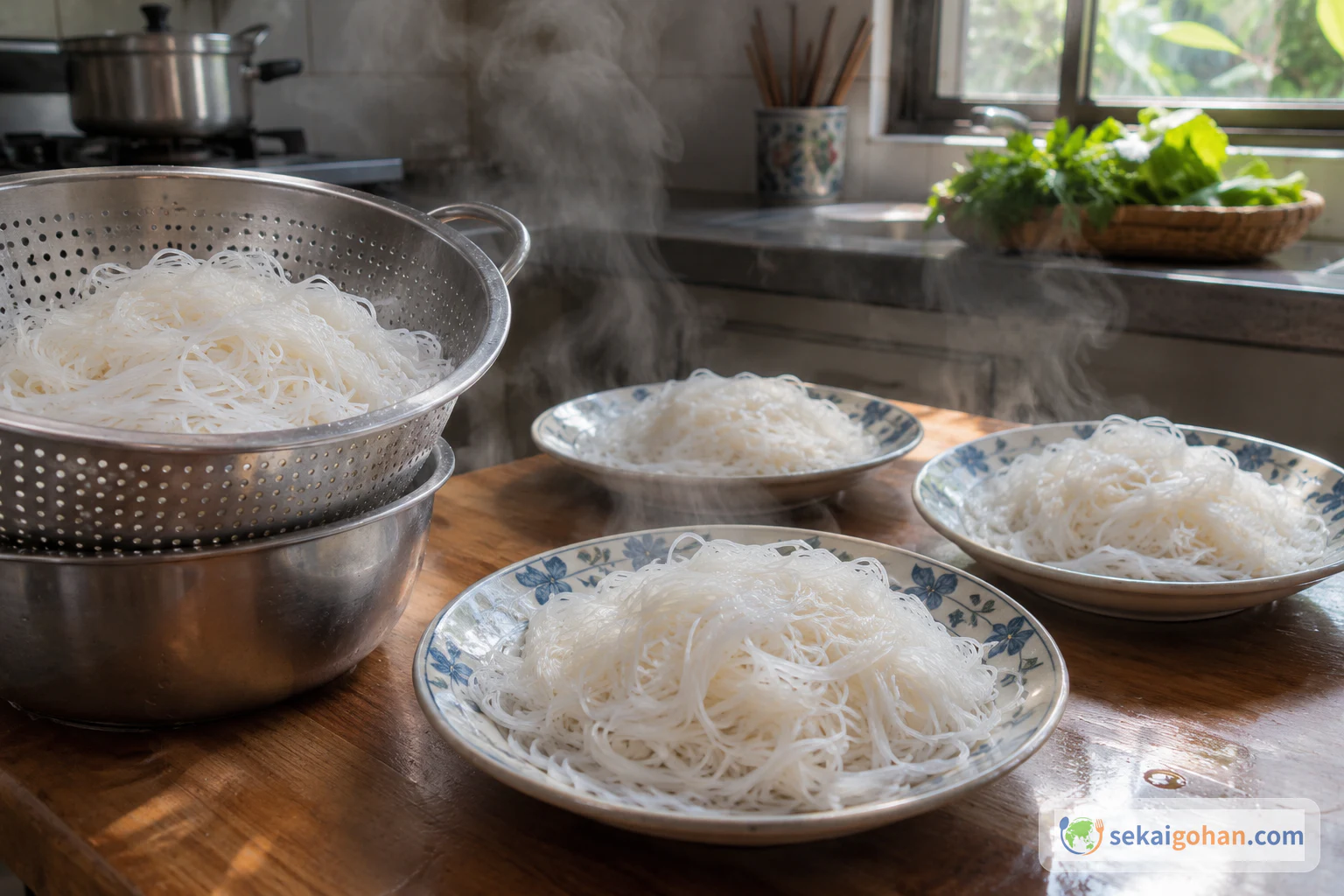
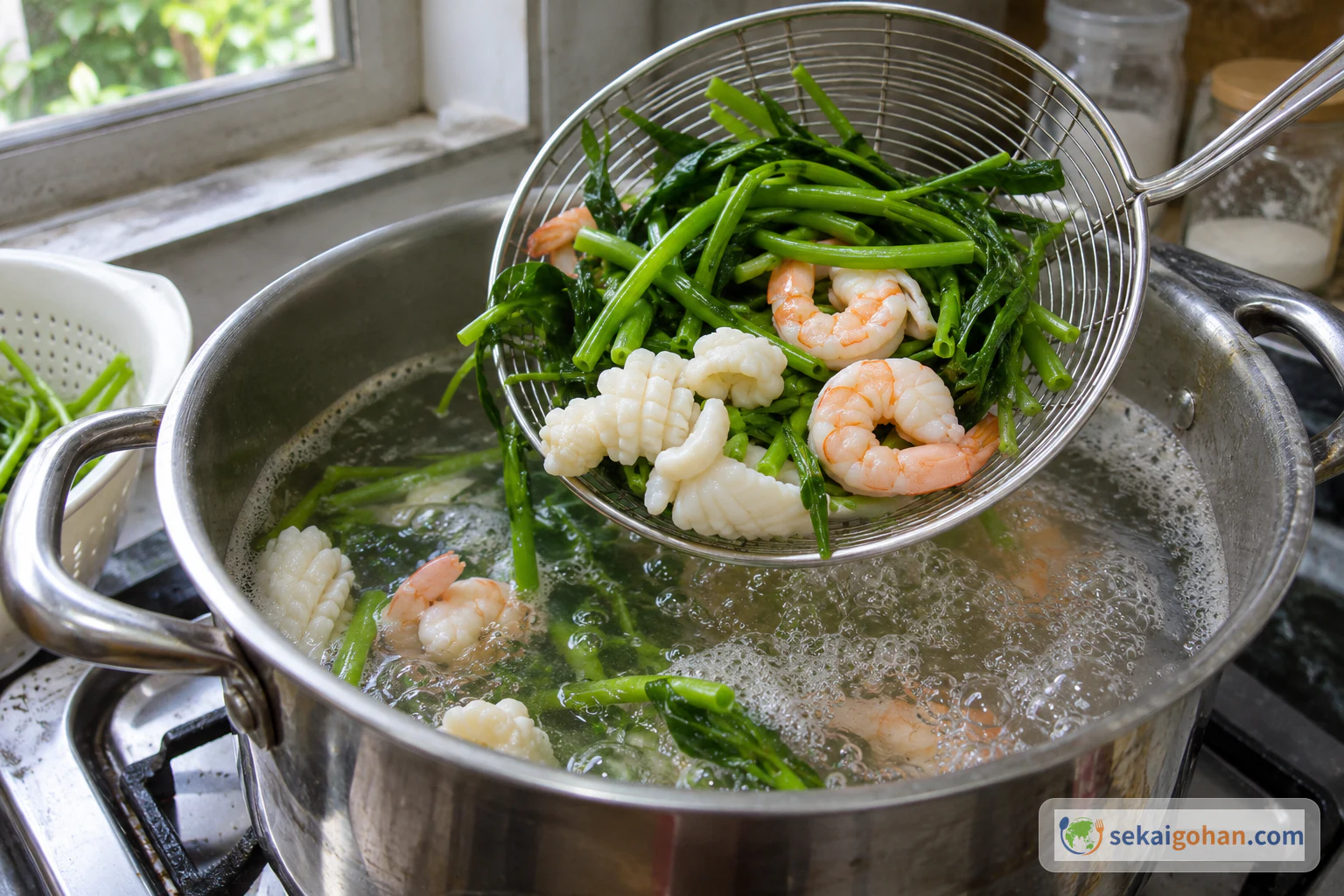
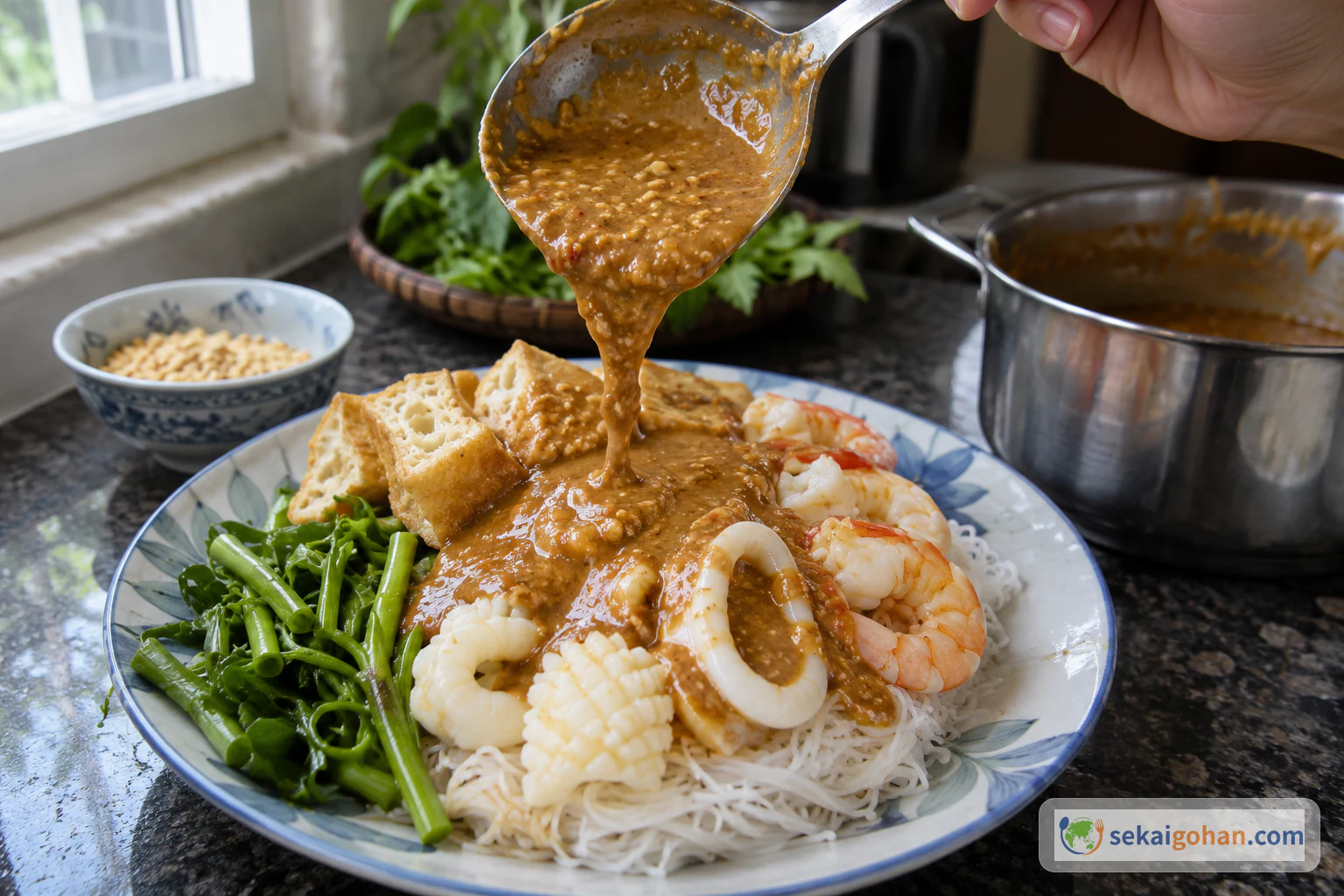
The red paste hits the hot oil and the kitchen fills with shallot, garlic and lemongrass. A few minutes later the coconut milk and crushed peanuts go in, and the wok turns a creamy orange. By the time the sauce is ready, a slick of red oil sits on top and the sauce falls from the ladle in a slow, thick ribbon. That ribbon goes over a plate of rice vermicelli, cuttlefish, water spinach, shrimp and fried tofu puffs, and the plate goes straight to the table.
Satay bee hoon is a Singapore hawker dish, and the satay in its name belongs to the sauce: hot with dried chillies, sour with tamarind, sweet with brown sugar and kecap manis, and rounded out with coconut milk.
A Satay Sauce Poured Over Noodles
Most people hear "satay" and picture skewers over charcoal. Satay bee hoon takes the other half of that meal, the spicy peanut sauce, and pours it over a plate of thin rice noodles with blanched toppings. The sauce is the dish. The noodles and toppings are there to carry it, so every strand comes up coated and every piece of cuttlefish drags a little peanut with it.
Bee hoon is the Hokkien word for rice noodles. Satay refers to the peanut gravy, which resembles the dipping sauce served with satay skewers.
It is a popular hawker plate in Singapore, a city where Chinese and Malay cooking sit side by side, and the dish reads like a meeting of the two. It is usually described as a blend of Teochew and Malay cooking, and some trace it to Malay or Javanese cooks working alongside Teochew immigrants. When and where it was first made is not settled.
What changes from plate to plate
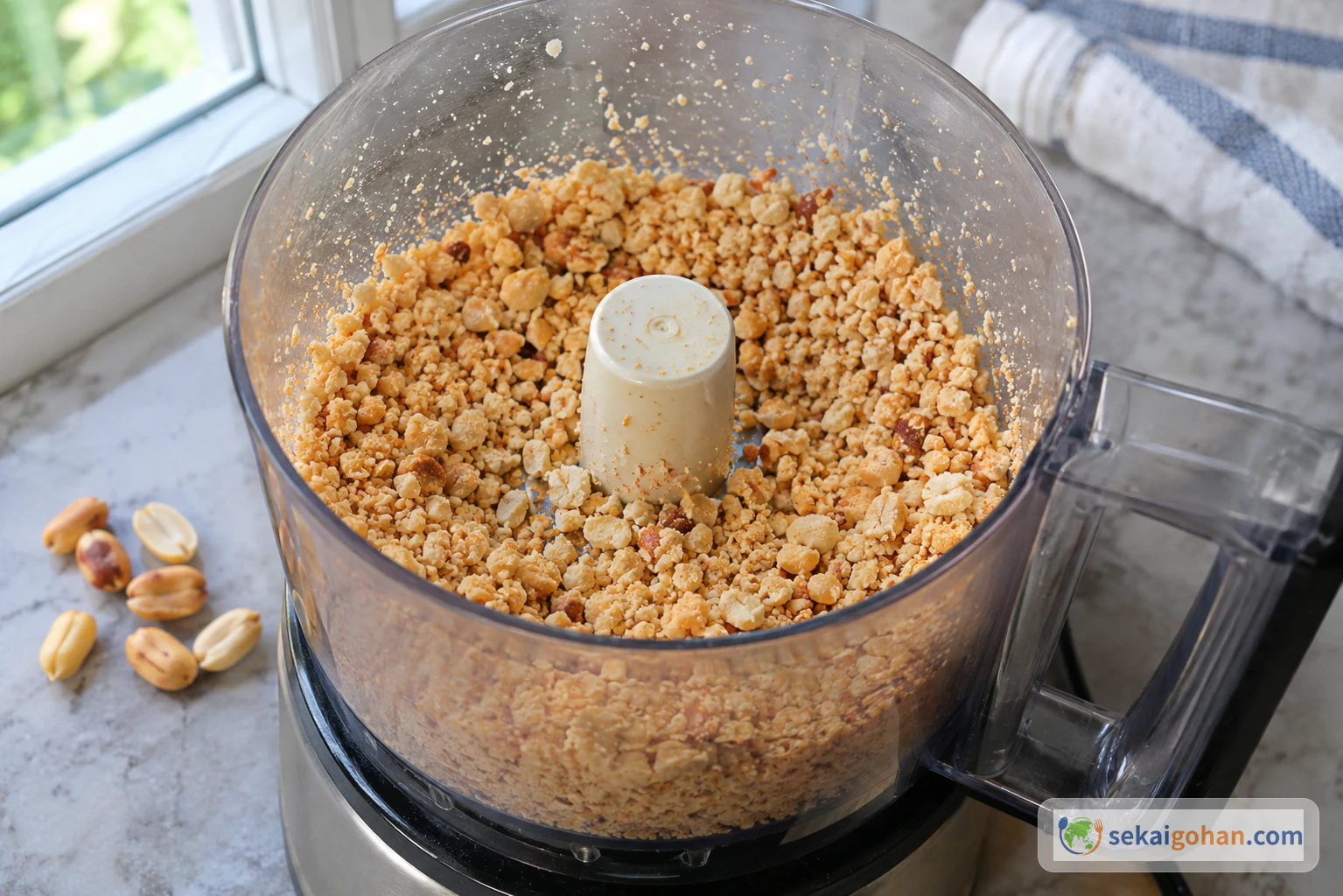
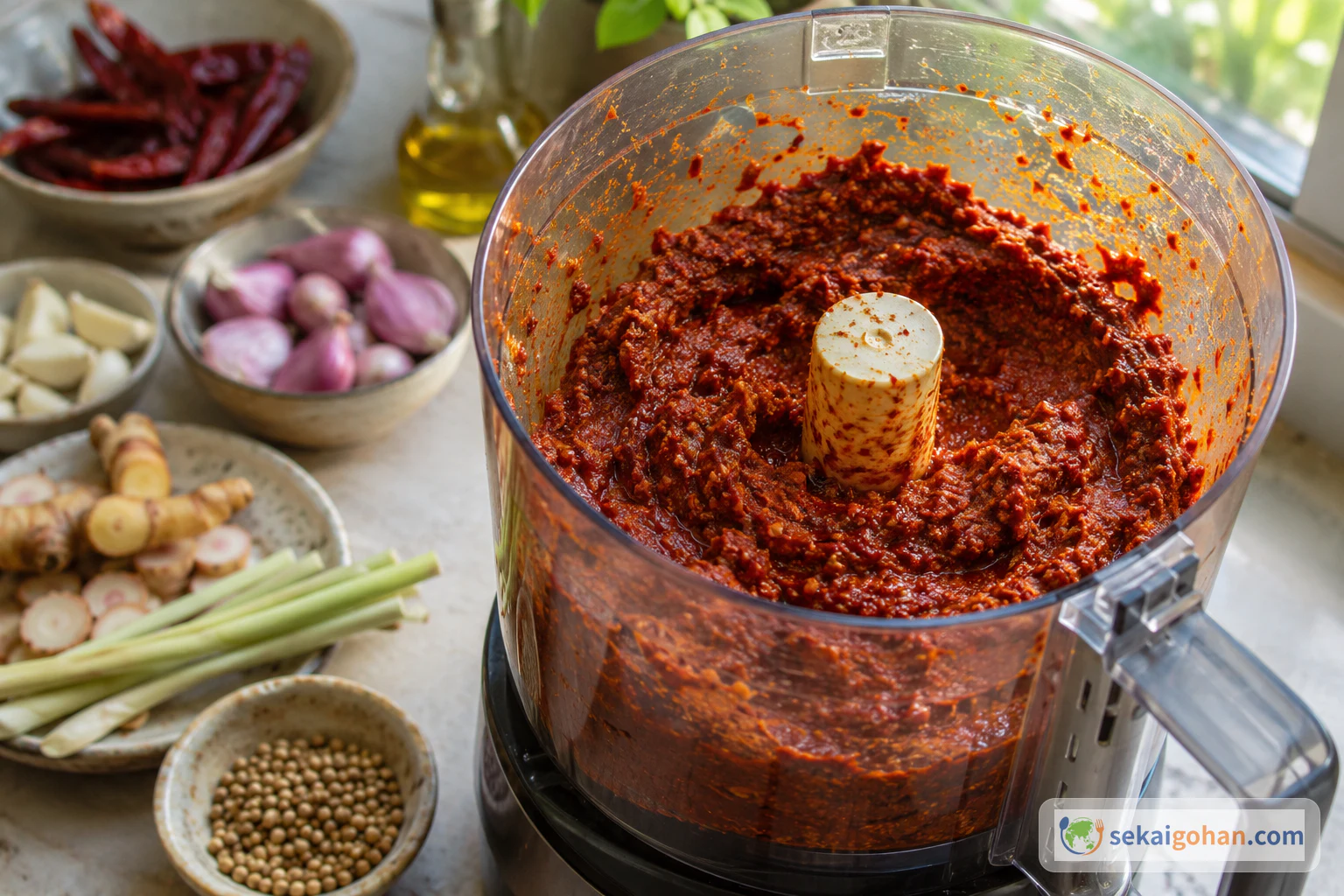
The toppings move around. Fried bean curd puffs (tau pok), cuttlefish, water spinach (kangkung) and prawns are the familiar set, and some plates also carry cockles, pork slices or bean sprouts. The sauce changes too. The version here grinds dried chillies, shallots, garlic, coriander seed, galangal and lemongrass, then sharpens the peanuts with tamarind and softens them with coconut milk. Other sauces lean on candlenut, fennel, cumin, belacan, kaffir lime and palm sugar, which gives a deeper, more pungent gravy.
Its nearest relative on the same hawker tables is mee rebus, which also pours a thick gravy over noodles. Mee rebus builds that gravy on sweet potato. Satay bee hoon builds it on peanuts and chilli, so it eats spicier, nuttier and grainier.
Ingredients (serves 4)
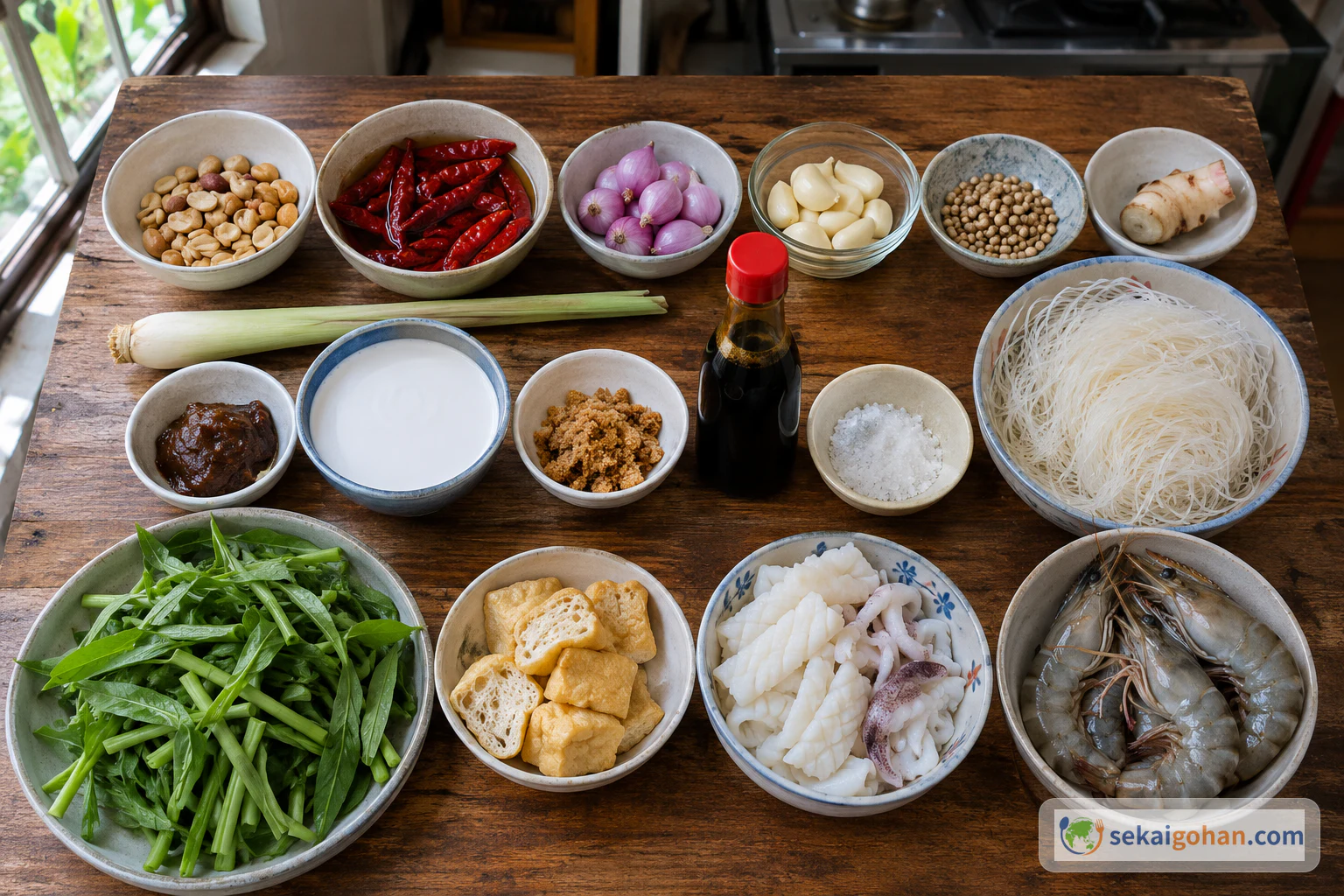
The paste and sauce make enough to pour generously over four plates. The toppings cook in minutes, so get everything weighed out before the wok goes on.
Choose unsalted roasted peanuts. The roasting gives the sauce its toasty depth, and leaving out added salt keeps the seasoning in your hands at the end of the simmer.
This dish contains peanuts, shrimp, cuttlefish (a mollusc), coconut and soy (tofu puffs and kecap manis). Cockles, if used, are shellfish. Some brands of kecap manis contain wheat, so check the label.
Equipment
- Food processor
- Large pot or wok for the sauce
- Second pot for blanching the toppings
- Pot or bowl for the noodles, and a colander
- Spider strainer or slotted spoon
- Ladle
Choosing and Substituting
What makes this taste like satay bee hoon is four tastes living in one sauce: chilli heat, tamarind sourness, the sweetness of brown sugar and kecap manis, and the richness of coconut milk. Keep all four and the plate stays on course even when some ingredients change.
Three things are worth a trip to an Asian grocer or an online order: tamarind paste, kecap manis and galangal (frozen or as a paste). Rice vermicelli is on most supermarket shelves.
| Ingredient | Swap | What changes |
|---|---|---|
| Galangal | Fresh ginger | Ginger brings warmth but a different flavour; the citrusy note of galangal goes |
| Tamarind paste | Lemon juice | Still sour, but a sharper, thinner acidity |
| Kecap manis | Soy sauce plus sugar | Close in sweet-salty balance, not the same depth or thickness |
| Shallots | Small onion or red onion | Keeps the sweetness and aroma of the paste |
| Coriander seeds | Ground coriander | Works; use a little less |
| Lemongrass | Dried lemongrass or lemongrass paste | Keeps the lemony aroma in a milder form |
| Dried red chillies | Small hot dried chillies plus paprika | Paprika restores the red colour; adjust the chillies for heat |
| Fried bean curd puffs | Thick fried tofu or fried tofu pouches, cut small | A firmer bite, still good at soaking up sauce |
| Water spinach | Baby spinach | Softer, without the hollow-stem crunch |
| Cuttlefish | Shredded chicken or other seafood | Changes the protein; the sauce carries it the same way |
Method
Soak the chillies first, since everything in the paste waits on them. The sauce simmer is the hands-off stretch: while it cooks, boil the noodles and blanch the toppings, so all three are ready together. The plate is assembled in the last minute and goes out at once.
The sauce is done when red oil floats on the surface and it falls from the ladle in a slow, thick stream. If it mounds on the spoon, add water a little at a time until it flows again.
Shake the blanched toppings well before they go on the plate. Water clinging to them runs into the sauce and thins it right where you eat.
The wet paste spits when it meets hot oil, so add it carefully and keep stirring. Cockles are among the shellfish most strongly linked to hepatitis A. If you use them, cook shelled cockles in water at a full boil, 212°F (100°C), for at least 5 minutes, and keep separate boards and utensils for raw and cooked seafood. Do not serve cockles to pregnant people, older adults, young children or anyone with weakened immunity. Leave them out by default.
When It Goes Wrong
| What you see | Why | What to do |
|---|---|---|
| The sauce mounds on the ladle and will not pour | Simmered too far, or the peanuts have soaked up the liquid | Stir in water a little at a time until it flows in a slow, thick stream |
| The sauce is thin and no oil shows on top | It has not simmered long enough | Keep simmering on low heat until it thickens and red oil floats |
| The sauce turns watery on the plate | The toppings or noodles went on wet | Drain everything well; shake the toppings in the strainer before plating |
| The sauce tastes raw and sharp, with harsh garlic | The paste went into the liquid before it was fragrant | Fry the paste fully next time; for now, simmer the sauce longer |
| The sauce tastes flat | Not enough salt for the sweetness and sourness | Add salt a pinch at a time and taste again |
At the Table, Variations and Leftovers
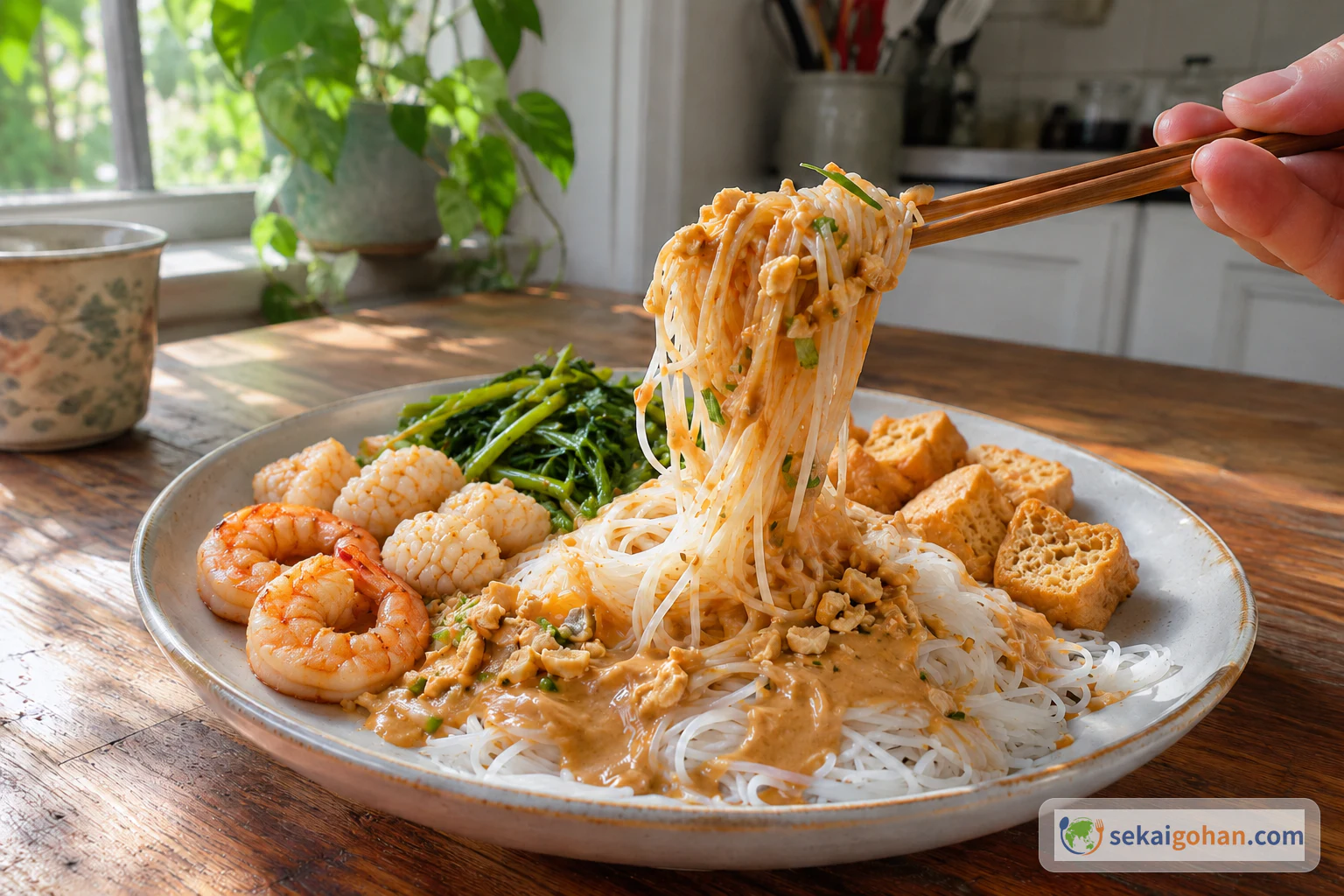
Satay bee hoon is a plate for one person, eaten straight away while the sauce is hot. Chopsticks go to the bottom of the plate and lift the noodles through the sauce, so each mouthful has peanut, chilli and a piece of topping. It needs nothing else beside it.
Variations
- Chicken and shrimp. Swap the cuttlefish for shredded chicken. The plate turns milder and meatier, and the shrimp keep the seafood sweetness.
- With boiled egg. A halved boiled egg on top adds richness and gives the sauce something else to cling to.
- Hawker style with cockles. Shelled cockles bring a briny edge that pulls the plate toward the hawker version. Cook them by the cockle rule in the method warning.
- A deeper, spicier sauce. Grind candlenut, fennel, cumin, belacan and kaffir lime into the paste and sweeten with palm sugar. The result is darker and more pungent, with a funky shrimp-paste depth.
Leftover sauce
The sauce works beyond noodles. Pour it over tofu, use it as a dressing for gado-gado or blanched vegetables, or serve it as a dip for spring rolls.
Storing
Keep the sauce and the noodles separate. Cool them, cover them and refrigerate them promptly, and eat them the same day. When you reheat the sauce, stir in water a little at a time until it pours again, and heat until it is steaming throughout.
Frequently asked questions
How do I make it less spicy?
Use fewer dried chillies when you grind the paste, since all the heat sits in the paste. Add paprika to keep the red colour without the burn. Decide before you blend; you cannot take the heat out of a finished sauce.
Can I use peanut butter instead of roasted peanuts?
You can, but the sauce changes. It turns smooth and dense and loses the grainy bite that chopped peanuts give. Add water gradually during the simmer until it pours.
My vermicelli package has no instructions. How do I cook it?
Soak the vermicelli in hot water for 30 minutes, then blanch it in boiling water for 2 minutes. Drain it well and divide it among the plates.