
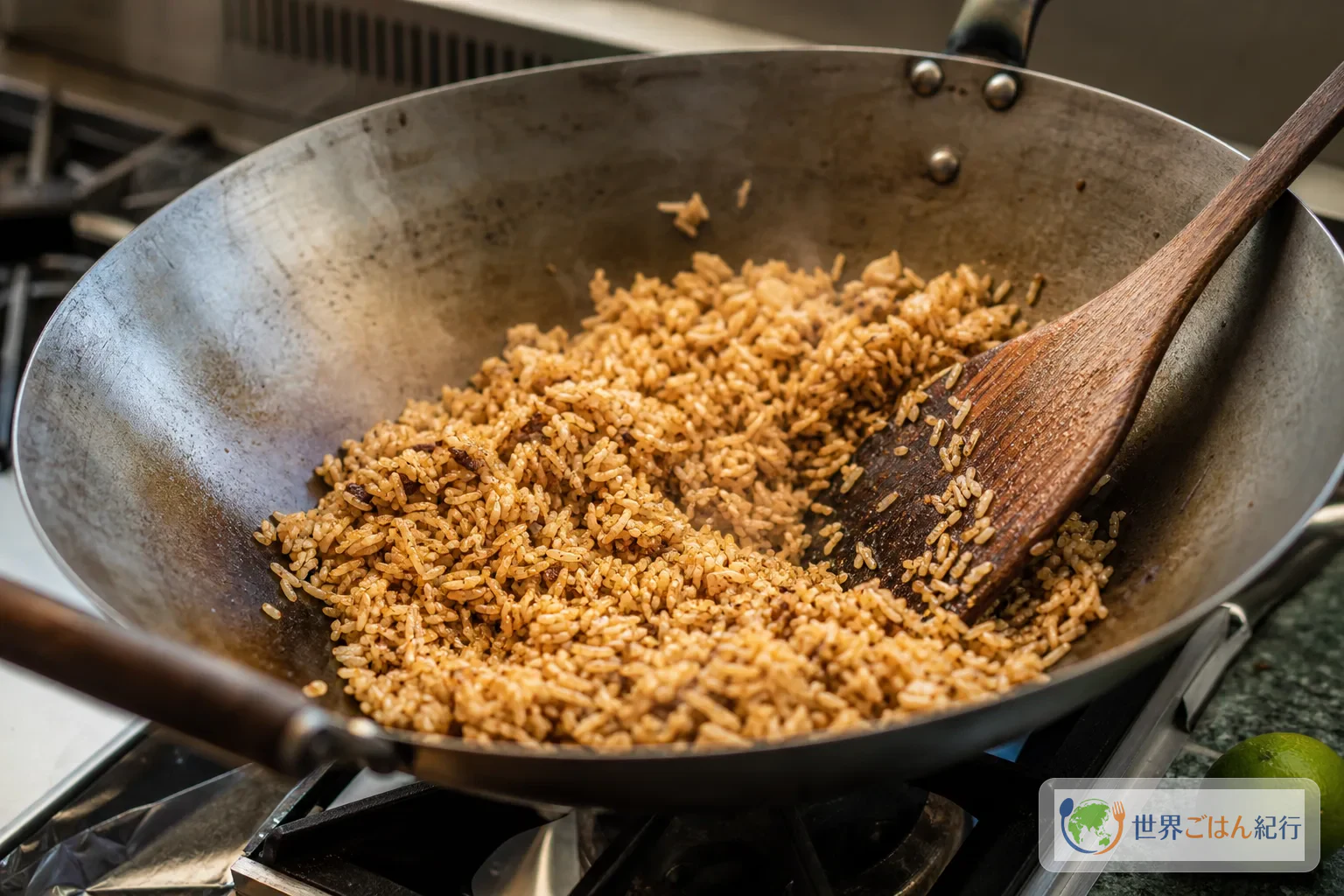
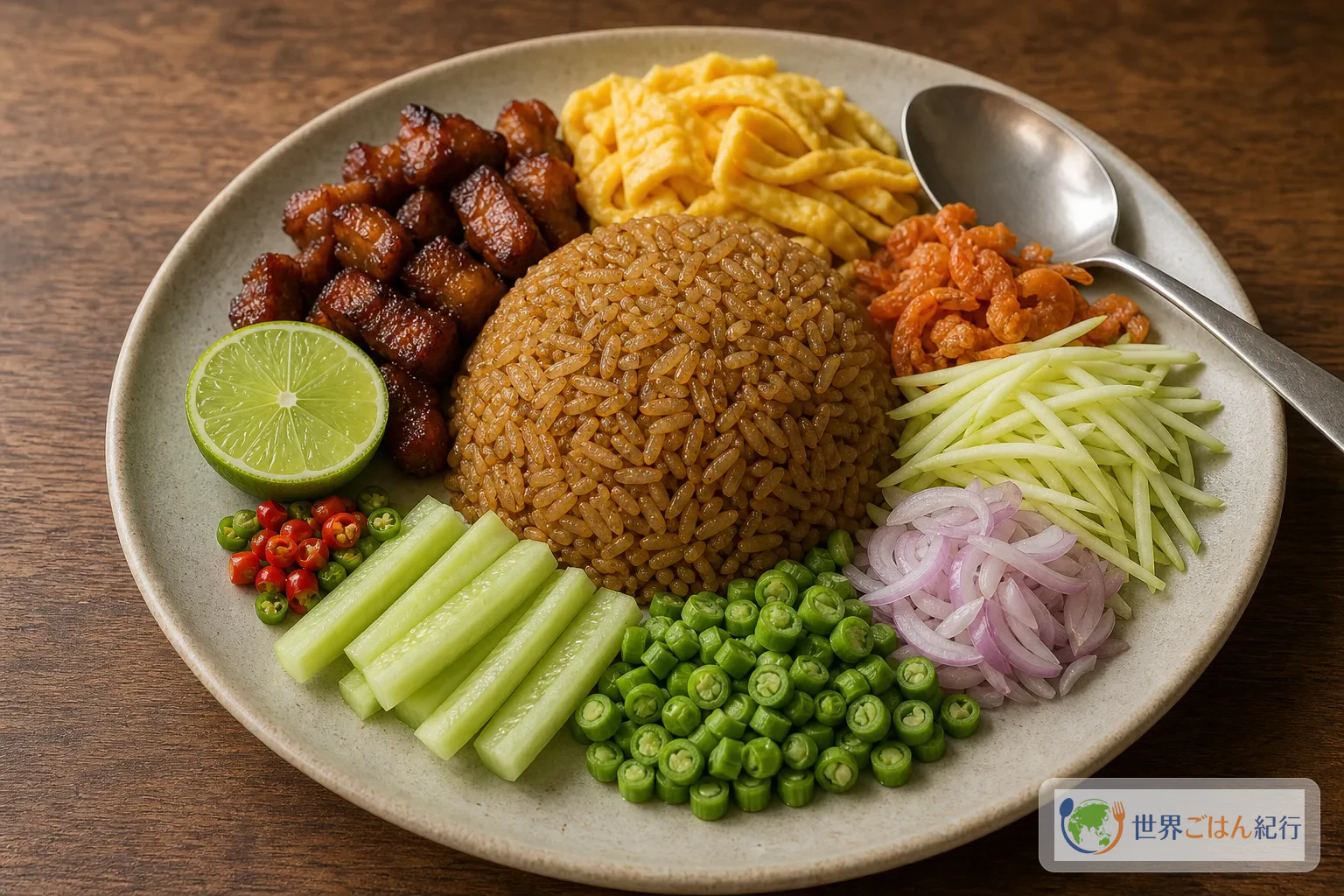
Turn on the range hood before the kapi hits the pan: a Central Thai table
Before you fry the rice, switch the range hood to high. The stove isn't even on yet, but the smell of kapi out of its packet is enough to change the air in the kitchen. Behind the salt rises the aroma of fermented shrimp.
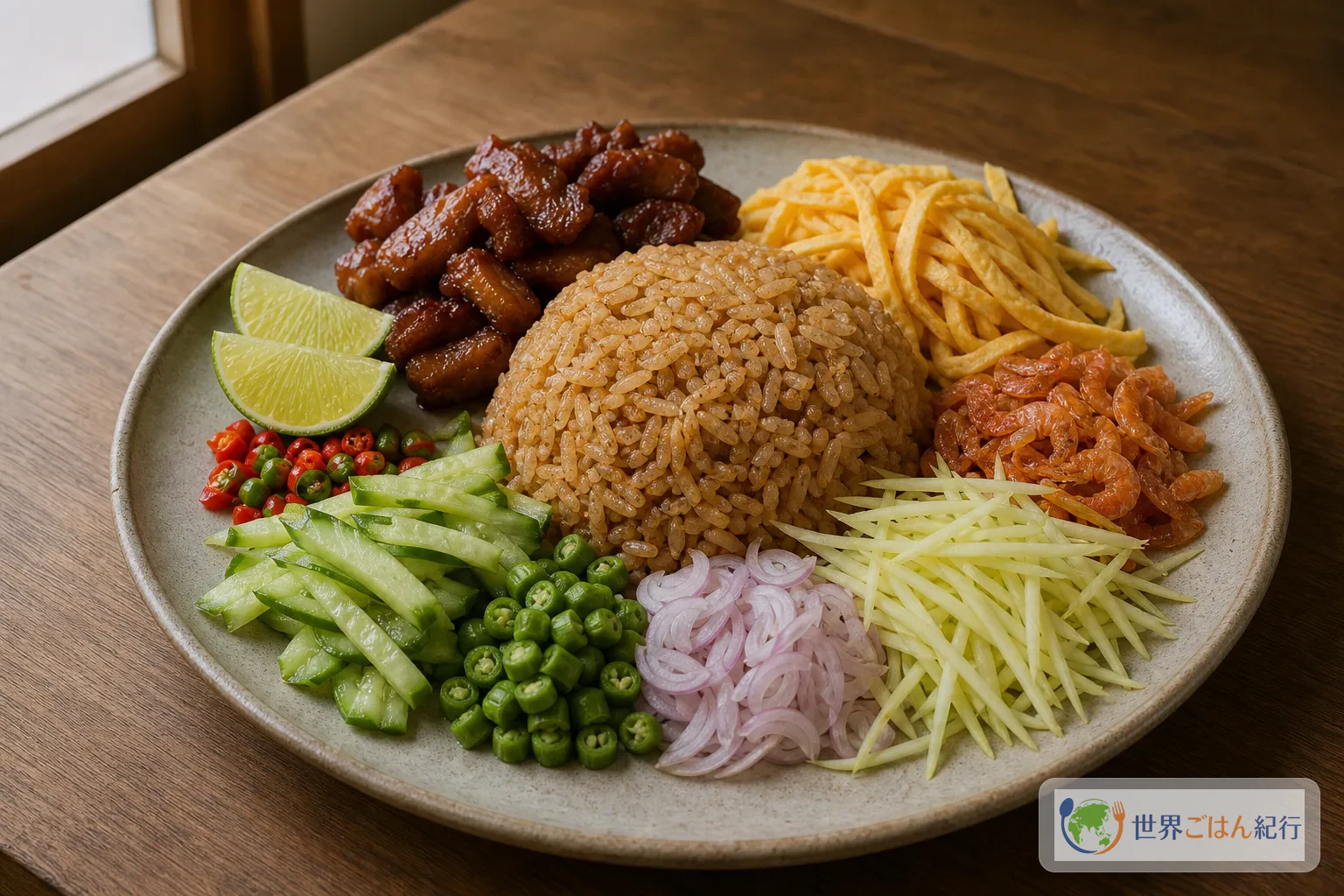
Loosen that aroma in oil, add cold rice, and its edge softens. In the middle of the plate sits golden-brown rice. Around it go glossy sweet pork, thin strips of omelet, sour green mango, cucumber, green beans and red chiles. Because nothing is mixed at the start, the salt, sweetness, sourness and heat can change with every bite.
This is khao kluk kapi (ข้าวคลุกกะปิ). Khao means rice, kluk means to mix, and kapi is fermented shrimp paste. The rice itself is fried with kapi, but the final "mixing" happens not in the pan but at the tip of each diner's spoon. Thai recipes describe the standard form as sweet pork, thin omelet, a sour fruit and raw vegetables served separately alongside.
This recipe serves 4. You prepare the sweet pork and toppings first, then quickly fry the kapi rice over fairly high heat at the end. Keeping the kapi restrained and holding on to the sourness and raw vegetables lets that strong aroma settle at the center of the plate.
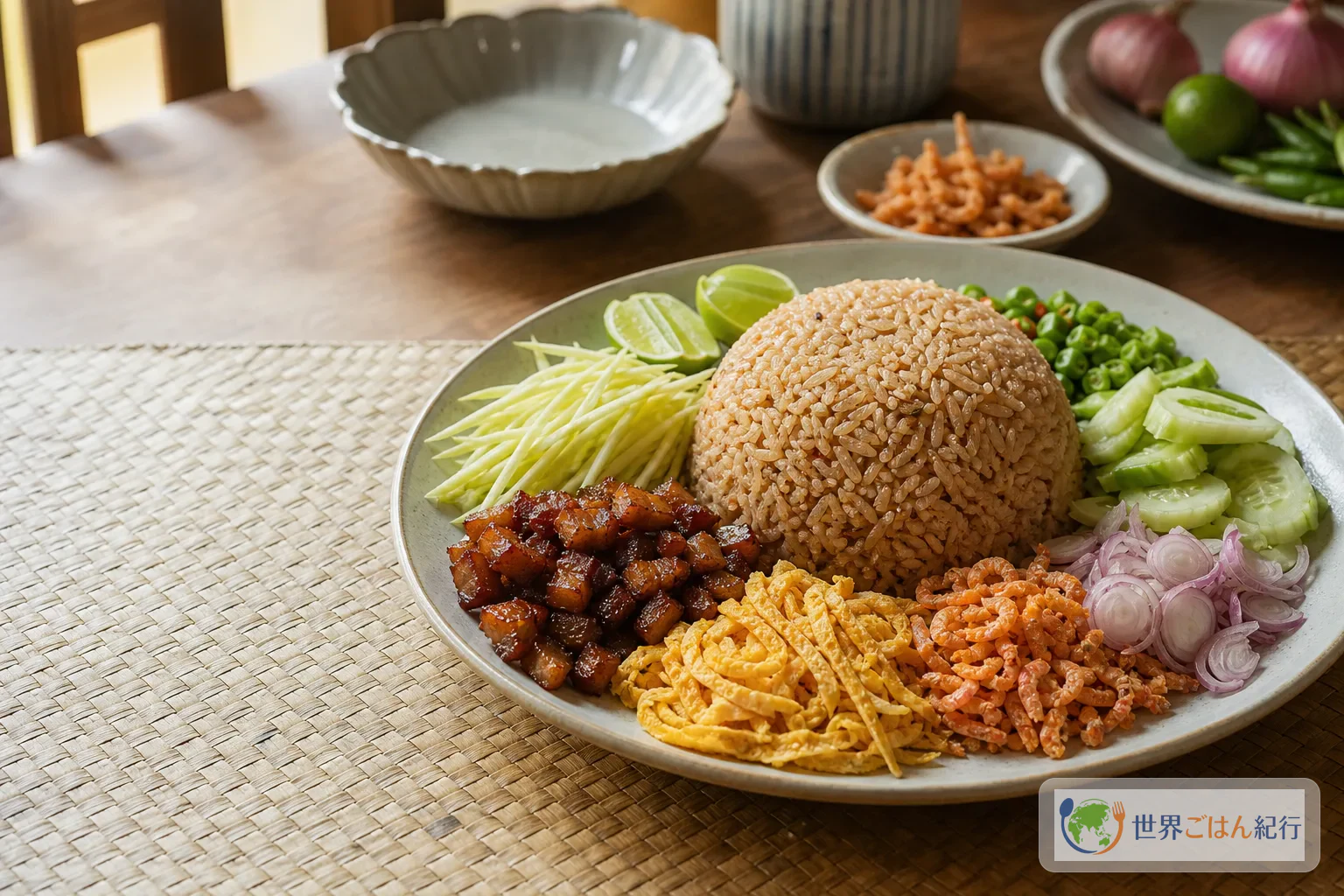
- The kapi rice is the base of salt and savoriness. Don't go beyond 2 tbsp at the start.
- Plate the sweet pork, sour green mango and hot chiles separately, and adjust bite by bite.
- If you're making it just once at home, prioritize the kapi and cold rice over special equipment.
- When buying kapi, check the net weight and ingredients on the label, and think first about whether you can use up a large tub.
Why serve the toppings unmixed?
Khao kluk kapi isn't a fried rice tuned to a single flavor. It's a dish that holds, on one plate, kapi's salt and fermented savoriness, the sweet gloss of moo waan (sweet pork), the sourness of green mango, the softness of egg and the juiciness of the vegetables. Mix everything into the rice and it becomes uniform, but the sourness and moisture are lost to the heat. Kept separate, the diner decides each combination: sweet pork over the deep-flavored rice, or green mango and lime to lighten it.
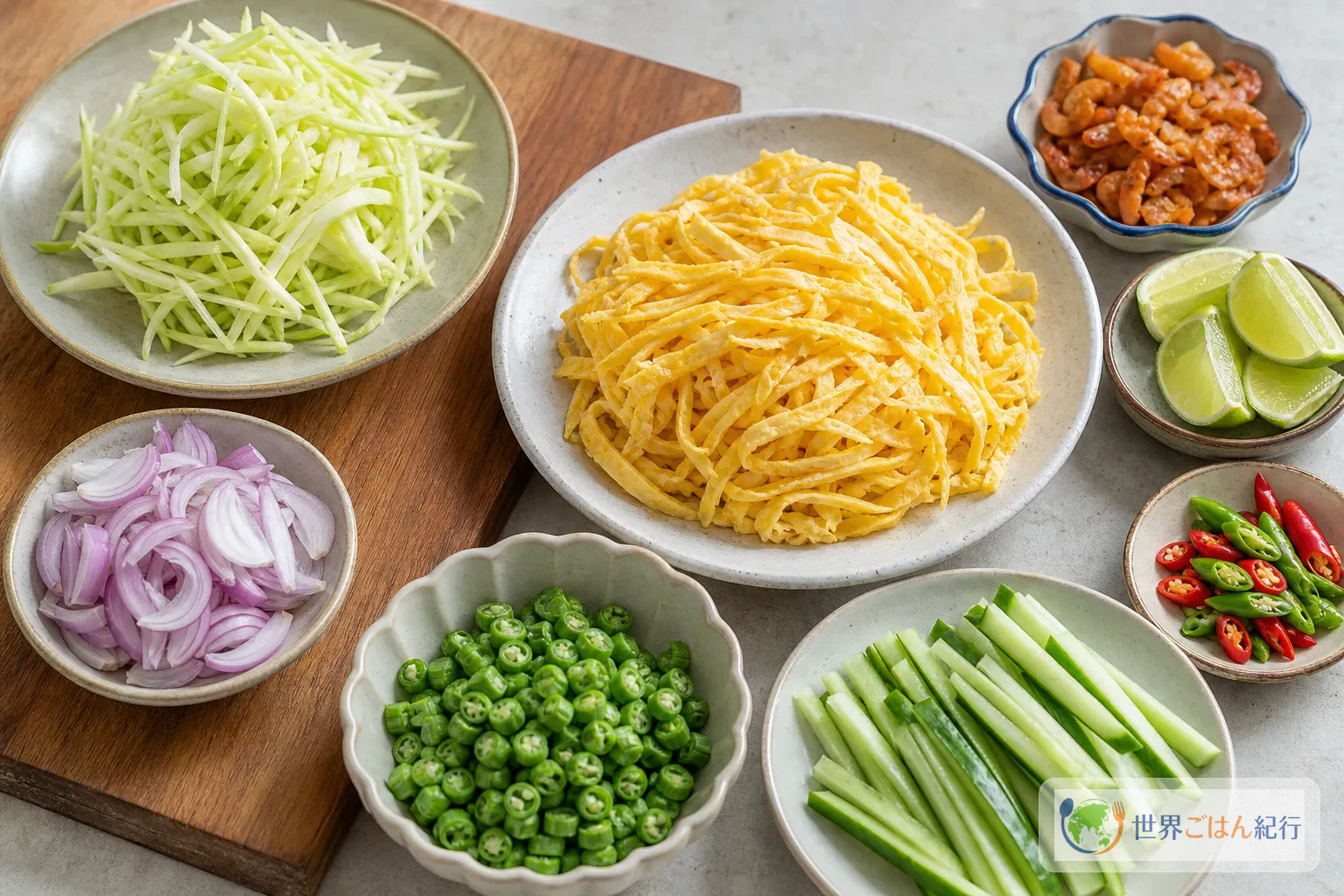
Thai recipe write-ups also lay it out this way: rice, sweet pork, green mango, shallots, long beans, dried shrimp, egg and lime prepared separately and mixed when eaten. SiamKapi's explanation of the dish describes preparing each topping individually and combining them at the table. The number of toppings isn't decoration; it's how kapi's intensity gets adjusted at the table.
Material from Suan Dusit University explains that Central Thai food culture developed from the Ayutthaya period onward under Chinese, Indian and Western influences, with refinement not only in flavor but in presentation. On Central Thai tables you also see jasmine rice served with nam prik kapi, raw vegetables and several side dishes. Raw toppings like green mango, cucumber and shallots aren't garnish; they switch each bite back to freshness between rich sweet pork and salty rice. The university's material on the Central Thai table
A standard hospital recipe from Thailand's Ministry of Public Health also fries kapi in oil, adds rice, combines it with ground pork and carrot, and plates it with shallots, fried Chinese sausage, shredded egg, pineapple and more. Toppings at home and in shops aren't fixed. Here, sweet pork and green mango are the core, because green mango's sourness makes kapi's aroma and the sweet braising sauce easy to take in at any table. Ministry of Public Health standard recipe
We avoid pinning the origin to a single story. Thai Food Guide's description of the dish presents one theory that it developed in the reign of Rama II (early 19th century) through a link to Mon cooking, but we don't treat that as the one confirmed origin. What can be confirmed is its present form: kapi rice laid out with sweet pork, egg and sour toppings on one plate, mixed by whoever eats it. Rather than asserting history, this recipe preserves, in a form you can reproduce in the kitchen, why the toppings are kept apart.
Kapi changes color and aroma by where it's made
Kapi ranges from pale to dark. The Suan Dusit University material explains that kapi from the Andaman Sea side can be lighter because of plankton, while kapi from the Gulf of Thailand side can be closer to a muddy color. It's an example of differences in origin and raw material showing up in appearance. You can't judge quality or saltiness from color alone.
So if your rice doesn't turn brown, that doesn't necessarily mean failure. A pale kapi keeps the rice lighter; a dark one gives strong color even in small amounts. Aroma and saltiness vary by product, so start with the amount given, taste a little of the fried rice, then add more. If you like Thai dishes such as pad kaprao (in Japanese), som tam (in Japanese) or pad thai (in Japanese), where strong seasonings are balanced by toppings and sourness, this serve-separately setup will make sense quickly.
Decide on ingredients and shopping first
Strongly aromatic seasonings tend to end up at the bottom of the ingredient list. In khao kluk kapi, kapi's salt and aroma define the rice. If you buy all the toppings and then add kapi by feel at the end, it's hard to walk back, so settle the amounts and the range of substitutes here. On the other hand, an ordinary skillet, a knife and a small frying pan you already have are plenty. There's no need to buy special tools first.
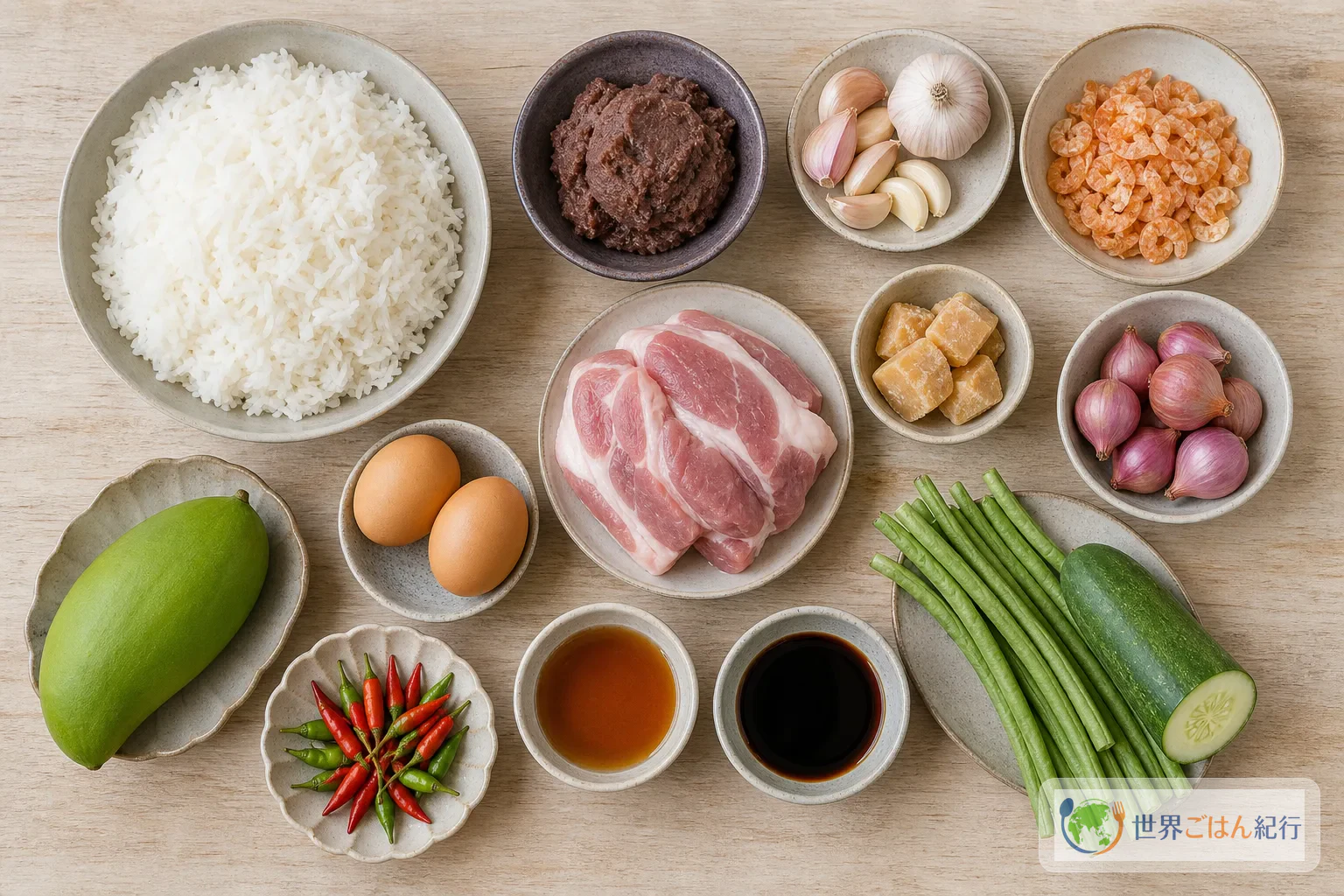
Kapi, dried shrimp and fish sauce contain shrimp and other seafood. Including eggs and soy-based seasonings, anyone with allergies should check product labels. Don't eat undercooked pork; cook it until hot all the way through, as food-safety guidance advises. Japan's Ministry of Health, Labour and Welfare, "Cook meat thoroughly before eating"
Buying kapi: will you use up a large tub?
Kapi can be hard to find at an ordinary supermarket, and when you do find it, it isn't always in small sizes. If you're trying this dish just once, look for a small pack at a Thai or Asian grocery, or think first about whether you'd use up a large tub. If you'll keep cooking Thai food and want kapi's aroma in som tam and stir-fries too, it's worth keeping a sealed container in the fridge and using it a little at a time.
The deciding question isn't "because it's authentic" but whether you want to avoid replacing the aroma at the dish's center. Fish sauce plus dried shrimp gives you the savoriness of the sea, but not the depth particular to fermented shrimp paste. If you pass on it, make a shrimp-flavored fried rice without kapi rather than treating a substitute as the real thing. Kapi varies in saltiness and aroma even under the same name, so check the ingredients and storage instructions on the label; many tell you to refrigerate after opening.
Will you use a mortar for more than kapi?
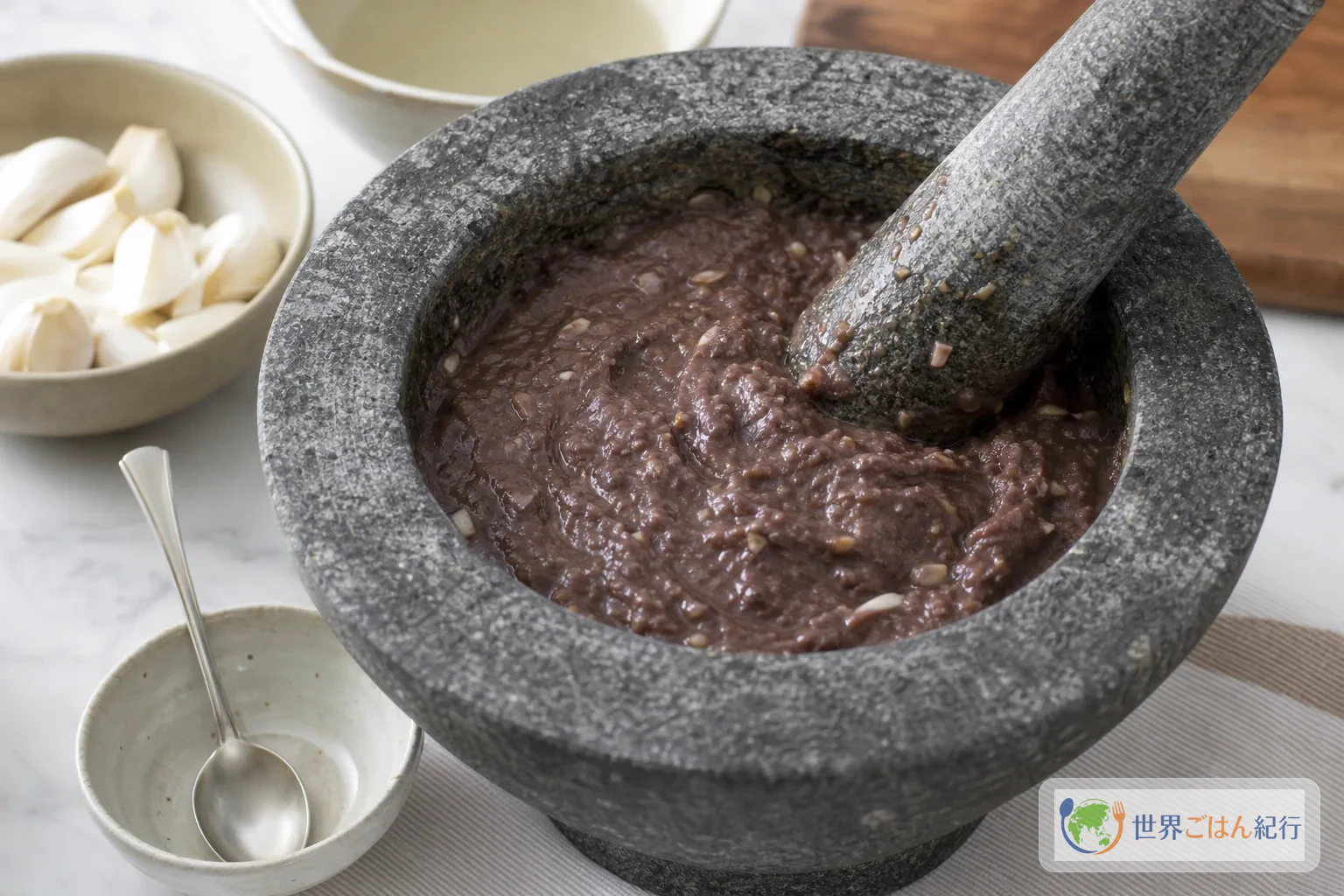
Bringing the garlic, kapi and dried shrimp together can be done just by chopping with a knife. But if pieces remain, some bites turn salty and the aroma separates before it coats the rice. If you also plan to make som tam, nam prik or spice dishes, a heavy granite mortar and pestle is useful. For this dish alone, mash everything against the bottom of a sturdy bowl and skip the purchase.
Instructions: sweet pork, then kapi rice, then sourness
Finish the toppings first and fry the rice just before it goes to the table. Cold rice makes it easier to coat each grain with kapi's aroma while keeping them separate. If it's stiff straight from the fridge, break it up by hand before using.
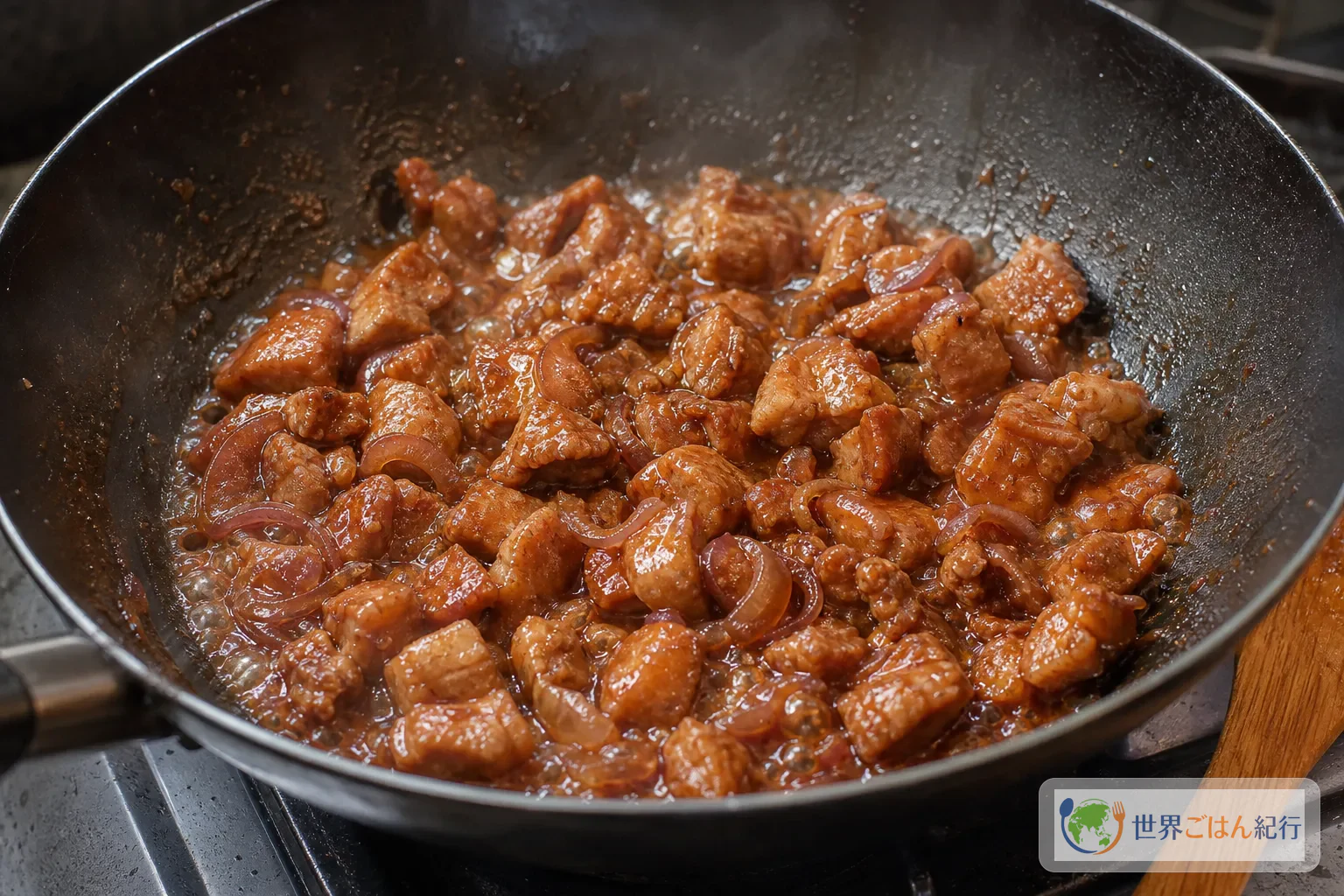
The kapi rice is right when the grains are separate, the surface isn't wet, and the aroma has shifted toward toasted shrimp. Stop the moo waan when the pork is cooked to the center and the sauce coats the surface thinly. Plate the raw vegetables before they release water.
When it's too salty, too pungent or not sour enough
If the kapi is too salty, add more fried rice and serve cucumber and green mango alongside. Adding water and simmering makes the rice heavy, so it's not a good way to dilute salt. If the moo waan sauce is watery, take the pork out, reduce just the sauce over medium heat a little, then return the pork. If the moo waan is too sweet, cut the pork smaller and eat it with the raw vegetables. Rather than adding acid directly to the sauce, squeezing lime just before eating is easier to adjust within the plate.
If the green mango isn't sour enough, use half a lime more. Don't mix the chiles into the rice from the start; put them at the edge of the plate so people with different heat tolerances can share the same dish. If you want to mellow kapi's aroma, don't add more sugar to cover it; increase the egg and cucumber instead.
If you substitute, change only one thing
| Hard to find | Substitute | What changes |
|---|---|---|
| Jasmine rice | Cooled short-grain white rice | Shorter, slightly sticky grains. Spread out to chill and fry in small batches |
| Green mango | Granny Smith apple | Close in sourness and crunch, but the green aroma is weaker |
| Thai long beans | Green beans | Slightly different sweetness and texture. Cut into 5 mm pieces |
| Palm sugar | Light brown sugar | Gives sweetness, but the molasses-like aroma is lighter |
| Dark soy sauce | A little tamari | Pork color and sweet aroma are more subdued |
| Kapi | Fish sauce + chopped dried shrimp | Brings sea savoriness, but the depth of fermented shrimp is something else |
Kapi is the one ingredient where substituting changes the center of the dish. It's worth seeking out if you want to experience the fermented aroma. If you'd rather not end up with leftover ingredients, skip the kapi and enjoy it as a fish-sauce-flavored fried rice.
You can also add the pineapple or Chinese sausage from the Ministry of Public Health standard recipe. But pineapple is sweeter than green mango, and Chinese sausage adds salt and fat, so adding both from the start makes the whole thing heavy. Keep the green mango and try a small amount, or leave out the green mango and make up the sourness with lime; changing just one element makes the flavor easier to tune.
Store components separately and eat within a day
Put the kapi rice, moo waan, egg and vegetables in separate airtight containers if you can. Don't stack them while hot; refrigerate once they've cooled. Green mango, cucumber and red onion release water easily, so cutting them just before eating keeps them crisp.
Eat refrigerated rice and pork the same day or the next, and reheat until hot all the way through. If you make the pork ahead to use the next day, reheat it in its refrigerated sauce before plating. Don't use cooked rice that has sat at room temperature for a long time; next time, spread it in a shallow container to cool quickly.
FAQ
Is it still khao kluk kapi without kapi?
Kapi is at the heart of the dish's name, so made with fish sauce alone it becomes a different shrimp-flavored fried rice. It works as a dish, but you can't say it reproduces the aroma of fermented shrimp. For a first try, look for a small container of kapi; if you don't plan to keep cooking Thai food, you can decide to skip the large sizes.
What if the kapi smell lingers in the kitchen?
Run the range hood from before you pound the kapi, and keep the frying to 1–2 minutes. Mortars and pans left soaking in plain water hold on to the smell, so wash them promptly with warm water and detergent. Aroma intensity varies by product, so next time start with 1 1/2 tbsp and add more after tasting the rice.
Can I fry freshly cooked rice?
You can, but lots of steam makes the rice clump. Spread it thinly on a tray to let the steam escape, then chill it in the fridge once it has cooled a bit. Don't leave it at room temperature for long; break up the cold rice by hand and don't add too much to the pan at once.
Can I swap the pork for chicken or tofu?
Yes. Cook chicken through in the same sauce; press tofu and let it soak up the sauce. But moo waan's fat and sweet glaze change, so as a plate of khao kluk kapi it becomes a different composition. If you're avoiding kapi and seafood, you'll need plant-based seasonings whose labels you've checked.
Can I make the toppings the day before?
The moo waan, dried shrimp and thin omelet can be made the day before. Store the vegetables uncut, and fry the kapi rice just before eating. When reheating, keep the egg and raw vegetables separate and warm only the sweet pork.
In short: whether to buy kapi depends on your next dish
Khao kluk kapi isn't a dish that ends once you've mixed the toppings into kapi-fried rice. Because the sweet pork, thin egg, green mango and vegetables are kept apart and each diner decides the intensity, a single fermented seasoning doesn't weigh down the plate. The Central Thai sense of combining a staple with side dishes shows in this arrangement too.
If you're making it once, use an ordinary skillet and bowl and look for a small pack of kapi. If you'll keep cooking Thai food, a large tub of kapi and a mortar will earn their place. Whatever you buy, check the net weight, ingredients and what's included rather than just the price.
Sources
- SiamKapi「ข้าวคลุกกะปิให้อร่อยครบเครื่อง」 (ingredients, method, serving the toppings separately; accessed and link checked 17 August 2026)
- Thai Food Guide「Khao Kluk Kapi」 (composition of the dish, flavor balance, theories on its origin; accessed and link checked 17 August 2026)
- Ministry of Public Health, Thailand「คู่มือตำรับอาหารมาตรฐานในโรงพยาบาล」 (standard recipe frying kapi and plating it with rice; accessed and link checked 17 August 2026)
- Suan Dusit University「สำรับอาหารไทยภาคกลาง」 (the Central Thai table, regional differences in kapi; accessed and link checked 17 August 2026)
- 厚生労働省「お肉はよく焼いて食べよう」 (cooking pork thoroughly; accessed and link checked 17 August 2026)
Nutrition information is an estimate based on dividing the amounts above into 4 servings. It varies with the kapi, fish sauce and fat content of the pork you use.



