

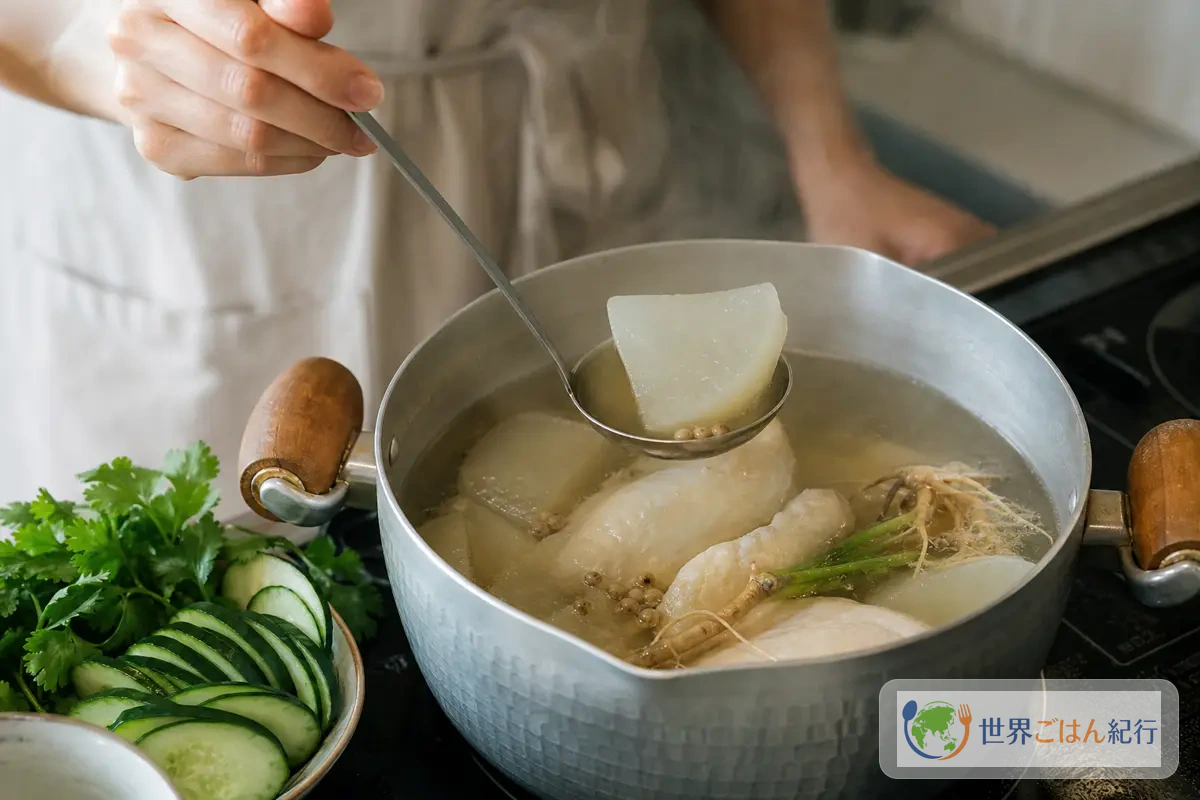
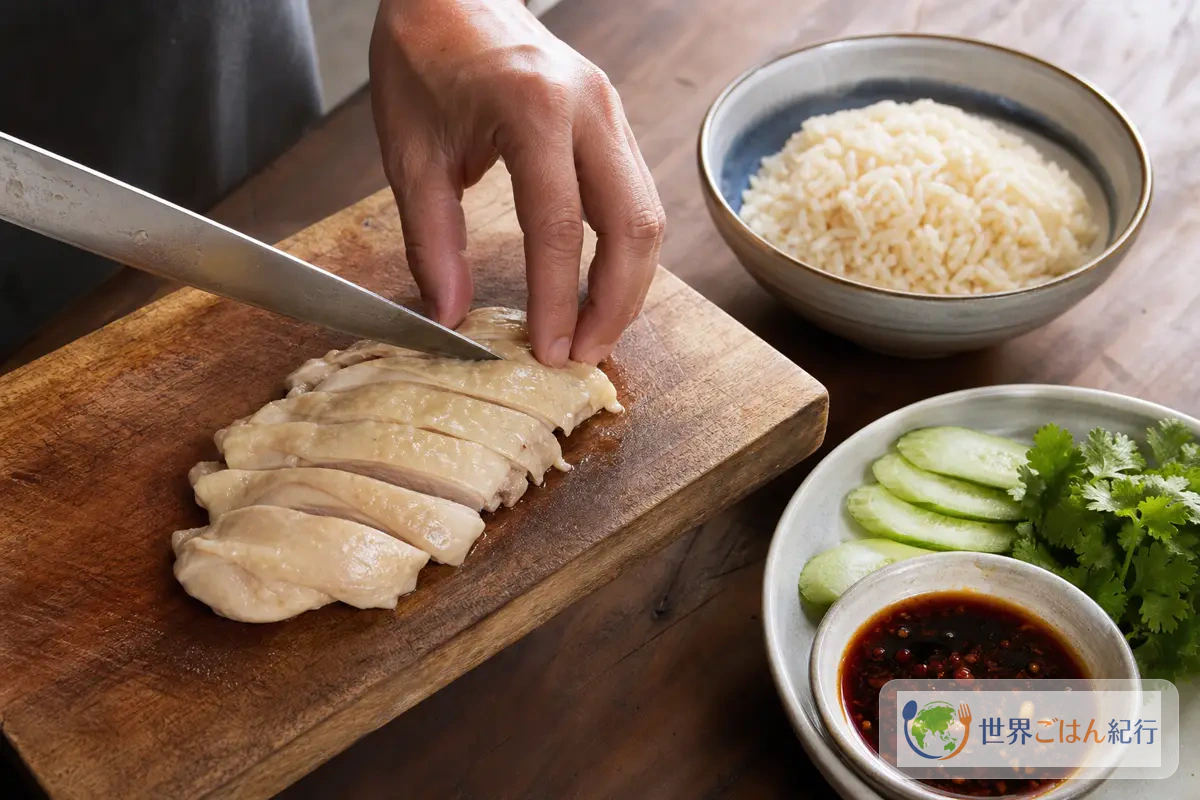
A white feast from the street stall, where the chicken's aroma moves into the rice
Order khao man gai at a Thai street stall and the cook cuts the poached chicken with a few chops of a big cleaver and lines it up neatly beside the white rice. The plate is not showy. No red curry, no heap of herbs. Yet the moment you put a spoon in, the smell of chicken fat and ginger rises, and the strong ginger sauce served alongside changes the whole expression at once.
Khao man gai (ข้าวมันไก่ / khao man gai) is chicken and rice eaten every day in Thailand. Take the name apart: khao is rice, man is fat, gai is chicken. In other words, "chicken fat rice." It belongs to the same family as the similar-looking Hainanese chicken rice (in Japanese), but in the Thai version the star is a bold sauce that combines fermented soybeans called tao jiew, ginger, chili and vinegar.
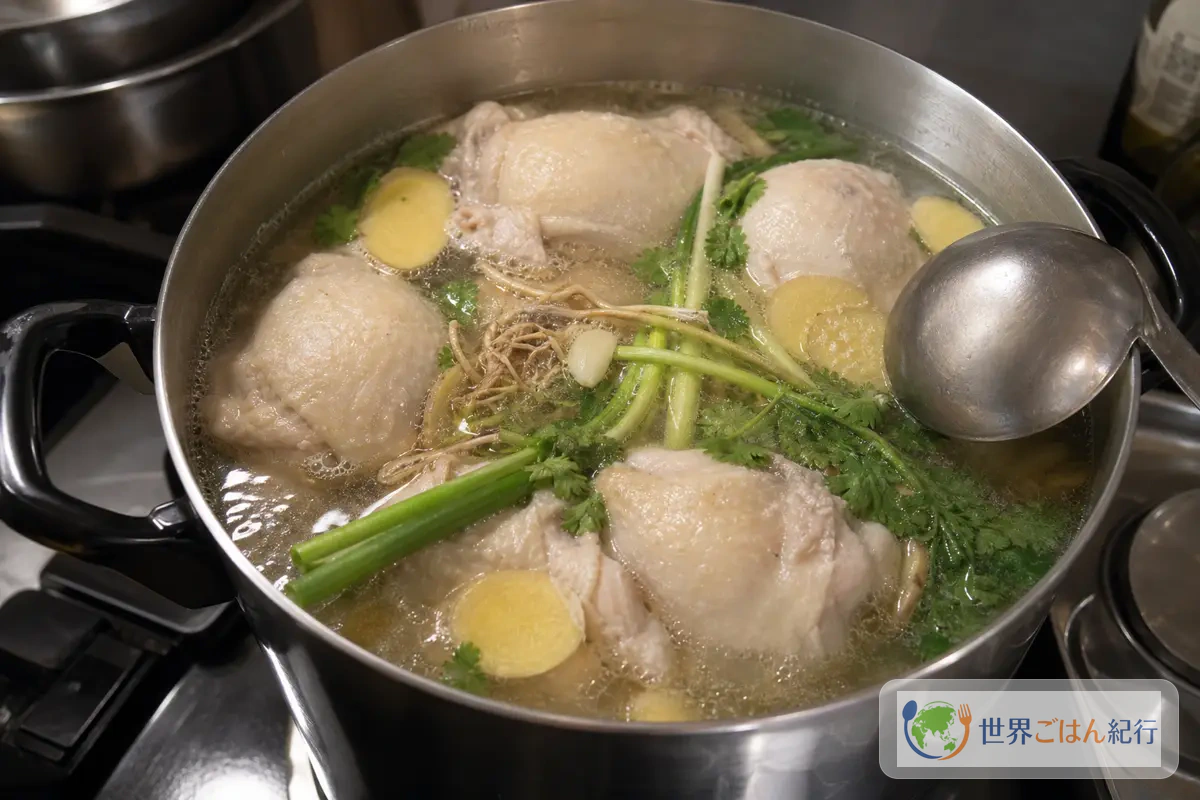
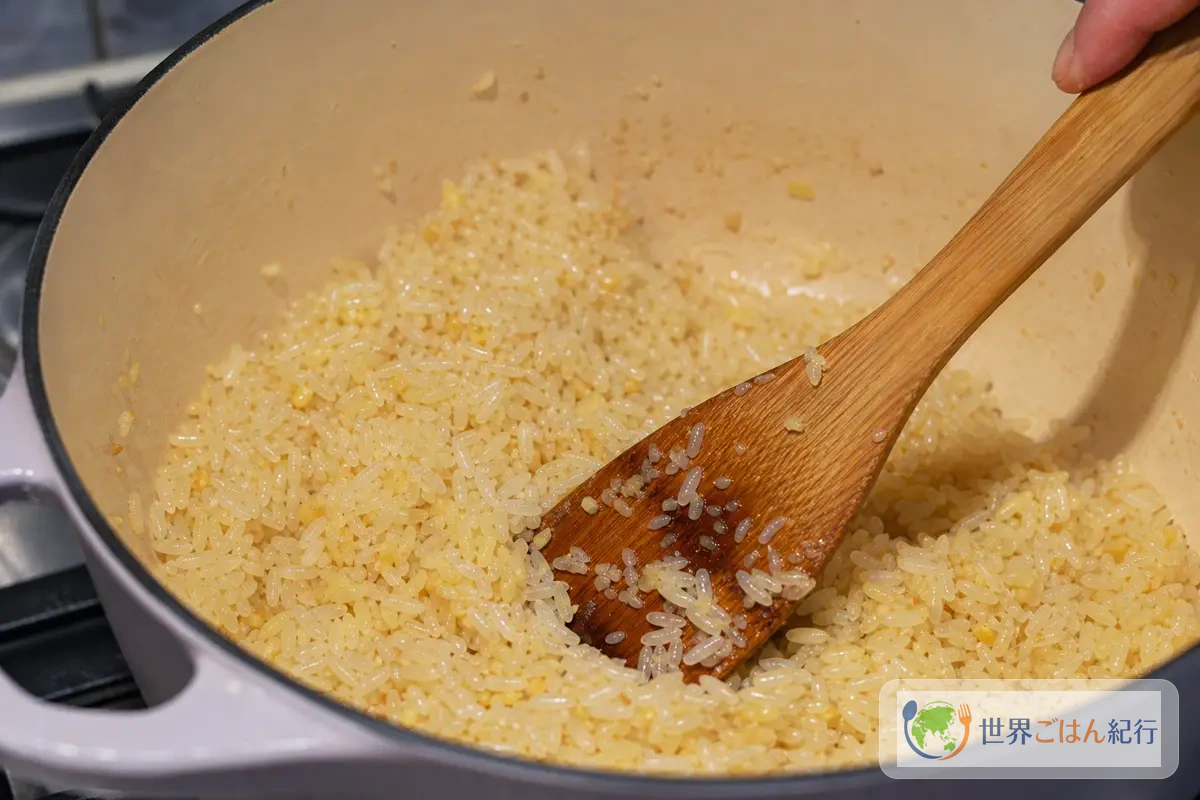
The hard part when making it at home is less poaching the chicken until plump than keeping the rice from turning sticky. Cooking rice in the chicken's poaching liquid tends to bring too much water. So in this recipe, jasmine rice is lightly fried in chicken fat, ginger and garlic before cooking. When the grains stand up, the whole plate moves firmly toward a Thai street stall.
The other key is not to make the sauce too sweet. Make it like a teriyaki sauce and it moves closer to a chicken rice bowl than khao man gai. If you cannot find tao jiew, substitute a small amount of light-colored miso with light soy sauce, but if you keep the acidity and the ginger properly, you hold on to the Thai outline.
Compared with strongly flavored Thai dishes such as pad kra pao and pad thai, khao man gai is a quiet dish. That is exactly why small differences in chicken, rice, sauce and soup show directly in the flavor. This article uses bone-in chicken thighs, which are easy to buy, instead of a whole chicken, and fits it to a form you can make with a home pot and a rice cooker.
Among rice dishes from Thai street stalls, if you want one where a sweet-savory braising liquid goes over rice, khao kha moo is a close neighbor. Where khao man gai moves the aroma of chicken into the rice, khao kha moo is a plate of pork trotters braised with star anise and dark soy, eaten cut with pickled mustard greens and chili vinegar.
What to protect: cook the rice in the chicken's poaching liquid, move the chicken fat into the rice, serve a strong fermented-soybean sauce alongside, and set a clear radish soup beside the plate. At home, getting these four right is more likely to succeed than a whole chicken or an authentic breed of bird.
How it differs from Hainanese chicken rice
Thai khao man gai is easiest to understand as the Thai version of the chicken rice culture that spread from Hainan Island across Southeast Asia. In Singapore and Malaysia, chili, ginger and thick soy sauce are often served separately, while at Thai street stalls ginger, chili, tao jiew, soy sauce, vinegar and sugar are gathered into one strong sauce.
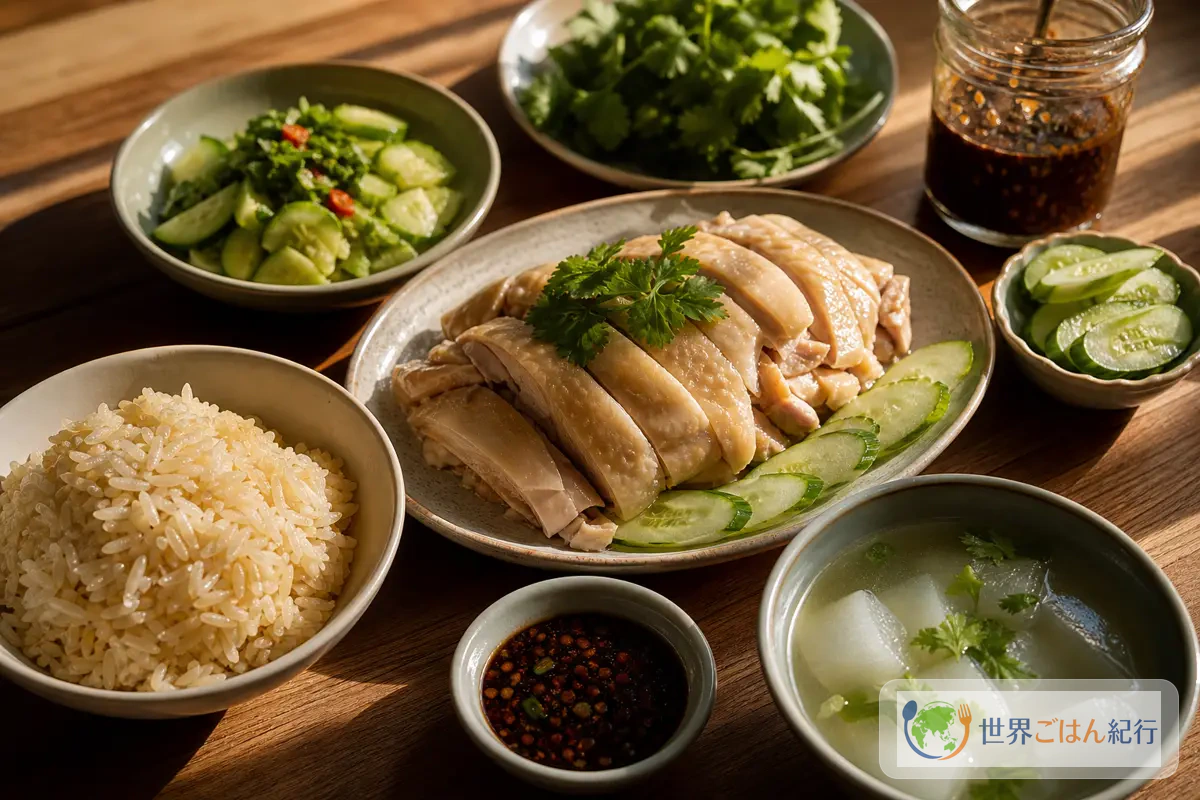
This difference shows in how it is eaten. Hainanese chicken rice changes flavor with each bite: a little chili, a little ginger, a little dark soy. Khao man gai is eaten by putting a strong sauce on the chicken and the rice a little at a time, waking the mild chicken with the acidity and heat of the sauce. It looks like a white plate, but only the spots where the sauce is mixed in suddenly taste of the street stall.
Thai Cookbook TV's khao man gai uses chicken, daikon, cilantro, ginger, garlic, chili, vinegar, dark soy, light soy, coconut sugar and yellow soybean paste, and builds the rice and soup from the chicken's poaching liquid. As this shows, khao man gai is not "a plate of poached chicken" but a dish that sends the poaching liquid around to the rice, the soup and the sauce.
In Thai eateries there is not only white poached chicken but also khao man gai tod with fried chicken on top, a plate with half poached and half fried chicken, and plates with congealed chicken blood or liver. For your first time at home, poached chicken alone is enough, but on a day you want a touch of the street stall, cut the cucumber thick, serve the soup in a small bowl and put the sauce on the table for each person to add. Rather than making the plate lavish, letting the eater adjust with the sauce and soup gives the room that makes it khao man gai.
You do not need to use authentic ingredients for all of it in a home kitchen. What matters is telling where substitution is fine.
| Element | Its important role in the Thai version | A realistic way to approach it |
|---|---|---|
| Rice | Absorbs the chicken fat and poaching liquid | Jasmine rice is best. With short-grain rice, reduce the water |
| Chicken | Both the poaching liquid and the meat are used | Bone-in chicken thighs. If unavailable, skin-on thighs |
| Sauce | Ginger, chili and fermented soybeans wake the plate | Tao jiew, or light miso with light soy sauce |
| Soup | Rests the fat on the plate | Clarified with daikon, white pepper and cilantro roots |
| Side vegetables | Add texture and coolness | Cucumber, cilantro, scallion greens |
A rich coconut curry noodle like khao soi (in Japanese) cuts its heaviness with toppings. Khao man gai is the same: it looks mild, but it is designed to be eaten onward with the sauce, cucumber and soup. Making the sauce and soup properly raises satisfaction more than adding more chicken.
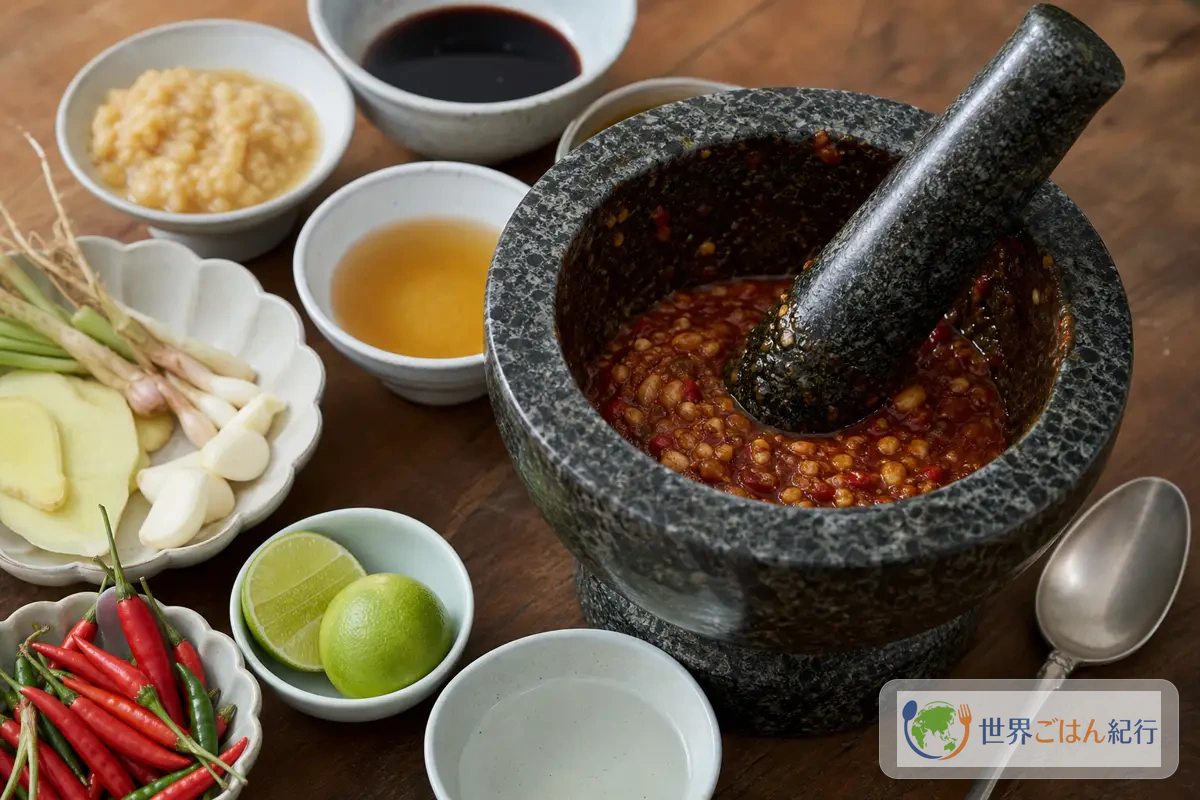
Tao jiew is a Thai fermented soybean seasoning. If you cannot find it nearby, substitute 1 tbsp light-colored miso, 2 tsp light soy sauce and 1/2 tsp sugar. The aroma is not exactly the same, but combined with ginger, garlic, vinegar and chili, it works well enough as a khao man gai sauce.
Ingredients: separate the chicken, rice, sauce and soup
This recipe serves 4. With bone-in thighs, the poaching liquid gains savor. If you cannot get bone-in, you can make it with 900 g of skin-on boneless thighs. In that case shorten the poaching time and always check the internal temperature.
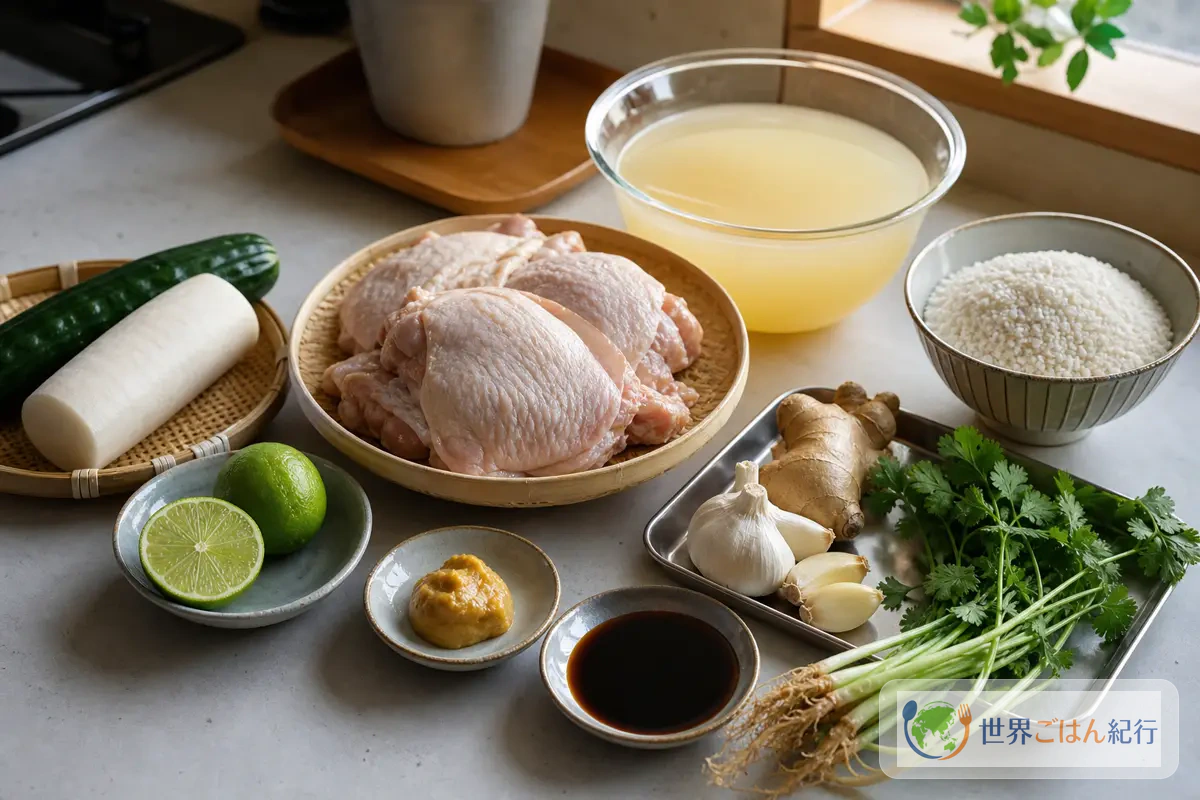
This recipe contains chicken, soybeans, and soy sauce that may contain wheat. Cook the chicken thoroughly through the center. Food-safety guidance from Japan's Ministry of Health, Labour and Welfare shows heating the center of meat at 75°C for at least 1 minute as a guide for preventing food poisoning. Bone-in meat tends to cook unevenly, so check the thick part with a thermometer.
Ingredients worth looking for when shopping
You can make khao man gai if you can buy chicken and ginger nearby. But having jasmine rice, dark soy sauce and a probe thermometer raises how reliably you can reproduce it. Tao jiew is an ingredient to use if you find it, but for the first time a miso substitute is fine.
Method: do not boil the chicken hard, and move the aroma into the rice
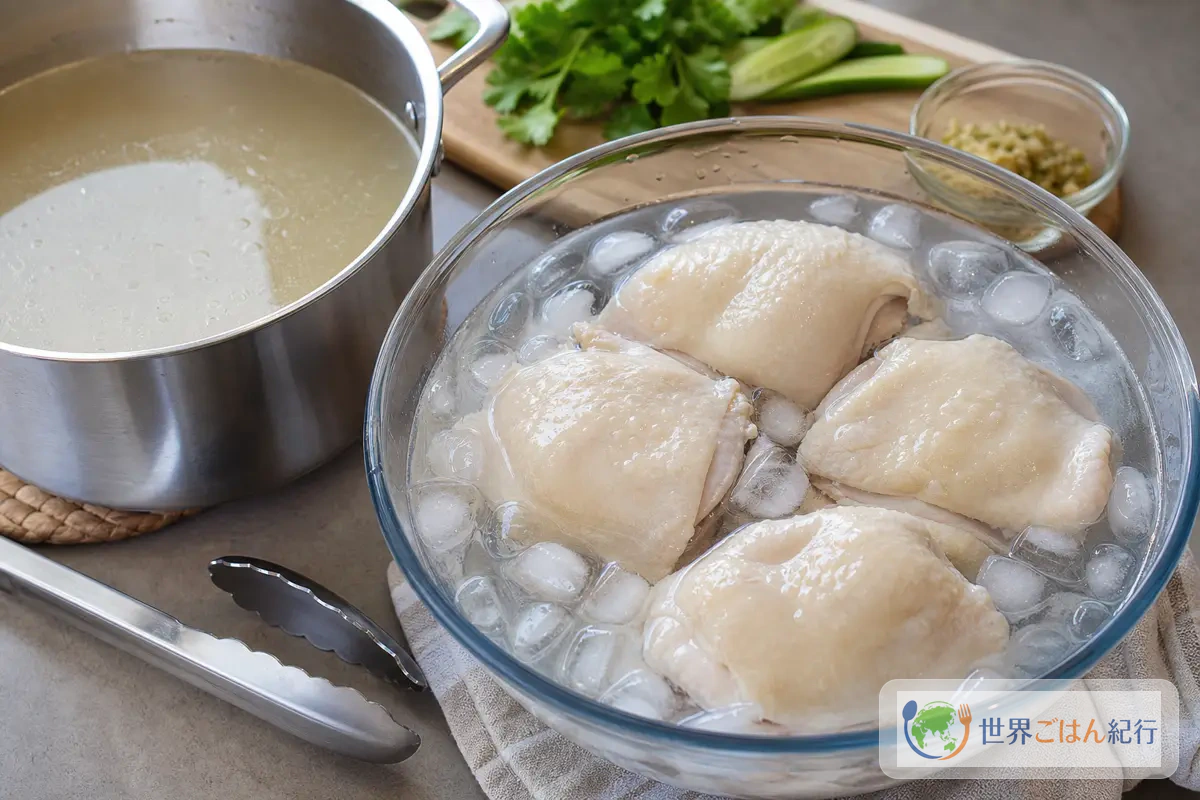
Because you make the chicken, rice, sauce and soup separately, the steps look many. In practice, if you work on the rice and sauce while the chicken poaches quietly, you can reach the table in about an hour and a half. Prepare the ice water, a colander and a bowl for storage first and you will not be flustered.
The khao man gai sauce is strong, so pouring it over the whole plate at once hides the aroma of the rice. First a little on the chicken, then a little at the edge of the rice. Drinking the soup last releases the lingering chicken fat.
Substitutes and causes of failure: what to protect in a home kitchen
Because khao man gai is simple, which substitutes suit and which do not shows clearly. Rather than chasing unusual ingredients, not losing the core of the rice and the sauce takes you closer to the authentic one.
| Ingredient or step | Can it be substituted? | A judgment that is hard to get wrong |
|---|---|---|
| Jasmine rice | Yes | With short-grain rice, reduce the water by 3 tbsp and fluff right after cooking |
| Bone-in chicken thighs | Yes | Use skin-on thighs. Breast alone gives a weak poaching liquid |
| Tao jiew | Yes | Substitute light miso and light soy sauce. Red miso is too assertive |
| Dark soy sauce | Yes | Get close with regular soy sauce and dark brown sugar |
| Chicken fat | Hard to substitute | Render it from the chicken skin. Rice bran oil alone lacks aroma |
| Daikon soup | Yes | Winter melon or turnip also works. Avoid sweet vegetables |
The rice is sticky
The poaching liquid has too much water, or the rice was not drained enough. Leave the jasmine rice in a colander for 10 minutes after rinsing, drain the surface water and then fry it. When making it with short-grain rice, use less water than for usual cooking and fluff from the bottom right after it is done.
The chicken is tough
It may have been boiled hard. The chicken for khao man gai is cooked over low heat and residual heat, not boiled vigorously to make stock. Checking the internal temperature and adding more time over low heat if needed is less error-prone than boiling it hard from the start.
The sauce tastes Japanese
When made with the miso substitute, it inevitably leans toward Japanese flavor. Do not reduce the ginger, add the vinegar and lime juice, and put in at least a little chili. Strong sweetness moves it toward a chicken rice-bowl sauce, so stop the sugar at 2 tsp.
The soup is cloudy
You boiled the chicken hard, or cooked the daikon too long. A cloudy soup can still be eaten, but the lightness of a small stall bowl is hard to get. Next time poach the chicken over low heat and turn off the heat for the daikon while the corners remain.
The whole plate tastes mild
Look not at the amount of sauce but at where the salt is. If the rice lacks salt, only the sauce floats on top. Taste the poaching liquid before cooking and salt it to where you could drink it as a light soup, then use it for the rice, and the whole plate comes together.
Storage and menus: keep the chicken, rice and sauce apart
Khao man gai can be made ahead. But if you put the chicken, rice, sauce and soup in one container, the rice absorbs moisture and turns heavy and the chicken skin goes limp. If you are keeping leftovers, separate them from the start.
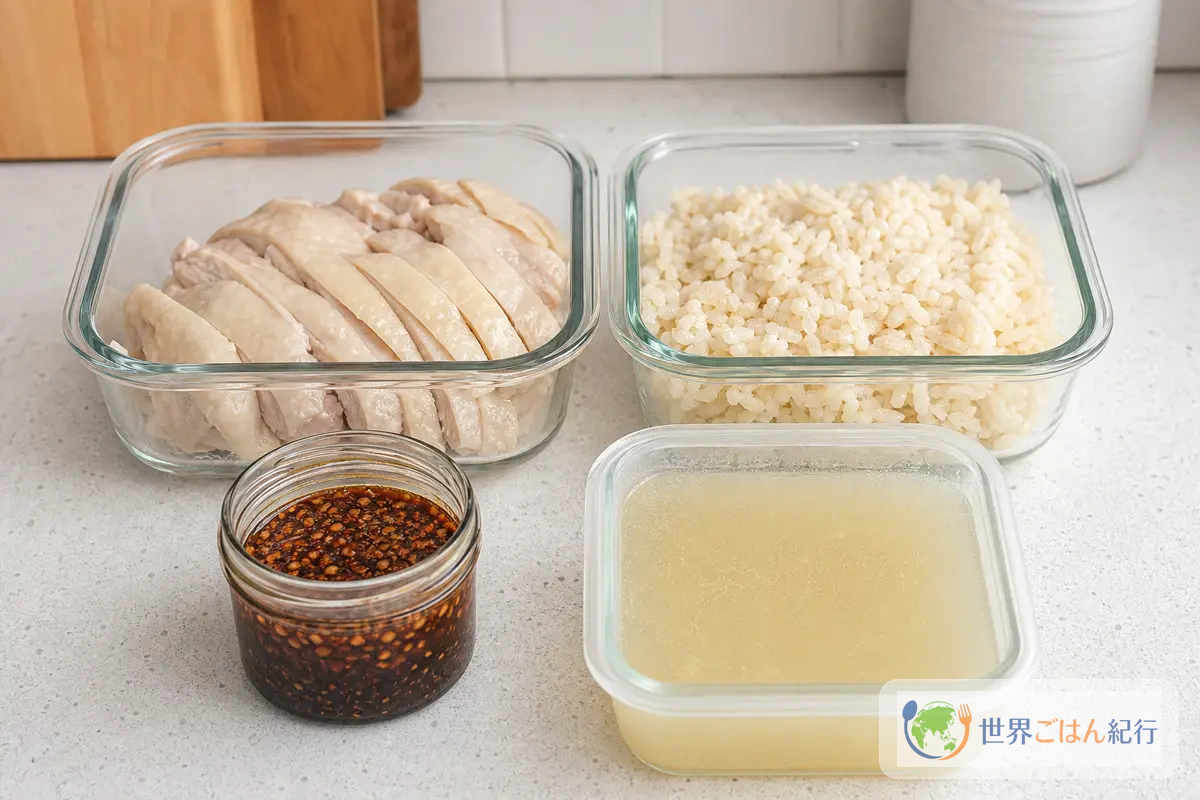
Let the chicken cool a little, put it in an airtight container and finish it within 2 days in the refrigerator. To reheat, spoon 2 tbsp poaching liquid over it, cover with plastic wrap and microwave at 600 W starting from 1 minute 30 seconds and watching. After heating, confirm that it is hot through the center. You can also eat it cold, sliced, with the sauce over it like a salad.
Rice keeps 2 days in the refrigerator and 2 weeks in the freezer as a guide. To freeze, wrap each portion flat, and reheat at 600 W for about 2 minutes 30 seconds. Too much water dilutes the aroma of the chicken fat, so a mist of water is enough.
The sauce keeps about 3 days in the refrigerator. Because it contains ginger and garlic, take it out with a clean spoon. Leftover sauce goes well with boiled pork, steamed eggplant and chilled tofu, but it is quite strong, so start with a little.
For a menu, rather than adding a heavy stir-fry to khao man gai, setting out a small dish with acidity or vegetables makes it easier to keep eating. Som tam brings out acidity and texture, and tom yum goong (in Japanese) goes in a different aromatic direction, so together they make a weekend Thai menu. For a quieter pairing, salted cucumber, a boiled egg and a cold tomato are enough.
| Occasion | Dishes to pair | Reason |
|---|---|---|
| Weeknight dinner | Salted cucumber, cold tomato | Little extra shopping, and the vegetables rest the chicken fat |
| Weekend Thai menu | Som tam, tom yum goong, cold beer | Heat, acidity and herbs go in different directions so the plates are not monotonous |
| A day to compare Southeast Asian chicken dishes | Hainanese chicken rice, pho ga, soto ayam | Shows the different ways of using chicken broth |
| A day for a lunch box | Cool chicken and rice separately and put the sauce in a small container | The rice stays unsticky and the sauce aroma is less likely to fade |
Frequently asked questions and sources
Q1. Can I make it in a rice cooker alone?
Yes. After poaching the chicken, you may skip the step of lightly frying the chicken skin, ginger, garlic and rice in the inner pot. The aroma will be weaker, however. Even when making it in a rice cooker alone, keep to cooking the rice in the poaching liquid and adding 1/2 tsp salt.
Q2. Can I make it with chicken breast?
You can, but the savor of the poaching liquid and the aroma of the skin are weaker. When using breast, choose skin-on, poach 12 minutes over low heat, turn off the heat and leave 10 minutes, then check the internal temperature. It dries out if overcooked, so a thermometer gives peace of mind.
Q3. Does it still taste Thai without tao jiew?
It will not smell exactly the same, but combining light miso, light soy sauce, vinegar, ginger and chili gets close. With miso alone it leans Japanese, so it is important not to leave out the acidity and the chili.
Q4. What if I do not have jasmine rice?
You can make it with short-grain rice. It tends to turn sticky, though, so reduce the poaching liquid by about 3 tbsp from usual and fluff right after cooking. If you aim for the lightness of the local dish, it is worth using jasmine rice next time.
Q5. Is it eaten with cold chicken?
At Thai street stalls the chicken is sometimes served close to room temperature. At home, put food safety first: eat it right after cooking, or reheat refrigerated leftovers to the center. Do not leave it out on the table for long.



