


A brown plate in a cloud of star anise steam
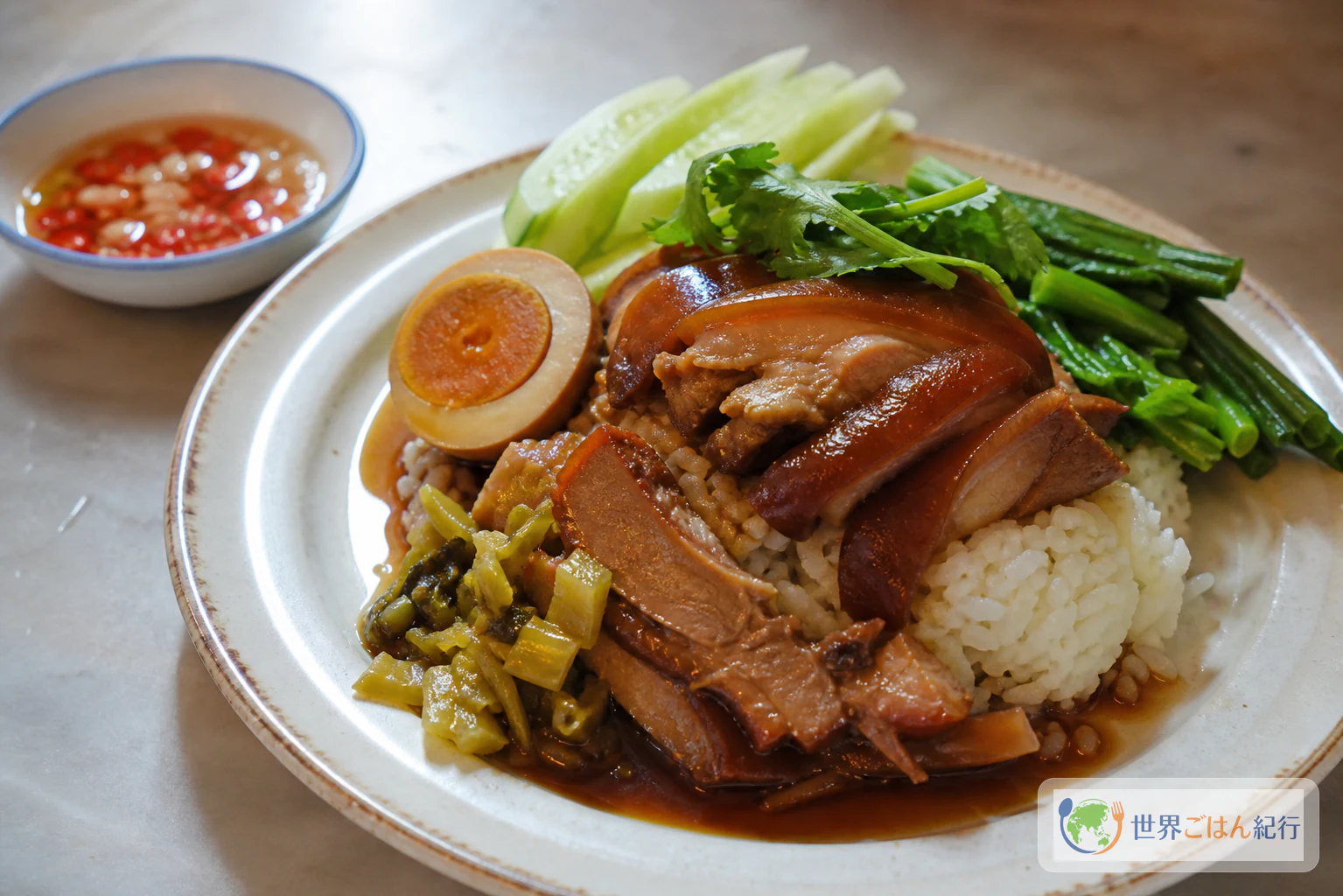
Order khao kha mu at a Thai market and almost everything on the plate is brown: white rice, pork leg braised nearly black, a braised egg, pickled mustard greens, a few greens. There are hardly any bright herbs, yet the scent of star anise and sweet soy rising from the stall's pot tells you why there's a line. Break the pork skin with a spoon and what soaks into the rice isn't fat but gelatin that has drunk up the braising liquid.
Khao kha mu (ข้าวขาหมู / khao kha mu) is Thai braised pork leg over rice. Khao means rice, kha means leg, and mu means pork. Bone-in pork trotters or pork shank are simmered for a long time with star anise, cinnamon, dark soy, sugar, garlic and cilantro roots, then laid over rice. On the side come a boiled egg, greens similar to Chinese broccoli (gai lan), pickled mustard greens and a sour chile sauce.
Khao kha mu is said to have spread under the influence of the cooking of Chinese immigrants to Thailand, especially the Teochew. Its other name, "kha mu palo," uses palo (พะโล้), a word for dishes braised with spices and soy sauce. Today it's a lunch you can find anywhere in Thai cities, from street-corner stalls to department-store food courts and well-known specialty shops.
The hard part at home is deciding how close to get to the original with the pork. Whole trotters may only turn up at a butcher or a Chinese grocery. This recipe uses pork trotters or skin-on pork shank if you can get them, and otherwise a combination of pork shoulder and spareribs. The outline to protect is the wobbly texture of skin and tendon, the sweet scent of star anise, the deep brown braising liquid and the sour sides.
If khao man gai (in Japanese) is a dish of rice eaten quietly with chicken broth, khao kha mu is a dish where you spoon braising liquid over the rice. They're both Thai street-stall rice plates, but they head in very different directions. It's also unlike herbal pork soups such as bak kut teh (in Japanese): this is a lunch plate driven by a sweet-salty braise and a sour sauce.
Rather than fixating on whole trotters: include a gelatin-rich cut, use star anise and cinnamon in small amounts, build the color with dark soy, and cut the sweetness with pickled mustard greens and vinegar-chile sauce. Keep those four and even a home kitchen heads toward a Thai street stall.
What goes on a plate of khao kha mu
Thai Cookbook TV's khao kha mu uses pork leg, coconut sugar, light soy, dark sweet soy, five-spice powder, star anise, cinnamon, garlic, cilantro roots, pepper, eggs, gai lan, pickled mustard greens, and a vinegar and chile sauce. The key point is that although this is a pork braise, the finished plate is defined by its sides as much as by the meat.
On a plate in Thailand, rice generously moistened with braising liquid is topped with a little each of lean meat, skin and fat. Rather than piling on meat, the stall approach uses the braising liquid, pickled greens, fresh greens and egg so you don't tire of it. The little dish of vinegar-chile sauce is about sourness more than heat. It tightens up the sweet braising liquid with each bite and lightens the richness of the pork skin.
In a home kitchen, Thai pak kad dong is the ideal pickled mustard green, but pickled mustard greens given a quick rinse and chopped play much the same role. If you can't find gai lan, komatsuna is fine for the greens. For the pork, skin-on pork shank gets you closest. If you can't find it, adding 300 g spareribs to 600 g pork shoulder gives you lean meat plus savory flavor from the bones. The wobbly texture of the skin will be weaker, though, so if you can mix in even a little pork trotter, do.
| Element | Role at a Thai stall | How to approximate it at home |
|---|---|---|
| Pork trotters / shank | Brings skin, tendon and lean meat together in the braise | Trotters or skin-on shank. Otherwise shoulder and spareribs |
| Dark soy | Color and a toasty, caramel aroma more than saltiness | Regular soy sauce alone is too pale. Add a little dark brown sugar |
| Star anise, cinnamon | Infuses the braising liquid with a sweet aroma | Don't overdo it: no more than 2 star anise and 1 cinnamon stick |
| Pickled mustard greens | Sourness and salt to cut the sweet braise | Rinse and chop pickled mustard greens |
| Vinegar-chile sauce | Lightens the richness of skin and fat | Make it with rice vinegar, garlic, chile and braising liquid |
If you'd like to try another braise built on star anise, Vietnam's beef stew bo kho (in Japanese) sits close to this one.
Ingredients: think in terms of pork, braise and sides
This recipe serves 4. The braising time is long, but you don't need to stand over the pot. Blanch the pork, fry the aromatics, and while it simmers over low heat, prepare the eggs, greens and vinegar-chile sauce.

This dish uses pork, eggs, soy sauce (which contains soy and wheat) and fish sauce (which contains fish). Do not eat pork raw or undercooked. Japan's Ministry of Health, Labour and Welfare advises cooking meat thoroughly to the center and notes that most pathogens are killed by heating at 75°C (167°F) for at least 1 minute. With bone-in or thick cuts, don't judge by appearance alone; keep simmering after the center is hot.
Shopping: the seasonings worth seeking out
The pork, eggs, rice, greens and pickled greens come from any nearby store. The items worth hunting for at an Asian grocery are the seasonings that create khao kha mu's signature aroma and color. Dark soy provides the color, star anise the aroma, and fish sauce the savory depth of the braising liquid.
Star anise infuses the braising liquid with a sweet aroma that powdered five-spice alone struggles to deliver. Too much and it turns medicinal, so 2 pods are plenty for 4 servings. Leftover star anise can go into bak kut teh (in Japanese) or bo kho (in Japanese).
Even just 1 tbsp of fish sauce makes a big difference to the depth of the braising liquid. It's easier to use if you think of it not as a way to add salt but as savoriness that pushes the pork's aroma toward the street stall. You can use the rest in tom yum goong (in Japanese).
Method: braise over low heat until the skin is just short of falling apart
If the pork boils hard, the skin splits and the fat clouds the liquid. Keep it over low heat, with small bubbles rising from the bottom of the pot, and turning the pork over once along the way is enough. The eggs and greens go in at the end and take on the aroma of the braising pot.
Blanching and frying the aromatics are the same. Put the pork, braising liquid and spices in a pressure cooker and cook at high pressure for about 35 minutes, then let the pressure release naturally for 20 minutes. After opening the lid, add the eggs and simmer over low heat for 15 minutes to color them. If the liquid tastes thin, simmer it uncovered over medium heat for about 8 minutes to reduce.
Common problems and how to fix them
Khao kha mu goes wrong because of heat control more than seasoning. Boiling too hard, burning the sugar, not rinsing the pickled greens: avoiding just these three makes it far more reliable.
| Problem | Cause | Fix |
|---|---|---|
| Skin falls apart and it's greasy | Boiling too hard | Lower the heat and set the lid ajar |
| Bitter braising liquid | Burned sugar or garlic | If it's coloring too fast early on, turn off the heat and add 2 tbsp water to cool it down. If it smells burnt, start over |
| Pale color | Not enough dark soy | Add 2 tsp dark soy and simmer 8 minutes |
| Too salty | Liquid reduced too far | Add 100 ml hot water and 1 tsp sugar |
| Tough meat | Not braised long enough | Add hot water and braise 20 minutes more over low heat |
| Plate feels heavy | Not enough sourness or pickled greens | Add more vinegar-chile sauce and pickled mustard greens |
What's easy to overlook is the role of the sides. Khao kha mu isn't complete with the braised pork alone. The pickled mustard greens add salt, the greens add bitterness, the vinegar-chile sauce adds sourness and the cucumber adds freshness. Leave them out and it drifts toward a plain sweet-salty pork rice bowl. Especially the first time, don't skip the sides.
Storage and reheating
Store the pork submerged in its braising liquid. Let it cool slightly, then transfer to a clean container and refrigerate for up to 2 days. To freeze, divide the pork and liquid into single portions and use within 2 to 3 weeks. After thawing, heat in a small pot over low heat and keep it at a steady bubble for at least 5 minutes.
Store the rice separately. If you store it with braising liquid poured over, the rice breaks down and feels heavy the next day. Eat the greens the same day; the pickled mustard greens and vinegar-chile sauce keep in the fridge for up to 2 days. Eggs keep absorbing salt as they sit in the braising liquid, so leave only what you'll eat the next day and finish them first on day two.
The next day, shred the pork finely, warm it in a little braising liquid, and add a fried egg and cucumber for an easy lunch. For a Thai-style menu, pair it with tangy som tam (in Japanese) or herb-heavy laab (in Japanese) so the sweetness of the braise doesn't pile up.
Frequently asked questions
What can I use if I can't find pork trotters?
You can make it with 600 g pork shoulder and 300 g spareribs. Shoulder alone makes a delicious braising liquid, but you won't get the wobbly texture of skin and tendon. If your butcher can add just 300 g of trotters, braising them with the shoulder is the practical solution.
Can I make it without dark soy?
You can, but the color will be paler. Combining 2 tbsp regular soy sauce, 2 tsp dark brown sugar and 1 tsp tamari gets you close. Dark soy is more about color than saltiness, though, so if you plan to keep cooking Southeast Asian food, a small bottle is handy to have.
I don't like star anise.
Cut it to 1 pod and halve the cinnamon. Five-spice powder keeps the aroma present, so leave that out too if you dislike it. Removing them entirely softens the Thai street-stall outline, but with garlic, ginger, dark soy and fish sauce it still works as a braise.
Can I add the eggs from the start?
If added at the start, the whites turn rubbery and crack easily on the bottom of the pot. Boil them first and put them in the braising liquid for only the last 15 minutes to color them while keeping the whites tender. For a deeper color, soak them in the braising liquid for 30 minutes after turning off the heat.
Can I substitute Japanese takana for the pickled mustard greens?
Yes. Many takana pickles are quite salty, so give them a quick rinse, squeeze out the water and chop into 1 cm strips. Simple salt-pickled or sour versions work better than takana with a strong sesame oil flavor.
Sources
- Thai Cookbook TV, “Khao Kha Moo Recipe | How to Make Thai Braised Pork Leg Roast | ข้าวขาหมู”, https://www.thaicookbook.tv/thai-recipes/one-dish-meals/khao-kha-moo-thai-stewed-pork-leg/ (accessed 22 October 2026)
- Wikipedia, “Khao kha moo”, https://en.wikipedia.org/wiki/Khao_kha_mu (accessed 22 October 2026)
- 厚生労働省「お肉はよく焼いて食べよう」, https://www.mhlw.go.jp/stf/seisakunitsuite/bunya/0000049964.html (accessed 22 October 2026)



