Unwrap the Leaf, and the Banana Catches Up with the Sweetness of the Rice
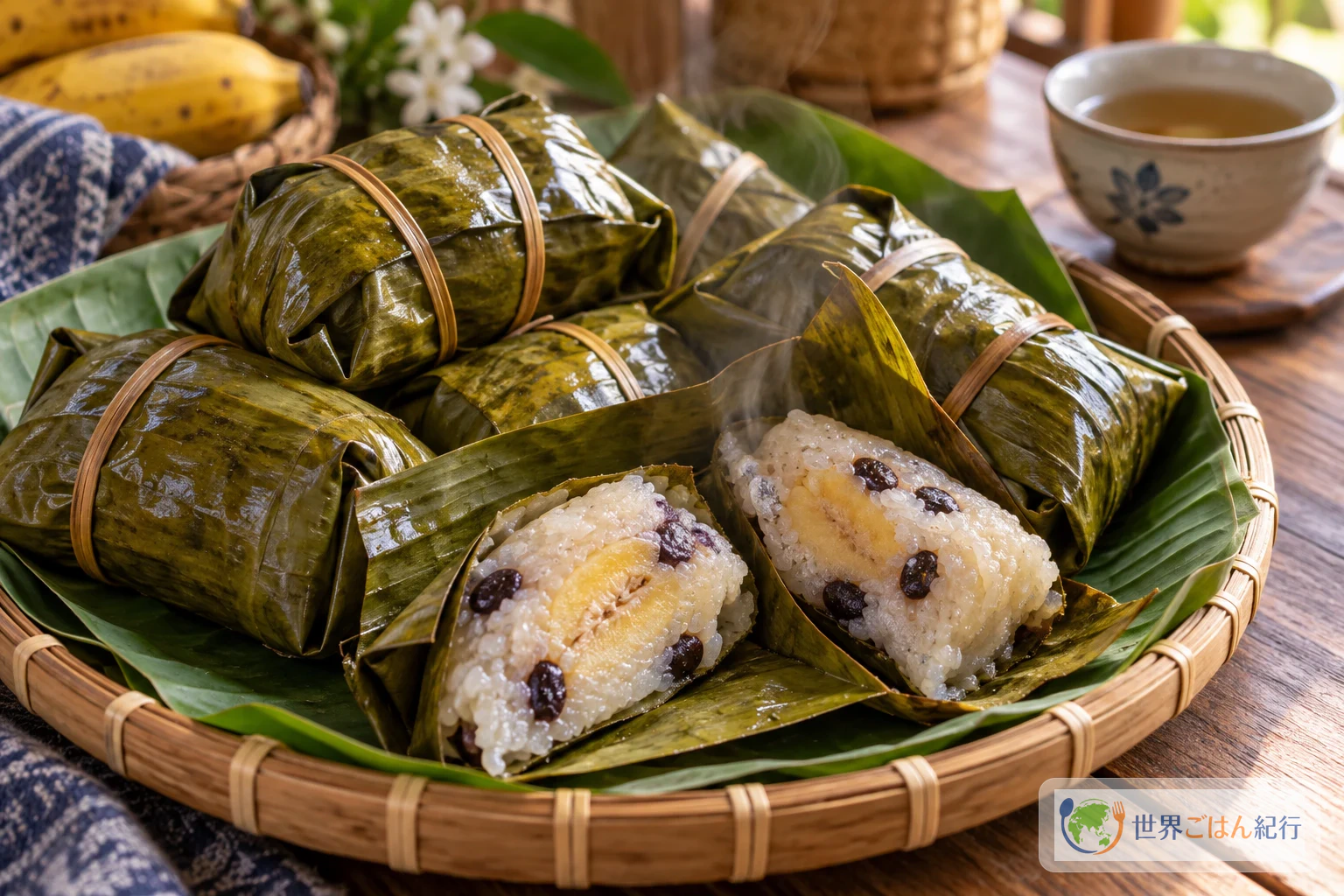
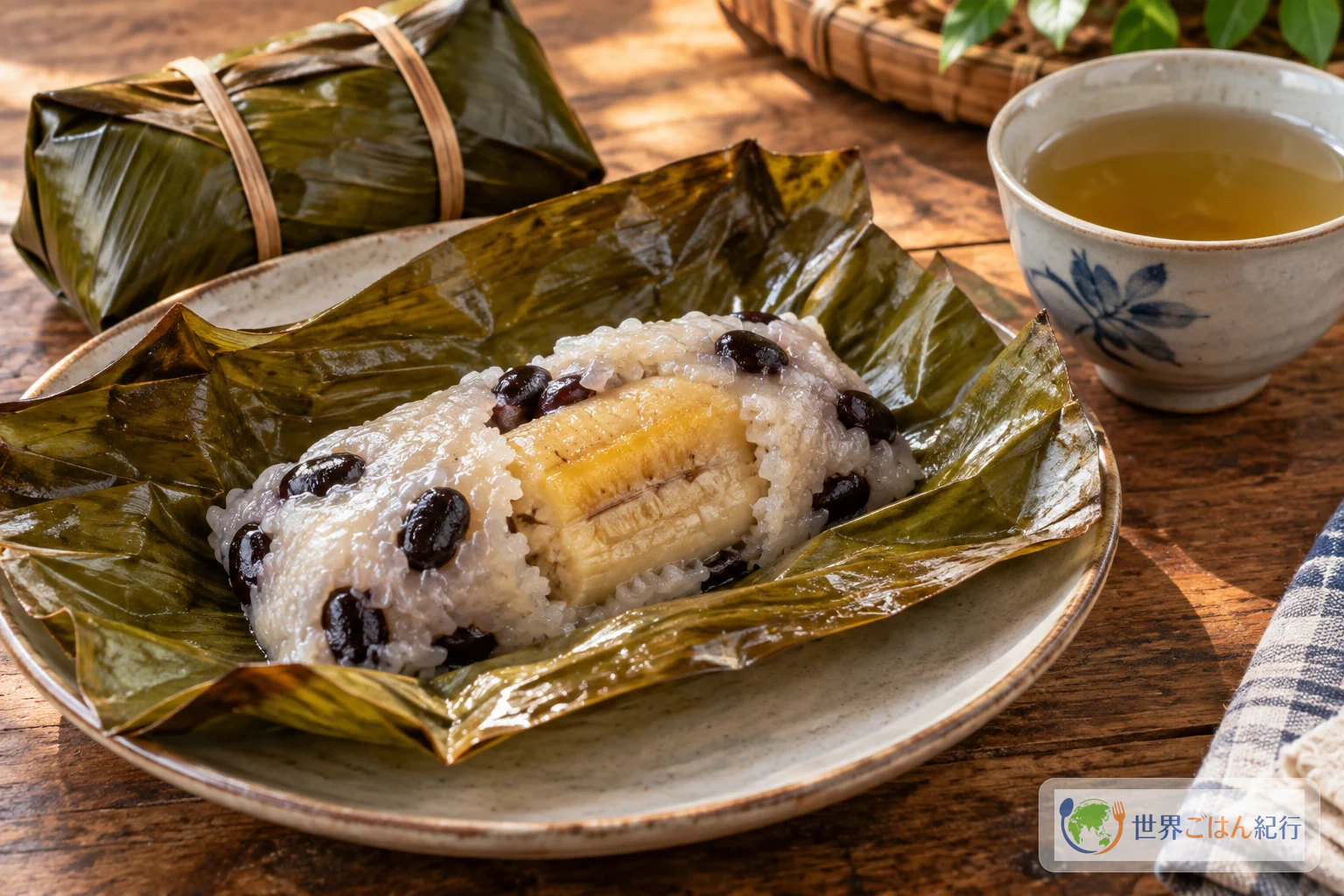
When you untie the knot of khao tom mat, the first thing you see is white sticky rice. Steam has gathered inside the leaf, and the rice, enriched with the fat of coconut milk, has softened while keeping the outline of each grain. The banana at the center has grown sweeter with the heat, and the beans here and there add a small bite to the sticky texture.
Khao tom mat (ข้าวต้มมัด) is a Thai sweet in which sticky rice is seasoned with coconut liquid, sugar and salt, wrapped with banana and beans in banana leaf, and steamed. The long packets tied in pairs are the best-known image, but the shape of the packet and the combination of fillings vary with the occasion and the region.
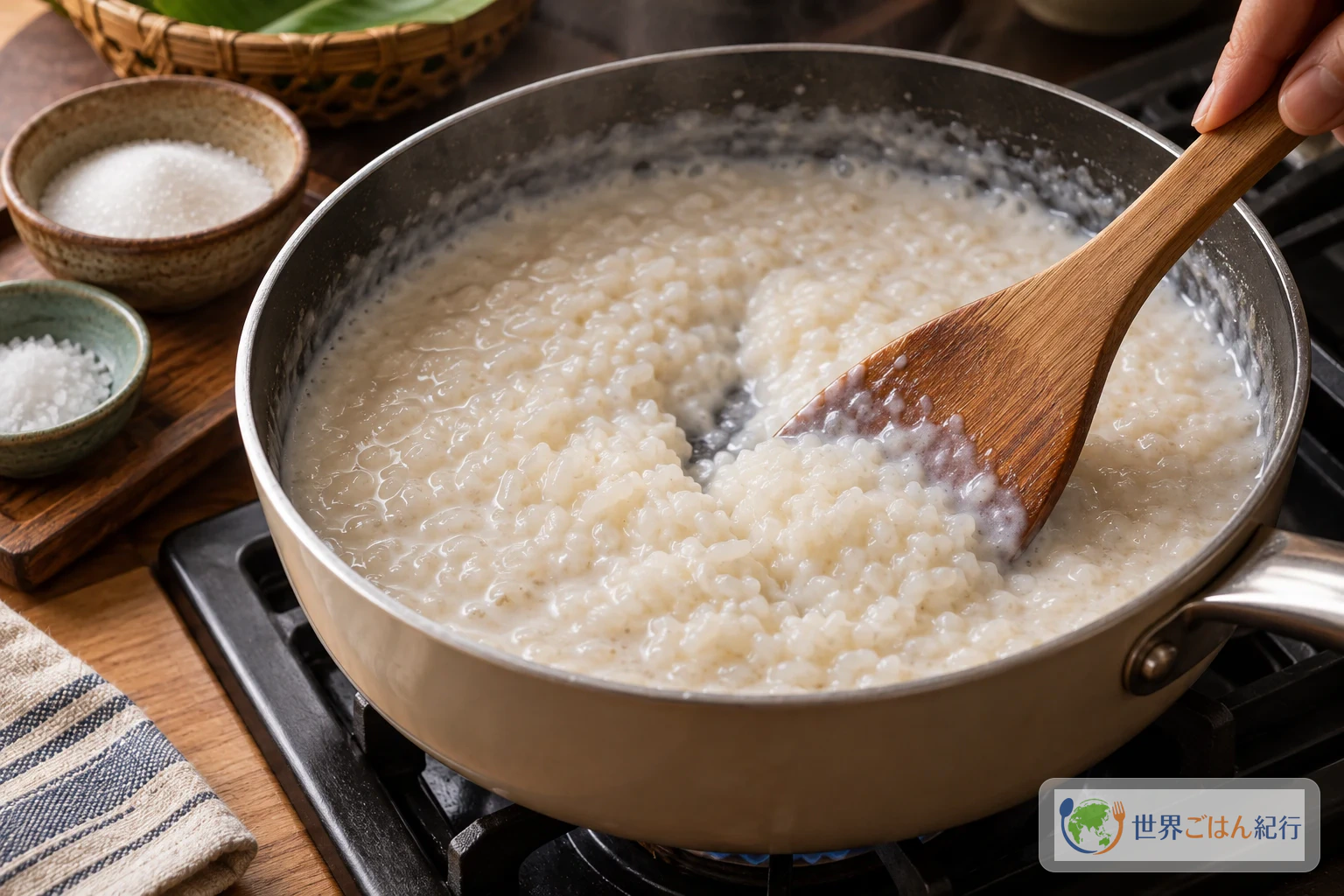
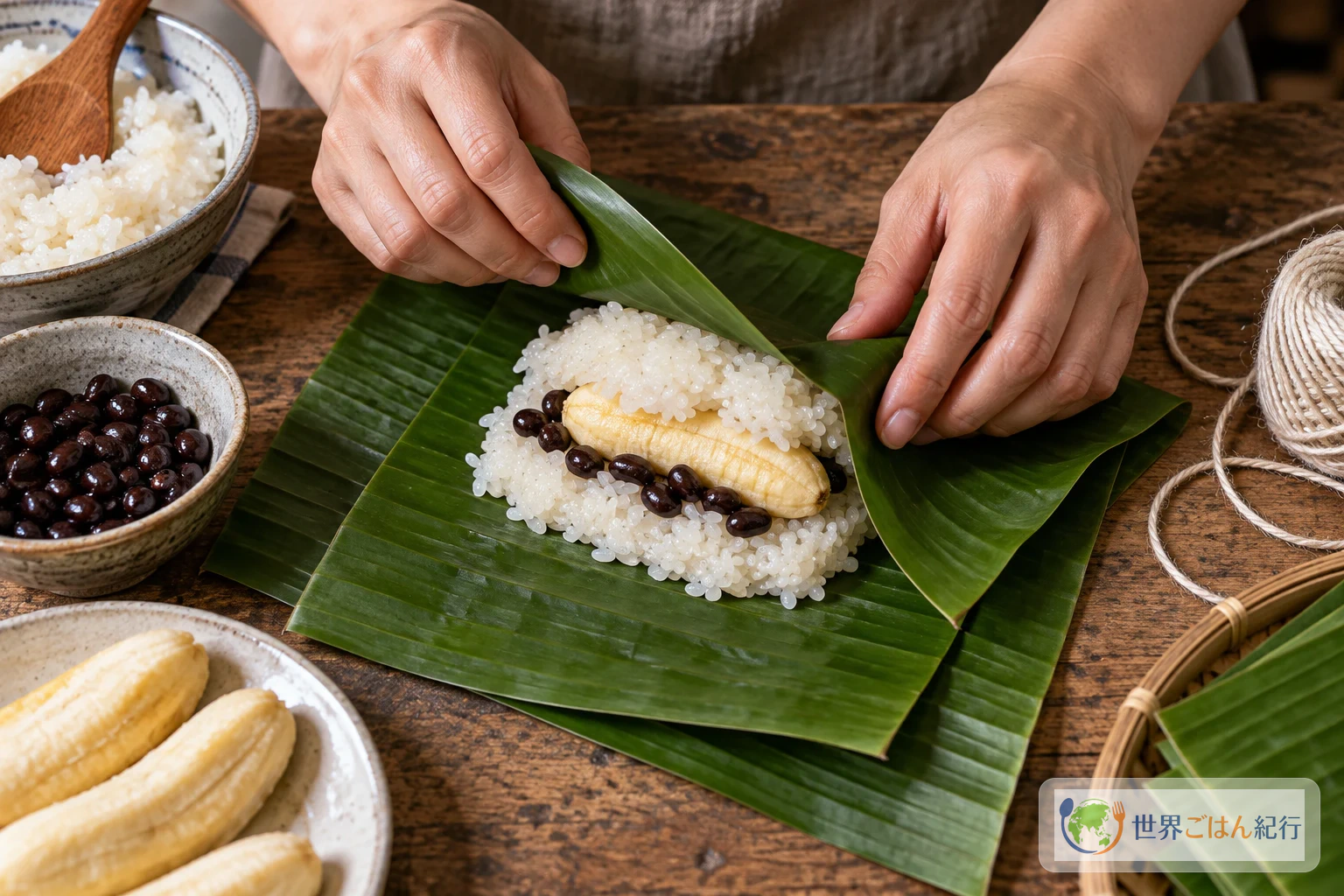
This recipe does not cook the rice fully in one go: you wrap it half-cooked and leave the final cooking to the steam. To add only the leaf aroma you could substitute paper, but when doubled leaves hold the steam and sweet liquid, the rice dries out less even when cool. The ingredients and steps follow a Thai government cooking source, adjusted to 12 pieces for a household.
If you are deciding what to buy first, it comes down to three things: Thai sticky rice, which is the center of the flavor; unsweetened coconut milk; and a steamer that keeps the steam steady. Frozen banana leaf is fine. If you only want to try it once, you can start with ordinary sticky rice and the deep pot and steaming rack you already own, and still learn how a wrapped sweet works.
The condition for choosing Thai sticky rice is that the ingredient is sticky rice and the label says "sticky rice" or "glutinous rice." If you plan to make larb or khao niao next, it is worth testing its aroma and how the grains hold together. If a large bag would be too much for one sweet, you can cook with ordinary sticky rice and put the budget toward the leaf aroma and the steaming. On the product page, check the net weight and the ingredients.
A Wrapped Sweet Set Out for Offerings and Celebrations in Thailand
If you pin khao tom mat to a single region's specialty, the occasions on which it has been eaten slip away. In an article on Sen Donta introducing the food culture of Khmer communities in lower Isan, particularly Surin, Sisaket and Buriram (not southern Thailand), the Thailand Foundation lists khao tom mat among the dishes offered to ancestors in the tenth lunar month, around September to October today. Sticky rice wrapped in leaf with banana inside is a sweet and at the same time an offering that ties a family to its ancestors.
In Sen Donta, Wan Bent Thom, the 14th day of the tenth lunar month, is described as an important day for making offerings. The offerings are directed to monks and ancestors, and sticky rice is spoken of as a symbol of family bonds and of keeping distant people close. When you eat khao tom mat, if you consider not only a sweet rice snack with banana but also the actions of tying, sharing and offering, the long packet shape starts to make sense.
Another Thailand Foundation article introduces the connection between the merit-making of the Mon of central Thailand and coconut sticky rice sweets. There, khao tom look yong is distinguished as a triangle with a long tail, khao tom mat as a leaf-wrapped stick tied at each joint, and khao tom kruk as a bite-sized piece not wrapped in leaf, served with shaved coconut. Even if the names are similar, how you fold the leaf and bring it to the table changes the impression in the hand.
So the stick-shaped khao tom mat we make here is not the one correct form but one form of Thailand's coconut sticky rice sweets. Folded into a triangle it moves toward a different related sweet, and unwrapped and piled small it becomes a form suited to offerings or shared plates. Rather than tracing its origin back to a single region, it is more natural to see it as a dish in which sticky rice, coconut, leaf and sweet fruit have moved between festivals and homes.
The order of what to protect in a home kitchen is as follows.
| What to protect | Role in a Thai wrapped sweet | Judgment for cooking abroad |
|---|---|---|
| Sticky rice | A sticky base that binds the coconut and filling | Thai rice brings the aroma closer. If you are making it first, ordinary sticky rice is fine |
| Coconut and salt | Rounds the sweetness while bringing out the outline of the rice | Choose unsweetened and don't skip the salt |
| Banana | Adds sweetness and moisture at the center of the packet | Prioritize ripe and fragrant over variety name |
| Banana leaf | The wrapper that carries aroma and holds in steam | Frozen leaf works. Paper and aluminum foil change the aroma |
| Beans | Add bite to the soft rice | Use unsweetened black or red beans, boiled |
Ingredients: Serves 6, Makes 12
Two pieces per person, making 12 long packets. Sticky rice gets heavier once soaked, so measure it dry. Rather than putting in a whole banana, cut it into sticks to fit the length of the packet.
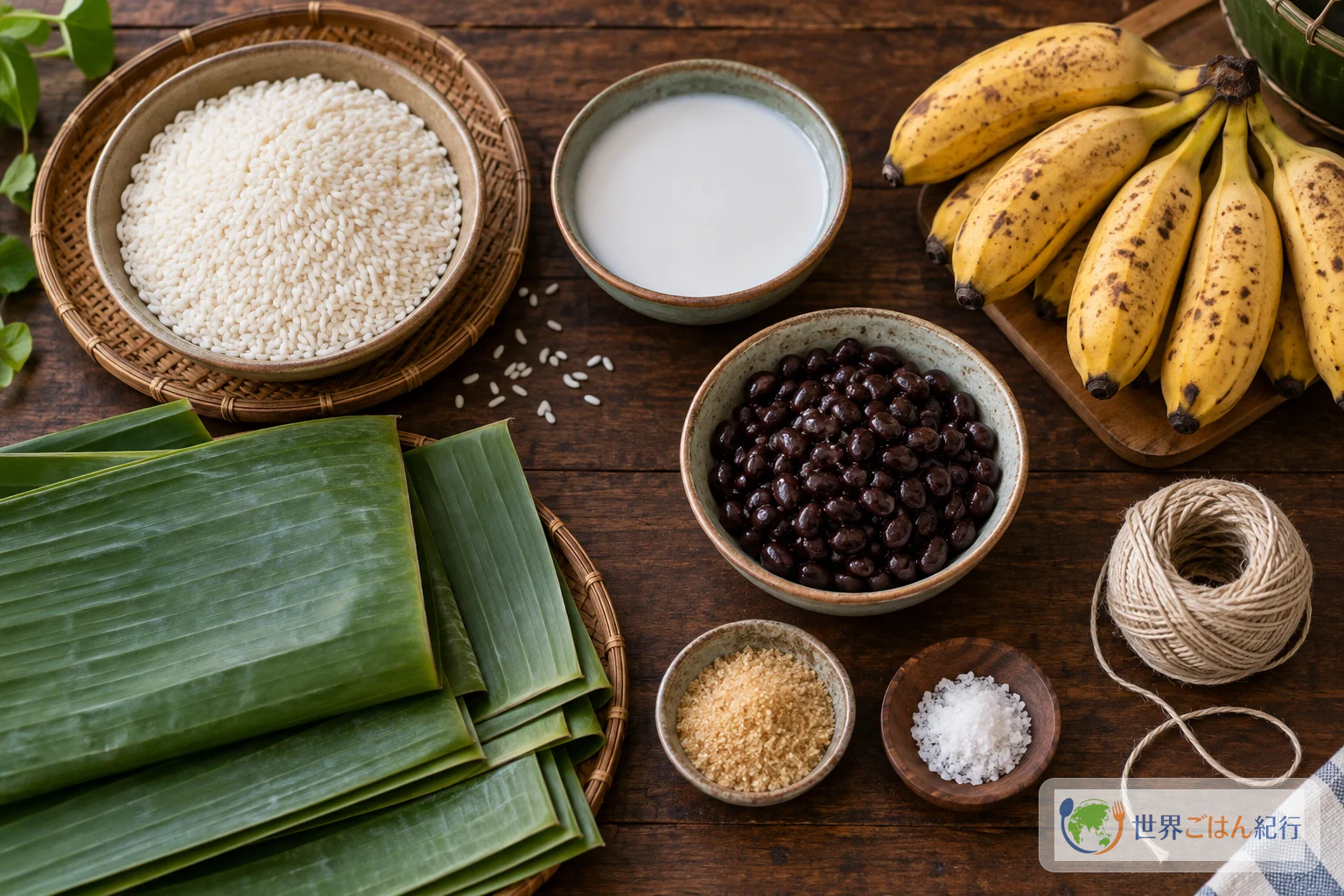
If you buy coconut milk, choose an unsweetened can whose ingredients are mainly coconut and water, not a sweetened drink. A can of around 400 ml is used up by this amount. If you already have an unsweetened one, you don't need to buy more. The one thing to check is that it is unsweetened, more than the product name, and the volume.
Deciding the Ingredient Differences Up Front
The Thai government source says nam wa bananas should be ripe. If you use Cavendish bananas, pick ones with spots on the skin and a rising aroma that don't collapse when lifted. Still-green bananas lack sweetness and moisture and leave a hard center even after steaming, so don't force it the day you buy them. Bananas whose flesh is nearly liquid, on the other hand, run out of the rice when wrapped.
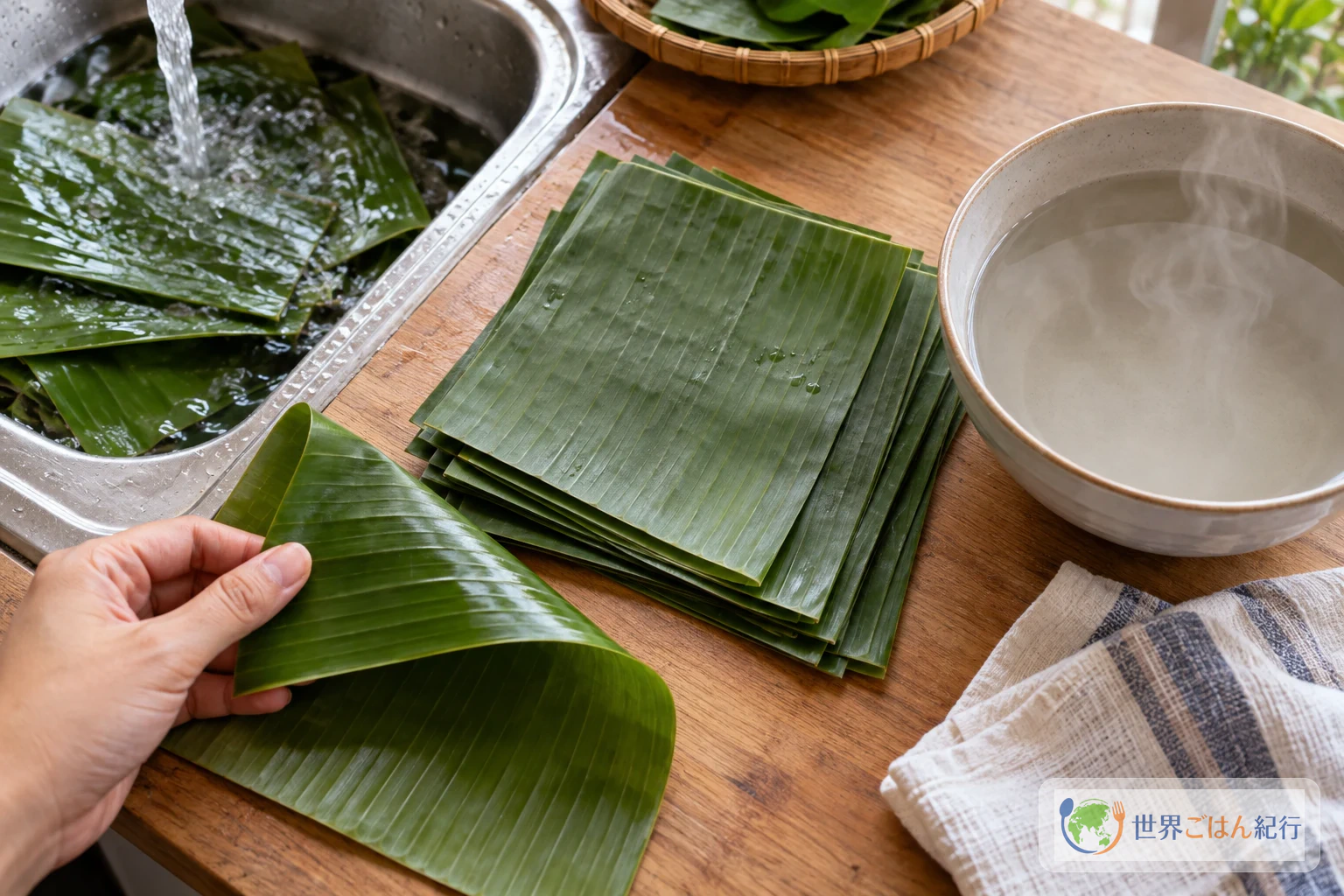
Frozen banana leaf can be thawed and used. Wipe the surface with a clean cloth and cut off the hard central rib if necessary. If the leaf cracks easily, pour boiling water over it or hold it briefly over steam to make it pliable. If you can't get leaves, you can switch to wrapping in parchment paper and closing the outside with aluminum foil. The green aroma of the leaf and the pleasure of unwrapping it will not come back, though.
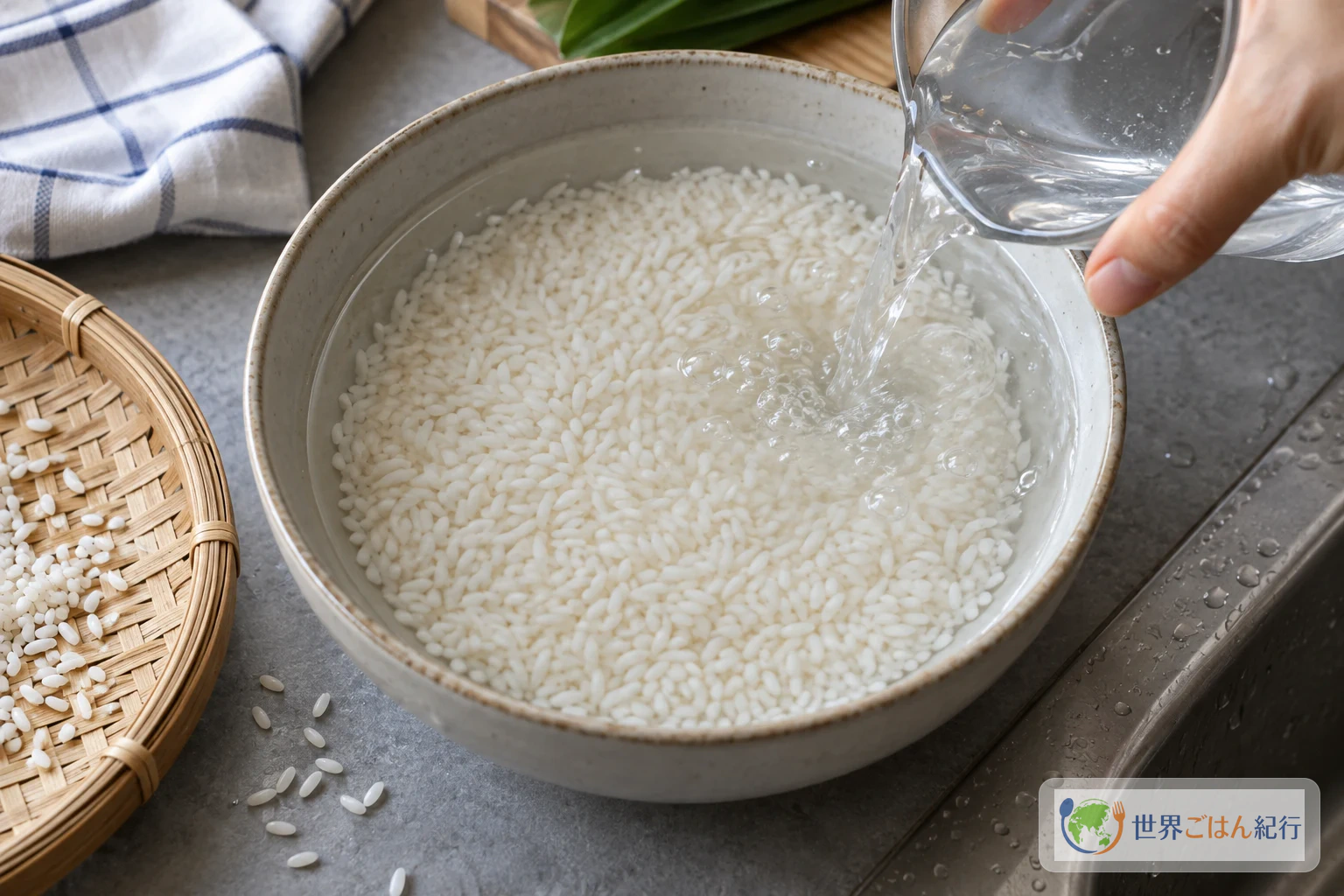
Switching to ordinary sticky rice still works if you keep to the soaking and the way of telling when it has steamed. The point of buying Thai rice is that the rice itself has a slight aroma and keeps the presence of the grains even after it takes in coconut. Using ordinary rice the first time and Thai the second lets you judge the difference between ingredients with your own tongue.
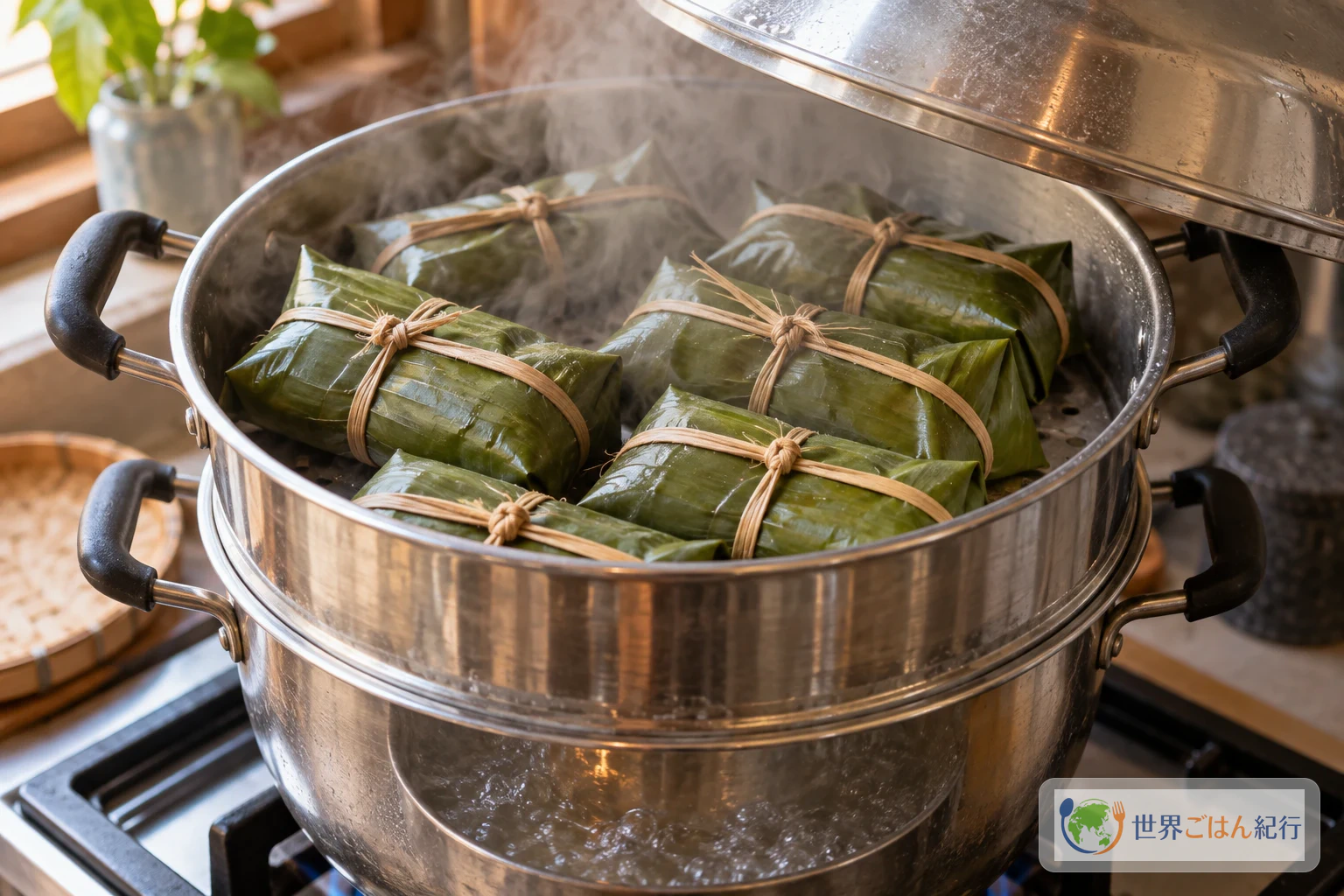
The steamer must be big enough that the packets can stack without touching the lid and you can add water. If you will make sticky rice and steamed sweets often, it makes sense to choose one that fits your pot. For a single try, a deep pot, a steaming rack and a heatproof plate are enough. If you buy one, check its diameter (about 28 cm), whether it is stainless steel, and whether the steaming tray and pot come as a set or separately.
Method: Finish the Half-Cooked Rice by Steaming It in the Leaf
The water in the pot is not for boiling the rice but for making steam. Reduce the number of times you lift the lid and keep steam rising steadily from the steamer. Success is decided not by time alone but by opening one packet and checking the center.
Rescuing a Failed Packet: Telling Rice Firmness and Moisture Apart
Failures in khao tom mat come from uneven moisture more than from sweetness. Before opening all the packets, look at the edge of the knot and the swelling of the leaf. If the leaf is dry and the packet light, the steam was insufficient; if liquid has collected at the bottom of the leaf, the half-cooked rice may have been too loose.
| State | Main cause | How to rescue |
|---|---|---|
| Hard core in the center | Under-soaked, rice layer thick, steam weak | Close the packet again and re-steam 15 minutes at a time. Don't let the water run out |
| Rice runs out of the leaf | Too much liquid left at the half-cooked stage | If not yet wrapped, return to the pot and drive off moisture over low heat 5 minutes at a time |
| Leaf tears and beans come out | Leaf was dry, string tied too tight | Rewrap the torn packet in fresh double leaf and loosen the knot |
| Banana is green and hard | Underripe, cut too thick | Next time use fruit with aroma. Re-steam this batch to the center |
| Too heavy-sweet | Too much sugar, overripe banana | Serve with unsweetened tea and cut the sugar by 10–15 g next time |
| Only the beans are hard | Under-boiled, or dried beans added as they were | Use boiled unsweetened beans. You can't fix beans alone after it's finished |
If the rice is hard after steaming, re-steam with the packet's shape kept rather than opening the leaf and pouring water on it. Pouring water directly lets the sweet liquid run off and softens only the outside of the rice. For packets that still have a core after re-steaming, taking the rice out of the leaf and warming it in a pot with a little water to eat like a coconut rice pudding wastes the least.
To store, let them cool, put them in a clean container and refrigerate; don't leave them at room temperature for a long time. Steam only the amount you will eat from the refrigerated packets until hot to the center. If there is an off smell, a change in appearance or a stronger sourness, discard without eating. For freezing, wrap each piece in its leaf, put them in a freezer bag, and steam on the day you eat them. Microwave alone gives a weaker leaf aroma and leaves a temperature gap between center and outside, so steaming is better.
Changing the Shape Shows How It Differs from Related Sweets
Changing how it is wrapped changes the occasion even for the same coconut sticky rice. Stick-shaped khao tom mat is easy to divide for two when you untie the string and also easy to carry. Khao tom look yong, folded into a triangle, has standing leaf corners and a different look. Khao tom kruk, which uses no leaf, is made bite-sized with shaved coconut and is easy to bring out on serving plates.
| Shape | Filling and style | Judgment for trying it abroad |
|---|---|---|
| Stick, two tied as a pair | Banana and beans wrapped in rice, leaf tied at the joints | This recipe. Prioritizes leaf aroma and portability |
| Triangle | A corner-edged leaf wrap that leaves a tail-like leaf | Reduce the rice and make the folds first so it holds |
| Leafless bite-size | Rice and filling gathered small, shaved coconut served alongside | A substitute when you can't buy leaf. Chooses ease of serving over aroma |
This is not a question of right and wrong in the same dish but of the relation between wrapper and table. If you want the leaf aroma to lead, look for frozen leaf and wrap it double. If you only want to test the shape, make it with parchment and aluminum foil, confirm the rice and filling combination, and buy the leaf afterward.
Changing It at Home: Move Only One Axis of Flavor
You can keep the traditional ratios and still make small changes to suit the ingredients you can get and the people eating. Changing several things at once makes it impossible to tell why the rice was hard or what made the sweetness differ, so change only one at first.
- Swap black beans for red beans. The Thai government source lists both black and red beans. Red beans' skin color tends to bleed into the rice, so drain the cooking liquid well first.
- Reduce the sugar by 10–15 g. When the bananas are ripe enough, you can hold back the rice's sweetness and bring the fruit's aroma forward. Don't cut the salt too far or the outline of the coconut is lost.
- Swap the banana for taro. This is a home arrangement. Cut cooked taro into sticks, coat with a little sugar and wrap. It has less moisture, so make the rice mixture slightly softer.
- Add a little roasted sweet potato. Without replacing all the banana, make only half of it roasted sweet potato, and you keep the leaf aroma while moving toward an autumnal sweetness. If the filling is thick the center of the rice splits, so don't make it thicker than 1 cm square.
- Replace part of the coconut milk with coconut cream. Using cream for just 100 ml strengthens the fatty aroma. Replacing all of it makes the mixture heavy and the half-cooked point hard to judge, so use it for only part the first time.
The order of priority for being close to the local dish is banana leaf, sticky rice, coconut and ripe banana. Moving closer on whichever of these four you can buy, one at a time, makes the differences in flavor easier to read than adding tools or kinds of sugar first.
Tracing the Occasions: Sharing Sweet Rice by Hand
ThaiCookbook.tv introduces khao tom mat as a soft sweet picked up by hand at festivals and temples. In two Thailand Foundation articles, examples tied to offerings to ancestors and alms for monks can be found. This does not mean every household eats it at the same event, but what they share is that a sweet wrapped in leaf is not finished on the plate: it is also a food that is divided and handed on.
At the table, leaving the leaf under the sweet when serving rather than removing it fully keeps the aroma. While hot, the rice and coconut come first; as it cools the sweetness of the banana deepens. Two pieces make one portion so that you can pick up each stick-shaped packet and pass one to your neighbor. This is a suggestion for home serving, not a fixed etiquette.
If you want to compare another Thai sweet sticky rice, khao niao mamuang, eaten with mango and a moist, salty sauce, is a good choice. For comparing the springiness of steamed sweets and coconut aroma, go on to khanom chan, which layers rice flour and tapioca starch. When you want to see another form of rice wrapped in leaf and set out for festival plates, Vietnam's banh chung offers a contrast.
Frequently Asked Questions: Untangling Doubts About Leaf, Rice and Sweetness
Q. If I make it with ordinary sticky rice, is it not khao tom mat?
It takes the form. Thai sticky rice brings aroma and the cohesion of the grains closer, but with ordinary sticky rice, if you keep the 4-hour soak, wrap it half-cooked and steam it to the center, it becomes a sweet that wraps banana and coconut. If you want to see the difference, change only the rice and compare with the same amounts.
Q. Is frozen banana leaf rather than fresh all right?
Yes. Thaw it completely and wipe the water off before use. If the leaf is stiff, pour boiling water over it until it is pliable enough to bend. Frozen leaf can have a weaker aroma than fresh, so prioritize wrapping double and not taking the leaf off until just before you open the packet.
Q. Can I use sweet simmered black beans?
You can, but the whole thing becomes quite sweet. Start with unsweetened boiled black or red beans, and when using sweet simmered beans reduce the sugar by 10–20 g. Wet beans collapse inside the rice, so press the surface lightly with paper towels.
Q. Can't I make it without a steamer?
You can. Put a rack in a deep pot, set a heatproof plate on it and cover with a lid. Make sure the packets sit above the water and don't let it boil dry. Only if you make steamed dishes often is it enough to choose a dedicated steamer whose diameter fits your pot.
Q. If I want less sweetness, do I just reduce the sugar?
First reduce it by only 10–15 g and leave the salt as it is. Cutting the salt as well doesn't lighten the sweetness; it blurs the taste of coconut and rice. On a day when the bananas are ripe, reduce the sugar; on a day when they are still weak in aroma, go back to the standard amount.
Q. Can I eat it the next day?
Yes, if you cool it, refrigerate it, and steam only what you will eat until hot to the center. Storing it with the leaf opened dries the rice, so keep it sealed in its packet. Don't eat anything left at room temperature for a long time, or anything with a change in smell or appearance.
Khao tom mat is not a sweet that becomes more authentic the more special sugar or decoration you add. Sticky rice holding its liquid, banana aroma staying inside the leaf, and beans showing their outline partway through a bite: if those three are in place, even your own pot can capture the center of the dish. When you want to push the leaf aroma one step further, buying Thai sticky rice or a dedicated steamer is enough.
Sources
- Thailand Foundation, "Saen Don Ta: How Ethnic Khmers in Thailand Honor their Ancestors", https://thailandfoundation.or.th/saen-don-ta/ (published 30 September 2024; accessed and checked 26 September 2026)
- Thailand Foundation, "Tak Bat Nam Phueng: The Honeyed Merit-Making", https://thailandfoundation.or.th/th/tak-bat-nam-phueng-the-honeyed-merit-making/ (published 29 September 2025; accessed and checked 26 September 2026)
- Department of Older Persons, Ministry of Social Development and Human Security, Thailand, "ภูมิปัญญาผู้สูงอายุ ขนมหวาน อาหารคาว", https://www.dop.go.th/download/knowledge/th1614777093-525_0.pdf (published April 2013; accessed and checked 26 September 2026)
- ThaiCookbook.tv, "Sweet Sticky Rice with Banana Filling", https://www.thaicookbook.tv/thai-recipes/desserts/sweet-sticky-rice-with-banana-filling/ (published 2 March 2015; accessed and checked 26 September 2026)