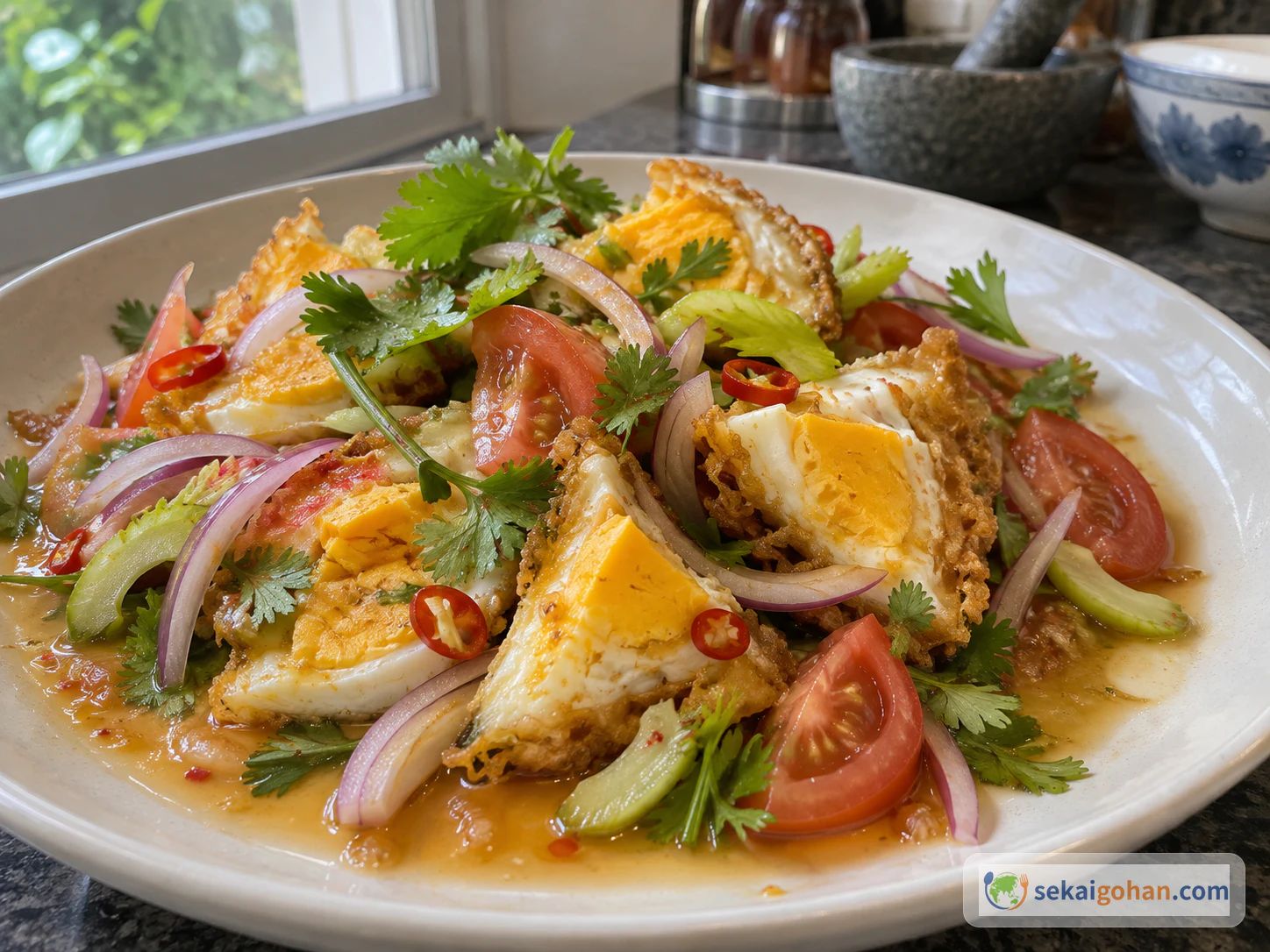
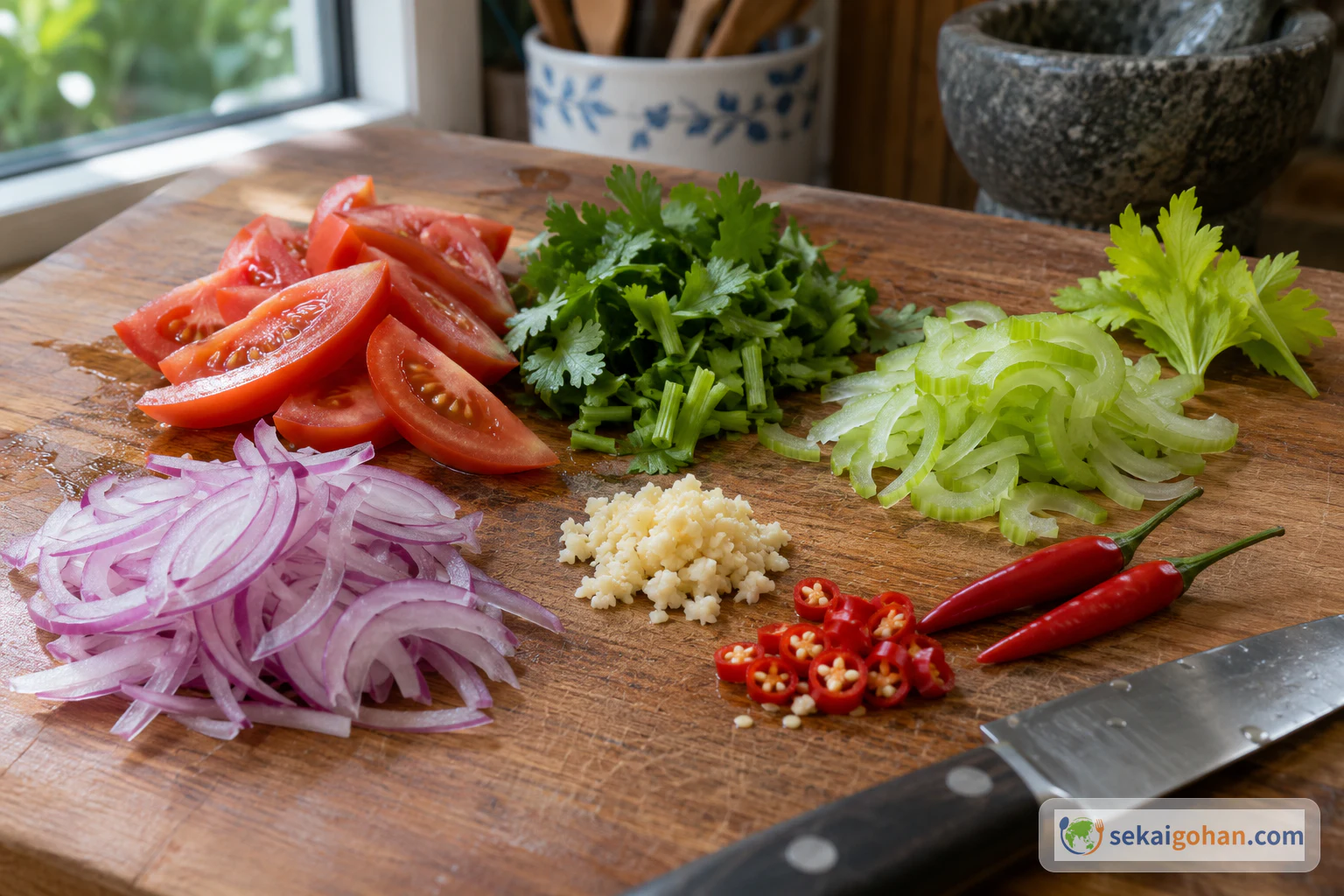
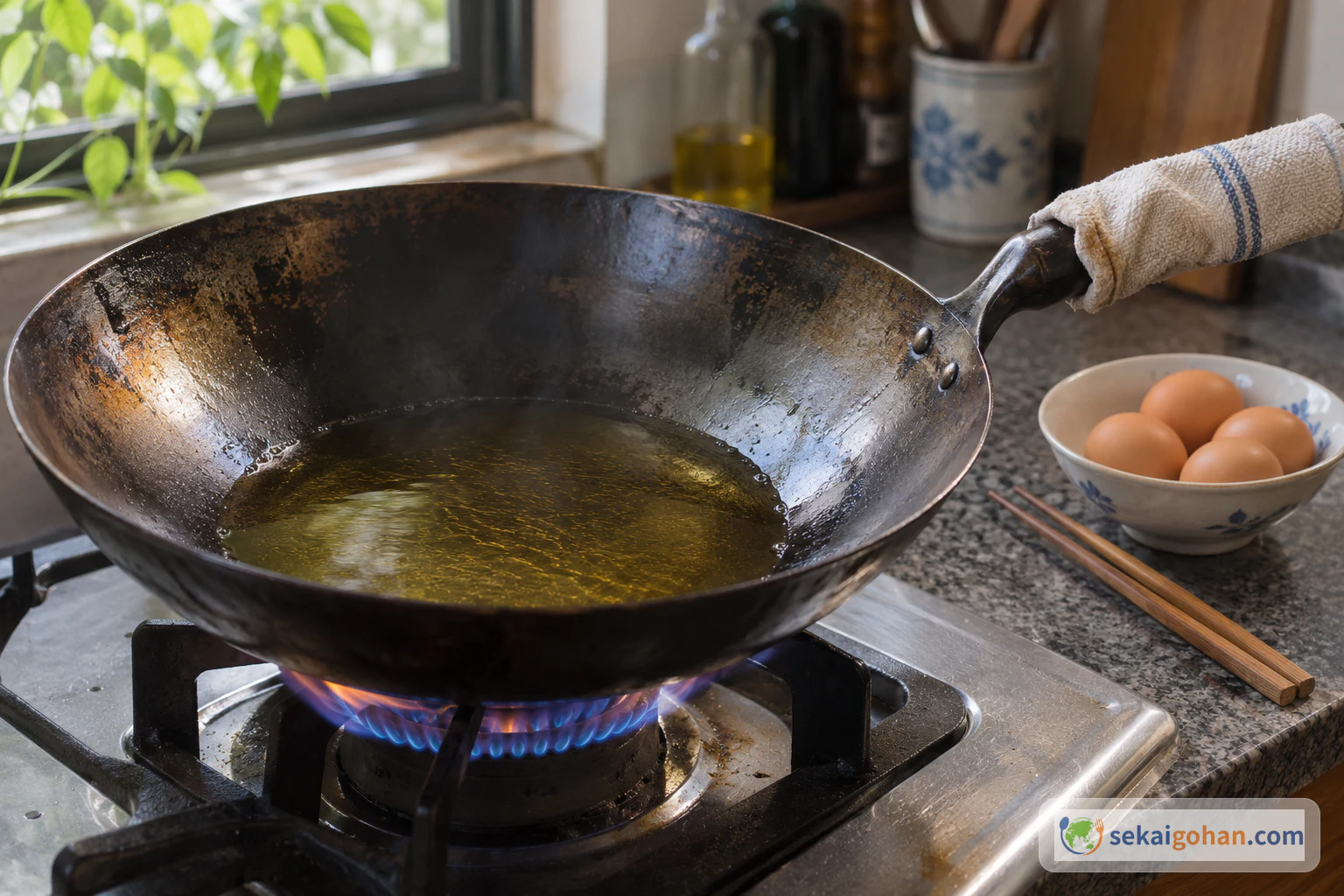
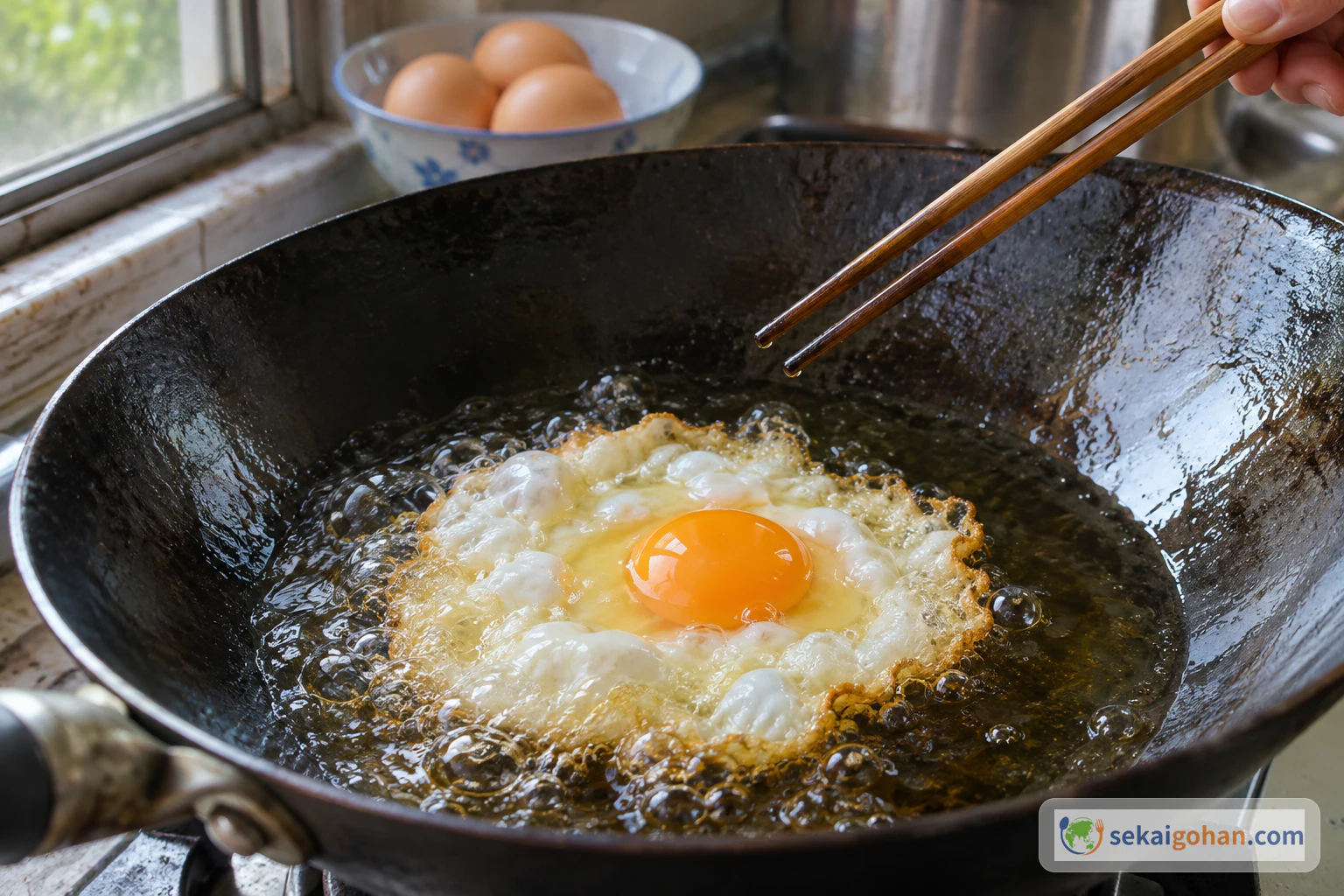
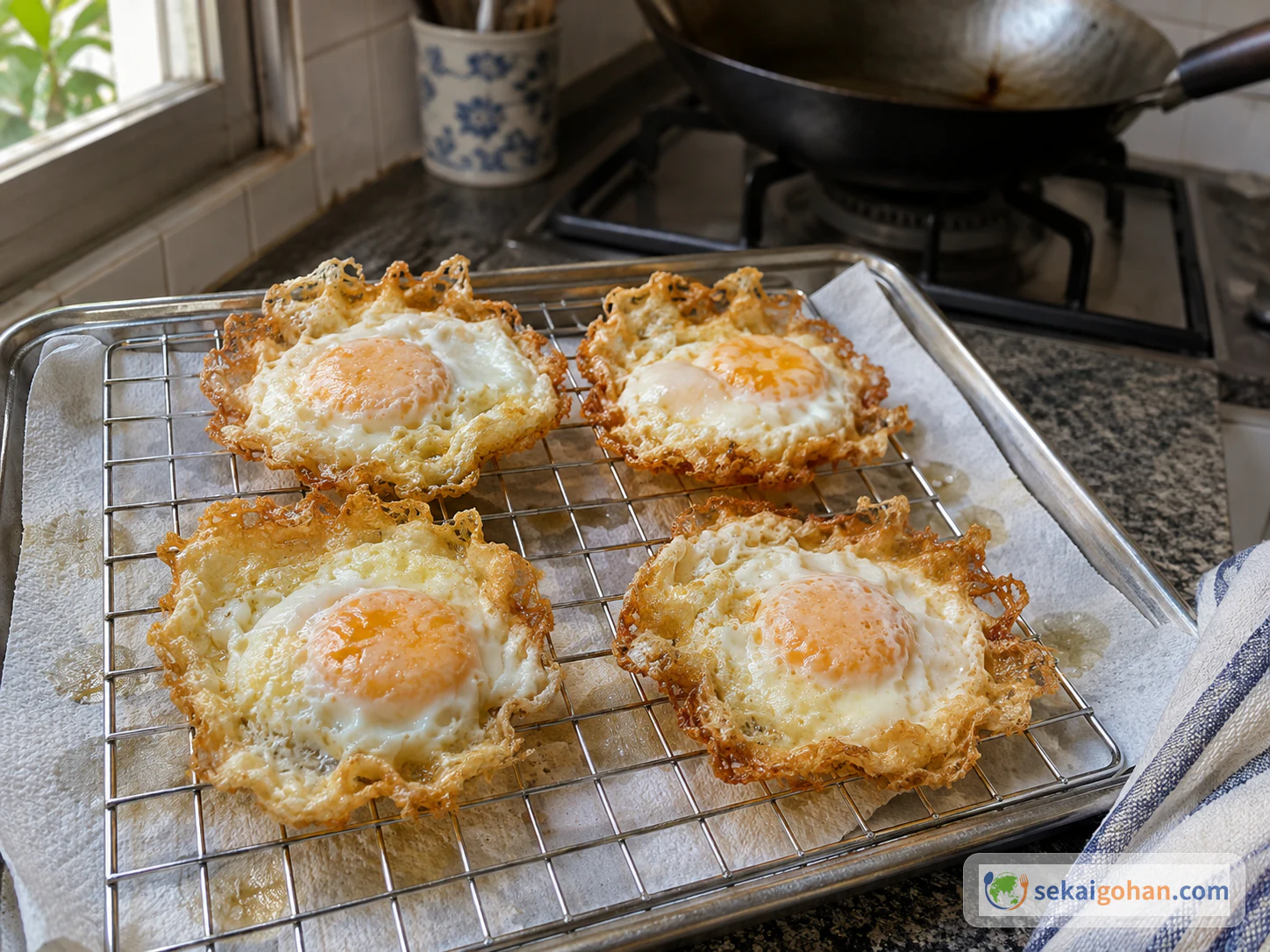
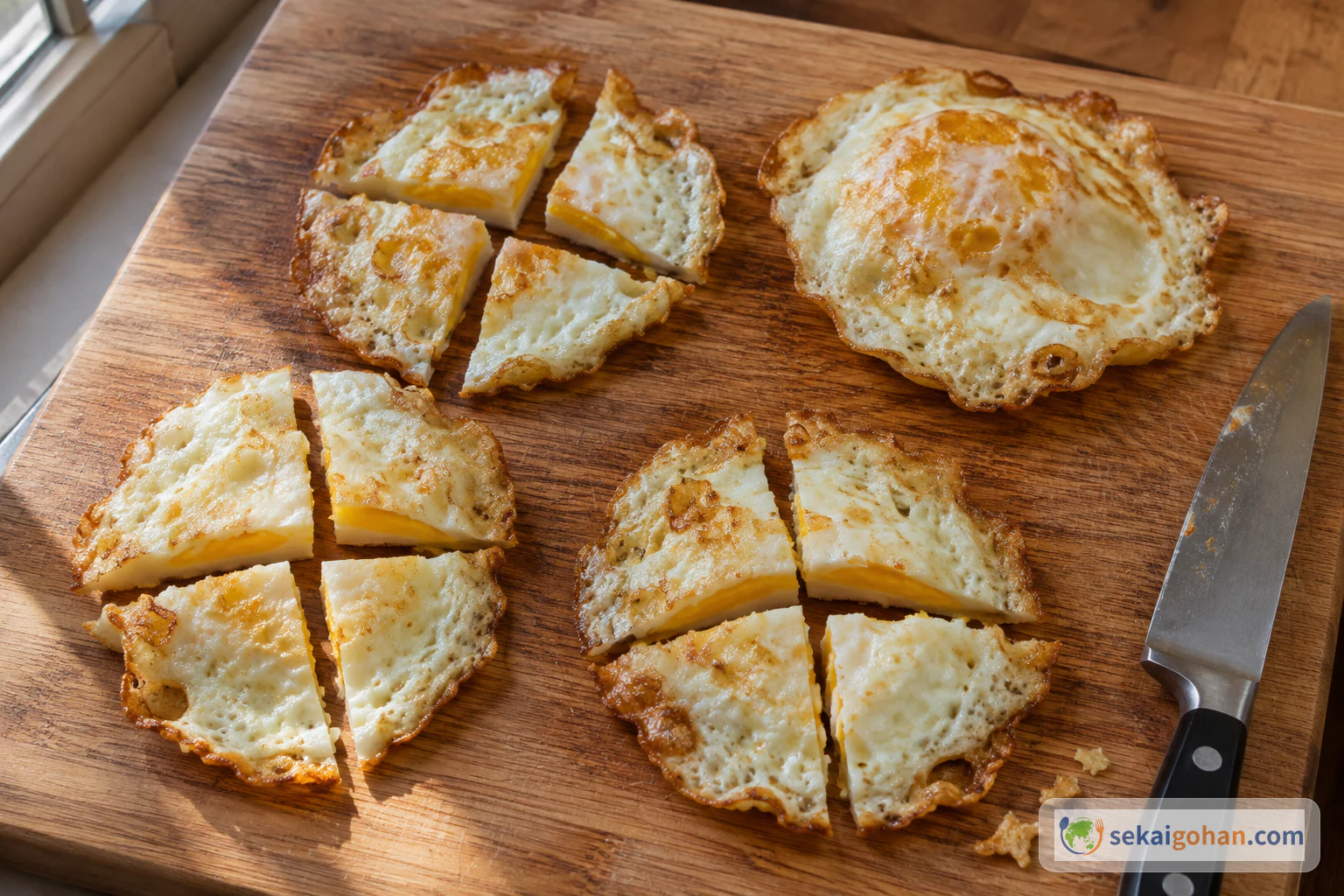
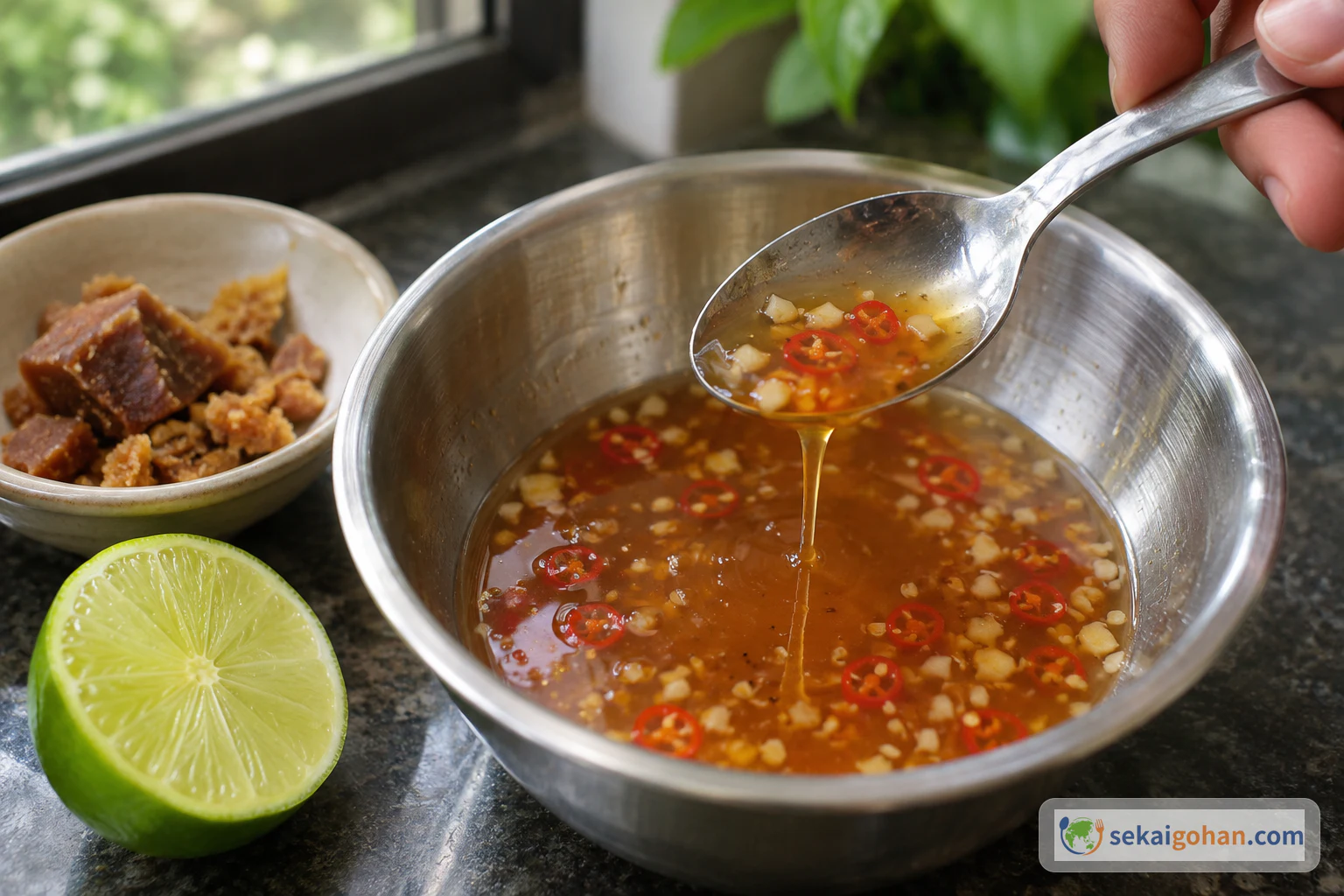
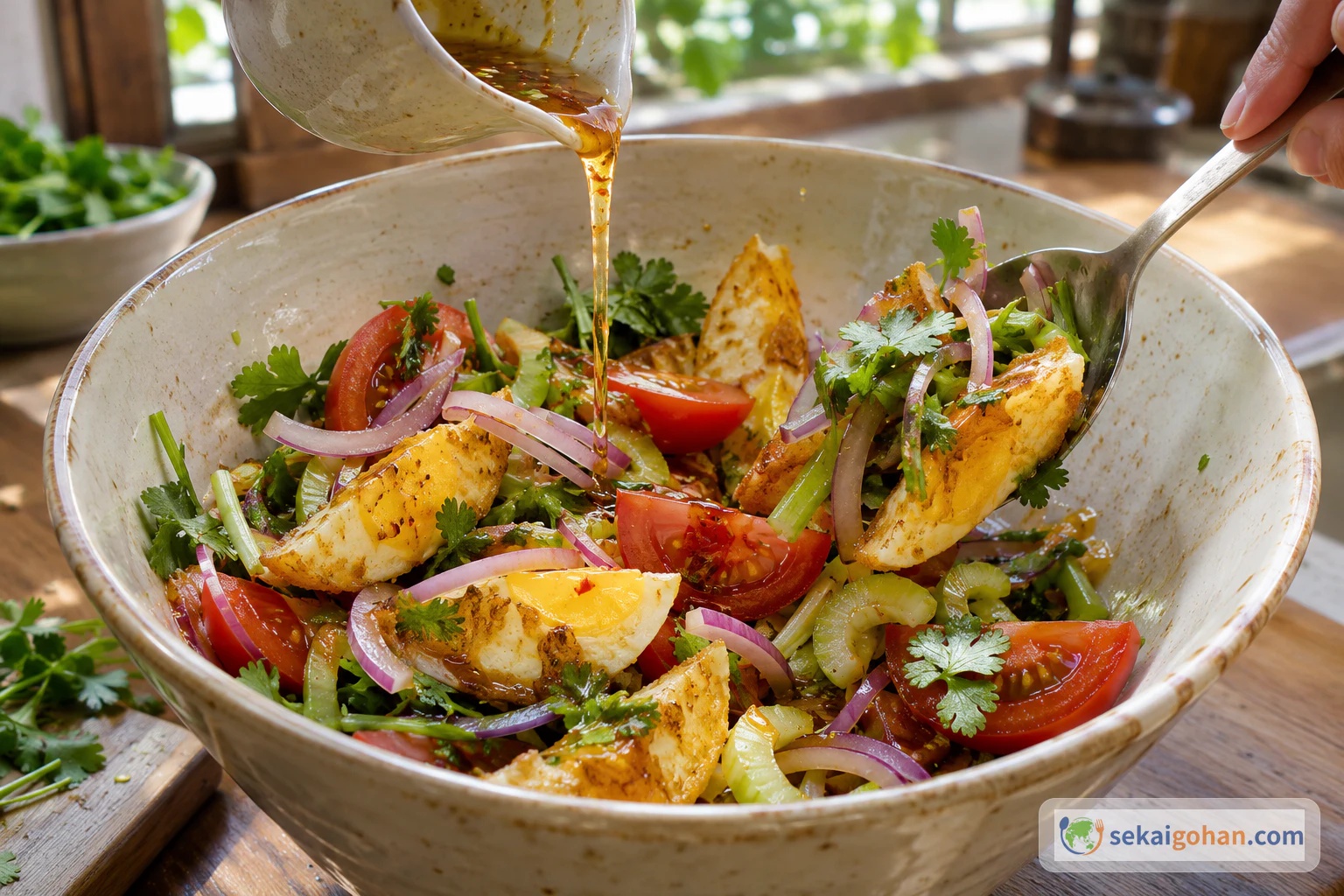
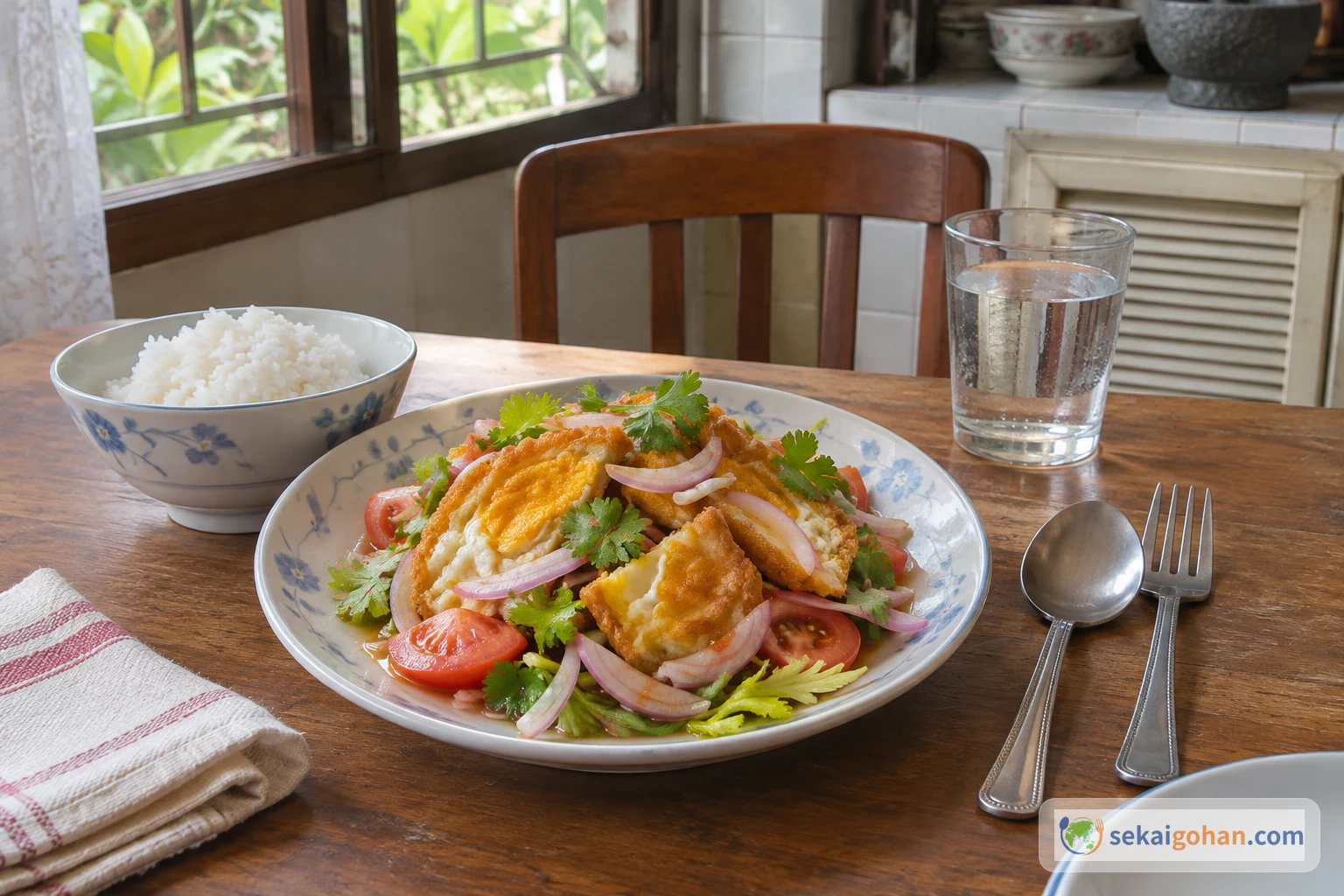
The egg slides into oil that is already shimmering, and the white erupts at once. It foams up around the yolk, the edges blister into a lacy frill, and within a minute they have turned golden and crisp. That egg, cut into wedges and tossed while still warm with lime juice, fish sauce, palm sugar, chili and garlic, becomes yam khai dao (ยำไข่ดาว), Thailand's fried egg salad. It is sour first, then salty and sweet, then hot, with raw red onion, tomato, cilantro and celery cutting through the richness of the fried egg. The cooking takes minutes. The one thing that decides the result is how you fry the egg.
An Egg Salad Built Around Crisp Fried Eggs
In Thai, yam (ยำ) is a salad tossed in a sour, spicy dressing, and khai dao (ไข่ดาว) is a fried egg. Together the name means fried egg salad, and in English it turns up as yam khai dao, yum khai dao or yum kai dao. Here the egg is the main ingredient. The vegetables are there to take on its fat and depth, and the sharp dressing keeps every bite bright.
Khai dao translates literally as "star egg." The name is usually explained by the way a Thai fried egg spreads in hot oil, its edges rippling outward like the points of a star.
A Thai fried egg is its own thing. It is fried in plenty of oil, so the white puffs up and the edges turn crisp and brown, and that crunch is what makes it good in a salad. Thai home cooks know several ways to fry an egg: the puffed, crisp style used here, a soft cloud-like egg, a poached-style egg, and the Western sunny-side egg. Only the first holds up to a dressing.
Where it sits on the table
Yam khai dao goes on the table as part of a meal, next to jasmine rice, curries and stir-fries, and everyone takes a little alongside everything else. It is not a starter eaten on its own before the main course. It is a familiar dish at khao gaeng (ข้าวแกง) shops, where rice comes with a choice of ready-cooked dishes ladled on or beside it, and at khao tom (ข้าวต้ม) shops serving rice soup. It is also eaten as kap klaem (กับแกล้ม), food that goes with drinks, where the chili and lime are welcome next to a cold glass. More of the country's cooking is gathered on the Thailand page.
Easy to mix up
Several Thai egg dishes sound close. Khai jiao (ไข่เจียว) is an omelet made from beaten eggs; here the eggs are fried whole. Son-in-law eggs (khai luk khoei, ไข่ลูกเขย) are boiled eggs, fried and coated in a sweet-tangy sauce. Meat salads such as larb follow the same tossed-salad idea with meat as the base. In dishes like stir-fried holy basil over rice, a fried egg sits on top; in yam khai dao, it is cut up and tossed. And it has nothing in common with a Western egg salad bound in mayonnaise.
Ingredients (serves 4)
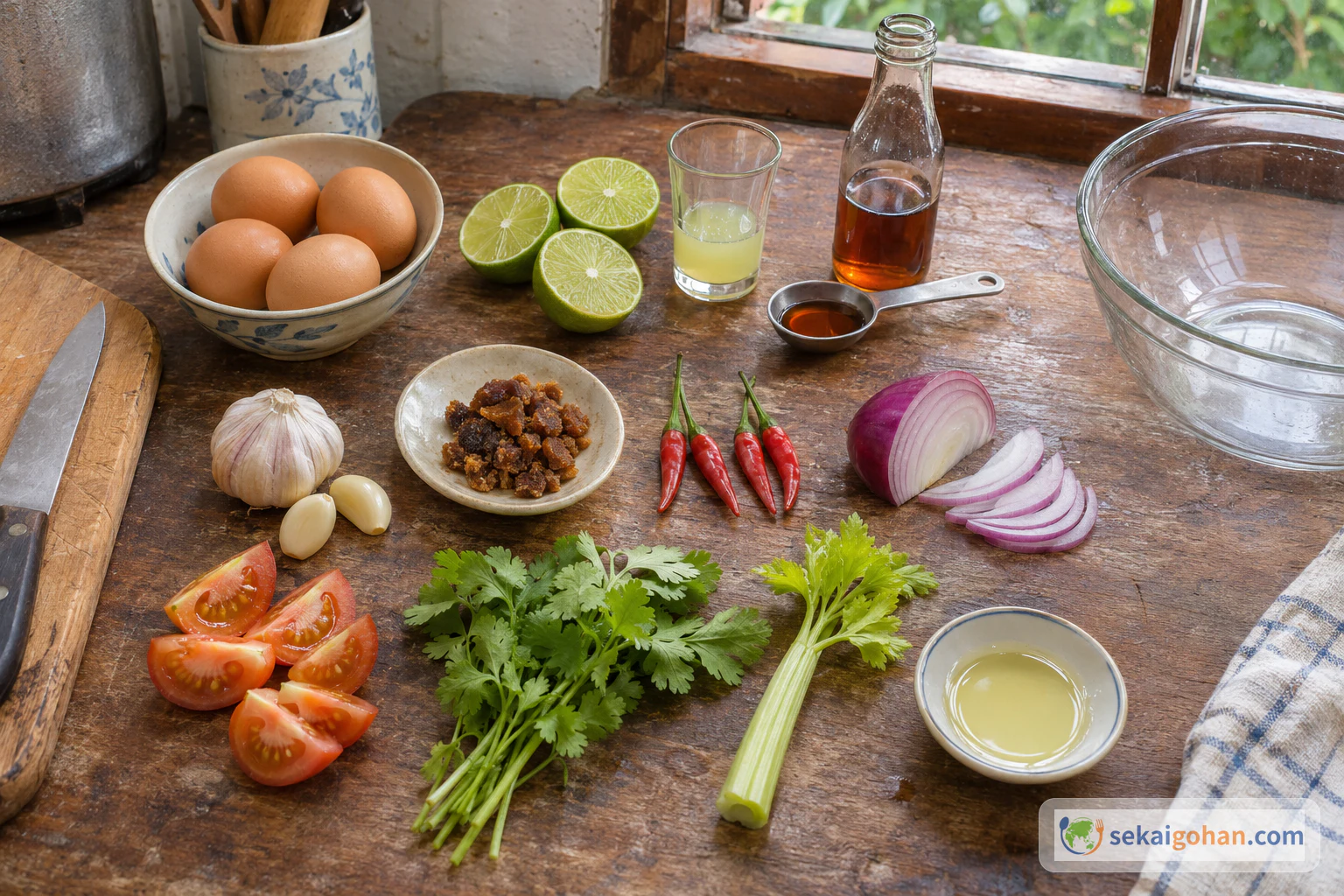
The dressing runs lime 3, fish sauce 2, palm sugar 2, measured in tablespoons. That balance is the taste of the dish, so measure it the first time and adjust only after you have tasted it.
Limes vary a lot in size and juiciness, so scrub the lime skins under running water, then squeeze and measure the juice. Use the celery leaves too; they carry much of the fragrance that Chinese celery would bring.
This dish contains egg and fish (fish sauce). If you fry in peanut oil, it also involves peanut. Check the labels on fish sauce and other bottled ingredients for soy, wheat and other allergens.
Equipment
- Wok or deep skillet, about 9½–10 inches (24–26 cm) across
- Long chopsticks or a long-handled slotted spatula
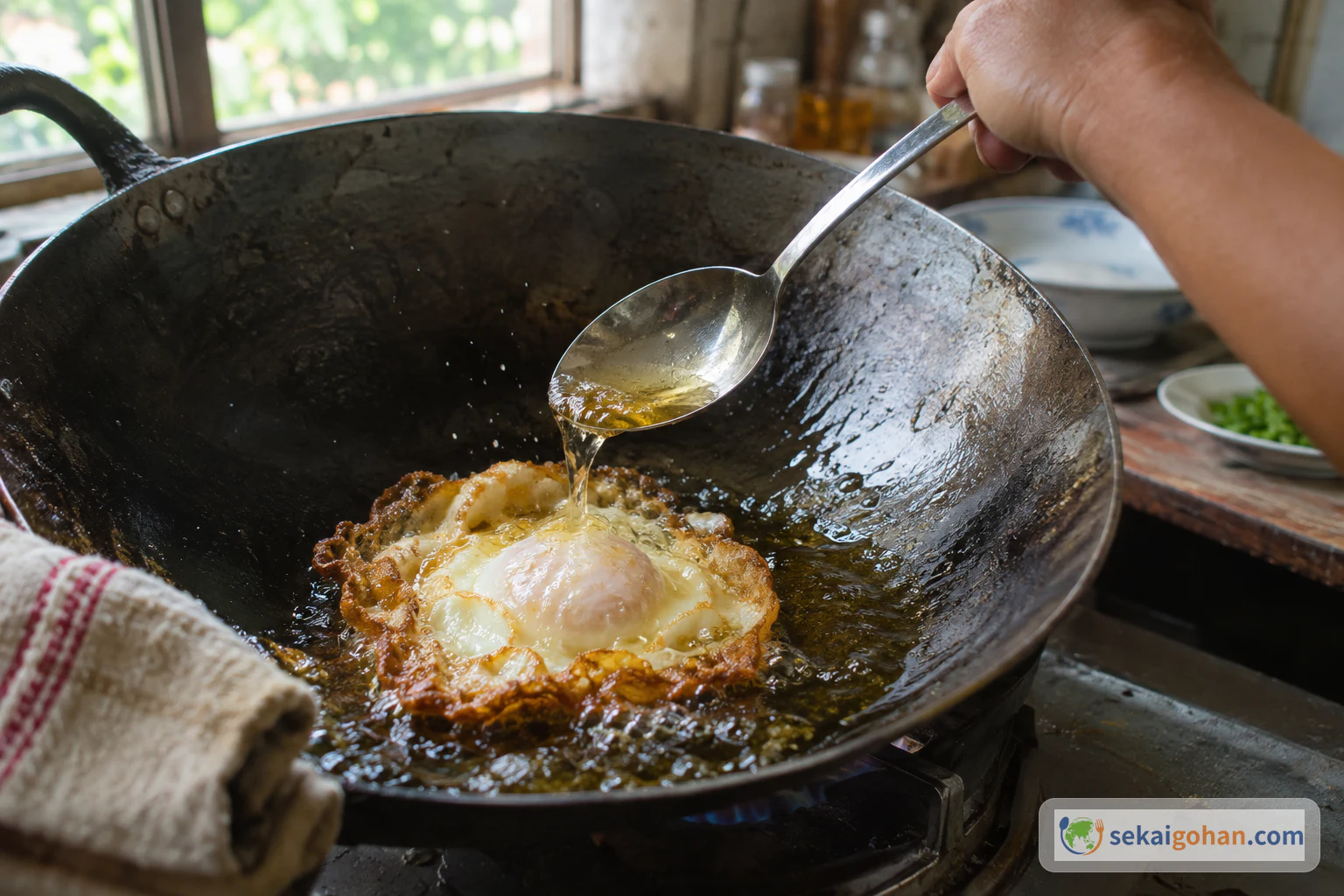
- Metal spoon for basting the yolk with oil
- Wire rack set over a tray, or paper towels
- Cutting board and sharp knife
- Small bowl for the dressing
- Large mixing bowl for tossing
Choosing and Substituting
Most of this list comes from an ordinary supermarket. The two things worth a trip to an Asian grocery or an online order are fish sauce, which nothing else replaces, and palm sugar, which is sold in hard discs or tubs that you chop or shave. Fresh bird's eye chilies are also worth finding; frozen or dried ones work too. Chinese celery, sold as kin chai or soup celery, has thinner stalks and a stronger scent than regular celery, and it is optional.
| If you can't find | Use | What changes |
|---|---|---|
| Fish sauce | Soy sauce with a little vinegar and salt, for anyone avoiding fish | The flavor moves far from the Thai version; season by taste |
| Palm sugar | Brown sugar | Sweetness changes at the same volume; taste the dressing and adjust |
| Bird's eye chilies | Cayenne or serrano chilies | A different kind of heat; seeding them makes it milder |
| Chinese celery | Regular celery with plenty of leaves, or fennel | A milder fragrance; the salad still works |
| Cilantro | Thai basil or mint | A different herb aroma entirely |
| Fresh lime | Bottled lime juice, then rice vinegar as a last resort | Bottled juice loses aroma; vinegar changes the character of the sourness |
| Red onion | White onion | Red is sharper and gives better color |
| Jasmine rice | Plain white rice | The rice loses its floral fragrance |
Keep fresh lime, fish sauce and the crisp-fried egg, and the salad tastes Thai. The kind of celery, sugar and onion can bend to what your shop has.
Method
Cut all the vegetables and aromatics before any oil goes on the stove, because the frying moves fast and the salad should be tossed the moment the eggs are ready. The eggs fry one at a time in the same oil. Mix the dressing while the last egg drains, then toss and serve right away.
Half a cup of oil at near-smoking heat spatters hard when wet egg hits it. Keep your face back, use long chopsticks, make sure no water gets into the pan, turn on the vent or open a window, and keep children away from the stove.
The egg edges are at their crispest in the first minutes after tossing. Have everyone at the table before the dressing goes on.
Buy fresh eggs and keep them refrigerated. Crack each egg only when you are about to cook it, and never crack eggs ahead and leave them standing. Cook eggs through to the center; unpasteurized eggs should reach 158°F (70°C) in every part, which matters most for older adults, infants and young children, pregnant women and anyone with a weakened immune system. A soft yolk is a personal choice; for those diners, baste until the yolk is fully set. Wash your hands and any tools that touched raw egg each time.
When It Goes Wrong
| What you see | Why | What to do |
|---|---|---|
| The egg stays flat and comes out oily | The oil was not hot enough | Heat until it shimmers just short of smoking, and test with a drop of egg white first |
| The edge burns while the yolk is still raw | The oil is too hot, or the egg sat too long without basting | Turn the heat down to medium and set the yolk by spooning oil over it |
| The dressing feels gritty | The palm sugar has not dissolved | Chop it finer and keep stirring until the spoon comes out smooth |
| The salad turns watery | Tomato juices pooled while the dressed salad sat | Toss only just before eating |
| It is too hot | Too many chilies, or the seeds went in | Next time seed them and use one; now, add a little sugar to the dressing |
| The egg breaks into crumbs | Wedges were cut too small or tossed too long | Stick to four wedges per egg and toss with a few broad turns |
Serving, Variations and Storage
At the table
Serve it with steamed jasmine rice, alongside a curry or a stir-fry, and let everyone take a little with each mouthful of rice. The sour, salty dressing soaks into the rice and the crisp egg breaks up the softer dishes around it. With a cold drink, a plate of it on its own works as a snack.
Variations
- Ground pork. Many Thai home cooks stir-fry ground pork and fold it into the salad, which turns it into a fuller main dish. The pork needs a bigger batch of dressing, so treat it as a different recipe rather than adding meat to this one.
- Pickled garlic brine. A splash of the liquid from a jar of pickled garlic in the dressing adds sourness and a fermented depth.
- On lettuce. Spread romaine or little gem leaves on the plate and spoon the salad over them; the leaves catch the juices and give you something crisp to wrap with.
- Peanuts or fried shallots. Scattered on top just before serving, they add another layer of crunch and a roasted note.
Storage
Yam khai dao is best eaten the day you make it. If there are leftovers, store the eggs separately from the vegetables and dressing in the refrigerator and eat them by the next day. Do not freeze. Warm the eggs in a skillet for about 30 seconds to bring back the crisp edge, then toss them with the vegetables and dressing just before eating.
Frequently asked questions
How do I make half the amount?
Halve everything: 2 eggs, half a garlic clove, 1½ tbsp lime juice, 1 tbsp palm sugar, 1 tbsp fish sauce and half of each vegetable. Keep the chili count between half a chili and two, to taste. Use the full amount of oil, since the egg needs depth to puff.
Can I fry the eggs in less oil?
Yes. A few tablespoons of oil in the pan still gives you crisp, brown edges. The white puffs up less, so the egg turns out flatter and denser, but it still holds up to the dressing.
What can someone who can't eat fish use instead of fish sauce?
Soy sauce with a little vinegar and a pinch of salt gives the salty, sour backbone the dressing needs. The result tastes noticeably different from the Thai version, so add it a little at a time and taste. Check the soy sauce label for wheat and soy if allergies are involved.