
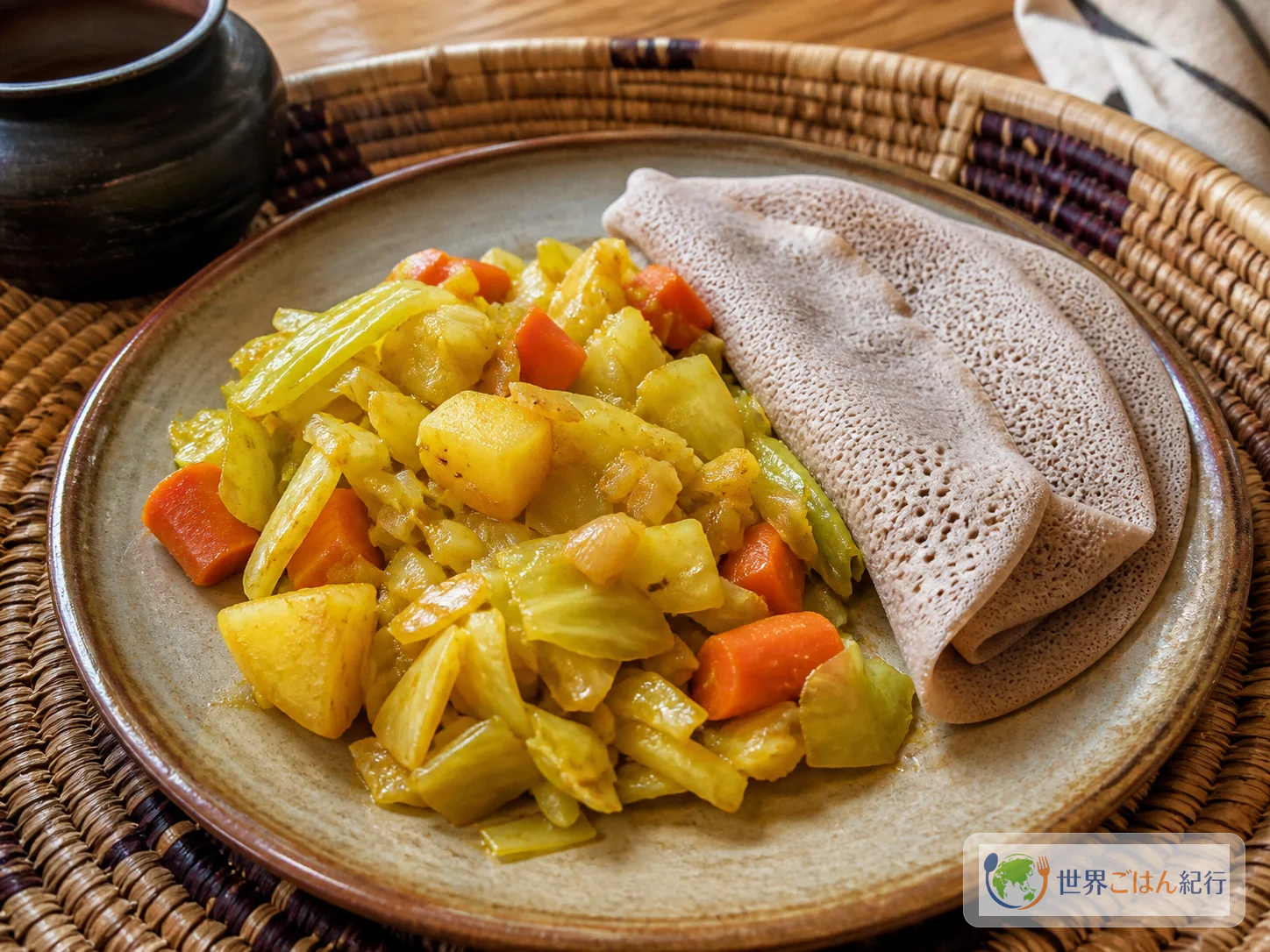
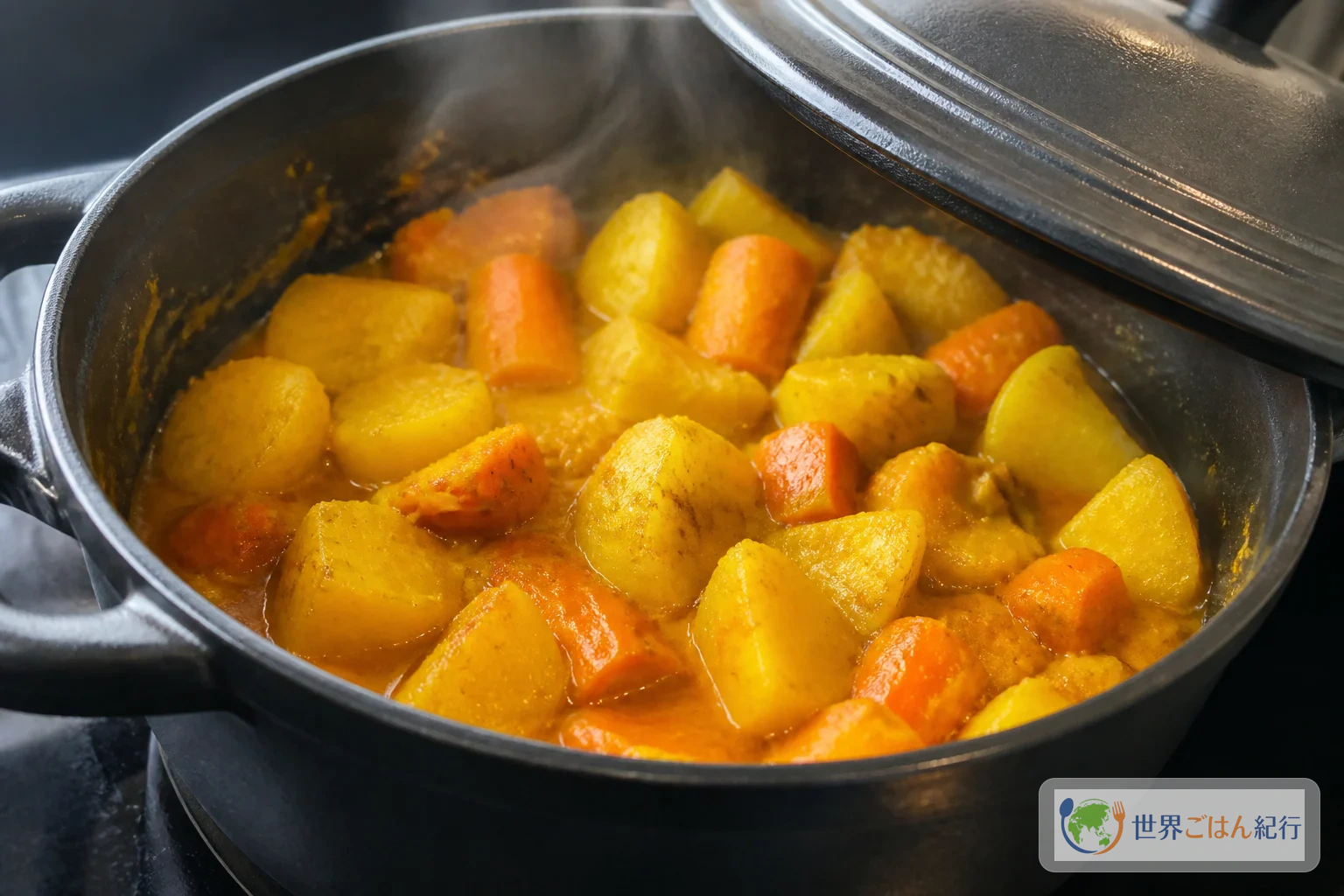
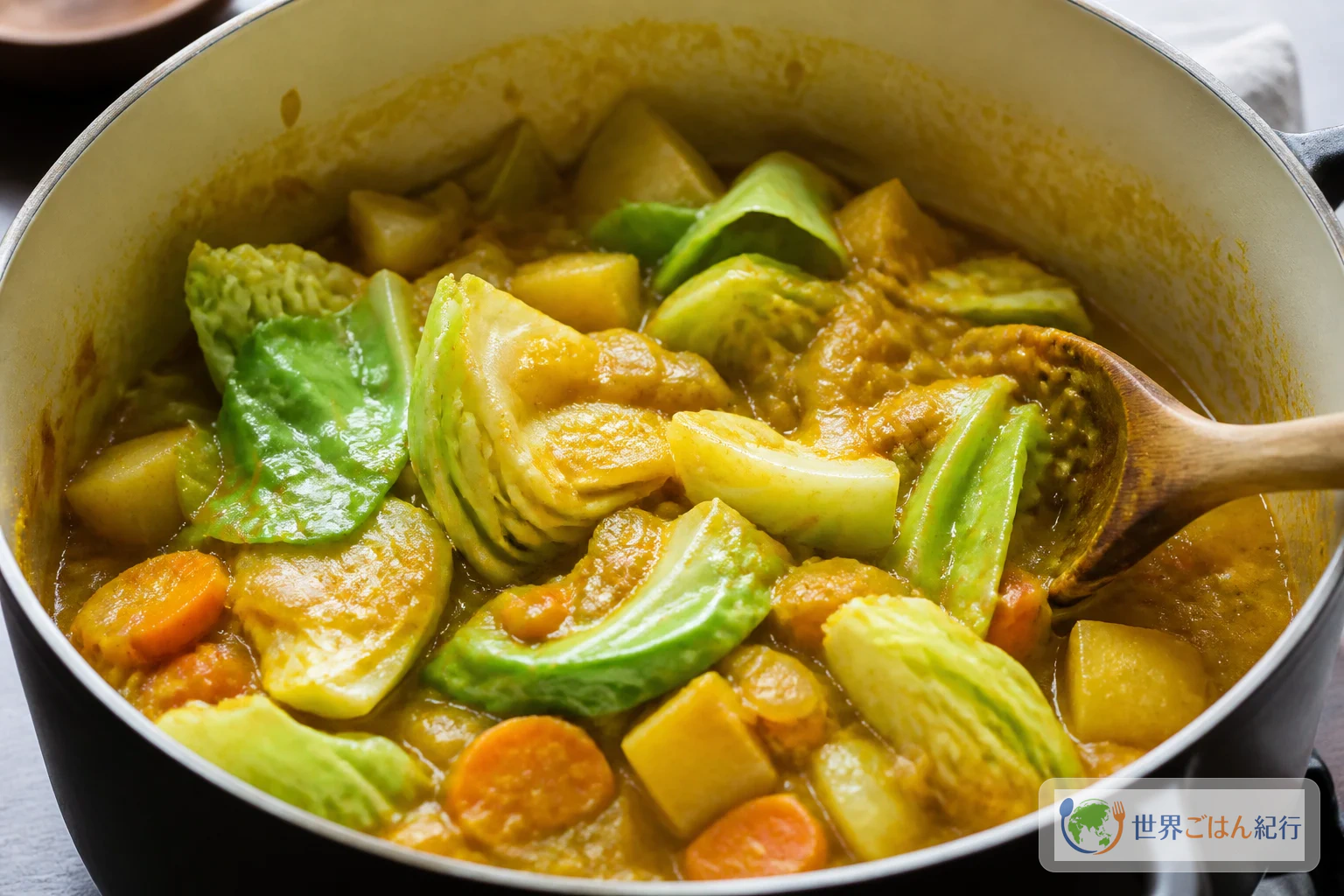
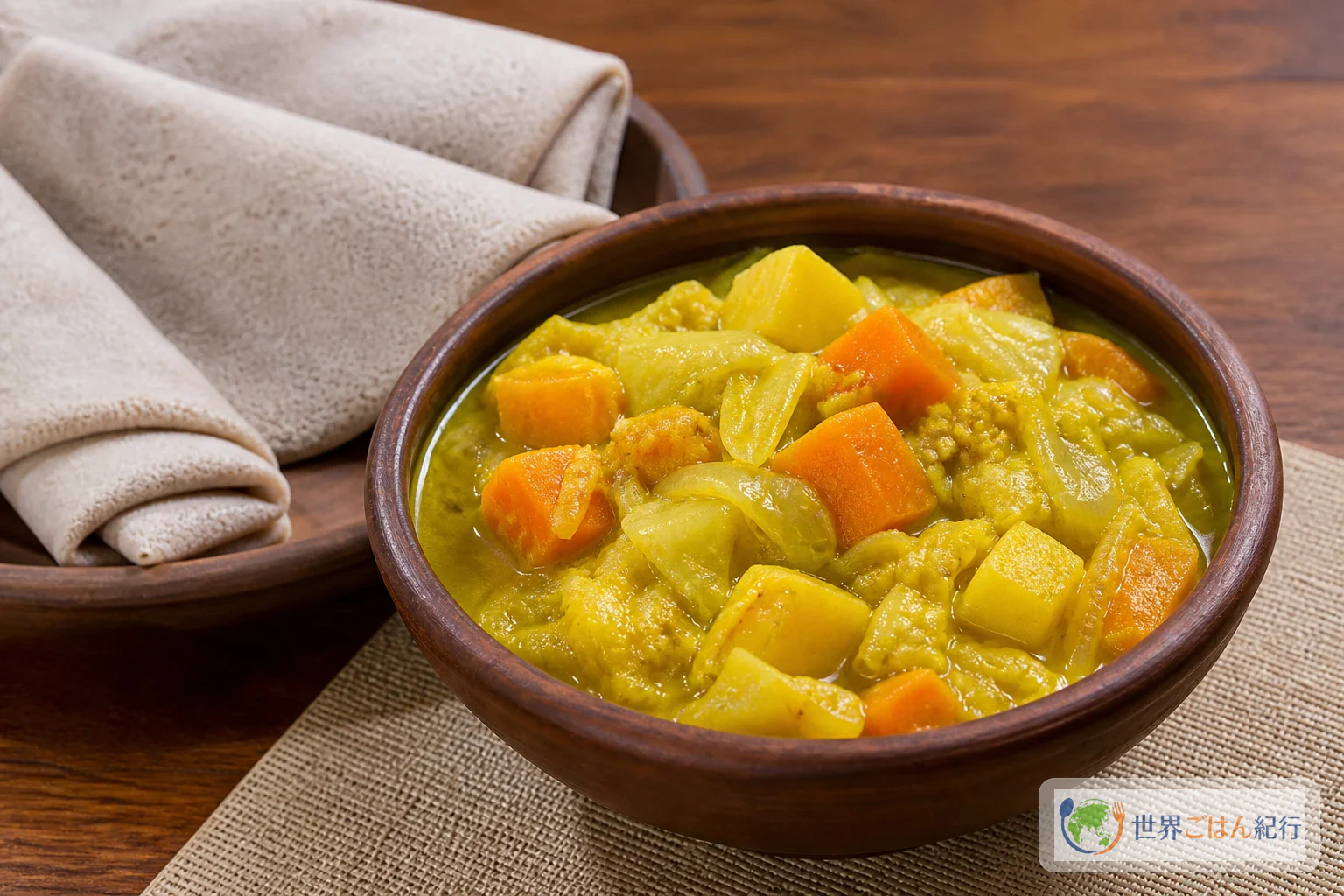
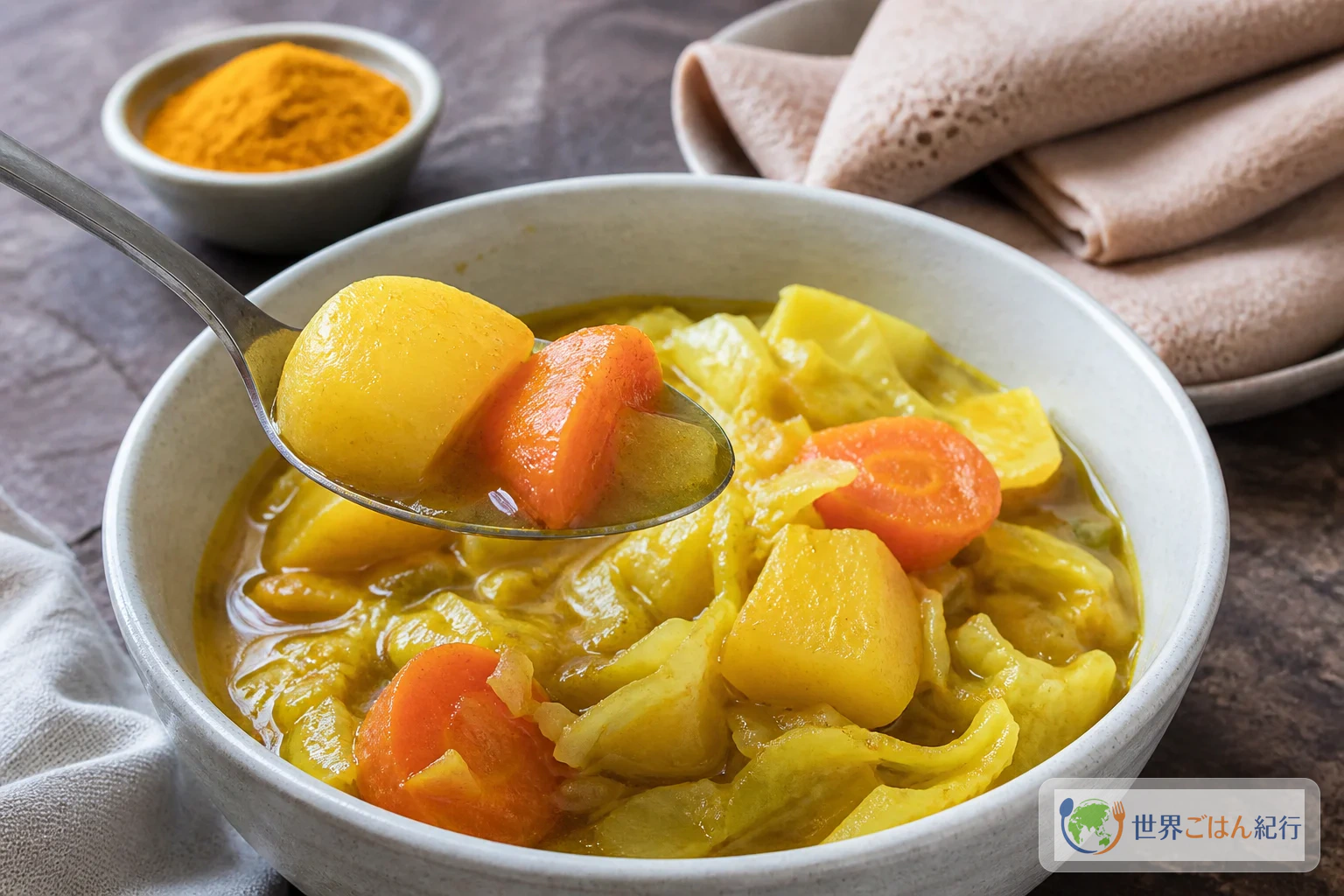
Lift the lid of the pot and the yellow of turmeric lies over the oil in which onions were cooked, and the sweet steam of cabbage rises from between the potatoes and carrots. It is not a stew that pushes heat forward; it is a dish that brings the moisture of the vegetables and the spices together in one pot.
Gathering Around a Yellow Vegetable Stew at an Ethiopian Table
Atakilt wat (Atakilt Wat / Atkilt Wot) is an Ethiopian vegetable dish in which cabbage, potatoes, carrots and others are cooked with onion and spices. The Amharic dish name has variations in spelling, and depending on the source it is written Atakilt Wat, Atkilt Wat, Atkilt Wot and so on. In this article I use "Atakilt Wat," which is easy to search for, as the main spelling.
At an Ethiopian table, wat is served on top of injera, and you tear the injera by hand to scoop up the stew. Fitted to the way of eating around one plate, atakilt is useful less as a stand-alone main than as a gentle dish alongside bean dishes, greens and meat stews. So you do not need to cook the liquid off completely. It is ready to eat when the yellow sauce thinly clings to the vegetables to a degree that the injera can catch it.
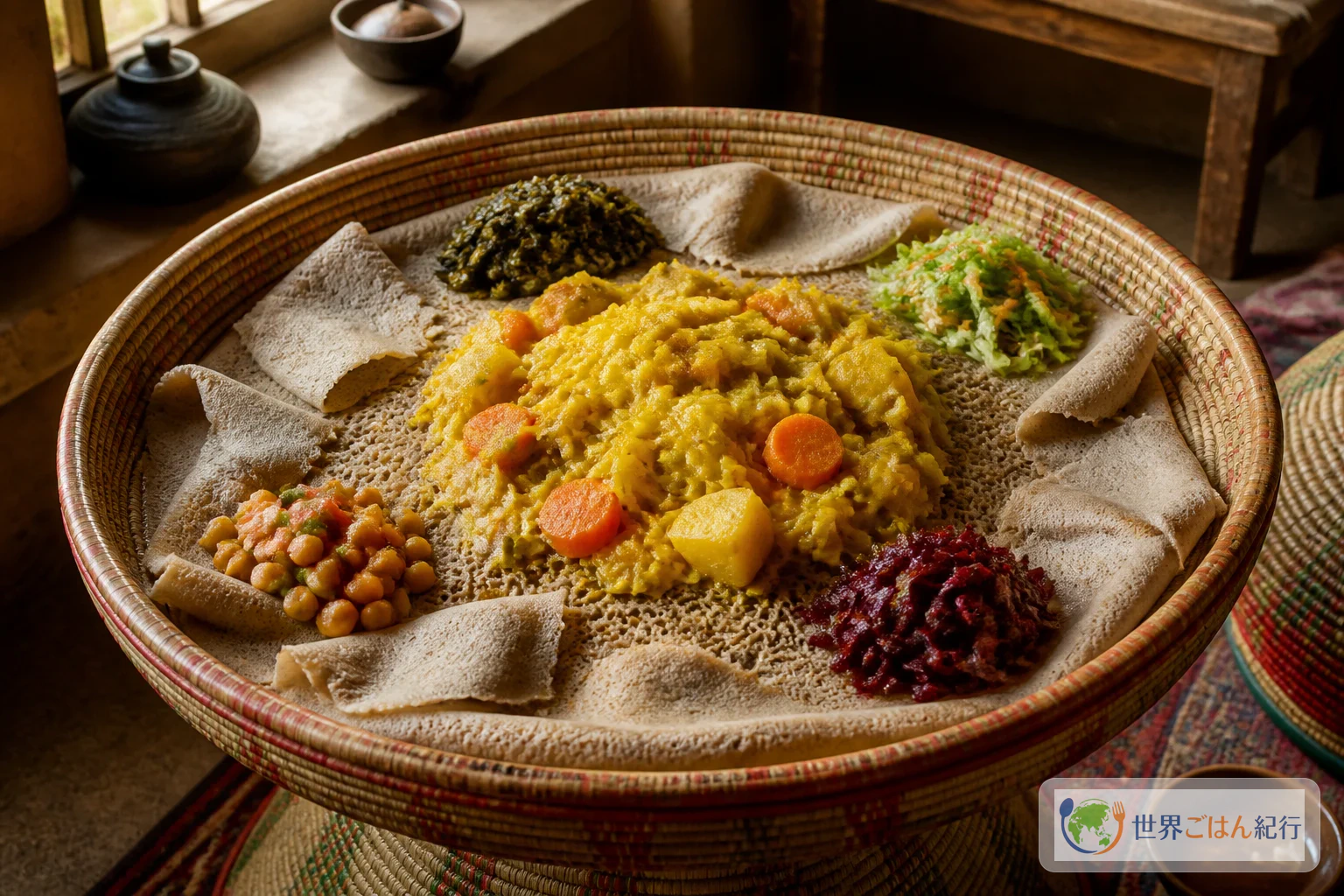
Depending on the source, atkilt wat may refer broadly to vegetable dishes. There are also examples of calling a stew of potatoes and carrots by a more specific alternative name, so even if the ingredients are slightly different at a restaurant or in a household, it is not necessarily a different dish.
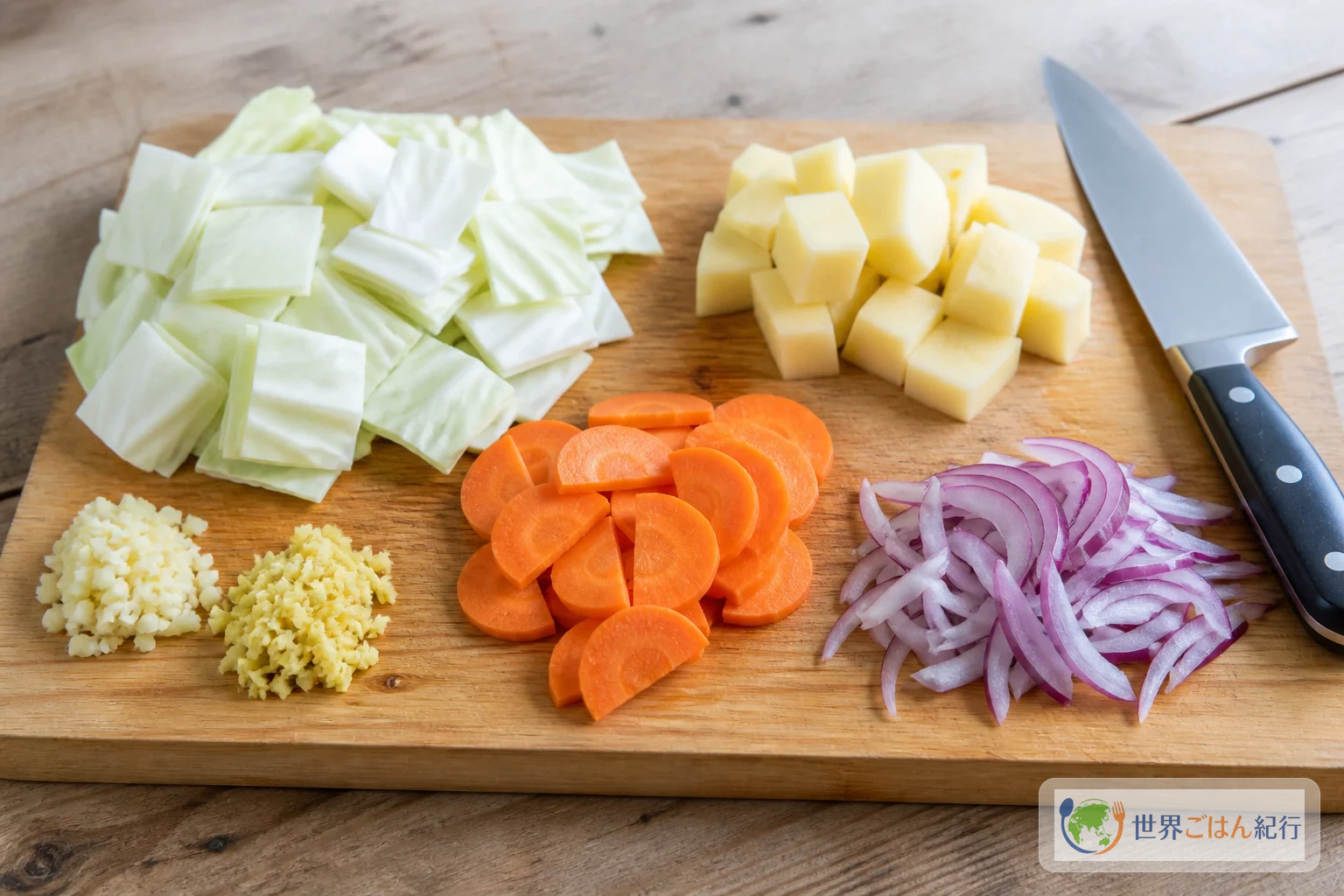
Ingredients (serves 4)
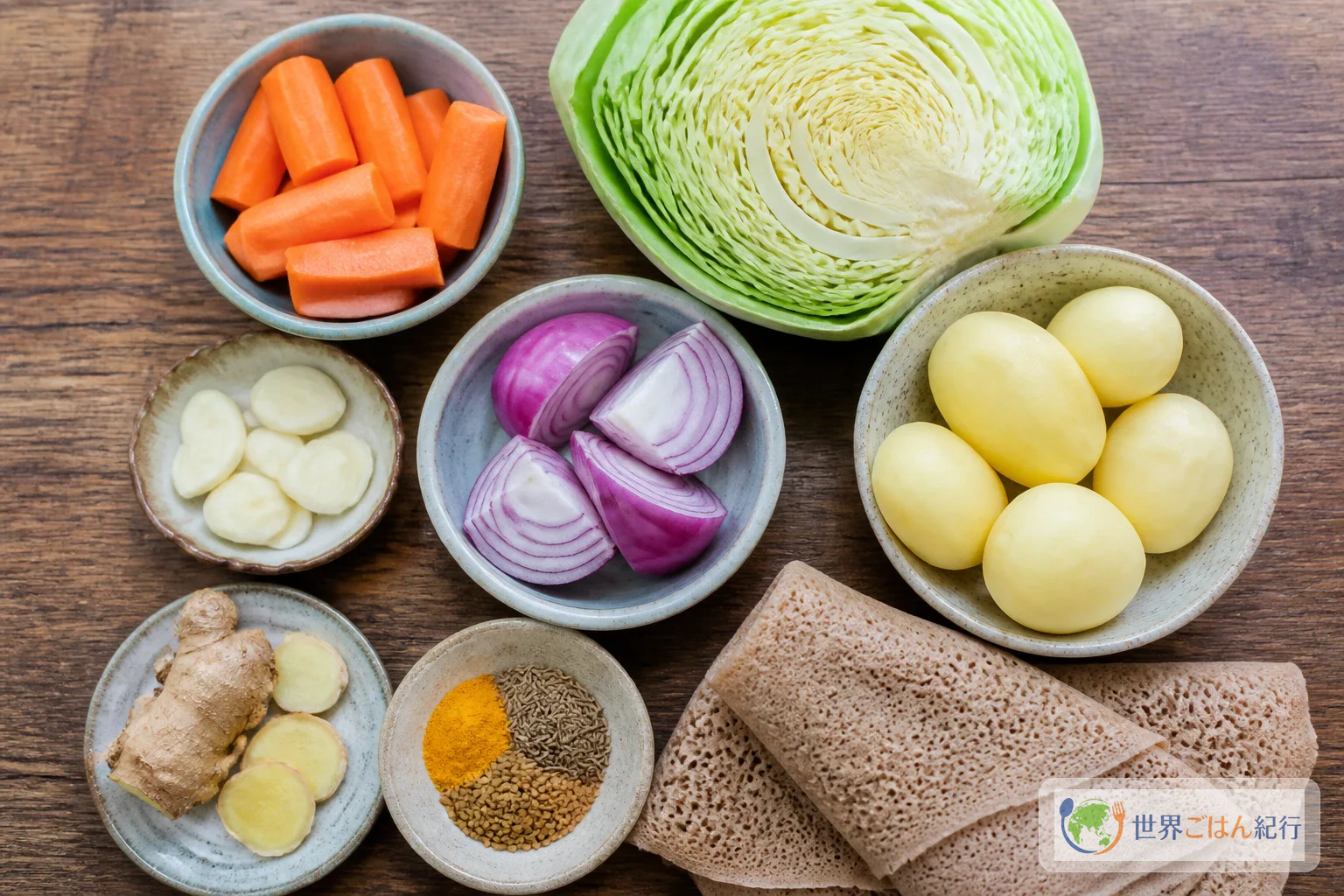
Red onion, oil, turmeric, cabbage, potatoes and carrots can be gathered at an ordinary supermarket. What is worth seeking out is injera itself and whole fenugreek, which creates the niter kibbeh-style aroma. On the other hand, spicy berbere is not an essential ingredient of this dish. After you have confirmed the gentle outline of atakilt, adding a little at the table does not hide the sweetness of the vegetables.
Fenugreek is used at only 1/2 tsp, so if you will make the oil-based version just once, you can choose not to buy it. If you will go on to make doro wat, berbere and niter kibbeh-style seasoned oil, choose whole seeds and check the package size and the condition of the seeds before you prepare.
Injera greatly changes the impression of the table, because the sourness of fermentation and its fine holes catch the dish. But you do not have to buy teff flour and start fermenting from the first time. You can choose, in the order of store-bought injera, thin bread with some sourness and white rice, by the time in your kitchen and what is available.
Method: Root Vegetables First, Cabbage Later
Steam-simmer the potatoes and carrots first, and add the cabbage last. In this order you avoid the situation where only the cabbage falls apart while the root vegetables stay hard. A lidded pot about 24 cm across and deep is easiest to use, and lets you stir without piling up the ingredients.
Cooking Tips: Do Not Scorch the Yellow Oil, and Cook in the Vegetables' Own Moisture
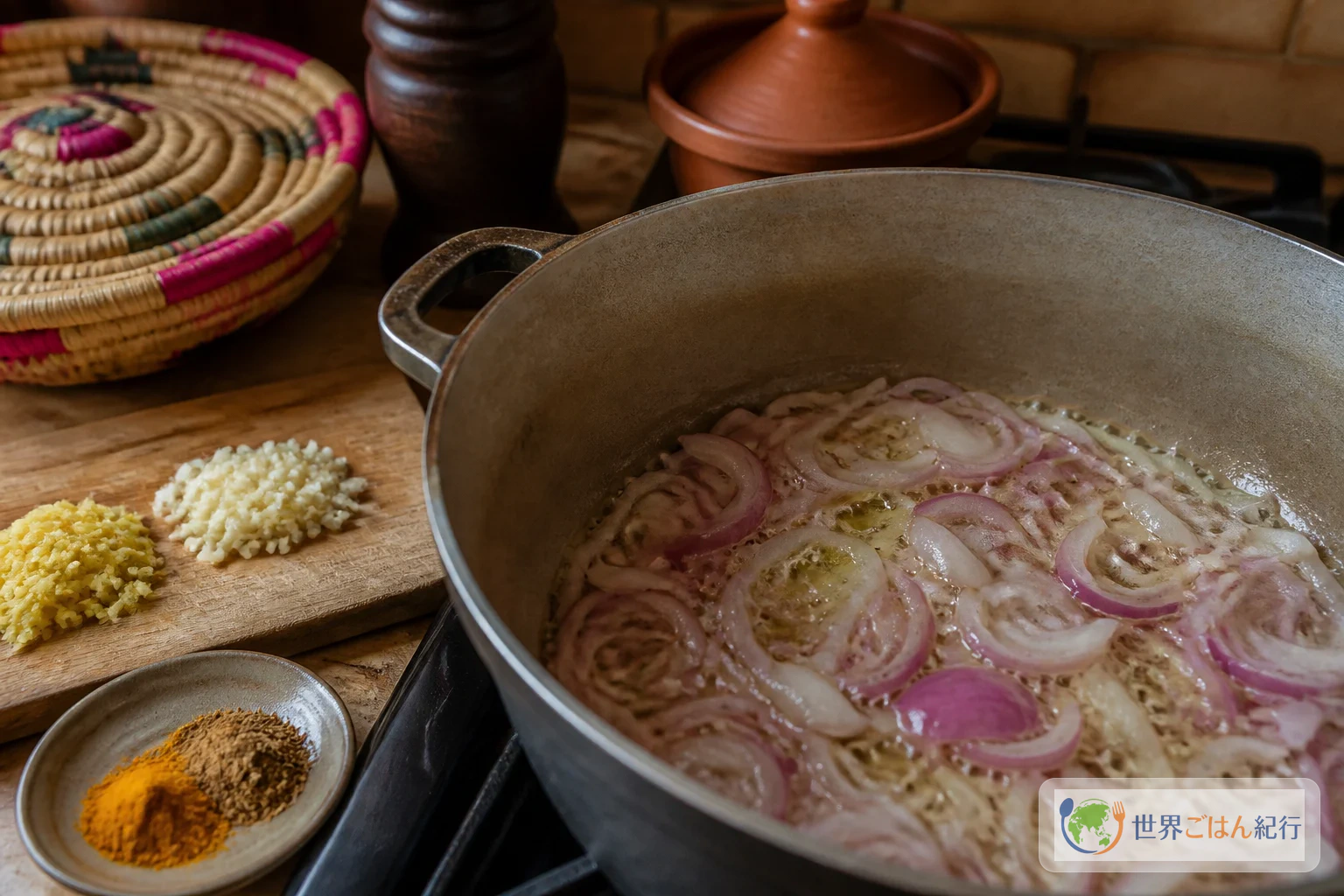
Do not brown the onion
Coloring the red onion dark gives savoriness, but bitterness comes forward over the gentle aroma of turmeric. Sauté for 10 minutes over low heat until it is translucent and moisture remains at the bottom of the pot, and if it looks about to scorch lower the heat a notch. This onion holds a little water and becomes the core of the sauce that carries flavor to the vegetables.
Water only enough to protect the bottom of the pot
Atakilt wat is not a dish that floats the vegetables in plenty of soup. The first 120 ml is the amount to make steam and soften the potatoes and carrots. Cabbage also gives off water, so on days you use spring cabbage or vegetables just washed, reduce the first water to 100 ml and see how it goes.
Do not confuse the oil-based version with the niter kibbeh style
Made with vegetable oil, it can be placed on a table with no meat, dairy or egg. The version using niter kibbeh is a rich finish in which spices are infused into clarified butter. Choose not by which is better in taste but by whether you want a dish for fasting or a festive dish with layered aroma.
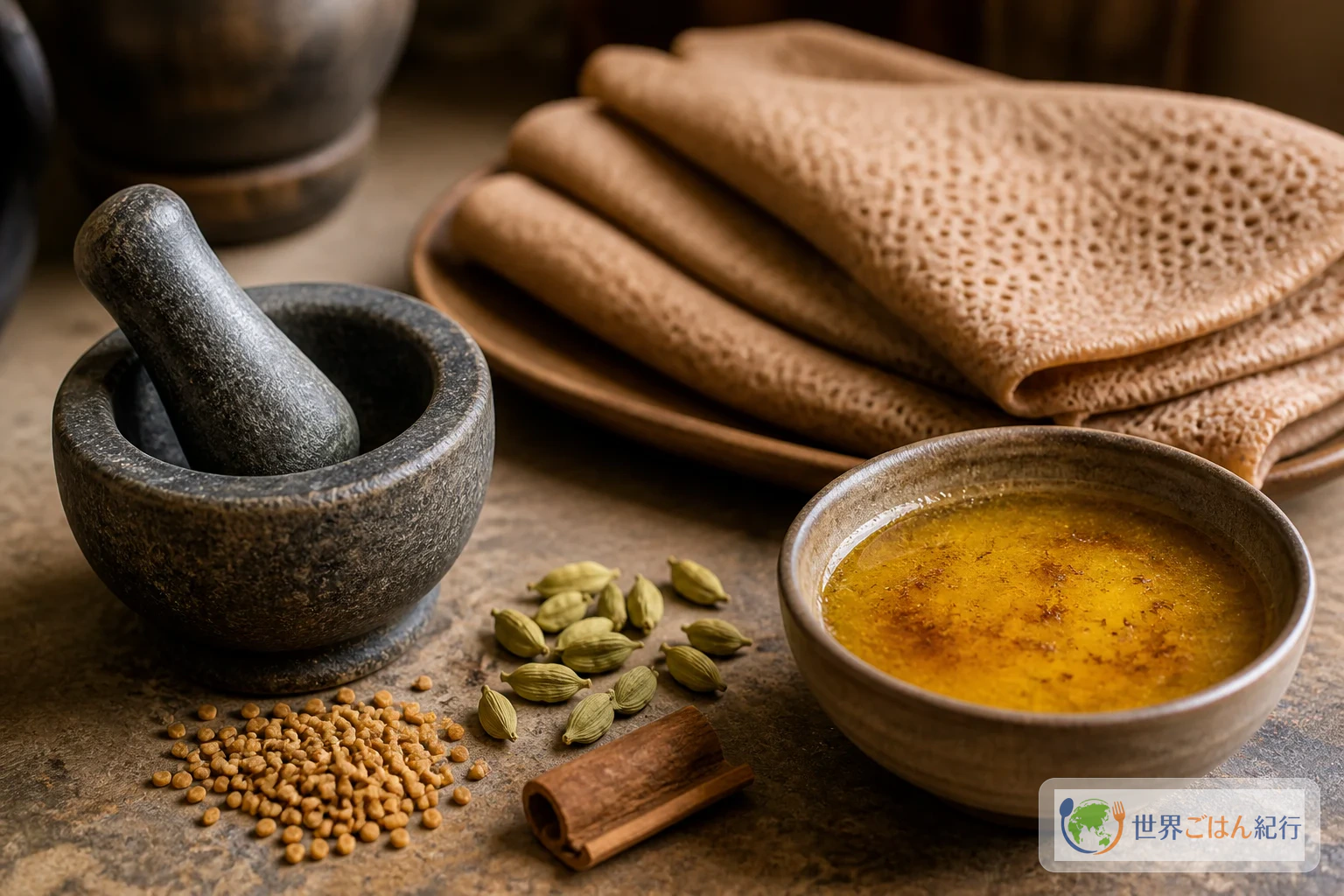
If you make the niter kibbeh-style aroma yourself by crushing small amounts of whole fenugreek, cardamom and cinnamon, a mortar is useful. But it is not needed by someone who buys fenugreek powdered and will make the oil-based version just once. If you buy one, check the stone, the bowl's diameter and what comes with the pestle, and decide whether you will also use it for berbere and other spice dishes later.
If you burn turmeric or cumin in the oil, the bitterness does not go away even if you add water. Before it turns black, add 1 tbsp water to lower the temperature and scrape the bottom of the pot with a wooden spatula. If smoke has already come out, it is safer to discard the bitter oil and start again from the onion.
Where to Change a Local Vegetable Dish in a Home Kitchen
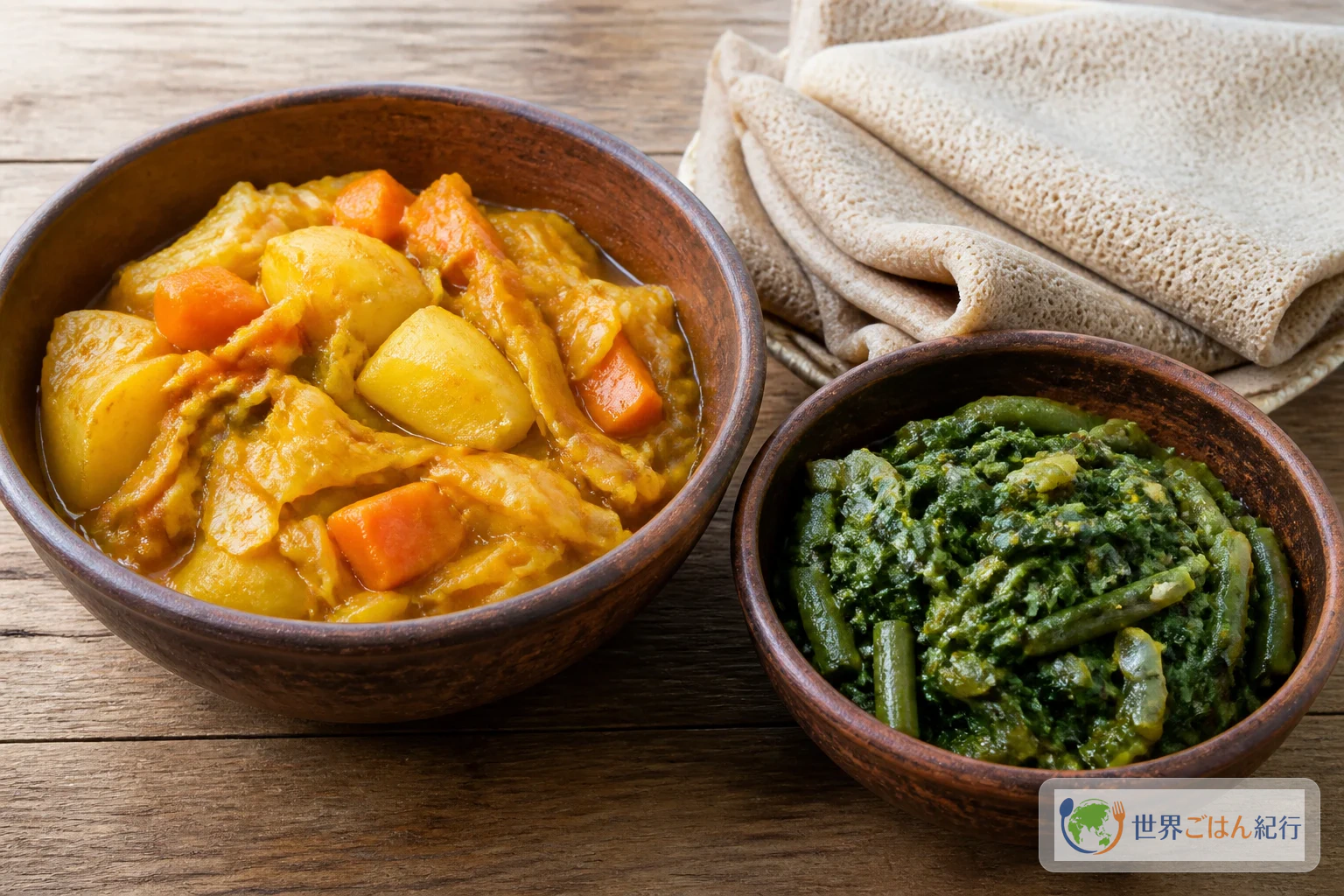
When putting together the same plate elsewhere, there is no need to replace every ingredient with imports. The combination of cabbage, potatoes and carrots makes it easy to compare the sweetness of the vegetables and the difference in how they break down, and suits a first reproduction. What is worth changing is not the heat of the spices but how the table receives it.
- The oil-based version for fasting: Use vegetable oil, and add no butter or meat or poultry stock. Easy to put on the same large plate as bean and green dishes.
- The rich version with niter kibbeh: Replace the oil with the same amount of niter kibbeh and keep fenugreek to 1/2 tsp. Increasing it because you want a stronger aroma lets the bitterness win.
- A home version with heat added: Add only 1/4 tsp berbere together with the spices. If someone in the family wants to separate the heat, add to individual dishes after it is done. You can check the blend in how to make berbere.
- A version with greens: Add 100 g green beans, or 80 g greens with the hard stems removed, at the same time as the cabbage. For thin-leaved greens, add them 3 minutes before turning off the heat.
- Replacing the staple: If you have no injera, use thin bread with some sourness, naan or white rice. But the sourness of injera and the texture of scooping sauce by hand are different, so do not think of the substitute as "the same."
Turmeric can be bought at a supermarket, but choosing by package size you can use up, the fineness of the powder and the ingredient label makes it easy to use for dishes other than atakilt. If you already have turmeric at home and are not unhappy with the aroma, there is no need to buy more.
Background of the Dish: Wat Is Not a Single Fixed Recipe
If you understand Ethiopian cooking only through one pattern of a national dish, you miss the breadth of the name atakilt wat. Culinary training material from the Ethiopian Ministry of Labor and Skills explains the basics of wat as a flow that begins with red onion and is made with niter kibbeh or vegetable oil. The same material separates berbere as the aroma of the spicy stews and turmeric as the aroma of the mild alicha, and also shows cases where neither is put into the vegetable stew atakilt wat.
What this tells us is that berbere is not essential in atakilt wat. Rather than imagining a red, spicy sauce and buying extras, preparing onion, oil, turmeric and vegetables and starting from a yellow, gentle plate gets closer to the core of the dish name. The material also has examples that use potatoes, carrots and greens in plant-based dishes. It also records examples that use atkiltwat broadly for vegetable dishes in general and call a stew of potatoes and carrots by a more specific name. Rather than deciding regional differences as fixed recipes by state, it is more accurate to read it as a dish whose ingredients and names move among households and restaurants.
Ethiopian Orthodox fasting also bears on the context of the table. According to the Ethiopian Orthodox Church's explanation, there are several fasting periods in the year, and during fasting people abstain from meat, milk, butter and eggs. Not everyone keeps the same rule for the same number of days, and the church's explanation also notes exemptions and individual differences, but here we can see the background in which wat made with vegetable oil supports a table. Treating oil-based atakilt not just as a "light substitute dish" but building it as a plant-based dish standing alongside beans and greens changes the dish's standing.
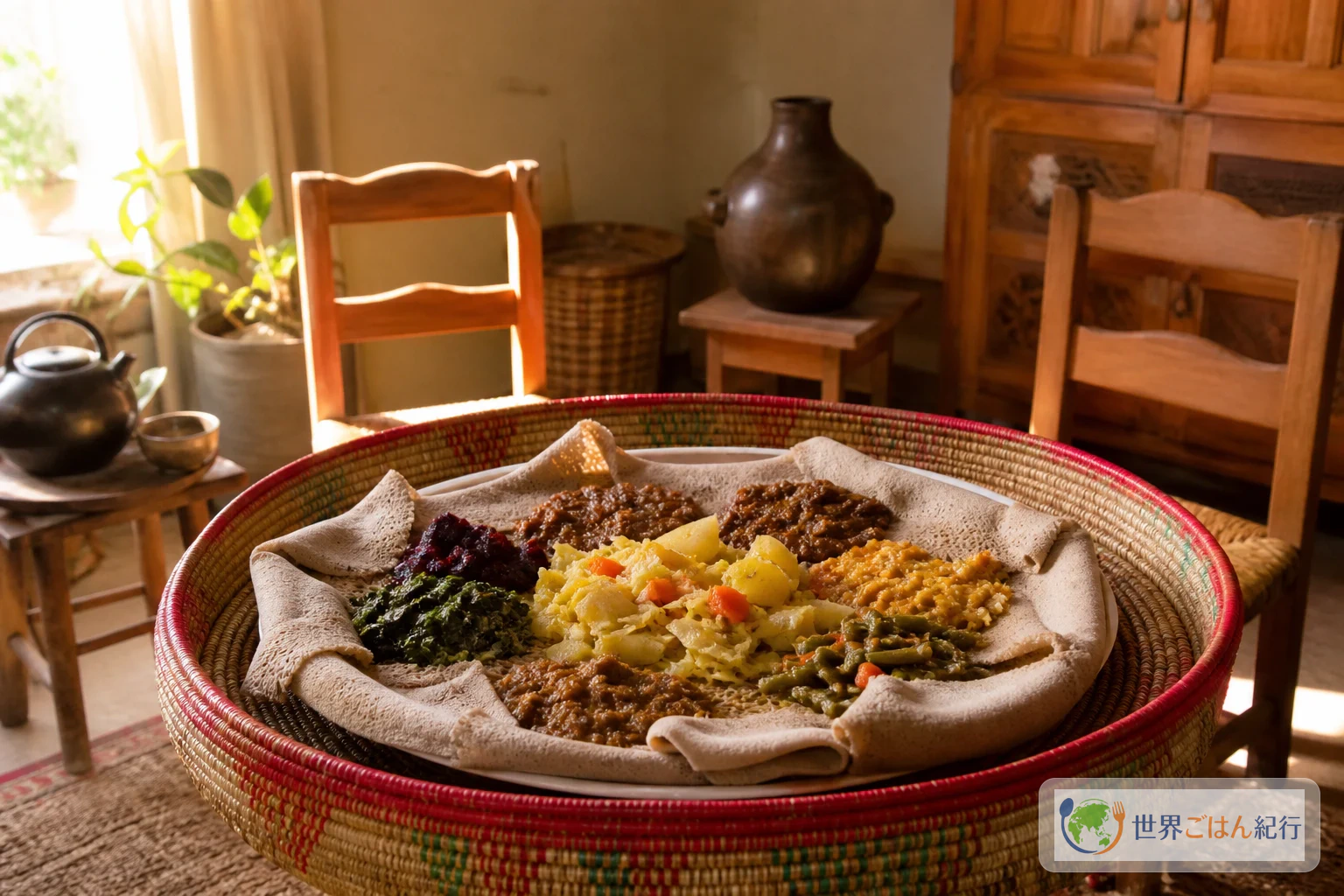
Injera is not merely an accompaniment either. Cultural introductions by embassies and studies of food culture describe a way of eating in which injera is spread on a large plate, meat and vegetable sauces are served on it and several people share. There are scenes of gathering around a woven stand called a mesob and scenes of using injera at family and holiday gatherings, and not just the taste of the food but the act of reaching to the same plate makes the table. At home you may serve it in an individual bowl, but arranging several vegetable dishes in small amounts and tearing injera to catch the sauce makes it easier to feel the role atakilt originally has.
Storage and Restoring It the Next Day
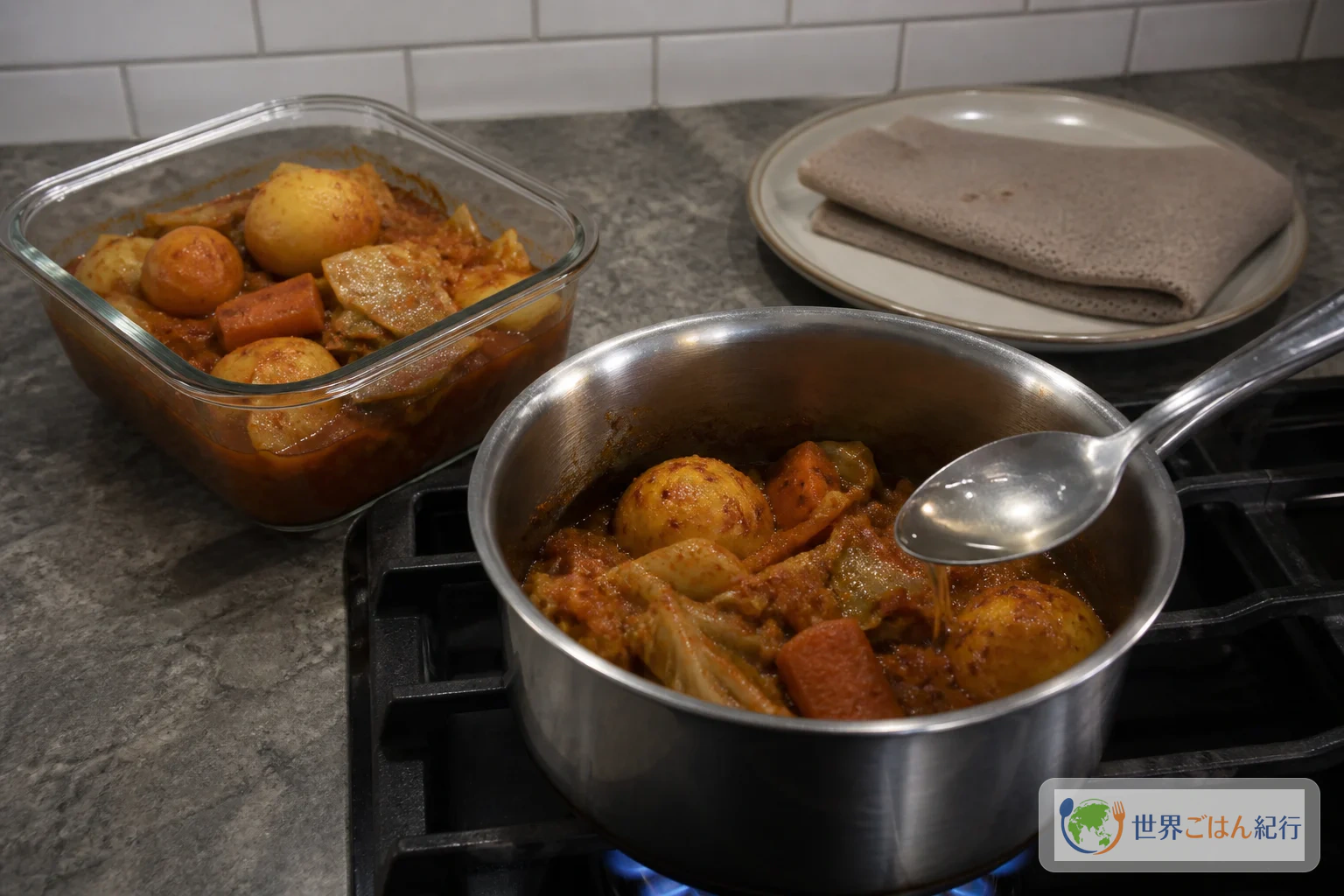
Once cooled a little, move it to a shallow storage container and store it in the refrigerator. The texture of the cabbage softens the next day, so this is not a dish where you look for the same bite as the day it was made. Finish it within 2 days as a guide, and do not use anything left long at room temperature.
To reheat, move one serving to a small pot, add 1 tbsp water and set over low heat. Cover and heat for 5–7 minutes, shaking the pot now and then so that it warms to the center, taking care not to mash the potatoes with a wooden spatula. If there is a lot of liquid, take off the lid only for the last minute. Wrap the injera separately and bring it to room temperature just before eating, or warm it briefly. Potatoes tend to change in texture when frozen, so for the first time it is easier to judge by making only the amount you will refrigerate rather than freezing.
Frequently Asked Questions
Are atakilt wat and tikil gomen the same?
The way of telling them apart varies by source, restaurant and household. Atakilt wat may refer broadly to vegetable dishes in general, and its ingredients can overlap with tikil gomen, which centers on cabbage. Rather than drawing a complete line by name alone, checking which of potatoes, carrots and greens go in besides cabbage reduces the gap in ordering or reproducing.
Can I make it without berbere?
Yes. The basic flavor is the yellow alicha style centered on turmeric, so try berbere from 1/4 tsp only if you want to add heat. If you add it in tablespoons from the start, you lose the sweetness of the cabbage and the bitterness of the fenugreek.
What do I change to make it for fasting?
Use vegetable oil, and add no butter, meat, dairy or egg. Niter kibbeh uses clarified butter, so however good the aroma, it does not become a plant-based fasting dish. If you use store-bought stock or seasonings, check the ingredient labels.
I have no injera. Is white rice okay?
It is fine. White rice catches the sauce and is easy to make as an everyday staple, but it does not reproduce the sourness of injera or the texture of tearing and wrapping. Thin bread, naan and tortillas also work, but think of them at first as substitutes for checking the flavor of atakilt and how the vegetables are cooked. On a day you also make a fermented bread, combine it separately with how to make injera.
The potatoes stayed hard while only the cabbage went soft.
If you can take the cabbage out, take it out, add 2 tbsp water to the pot, and return the potatoes and carrots to low heat with the lid on. When a skewer goes through, return the cabbage, take off the lid and adjust the liquid for just 1–2 minutes. Next time even out the potatoes to 2.5 cm cubes, and always add the cabbage last.
Sources
- Embassy of Ethiopia, "Culture – Food and Drinks": https://ethiopianembassy.org/culture/ (accessed and checked 2026-08-12)
- Visit Ethiopia, "Cultural Experience": https://visitethiopia.et/page/cultural-experience (accessed and checked 2026-08-12)
- Ethiopian Orthodox Tewahedo Church, "Worship": https://www.ethiopianorthodox.org/english/ethiopian/worship.html (accessed and checked 2026-08-12)
- Federal Ministry of Labor and Skills, "Prepare Ethiopian Cereal and Vegetable Dishes": https://library.dbpolytech.edu.et/Resource/ICT/Prepare%20Ethiopian%20Cereal%20and%20Vegetable%20Dishes%20.pdf (accessed and checked 2026-08-12)
- Abebe et al., "Review on the Ethiopian traditional fermented beverage, injera", Journal of Ethnic Foods: https://link.springer.com/article/10.1186/s42779-020-00069-x (accessed and checked 2026-08-12)
- Sanford Health, "Try Something New: Atakilt Wat": https://news.sanfordhealth.org/healthy-living/try-something-new-atakilt-wat-2/ (accessed and checked 2026-08-12)
- International Recipes, "Alicha Wat": https://worldinthekitchen.com/recipes-by-country/ethiopia/alicha-wat (accessed and checked 2026-08-12)



