

From the moment you spread the thin sheet, the aroma moves toward the Maghreb
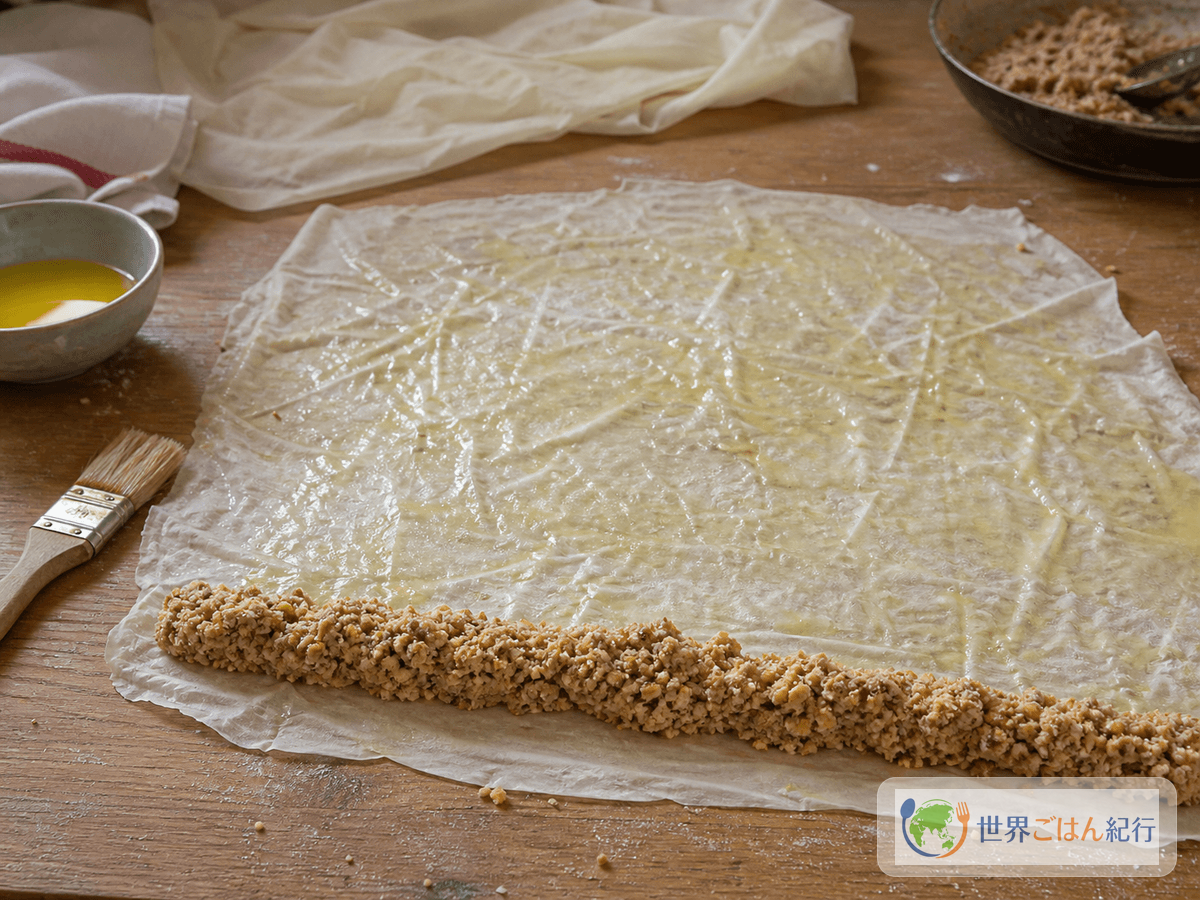
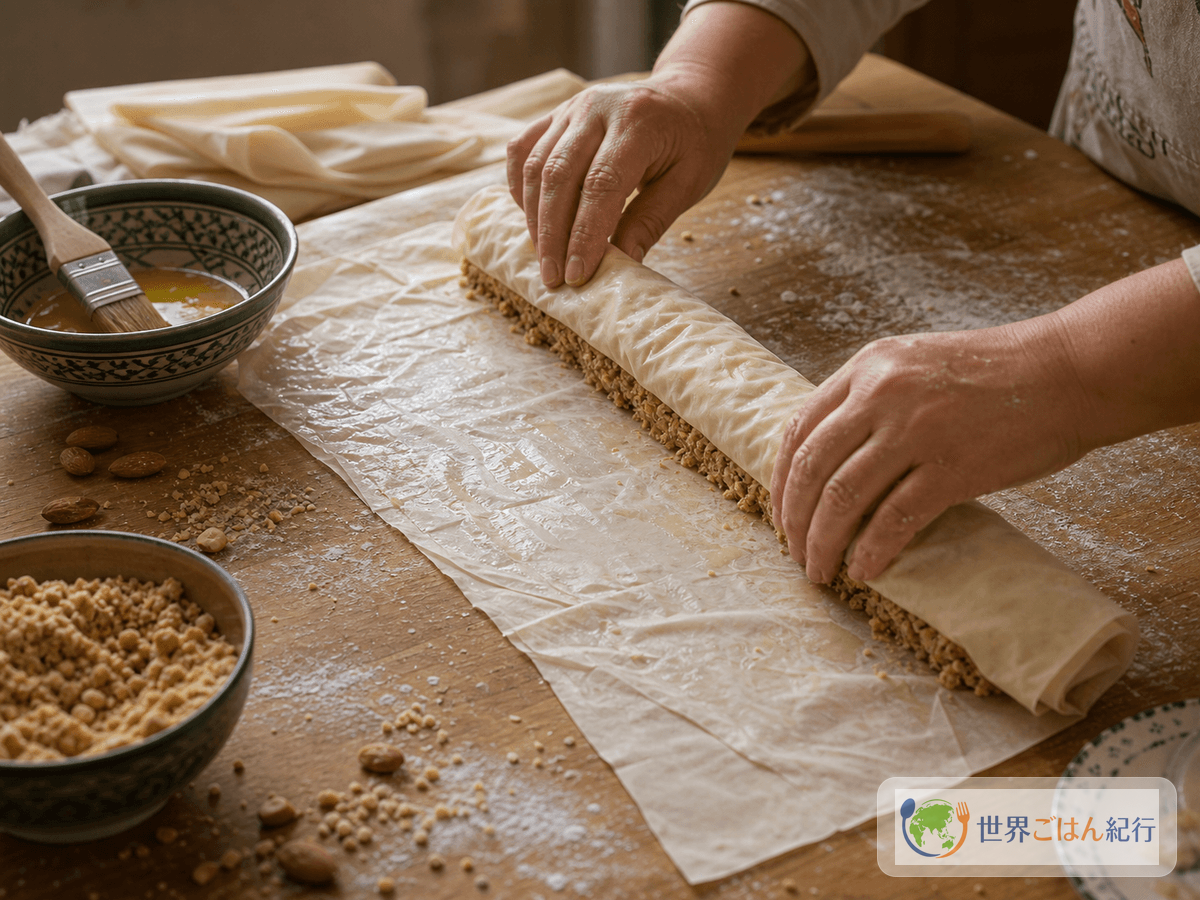
Spread out one sheet of filo and brush it with melted butter, and the dry rustle on the counter hushes. Lay a thin line of almond filling scented with cinnamon and orange blossom along it, and roll it into a coil. In the oven the layers rise, honey runs into the grooves, and before you even cut it the kitchen smells like a sweet shop. Mhancha (M'hancha / Mhencha) works not by adding ingredients but by getting three things right: the pastry sheet, the filling and the honey.
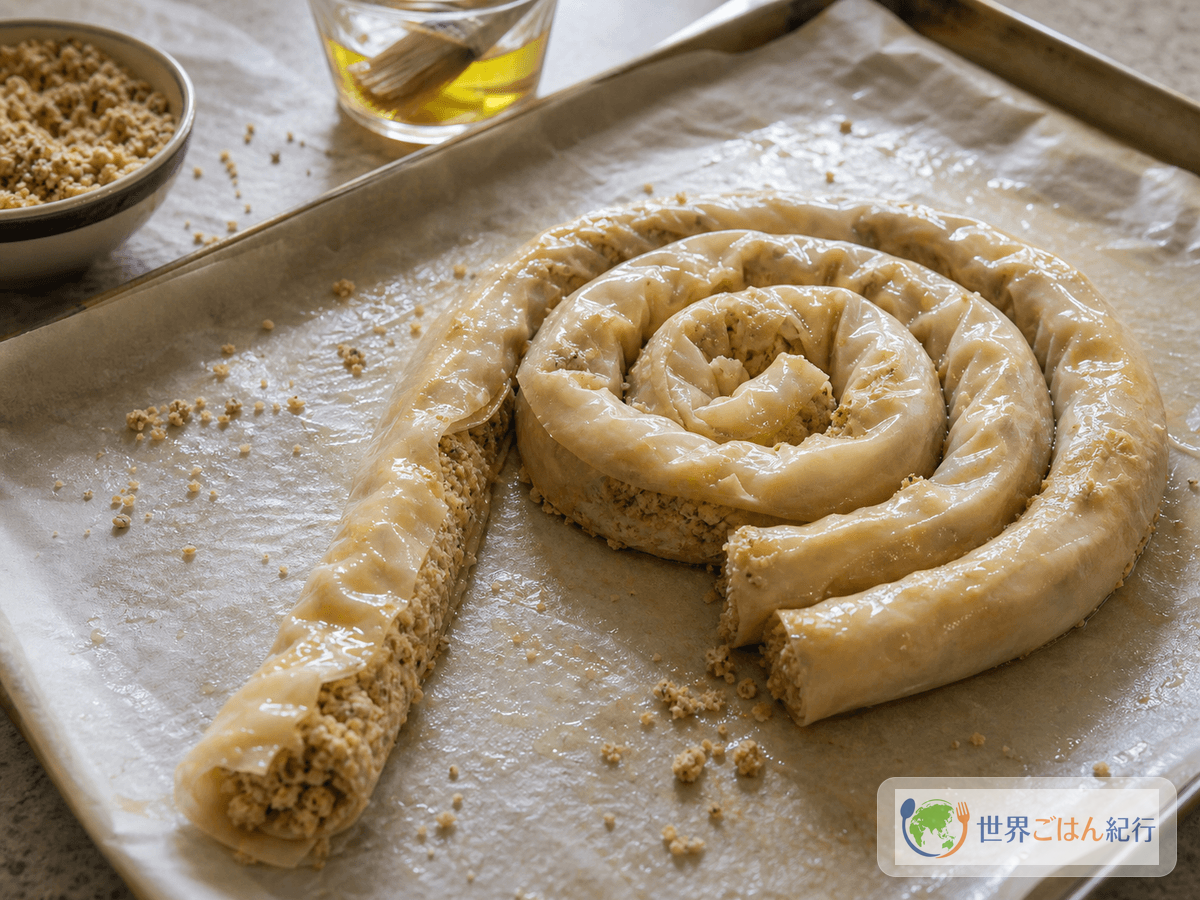
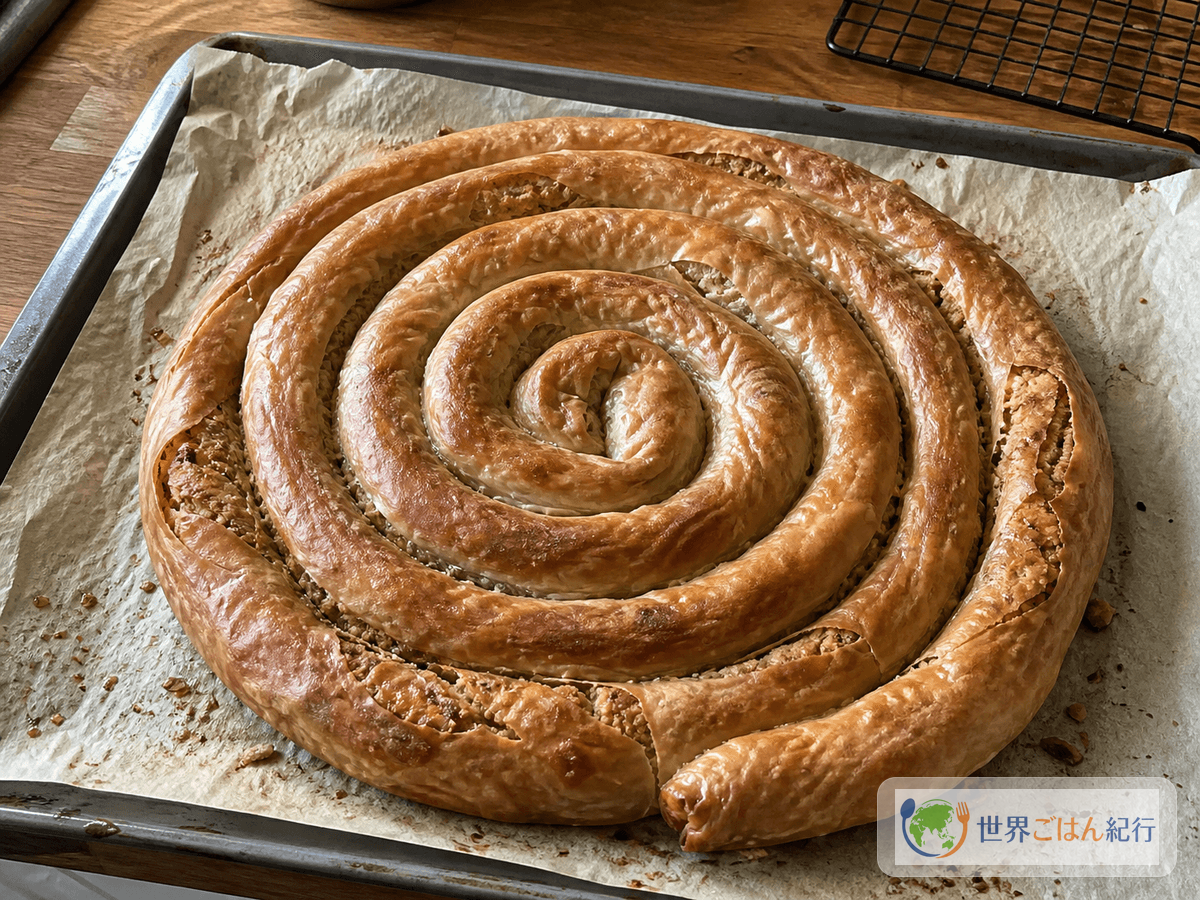
The name comes from the Arabic word for "snake," and is explained by the coiled shape. The core is thin pastry wrapped around almond filling, shaped into a circle or small coils and finished with honey, but the form differs from home to home. Decide at the start whether you are making a large baked coil or small fried coils, and which sheet you will use, and you avoid the failure of sheets drying out and cracking midway.
This article takes as its base a large baked version about 22 cm across, made with frozen filo. It also covers the more Algerian-style branch of small coils shallow-fried, swapping in the more widely available spring roll wrappers, the balance of moisture and aroma in the filling, and the temperature and application of the honey, all from the point of view of a home kitchen.
Where mhancha sits in Maghrebi celebrations and homes
The contexts in which mhancha is discussed overlap a little from country to country and home to home. The Algerian food outlet Cuisine DZ presents it as a traditional sweet prepared for the eve of Mawlid (the Prophet's birthday): thin dioul sheets wrapped around a filling of ground almonds, cinnamon and orange blossom water, dipped in honey after baking. Thin wheat sheets, nuts, floral scent and honey form the axis of the celebration plate.
Petite Panière, which records Algerian home sweets, gives the same sweet as "M'hencha": thin diouls / brick sheets filled with almond paste, fried, then soaked in warmed honey. It adds that diouls are used in both savory dishes and sweets across Algeria and North Africa and are easy to find in markets, and that the shape comes from a snake drawn in a coil. The same article ties the origin of mhancha to the Ottoman period and touches on the historical background of Algeria's strong Ottoman influence from 1512 to 1830.
The French Wikipedia entry for Mhancha places it as a Maghrebi dessert, describes it by category as made with puff pastry (pâte feuilletée) in a round shape, and records with several sources that it is filled with almonds and covered in honey, that the name is a transliteration of the Arabic word meaning "snake," and that this is explained by the circular shape. It also notes that the sweet appears in both Algerian and Moroccan cookbooks, and that the sweet of Tétouan is spoken of as a line influenced by Algerian and Ottoman tradition.
Meanwhile the Moroccan recipe "Moroccan almond pastry (mhancha)" presented by Australia's SBS Food says that the traditional sheet is the thin pastry called warka (warqa), with filo as a substitute, and shows the flow of baking a large coil in the oven. You make the filling from 500 g of almonds with sugar, orange blossom water, cinnamon and butter, shape it into 33 cm logs, wrap them in filo, join them into a coil, bake, and brush with warmed honey. The difference between versions is not a question of which is right; it is the result of what sheets a household has, how many people it feeds, and how it wants to present the sweet.
The first thing to grasp is that mhancha is less a single fixed sweet than a skeleton of thin pastry, nuts, floral scent and honey, on which each region and household lays its own habits. Some homes bake a large celebratory coil; others divide it into small pieces, fry them and let them soak up honey. Treat the explanations of name and etymology as guide lines, and in the kitchen concentrate on matching three things: the thickness and handling of the pastry, the firmness of the filling, and the temperature of the honey.
In English and French-speaking regions the spelling varies: mhancha, m'hanncha, mhencha, m'hencha. Algerian home-sweet sources sometimes write M'hencha, and Moroccan English recipes write Mhancha. This article uses "mhancha" with M'hancha as the original form.
After chorba frik or kesra, a small cut piece of mhancha beside mint tea moves an Algerian meal naturally from savory to sweet aroma. For comparison along the line of thin pastry and nuts, Turkey's baklava (in Japanese), Egypt's basbousa (in Japanese) and Lebanon's knafeh are also close next reads.
Decide first: baked or fried, filo or spring roll wrappers
What makes mhancha confusing is the order in which you decide, once the ingredients are ready, whether to bake or fry and which sheet to use. From the moment the sheets come out on the counter they start to dry, and the moisture in the filling changes as it meets the air. If you decide the form before you start, you can keep the handling of the sheets and the amount of honey consistent.
If you have frozen filo and an oven, the large baked version about 22 cm across is the first choice. It shows the coil well, and you can judge by browning and dryness at the center without tracking oil temperature. If you only have large spring roll wrappers, or want to serve a small amount as petits fours, dividing into 4 to 6 small coils and shallow-frying is less likely to tear. Spring roll wrappers are thicker than filo and lose some of the lightness of layers, but they are easier to roll and hold their shape even with less honey.
| What you have | Form to choose | Good for | Watch out for |
|---|---|---|---|
| Filo and an oven | Large baked version, about 22 cm | A day you want it at the center of the table | Do not wind too tight; leave a 5 mm gap |
| Only large spring roll wrappers | 4 to 6 small coils, about 8 cm | A day you cannot find filo | Start with 90 g honey because the sheets are thicker |
| Small servings wanted | Small shallow-fried version | A sweet after the meal, portions for guests | Medium heat, about 160°C, 2 minutes per side |
| A lighter sweetness | Baked version with less honey | A day you want less heaviness after the meal | The aroma weakens, so keep the flower water |
The difference between baked and fried shows in lightness and in how the honey is absorbed. The baked version has layers that rise and is easy to cut the next day. The fried version has crisp edges and takes up the warmed honey quickly. If you want stability the first time in a home kitchen, the baked version; if you want easy portions for a festive day, the fried version. That division is enough.
Ingredients (one 22 cm coil, 8 pieces)
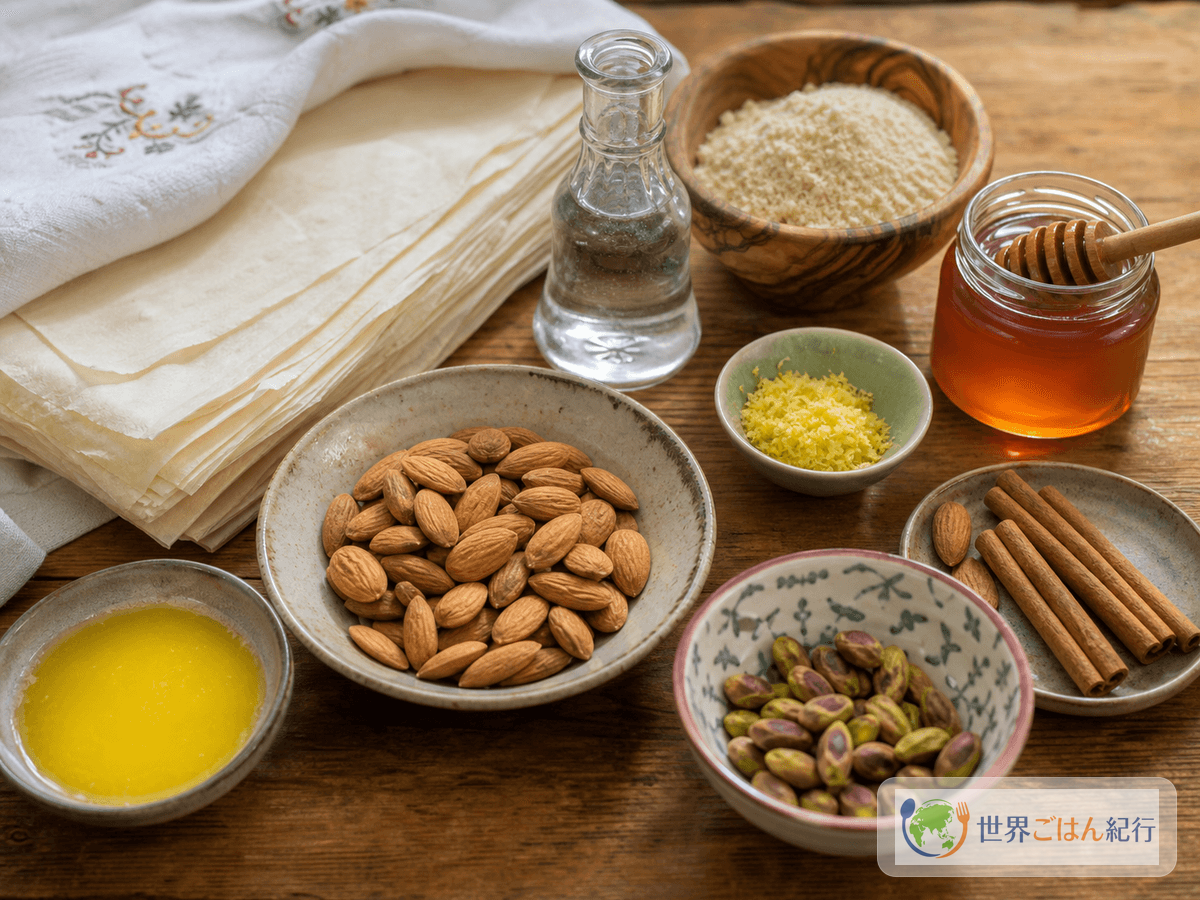
This makes one large baked coil. The sweetness is kept restrained for a Maghrebi sweet. To move toward the local level of sweetness, add 2 tbsp (about 40 g) honey. On a day you cannot find filo, switch to the method of dividing into 4 small coils with 12 large spring roll wrappers.
The local sheets and what to use instead
| Sheet described locally | Practical alternative | Difference in taste and handling |
|---|---|---|
| Dioul, brick, warka-type thin sheets | Frozen filo, large spring roll wrappers | Spring roll wrappers are thick, and the lightness of crumbling layers is weaker |
| Blanched almonds ground on the spot | Almond flour | The aroma is a little milder, but the filling moisture is easier to adjust |
| Orange blossom water | A little lemon zest and honey | The floral scent is different. If you will keep cooking such sweets, get a bottle |
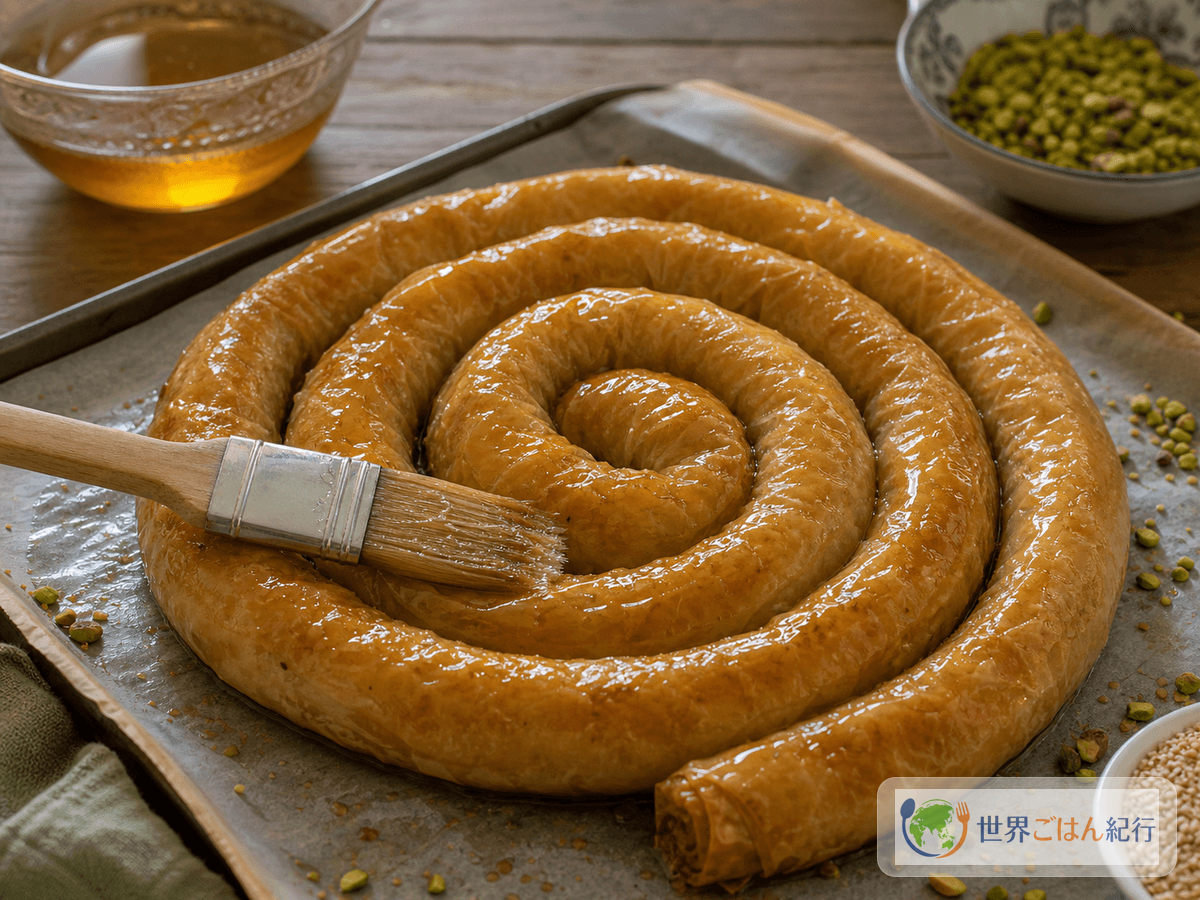
| Dipped in honey | Brush on warmed honey | Sweetness is easier to adjust, and the baked sweet is lighter |
| Small fried version | Large oven-baked coil | Less fried fragrance, but the temperature is easier to manage at home |
This recipe uses wheat, dairy, egg, almonds and pistachios. Filo and spring roll wrappers differ by product in whether they contain egg or dairy, so check the package label. If you have a nut allergy, it is safer to choose a different sweet than to substitute.
What is worth a detour when shopping
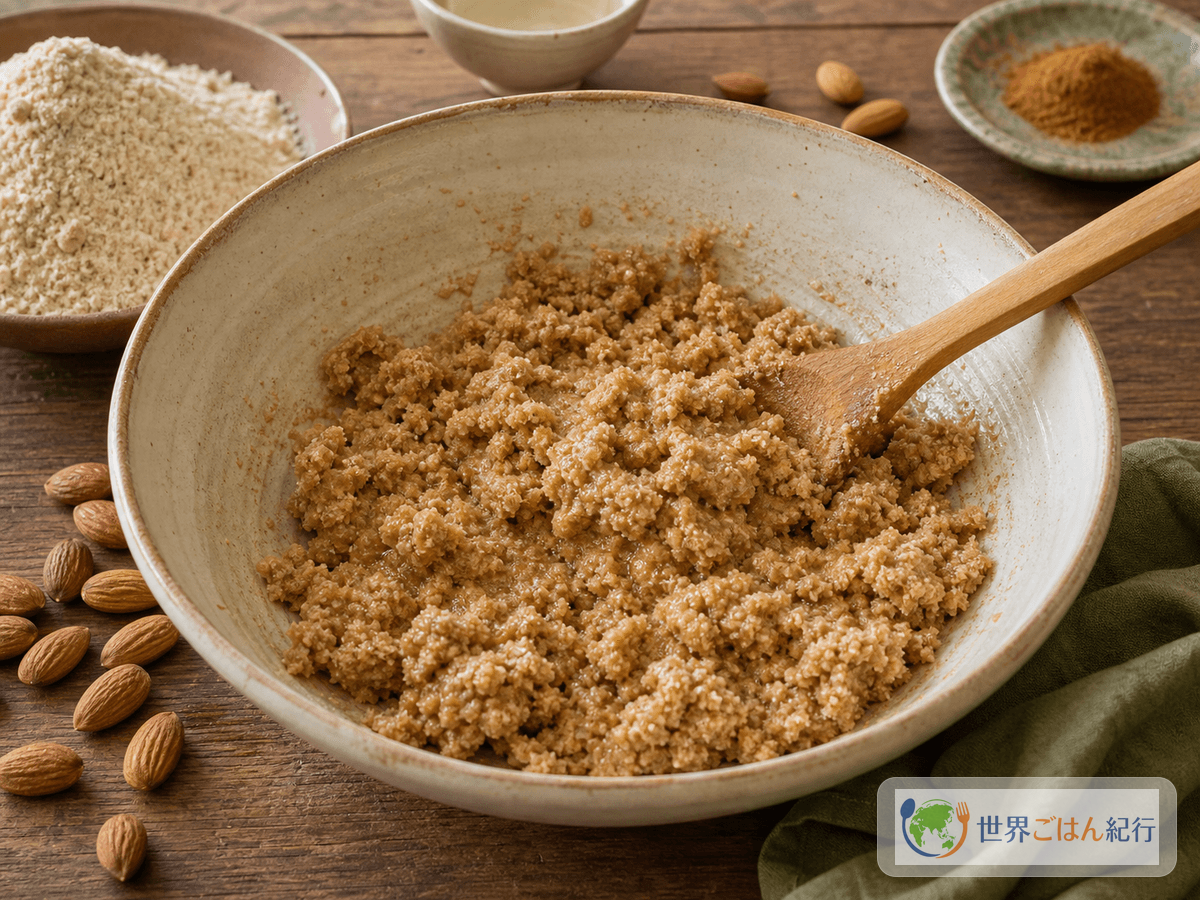
The thing worth looking for beyond the supermarket is the aroma that is hard to replace, and the spice that sets the aroma of the filling. Almonds, sugar, butter and honey you can get anywhere. If you choose just one thing first, make it orange blossom water. You use a little over 1 tbsp, but once it goes in, the axis moves from an ordinary almond pastry to the aroma of the Maghreb.
The condition for buying it is that you will keep making North African or Middle Eastern sweets, and that the label says it is for food use. Flower waters sold as cosmetic toners or for fragrance are not used in cooking. Look for a food-use label; a 240 ml bottle is a common size. If you want to try it only once, or do not like floral scents, skip it and use a little lemon zest and honey. The aroma is different, but you can make the sweet without adding to your shopping list.
Cinnamon works in powder form too, but because it goes into a nut filling, an old powder lets only the sweetness come forward. Grate a stick, or use a powder that still has its aroma after opening. Think about whether you will also use it in baked sweets or chai, and the decision to keep it in stock gets easier.
If you make it with almond flour a food processor is not required, but on days you make it from blanched almonds, or want to leave some grains, a small food processor is handy. You can stop short of a powder and leave grains of about 2 mm.
Method: do not wind tightly, dry it through to the center
For mhancha, the cohesion of the filling and the dryness of the sheet decide the outcome. Make a thin log of filling, wrap it in thin sheets, and join it into a coil. Wind too tight and it cracks when baked; too loose and the filling spills when you cut it. Roll with the feeling of leaving 5 mm of room inside the curve, so the pastry can expand while baking.
A small-coil branch for a more Algerian feel
In the Algerian version at Petite Panière, almond filling goes into dioul or brick sheets, rolled small, fried over medium heat and dipped in warmed honey. The fragrance of the oil and the way the honey is absorbed are appealing, but frying a large coil whole is not realistic in a home kitchen.
Cinnamon works in powder form. The condition for buying is that you want the filling's aroma a step clearer and will reuse it in baked sweets and chai. A 25 g jar is a typical size. If you already have a powder that keeps its aroma, or you are making this only once, skip it. Sticks mean the extra work of grating, so the powder is enough.
So when you want to move toward the Algerian style, divide into 4 to 6 small coils. Lay a thin line of filling on one spring roll wrapper, shape it into a coil about 8 cm across, and pour only 1 cm depth of oil into a frying pan. Shallow-fry over medium heat at about 160°C, 2 minutes per side, until pale golden. Take out and drain for 5 minutes, then dip each side for 10 seconds in warmed honey.
The difference between baked and fried is texture. The baked version has light layers and is easy to cut the next day. The fried version has crisp edges and takes up the honey quickly. For a large platter to show guests, choose baked; to serve small, like a sweet after the end of Ramadan, choose fried.
| Branch | Good for | Heat and temperature | Watch out for |
|---|---|---|---|
| Large baked version | A day you want it at the center of the table | Oven from 180°C to 160°C | Winding too tight makes it crack |
| Small shallow-fried version | A day you serve small amounts | Medium heat, oil about 160°C | It colors fast, so do not walk away |
| Spring roll wrapper version | A day with no filo | If baking, mainly 170°C | The wrapper is thick, so use less honey |
| Less sweet version | A light sweet after a meal | Reduce the honey to 90 g | The aroma weakens too, so keep the flower water |
When it goes wrong, go back to the center and the honey
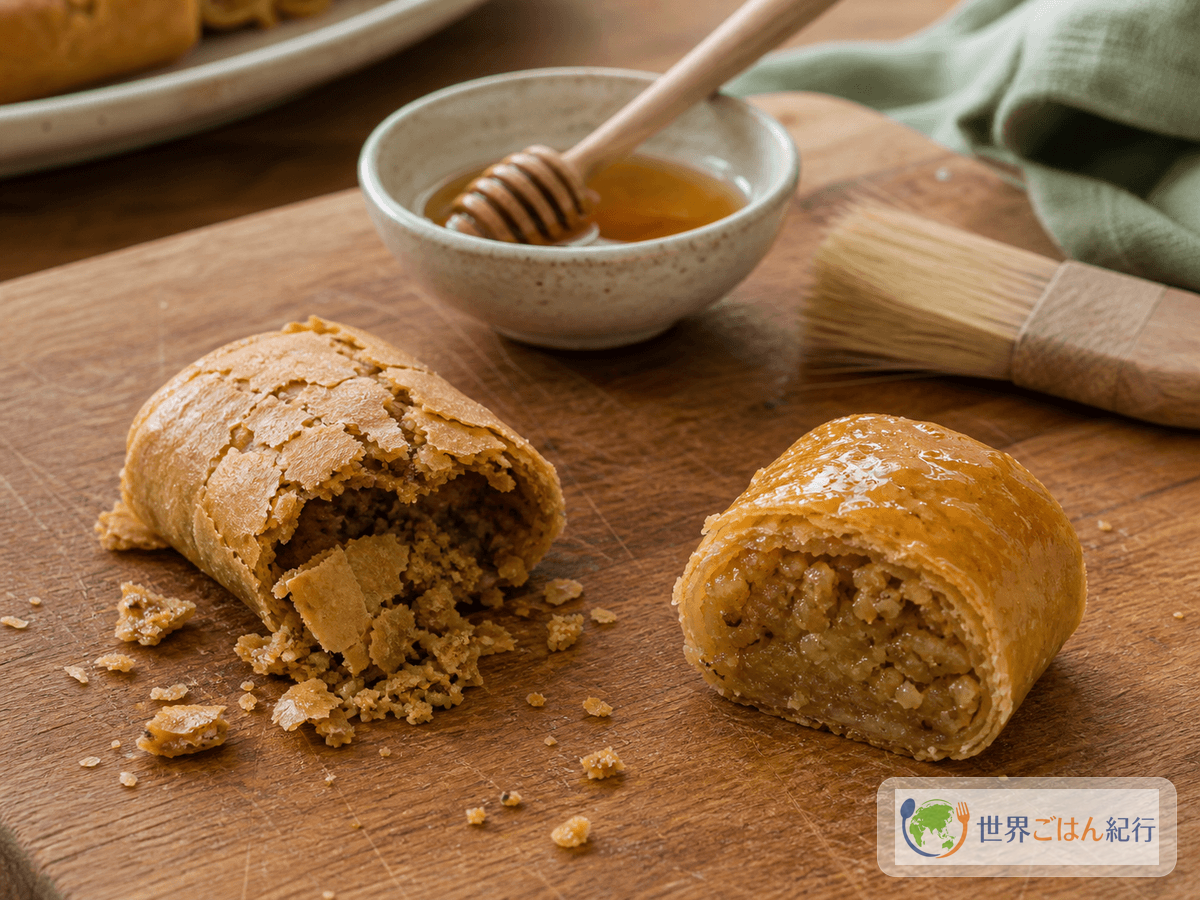
| Symptom | Cause | Fix |
|---|---|---|
| The sheets crack | The dough was left out, or the coil was wound tight | Cover with a cloth and leave a 5 mm gap between turns. Turn cracked spots to the underside |
| The filling crumbles out | Too little orange blossom water and egg yolk | Add moisture 1 tsp at a time. If you added too much, add almond flour |
| The center is white and raw | It was baked briefly at 180°C only | Lower to 160°C and bake 8 to 10 minutes more to dry the center |
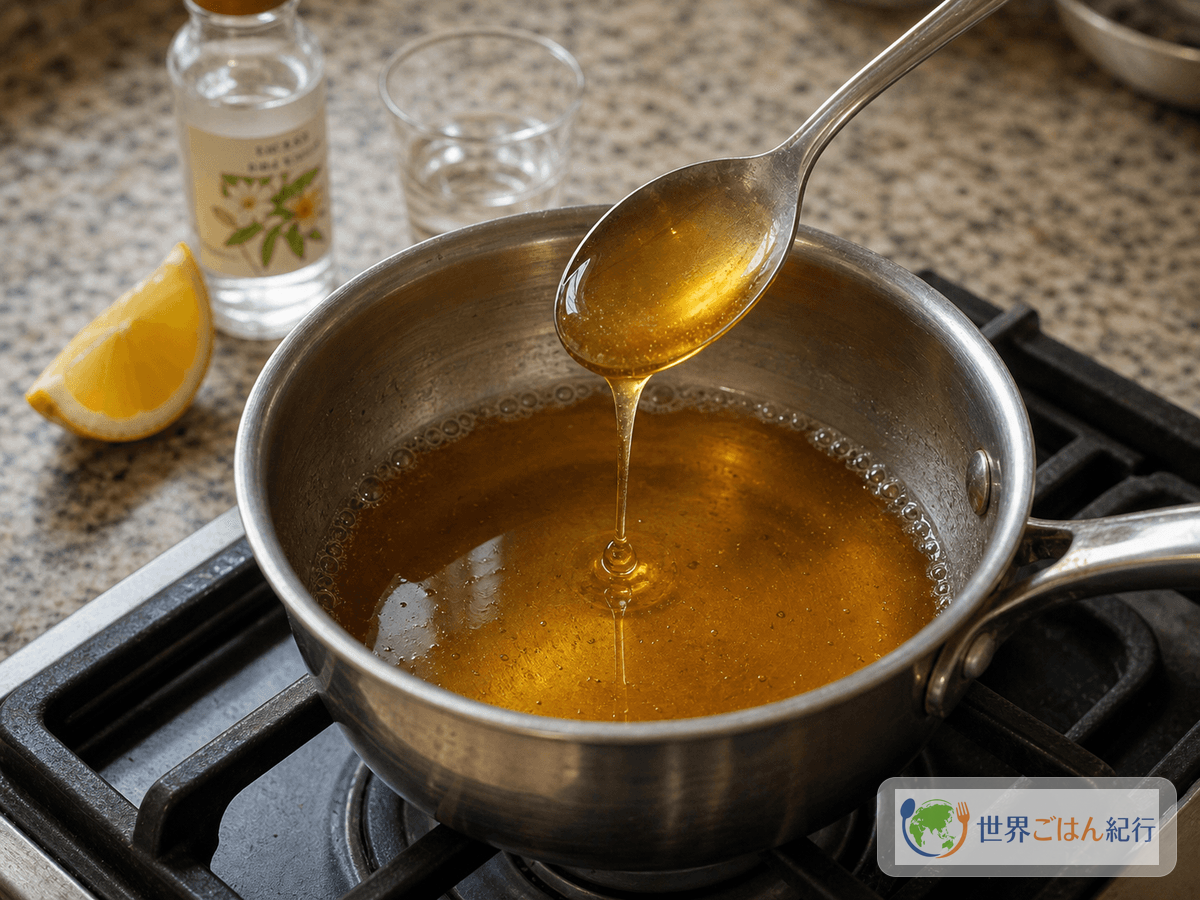
| The honey is stiff | It was cooked on high heat | Only warm it on low heat; if stiff, stir in 2 tsp hot water |
| The sweetness is heavy | All the honey was poured on at once | Half in the grooves, half on the surface. Do not put back what pools on the baking sheet |
The failure hardest to undo is letting the sheets dry out. Cracked sheets are not only ugly; during baking they let the oil and fragrance of the filling escape. Before you work, have a damp cloth, melted butter and the baking sheet all ready, so that once the sheets are out you do not hesitate.
The almond filling tastes better if you do not process it too smooth in the food processor. Turned into a perfect paste, the cut face becomes heavy and the lightness of the snake-like coil disappears. A few coarse grains left in give a texture between the honey-soaked pastry and the filling.
Storage, reheating and when to cut
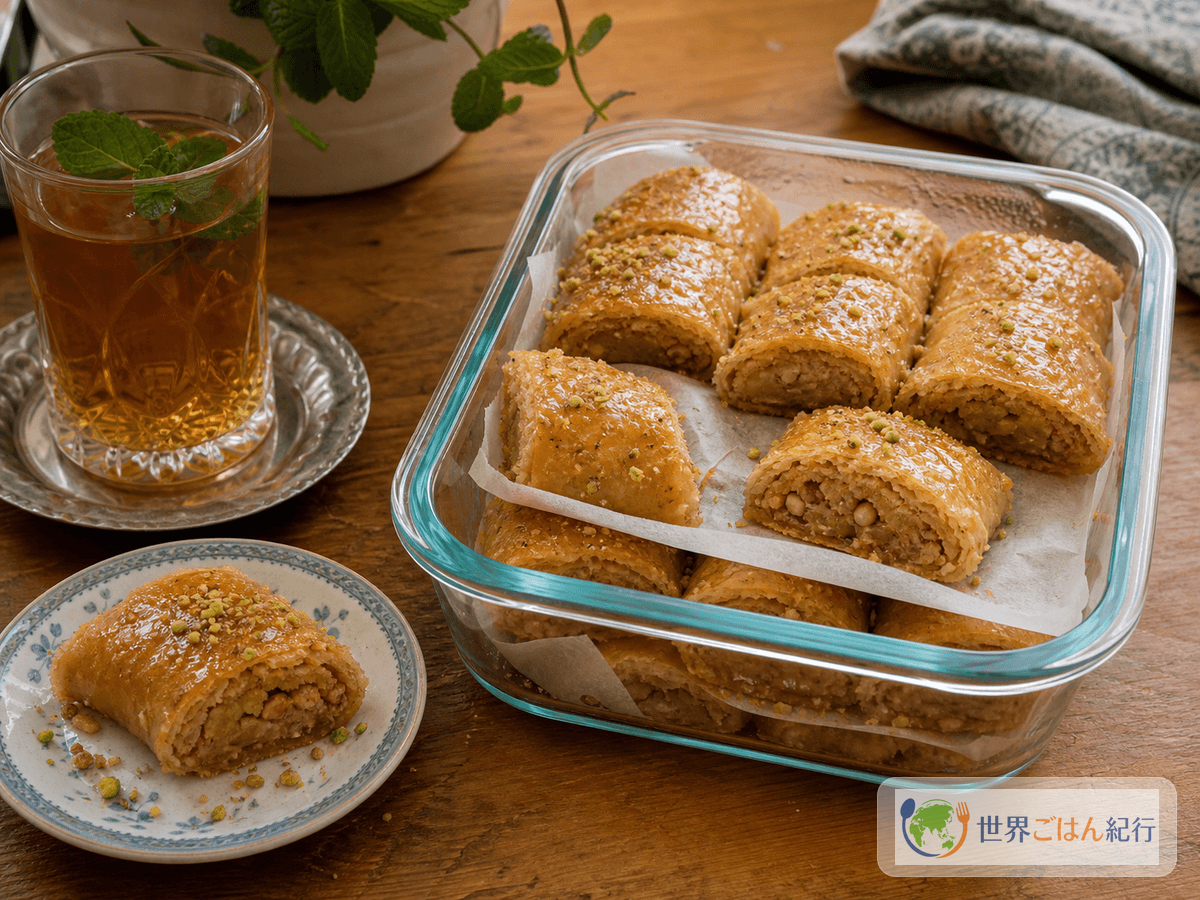
Mhancha smells best on the day it is baked. If you store it after it has cooled completely, cut it, put parchment between pieces and place in an airtight container. As a guide, 1 day at room temperature, 3 days in the refrigerator. In humid seasons, refrigerate it and take it out 10 minutes before eating.
Reheat in a toaster oven at 160°C for 3 minutes at most. Because the sweet is brushed with honey, strong heat scorches the surface. To bring back a little of the pastry after refrigeration, warm briefly at low heat without covering with foil. Microwaves tend to soften the pastry, so avoid them if the texture after storage matters to you.
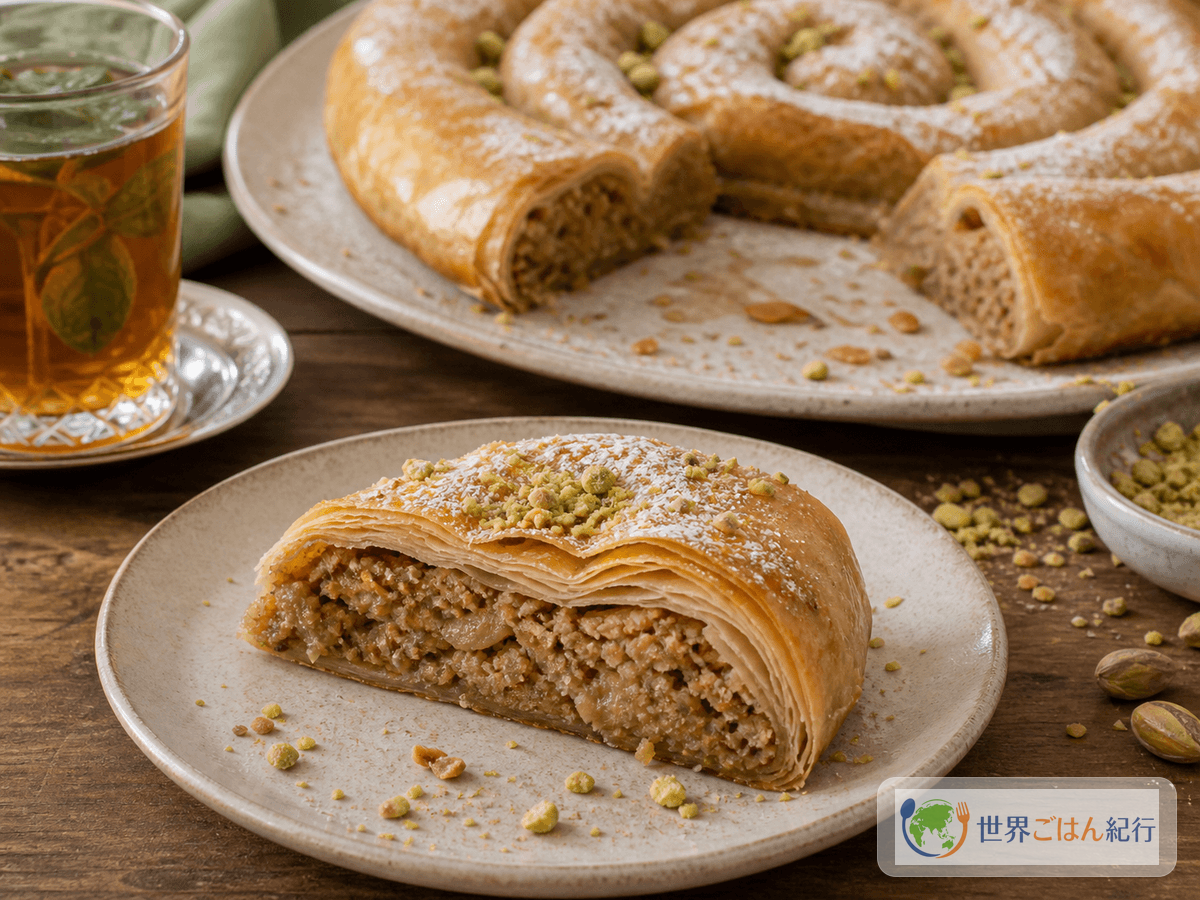
Cut it small as a rule. A large piece lets the sweetness of honey and almonds come forward too much. With unsweetened mint tea, strong black tea or bitter coffee, the aroma lingers longer. After finishing a meal with kesra or a soup, serving just a little thinly sliced mhancha makes the sweetness the end of the table.
Frequently asked questions
I have no filo. Can I use spring roll wrappers?
Yes. But it will not give you finely crumbling layers like filo. Spring roll wrappers are thick, so dividing into 4 to 6 small coils is easier than making one large coil. If baking, about 20 minutes at 170°C, starting with 90 g honey.
Is orange blossom water essential?
If you are aiming for the local flavor, it is worth adding. It turns the direction of the aroma from an ordinary almond pie to a Maghrebi sweet. If you have none, you can make up for it with a little lemon zest and honey, but the aroma is different. If you will keep making Middle Eastern and North African sweets, one bottle can be reused.
Which is closer to the authentic one, fried or baked?
It differs by region and household. In Algerian home recipes you see small rolls fried and dipped in honey. Moroccan English-language recipes, on the other hand, often present a large baked coil. In a home kitchen, the baked version is more stable for temperature control and shaping the first time.
Can I use whole almonds instead of almond flour?
Yes. Pulse 250 g blanched almonds briefly in a food processor until a mixture of fine and slightly larger grains. If you run it until oil seeps out, the filling gets heavy, so stop partway, stir, and pulse briefly again. The aroma is stronger than with almond flour.
This is a candidate only for those who want to use whole almonds and leave grains of about 2 mm. If you make it with almond flour, you do not need one. Check the capacity and how the blade is removed and washed before choosing.
Can I make it ahead?
Yes, but sheets brushed with honey absorb moisture. If making it the day before, cool it completely, cut it, and refrigerate with parchment between pieces. Warm it in a toaster oven at 160°C for 2 to 3 minutes before eating, and only the surface comes back a little.
What goes with it as part of a meal?
For an Algerian feel, serve a small amount after chorba frik and kesra. If lining up several sweets, cut it smaller than the syrup cake basbousa (in Japanese), and comparing it with the thin-pastry baklava (in Japanese) on the coarseness of the nuts and the shape is fun.
To make it, or to skip for now
If this is your first mhancha, choosing the large baked version with frozen filo is the clearest. It shows the coil well, and you can judge by browning and dryness at the center without worrying about oil temperature. On days you have only spring roll wrappers, or want to serve a small amount as a fried sweet, go to the small fried version.
| What you have | Form to choose |
|---|---|
| Filo and an oven | Large baked version, about 22 cm |
| Only large spring roll wrappers | 4 to 6 small coils |
| You want to try the flower scent but will not cook this again | Skip the orange blossom water and substitute lemon zest |
| You are not using whole almonds | Skip the food processor and use almond flour |
If you narrow what you buy to one thing, make it food-grade orange blossom water. It makes the largest difference in aroma and can also go into the syrup for basbousa and knafeh. Prices, stock and package sizes change, so check the label at the time you buy. If you are not sure the floral aroma suits your table, do not buy it this time, make the baked version, and decide next time; it is not too late.
Sources
- Mhancha: Wikipédia (French) (its standing as a Maghrebi sweet, the round shape filled with almonds and covered with honey, the etymology as a transliteration of the Arabic word for "snake," its appearance in both Algerian and Moroccan cookbooks, the account of the Tétouan line; accessed and checked 28 September 2026)
- Cuisine DZ: Mawlid Ennabaoui : mhancha, le gâteau traditionnel à préparer pour cette fête en Algérie (the traditional sweet for the eve of Mawlid, dioul sheets, the composition of almonds, orange blossom water, cinnamon and honey; published 15 September 2024, accessed and checked 28 September 2026)
- Petite Panière: Algerian Mhencha (diouls/brick sheets as the Algerian M'hencha, almond paste, the snake coil, the step of frying and soaking in honey, the note on Ottoman influence 1512-1830; accessed and checked 28 September 2026)
- SBS Food: Moroccan almond pastry (mhancha) by Hassan M'Souli (the relation of warka and filo in the Moroccan version, almond filling scented with orange blossom water, the step of baking a large coil; published 28 August 2014, accessed and checked 28 September 2026)



