
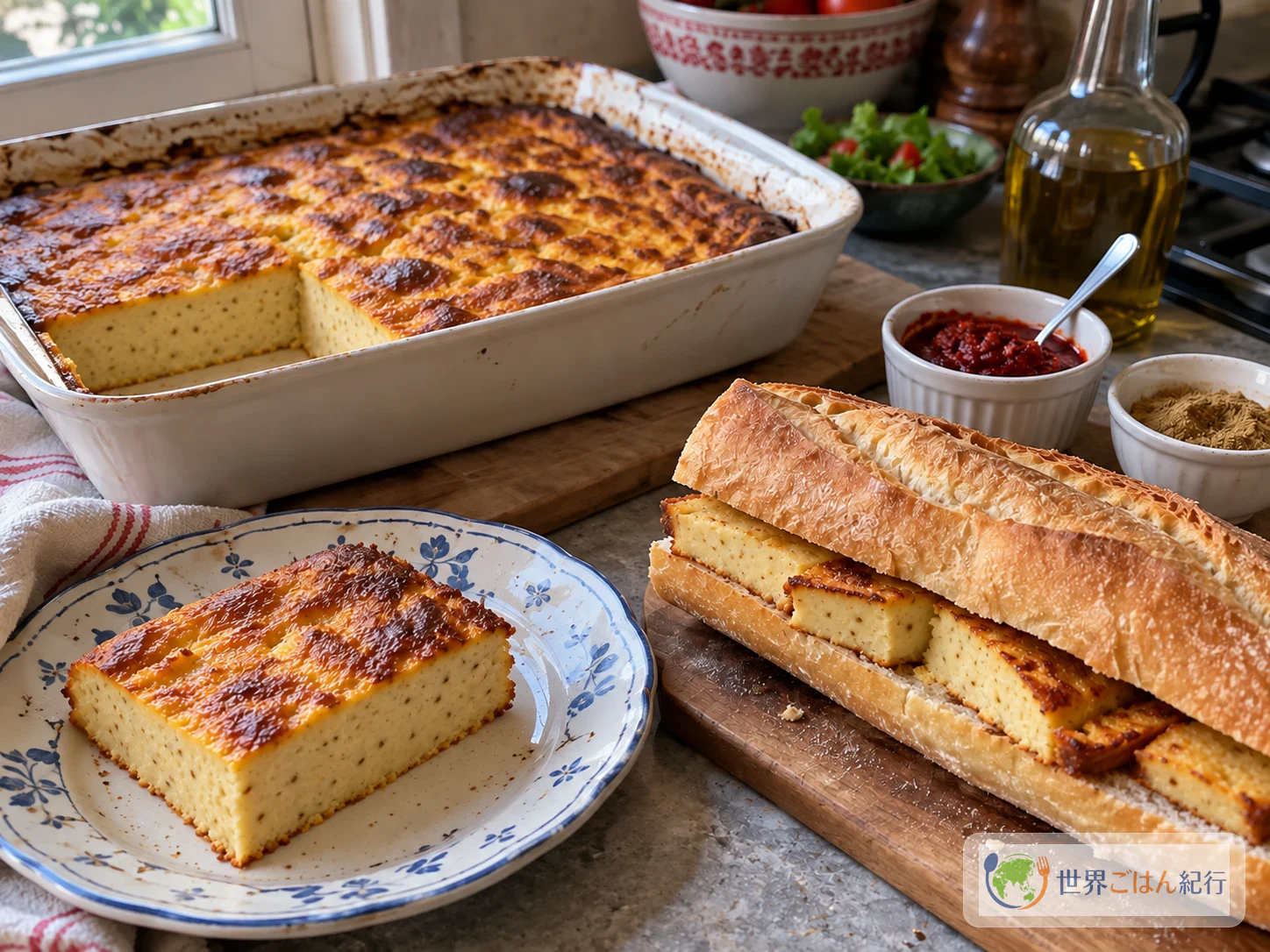
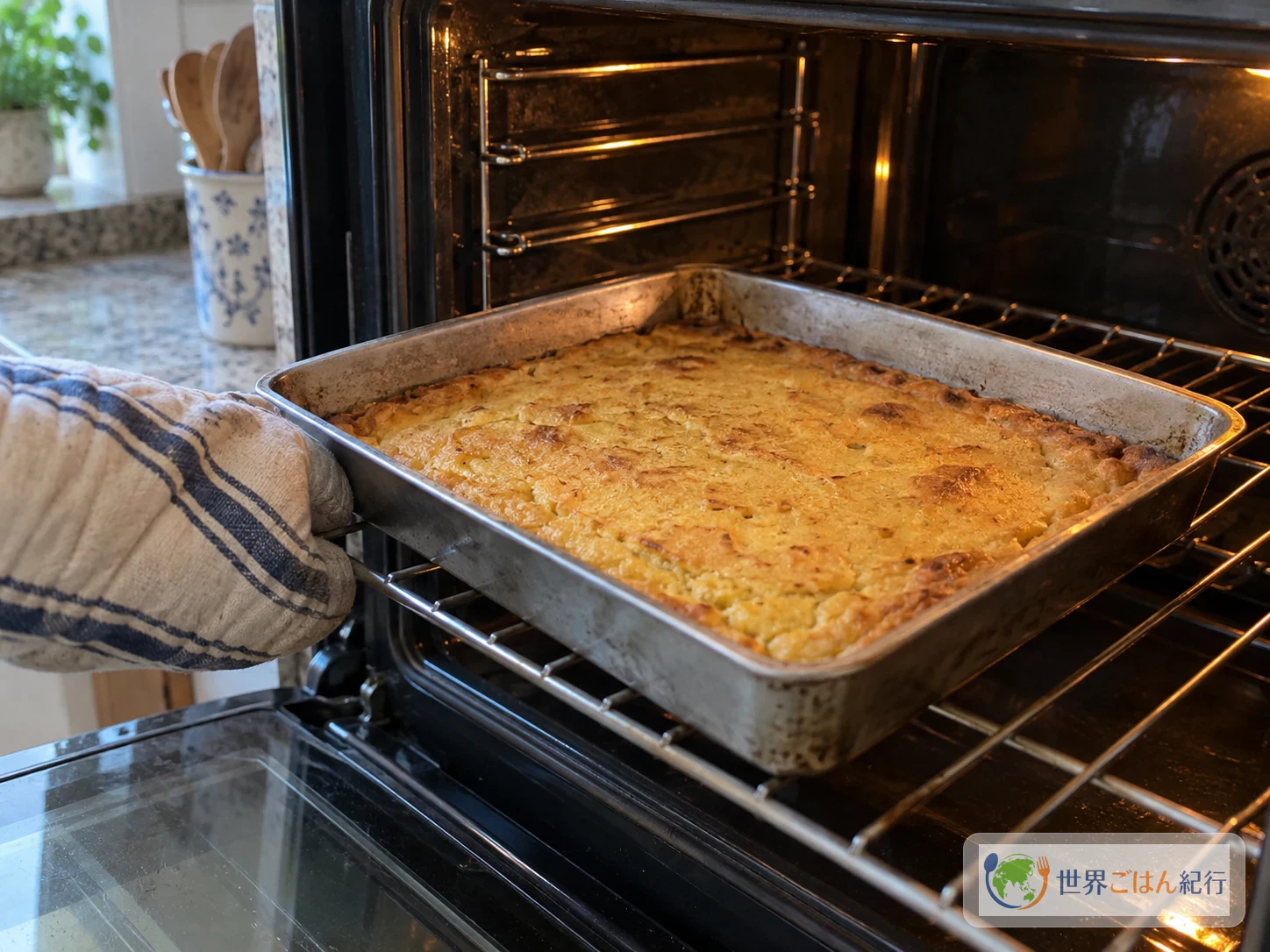
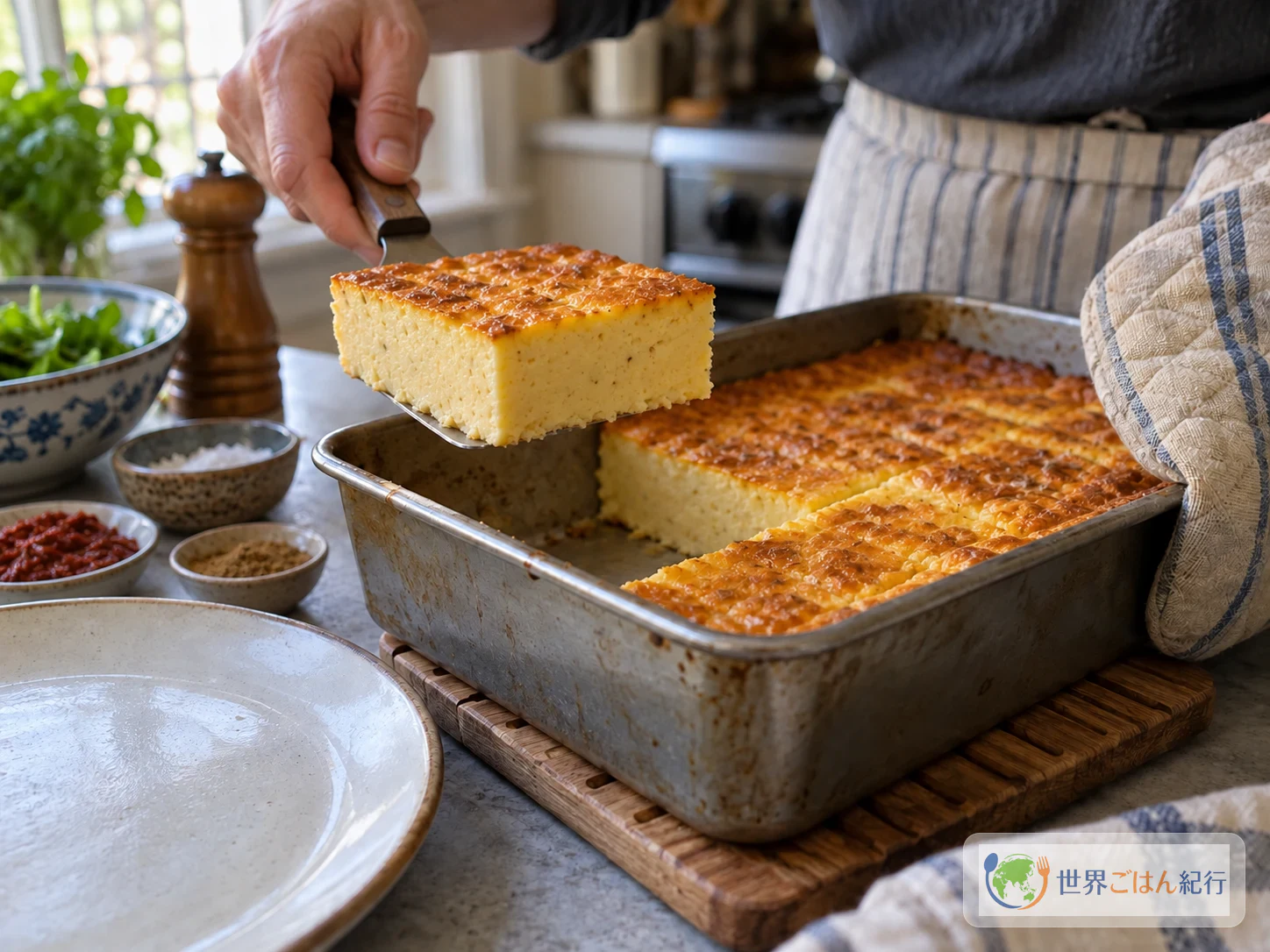
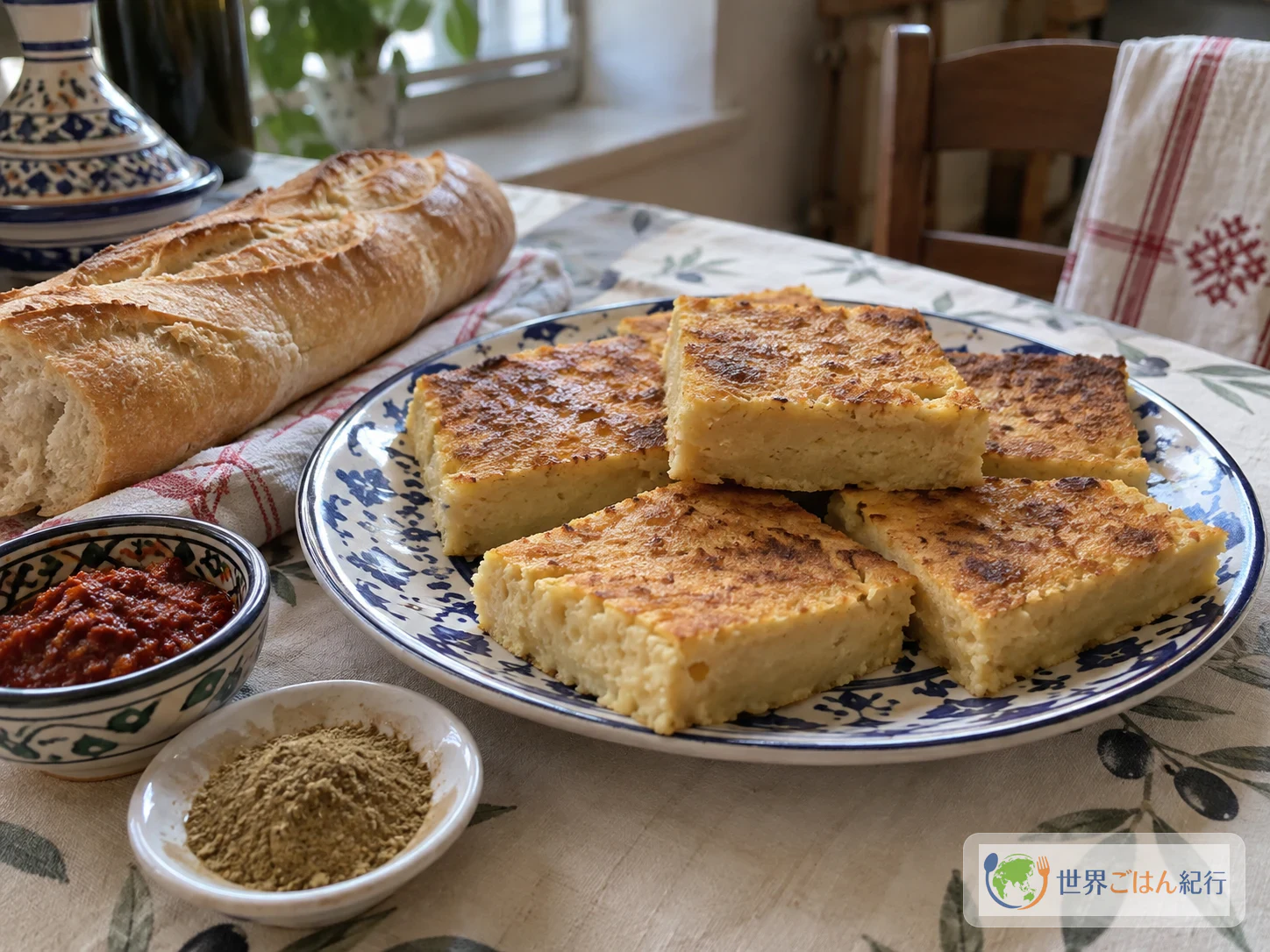
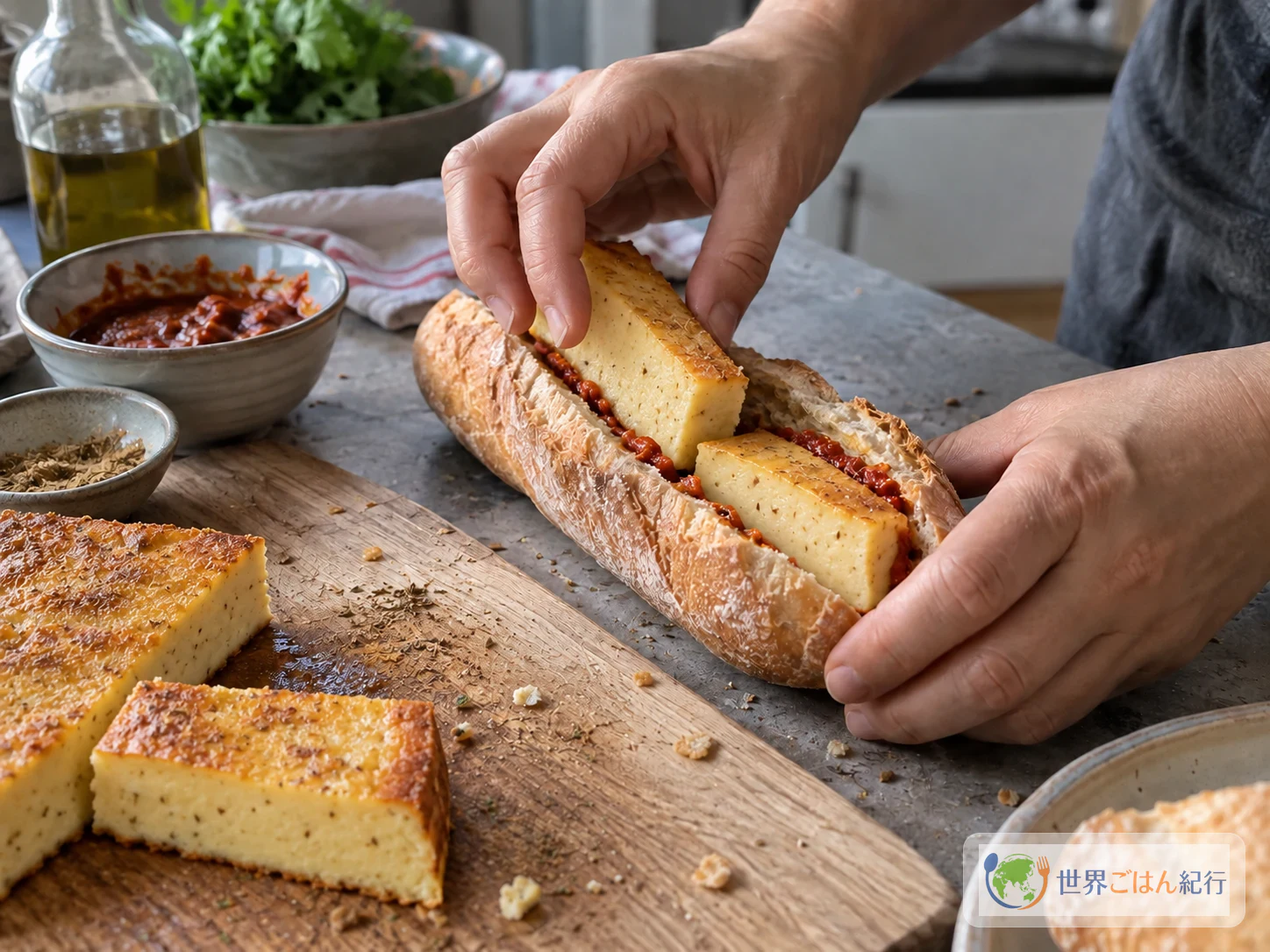
A steaming square slice slides between the halves of a split baguette. Sprinkle on cumin and smear on harissa. Bite in, and the crust of the bread crackles while the warm bean flan gives way, soft, from inside. Garantita (also karantika) as eaten in Algeria is a savory baked dish made from chickpea flour. The surface is lightly browned and the inside stays soft. The deliciousness lies in where that contrast meets the bite of the bread.
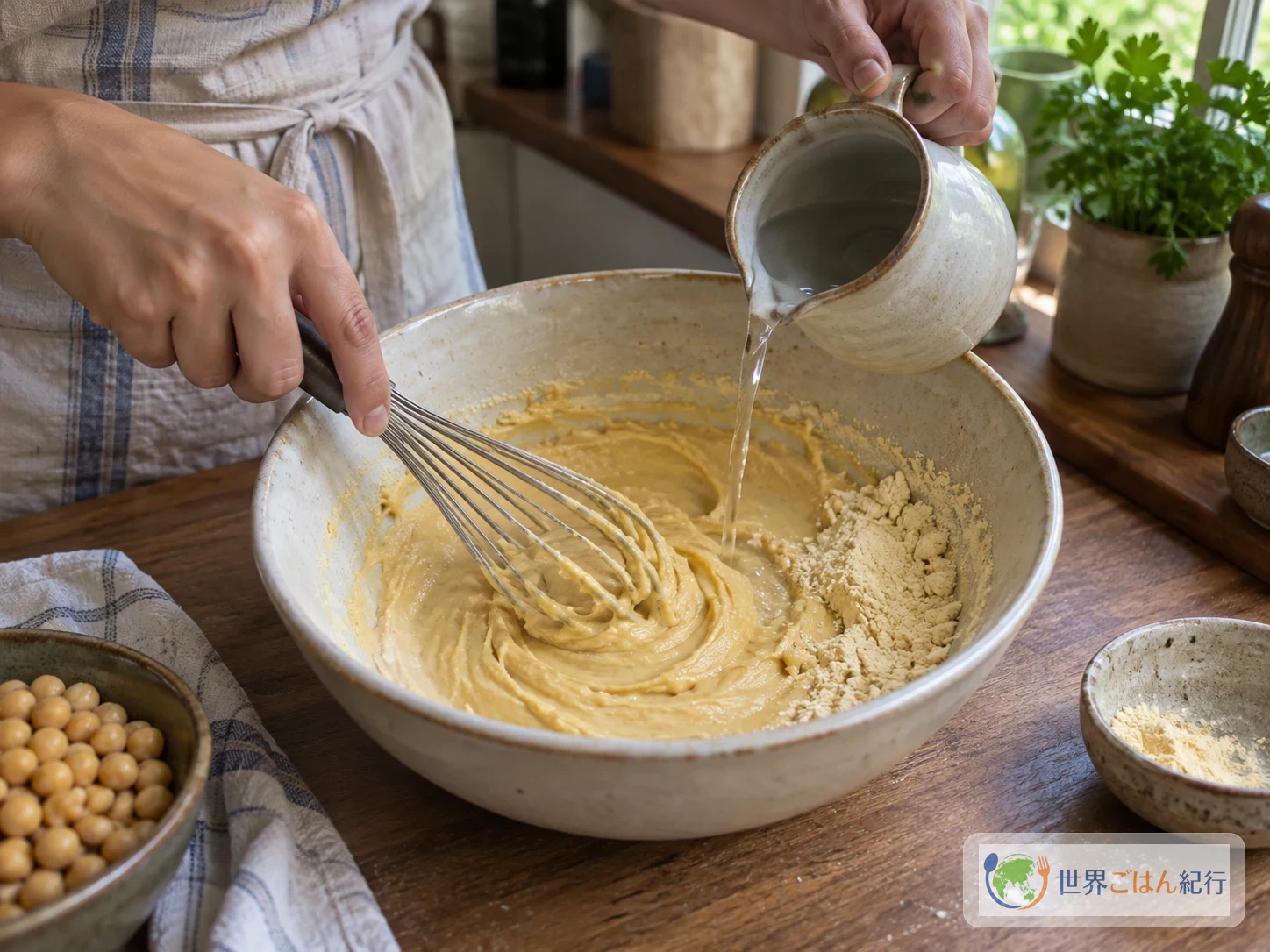
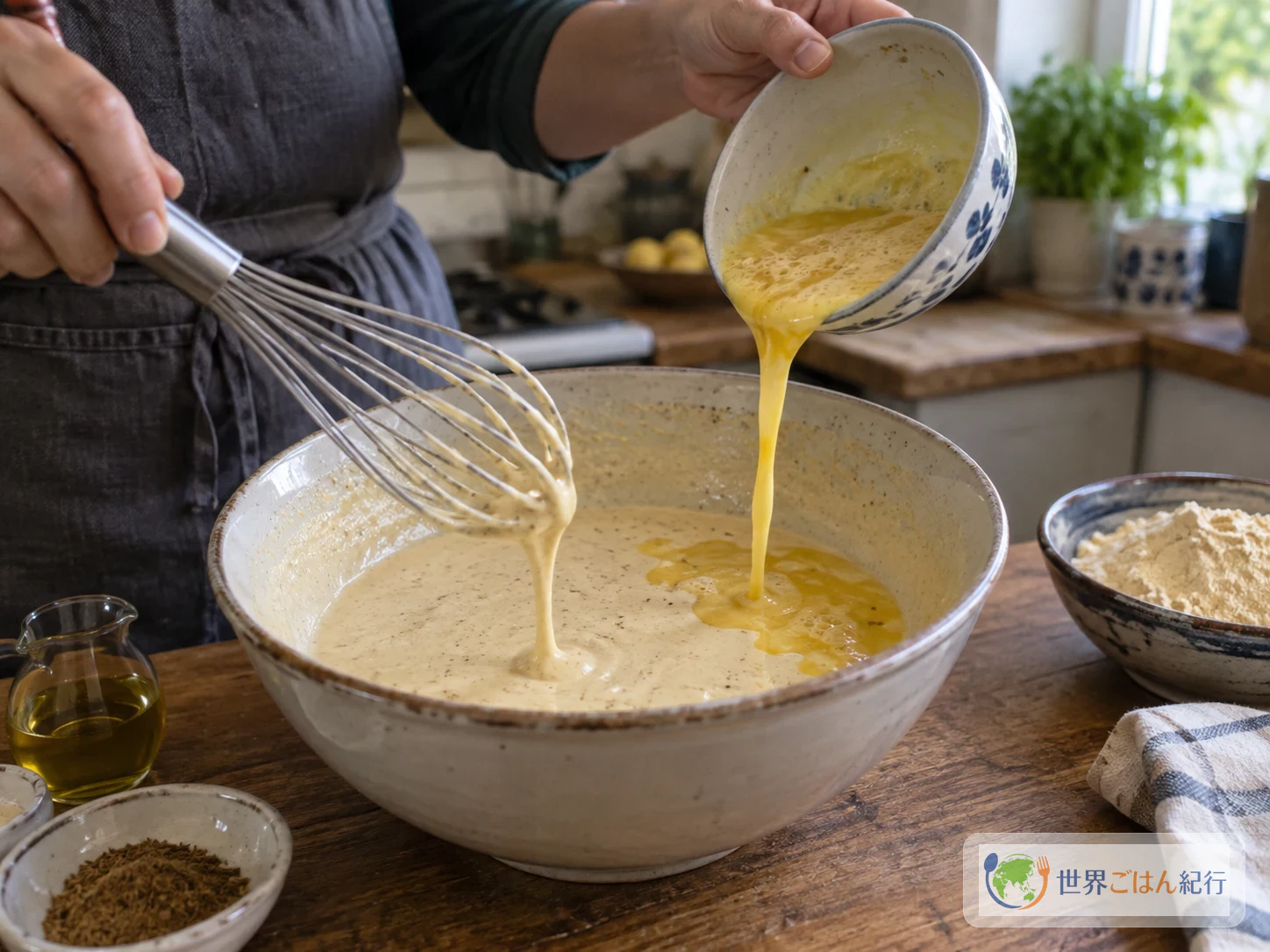
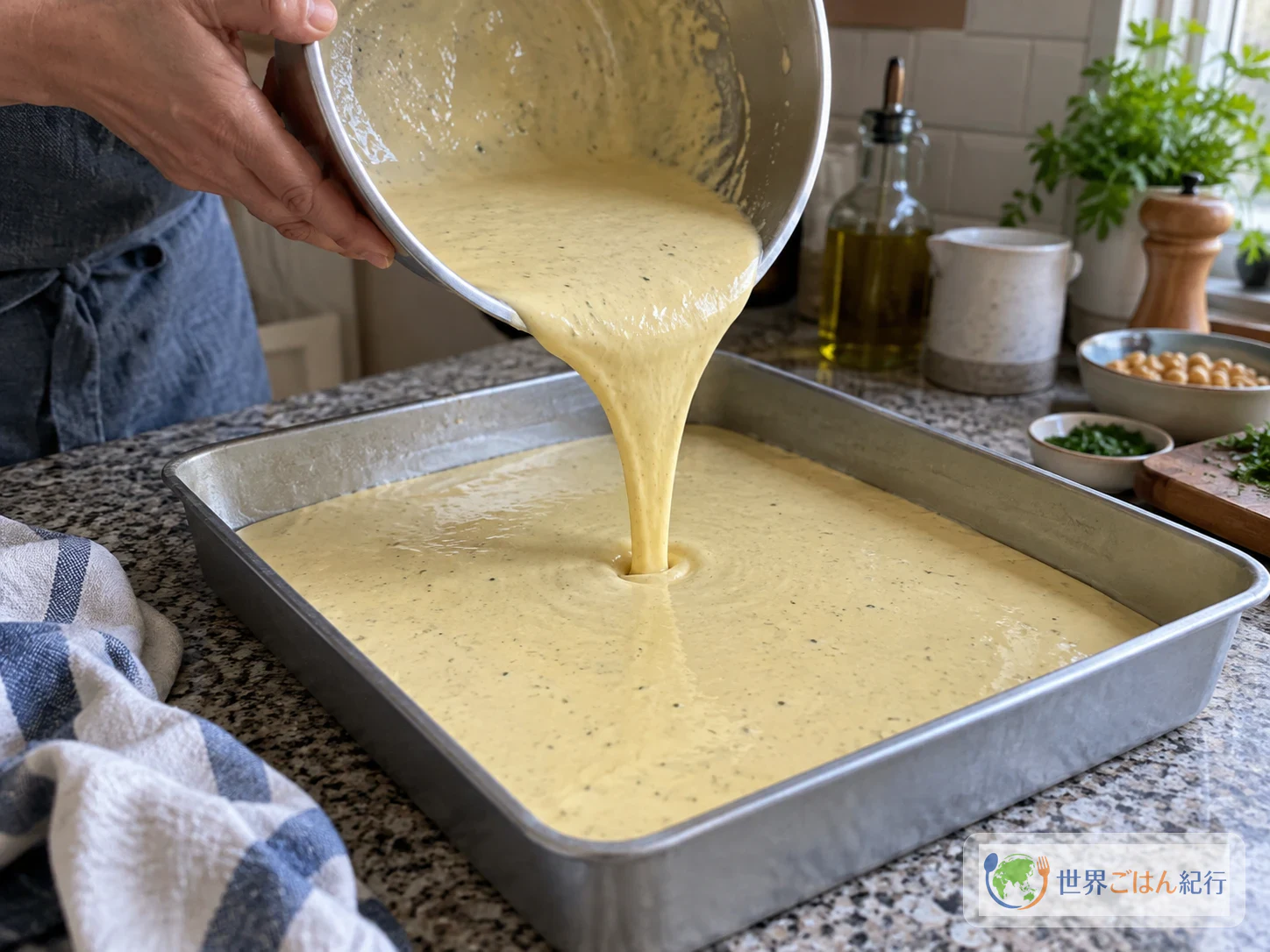
The batter uses no meat and no wheat flour. The main ingredients are chickpea flour, water, eggs and oil, and the batter before baking stays runny, close to a liquid. This watery batter sets in the oven and becomes not a dry pancake but a soft flan. There are two difficulties in a home kitchen: preparing the dedicated bean flour, and not letting the middle stay liquid when it comes out. Here we use a six-serving formula adjusted for home cooking, baked at 180 °C for 60 to 75 minutes. Preparation is 15 minutes, and about 90 minutes in total is the guide.
Names change by region at the Algerian table
This dish is known for names that vary by place. In the center it is garantita; in the west around Oran, karantika or karan; other spellings include calentica and kalentika. It is better seen not as separate dishes but as a range of names sharing a chickpea flour baked dish. Oran is a city spoken of in connection with this dish's street stalls and street-corner meals. But from the differences in names alone, we can't state exact provincial boundaries, practices common to every household or the year of origin.
How it is eaten differs between the street and the home. Besides in a baguette, there is a way of putting warm square slices on a plate and eating them with salad. In the home memories of Annaba (formerly Bône) told by the cook Zika, calentica was made as a starter, that is, a pre-meal dish. This is Zika's family history and does not show the present eating habits of Annaba as a whole. Even so, it conveys that a dish of the same flour can take the form of a portable meal in bread or a household starter served on a plate.
Formulas also differ by household. There are plain formulas with neither egg nor milk, formulas that add egg, and formulas that replace part of the water with milk. Egg gives a cohesion like a flan, and milk adds a dairy flavor. The presence of egg isn't decided by the name of the town alone: each household's formula has survived. The basic formula made here uses 2 eggs and no milk, and the milk variation is shown separately in the table later.
There are also records by people who pass on household cooking. The food blogger nadiyadel publishes a formula of 250 g bean flour, 1 L water and 1 egg as a recipe learned from a street-corner seller in Tlemcen. Meanwhile Soulef of Amour de cuisine publishes a formula with egg and milk inherited from her aunt Djamila. Both are provenances written down by the authors themselves, and good examples showing that a dish of the same name has several household formulas.
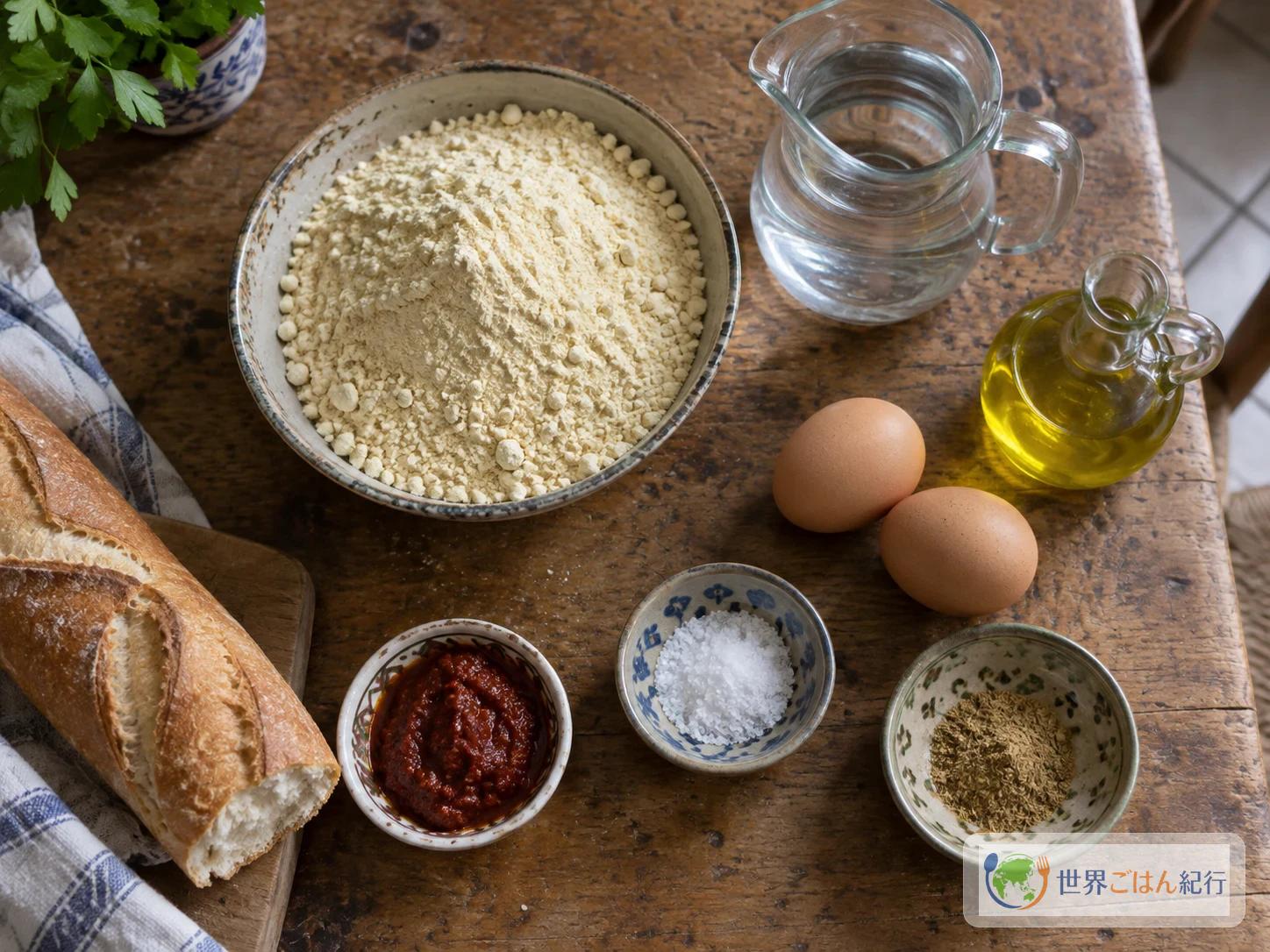
Ingredients (serves 6)
When shopping, look for the flour first. Choose unroasted chickpea flour with no seasoning mixed in. It is a different thing from roasted flour for confectionery. Check the ingredient label to confirm it is flour from chickpeas, and avoid seasoned mixes for frying. Mashed canned beans retain water and grain, so they cannot be swapped straight for this amount of flour. Prepare an oven-safe dish 22 x 33 cm and at least 4 cm deep, and check beforehand that it fits in the oven.
Tools are a whisk, a scale, a bowl of 2 L or more, an oven-safe dish, an oven and a spatula for serving. Look for the flour at stores selling imported foods or online, by the general name "chickpea flour." Prepare the cumin as powder, and choose the harissa by heat and ingredient label. No dedicated baking appliance is needed, but a microwave alone can't be said to give the same baked surface.
Pouring the whole amount into a smaller dish makes the batter thick and takes longer for the center to set. When changing dishes, check the capacity and the oven-safe label, and do not pour the batter up to the rim. Use 22 x 33 cm as the standard, and judge doneness by the state of the center, not only by time.
The basic flan contains egg and the bread contains wheat, and switching to a milk version adds dairy. Check the ingredients of the chickpea flour and harissa as well, according to what the eater avoids. Do not taste the batter, which mixes raw flour and egg. Keep it from touching cooked food or utensils, and wash hands, utensils and the work surface.
Method
Preparation is about 15 minutes and baking 60 to 75 minutes, and the guide of about 90 minutes includes the 5-minute rest before serving after baking. Even if the batter looks like a thin liquid, do not add flour to make it firm. It sets while baking. Steps 1 through 3 use no heat; the only heating is the 180 °C oven in step 4.
If small lumps of flour remain before baking, break them up with the whisk. Only for lumps that are hard to break up, remove them with a fine-meshed strainer. But if the lumps are so big that throwing out the flour would change the quantity, mix again. Foam on the surface and dry lumps of flour are different things. The runny consistency itself need not be fixed.
If it comes out hard and dry, it may be from overbaking or a dish that was too wide. Adding water after baking will not return it to the original flan. Next time go back to the specified dish and quantities, check the state of the center from 60 minutes, and stop baking there.
Eating it in bread, and what can be changed at home
Divide the 360 g baguette into 6 and cut a slit along the side. Cutting takes about 2 minutes. Spread 1/2 tsp harissa thinly per person and tuck in the warm flan. In the mouth you should sense separately the mild flavor of the flan, the aroma of cumin, the heat of the chile and the bite of the crust. People not used to heat can serve the harissa on a separate plate without spreading it and taste the baked flan first. Harissa served on the side is enjoyable enough.
Five ways to change the formula and the way of eating
| Change | Specific modification | Flavor, texture and cautions |
|---|---|---|
| Milk household formula | Make the 1,000 ml water 780 ml water plus 220 ml milk | Adds a dairy flavor. Egg and flour amounts stay the same; don't use for people who must avoid dairy |
| Make it with olive oil | Replace the 60 ml vegetable oil with the same amount of olive oil | Adds the flavor of the oil. The oil for the pan is a separate 5 ml |
| Serve without heat | Don't spread harissa; add only cumin | The basic flan itself contains no chile |
| Make it a starter on a plate | Serve the flan in small slices without bread | Taste the softness of the warm beans directly. A salad can go alongside |
| Try the Annaba household example | Add 1 tbsp Dijon mustard to the batter | A household example introduced by the cook Zika. Check the ingredients of the mustard and allergies |
If you want to bake the bread yourself too, kesra, the Algerian semolina flatbread, is a candidate. It is not stated as the standard bread for street-corner garantita, but one choice of bread to serve at home. If you want to know another warm bean dish of North Africa, try Tunisia's lablabi. Unlike this dish, which bakes bean flour, lablabi is a dish that makes the beans into a soup. It is also a next dish on days you serve garantita as a starter eaten on a plate.
Storage and reheating
For what is not eaten, don't tuck it in bread; divide only the flan into clean shallow containers. Refrigerate quickly in a shallow container. Time at room temperature should be within 2 hours, or within 1 hour if the surroundings are above 32 °C. The refrigerator should be 4 °C or below as a guide, and this dish is best eaten from the next day to within 2 days, a conservative home guide. FoodSafety.gov's general chart gives baked egg dishes 3 to 4 days, but here it is set shorter as an editorial guide, not something guaranteed by measurement.
When reheating, make sure the center reaches 74 °C or above. In a microwave, turn it partway so no cold spots remain. For reheating in an oven, the cook's guide is 160 to 170 °C, and here too check the center temperature, not just the time. Reheating does not necessarily make something that sat long at room temperature safe. Also don't wait several hours in the kitchen for it to cool completely before refrigerating.
Frequently asked questions
Can I replace the chickpea flour with wheat flour or canned beans?
This quantity is based on chickpea flour as the main ingredient. We cannot offer a method that swaps wheat flour, rice flour or canned beans at the same amount. To keep the flavor of bean flour and the texture of a watery flan, prepare bean flour as the main ingredient. Roasted flour for confectionery also does not necessarily give the same result as unroasted.
Is there a formula without egg?
Household formulas made of only flour, water, oil and salt are in fact introduced. But simply leaving out the 2 eggs of this recipe does not give the same baking time or cohesion. If you need to avoid egg, choose a different recipe whose quantities and steps have been confirmed as egg-free.
The center is runny but only the surface has colored
If the center batter runs, don't serve it as is; add 5 to 10 minutes at 180 °C at a time and check the center. If the surface color is deep, loosely cover with aluminum foil, without letting it touch the heating element. Browning and doneness are separate. A softly set flan and an uncooked liquid are different things, so also confirm that the center is 71 °C or above. For next time, points to review are a dish that was poured too thick, insufficient preheating and the oven's actual temperature difference.
Will it have the same texture if frozen?
The cook Soulef mentions that it may turn grainy after thawing and does not actively recommend freezing. Freezing is also no guarantee of a safe storage period, so the first time it is better to make an amount you can finish. Storage conditions are as in the earlier section: refrigerated, eat from the next day to within 2 days.
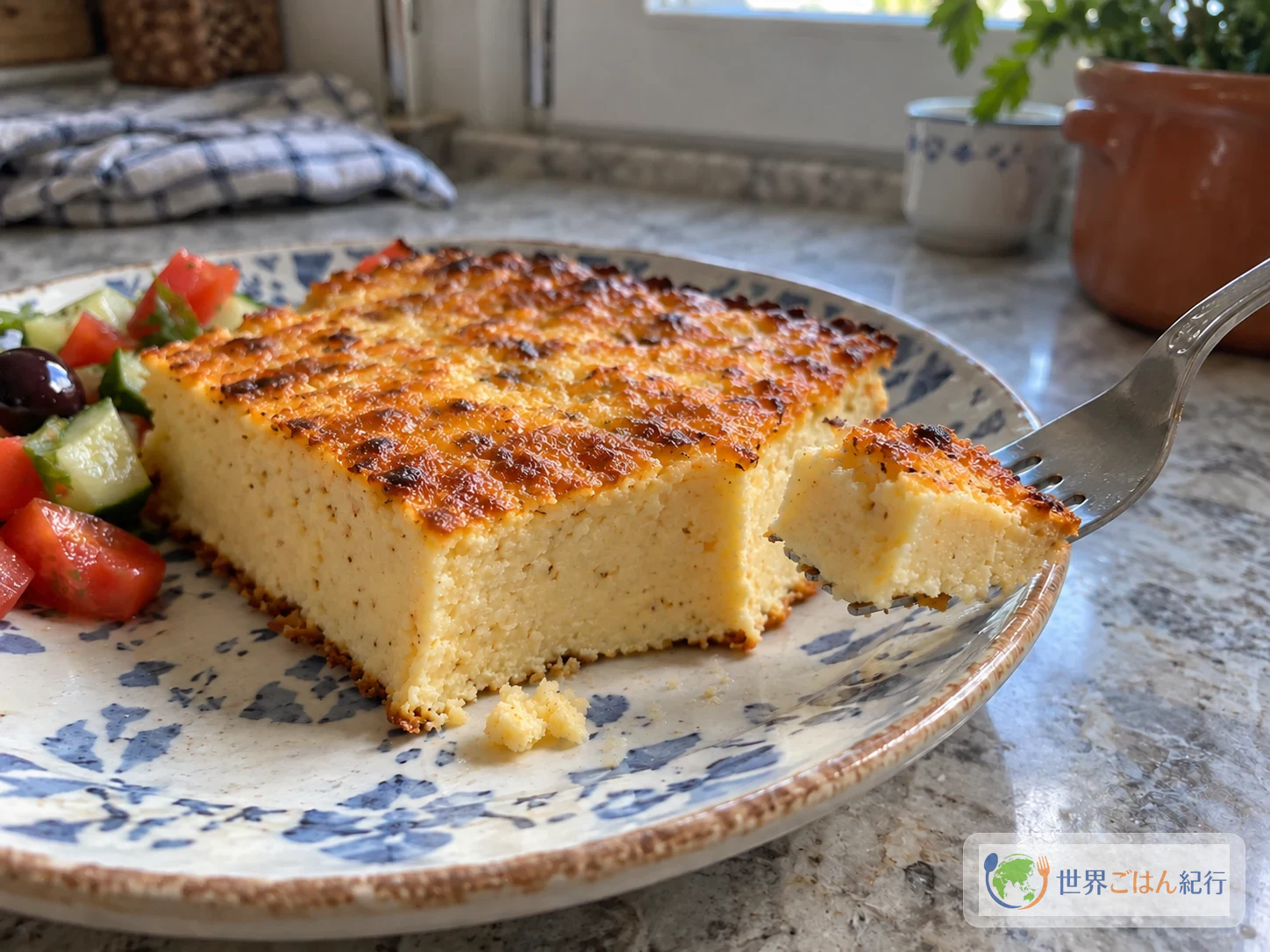
The nutrition information is an approximation for the whole flan, not including the bread, harissa or finishing cumin. It is calculated from 250 g bean flour, 100 g edible egg and a total of 65 ml oil, and varies with the product and the oil remaining on the dish. For one of six portions, about 275 kcal, about 11 g protein, about 15 g fat and about 24 g carbohydrate are the guide. Switching to the milk version changes the nutrition values from the basic formula.
Sources
- Soulef / Amour de cuisine, "Garantita : karantika algérienne" — names, household formulas, pan and baking temperature, how to eat it, fixing the texture. Accessed and checked: 5 October 2026.
- nadiyadel, "Recette de Karentika" — a formula said to be learned from a seller in Tlemcen, and how to eat it with bread, harissa and cumin. Accessed and checked: 5 October 2026.
- Cuisine de Zika, "Calentica – Karantika – Garantita pieds noirs espagnols bônois" — household memories of Annaba, unroasted flour, household formulas with egg and mustard. Accessed and checked: 5 October 2026.
- FoodSafety.gov, "4 Steps to Food Safety" — preventing cross-contamination from eggs and flour in the batter, cooling in shallow containers, refrigerator temperature and time at room temperature. Accessed and checked: 5 October 2026.
- FoodSafety.gov, "Cook to a Safe Minimum Internal Temperature" — guides of 71 °C for egg dishes and 74 °C for reheating leftovers. Last-reviewed date shown: 21 November 2024. Accessed and checked: 5 October 2026.
- FoodSafety.gov, "Cold Food Storage Chart" — general refrigerator guide for baked egg dishes. Last-reviewed date shown: 19 September 2023. Accessed and checked: 5 October 2026.
- FDA, "Handling Flour Safely: What You Need to Know" — not eating uncooked flour or batter, cleaning utensils and work surfaces. Accessed and checked: 5 October 2026.
- WhatYouEat, "Chickpea flour (besan)" — nutrient values for bean flour stated to derive from USDA FoodData Central. A reference for the nutrition estimate. Accessed and checked: 5 October 2026.


