Bazeen: A Barley Dome That Holds the Sauce
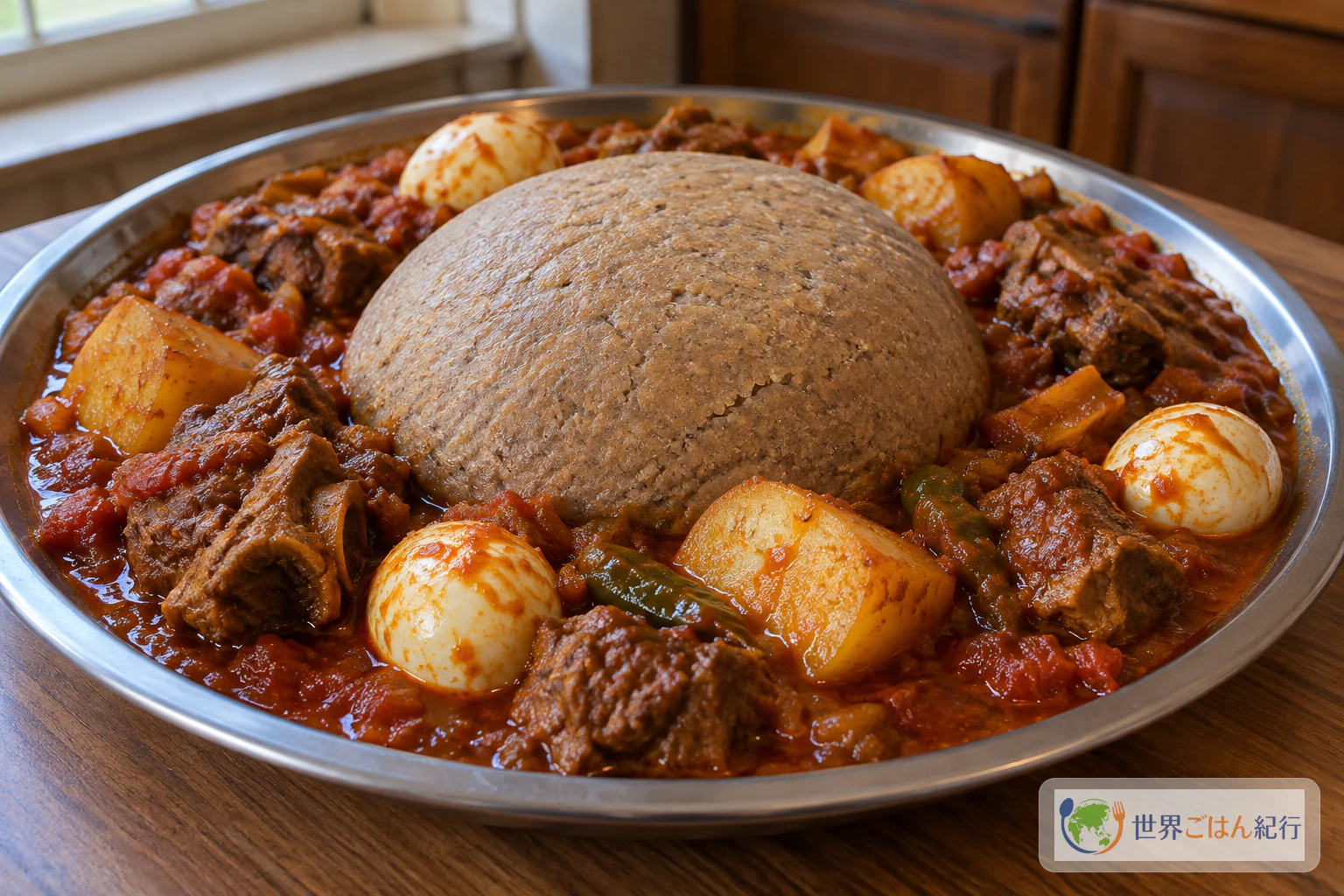
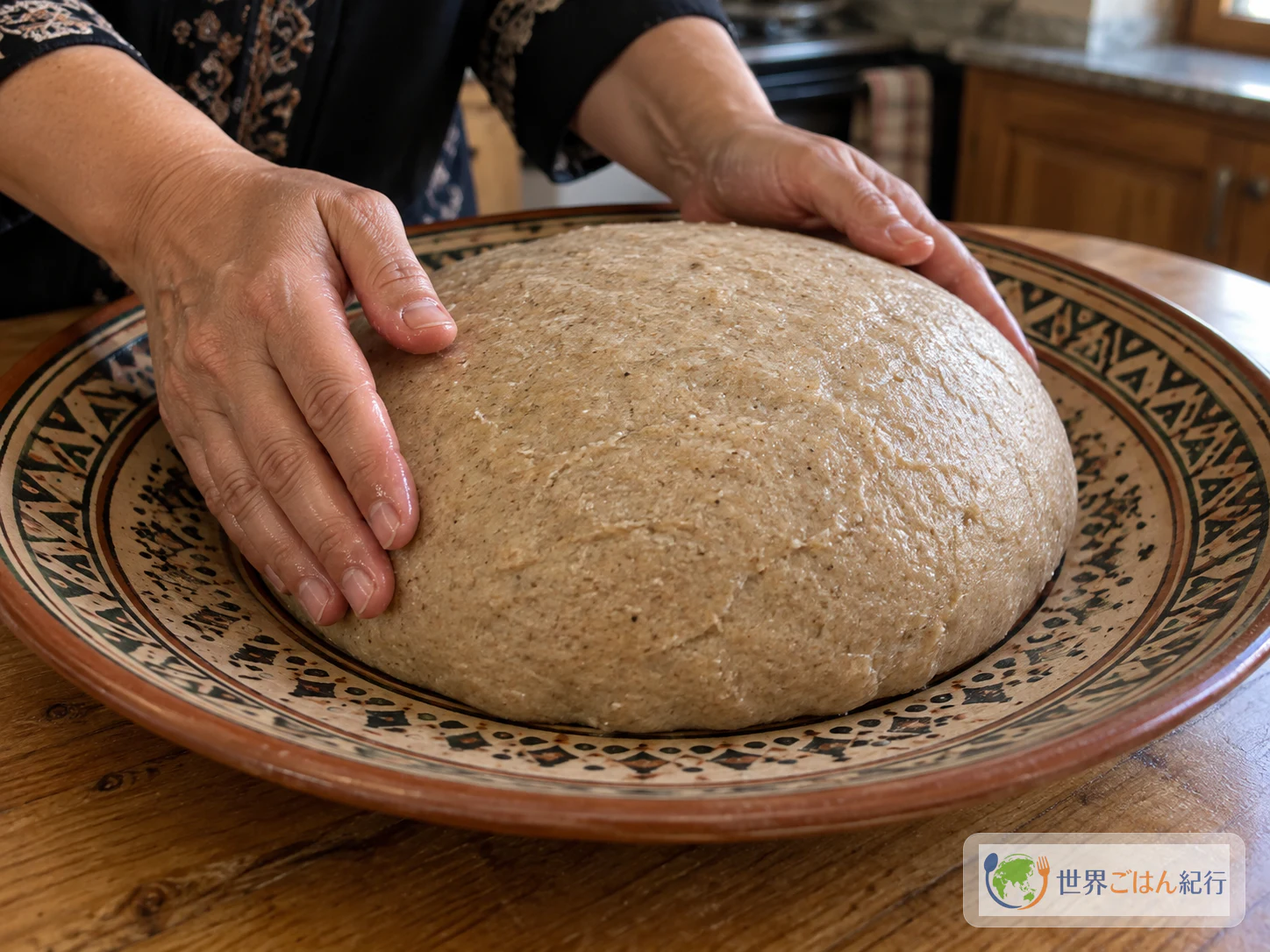
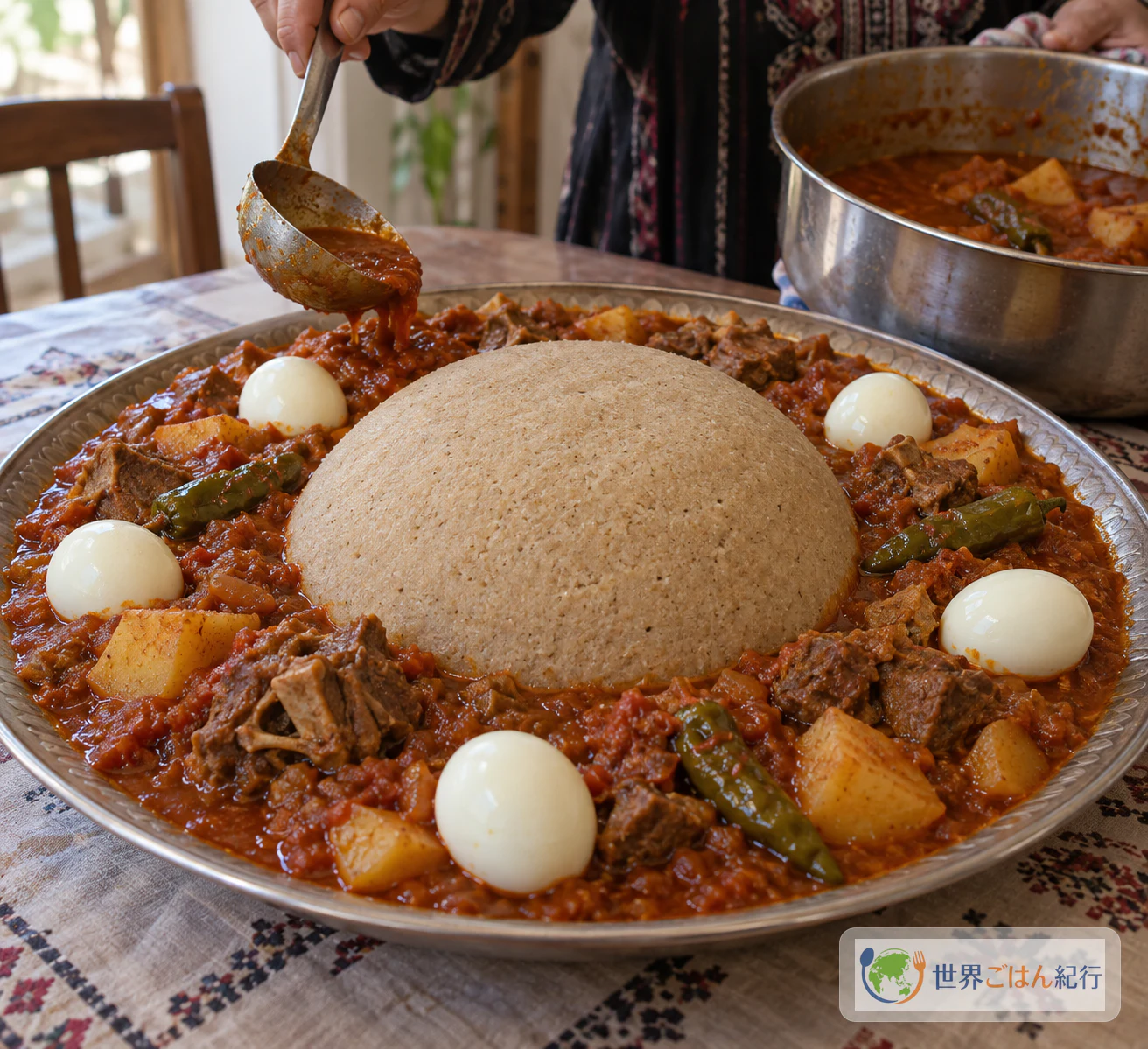
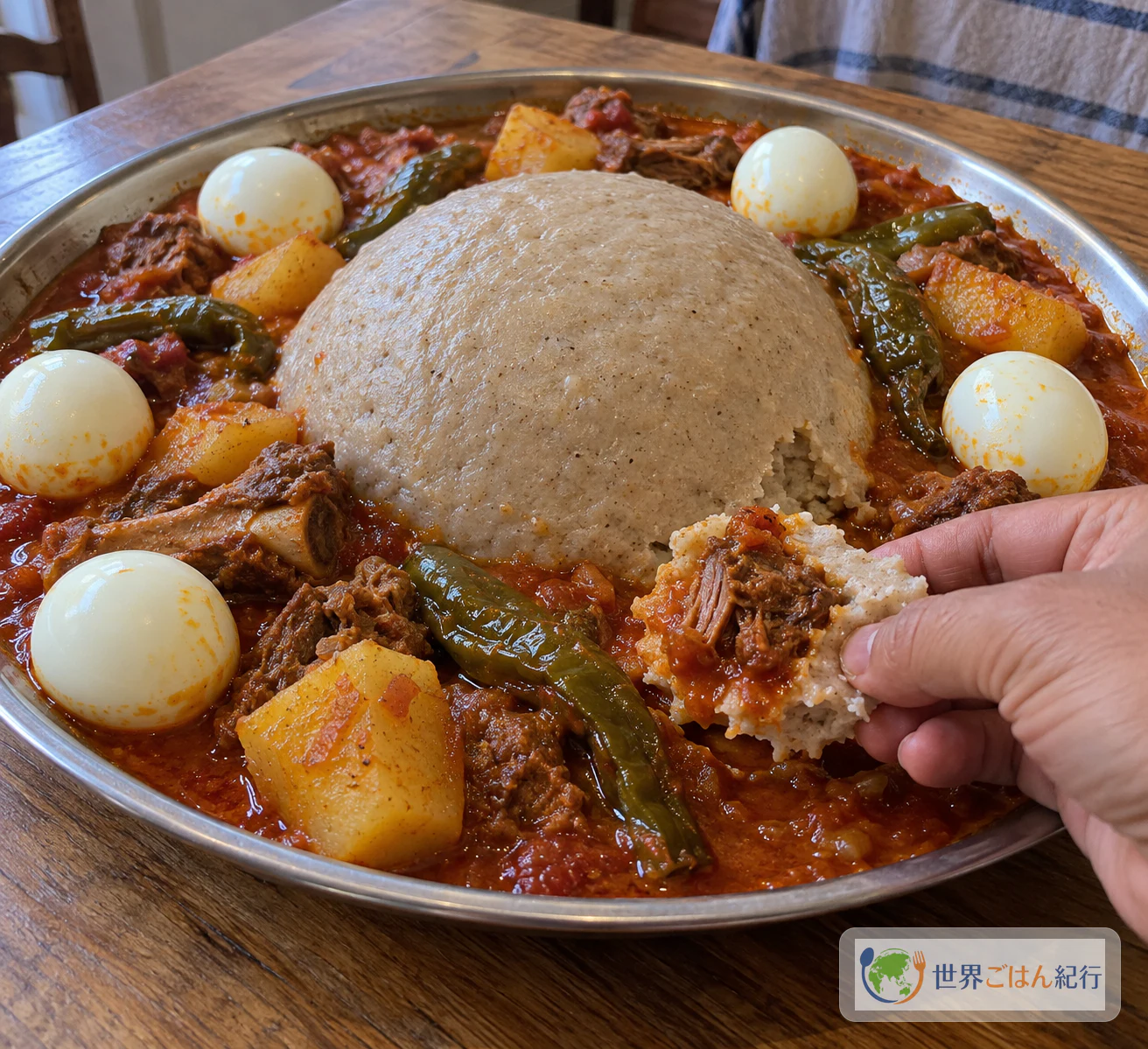
A dense dough made mostly of barley flour, worked until smooth and shaped into one dome. Around it, a red tomato stew of lamb and potatoes, with hard-boiled eggs. The dough is not a bread you slice; it is cooked, beaten and shaped, and it is there to carry the sauce.
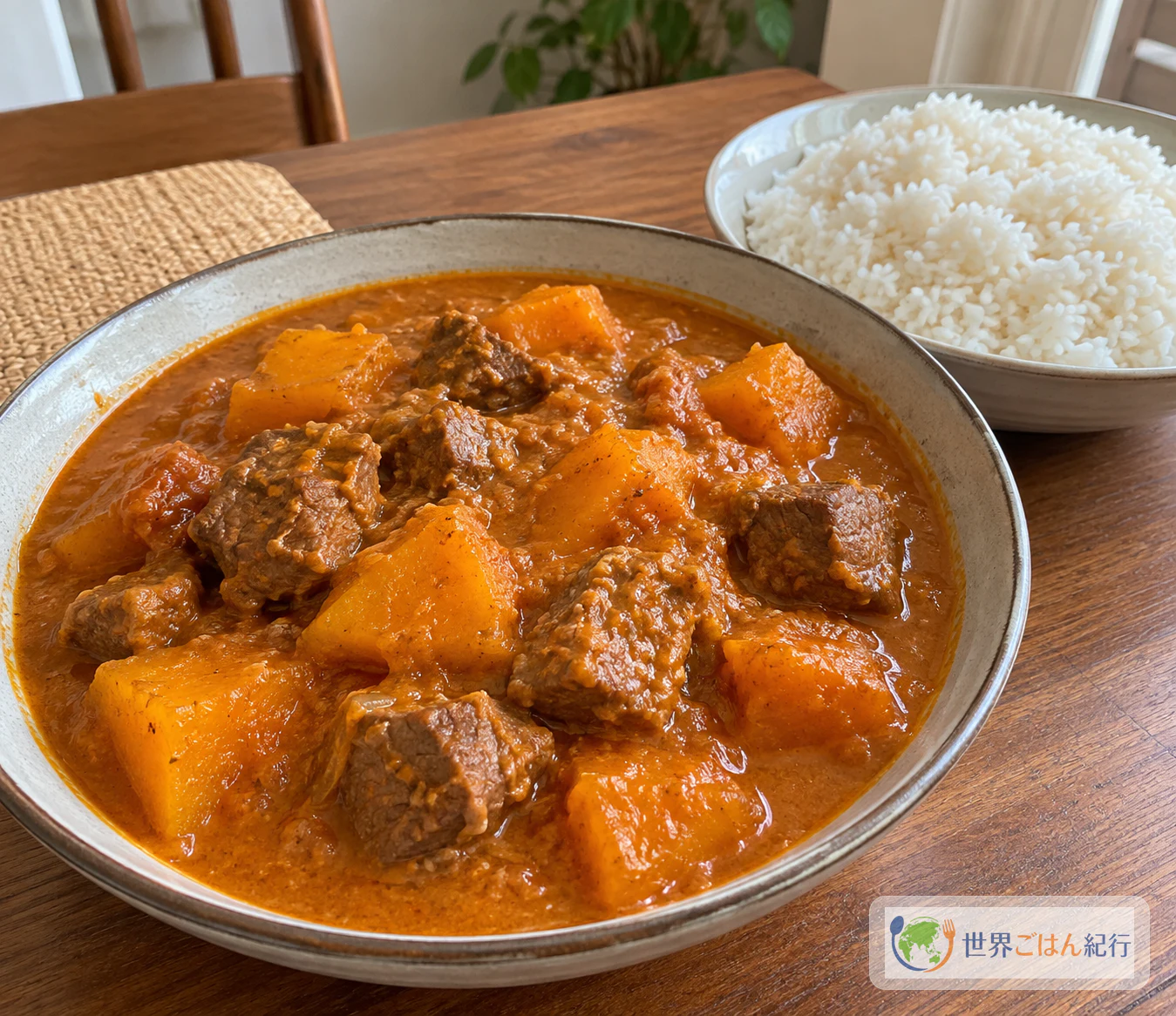
In the middle of a wide, flat platter sits a smooth, rounded dome of barley dough. Around its base runs a brick-red stew with pieces of lamb and halved potatoes, and peeled hard-boiled eggs are set into the sauce. To eat it, you tear a small piece from the dome and use it to scoop up sauce and meat. That is bazeen, a Libyan dish of barley dough and stew.
The dish appears under several spellings: Bazin, Bazeen and Bazine, and in Arabic البازين. Its sauce changes from region to region and from family to family. This article follows one specific recipe, the lamb and potato version published on the Libyan Food blog, and keeps it separate from other versions such as broad bean or chicken stews rather than blending them into one pot.
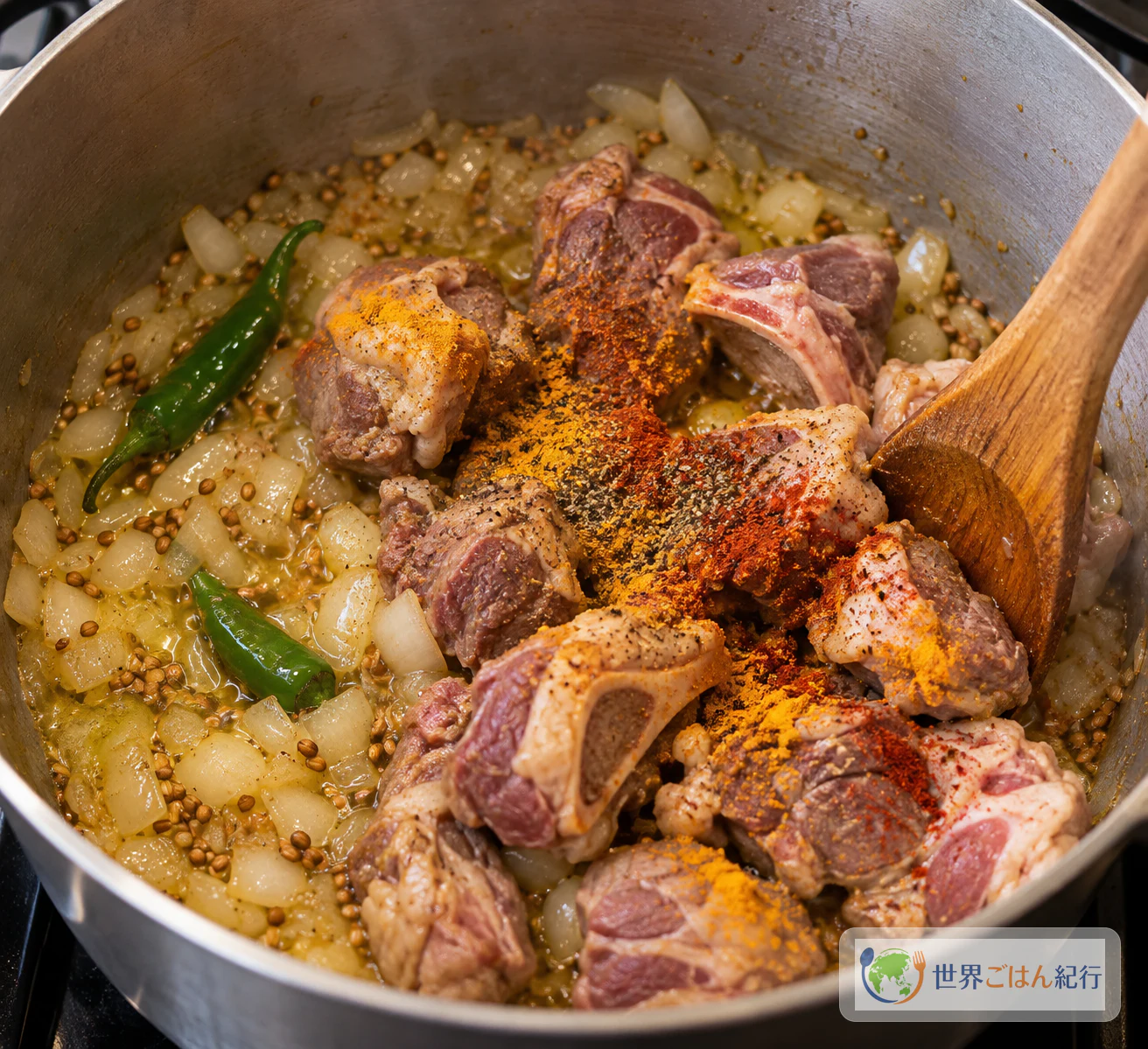
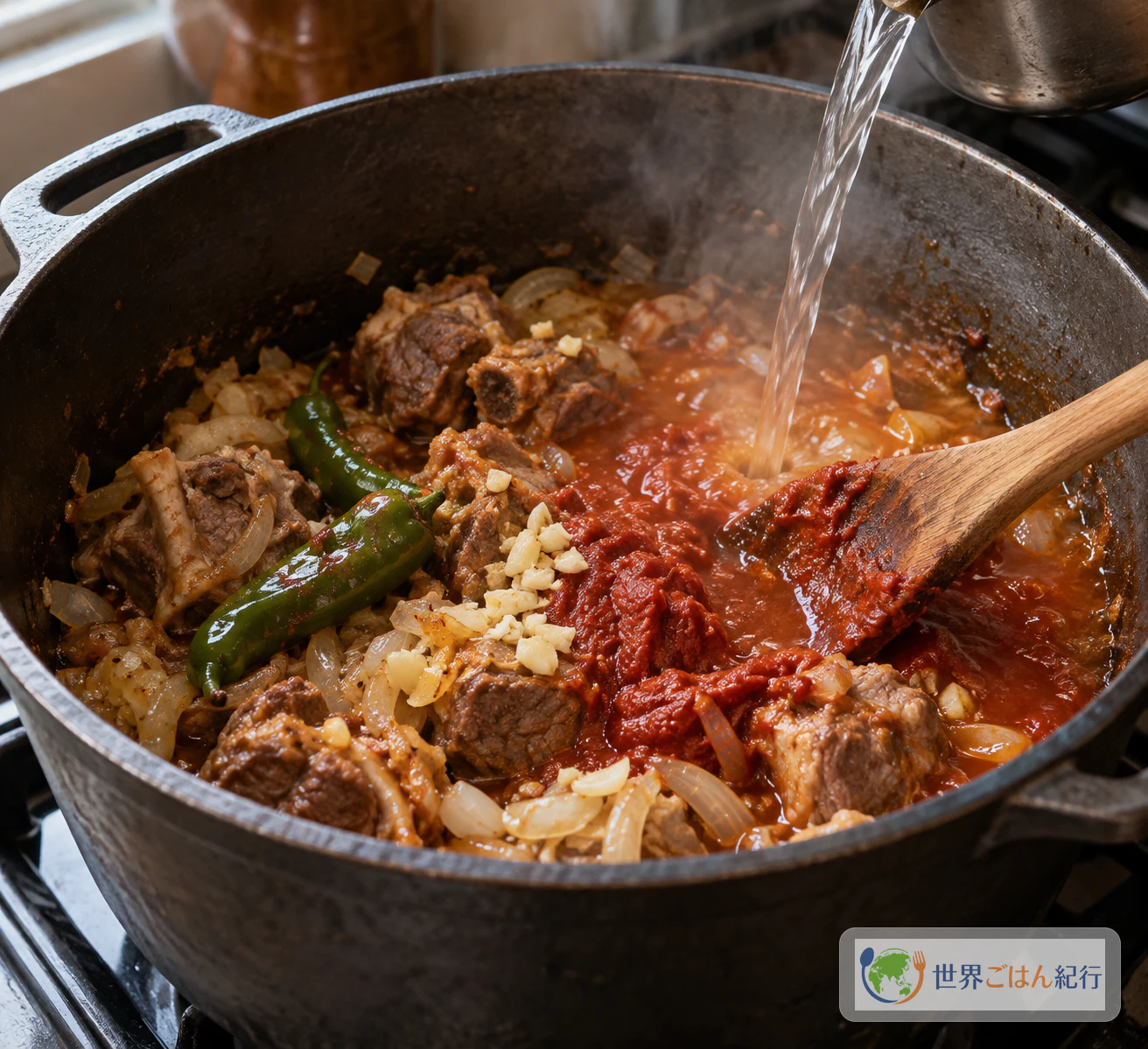
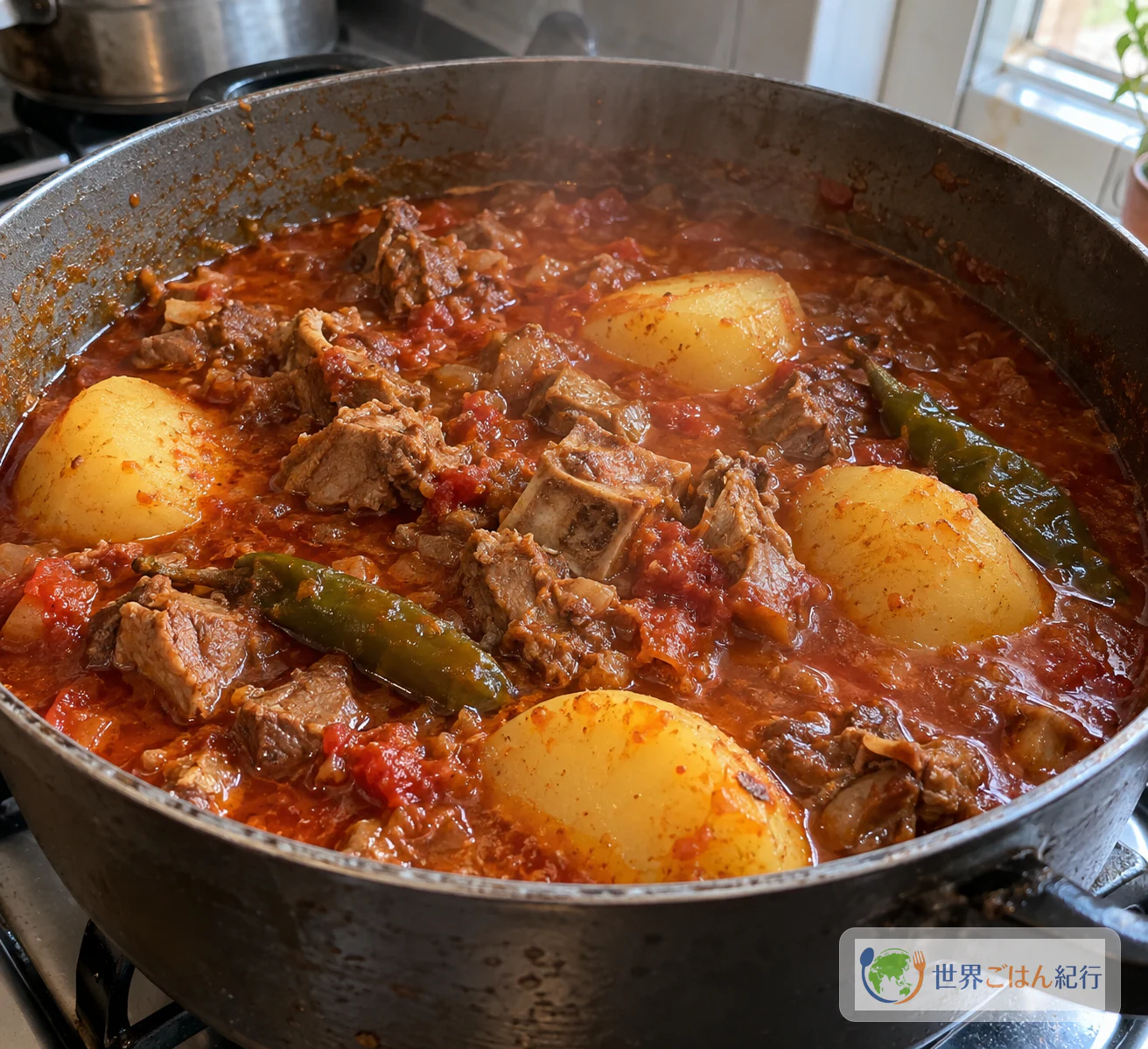
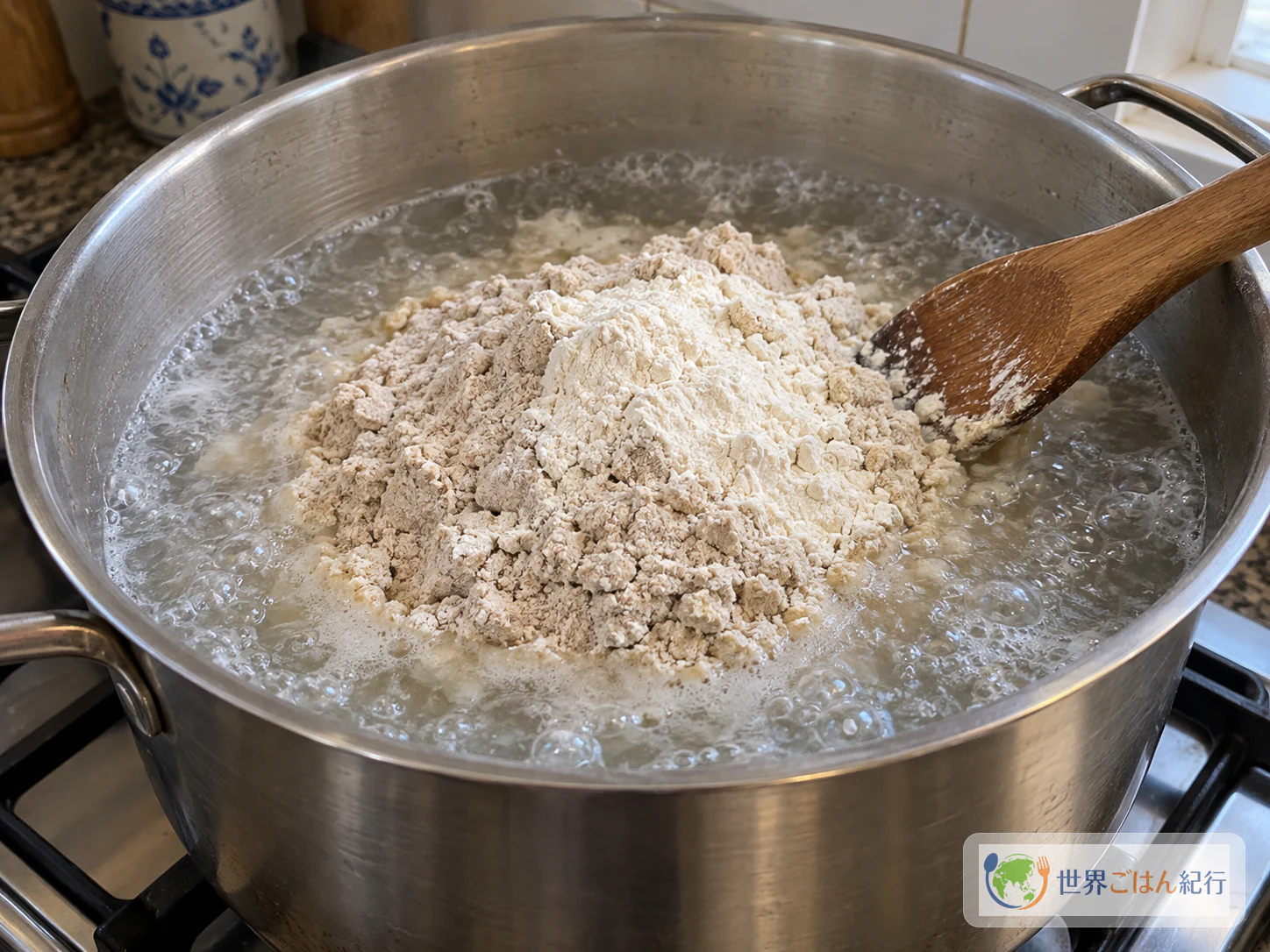
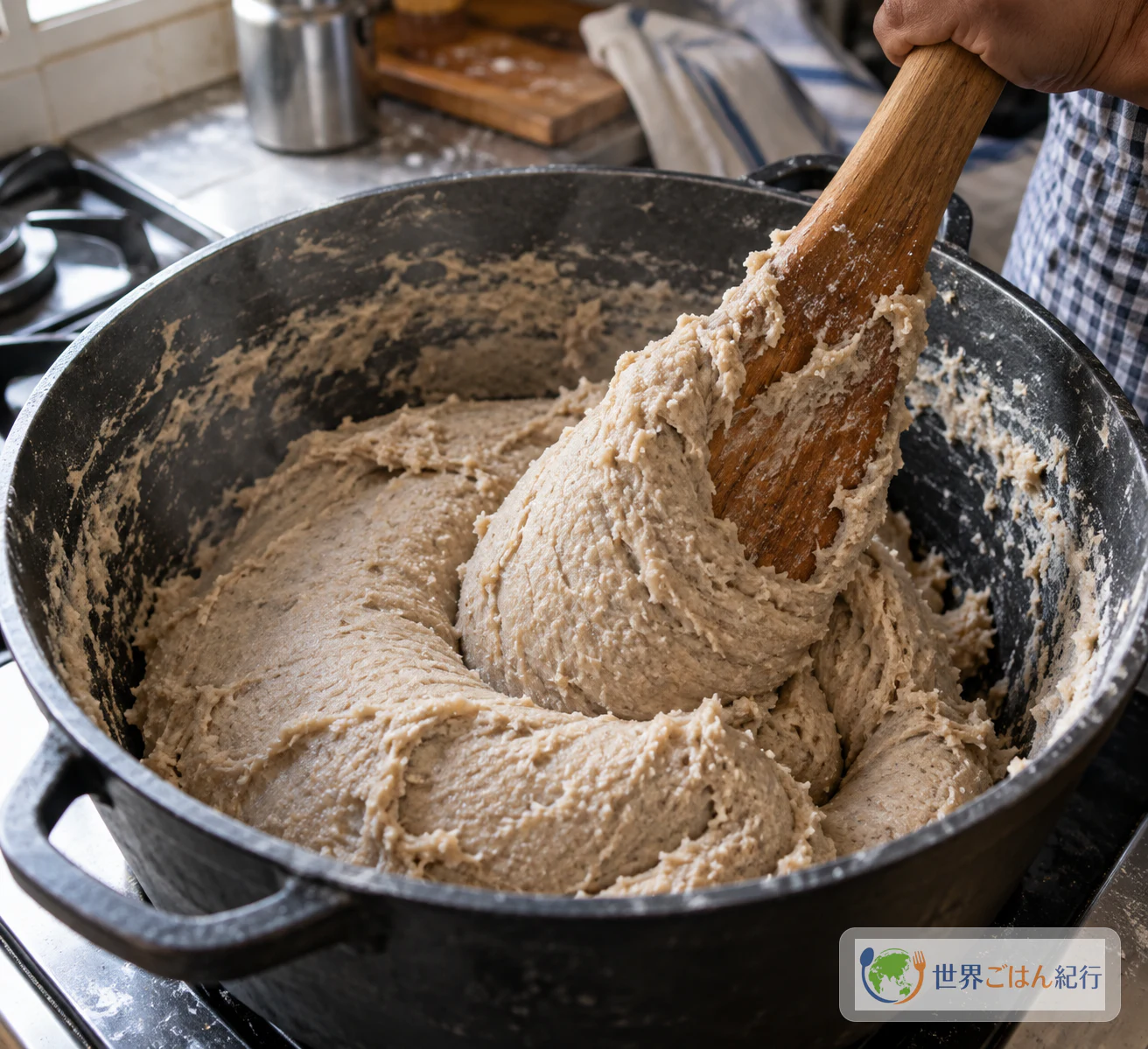
The trickiest part is the dough: cooking the flour over boiling water, then beating it into a firm, lump-free mass and shaping it into a dome. The sauce is a straightforward braise. The method below sets out the order of work, what to look for at each stage, and where the source leaves things open.
English sources write it Bazeen, Bazin or Bazine; the Arabic is البازين. Searching with more than one spelling makes it easier to find recipes and background.
A Shared Platter: Friday Lunch, Family Styles and a Ramadan Pot
The Libyan Food contributor describes bazeen as a staple of western Libya, served for Friday lunch. A separate writer on the Transparent Language Arabic blog describes it as commonly eaten for lunch, on Fridays and on special occasions. These are individual accounts, not a rule for every Libyan household or region.
The same Libyan Food post notes that the stew alongside the dough is not always lamb: camel, chicken, squid and broad bean stews are mentioned, and it also gives an example of eating bazeen in winter with a soup containing dried meat. The Libya Observer stresses family differences, describing both a meat-and-potato style and a broad bean style, noting that opinions on fenugreek and other spices differ between households, and mentioning camel meat at some wedding celebrations. This recipe stays with the lamb and potato style.
In 2025 the Associated Press reported from Tajoura, near Tripoli, where residents came together during Ramadan to make bazin in large pots and hand out servings to people waiting to break their fast, served with stew and sometimes a simple tomato sauce. It is one town's communal practice in a particular year, and a glimpse of how the dish can bring people together around a shared pot.
Ingredients: The Source Recipe for 4–6
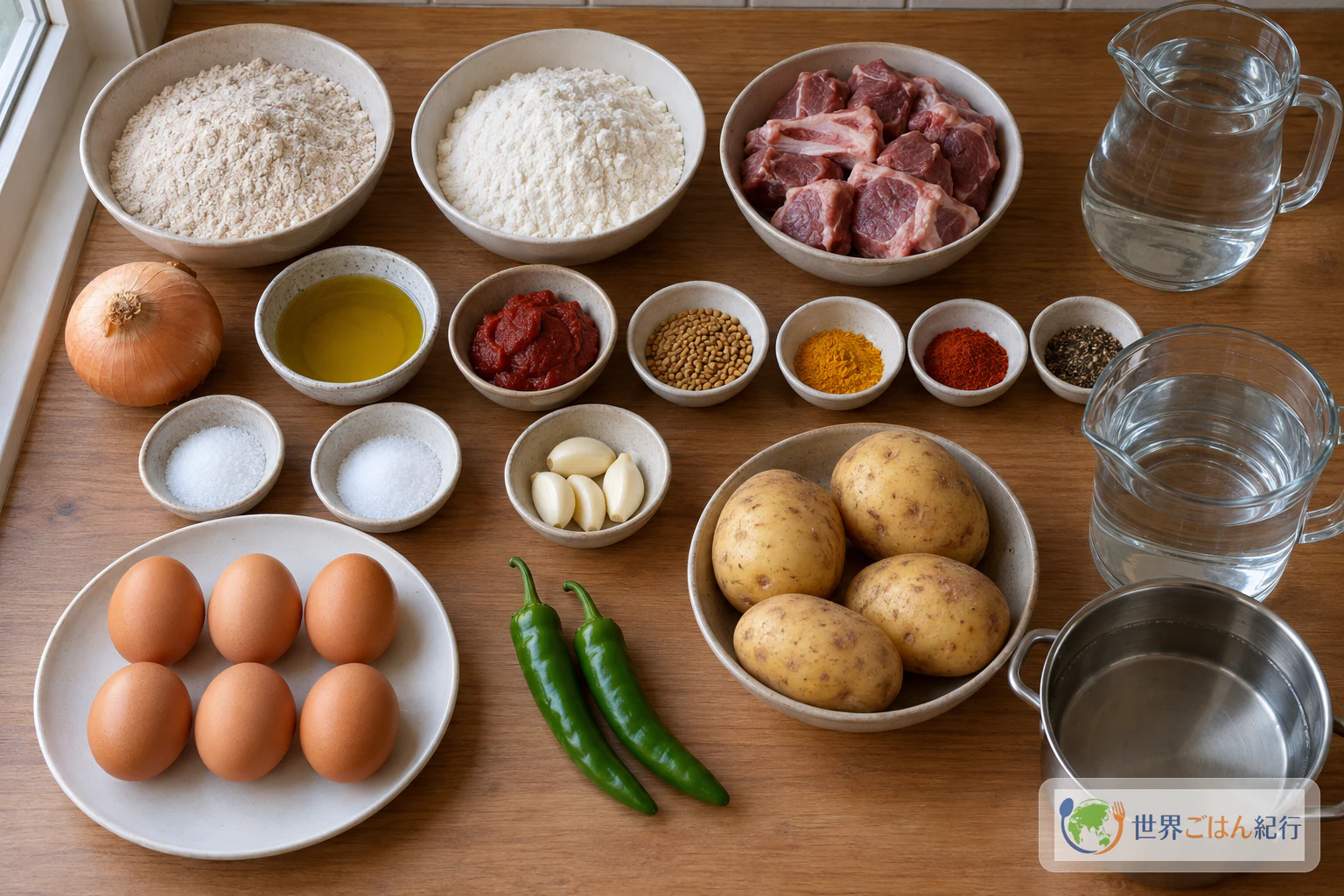
Serves 4–6.
This recipe has not been kitchen-tested by Sekai Gohan. The exact amount of water the dough absorbs, the finished weight and the total time are not confirmed.
If you measure by volume in millilitres, take 1 cup as 240 ml and 1 tbsp as 15 ml: olive oil 120 ml, tomato paste 45 ml, each spice and the sauce salt 15 ml, and the dough salt a separate 15 ml. Do not convert these to grams. Keep the two salts apart: one goes into the stew, one into the dough water. Do not combine them into a single spoonful or add either one twice.
Start the dough with 1 L of boiling water, and keep extra boiling water ready to add while you knead, judging by the dough. About 1.5 L in all is a guide; treat 1.5 L as neither a strict limit nor a guaranteed absorption amount. The sauce water (1/2 L, then 1 L) is separate from the 1 L for the dough; don't borrow the dough water for the sauce.
Equipment
- A large, heavy pot for the lamb stew
- A deep, sturdy pot for cooking the dough
- A long, wide wooden spatula or paddle with a strong handle (in Libya, a mughrif, also written mughruf)
- A wide, flat serving platter
- A small pot for boiling the eggs
- A heat-resistant, non-slip surface to steady the dough pot while kneading
- A skewer for checking the potatoes
A bread-dough machine can also be used for the kneading; that option has not been checked here.
Choosing and Substituting
Barley flour. Look for a flour whose ingredient label is mainly barley. Grind and type (for baking, whole grain and so on) change how easily the dough comes together. Potato starch and oat flour are not equivalents. Making the dough from barley alone or wheat alone changes the recipe, so if you switch, say which flour you used rather than calling it the same dish.
The flour ratio. This recipe uses 1 kg barley to 250 g wheat, 4:1 by weight. A 3:1 pattern is also common, but don't add or remove wheat flour to land between the two.
Plain flour. In Japan, medium-protein flour (chūrikiko) is a reasonable approximation.
Lamb. Use shoulder or leg. Beef makes a different version with a different flavor, not the same dish.
Fenugreek and chilli. This recipe uses whole fenugreek seed and ground red chilli, turmeric and black pepper. Families disagree about fenugreek; leaving it out is possible, but the aroma changes.
Spice amounts. A tablespoon of each spice is a bold amount. If you reduce the heat or bitterness, treat it as your own adjustment.
What's left out. Pumpkin (500 g, optional) and mushrooms are not in this version. Fresh chillies and lemon on the side are also omitted here (see Variations).
This dish contains wheat (plain flour), eggs and barley. If you react to particular grains, check with a medical professional before eating. Don't taste either flour raw.
Method: Start the Stew, Then Cook and Beat the Dough
The sauce goes on first, because it needs about an hour. While it simmers, cook the dough. The dough is beaten and shaped while it is still warm, so have the platter and paddle ready before step 6.
When Things Go Wrong
| Problem | Likely cause | What to do |
|---|---|---|
| The dough is full of lumps | The flour island was stirred while it cooked, or it wasn't pressed hard enough afterwards | Next time leave the mound undisturbed for the full 45 minutes. Now, keep pressing the dough firmly against the pot wall with the paddle |
| The dough cracks or won't come together | Not worked enough, or too dry | Knead it again, as the source advises. Add boiling water a little at a time, never all at once |
| The paddle bends or the dough won't move | The tool or pot is too light for a dough this stiff | Use a long, wide wooden paddle with a strong handle, and a large, sturdy pot |
| The pot slides while you beat | It isn't braced | Set it on a heat-resistant, non-slip surface. Don't pour water over the hot pot |
| The potatoes are falling apart | The heat is too high | Keep the stew on low and check with a skewer; stop once they are tender but whole |
| The lamb is still firm | Meat size and pot differ from the source | Keep simmering until it is tender; the source's times are a guide |
Variations from the Sources
Each of these is a different version, not an addition to the recipe above.
- Pumpkin. The Libyan Food recipe lists 500 g of pumpkin as optional.
- Other stews. The same post mentions broad bean, chicken, squid and camel stews. Squid would need its own timing rather than this recipe's braising times.
- Broad bean style. The Libya Observer describes a broad bean version alongside the meat and potato one.
- Fresh chillies and lemon. Both the Libyan Food post and the Libya Observer mention serving fresh chillies and lemon alongside. Add them at the table if you like.
- A different dough method. The Libya Observer describes cooking the dough as thin patties for 30–45 minutes before kneading, with flour measured by eye. It is a separate technique, not to be combined with the quantities here.
- Camel meat at weddings. The Libya Observer mentions this at some celebrations. It is part of the dish's story rather than a substitution to try at home.
Leftovers and Food Safety
No storage period has been verified for this dish. Following Japan's Ministry of Health, Labour and Welfare guidance for home kitchens, divide leftovers into small, shallow containers so they cool quickly, and reheat them thoroughly to 75°C or above as a guide. This is general home food-safety guidance, not a tested figure for bazeen.
Grain and Stew on One Platter
What makes bazeen is the way the barley dome and the stew work together: the firm, dense dough meets a rich red sauce, and everyone eats from the same platter. Whether it's Friday lunch in western Libya or a Ramadan pot shared in Tajoura, the dish centers on that shared plate. For more dishes from the country, see our Libya page.
Frequently Asked Questions
Can I make it with barley flour only?
This recipe uses 1 kg of barley flour with 250 g of plain flour. A barley-only dough is a different recipe from this one, and its handling hasn't been checked here. If you change the flours, say which ones you used.
How do I knead such a stiff dough?
Wait until the 45 minutes of undisturbed cooking are up, steady the pot on a heat-resistant, non-slip surface, and press the dough firmly against the sides of the pot with a strong wooden paddle until no lumps or dry flour remain. Add boiling water a little at a time if it is too stiff, and keep bare hands out of the hot dough.
Can I leave out the fenugreek?
Families differ on fenugreek, as the Libya Observer notes, so some leave it out. The aroma of the stew will change.
Can I use beef instead of lamb?
You can, but it makes a different version with a different flavor, not the same dish.
How many people does it serve?
The source gives 4–6 servings. The dough's weight and the actual size of a portion haven't been measured.
Sources
- Libyan Food (Tasnim), "Bazeen بازين." The recipe followed here: ingredients and quantities, the sauce and dough methods, shaping, 4–6 servings, Friday lunch in western Libya, stew variations and serving. https://libyankitchen.wordpress.com/2010/12/19/bazeen-%D8%A8%D8%A7%D8%B2%D9%8A%D9%86/
- The Libya Observer (RabiaGolden), "Traditional Libyan Bazine recipe." Regional and family variation, the lamb and potato and broad bean styles, camel meat at some weddings, lemons and fresh chillies on the side, the mughrif paddle, and an alternative dough method. https://libyaobserver.ly/culture/traditional-libyan-bazine-recipe
- Associated Press (Yousef Murad), "A Libyan town comes together to make a beloved Ramadan dish." Communal bazin cooking and sharing for Ramadan iftar in Tajoura, near Tripoli, in 2025. https://apnews.com/article/libya-ramadan-bazin-food-iftar-301b21e2152bdf0523357b2c0405be8c
- Transparent Language Arabic Blog (Hanan Ben Nafa), "Libyan Recipe: Bazeen بازين." The Arabic name البازين, the author's account of when it is eaten, the dough-and-sauce composition and the mughruf tool. Its quantities are not used. https://blogs.transparent.com/arabic/libyan-recipe-bazin-%D8%A7%D9%84%D8%A8%D8%A7%D8%B2%D9%8A%D9%86/
- Ministry of Health, Labour and Welfare, Japan, "家庭での食中毒予防" (Preventing food poisoning at home). General home guidance on heating food through, avoiding cross-contamination, cooling leftovers quickly in shallow portions and reheating. https://www.mhlw.go.jp/stf/seisakunitsuite/bunya/kenkou_iryou/shokuhin/syokuchu/01_00008.html