Mokary au Coco: Small Coconut Cakes for Breakfast and Snacks
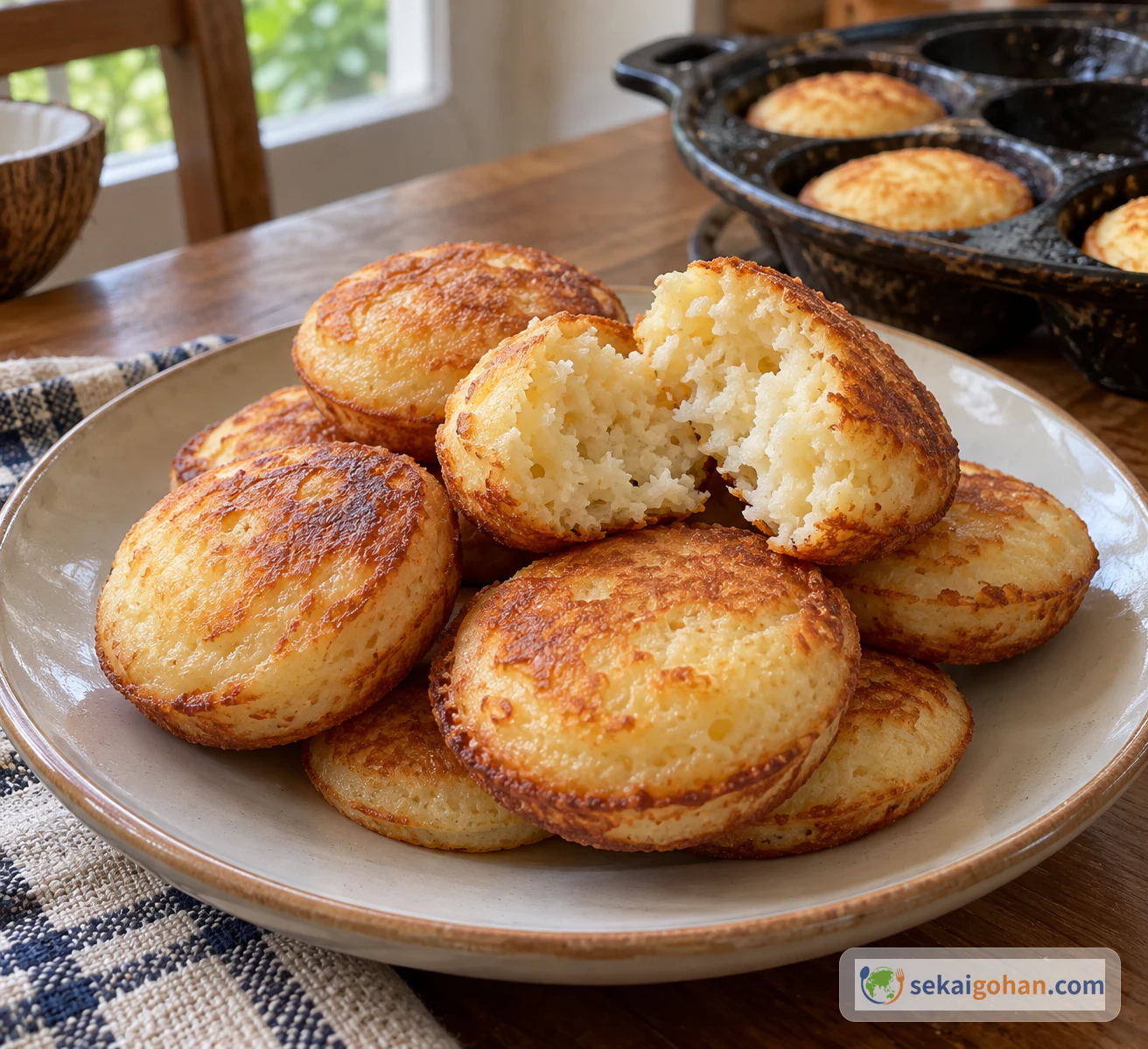
Aim for the softness of rice flour, the scent of coconut milk, the lightness of a yeast batter, and the small round shape that comes from a multi-well pan.
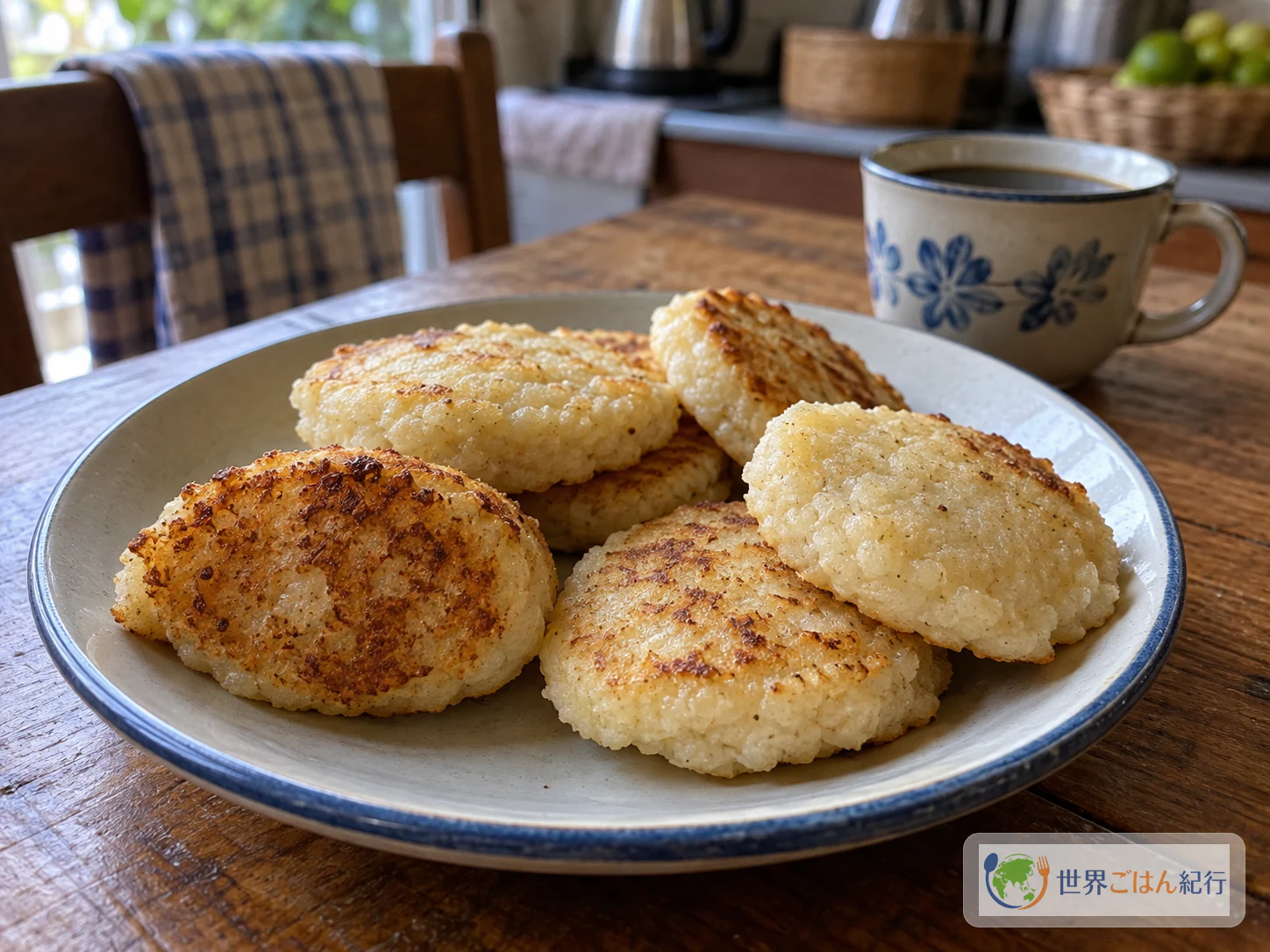
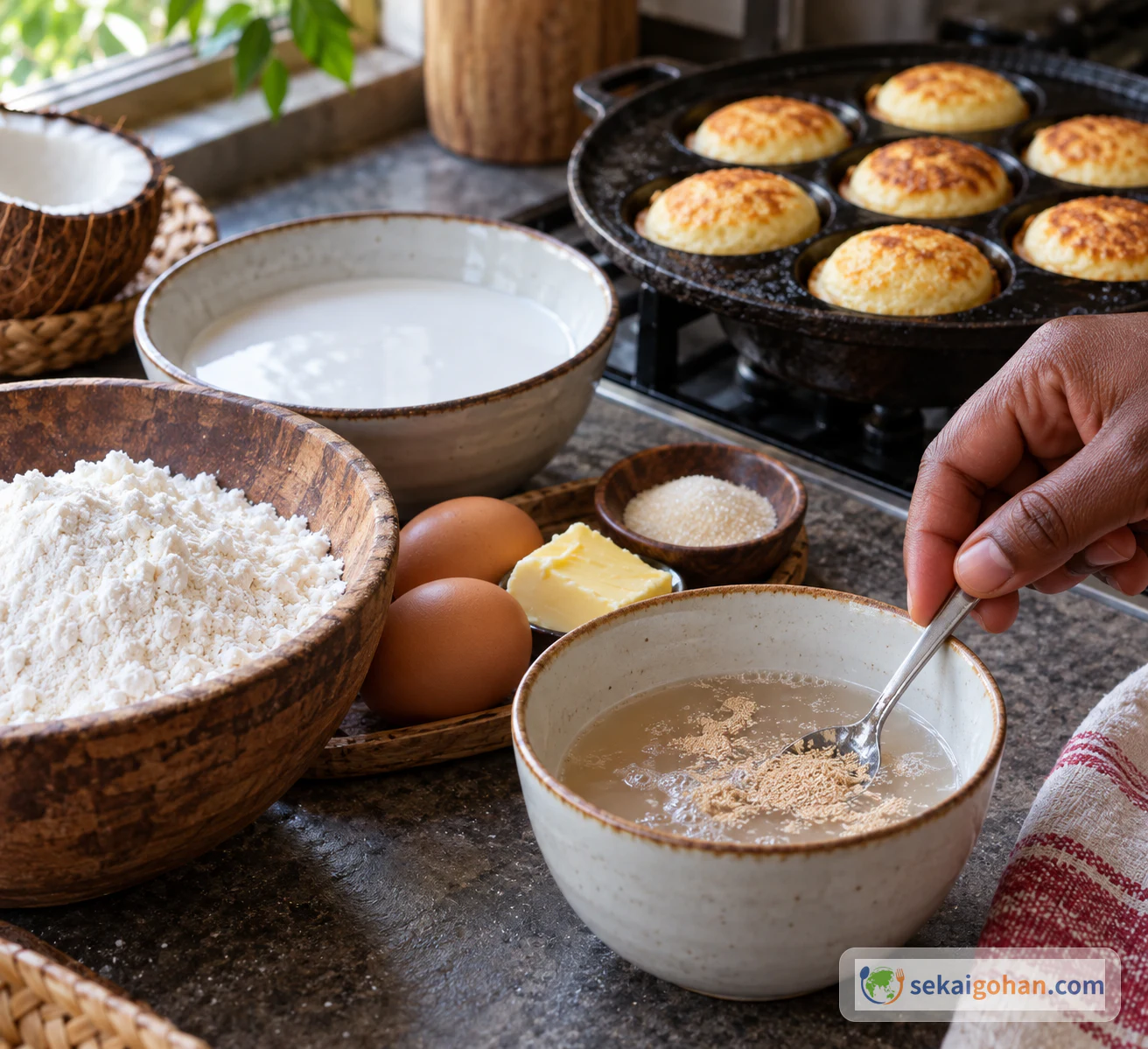
Picture a plate of small round cakes, golden on both sides and still warm, next to a cup of coffee or tea. Moov.Mg presents mokary au coco as a breakfast or snack, and the Madagascar Destination culture portal describes mokary as a soft, slightly sweet coconut-milk cake eaten with coffee or tea.
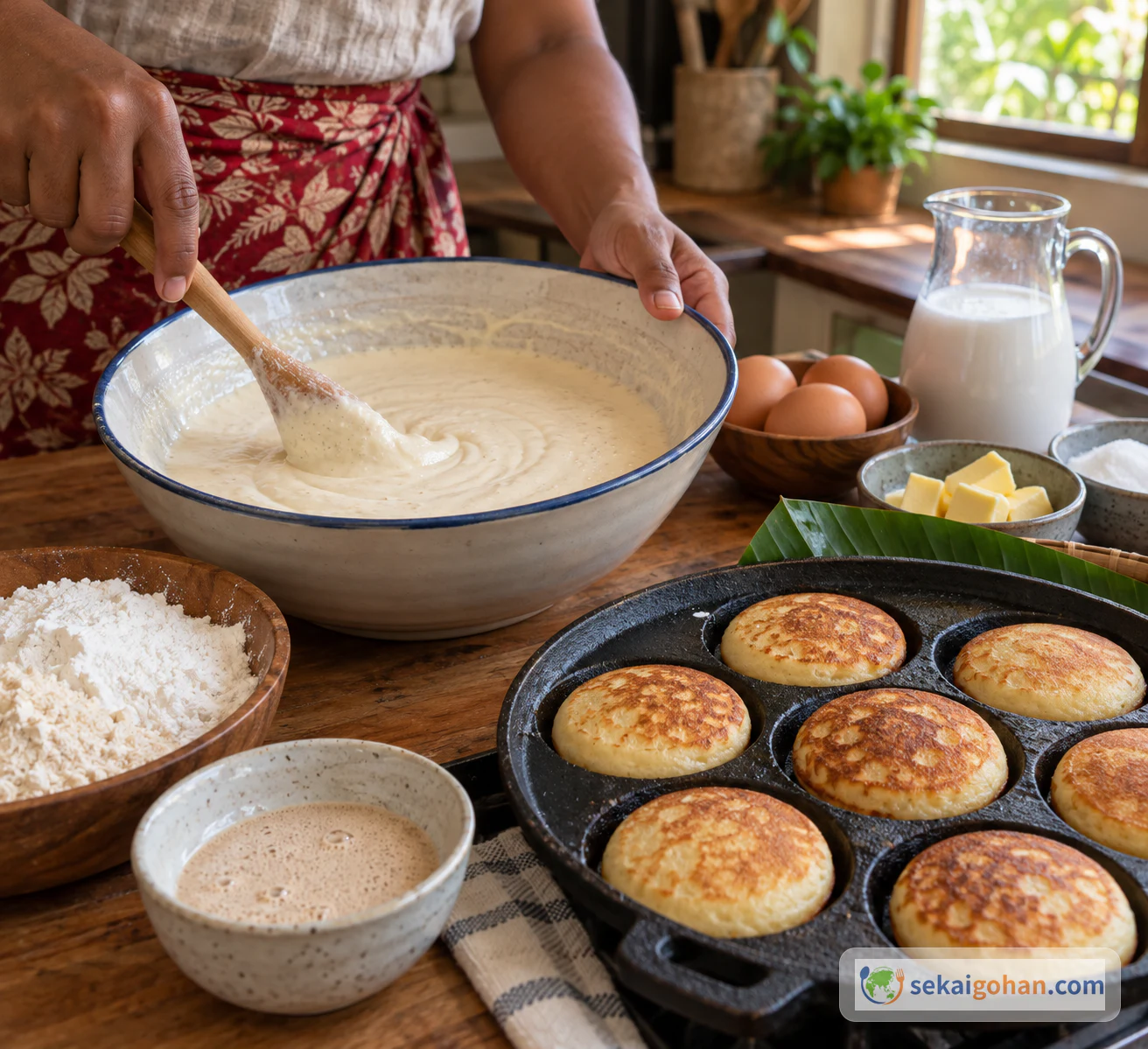
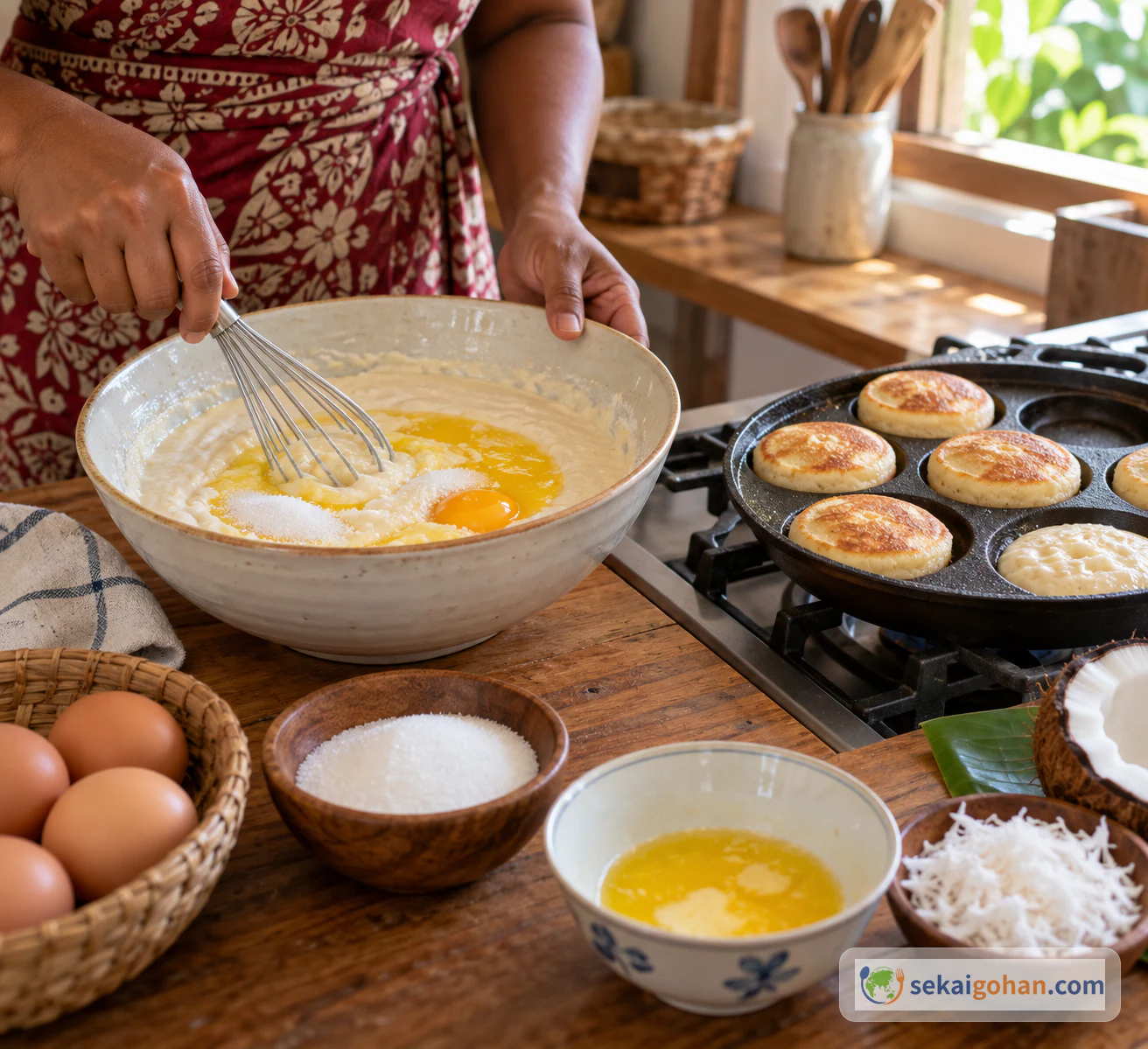
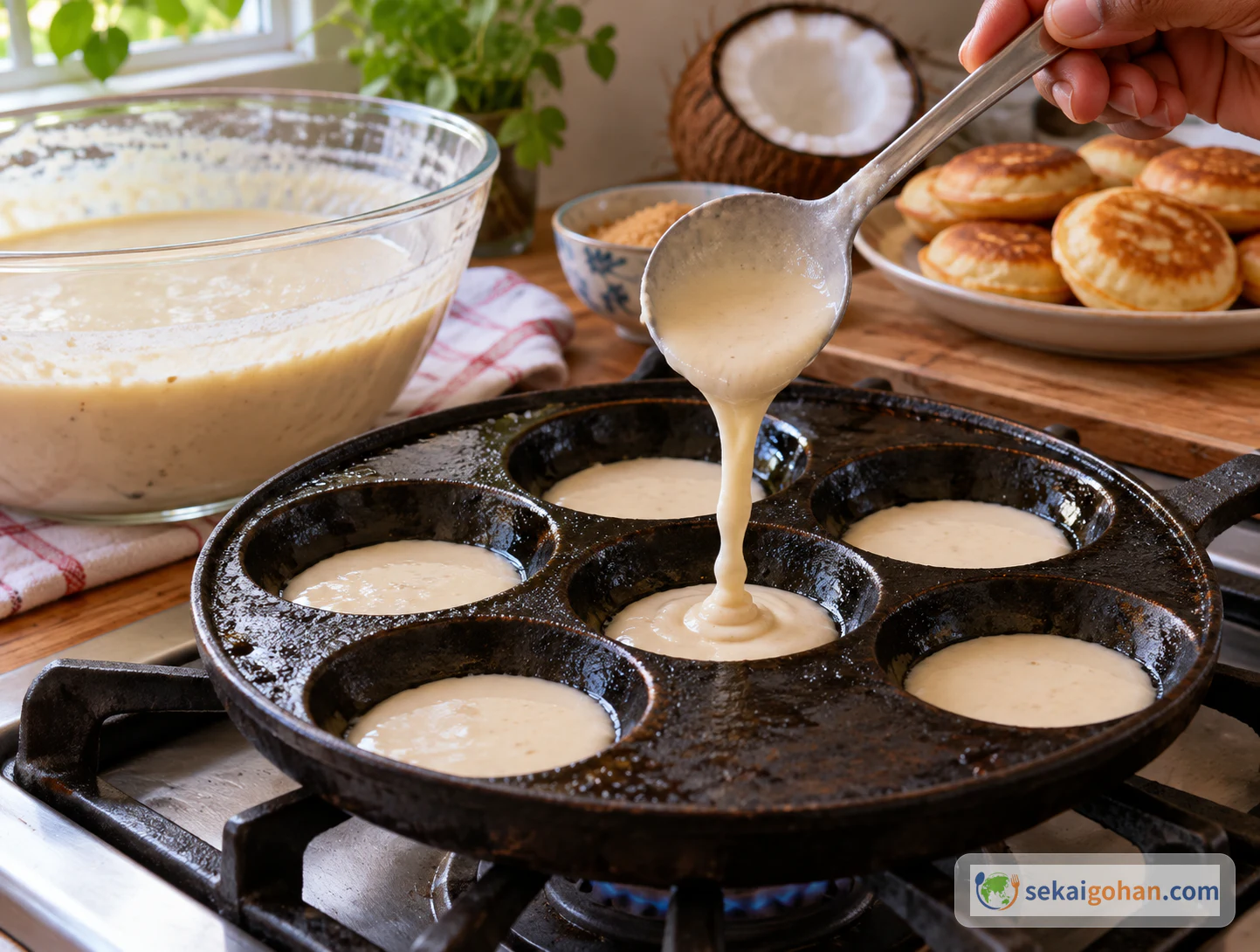
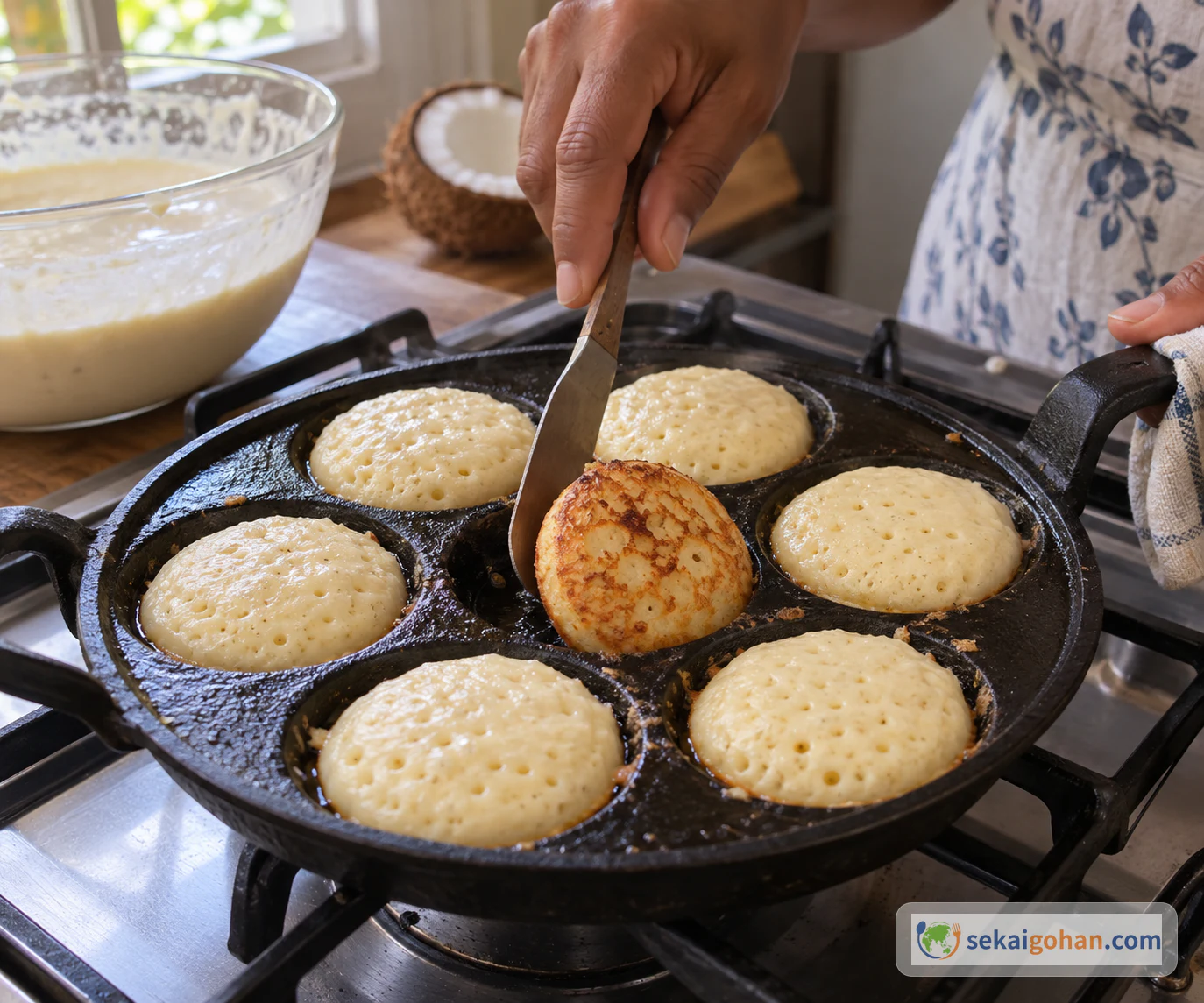
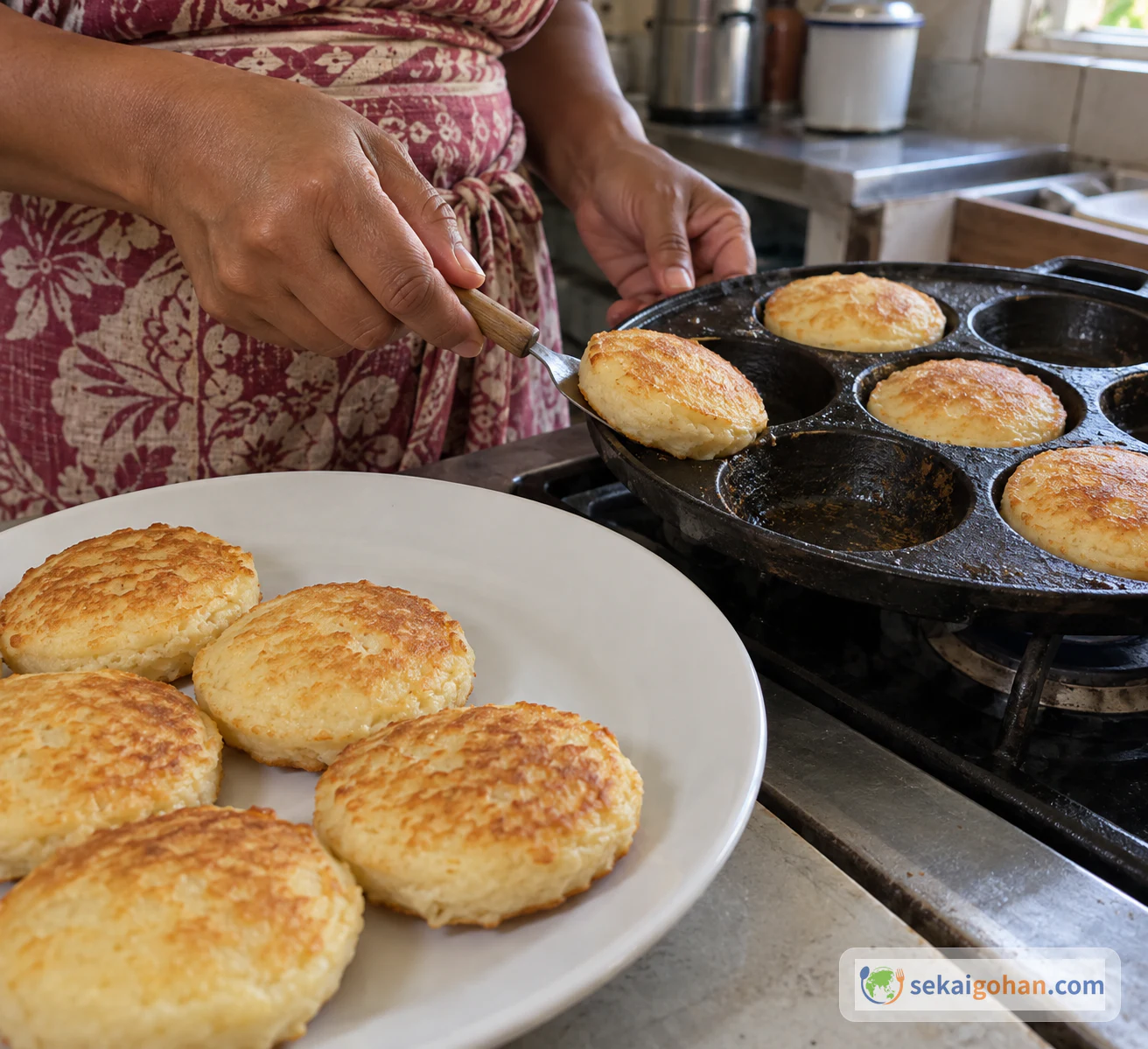
This version uses rice flour, wheat flour, coconut milk, yeast, eggs, butter and sugar. The batter rests, loosens to the consistency of crêpe batter, and cooks in small greased wells. Moov.Mg's recipe is the base here. Three of its amounts could not be used as written, and the section below explains how we handled them.
Mokary and Mokary Vary: Two Different Batters
The name alone does not settle the recipe. You will see both "mokary" and "moukary", and the word covers more than one formula. This article is about the coconut version, mokary au coco, as published by Moov.Mg.
Mokary vary is a separate preparation. On the personal blog Another Adventure, a Peace Corps volunteer who lived in northern Madagascar glosses the term as northern dialect for rice bread or cake, and records a morning routine of a village coffee stand, mokary vary and neighborhood conversation. That is one person's account, and it doesn't describe the whole country. Its recipe has no coconut and uses an overnight ferment, so we have not mixed any of it into this one.
| Mokary au coco (this recipe) | Mokary vary (Another Adventure) | |
|---|---|---|
| Coconut | Coconut milk, with optional grated coconut | None |
| Flour | Rice flour and wheat flour | Rice flour |
| Leavening and rest | Yeast, 1 hour 30 minutes | Yeast and baking powder, with a cooked rice-flour paste and an overnight ferment |
| Cooking | Greased multi-well pan | Small lidded pans over charcoal |
How the Amounts Were Settled
We have not cooked this exact formula, in a mokary pan or otherwise. The yield, cooking times and doneness are not measured results, and the amounts below do not guarantee a particular outcome.
Moov.Mg's flour, egg, coconut milk, butter and sugar amounts are used as published. It also calls for "a glass" of water and half a sachet of yeast with no volume or weight, and lists grated coconut as optional with no amount. We filled those three gaps as editorial estimates from other sources:
| Moov.Mg says | We use | Where it comes from | Limits |
|---|---|---|---|
| 1 glass of water | 200 ml to have ready | French-language kitchen conversions commonly take a glass as about 20 cl (Épicerie du Patrimoine, Jujube en cuisine, Les Commis) | Not an official measure. Épicerie du Patrimoine lists mustard glasses at 150–200 ml and tumblers at 200–250 ml, and we can't tell which glass Moov.Mg meant |
| 1/2 sachet of yeast | About 4 g | Half of Vahiné's 8 g sachet, which the maker rates for up to 500 g of flour | Moov.Mg names no brand, and sachet weights vary by brand |
| Grated coconut, optional | 5 tablespoons if used | Recette malgache, a blog with the same flours, yeast, eggs, butter and sugar | Moov.Mg gives no amount |
Water. Moov.Mg says to use a little water for the yeast and to add a little more if the batter is thick. Treating the one glass as the total for both jobs is our interpretation. The final test is Moov.Mg's own: batter like crêpe batter, which may leave water in the glass. Taking one tablespoon for the yeast follows Vahiné's instruction of two tablespoons for an 8 g sachet, halved.
Liquid ratio. As a rough plausibility check only, counting coconut milk and water but not eggs, this formula comes to about 1.33 ml of liquid per gram of flour if all the water goes in. Other mokary formulas (ProduitsGasy, Graine de faim kely, Omafaim) fall between about 1.13 and 1.67. That doesn't prove the result. Versions of this formula vary too: Recette malgache lists 1/2 tasse of coconut milk and 1 1/2 tasses of water, which we did not adopt.
Yeast. About 4 g is roughly half the maximum rate Vahiné gives, and less than Graine de faim kely's 3 g for a much smaller batch (90 g rice flour, 60 g wheat flour) with the same 1 hour 30 minute rest. The cakes may rise modestly. We still keep the rest at 1 hour 30 minutes, because batter should not sit out at room temperature for long.
Details left open. Moov.Mg specifies homemade coconut milk. It doesn't give the type of wheat flour or sugar, whether the butter is salted, the size of the eggs, a water temperature, heat levels or exact cooking times per side.
Ingredients (Makes About 50 Small Cakes)
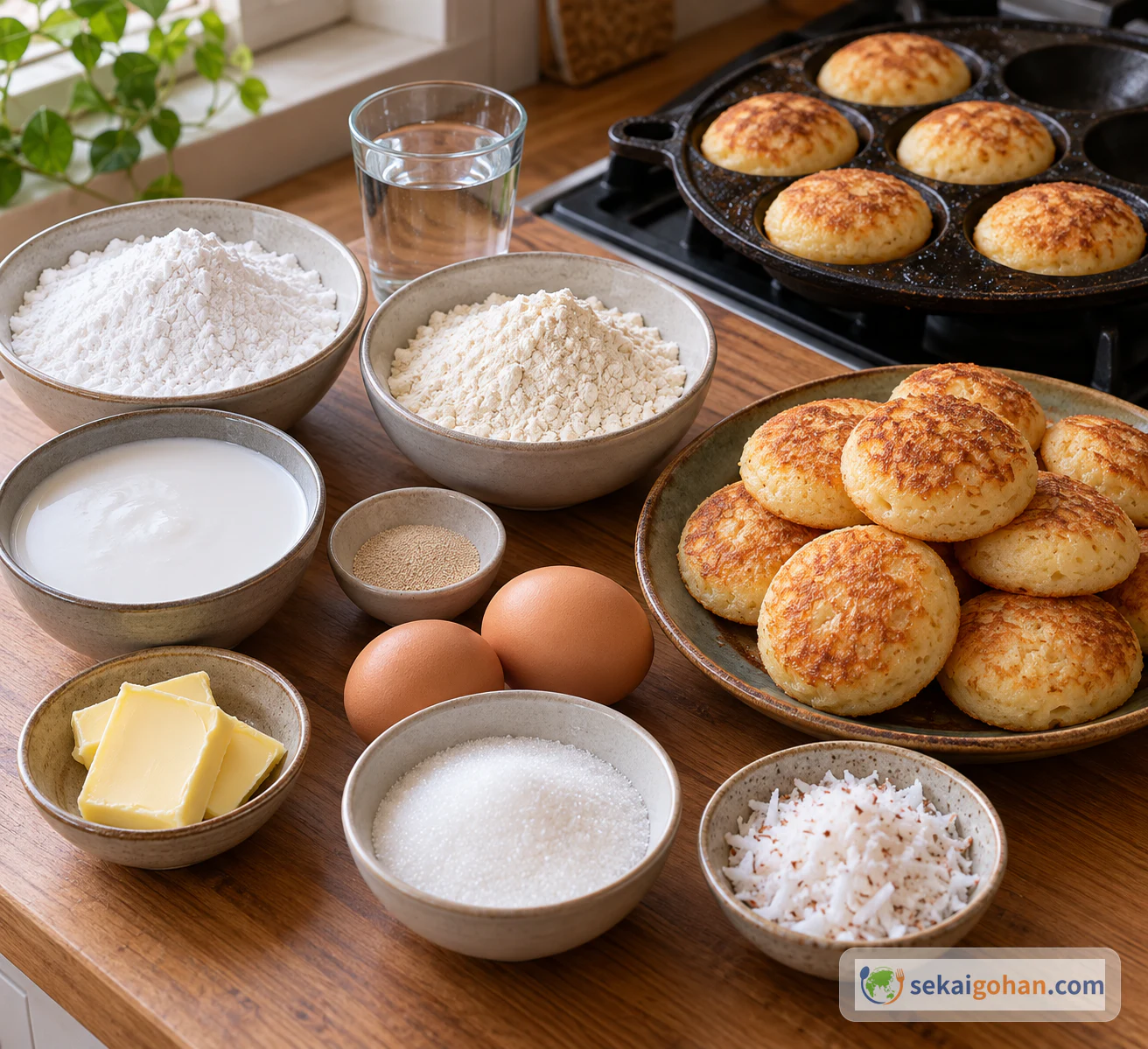
The number of cakes changes with the size of your pan's wells, so treat about 50 as a rough guide.
Choosing and Swapping
- Rice flour: Finely milled baking rice flour is the easiest to work with. Other rice flours differ in grind and may give a tighter texture, so don't treat them as equal.
- Wheat flour: Soft cake flour is a sensible starting point. Don't replace all of it with rice flour as a standard swap, because the texture and structure would need retesting.
- Coconut milk: Homemade is the starting point. Canned or carton coconut milk is a convenient swap, but choose unsweetened. Thickness and sweetness vary by product, so judge the batter by eye and don't expect an identical result.
- Yeast: Weigh dry yeast rather than going by sachet, and follow the directions on your product.
- Sugar: Ordinary white sugar is fine.
Equipment
- Mokary pan, or a multi-well blini or paniyaram pan
- Small cup for the yeast
- Large mixing bowl and wooden spoon
- Kitchen scale and measuring spoons
- Spoon or small ladle for pouring
- Small spatula or similar tool for turning
- Brush for oiling the wells (handy but not essential)
- Plate for the finished cakes
Fixing Problems in the Pan
These are home-cook adjustments rather than measured figures, so change one thing at a time and try a few cakes.
| Problem | Likely cause | What to do |
|---|---|---|
| Batter overflows the wells | Wells too full | Fill only about halfway to leave room to rise |
| Outside browns before the center is done | Heat too high | Lower the heat, cook longer, and test a small number before continuing |
| Batter feels heavy or thick | Not enough water | Add the remaining water a little at a time. Consistency matters more than using the full 200 ml |
| Cakes rise only modestly | The yeast amount is on the low side | Expect this as a possibility and don't extend the rest |
| Cakes come out as flat pancakes | Cooked in a flat pan | Use a multi-well pan for the small round shape |
Allergens, Safety and Leftovers
This recipe contains wheat, eggs, milk (butter) and coconut. Never taste raw batter, and cook the cakes through to the center. Don't leave the batter or the cooked cakes at room temperature for long. Rest the batter for no more than 1 hour 30 minutes, and cook it right away once the eggs are in. Take care with the hot pan when oiling and turning.
Mokary is best eaten warm. For leftovers, use clean utensils and plates, divide the cakes into shallow containers, cool them quickly and keep them in a refrigerator at 10°C or below. Reheat thoroughly to 75°C or above. Throw away anything kept too long or that seems at all doubtful. We give no storage time in days and no freezing time, because the guidance we rely on has no figure specific to this dish.
Variations
- No grated coconut: Leave it out for a smoother cake. It is optional in this recipe.
- Vanilla: Vanilla is a home addition of your own and isn't part of this formula.
- Blini pan: A lightly oiled blini pan is a close alternative to a mokary pan. Start with half-filled wells so the batter doesn't overflow.
- Flat frying pan: This lets you try the flavor, but you get a pancake shape rather than small round cakes.
Keep the coconut formula and mokary vary's overnight rice-paste method apart. Combining them makes a different, untried recipe.
Mokary at the Malagasy Table
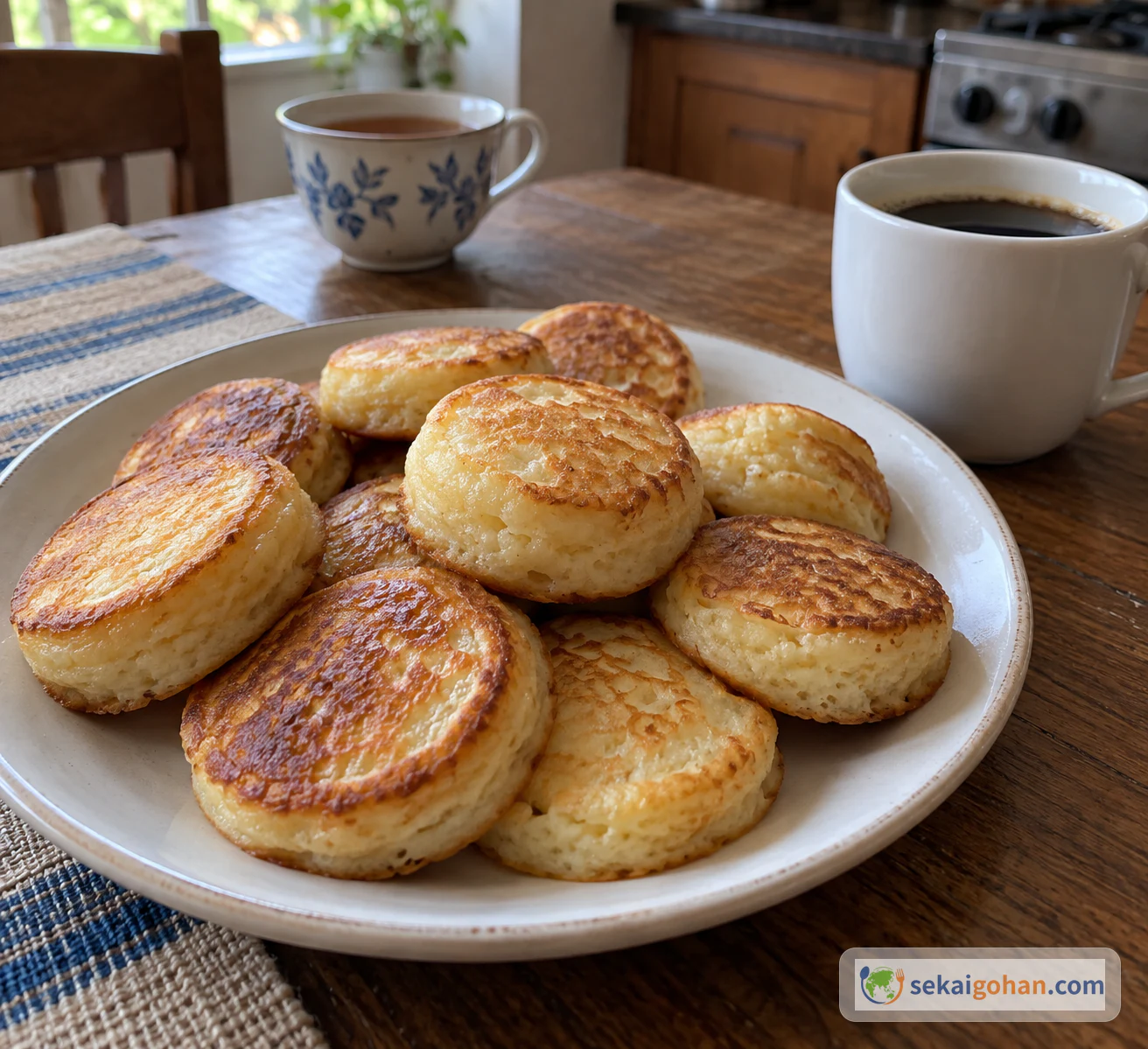
Moov.Mg and Madagascar Destination both place mokary at breakfast or snack time, with a hot drink alongside. Madagascar Destination also notes that family and regional variations exist: rice flour with or without wheat flour, and melted butter or grated coconut as variants. It describes the coconut version as especially popular on the coast. We have no primary historical source for that, so we make no claim about where the dish began or how it spread.
The memory of a village coffee stand in Another Adventure adds a small human detail, but it describes one writer's mornings with mokary vary in the north. It doesn't show how the whole country eats, or how coconut mokary is served.
You can explore more of the country's food on our Madagascar page. Two very different dishes from the same country are koba, a sweet steamed in banana leaf with peanuts, and romazava, a stew of meat and greens.
Frequently Asked Questions
Has this recipe been tested?
No. We have not kitchen-tested this formula, and the 200 ml of water and about 4 g of yeast are estimates from general conversions and a manufacturer's sachet size. They are not measurements of the glass or sachet Moov.Mg's author used.
Are mokary and mofo gasy the same?
They are closely related but not treated as identical here. Madagascar Destination associates mofo gasy with the highlands and with fermented rice-flour batter cooked in molds, and treats mokary as a coconut-containing member of that wider family. Its mofo gasy recipe is a separate one and isn't used here.
Can I use a regular frying pan?
You can try the flavor, but you won't get the small round shape. A mokary pan is the closest, and Madagascar Destination also mentions lightly oiled blini pans.
Is grated coconut required?
No. Moov.Mg lists it as optional and gives no amount. The 5 tablespoons here come from the Recette malgache blog, as a guide for when you use it.
Can I make the batter the day before?
We don't recommend it. Moov.Mg's formula rests for 1 hour 30 minutes. Other recipes, such as e-sakafo's version with a 4-hour or overnight ferment, use different formulas, so their timing doesn't transfer. Japan's health ministry also advises against leaving food at room temperature for long.
How many cakes does this make?
Moov.Mg says about 50, but the number depends on the size of your wells, and we have not measured it.
Why isn't the yeast rest longer, or the water warmer?
The 10 minutes for the yeast and 1 hour 30 minutes for the batter are Moov.Mg's times. Vahiné's instructions for its own yeast call for 35°C water and 15 minutes, which applies to that product. Moov.Mg gives no water temperature, so follow your yeast label.
Where does the storage advice come from?
The conditions for leftovers come from the home food-poisoning guidance of Japan's Ministry of Health, Labour and Welfare. The advice not to taste raw batter comes from the U.S. Food and Drug Administration. Neither gives a storage period for this dish.
Sources
- Moov.Mg, "Recette Malagasy : Le délicieux mokary au coco." The adopted ingredients and amounts, method, rest time, yield of about 50, and breakfast or snack context. https://www.moov.mg/article/67942-recette-malagasy-le-delicieux-mokary-au-coco
- Another Adventure, "Rice Cakes: Dady's Mokary Vary Recipe." A Peace Corps volunteer's personal blog, not an official Peace Corps position. The distinction from mokary vary and one writer's morning coffee stand routine. https://melaniemary.com/2018/12/22/rice-cakes/
- Madagascar Destination, "Mokary." General description, ingredients, pans, serving with coffee or tea, and family and regional variation. https://www.madagascar-destination.mg/culture/gastronomie/mokary.html
- Madagascar Destination, "Mofo gasy." Context on mofo gasy and mokary's place in the wider family. https://www.madagascar-destination.mg/culture/gastronomie/mofo-gasy.html
- e-sakafo, "Mokary au Coco." A different formula with a 4-hour or overnight ferment, for comparison only. https://www.e-sakafo.mg/recipe/recipe-detail/mokary-au-coco
- Graine de faim kely, "Minis Mokary au coco." A different formula, for comparison of yeast and liquid only. https://www.grainedefaimkely.com/2015/02/minis-mokary-au-coco.html
- Omafaim, "Mokary (Mofo-Gasy à la noix de coco malgache)." A different formula, for comparison of liquid only. https://omafaim.wordpress.com/2020/05/15/mofo-gasy-beignets-a-la-noix-de-coco-malgache/
- ProduitsGasy, "Recette de mokary malgache : beignets de riz moelleux." A different formula, for comparison of liquid only. https://produitsgasy.com/mokary-la-recette-des-beignets-de-riz-malgaches/
- Karibo Sakafo, "Mokary." The same formula and wording as Moov.Mg, with no added volume for the glass or weight for the sachet. https://www.karibosakafo.fr/archives/2015/05/19/32051764.html
- Recette malgache, "Mokary au coco." A closely matching formula and the source of 5 tablespoons of grated coconut. Its liquid amounts were not adopted. https://recette-malgache.blogspot.com/p/mokary-au-coco.html
- Vahiné, "Levure du Boulanger Classique." 8 g sachets of dried baker's yeast, for up to 500 g of flour. https://www.vahine.fr/products/levure-du-boulanger-classique
- Vahiné (Belgium), "Levure du Boulanger Traditionnelle." 8 g sachets, with one sachet in two tablespoons of water or milk at 35°C for 15 minutes. https://www.vahine.be/fr-be/produits/sucres-et-levures/levure-boulangere-traditionnelle
- Épicerie du Patrimoine, "1 verre en ml : types de verres et conversions en cuisine." A glass commonly taken as 200 ml in French recipes, and how other glasses differ. https://www.epiceriedupatrimoine.com/1-verre-ml/
- Jujube en cuisine, "Les mesures : équivalences." A medium glass taken as 200 ml. https://www.jujube-en-cuisine.fr/wp-content/uploads/2012/08/tableaux_conversions.pdf
- Les Commis, "Précis anti-galère : peser sans balance." A mustard glass taken as 20 cl. https://lescommis.com/blog/peser-sans-balance/
- Ministry of Health, Labour and Welfare, Japan, "家庭でできる食中毒予防の6つのポイント" (six points for preventing food poisoning at home). Room-temperature, refrigeration, reheating and discard guidance. https://www.mhlw.go.jp/stf/seisakunitsuite/bunya/kenkou_iryou/shokuhin/syokuchu/01_00006.html
- U.S. Food and Drug Administration, "Handling Flour Safely: What You Need to Know." Never eating or tasting raw flour, dough or batter, and cooking foods made with flour and raw eggs. https://www.fda.gov/food/buy-store-serve-safe-food/handling-flour-safely-what-you-need-know