


Senegalese Grilled Meat That Begins with the Smell of Smoke and Mustard
In the kitchen, cut the meat into large pieces and rub in mustard, lemon and garlic, and already before it is cooked a little of the street stall appears. Unlike a Japanese yakiniku sauce, acidity and heat come forward rather than sweetness. The moment you set the meat in the grill pan, the mustard on the surface foams in small bubbles and a savory smell just short of burning rises.
Dibi is a grilled meat dish loved in Senegal. Centered on lamb, and sometimes using beef or goat, it is grilled over charcoal, cut into easy pieces and served with onions, mustard and bread. The specialty shops are called dibiteries, and the dish is eaten along with the smell of smoke, meat cut to order and the casualness of being wrapped in paper.
The hard part of making it elsewhere is how to replace the charcoal. Many households cannot use charcoal on a balcony or indoors, so in this article I preheat a cast-iron grill pan well and bring it close to the satisfaction of a street stall through the browning, resting and internal temperature. You will not get a full charcoal aroma, but searing the surface of thick-cut meat hard and combining it with onions and mustard gives it a different outline from a plain steak.
If yassa chicken (in Japanese) is a stew of onion and lemon, dibi is a dish that places the same onion and mustard beside grilled meat. It is not a day for a big platter of rice like thieboudienne; it is the mood of picking at meat at night and wiping up the sauce with bread. It is also an easy dish to enter for those who like Nigerian suya or Kenyan nyama choma.
The English spelling is Dibi. A shop serving the dish is sometimes written dibiterie, a name typical of French-speaking West Africa. In this article I call the dish dibi and use dibiterie for the shop context.
Background of the Dish: Dibiteries and the Difference from Suya
Dibi is often introduced as Senegalese street food. English-language sources such as Britannica organize it as a dish of grilled meat, centered on lamb, eaten with onions, mustard and bread. TasteAtlas also introduces it as grilled meat eaten at small specialty shops in Dakar, explained in connection with city evening meals and gatherings of friends.
It is interesting that it is easily confused with suya. Both are West African grilled meats, but suya is a dish in which thinly sliced meat is coated in yaji, a peanut-chili spice. Dibi leans toward grilling the meat thick and serving it with mustard and onions. If you think of suya as eating the spicy powder and dibi as eating the smoke and juices, the difference shows.
| Point of comparison | Dibi | Suya |
|---|---|---|
| Main region | Senegal, Mali and other French-speaking West Africa | Mainly northern Nigeria, widely across West Africa |
| How the meat is cut | Thick chunks, sometimes bone-in | Often sliced thin and skewered |
| Axis of aroma | Charcoal, salt, pepper, garlic, mustard | Peanut, chili, ginger, spices |
| Served with | Onions, mustard, bread, french fries | Onions, tomato, cabbage, extra yaji |
| Crux of home reproduction | Browning and internal temperature | The yaji spice coating |
You do not need to reproduce the whole atmosphere of a dibiterie at home. But there are things worth keeping. Do not cut the meat too small. Do not treat the onions as a mere garnish. Do not turn the mustard into a sweet sauce. Serve something like bread or french fries that catches the juices and mustard. With these four, the dibi character remains even in a home kitchen.
Dibi is not a dish of "pouring sauce over grilled meat" but one in which you combine meat, onions, mustard and bread by hand. Not mixing everything from the start, and leaving room to mix a little at a time on the plate, gets closer to the casualness of a dibiterie.
Ingredients (serves 4): Lamb as the Axis, with a Shopping List That Also Works with Beef

This is a main dish for 4. Made with lamb alone it is closer to the local style, but lamb shoulder and lamb chops can be expensive in some places. For a first batch, a mix of 350 g lamb shoulder and 350 g beef chuck roll or skirt steak balances ease of buying and aroma. If you make it with beef alone, do not use only lean cuts; mix in a cut with a little fat.
Meat and marinade
Mustard onions
Accompaniments
This recipe uses lamb or beef and mustard. Mustard contains vinegar, wine vinegar and spices depending on the product. When serving children, older adults, pregnant women or people in poor health, cook it thoroughly to the center and let people add heat at the table.
Ingredients and tools for this dish
Meat, onions, lemon and bread are fine from a supermarket. The ones to be particular about are the mustard and the grill pan, and the thermometer is something to use at the point in the steps where it matters.
Dijon mustard is the axis that pulls together the onions and the juices. Choosing a type with acidity and heat, not sweet honey mustard, keeps it from losing to the grilled meat.
It can be made with just a broiler, but for a first batch a cast-iron grill pan makes it easier to manage the browning. The advantage is that you can make the sear on the surface in a short time and lower the heat at once if it is too strong.
With thick-cut meat it is easy to misjudge doneness by color alone. With a thermometer you can decide to stop before overcooking makes it tough. It is more useful to know in the steps "where to insert it" and "what to look at to stop" than to add more gear.
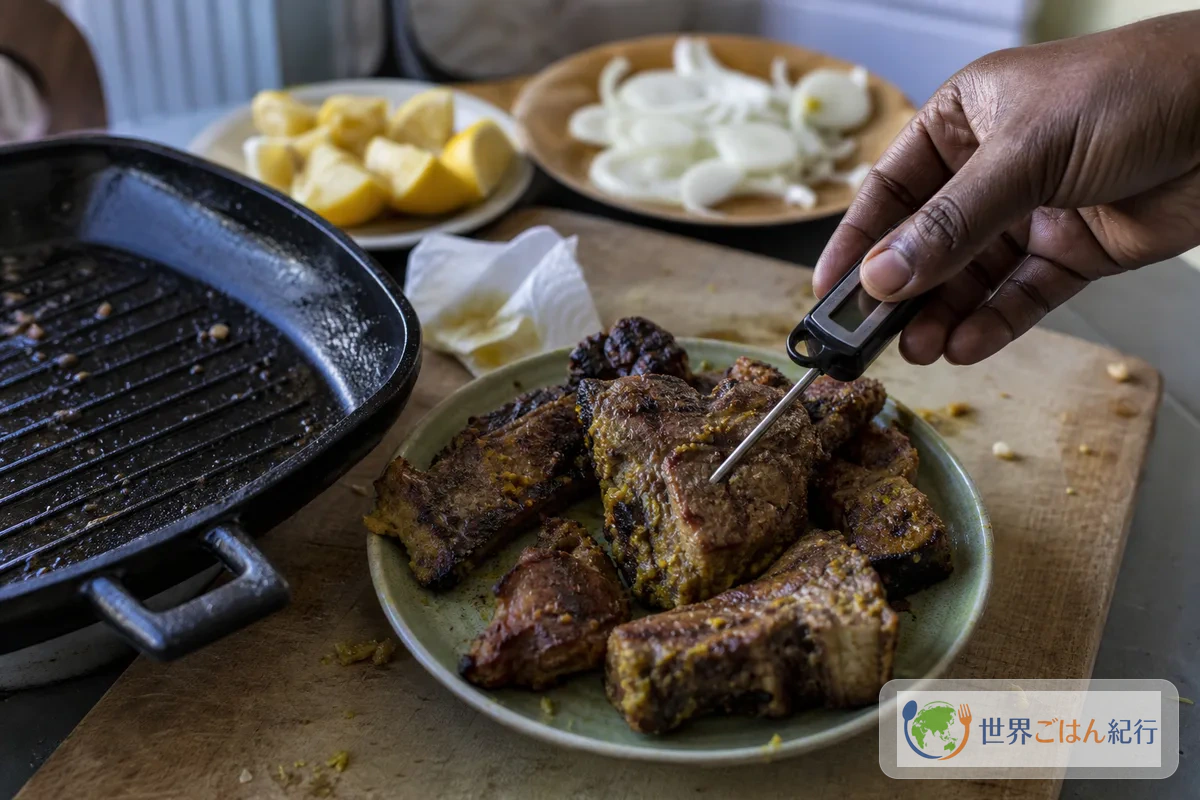
The essentials are meat, onion, Dijon mustard, lemon and bread. A grill pan and thermometer are reassuring from the first time, but if you have none, a heavy skillet and a broiler can substitute. Cumin and paprika are supporting roles that add aroma, and too much moves away from the plainness of dibi.
Method: Cut Thick, Grill Hard, Rest
Dibi is not a dish for long simmering. Cut the meat large and take off the surface moisture, season it with a short marinade, brown it over strong heat and rest it at the end. If you make the mustard onions before grilling the meat, you can bring it to the table without making the grilled meat wait.
The USDA gives a guide of 63°C (145°F) in the center with a 3-minute rest for steaks, roasts and chops of beef, lamb and so on. Japan's Ministry of Health, Labour and Welfare, on the other hand, points out the importance of cooking thoroughly to the center to prevent food poisoning, and says that many pathogens are killed by heating at 75°C (165°F) for 1 minute or more. At home, choose according to who is eating, including the option of cooking with no red left.
Finishing and Eating: Do Not Forget the Paper Wrap, Bread and Onions

Dibi suits being spread on a big plate or paper more than being plated neatly one serving at a time. Pile on the onions, add lemon and put the mustard in a small dish. Tear bread and scoop the juices and onions together, and the flavor is completed on the plate.
Adding french fries strengthens the snack feeling of a dibiterie. It is also good over white rice, but then use a little more mustard onion and squeeze lemon last so it does not get heavy. If you like the onion sauce of yassa chicken (in Japanese), the onions of dibi should also go with rice.
For a menu, rather than making it on the same day as the Senegalese thieboudienne, make dibi the star and tomato, lettuce, bread and a light soup are enough. To compare West African grilled meats, widen to suya with its peanut chili, nyama choma eaten with salt and smoke, and the skewer-leaning chapli kebab (in Japanese), and the differences show.
A Branching Table for Approximating the Authentic Dish in a Home Kitchen
| Point of hesitation | If leaning local | If making it easy at home | Why keep it |
|---|---|---|---|
| Meat | Lamb shoulder, bone-in lamb, goat | Mix lamb shoulder and beef chuck roll | The aroma of lamb creates the dibi character |
| Fire | Charcoal, outdoor grill | Cast-iron grill pan, with a finishing sear under the broiler | Makes the browning on the surface in a short time |
| Onion | Raw or lightly cooked onion | Dressed with lemon, vinegar and mustard | Plays a large role in cutting the fat of the meat |
| Mustard | Acidic French type | Dijon, whole-grain mustard | A sweet sauce blurs the outline |
| Starch | Baguette, french fries | Baguette, sandwich bread, rice | You need something to catch the juices and onions |
| Heat | A little chili | Omit the cayenne and add at the table | Adding at the table is safer when eating as a family |
What you must not substitute is removing the onion and mustard. Grilled meat with just salt is delicious, but that is a different grilled meat. In dibi, the browning of the meat, the pungency of the onion, the acidity of the mustard and the plainness of the bread work together.
When using a broiler as well, after browning all sides in the grill pan, lay the meat on a foil-lined tray and sear for just 2 minutes under high heat. The surface savoriness increases, but overdoing it makes it tough. If you have a thermometer, measure the center once before the finishing sear and see how many more degrees to raise it.
What makes a surprising difference at home is the preparation for ventilation. Smoke is the charm of dibi, but making too much smoke indoors tires you before you eat. Before you start grilling, turn the range hood to high, open a window slightly, and have a cloth ready to wipe oil spatter around the grill pan. When the smoke gets heavy, rather than adding water, move the meat out to a tray for a moment, lower the heat to medium, and then return. Adding water washes away the browning and turns it into steamed meat rather than dibi.
Causes of Failure: Telling Apart Burnt, Tough and Watery
| Failure | Cause | How to fix |
|---|---|---|
| Surface is black and bitter | Overheated, mustard too thick, too much sugar | Wipe the surface of the meat thin and lower from medium-high to medium |
| No browning | Moisture on the meat, or overcrowding | Wipe off moisture and grill in 2 batches |
| Meat is tough | Cut too small, overcooked, not rested | Keep to 3 cm cubes, check the internal temperature and rest 3 minutes |
| Onions are too sharp | Sliced thick, not soaked enough, too little acid | Soak 3 minutes after slicing and dress first with lemon and salt |
| Tastes Western | Too much mustard or too many herbs | Return to the guide of 2 tbsp mustard for the meat and 1 tbsp for the onions |
| Juices run onto the plate | Cut right after grilling | Rest 3 minutes on a tray before plating |
What easily happens the first time is lowering the heat too much for fear of burning. Grilling long over low heat lets the juices come out before the savoriness of the mustard. Make the browning over medium-high heat only at the start, and if it looks about to burn, lower to medium. Moving the heat down one notch at a time makes it hard to fail.
The other is cutting the meat too small. If you go to under 2 cm, in the feeling of a one-bite grilled meat, it turns tough quickly while grilling. Dibi is a dish you can cut into easy pieces after grilling, so slightly large is fine when grilling.
Storage and Reheating: Keep Onions and Meat Separate
If you make it ahead, store the meat and onions separately. Put the grilled meat in a clean container once cooled a little and refrigerate within 2 hours. Finish it by the next day as a guide. The onions are acidic, so the flavor blends, but put in with the meat they release moisture and the browning does not come back easily.
To reheat, put a little oil in a skillet and turn the meat for 1 to 2 minutes over medium heat. A microwave alone tends to toughen the meat, so warming it about 40 seconds at 600 W and then bringing back the surface in a skillet is easier to eat. Toast the bread lightly and add the onions cold, and the contrast with the warm meat comes through.
Leftover dibi can go into the next day's sandwich. Spread a thin layer of mustard on bread and just fill with meat, onions and tomato. To put it over rice, chop the meat, add onion and lemon, and gather it lightly like a grilled-meat salad rice rather than a bowl, and it does not get heavy.
FAQ
Can I make it if I dislike lamb?
Yes. Use 700 g beef chuck roll, skirt steak or rump. But with beef alone the lamb aroma typical of Senegal is weaker, so do not skip the mustard onions and bread, and brown it harder to keep the dibi character.
Can it still be called dibi without charcoal?
Charcoal is ideal, but a grill pan is enough to enjoy at home. What matters is not grilling the meat watery and making browning on the surface. Adding a 2-minute finishing sear under the broiler adds a little of the savoriness close to charcoal.
Can I use whole-grain mustard?
You can. Whole-grain mustard gives acidity and the texture of seeds, so it goes well with the onions. When using it for the meat marinade, the seeds scorch easily, so lightly knock off the excess seeds on the surface before grilling. Sweet honey mustard goes in another direction.
How long should I grill the meat for safety?
Do not judge thick meat by color alone. If you have a thermometer, one guide for whole cuts of beef and lamb is to rest 3 minutes after the center reaches 63°C (145°F). When serving small children or older adults, or if you are unsure of the condition of the meat, take 75°C (165°F) in the center as the guide, and leaving no red is safer.
Can I use the same spices as suya?
It is delicious, but it moves toward suya. Dibi stars the browning of the meat and mustard onions, not a peanut-chili coating. When you want to use suya's yaji, making it as suya on a different day lets you enjoy the difference.
Can I serve something other than bread on the side?
It can be eaten with white rice. But to bring out the dibi character, bread or french fries suit. Having a starch that can scoop up the juices, onions and mustard together brings the flavor together on the plate.



