Stretch It Thin Enough to See Through, Then Stack the Squares
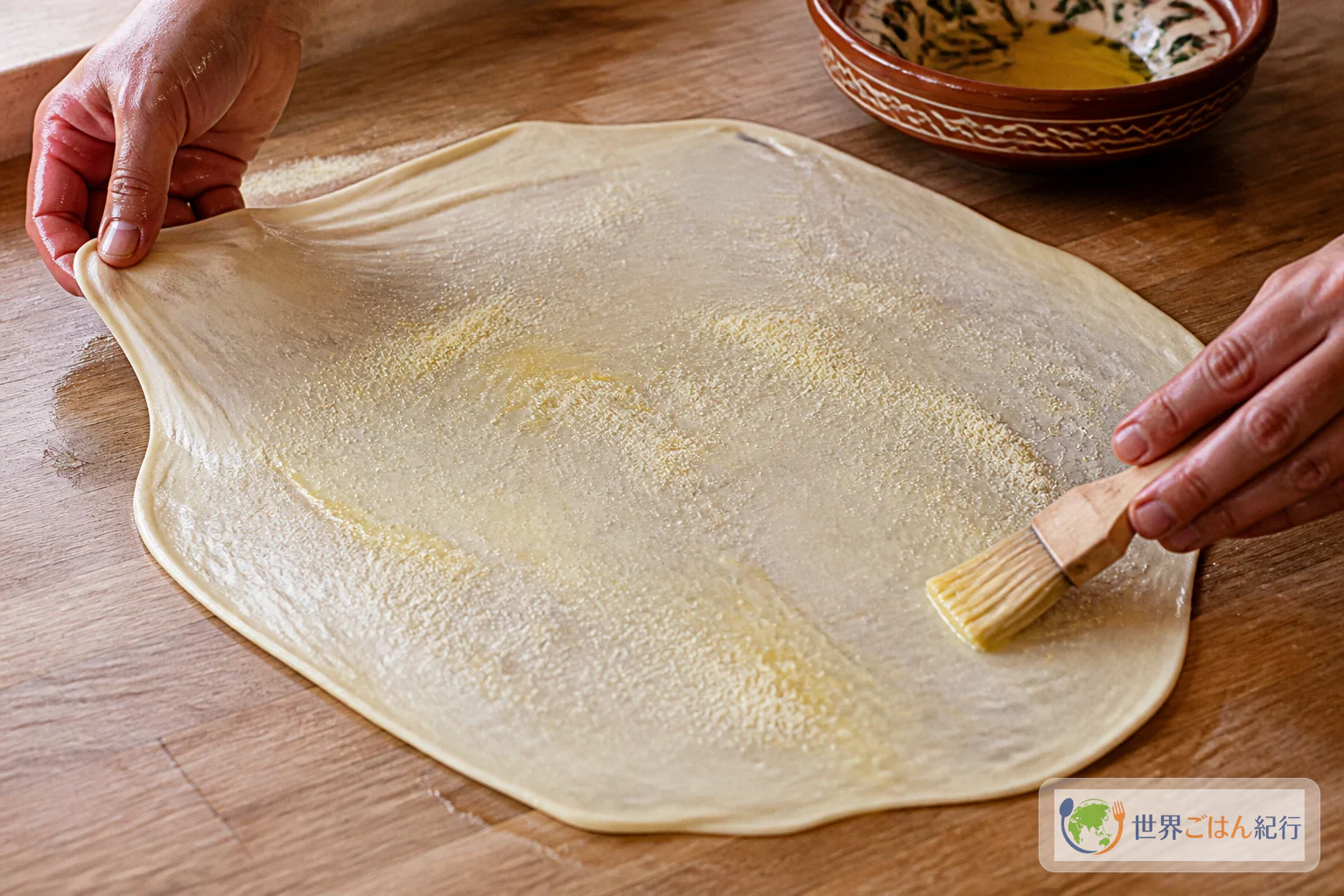
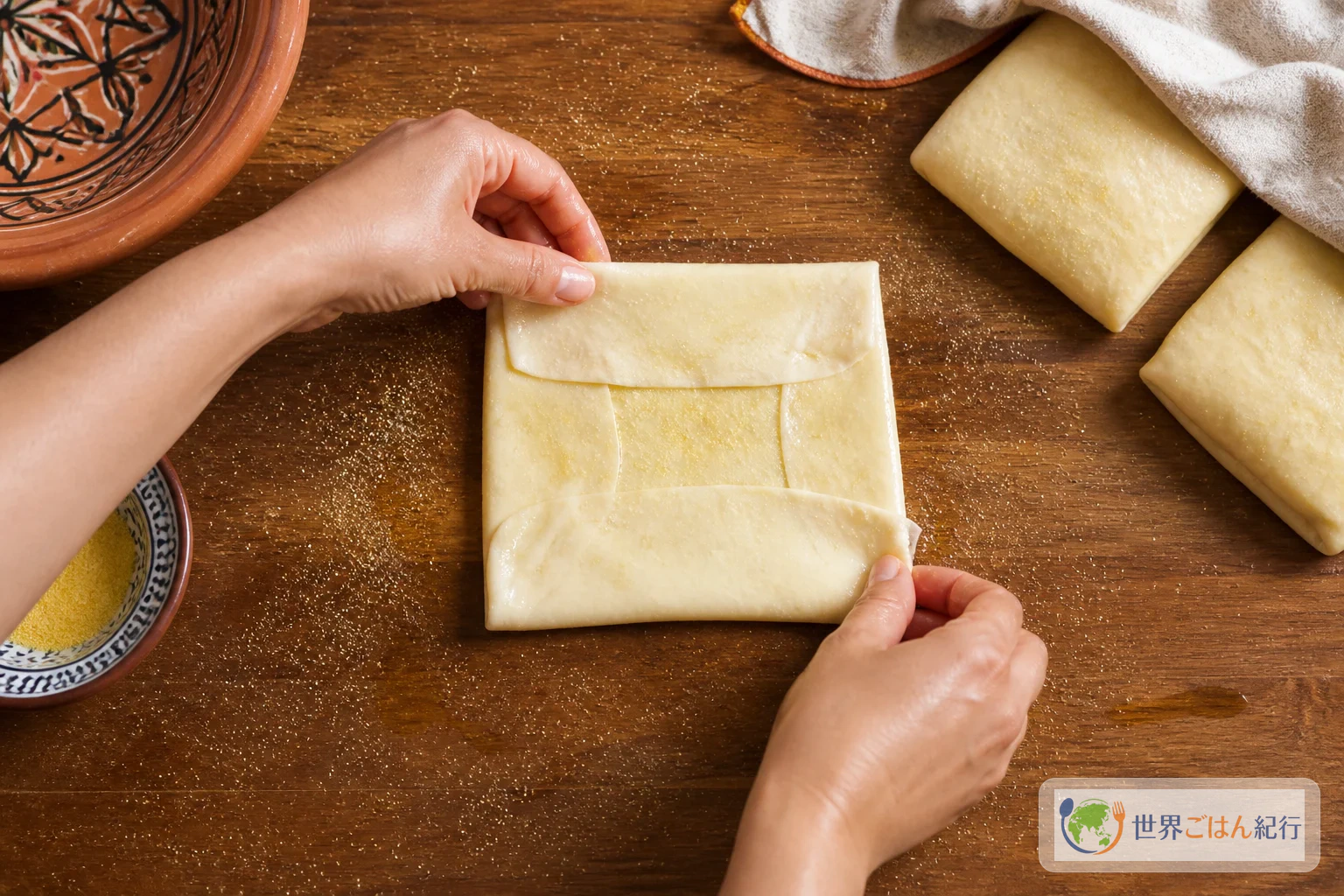
Set the dough on a lightly oiled surface and slide your fingertips from the center outward. When the wheat-colored dough is so thin that it picks up the color of the surface, brush on fat, scatter fine semolina, and fold it in thirds. Fold the top and bottom as well, and the sheet is back to a small square before it is cooked.
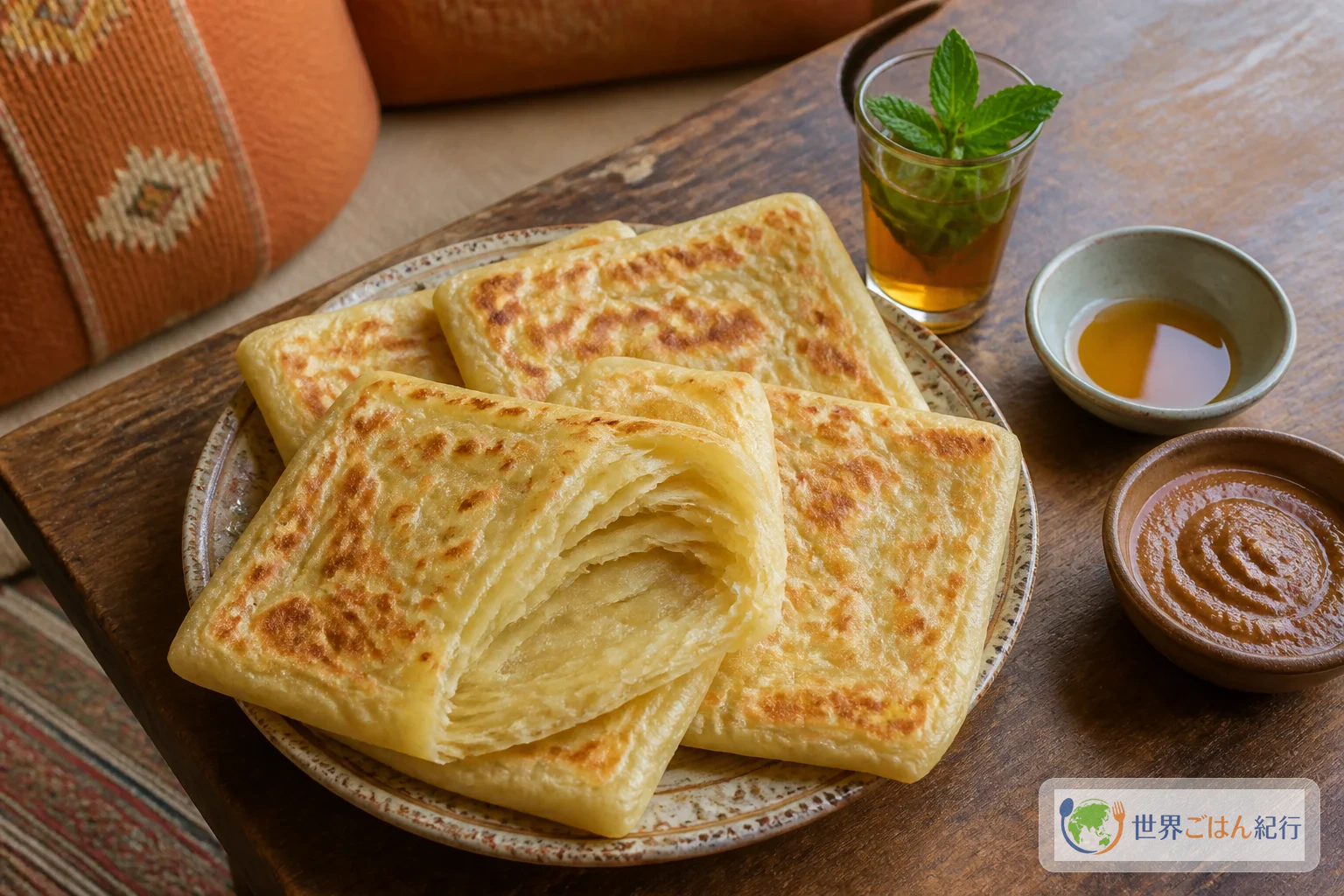
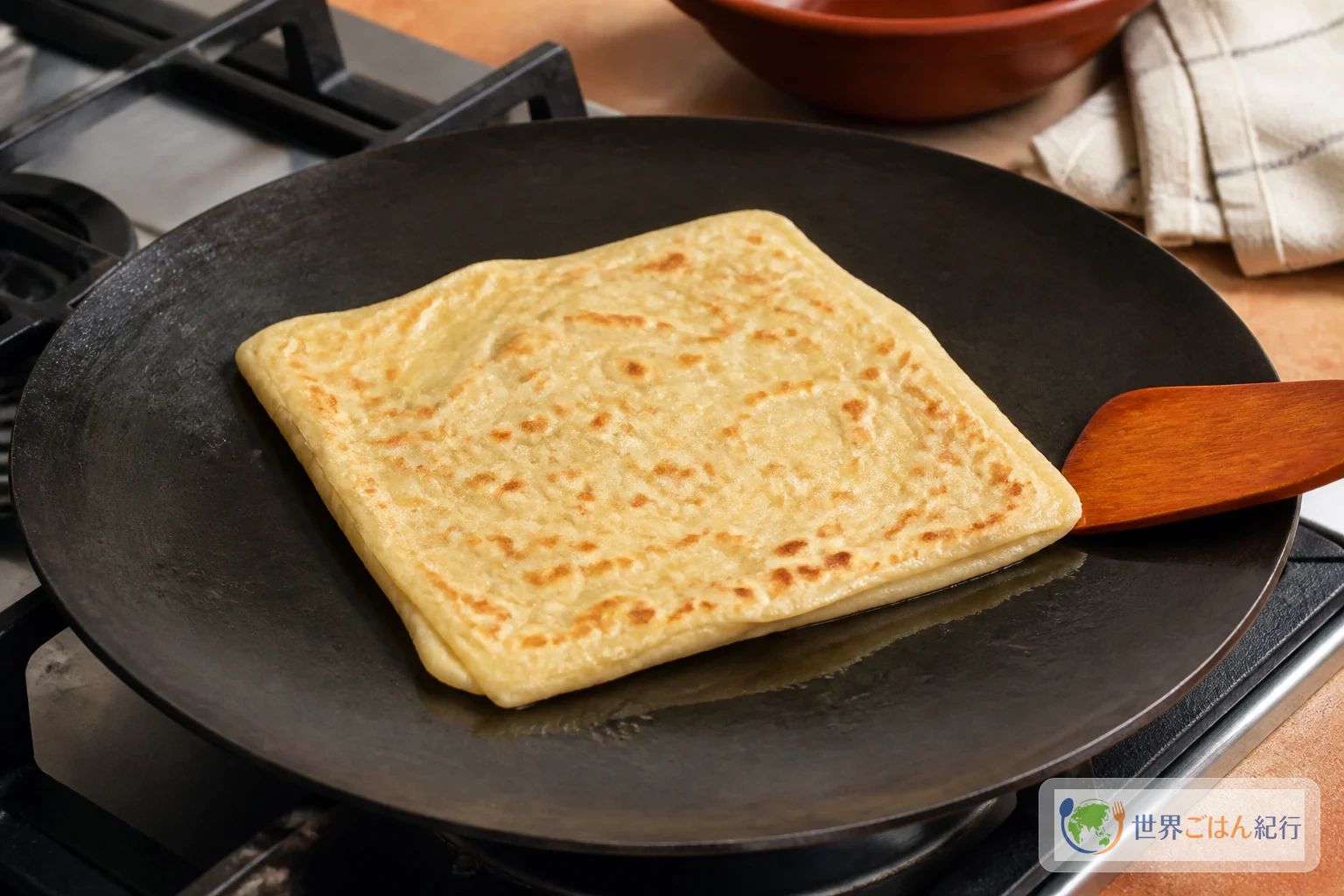
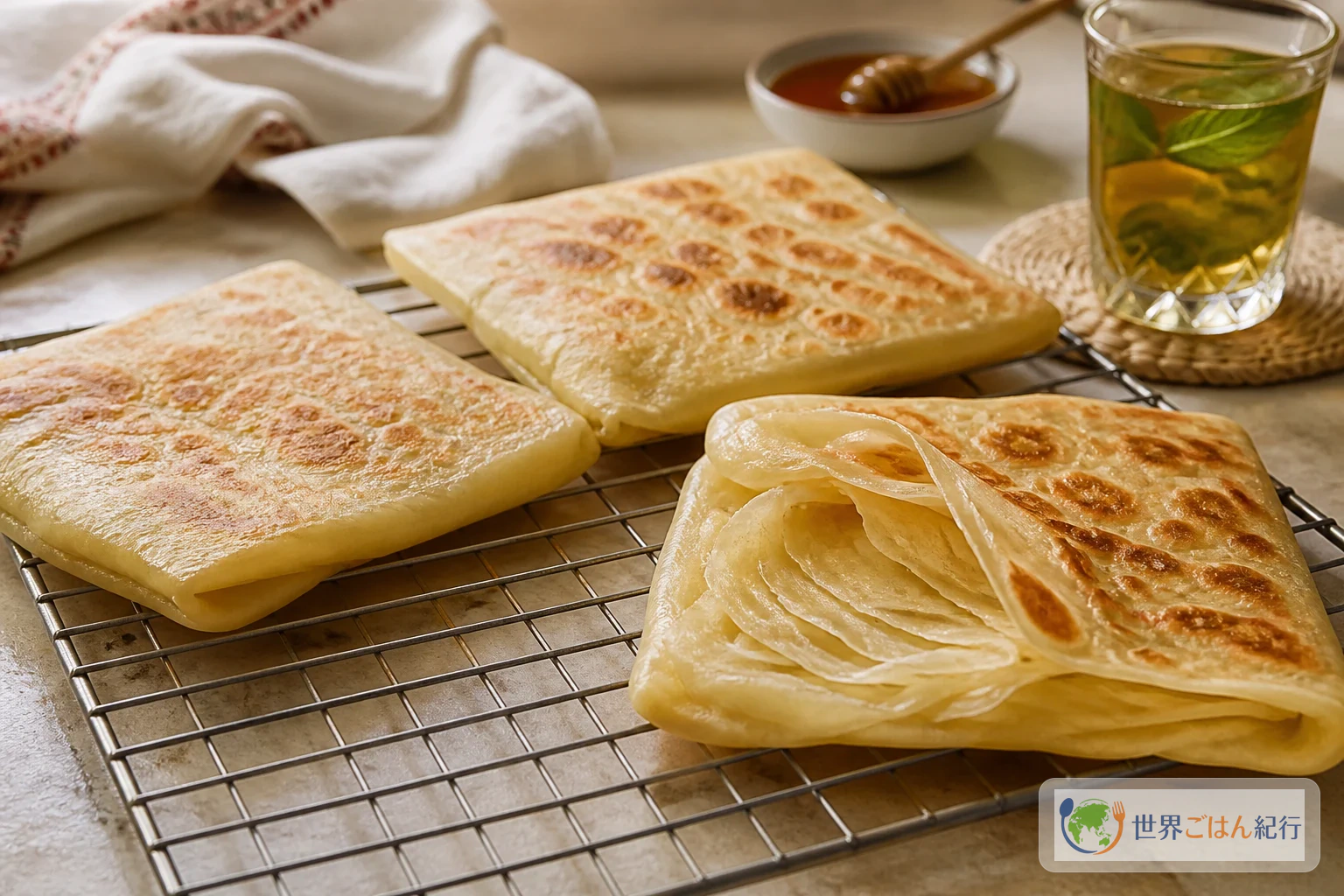
A cooked msemen has small brown spots on the surface, and when you lift an edge, many thin layers slowly come apart. It is a flatbread that is lightly toasty outside and keeps a fat-rich suppleness inside.
Msemen is often spelled Msemen or Msemmen in Morocco, and some sources also list rghaif and melaoui as names for closely related flatbreads. With this method, which folds fat into a dough made without yeast, you do not wait for fermentation and can judge doneness by how thin you stretch it and by its color.
Food-culture material from the Moroccan National Tourist Office presents msemen as a pancake spread with butter or honey, on the table around 9 a.m. at breakfast. Treat it only as a sweet bread, though, and it becomes hard to see why salt goes in the dough and why the surface is cooked until toasty.
You stretch it thin not to dry the dough but to separate the layers with fat and semolina.
Rest a soft dough that has kept its moisture long enough, and put fat on the surface in a thin, even layer. If you keep to these two things, you get close to a msemen fit for a morning table without any special starter.
Msemen Links Breakfast and Tea Time
In Morocco bread is part of the staple on the daily table. The tourist office presents bread as a food at the center of the meal, tied to the custom of hospitality in which meals are shared. Msemen, too, suits being served not as a single piece by itself but with honey, olive oil, soft cheese, amlou, and the like split into small dishes, each person changing the flavor as they go.
Mint tea is not only a drink after meals. It is served when welcoming guests, and is described as a drink that gives form to the time of hospitality, down to the gesture of pouring from a height into a colored glass. A bite of sweet honey, a sip of hot tea, then a bite of freshly cooked layers: the coolness of the tea cuts the weight of the fat.
If you are preparing it away from Morocco, do not brew the tea too strong. Even green tea with fresh mint added makes a table that can receive the toastiness of the bread. On days you cannot prepare tea, honey and olive oil in separate small dishes still keep a setup in which you move between sweetness and saltiness yourself.
Msemen is not only a morning bread, either. The Moroccan tourist office presents rfissa, known as a dish that originated in Casablanca, as a dish in which msemen or trid is torn and combined with a broth of chicken, onion, lentils, cilantro, ras el hanout, and fenugreek. If you cannot finish it freshly cooked with honey, you can use the dried parts the next day, torn, as bread to receive broth. How to make rfissa (in Japanese) covers in detail how msemen works as an ingredient that soaks up liquid while keeping its layers.
Among Moroccan flour dishes, couscous is a dish whose staple is steamed grains. The fine semolina used in msemen dough and the granulated couscous have different roles. If you want to know the table finished with a steamer and a large platter, setting Moroccan couscous beside it lets you compare how textures divide within the same grain culture.
Square, Round, or for Broth: The Shape Changes by Region and Household
If you remember msemen as only one fixed shape, you get lost when you meet the local names. A WIPO study of Moroccan food culture lists m'semen, r'ghaif, and melaoui as close kinds of Moroccan bread, and records both making them at home and buying them from specialist bakers. Cooking sources, on the other hand, sometimes describe msemen as a flatbread folded into a square and melaoui as a type that is rolled and finished round.
The line between names and shapes overlaps by region, shop, and household blend. Some doughs use more semolina to bring out grain aroma, and others use more wheat flour to stretch softly. Some households fold with oil alone, and others mix in a little butter for color and aroma. The square formula here is not meant to settle on one name, but to serve as a standard that makes the order of folding the thin dough and the layers easy to recognize in a home kitchen.
How it is eaten also varies. At breakfast honey, amlou, olive oil, jam, and cheese are easy choices, and in cafés it goes with tea or coffee. When stuffed, there are versions that add finely chopped onion, cilantro, black pepper, chile, ground meat, and so on, but if you set a watery filling raw inside, juices come out of the folds and the layers collapse. If you try a stuffed one, cook off the moisture first, cool it completely, and put a small amount in the center.
Amlou, enjoyed around Agadir in the southwest and elsewhere, is a paste of argan oil, honey, and almonds. Served with msemen, it adds not only the sweetness of honey but also the aroma of nuts and the character of argan oil. It is not something served in every region without fail, though, and cannot be used by anyone with an almond allergy. You can enjoy the difference at the table quite well by eating it first with the honey and olive oil you have, and choosing amlou as a separate ingredient afterward.
Ingredients (8 pieces, serves 4): Choosing Flour and Fat
This formula makes 8 pieces for 4 people. Each piece of about 100 g of dough is folded into a square, at two per person with honey and tea. Rather than increasing the ingredients and making many at once, making 8 the first time makes it easier to find the cause of failures by matching how thin you stretch and the color of cooking.
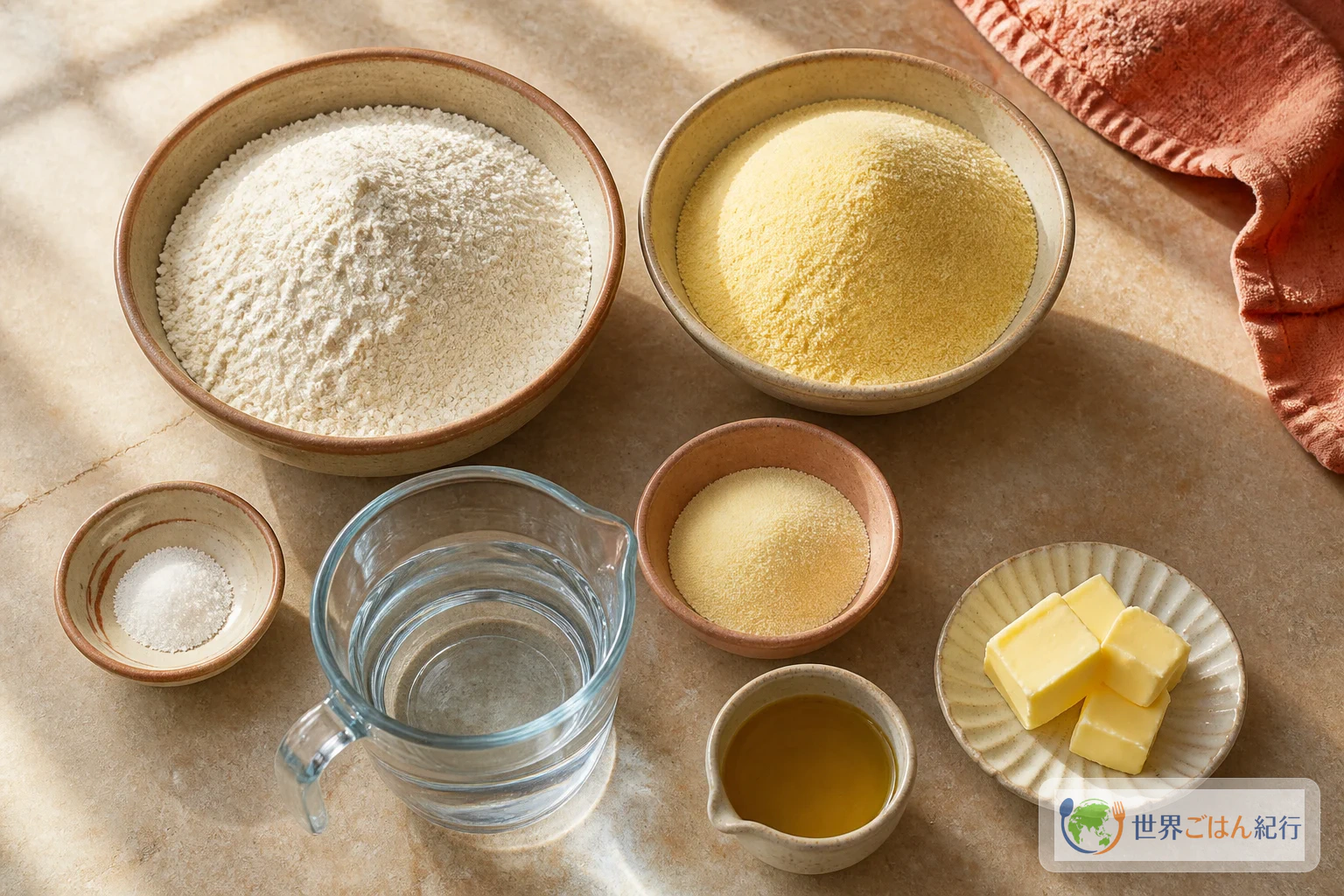
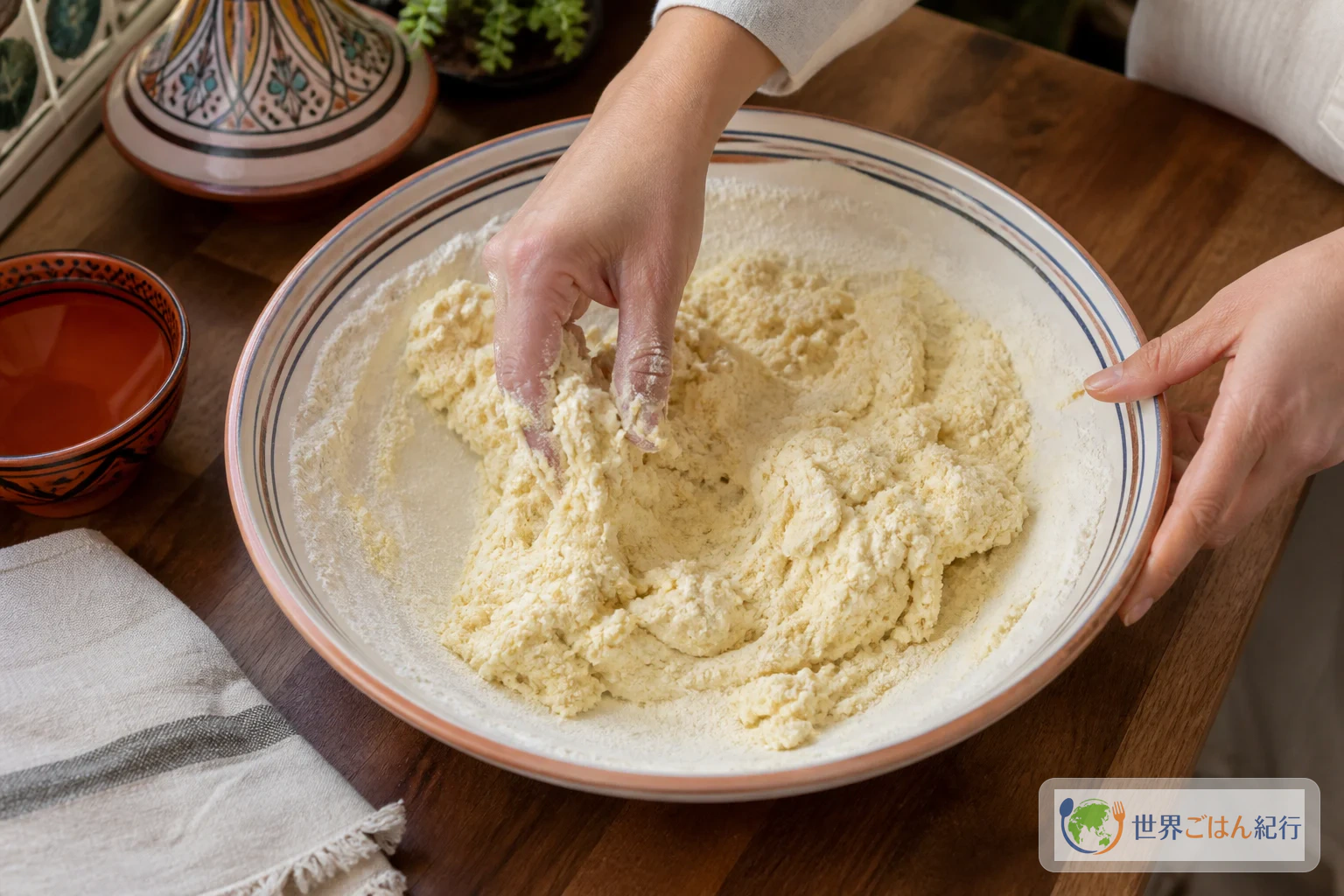
For 500 g of flour (all-purpose plus semolina), take 300 ml water as the starting point. Because absorption differs by brand and humidity, do not put in even the reserve water from the start and then firm up a sticky dough with flour. Stop kneading while a little dry flour remains at the start, and if the rested dough is stiff, bring moisture back little by little with wet hands.
The foundation of msemen is the graininess of fine semolina. On the product label, what to check is that the name includes "fine," "durum," or "semolina," that the ingredient is wheat, and the net weight. Granulated products labeled only "couscous," or ones only coarsely ground, change the absorption and the feel of the surface in the 1–2 minute stretch used here.
Butter adds aroma and color, but it is not an absolute condition for making layers. When avoiding dairy you can replace it with oil only. A dough with oil alone has a slightly lighter mouthfeel and loses the milky aroma of butter, so do not think of it as the same taste; choose according to the needs of the person eating. It contains wheat, so it is not a recipe for people who need to avoid gluten.
If you only want to try it once, looking for a small amount of fine-ground semolina at an import grocer leaves you with less flour left over. Those who already have fine semolina do not need to buy more and can check the fineness of the grain on the label at hand.
Method: Rest the Dough, Then Stretch Thin, Fold, and Cook
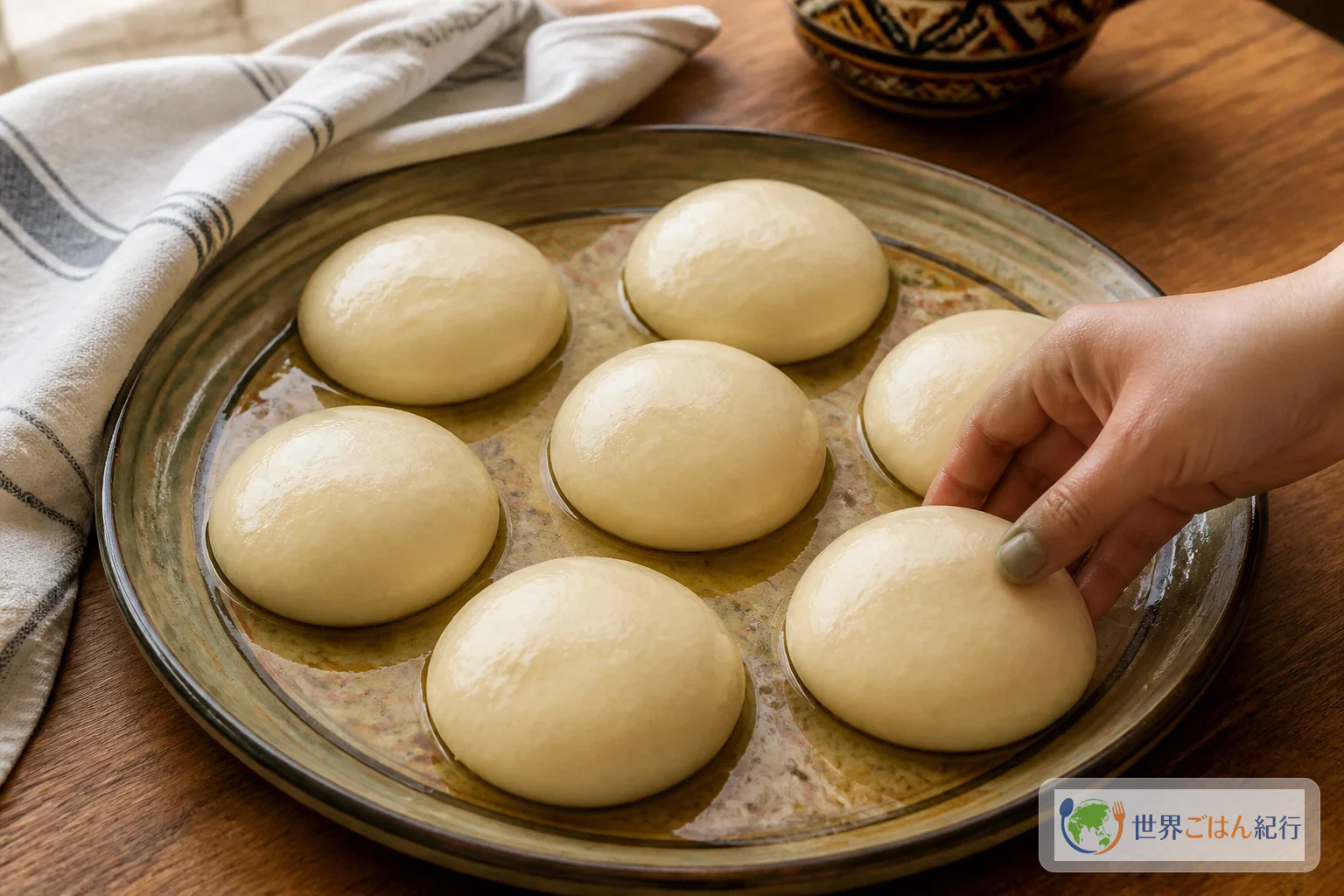
With msemen, how easy the dough is to handle depends less on the force of kneading than on whether you can secure time to leave the dough alone. Even if the kneaded dough is a little stiff, a 10-minute rest lets the moisture travel and the next kneading smooths the surface. Do not press the folded squares right away either; wait until the fat settles inside the dough.
A Flat Cooking Surface: A Dedicated Tool Does Not Decide the Taste
If you cook msemen one piece at a time, an ordinary frying pan about 24 cm in diameter will do. A dedicated tava makes sense for someone who wants to turn an 18–20 cm square of dough without it touching the rim, or who wants to keep the conditions of the cooking surface consistent across many pieces. If you only want to try it once, there is less waste in using the pan you already have and paying attention to how to read the color.
The one point to check before buying is the diameter of the flat cooking surface, whether it works with your heat source such as gas or induction, and, if it is iron, how to season and care for it. Search results mix products of different shapes, for chapati, crepes, or frying-pan style, and if you choose a pan with a deep rim, the corners of the dough will fold when you turn it.
This kind of tool is chosen by people who cook thin doughs such as msemen, chapati, and crepes again and again. If you have limited storage space, want to try just one piece first, or want to avoid products whose induction compatibility is unclear, proceed with a shallow frying pan. A dedicated flat surface helps with turning, but it is not a tool for fixing insufficient resting of the dough or too strong a flame.
When It Doesn't Go Well, Fix the Dough Rather Than the Cooking Time
If you try to recover a msemen failure after cooking has started, the layers set. The quicker route is to look at the condition of the dough at the stretching stage and go back to one of three: rest it, bring moisture back, or use a thinner fat.
| What you see | Main cause | How to fix it on the spot |
|---|---|---|
| Tears badly while stretching | Not rested enough, or the dough is dry | Fold it back, oil it, cover with a cloth, and rest 15 minutes. For a small hole, brush on fat and fold as it is |
| Shrinks back right after pressing | The gluten tension remains | Do not force it; rest the balled dough another 10–15 minutes |
| Cooks as one thick bread | The stretched sheet is thick, or the folding semolina is bunched in one place | Stretch the next one to 35–40 cm and scatter 1–2 tsp semolina evenly |
| Only the surface burns, the center is white and damp | The heat is high, or the square is thick | Lower to medium-low, press the thickness to 4–5 mm with your palm, and cook an extra 20–30 seconds per side |
| Still white after 4 minutes, layers dry | The cooking surface was not hot, or turning too often let heat escape | Preheat 2 minutes for the next one and cook for 30–60 seconds at a time without increasing turns |
| Oil pools on the plate and it feels heavy | Too much oil on the surface and dough | Move to a rack and lightly blot surface oil with paper towel. Next time brush on a thin film |
| Hardens soon after cooking | Not moved to a rack and steam was trapped, or overcooked | Cool 5 minutes on a rack, and the next day warm covered over medium-low heat without oil for 2–3 minutes |
You do not need to throw away torn dough. For one with a large hole, lay another thin sheet over it, add a little fat and semolina, and fold, and it will cook with fewer layers. A piece that does not hold its shape can be torn into 2–3 cm pieces after cooking and used for rfissa with a broth of chicken and lentils, using the texture of msemen in another dish.
Substitutes and the Order of Buying
If you replace fine semolina with all-purpose flour, you can make the dough, but the fine gaps between grains decrease and the layers cut more smoothly. It is not a perfect substitute, but a replacement for days you don't want to be left with extra flour and want to practice the motion of folding and cooking. When making 500 g with all-purpose flour only, put in just 280 ml water at first, rest 10 minutes, and add 5 ml at a time judging the firmness. If you put in the same 300 ml as the semolina formula from the start, it tends to stick to your hands when stretched thin.
I do not recommend substituting coarse semolina or couscous crushed fine. The grains stay large, so they catch the dough while it is stretched to 35–40 cm and cause holes and thick lumps. When buying, give priority to "fine," and if the label is unclear, do not decide by the package image alone; open the ingredients and the grain description to check.
Oil and butter share the role not only of taste but of separating the dough. Oil is hard to set even when cooled and smooths the surfaces of the folds. Butter adds aroma and color. Oil alone avoids dairy but cannot reproduce the same butter aroma. Conversely, too much butter runs onto the cooking surface and only the surface colors early, so it is easier to judge if you do not increase it from the first formula.
If you make a stuffed one elsewhere, start with a small amount of sautéed onion and cilantro with black pepper, cooled. If adding ground meat, always cook it through first and drain off the juices before wrapping. If you wrap raw meat in thin dough and just cook it, the outside color goes ahead first and you cannot judge from the surface whether the center is cooked.
Storage and Reheating
Cool freshly cooked msemen completely on a rack and then wrap each in plastic wrap. If sealed hot, water droplets return and the cooked surface softens. To eat from the same day to the next, cool, put it in a sealed container in the refrigerator, and before eating warm it covered over medium-low heat for 2–3 minutes, then uncovered for about 30 seconds.
If you made many, cool them completely, wrap each in plastic wrap, and put them in a freezer bag. A guide that is easy to handle at home is within 1 month. Thaw naturally, move to a pan, and use a lid if the surface looks about to dry. Reheating only in a microwave for long steams the layers and makes them hard to stretch, so a short time to bring the center back followed by tidying the surface on a cooking surface suits it.
Do not store any that have had honey or amlou poured on; serve only the amount you will eat. Keep the plates and knives used for amlou with nuts separate from those used for portions for people with allergies.
Msemen dough uses wheat and butter. If you have an allergy to wheat, milk, almonds, or anything else, check the ingredient labels and the sharing of utensils, and do not use amlou. If you stuff it, do not judge by cooked color alone while it is wrapped around raw meat or eggs; confirm that it has been cooked through to the center.
Nutrition (approx., per serving = 2 pieces)
This is a guide calculated by dividing the flour, semolina, oil, and butter into four. Accompaniments such as honey, amlou, and cheese are not included. Not all of the oil necessarily stays in the dough, so the actual values vary with how you brush it on and with the products.
| Item | Per serving (approx.) |
|---|---|
| Energy | About 700 kcal |
| Protein | About 14 g |
| Fat | About 32 g |
| Carbohydrate | About 93 g |
| Fiber | About 3 g |
| Salt equivalent | About 2.0 g |
Frequently Asked Questions
Do I put yeast in msemen?
Not in the basic dough here. Msemen can be made as a flatbread of kneaded dough that is rested, then cooked with fat and semolina sandwiched in. There are variations that use a little yeast depending on the household or recipe, but they change the fermentation time and the way it puffs, so it is easier to understand if you first confirm how to build the layers without yeast.
Can I not make it without semolina?
With all-purpose flour alone you can practice stretching thin and folding. However, the graininess and the way layers separate when fine semolina is scattered between the fat becomes weaker. Rather than substituting coarse couscous, start from 280 ml water as a practice dough of all-purpose flour only from the beginning, which makes tearing easier to control.
The dough won't stretch thin.
Before adding force to push it out, extend the rest by 10–15 minutes. A dough that springs back right away when pressed with a finger still has tension. Re-oil the work surface and your hands thinly, relax, and spread from the center outward, and you can make a surface that is less likely to tear.
Can I wrap in something sweet?
Low-moisture nuts, cinnamon, and a small amount of sugar can be wrapped, but if sugar comes out at the edges it burns first on the cooking surface. At first, serving honey or amlou with the finished bread and, if filling, placing only a small amount in the center makes the color easier to manage.
Can I make it in a frying pan?
Yes. A frying pan about 24 cm in diameter with a flat bottom is easier to handle than a deep pot. A tava is not required; it is a dedicated tool for people who cook many pieces to turn a square of dough without touching the rim.
How do I eat cooked msemen?
Serve honey, amlou, olive oil, cheese, and jam separately and pair it with mint tea or coffee. There is also eating it wrapped around salty fillings and tearing the cooked bread to combine with the broth of rfissa. It is a bread that is not fixed to a sweet plate, and by changing the accompaniments can serve both breakfast and a meal.
Sources
- Moroccan National Tourist Office, "Food & Drinks": the food culture of bread, mint tea, and rfissa with msemen. Accessed and checked: 2026-08-28
- Moroccan National Tourist Office, "Immersion: Moroccan gastronomy" PDF: msemen at breakfast, honey and butter, and the culture of sharing the table. Accessed and checked: 2026-08-28
- World Intellectual Property Organization, "Scoping study on the gastronomic tourism sector in Morocco" PDF: the position of m'semen, r'ghaif, and melaoui, ingredients, and how they are made at home and in specialist shops. Accessed and checked: 2026-08-28
- Slow Morocco, "What Morocco Eats for Breakfast": msemen layers, breakfast accompaniments, and regional ways of eating with honey and tea. Accessed and checked: 2026-08-28
- Moroccan Culture, "Moroccan Msemen Recipe: Flaky, Layered Flatbread": formula, folding, signs of doneness, and variations with amlou and fillings. Accessed and checked: 2026-08-28