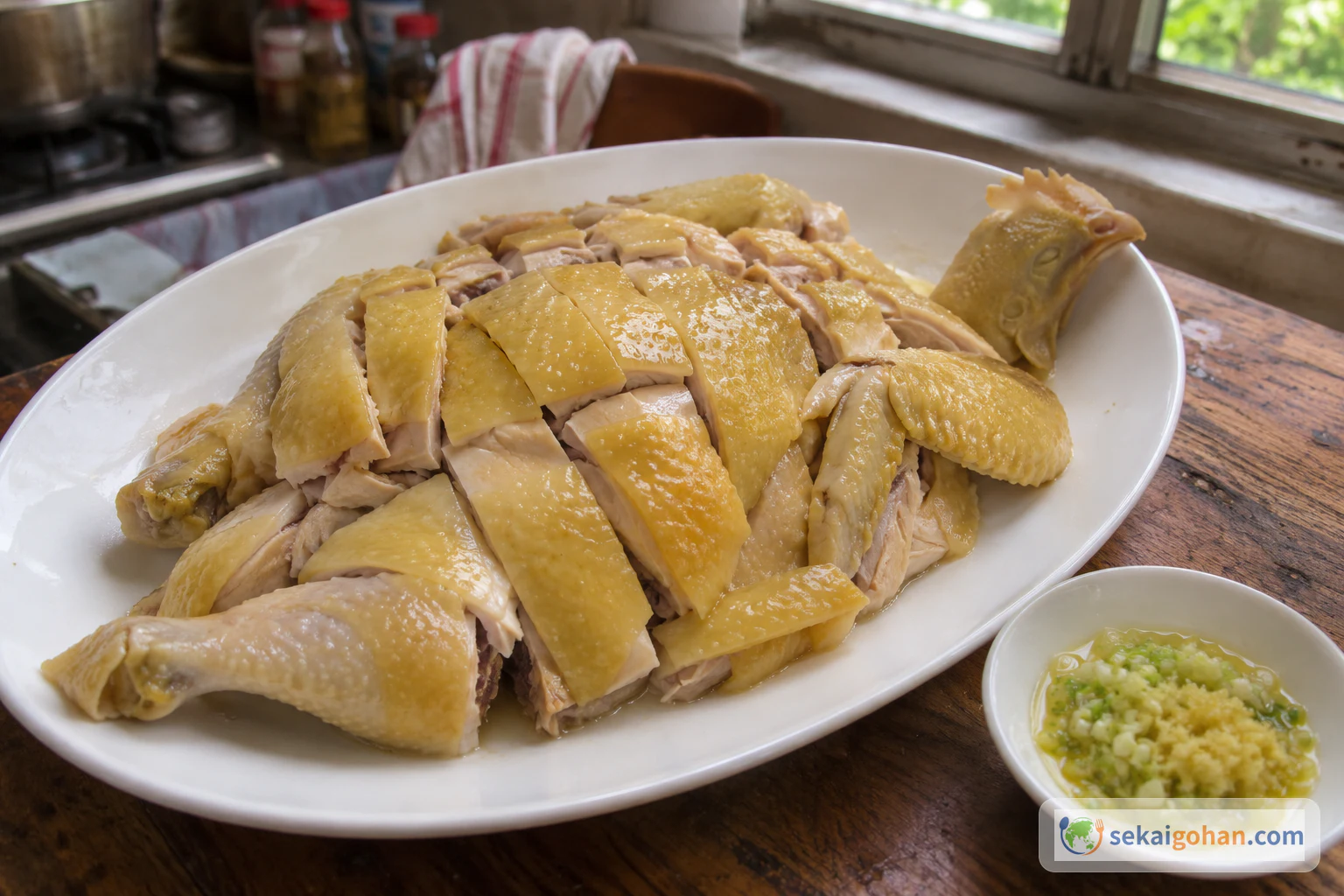
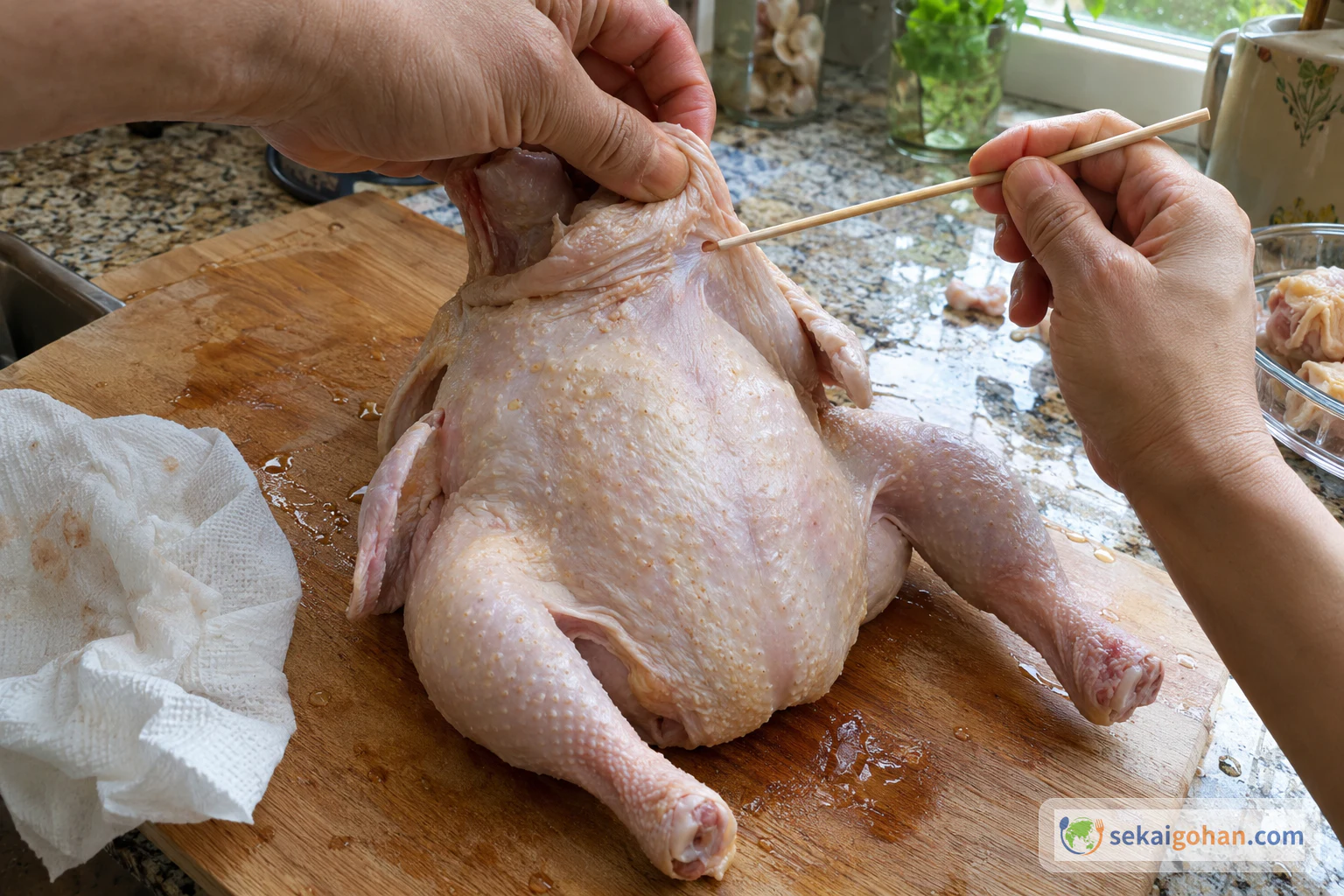
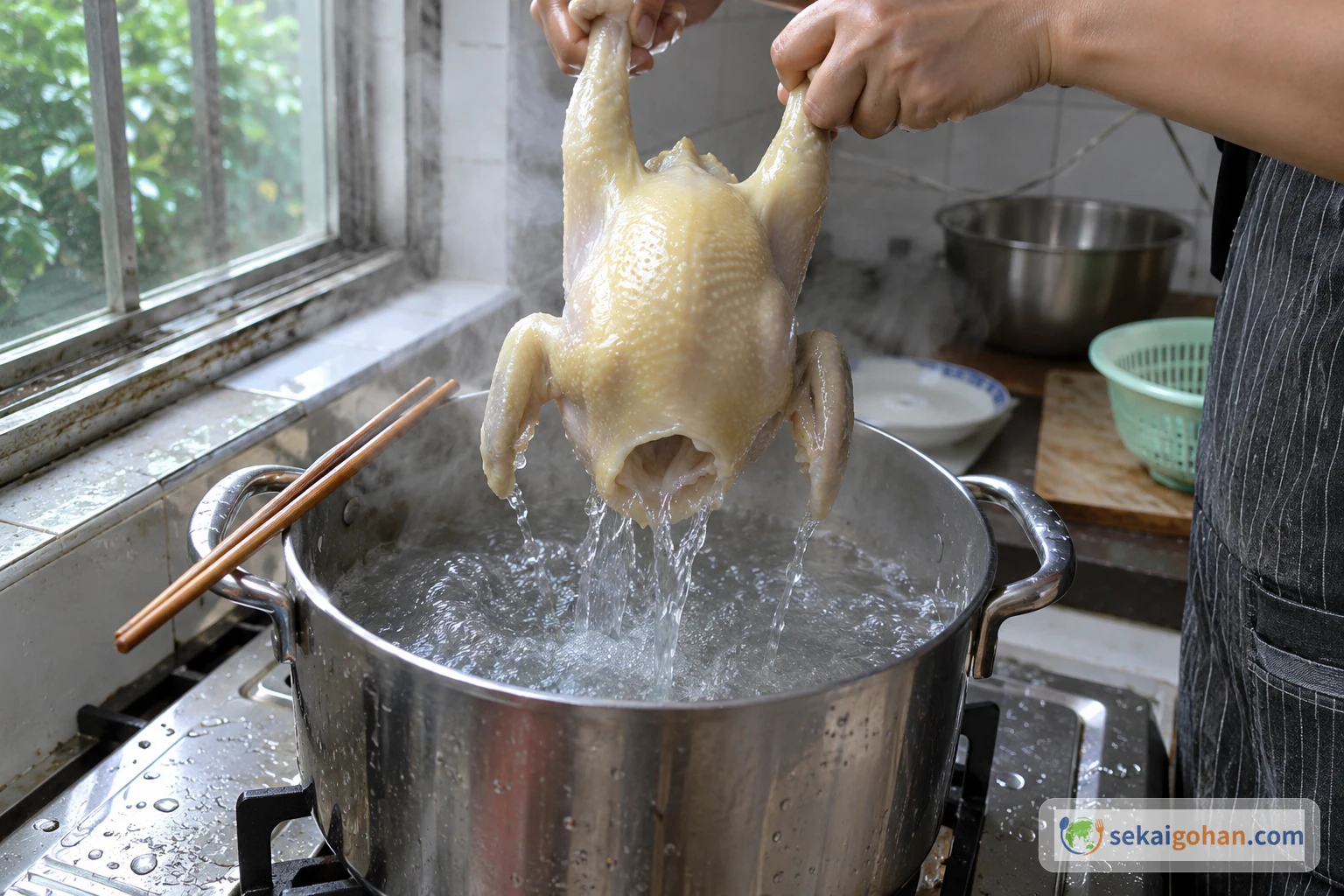
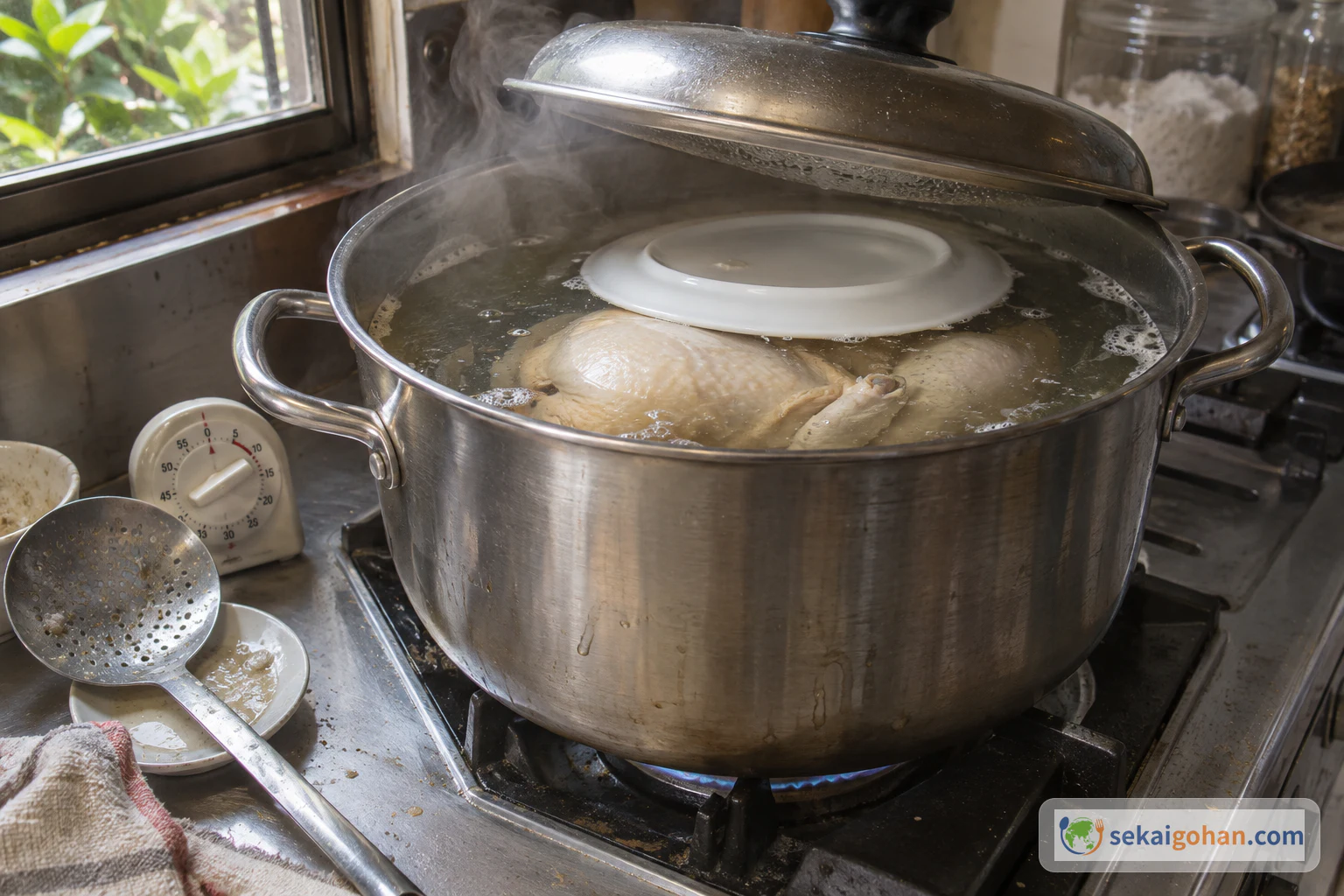
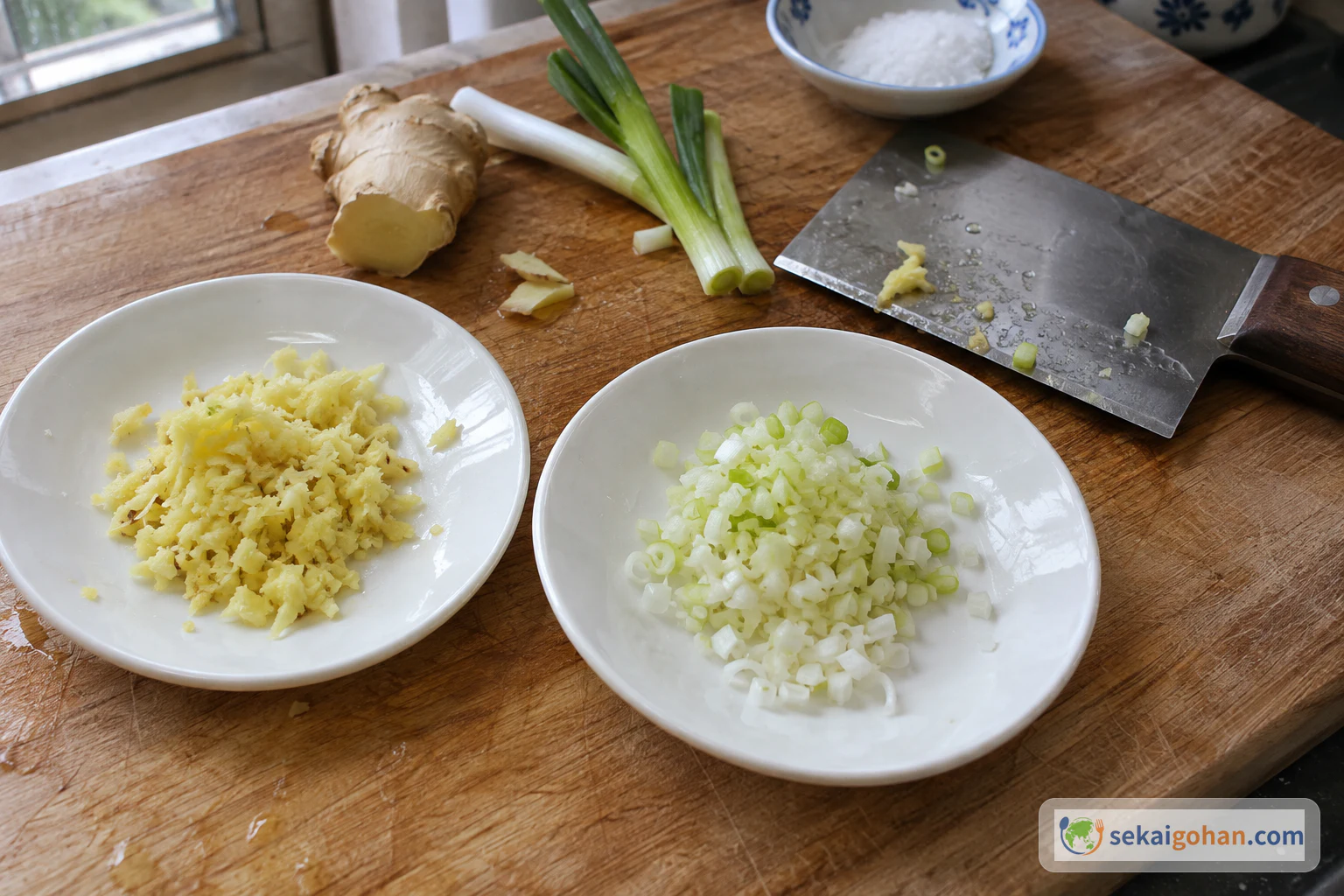
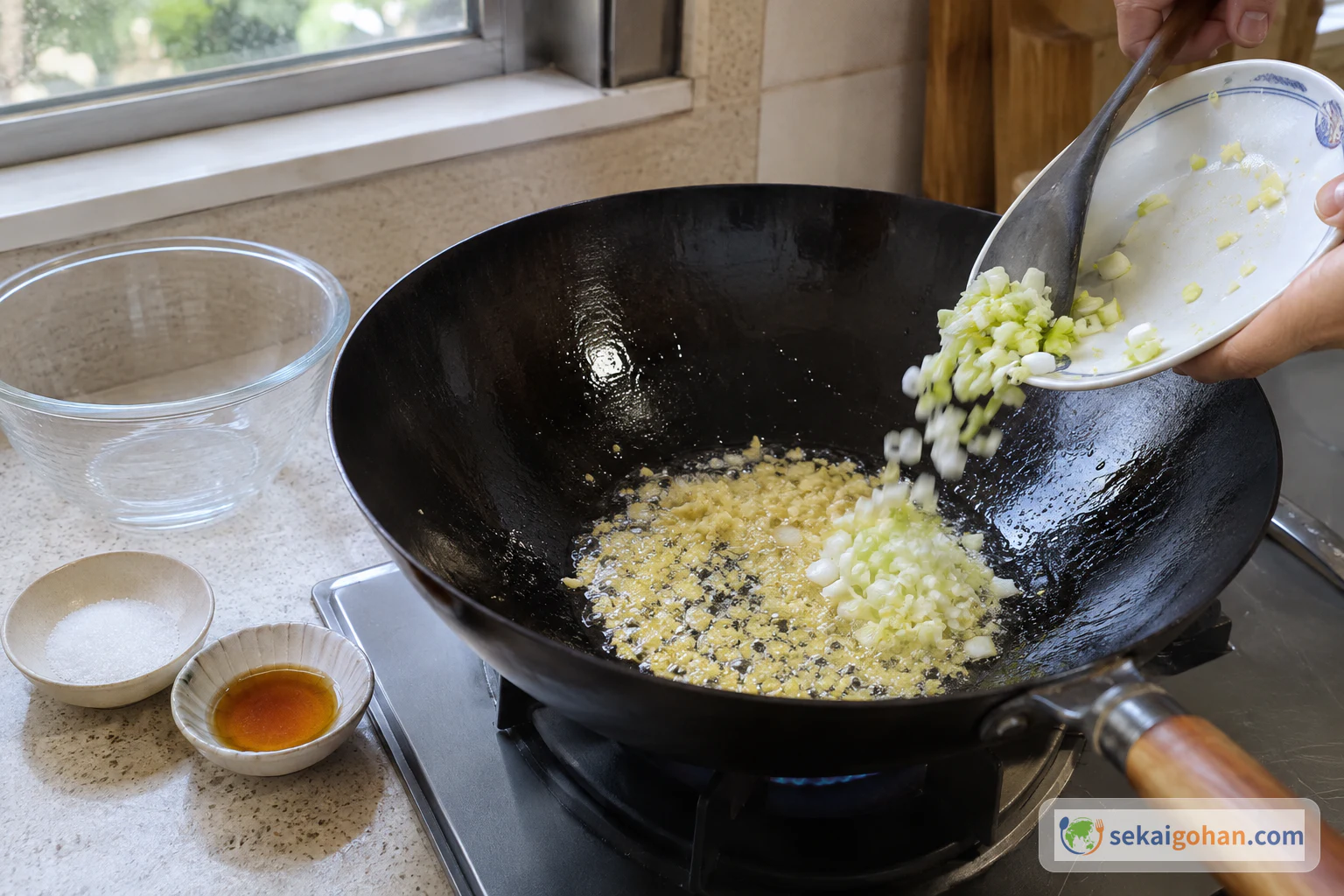
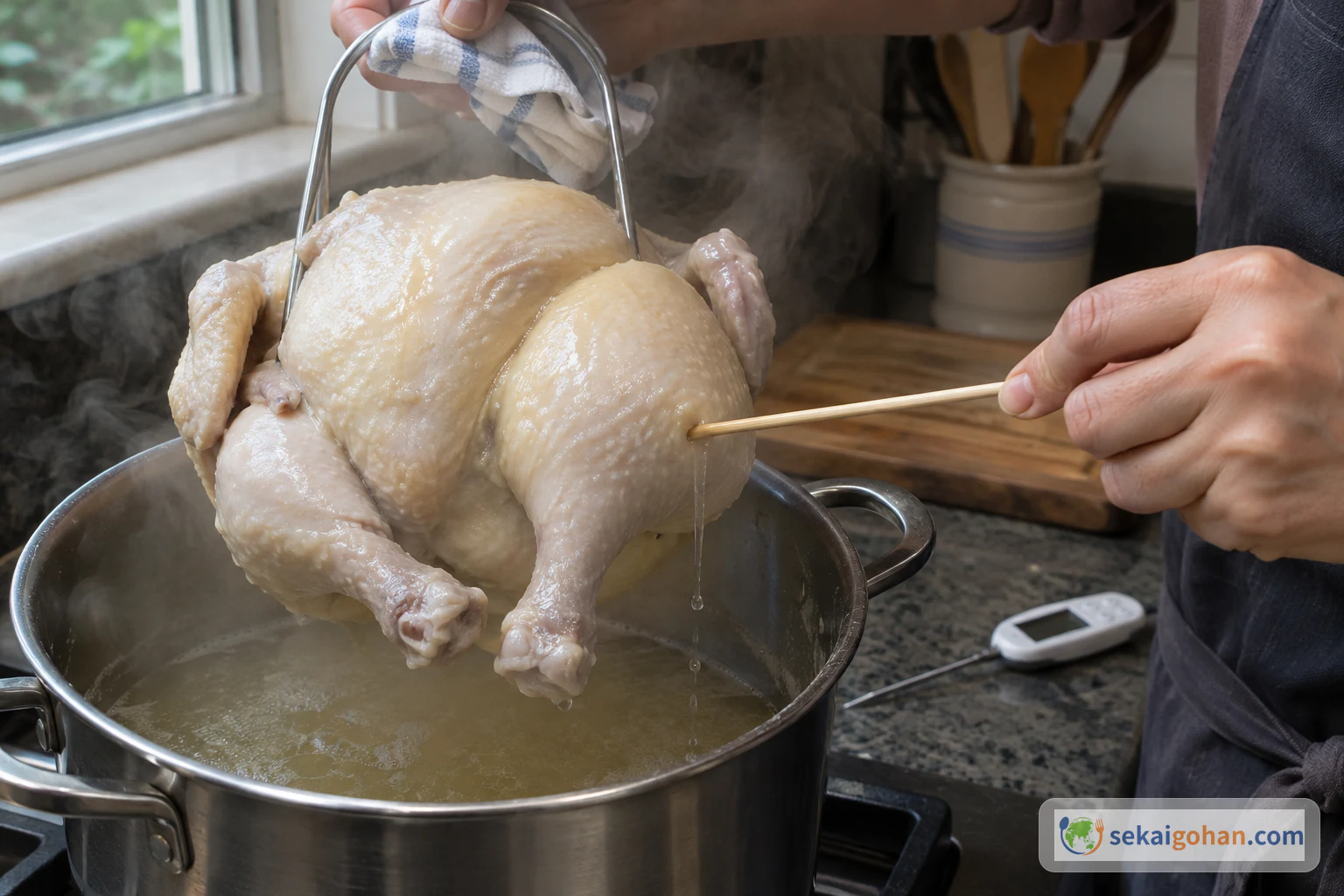
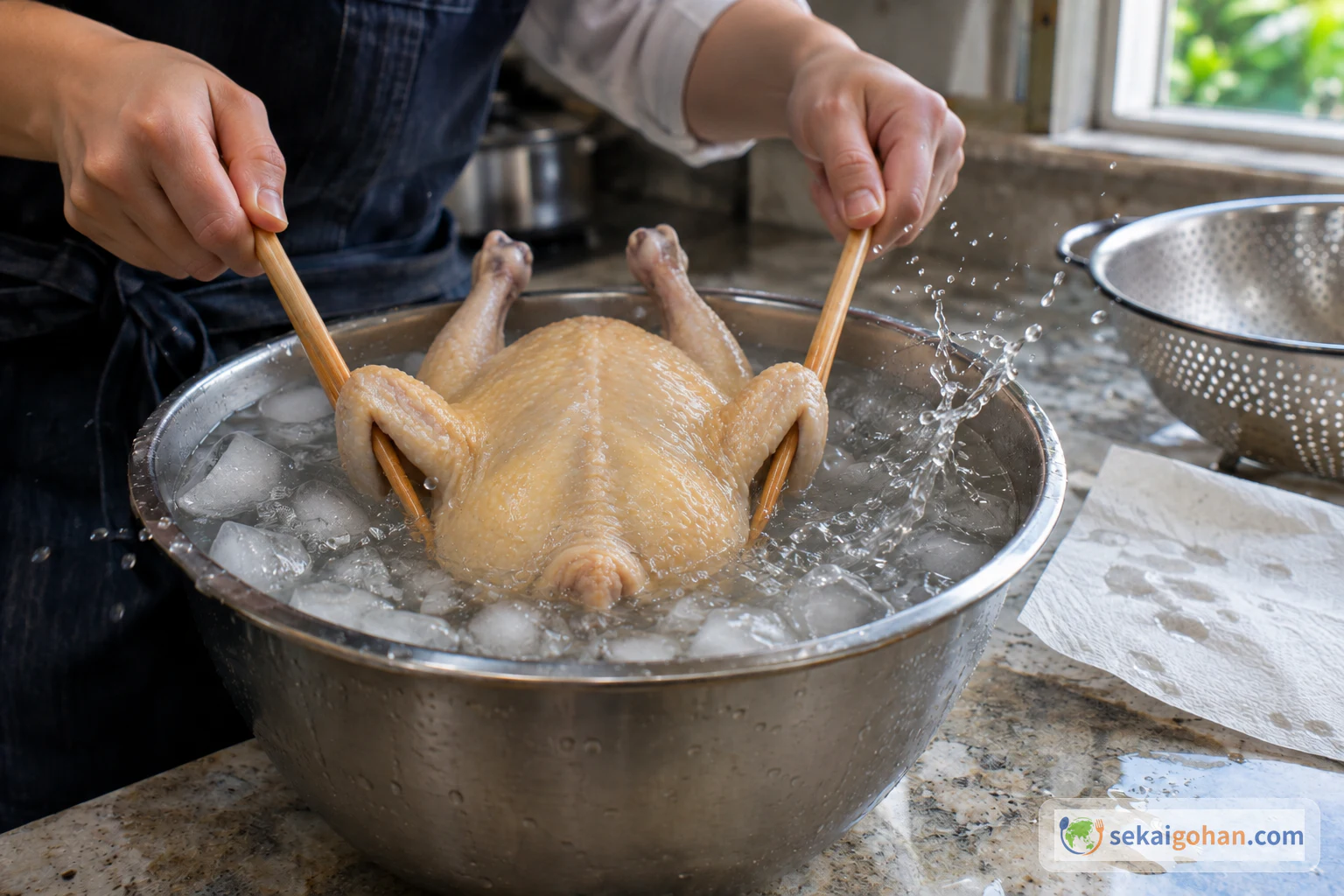
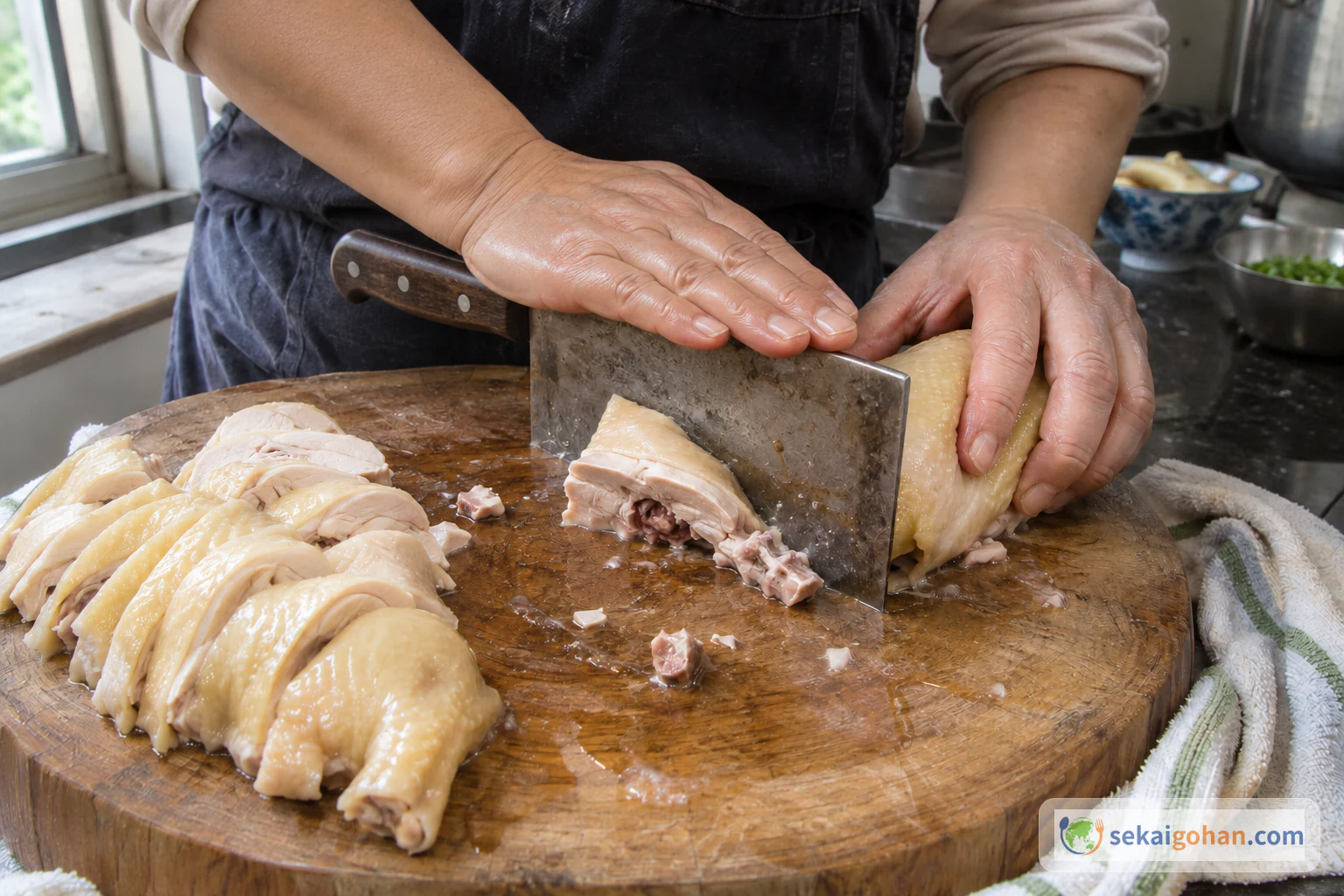
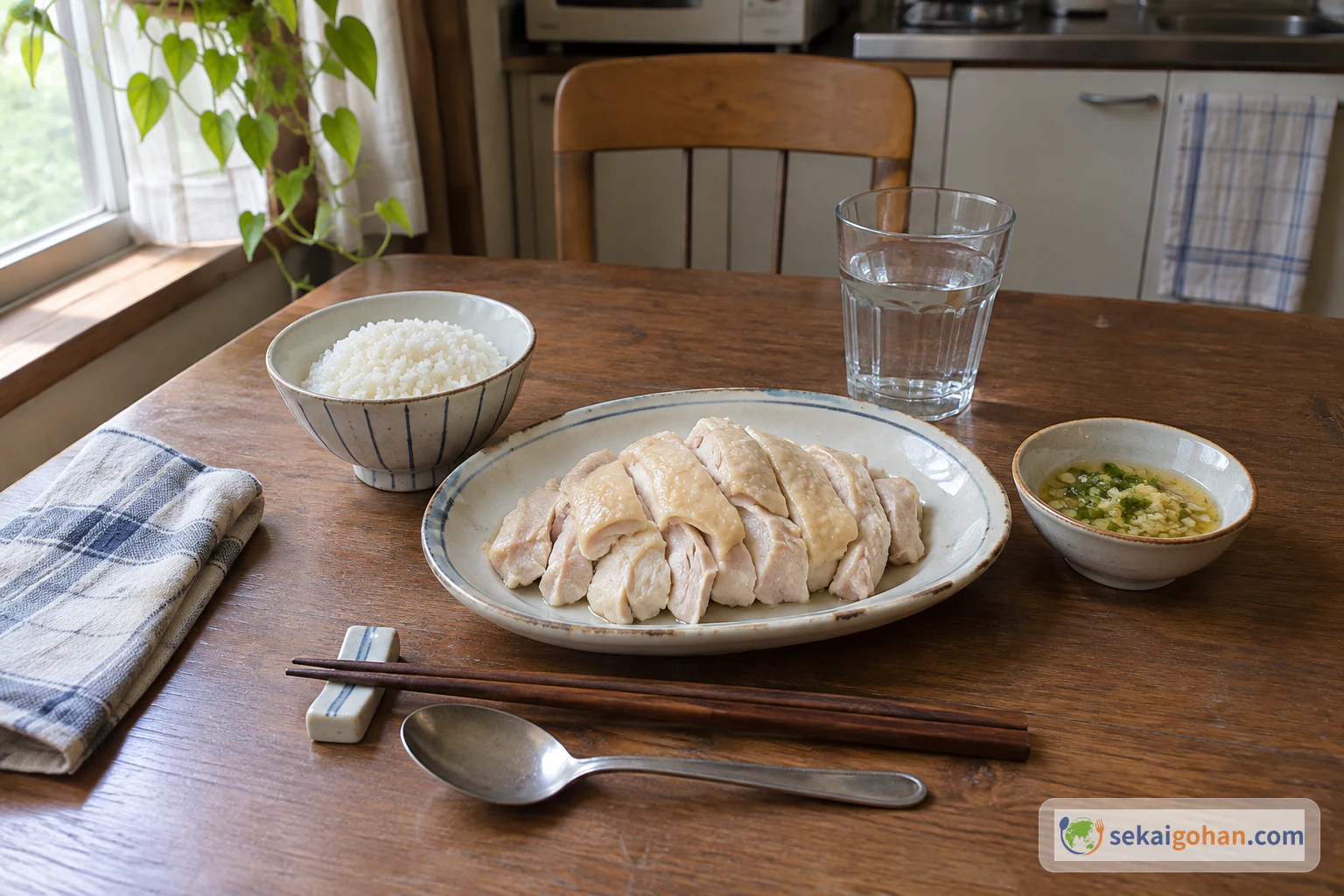
The water in the pot should hardly move. A whole chicken lies under it with the lid on, and now and then a small bubble rises and breaks. When the bird comes out, it goes straight into a bowl of ice water, and the skin draws tight around the meat. Then the cleaver comes down through the bone, the pieces go back onto an oval plate in the shape of the bird, and a small dish of ginger and green onion in hot oil goes beside it.
White cut chicken, baak cit gai in Cantonese, is how Guangdong cooks serve a good chicken with nothing hiding it: no marinade, no soy color, only lightly salted water, ice and a sharp sauce. The meat tastes clean, the skin is springy, and a thin layer of jelly sits between skin and flesh. All the seasoning lives in the ginger-scallion oil, salty and pungent, that you drag each piece through.
A chicken for the feast table
The name says exactly what happens. "White" means no soy sauce colors the bird; "cut" means it is chopped into pieces through the bone. In Shanghai and the Jiangnan region the same idea goes by bai zhan ji, "white chopped chicken," and in Guangzhou you hear both names.
Cantonese speakers say baak cit gai, also written bak chit gai. In Mandarin it is báiqiējī, and around Shanghai báizhǎn jī. All three describe a chicken cooked plain and chopped to order.
In Guangdong there is a saying, "no feast without chicken." At New Year and at Qingming, a whole chicken is set out as an offering first, then carried back to the board, chopped and eaten. At Lunar New Year it comes to the table with its head and feet on. The word for chicken sounds close to the word for good fortune, and a bird with both head and tail means a year that starts well and ends well.
On an ordinary day it hangs in the window of a siu laap shop, the Cantonese roast meat counter, next to the char siu. The shop sells it whole, by the half or the quarter, or chopped over rice as white cut chicken rice, and market stalls sell it by weight. Shops usually pair it with ginger-scallion sauce, while many families dip it in soy sauce at home. In Guangzhou it is served at room temperature, as a cold plate among the hot dishes.
From Guangzhou to Shanghai, a different bird and a different dip
Each region in the south keeps its own chicken and its own dip, which makes this one of the clearest examples of how cooking in China shifts from one province to the next.
| Region | Chicken | Dip |
|---|---|---|
| Guangzhou and the Pearl River Delta | Qingyuan chicken, fine-boned and tender | Ginger-scallion sauce |
| Zhanjiang and western Guangdong | Zhanjiang chicken, larger, fattier, firmer, heavier in the bone | Sand ginger soy, or garlic with peanut oil |
| Chaoshan | Local chicken; at feasts goose matters more | Puning bean paste |
| Hainan | Wenchang chicken | Soy sauce, garlic, chili and green citrus |
| Beihai, Guangxi | Local chicken | Salty sand crab sauce |
| Guangxi | Birds raised more than 180 days, and capons | Sand ginger soy |
| Shanghai and Jiangnan | Three-yellow chicken | Sweetish soy dip, with chicken congee alongside |
The Zhanjiang sand ginger dip is usually said to have become common in Guangzhou only in the last twenty or thirty years. Hainanese chicken rice and Wenchang chicken rice use steeped chicken too, but there the bird is one part of a rice meal with broth and several sauces. White cut chicken stands alone, with one sauce and no rice required.
An old idea, a newer ice bath
Where steeped, chopped chicken began is not settled. A food record from 1792 already lists a dish of fatty chicken cut plain and white, which shows the idea is old, though it says nothing of steeping, ice or dips. A Cantonese recipe from 1976, as Chinese Food Atlas reports it, steeps a smaller bird, about 2¾ lb (1.25 kg), at a bare simmer for about 15 minutes, lifts it out twice to drain the cavity, cools it in cold boiled water, rubs the skin with cooked peanut oil, then chops it and rebuilds the bird on the plate.
Ingredients (serves 6)
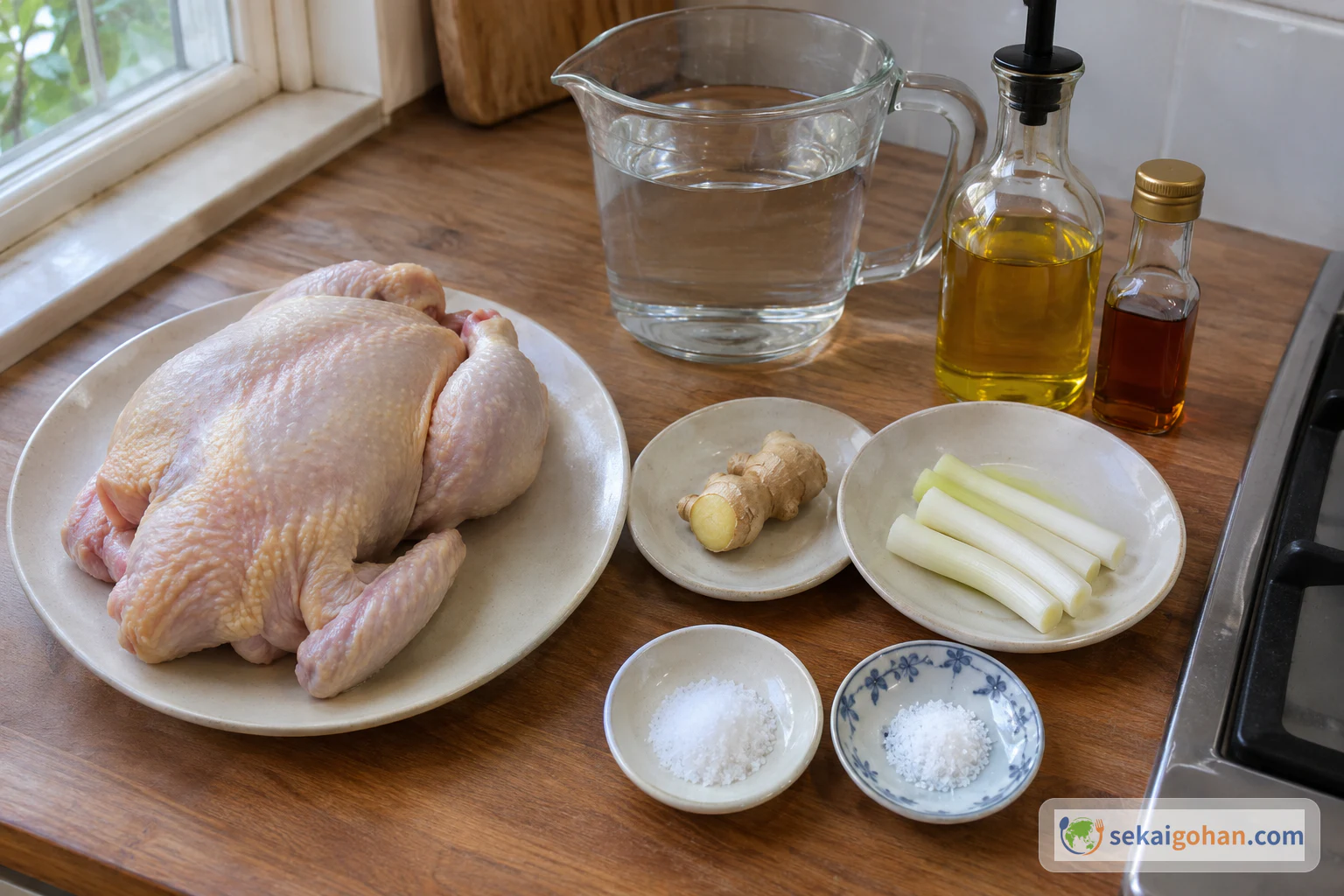
The ginger to green onion ratio can be loose, and leftover sauce is a good thing to have. What decides the result is hot enough oil and ginger going in before the green onion.
This dish contains chicken and sesame (sesame oil). Corn oil is the frying oil; if you swap in a blended vegetable oil, check the label for soy. The sand ginger soy variation below contains soy and wheat, and any version made with peanut oil contains peanut.
Equipment
- A large, deep pot with a lid, big enough for the chicken to sit fully under water
- A heatproof plate that fits inside the pot
- A wok or skillet
- A heatproof bowl
- Bamboo skewers
- An instant-read thermometer, and an oil thermometer if you have one
- A large bowl for ice water
- Two long chopsticks
- A thick wooden cutting board and a damp cloth to set under it
- A Chinese cleaver or a heavy knife
- A large oval platter and a small dish for the sauce
- Paper towels
Choosing the chicken, oils and aromatics
A 4 lb bird is the sweet spot: the steeping time fits it, and a larger chicken needs longer. At an Asian grocery, look for a yellow-skinned bird such as a yellow hair chicken or a Kwai Fei chicken. An ordinary young whole chicken close to 4 lb works well; it has a different aroma and amount of fat, but keeping the weight close is what makes the timing hold. Firm-fleshed heritage or premium birds tighten up faster, so check the thigh early if you use one.
If you cannot get a whole chicken, four bone-in legs, about 2¾–3 lb (1.2–1.4 kg) in total, will steep the same way. You lose the skin of the whole bird and the platter rebuilt in its shape, and the whole-bird timing no longer applies, so stop when the thickest part reaches 167°F (75°C) on a thermometer.
| Item | Use | What a swap changes |
|---|---|---|
| Green onion | White parts, weighed | Sliced green tops smell sharper and grassier; match the weight |
| Ginger | Mature ginger root | Young ginger is watery and gives a thinner aroma |
| Corn oil | Any neutral oil | Blended vegetable oil often contains soy |
| Sesame oil | Toasted | Untoasted sesame oil barely registers in the sauce |
| Peanut oil | Only for the variations | Tastes like a Guangzhou kitchen; a peanut allergen |
| Soy sauce | In its own dish if wanted | Mixed into the ginger sauce it becomes a different dip |
Sand ginger, also sold as kencur or sha jiang powder, belongs to a different family of aromas from ordinary ginger. Use it only for the Zhanjiang dip, and when you have none, serve the ginger-scallion sauce alone. Keep plain salted water, the ice bath and toasted sesame oil; those three are what make the dish taste of Guangdong.
Method
Take the chicken out of the refrigerator first, since it needs time to lose its chill. Once it is under the water and the heat is low, you have 35–40 hands-off minutes, which is when you mince and fry the sauce. Set up the ice bath before you test the thigh, because the bird has to go from the pot into ice with no delay.
Do not rinse raw chicken; splashes carry bacteria around the sink and onto other food. Wipe drips with paper towels, keep the raw bird away from the sauce ingredients, and wash your hands before cooking and after touching it. Afterwards wash the board and knife with detergent, sanitize them with boiling water or chlorine bleach, and let them dry well. Dry the wok fully before the oil goes in, and keep your face clear of the pot when you lift the bird out of boiling water.
A hard boil tears the skin and tightens the meat. Once the pot has come back to the boil, only small, slow bubbles should reach the surface for the rest of the steep.
When it goes wrong
| What you see | Why | What to do |
|---|---|---|
| Torn skin, dry tight meat | The water kept boiling hard | After the 5-minute return to the boil, drop to low and keep only small bubbles |
| Juice runs out as you chop; skin slides off the meat | The ice bath was skipped or came late | Drain for 30–45 seconds and go straight into ice for 5 minutes |
| One patch is undercooked | Part of the bird sat above the water | Top up with boiling water until it is fully covered; weigh it down with a plate if it floats |
| Red juice at the skewer | Not cooked through | Steep a few minutes more and check for 167°F (75°C) in the thigh |
| Sauce too salty | All the sauce salt went in at once | Next time start with 1½ teaspoons and add to taste |
| Sauce smells flat | The oil was not hot enough | Heat to 350–400°F (about 177–204°C); ginger 15 seconds, then green onion 20–30 seconds |
| Sticky or dry-looking skin | Water left on it after the ice bath, or the cut pieces sat out | Pat dry; let the bird rest uncovered in the fridge to dry the surface; rub a little sesame oil on the skin before serving |
Serving, variations and storage
At the table
Put the platter in the middle with the sauce in its own small dish, and let everyone pick pieces with chopsticks and swipe them through it. A bowl of plain rice turns it into the white cut chicken rice of the siu laap shops, and a separate dish of soy sauce suits anyone who grew up with the home version. For Lunar New Year, serve the bird whole on the platter with the head and feet in place. It is meant to be eaten cool, soon after chopping.
Variations
Zhanjiang sand ginger soy. Mince 1 shallot and fry it in a little peanut oil, then stir in 1 tablespoon sand ginger powder, 1 tablespoon Maggi seasoning sauce and a little chicken broth. It tastes warmer and more floral than the ginger-scallion sauce and suits a fattier bird. Set it next to the ginger-scallion sauce and the platter becomes a side-by-side of Guangzhou and Zhanjiang, with the chicken left exactly as it is.
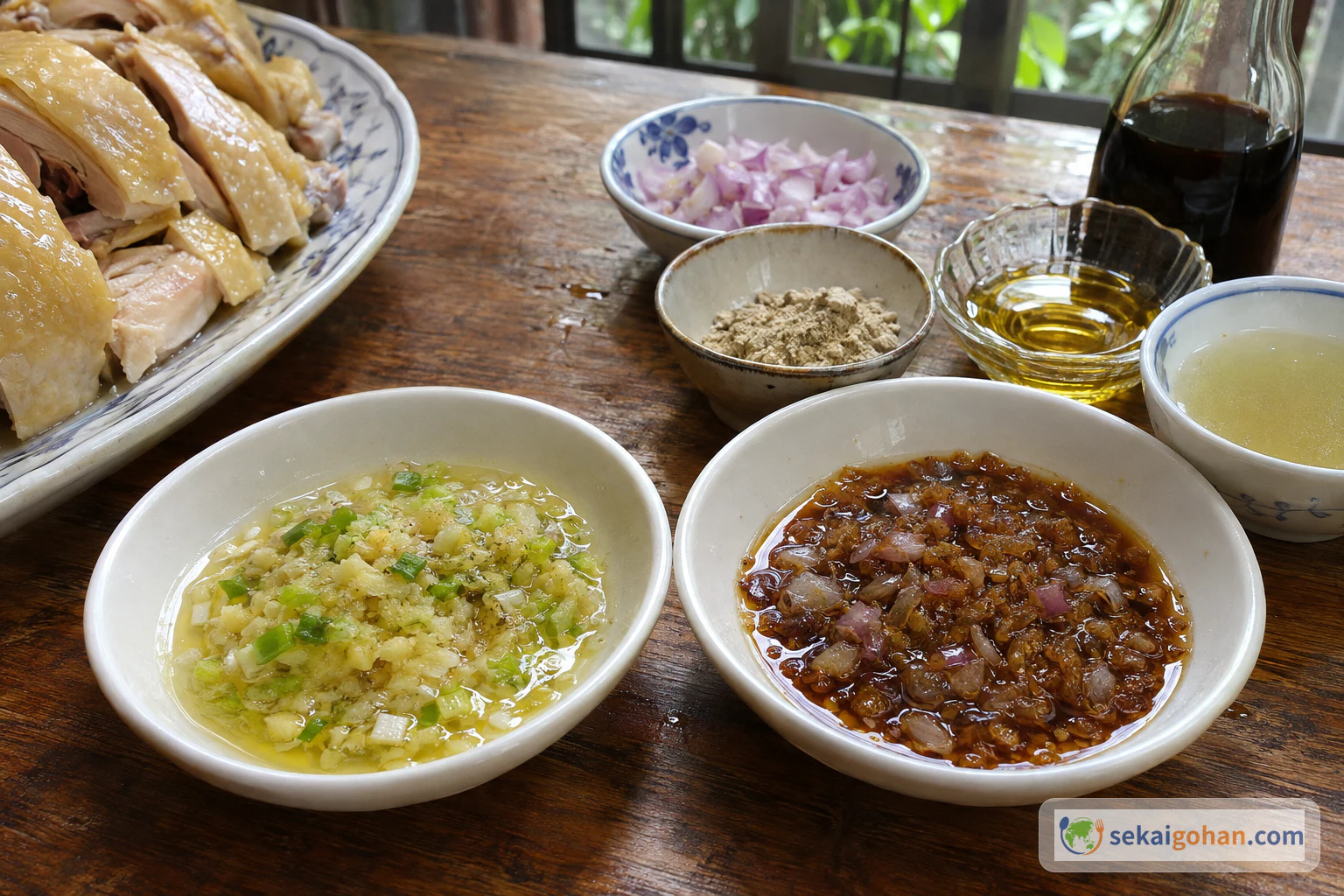
Guangzhou-style ginger-scallion with broth. Use 1¾ oz (50 g) each of minced ginger and green onion whites, 1 teaspoon salt, 3 tablespoons hot peanut oil, 1 tablespoon sesame oil and 2 tablespoons chicken broth. The broth loosens it into a spoonable sauce, and the peanut oil gives it the flavor of the old Cantonese kitchen. Make it as a separate batch rather than mixing it into the corn oil version.
Congee or rice from the pot. The steeping liquid makes a light chicken congee, the way Shanghai serves its white chopped chicken. Dilute the liquid with water first, since it is salted, then cook rice in it at about 1 part rice to 10 parts liquid, uncovered over low heat, for about 30 minutes. The fat that rises to the top of the pot can also be skimmed off and used to cook rice, which leans toward chicken rice.
The poaching liquid and leftovers
Skim the steeping liquid and keep it for soup stock, blanching greens or noodle soup; it is salted, so dilute it rather than drinking it straight. The 5-minute ice bath only sets the skin, so cool any chicken you are keeping from 140°F (60°C) to 68°F (20°C) within 2 hours, then refrigerate it promptly in a covered container at 39°F (4°C) or below until shortly before eating.
Once chopped, eat the chicken soon. These limits are Hong Kong's Centre for Food Safety guidance for poached chicken, not Japanese law. Chicken that has been out for less than 2 hours can go into the fridge for later or be finished within 4 hours. Chicken out for 2 to 4 hours must be finished within 4 hours and never goes back into the fridge. After 4 hours at room temperature, throw it away.
To reheat, bring the center to 167°F (75°C). Heat loosens the springy skin the ice bath gave it, so steam the pieces briefly or warm them in the steeping liquid rather than using the microwave, which roughens the skin.
Frequently asked questions
Why dip the chicken three times before it goes in?
Each dip fills the cavity with boiling water and pours it out again, so the inside warms along with the outside. Cantonese cooks call this "three lifts, three drops." Without it, the thick meat near the bones lags behind the breast and skin.
Is a little red near the bone acceptable?
Some Cantonese cooks prize meat that is just cooked with a trace of red in the marrow at the joints. At home, cook until the thigh juice runs clear and no blood shows when you cut, and reach 167°F (75°C) in the thickest part. If red juice comes from the meat, return the bird to the pot.
Can I leave out the sesame oil?
Keep it in. One tablespoon of toasted sesame oil finishes the sauce, and without it the ginger-scallion oil tastes raw and thin. Add it after the hot aromatics are in the bowl, so its aroma stays bright.
Can I serve it warm, straight from the pot?
The ice bath is part of the dish, so the chicken reaches the table cool rather than hot. In Guangzhou it is eaten at room temperature, where the firm skin and jelly layer show best. Chop it close to mealtime and serve it right away.