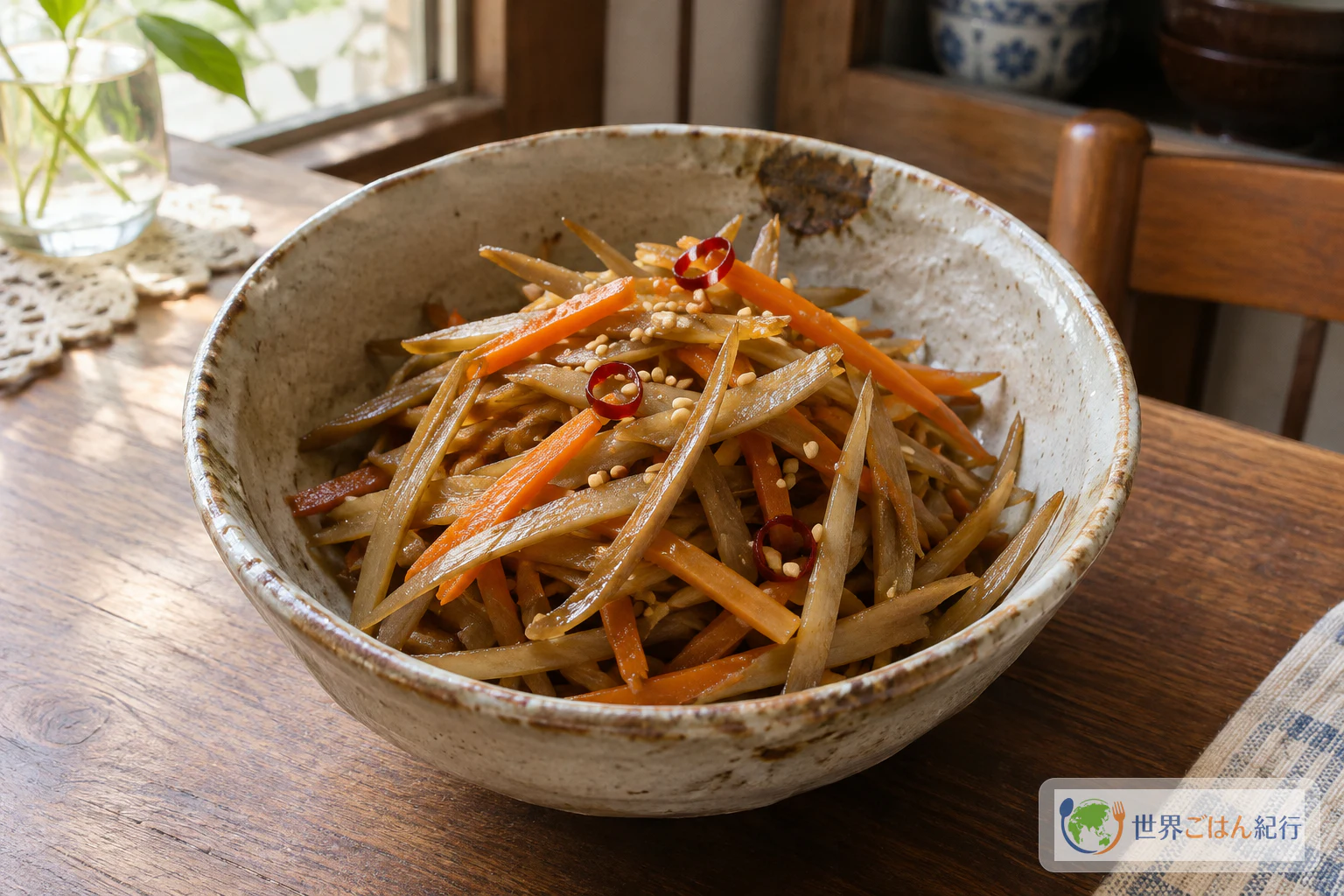
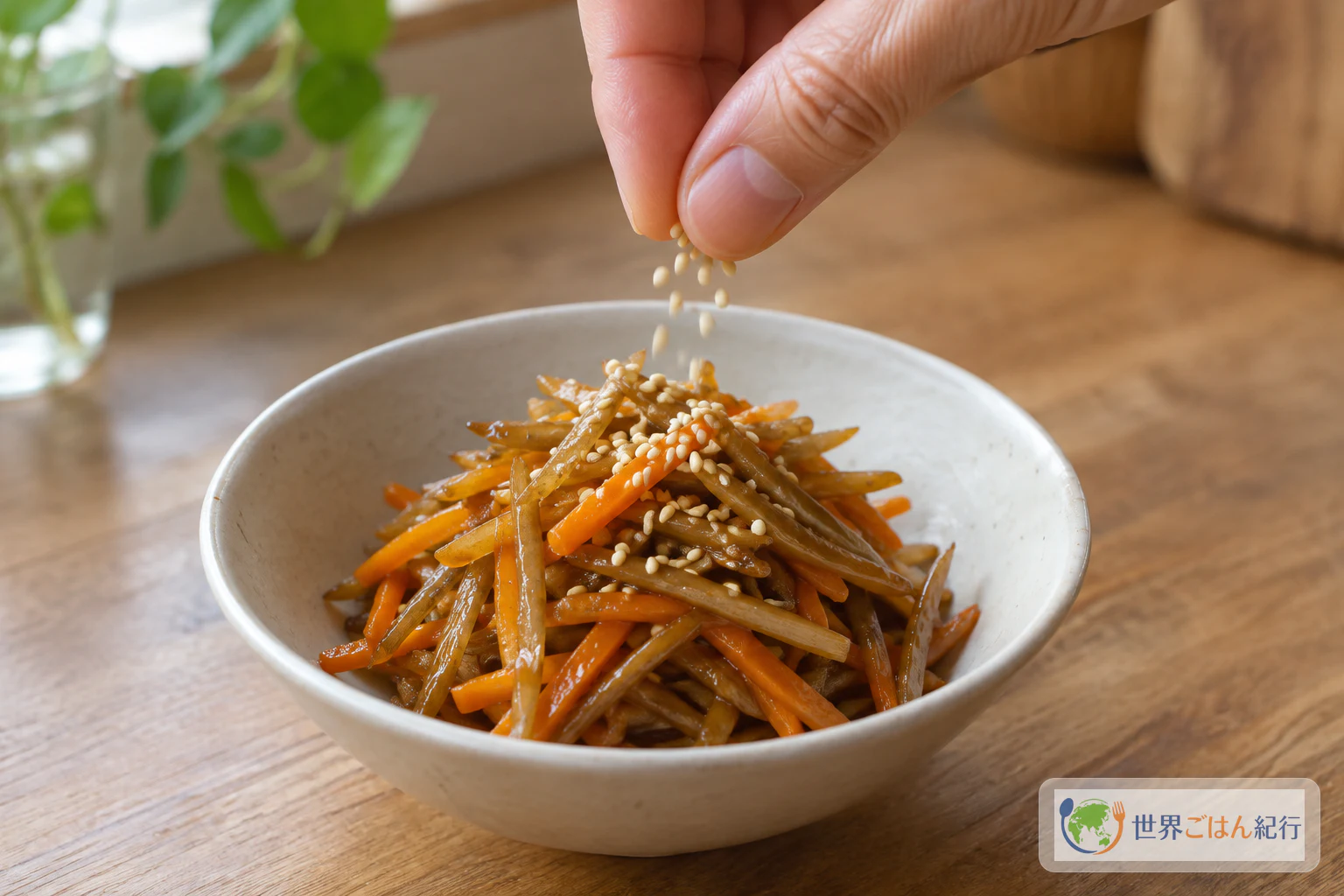
Kinpira Gobo: Tough Burdock Turned Into a Glossy Little Side Dish
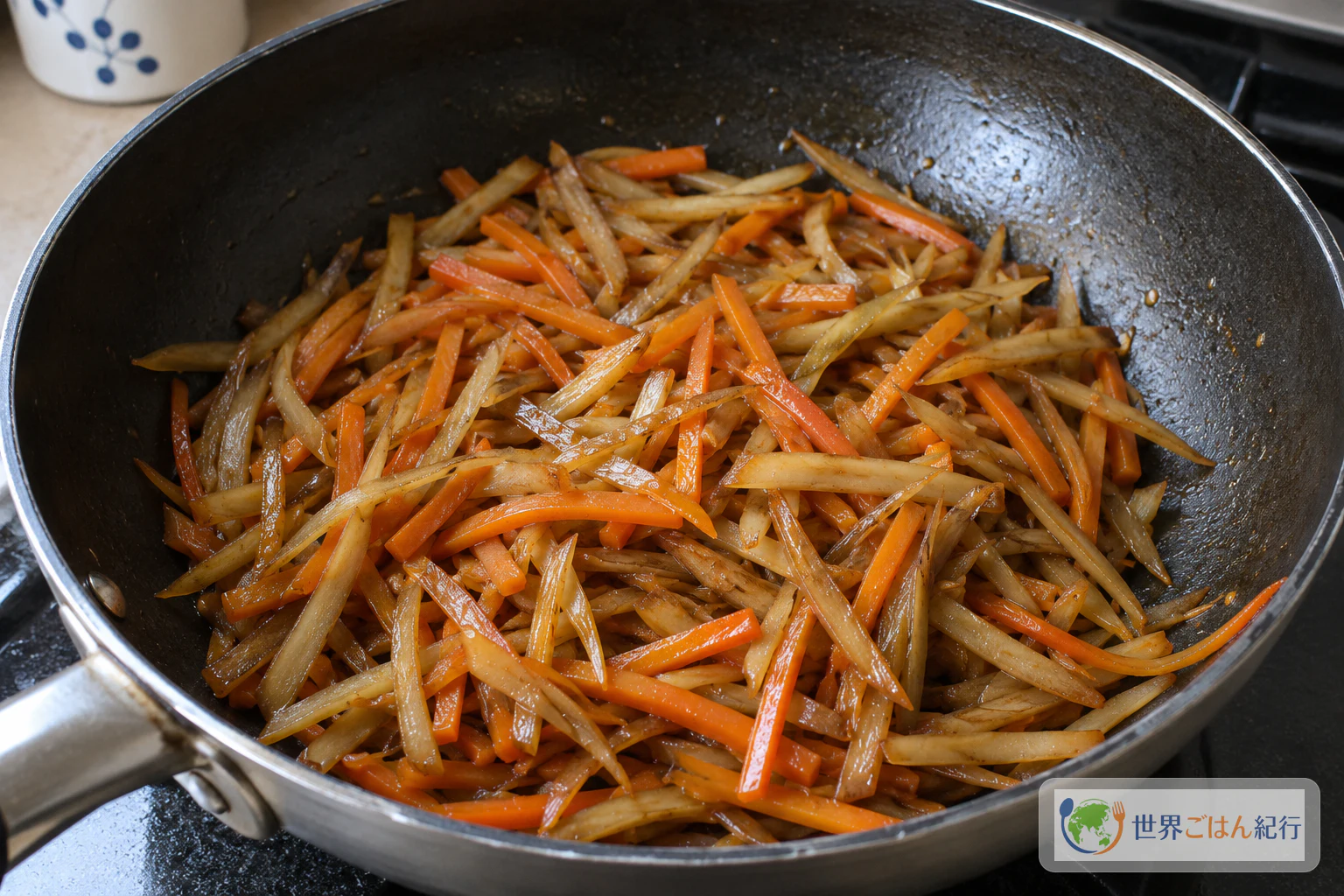
Keep the earthy aroma and bite of the burdock, the sweet-savory balance of soy sauce and sugar, and a gentle warmth from red chili. The finish is the moment the liquid has almost disappeared from the pan.
Burdock root is hard, fibrous and smells of soil. Cut into thin 5 cm strips and stir-fried in sesame oil, it becomes something else: a small bowl of glossy, sweet-savory strands you set beside rice. Kinpira gobō (金平牛蒡, きんぴらごぼう) is that transformation, and it is a side dish in Japanese home cooking.
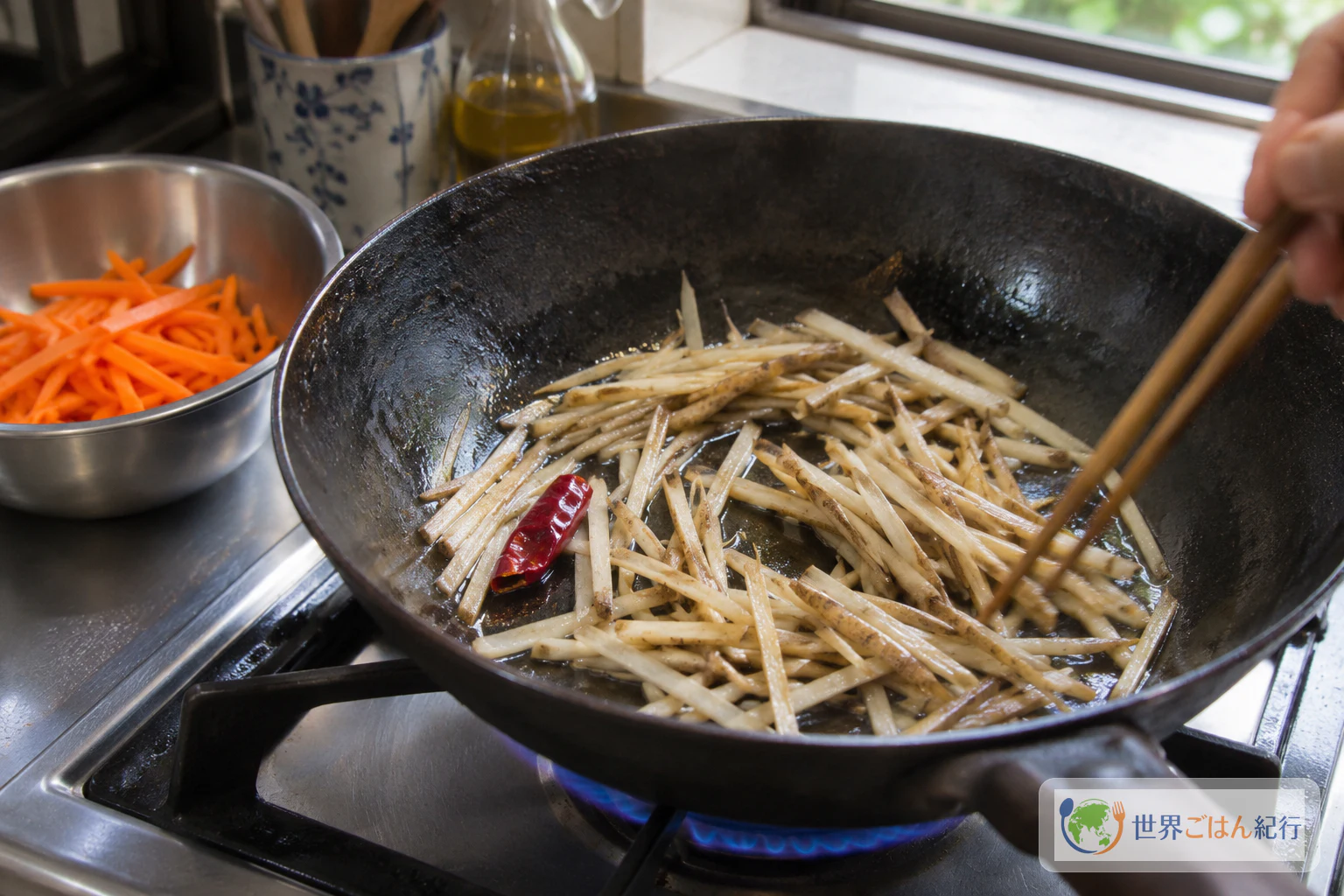
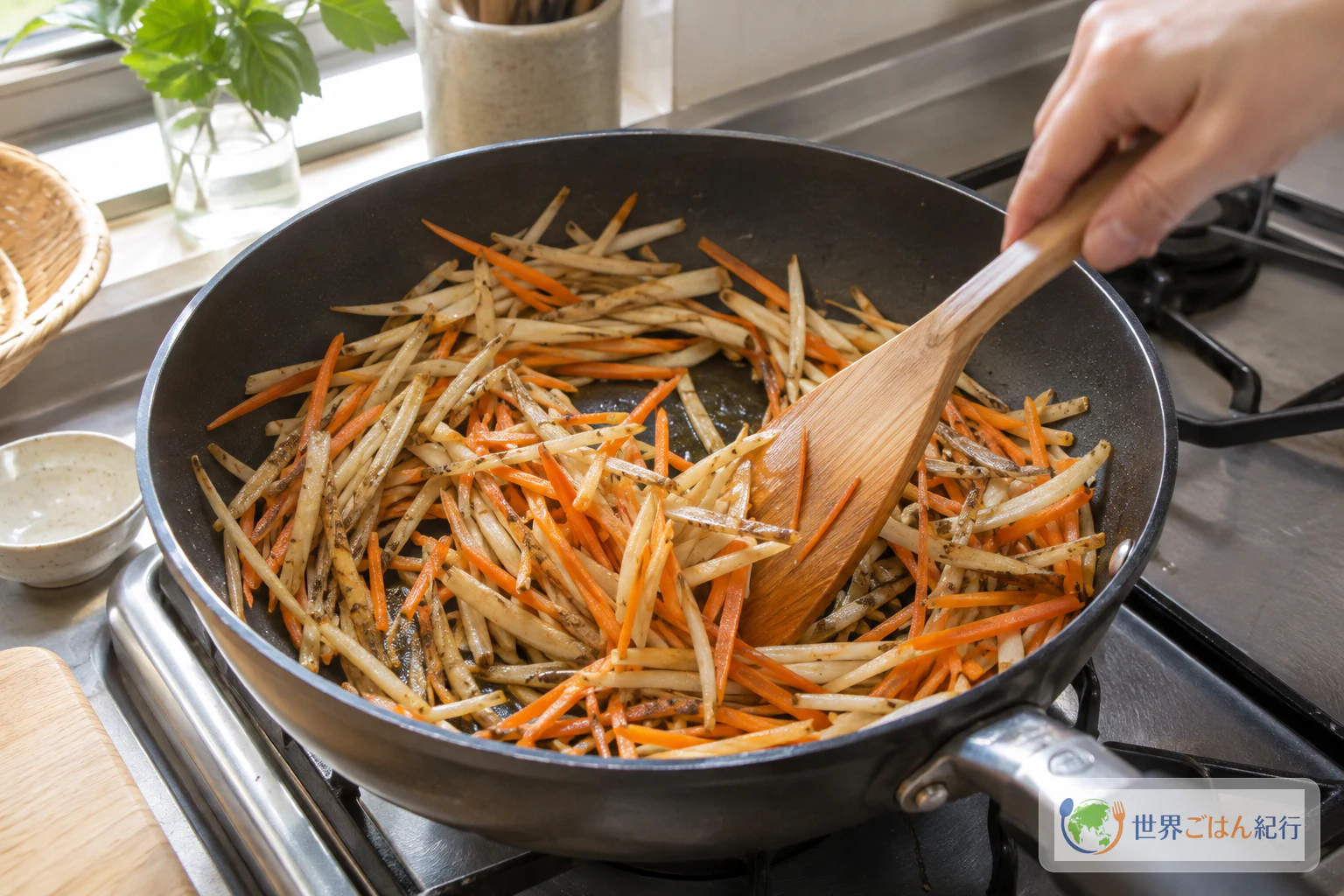
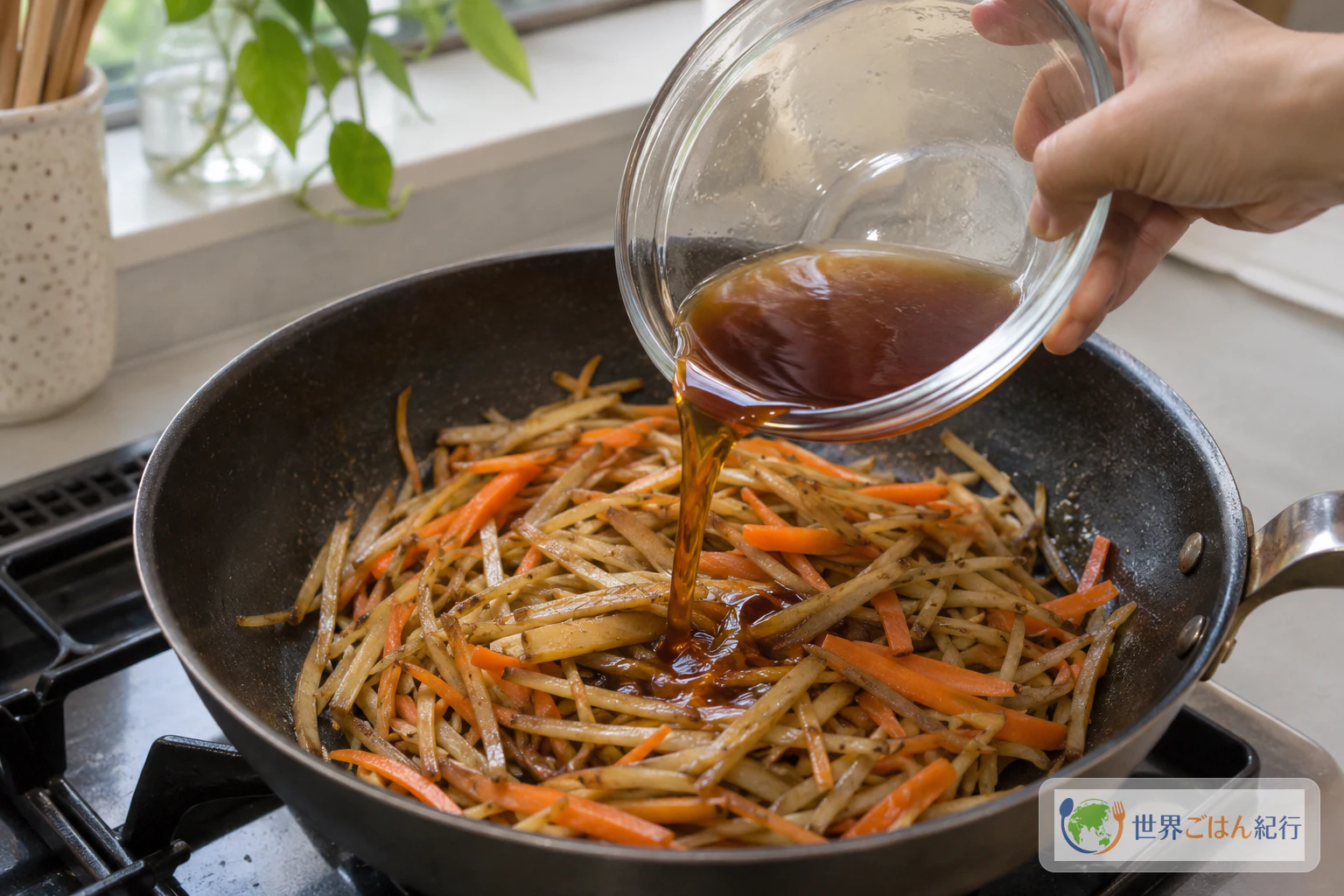
The version here is the Tokyo kinpira published by Japan's Ministry of Agriculture, Forestry and Fisheries (MAFF) in its "Our Regional Cuisines" collection, a recipe credited to Etsuko Kondo from her book Shokuzai erabi kara wakaru ouchi gohan. It uses only burdock and carrot, for two servings. The pan follows a clear order: sesame oil and red chili go in before the heat is turned up high, the burdock goes in first, the carrot follows, one premixed seasoning liquid is poured in all at once, and the heat goes off when the pan is almost dry.
The amounts and steps below follow the MAFF Tokyo recipe. Sekai Gohan has not kitchen-tested this recipe. Soaking times, frying times and temperatures are not given, so the steps tell you what to look for in the pan rather than how many minutes to wait.
Kinpira is a style as much as a single recipe. Lotus root and other crunchy vegetables are also cooked "kinpira-style," some cooks add dried squid or pork, and some use a bottled sauce. Those versions appear in the variations section below. They are kept separate from the main recipe so the root-only Tokyo version stays clear. For more dishes from the same table, see our Japan page.
Why It Is Called Kinpira: A Tokyo Side Dish From the Edo Period
MAFF lists kinpira as a traditional dish handed down across all of Tokyo. It describes kinpira as an everyday side dish of ordinary people from the late Edo period. Today it is still eaten at daily meals and also appears at occasions such as New Year osechi, celebrations and funerals. MAFF's page also touches on the history of Takinogawa burdock, a variety long associated with Tokyo.
The name is said to come from Sakata Kinpira, a strong hero of kinpira jōruri, a style of early puppet-theater storytelling. MAFF presents this as a traditional explanation, and it is best read that way rather than as proven history. MAFF also notes that burdock with carrot was the standard combination until the latter part of the Shōwa era. Later, the name "kinpira" spread to sweet-savory stir-fries of other firm, crunchy roots such as lotus root.
Kinpira is not identical in every kitchen. MAFF states plainly that the recipe differs by area and household. Outside Tokyo, a study of burdock dishes across Japan published in the Journal of Home Economics of Japan notes in its abstract that kinpira gobō is popular in northern Kantō. That is as far as the abstract goes, so it is not stretched here into claims about the whole country.
The appeal of the dish comes down to three things. There is the aroma and chew of burdock, the sweet-savory pull of soy sauce and sugar, and the gentle heat of red chili. A cooking-school introduction from Tsuji Culinary Institute adds that cutting the vegetable thinly keeps its texture while letting the seasoning get in, and that kinpira can be made with one vegetable alone, such as burdock, udo or carrot.
Ingredients (Serves 2)
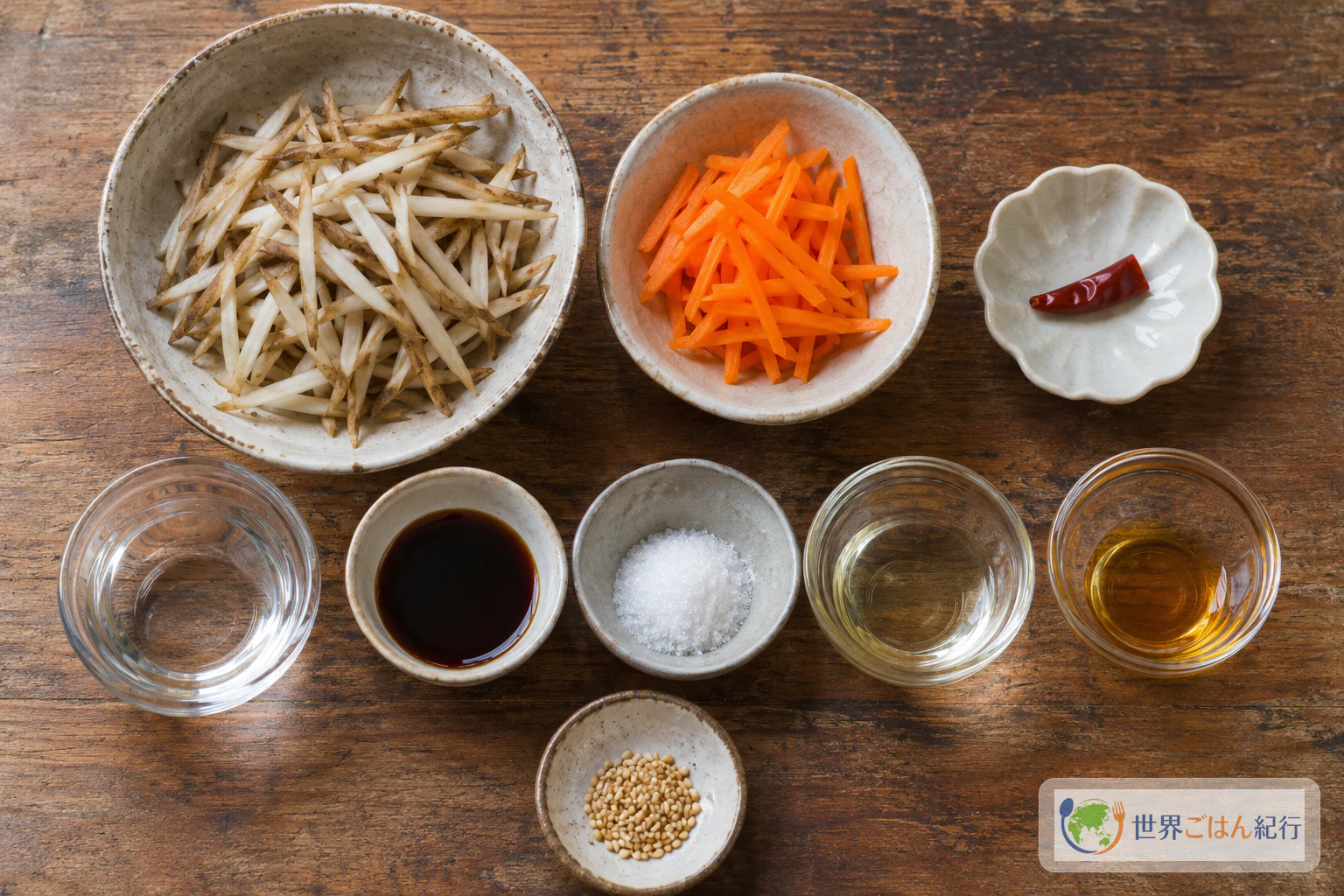
Equipment
- Knife and cutting board
- A bowl of water for soaking the burdock, and a strainer for draining it
- A small bowl for mixing seasoning liquid A
- A frying pan or shallow pan
- A spatula or cooking chopsticks for stirring
- Chopsticks for plating, and a small serving bowl
Choosing and Handling the Ingredients
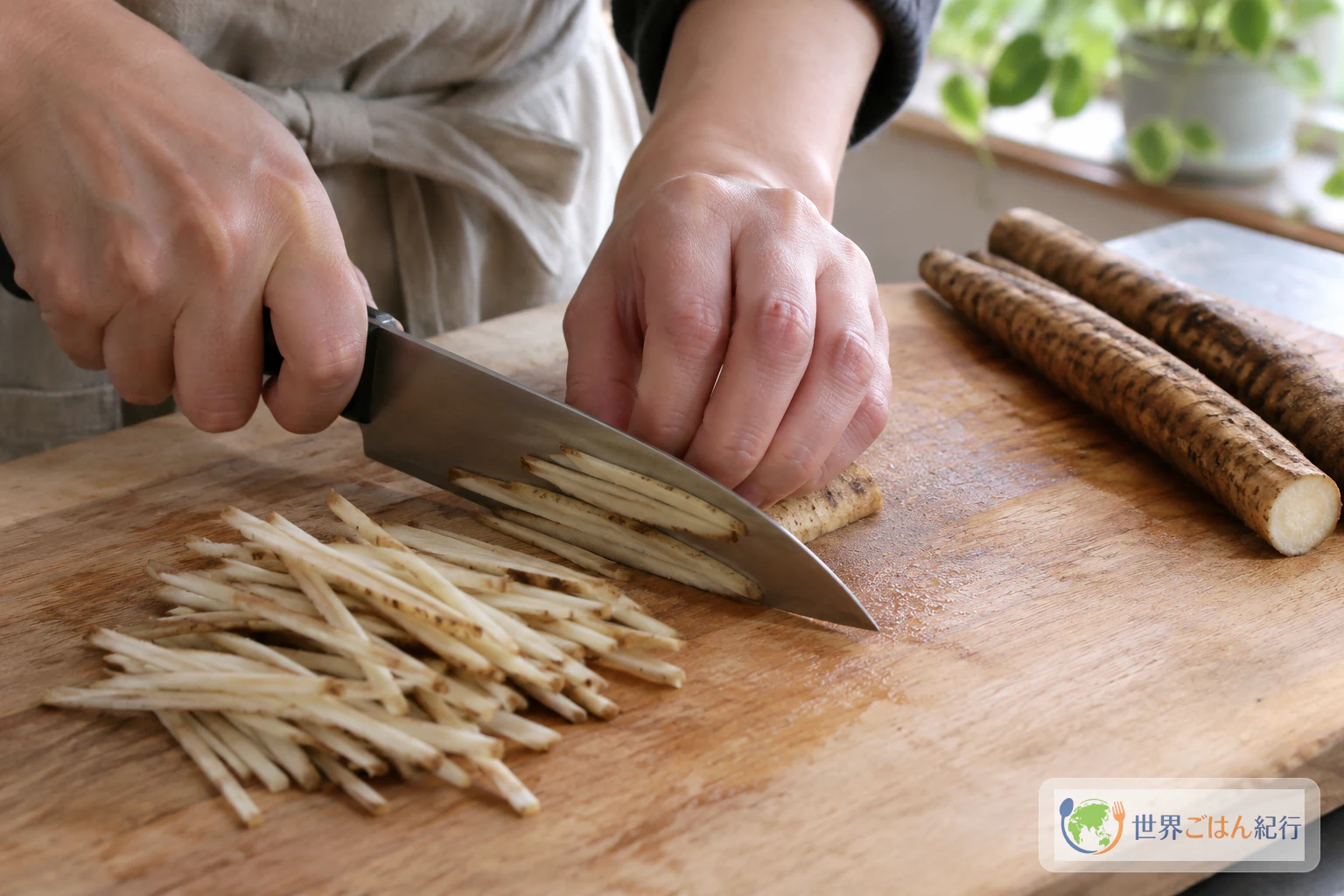
Burdock. Leave the skin on to retain its flavor, and scrub off the soil. Choose a root you can cut into even 5 cm strips.
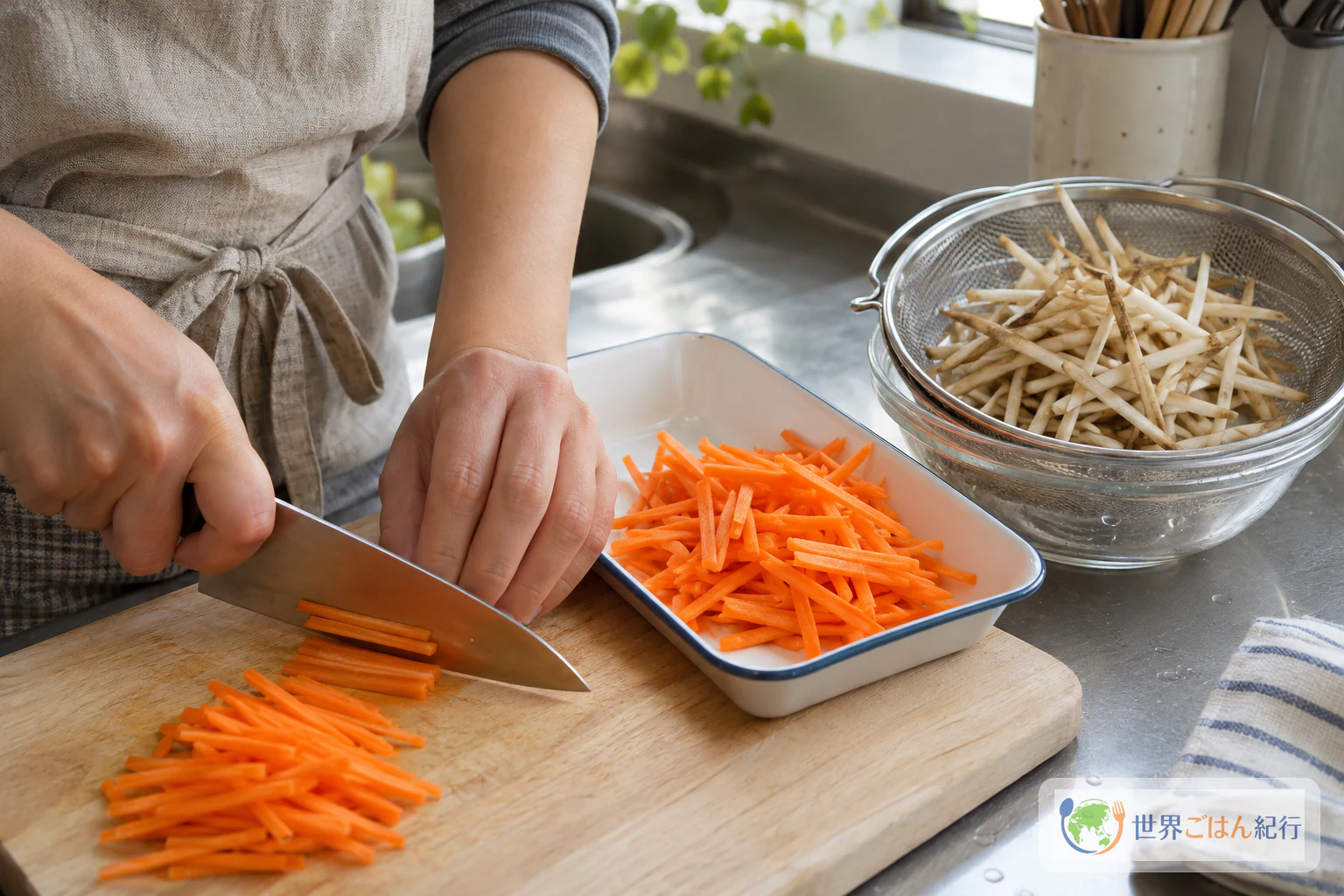
Burdock and carrot cut to the same length. Both are cut into 5 cm julienne. Matching the length keeps the two vegetables together in the pan and in the bowl.
Soy sauce. Use soy sauce. Check the bottle label for wheat and soybeans if allergies matter at your table. Sesame oil and sesame seeds are also used.
Red chili. Use half a dried red chili with the seeds removed. If you want less heat, use less; leaving it out entirely is your own adjustment to the dish.
Method: Burdock First, One Pour, Then Almost Dry
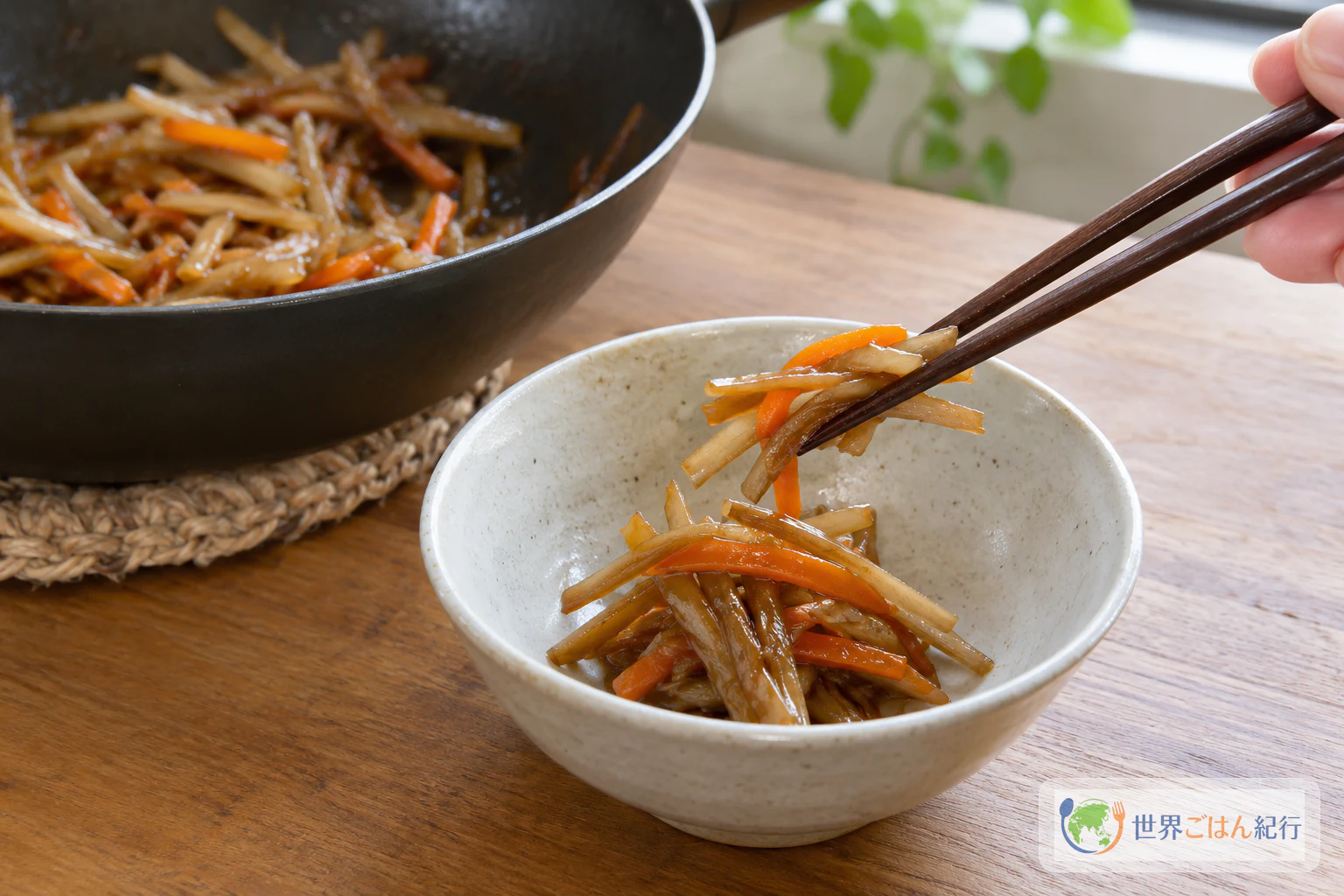
Oil and chili go into the pan before the heat goes on high. Burdock goes in before carrot. All of seasoning liquid A goes in at once. Turn off the heat when the liquid is almost gone, let it sit a moment, then plate and add the sesame.
Fixing Common Problems
| What you notice | Likely cause | What to do |
|---|---|---|
| Liquid still pooling in the pan | The heat went off too early | Keep stir-simmering until the liquid is almost gone, then turn off the heat |
| The flavor tastes thin or watery | Soaking water was added in place of, or together with, the 50ml in seasoning liquid A | Drain the burdock well, and use only the premixed liquid A for simmering |
| The burdock lacks its earthy aroma | The skin was peeled away thickly | Next time, scrub the soil off instead of peeling |
| Uneven strands, some limp and some stiff | The burdock and carrot were cut to different sizes | Cut both into 5 cm julienne of similar thickness |
| Too spicy | Chili seeds were left in, or the chili went in whole | Remove the seeds, and use less than half a chili next time |
| Seasoning added in separate splashes | Soy sauce, sugar and sake were poured in one by one | Mix them with the water beforehand and add all of liquid A at once |
Variations Without Changing the Base Recipe
The Tokyo version stays exactly as above. These are separate directions, each kept as its own dish.
Different cuts. Burdock can be cut into julienne or into thin shavings (sasagaki). The cut changes how quickly the burdock cooks and how it feels to bite, so watch the pan rather than the clock. The amounts stay the same.
Milder heat or no sesame. Use less than half a chili for a gentler kinpira. The sesame finish is "to taste," so you can also leave it off.
Burdock-only kinpira. Tsuji Culinary Institute's introduction notes that kinpira can be made with a single vegetable. Leaving out the carrot is your own editing of the Tokyo recipe, not a different traditional formula, so treat it as a separate variation.
Kinpira with dried shredded squid. On the Gurunavi "Chef Gohan" recipe site, chef Shin Okamoto's kinpira serves 4 and uses 200g burdock, 100g carrot, 40g dried shredded squid (saki-ika), 1/2 chili, 40cc sake, 40cc koikuchi soy sauce and 20g sugar. In that method the vegetables and seasoning are separated after cooking, and only the liquid is reduced before everything is combined again. It is a different recipe with its own amounts and steps; make it as a whole set rather than mixing it into the Tokyo version.
Pork and bottled sauce. Ebara Foods publishes a kinpira made with pork belly and its bottled sukiyaki sauce plus water, stir-fried until the liquid is gone and finished with sesame oil. The company notes that omitting the pork turns it into a burdock-and-carrot version. It is a modern shortcut built on a commercial product, separate from the Tokyo recipe.
On the Table
Kinpira is a side dish: a small bowl placed beside rice and other dishes at an everyday meal. MAFF describes it at daily meals and also at New Year osechi, celebrations and funerals. Serve it plated on its own in a small bowl with the white sesame on top, and let the burdock's chew and sweet-savory glaze carry it.
The sources give no storage period, chilling method or reheating instructions for kinpira, so none are given here. MAFF mentions that a stronger seasoning helps kinpira keep; that is not a reason to leave it at room temperature or to rely on any particular number of days. Handle and store it with your usual food-safety practice. Check soy sauce labels for wheat and soybeans, and note that sesame oil and sesame seeds are used.
Frequently Asked Questions
Do I need to peel the burdock?
No. MAFF's Tokyo recipe explains that the skin has flavor, so scrub the root to remove the soil rather than peeling it thickly.
How long should I soak the burdock?
The recipe tells you to soak the cut burdock in water but gives no time, water amount, or vinegar. No soaking time is suggested here either. Soak the burdock while you prepare the carrot and seasoning, then drain it, and there is no need to leave it sitting longer than that.
Why does the burdock go in before the carrot?
That is the order MAFF's recipe gives. The oil and chili go in first, the burdock is stir-fried over high heat, and then the carrot is added and stir-fried further. Following the order keeps the pan the way the recipe describes it.
How do I know when it is done?
When the liquid has almost disappeared from the pan, turn off the heat and let it sit briefly so the flavor settles. The recipe gives no cooking time or temperature, so judge by the pan: glazed strips with almost no free liquid.
Can I make it less spicy?
Yes. The recipe uses half a dried chili with the seeds removed. Use less for milder heat; leaving it out completely is your own adjustment.
How long does kinpira keep?
The sources do not give a storage period, so no number of days is offered here. MAFF's remark that stronger seasoning helps kinpira keep does not mean it can be stored at room temperature. Follow your usual food-safety practice for cooked dishes.
Is the version with dried squid "real" kinpira?
It is a chef's kinpira with its own amounts and method, published on Gurunavi's Chef Gohan site. MAFF notes that kinpira differs by area and household. This article uses the root-only Tokyo version as the main recipe and presents the squid version separately.
Sources
- Ministry of Agriculture, Forestry and Fisheries (MAFF), "Kinpira, Tokyo" (Our Regional Cuisines). The main recipe: two-serving amounts, 5 cm julienne, soaking, scrubbing instead of peeling, the stir-fry order, seasoning liquid, finish and white sesame. Also the background on kinpira as a Tokyo traditional dish, its late Edo origins as a side dish, its use at daily meals and occasions, the traditional explanation of the name, the spread of the name to other roots, and household differences. Recipe credited to Etsuko Kondo, Shokuzai erabi kara wakaru ouchi gohan. https://www.maff.go.jp/j/keikaku/syokubunka/k_ryouri/search_menu/menu/34_27_tokyo.html
- Gurunavi "Chef Gohan," "Kinpira" by chef Shin Okamoto. A separate four-serving variation with dried shredded squid, its amounts, and the method of reducing the liquid on its own before recombining. https://chefgohan.gnavi.co.jp/detail/97
- "Regional Distribution and Food Culture of Dishes Using Burdock in Japan," Journal of Home Economics of Japan (J-STAGE). Used only for the abstract's note that kinpira gobō is popular in northern Kantō. https://www.jstage.jst.go.jp/article/jhej1987/52/6/52_6_511/_article/-char/ja/
- Tsuji Culinary Institute, WA·TO·BI, "Words of Japanese Cuisine: Kinpira." Introduction page used for the idea that thin cutting keeps texture while letting seasoning in, and that single-vegetable kinpira exists. https://www.tsuji.ac.jp/hotnews/web/watobi24.html
- Ebara Foods, "Kinpira gobō recipe." A modern variation with pork belly and bottled sukiyaki sauce, with a note on omitting the pork. https://www.ebarafoods.com/recipe/detail/recipe149.php