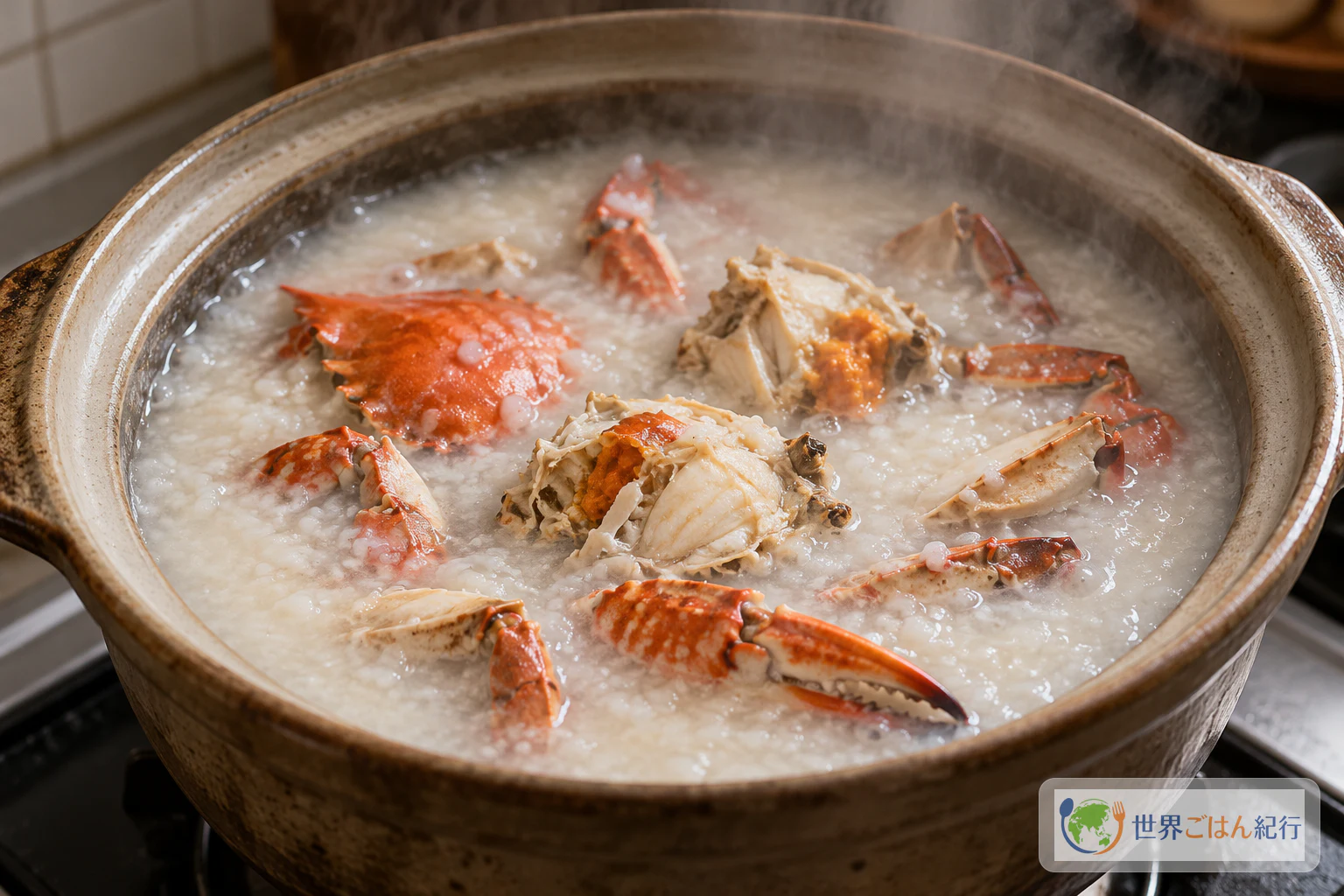
A Bowl Remembered, Re-created in a Home Kitchen
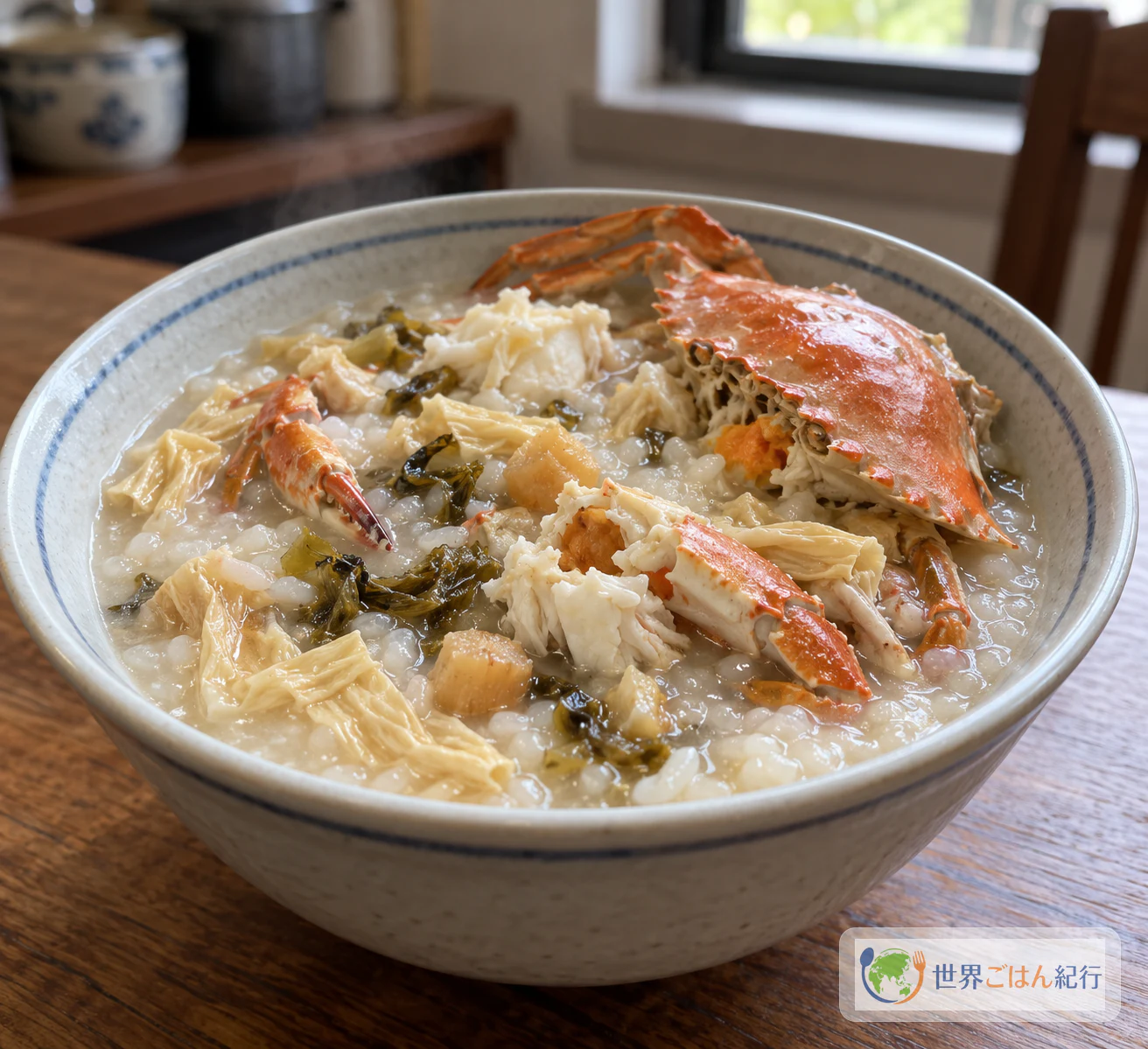
Rice cooked slowly until the grains open and the congee turns smooth, with crab and preserved winter vegetable added only at the very end. The author's times are a record of their method. They do not tell you when crab is safely cooked.
This recipe starts with a memory. A home cook on the Chinese recipe site Xiachufang, posting as 元气满满的马卡龙, wanted to re-create a bowl of crab congee they remembered from Macau, so they worked it out in their own kitchen. They published the result in 2024 as 家常版澳门水蟹粥, "home-style Macau crab congee."
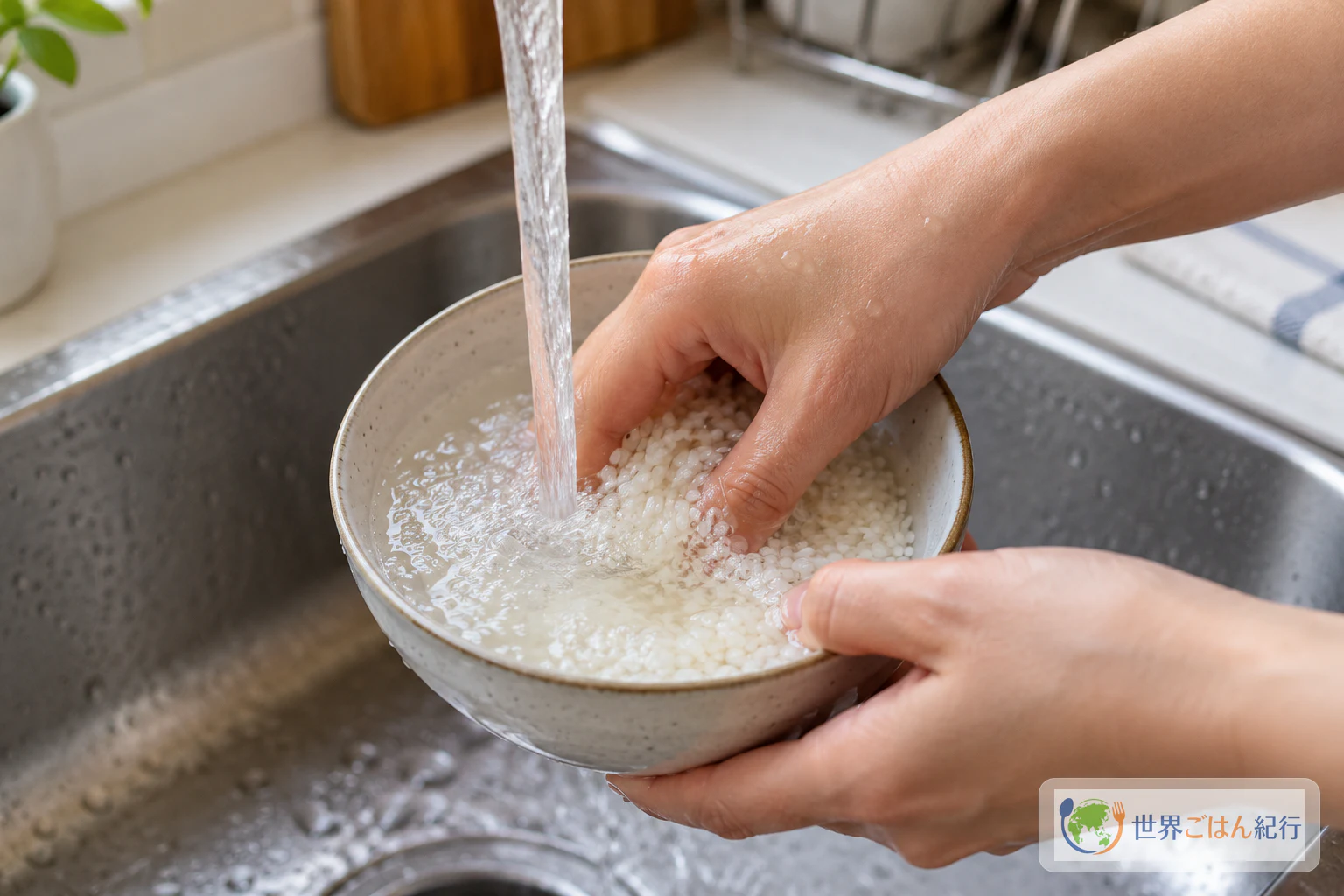
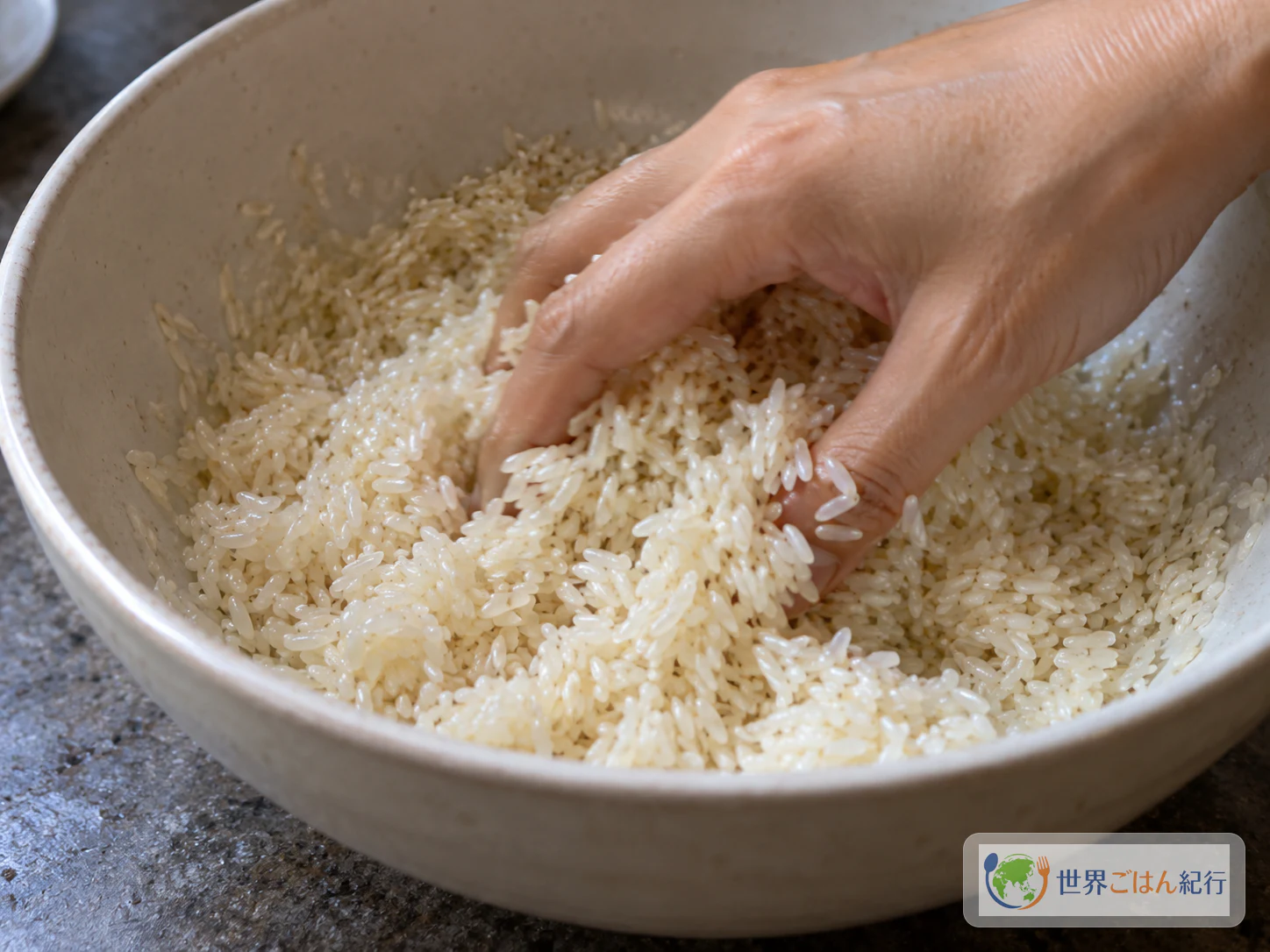
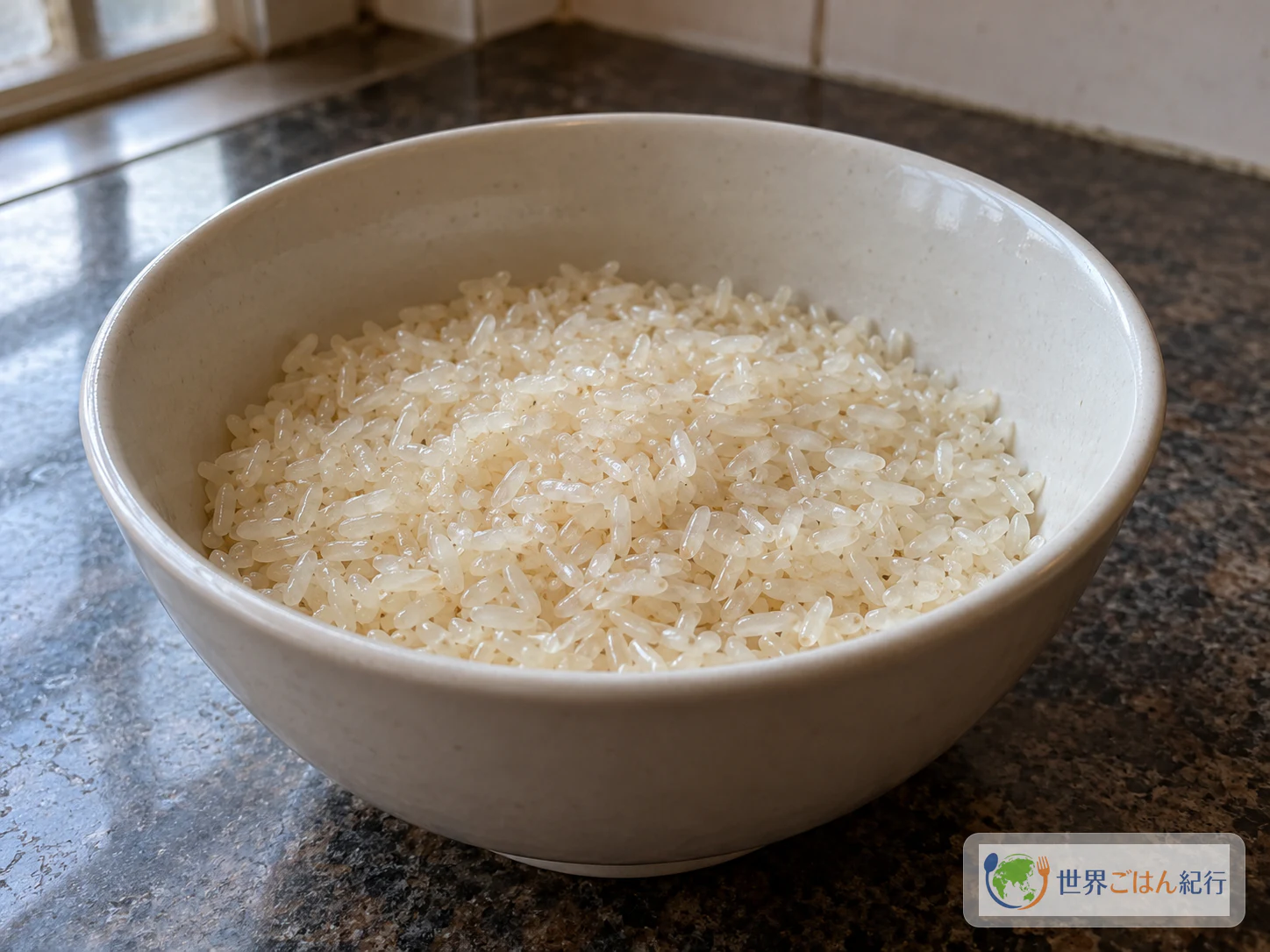
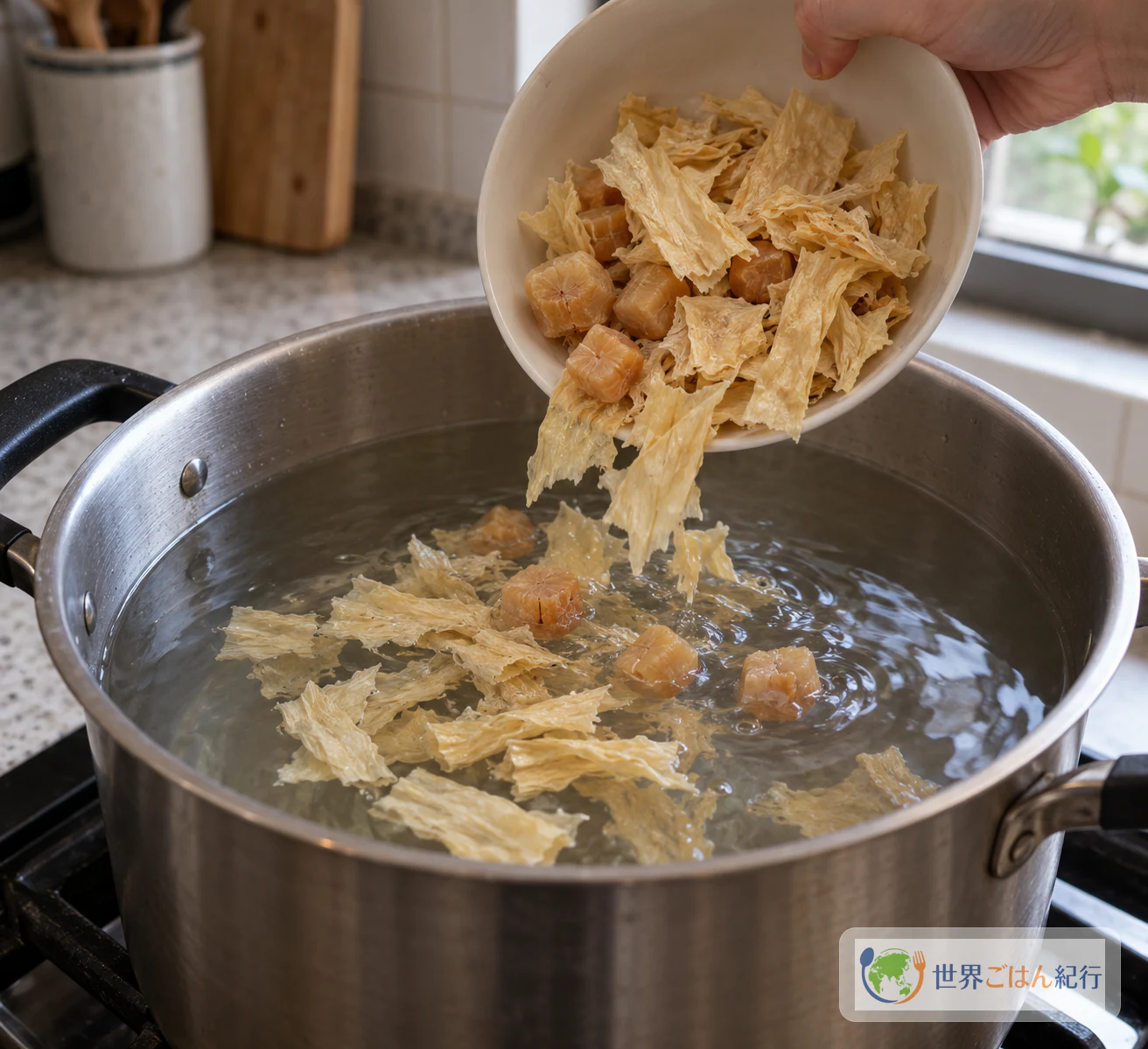
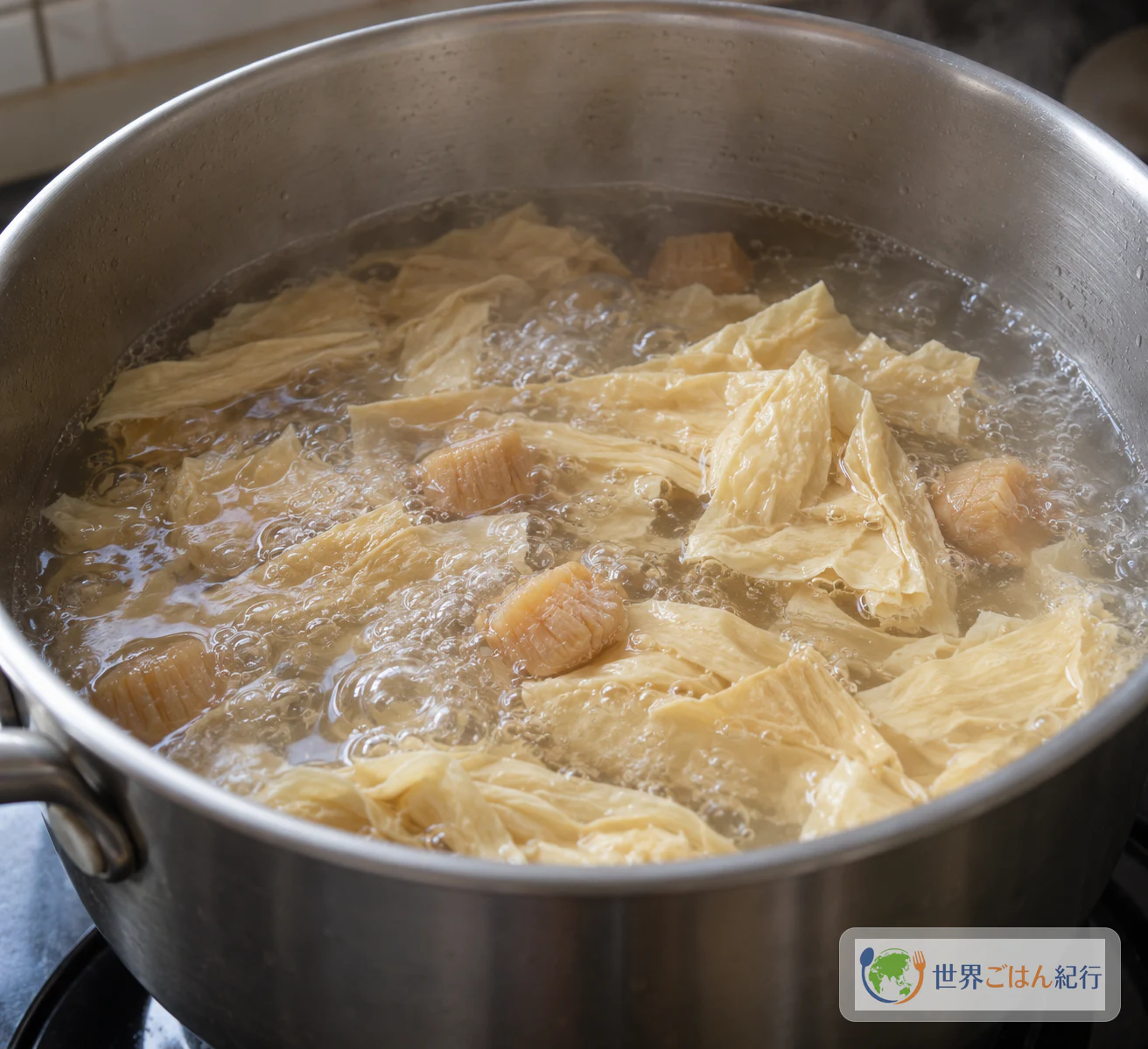
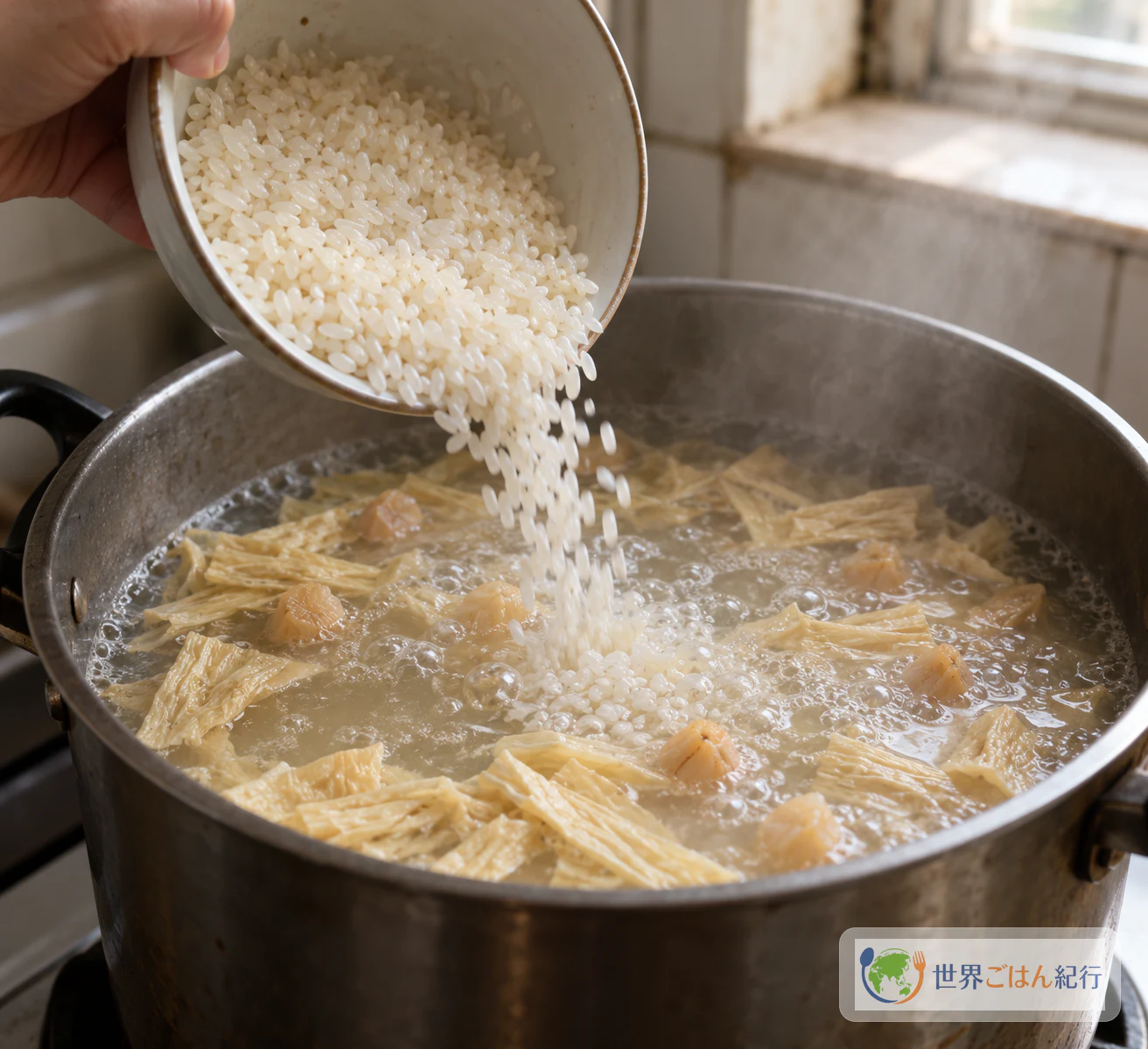
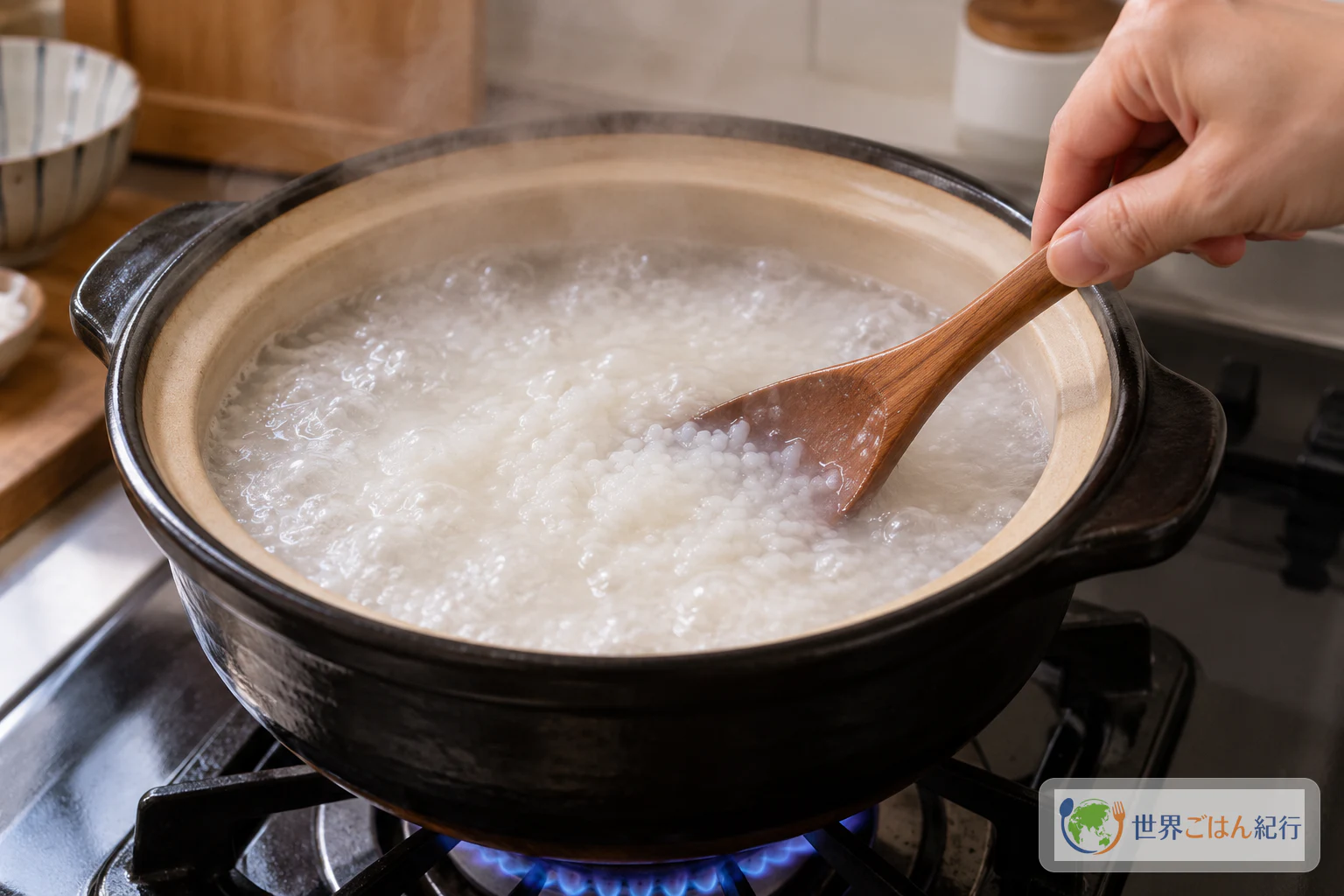
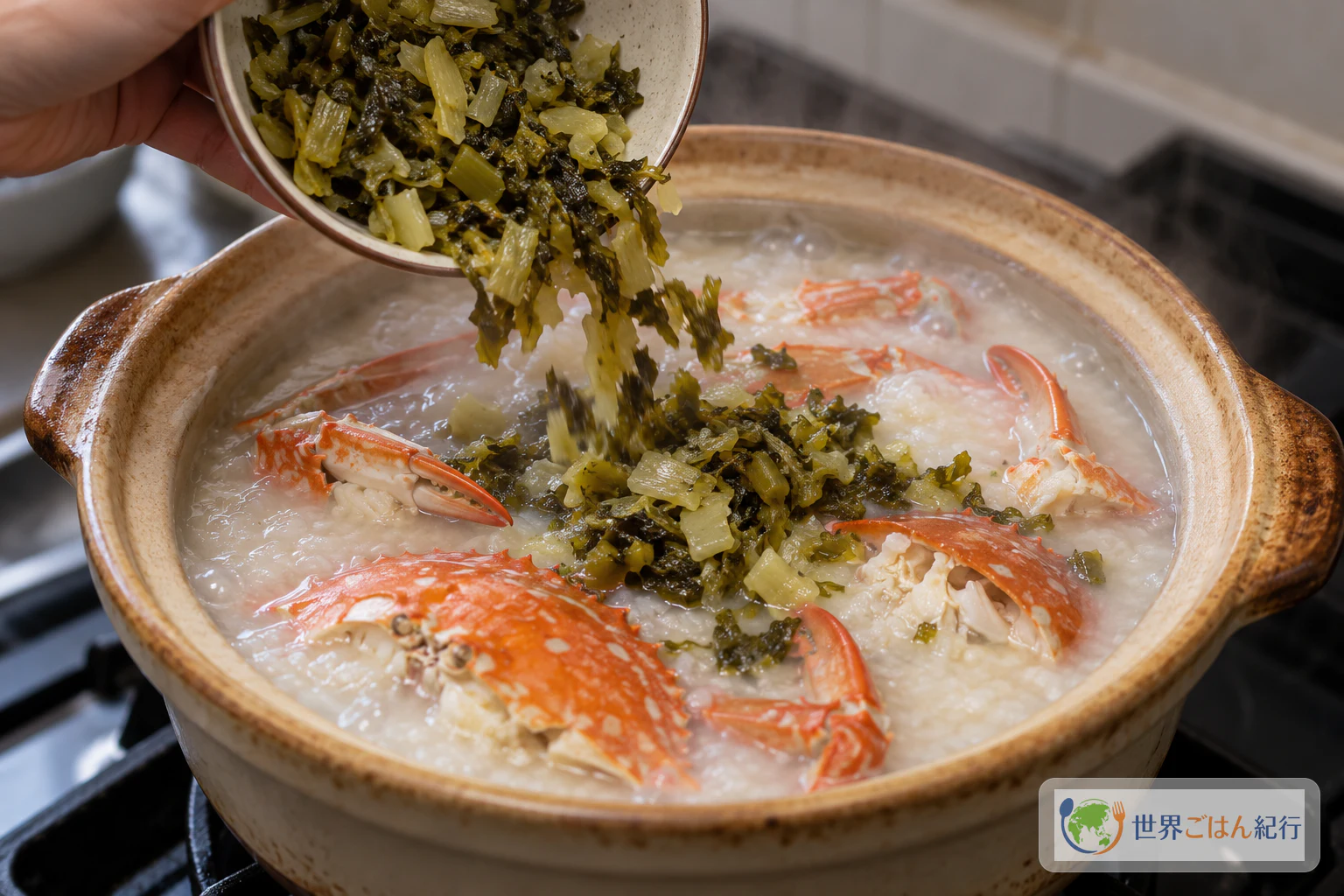
This article follows that recipe. It is one person's home version. It is not a restaurant's or a chef's recipe, and it is not the one authentic Macau congee. The method is simple. Rinsed rice rests with salt and peanut oil. Dried scallop and torn bean-curd skin go into the water before it boils. The rice then cooks through high, medium and low heat. The crab goes in only after the rice has opened and the congee has turned smooth, and the preserved winter vegetable follows a minute before the end.
Sekai Gohan has not kitchen-tested this recipe. The amounts, order and times below are the author's own as published. Where the author gives no amount or detail, this article does not fill one in.
Congee in Macau, and Where This Recipe Comes From
Two different sources stand behind this page, and they do different jobs. The Macao Government Tourism Office lists congee among Macau's local foods and describes it as a breakfast dish. Among its suggestions is a congee with a whole fresh-water crab in it. That gives the regional setting. It is not this recipe, and it says nothing about the crab, amounts or steps used here.
All the amounts, the order of steps and the cooking times come from the single Xiachufang post. The author mentions 羔蟹 (奄仔) in the text, but the ingredient list says only "one crab." Neither that word nor the tourism office's "fresh-water crab" identifies a species, and this article does not try to. For more dishes from the same place, see the Macau country page.
Ingredients (3 servings)
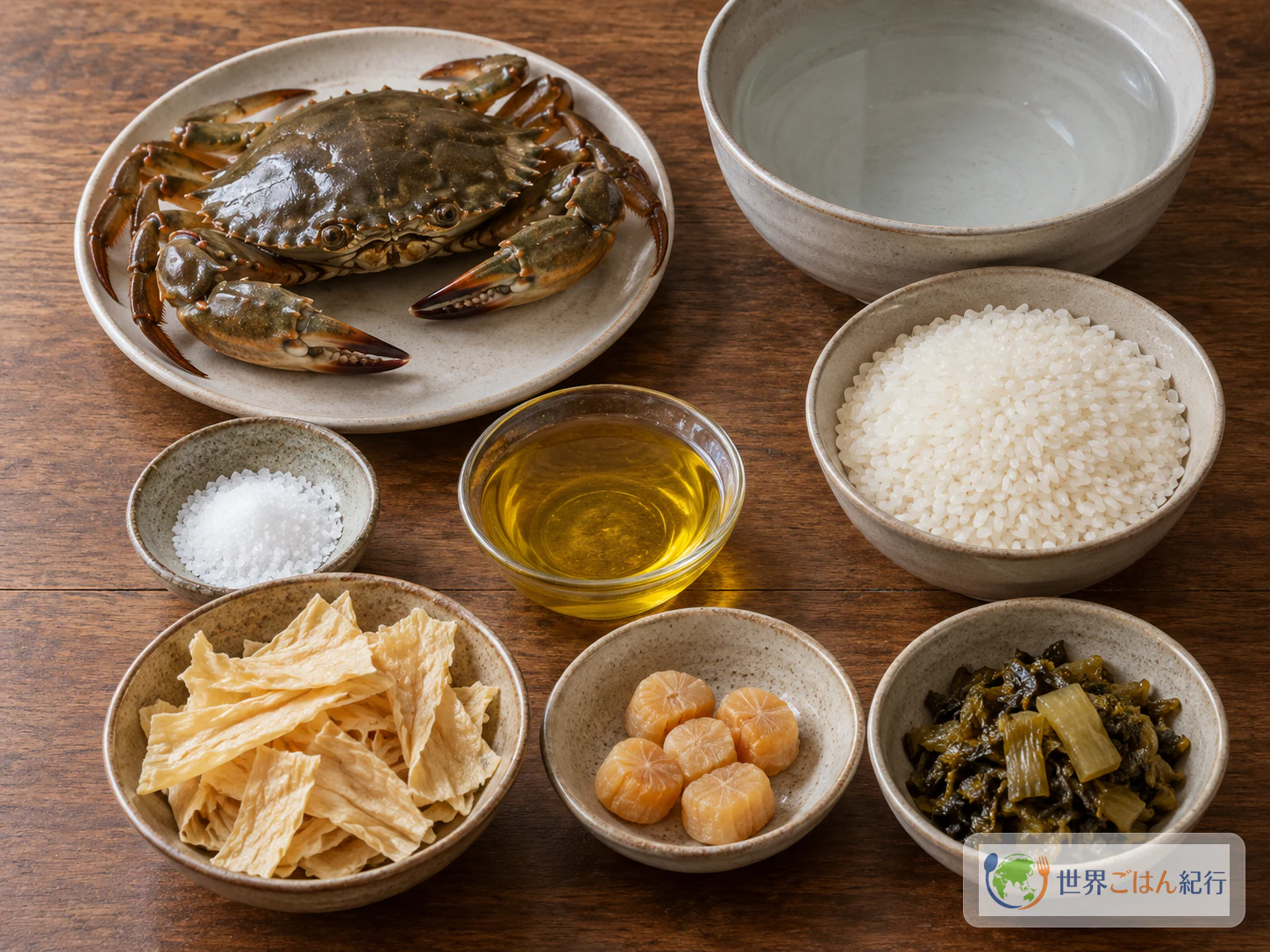
Only the crab, rice and water have fixed amounts. Use the other five as needed.
Equipment
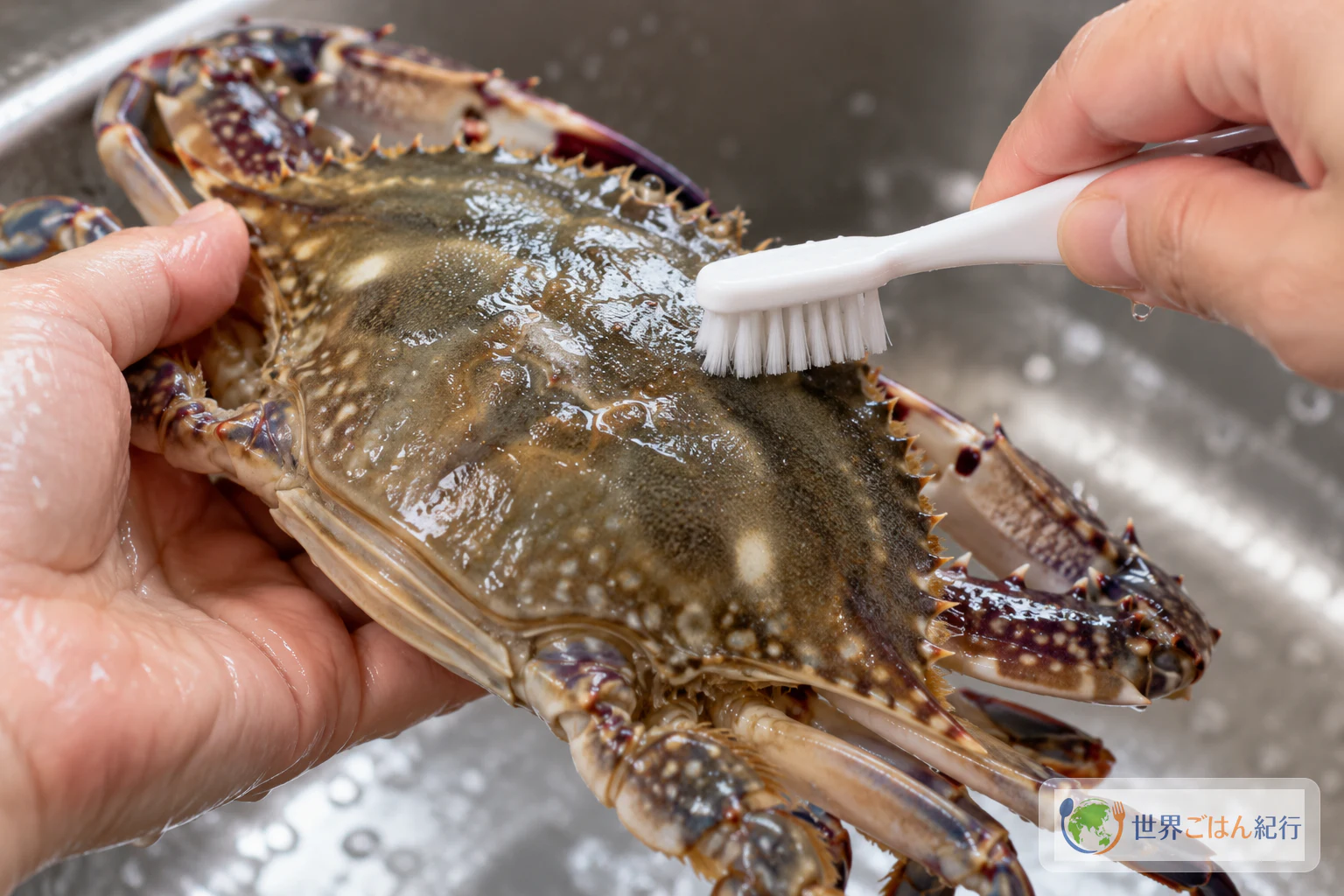
- A small, clean toothbrush, for scrubbing the crab
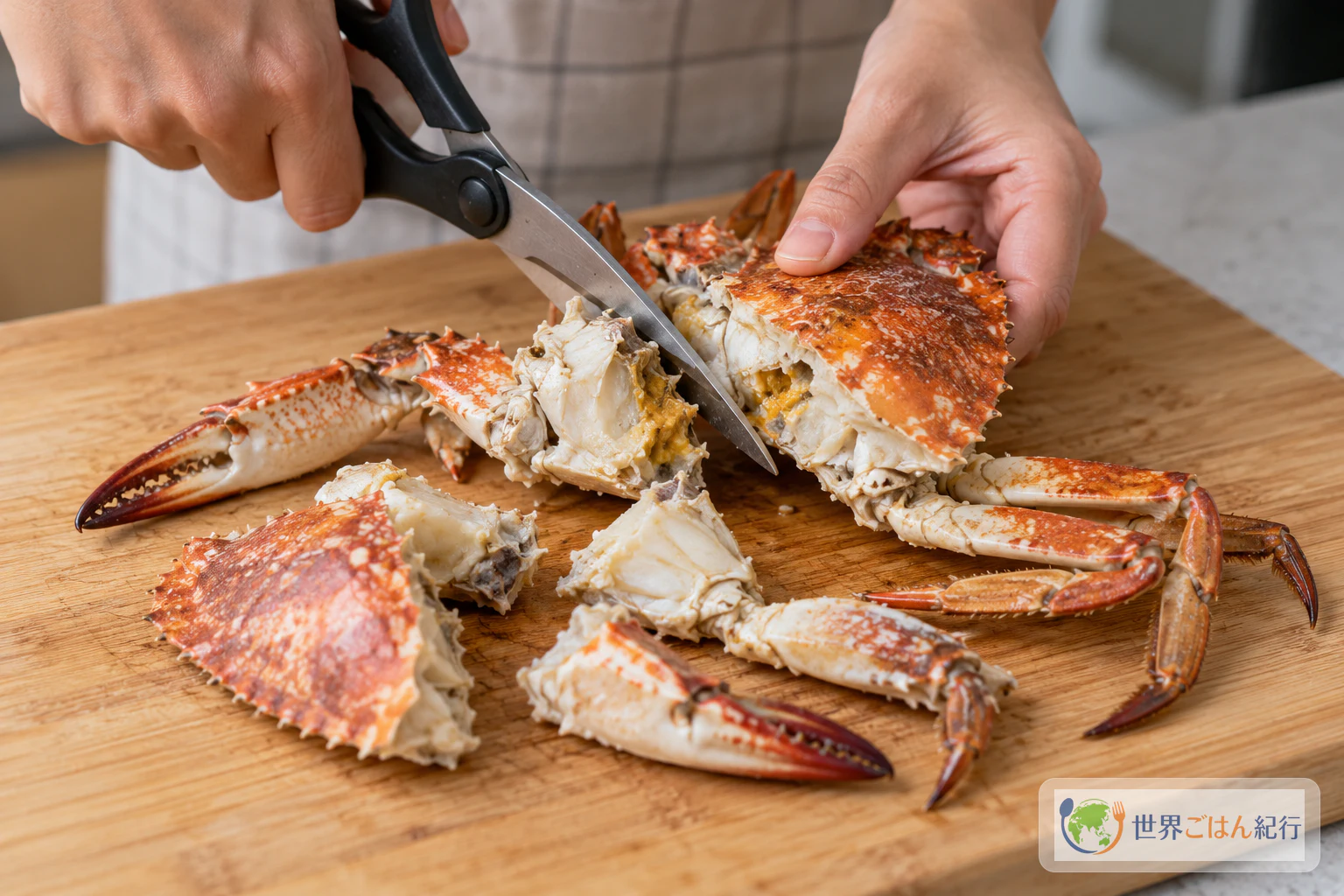
- A cutting board, plus a knife or kitchen scissors
- A bowl for rinsing and resting the rice
- A pot that holds the 3L of water, with something to stir with
Choosing and Reading the Ingredients
Crab. Use one crab, scrubbed and cut into pieces. There is no pre-boiling step, no cooked-crab or picked-meat version, and no cleaning beyond scrubbing. If there is roe (蟹黄) in the crab, it stays attached as part of the crab. It is not a separate ingredient or a garnish.
Rice. Use 80g of rice.
Water. The 3L is the water you start with, not the finished volume.
Fupi (腐皮), dried scallop (江瑶柱) and preserved winter vegetable (冬菜). Shop for them under these names. Do not treat the fupi as interchangeable with other bean-curd products. Use preserved winter vegetable, not fresh cabbage. No substitutes are given for any ingredient.
Do not add ginger, scallion, garlic, wine, extra stock or finishing oil.
Method: Rice First, Crab Last
Keep the stages separate and in order. The times below do not confirm that the crab is safely cooked, so check the crab before serving as described after step 9.
FoodSafety.gov, the U.S. government food-safety site, advises cooking crab (along with shrimp, lobster and scallops) until the flesh is pearly or white and opaque. This guidance is separate from the recipe and does not confirm the author's times. The recipe doesn't state the crab's species, size, weight, or whether it starts raw or cooked. That means the 4 minutes for the crab and the 1 minute for the winter vegetable cannot be treated as a safe cooking time for every crab. Follow the recipe's order. Then, before serving, check that the crab flesh is white and opaque. If it isn't, keep cooking before you serve.
Points to Watch in the Pot
| What you see | What the materials say |
|---|---|
| The pot is about to boil over during the high-heat stage | The author says to stir during this stage specifically to prevent boil-over. No stirring frequency is given |
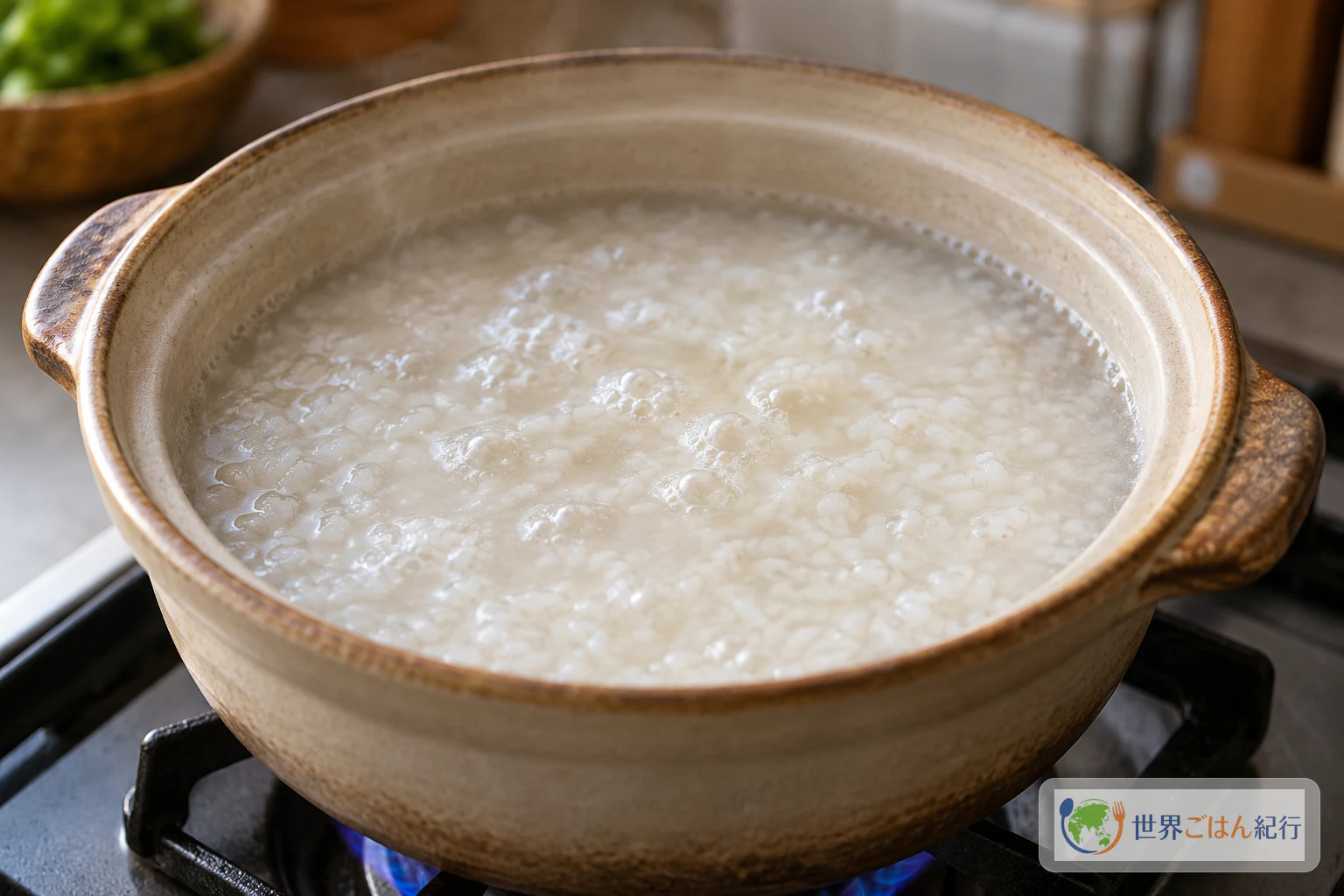
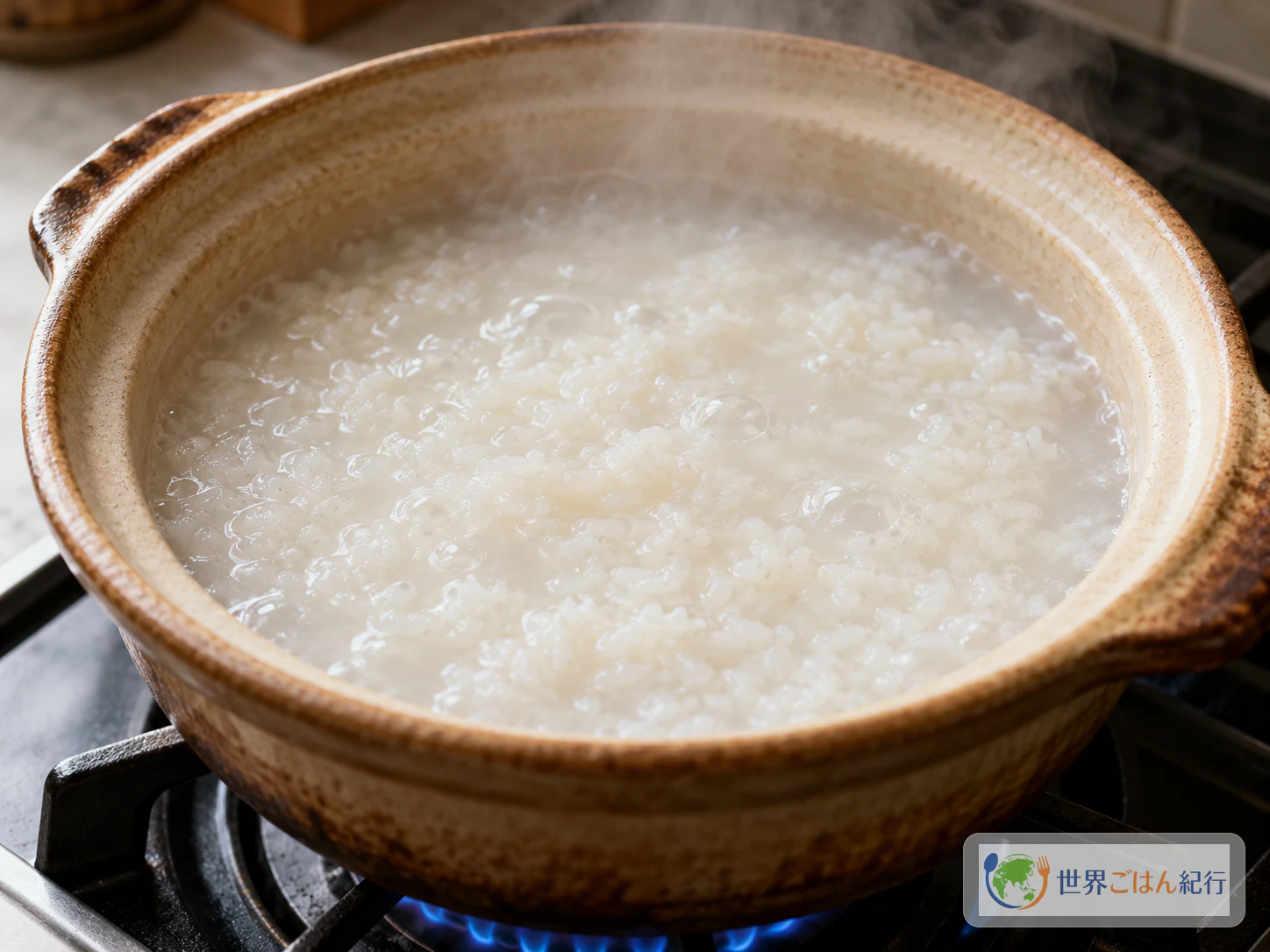
| You're unsure whether the rice is ready for the crab | The author's cue is rice that has opened and congee that has turned smooth. The recipe gives no further instructions |
| The crab flesh isn't white and opaque when you're ready to serve | Keep cooking before you serve, following the FoodSafety.gov guidance above |
| You're tempted to soak the rice | The 15-minute rest is with salt and peanut oil only. The recipe has no soaking step |
The recipe gives no storage or reheating guidance, so this article offers none.
What the Recipe Leaves to the Cook
This is a single home version, so some choices belong to whoever is at the stove.
- Rice. The author chose Wuchang rice because it is their everyday rice. They present it as their own choice, not a requirement.
- Cutting the crab. The author mentions scissors as one way to cut the crab, so the roe doesn't stay behind on the board.
- Seasoning amounts. Salt, peanut oil, fupi, dried scallop and preserved winter vegetable are all "as needed." The amount of each is your call.
The recipe does not suggest any ingredient substitutions or additions.
Frequently Asked Questions
Keep the stages in the author's order and check the crab before serving. Most of the questions below come back to one of those two points.
How many servings does this make?
The author lists the ingredients for 3 servings. The recipe doesn't give a finished volume.
The recipe says "half a cup" of rice. How much is that?
The source lists "80g / half cup" but doesn't say what size cup. This article uses the 80g.
Is the rice soaked for 15 minutes?
No. After rinsing, the rice is mixed with salt and peanut oil and left for 15 minutes. It is not soaked in water.
Does 3L of water give 3L of congee?
No. The 3L is the water at the start. The recipe doesn't say how much congee you end up with or how thick it should be.
Is 4 minutes enough for the crab?
The 4 minutes is the author's time, and the winter vegetable's 1 minute follows it. Neither is a verified safety time. Before serving, check that the crab flesh is pearly or white and opaque. If it isn't, keep cooking.
Which crab should I use?
The recipe calls for one crab and gives no species, weight, size, or raw or cooked state. The author mentions 羔蟹 (奄仔) in the text, but this article doesn't identify a species from that word or from the Macao Government Tourism Office's mention of fresh-water crab.
Sources
- 元气满满的马卡龙, "家常版澳门水蟹粥" (Home-style Macau crab congee), Xiachufang, 2024-07-29. The source for the ingredients, the amounts for 3 servings, the order of steps, the heat stages and times, and the author's framing as a home re-creation of a remembered bowl. https://www.xiachufang.com/recipe/107383207/
- FoodSafety.gov, "Cook to a Safe Minimum Internal Temperature," page last reviewed 2024-11-21. The source for the guidance to cook crab until the flesh is pearly or white and opaque. The crab entry gives no numeric temperature, and this page does not verify the recipe's times. https://www.foodsafety.gov/food-safety-charts/safe-minimum-internal-temperatures
- Macao Government Tourism Office, "Local Food – A Taste of Macao's Daily Life." Used for regional context only: congee as a Macau local food and breakfast dish, and its suggestion of congee with a whole fresh-water crab. https://www.macaotourism.gov.mo/en/dining/taste-of-macao/local-food