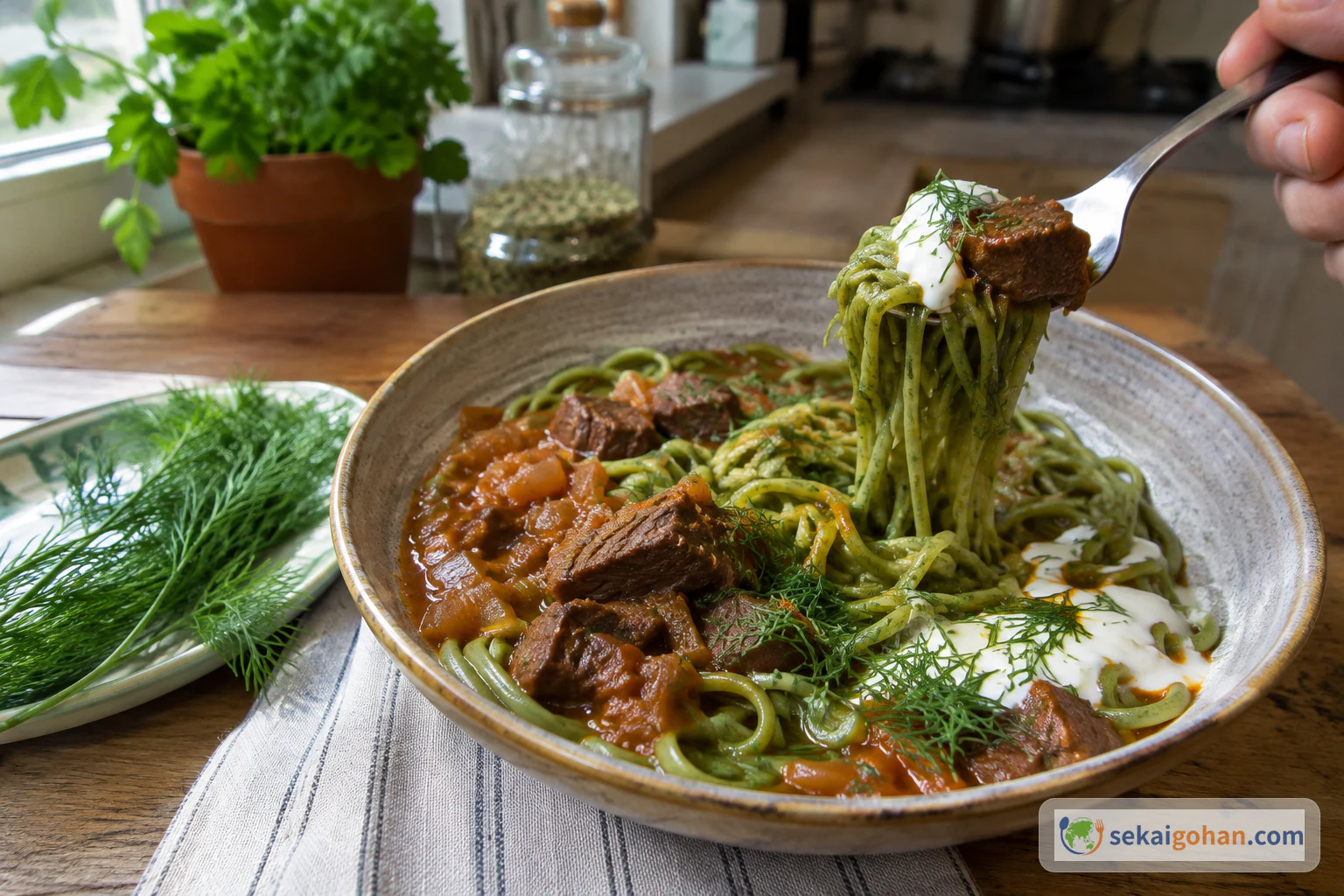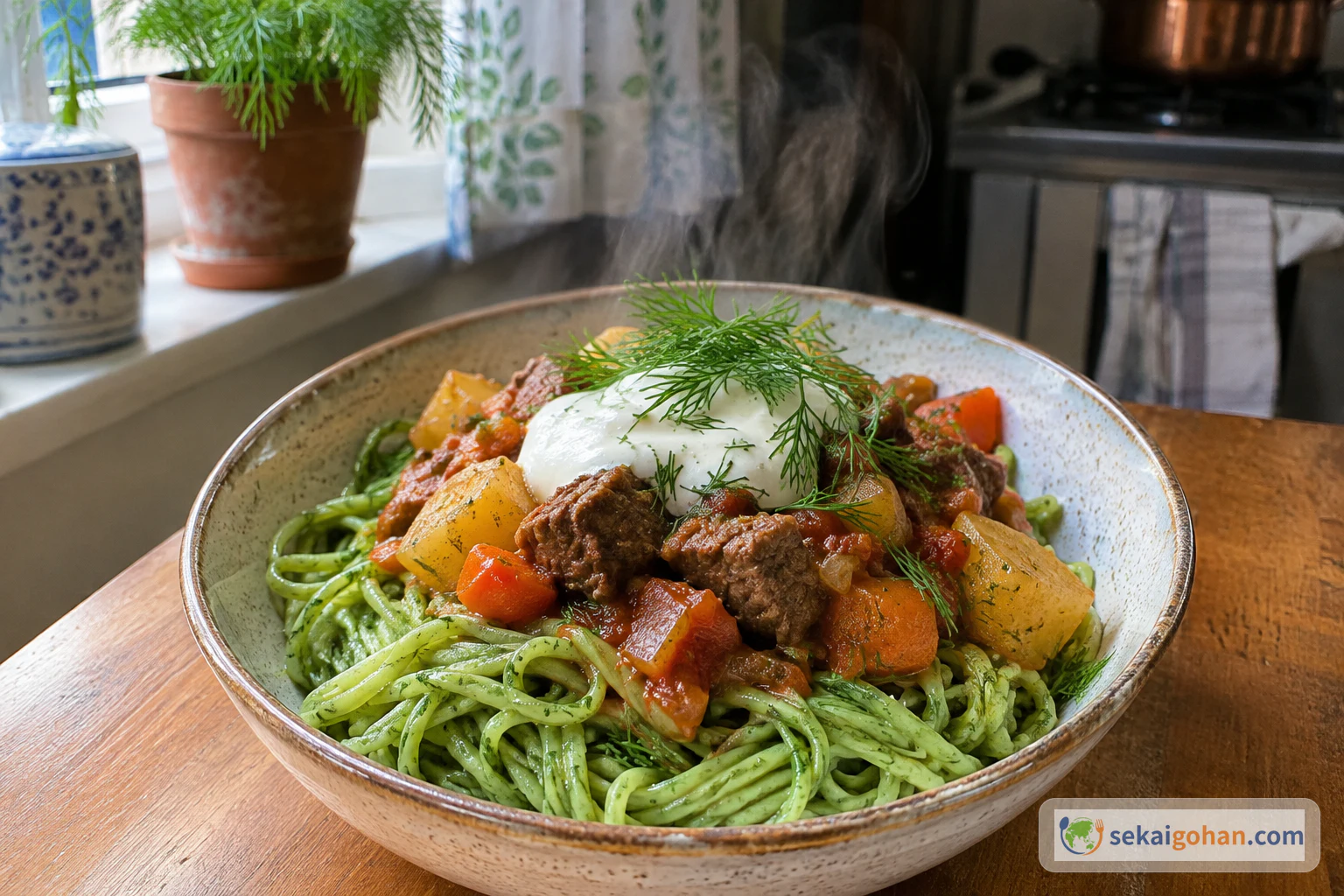
A finished bowl of shivit oshi: bright green dill noodles under beef and vegetable stew, topped with yogurt and fresh dill
CuisineUzbek

Shivit Oshi: Khivan Green Dill Noodles with Beef Stew

Shivit oshi from Khiva, Uzbekistan: green noodles made with dill water under a slow beef stew. Learn the milk reduction cue, the dough, and what to buy.

Cooking flow

Cooking steps

STEP 11 / 9

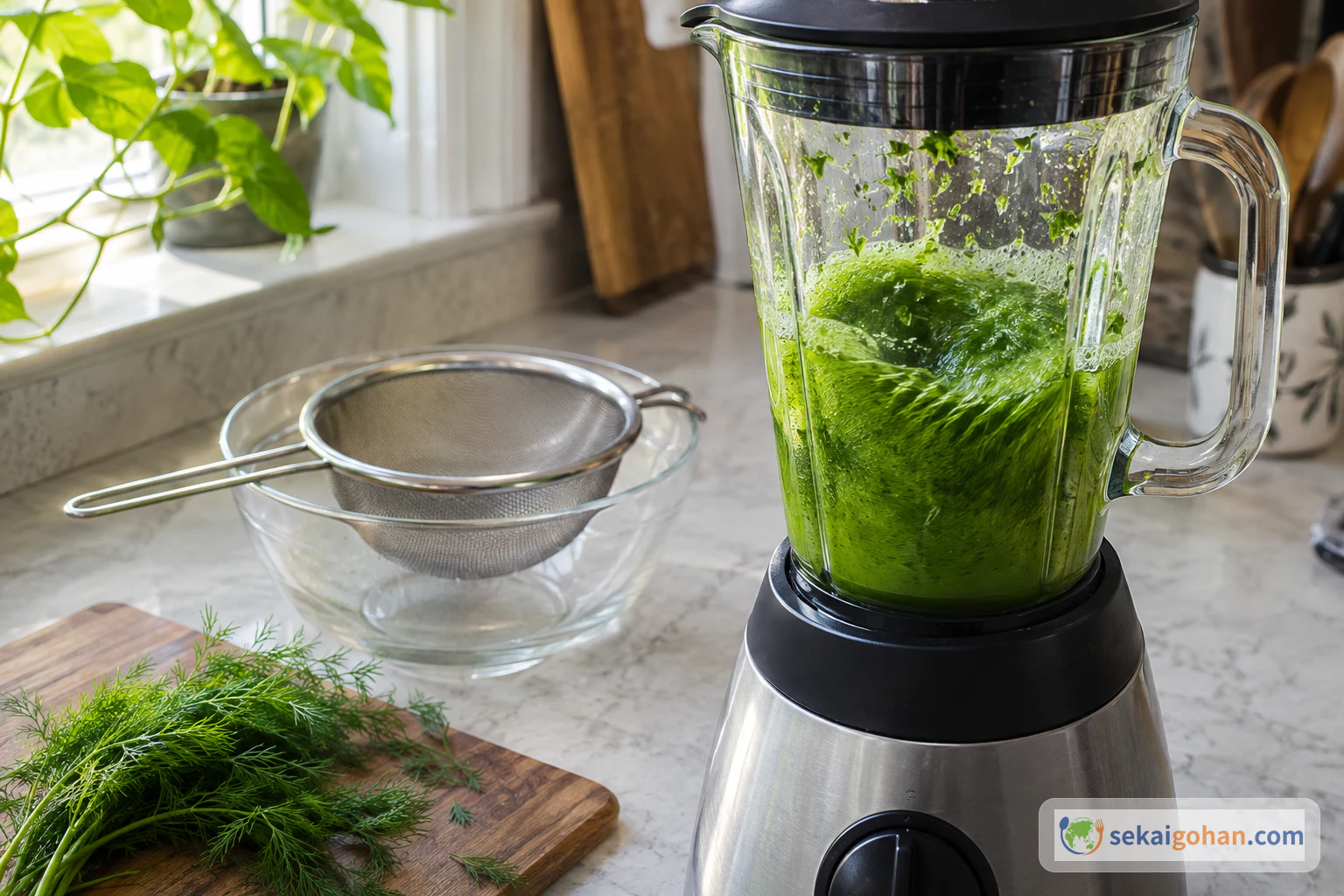
Make the dill water

Fresh dill and water blending into a bright green liquid, with a bowl and fine strainer beside the blender
Strain through a fine mesh so no leaf specks end up in the dough

Put the dill and the scant cup (200 ml) of water in a blender and blend until the liquid is smooth and brightly green. Let it steep for at least 1 hour; on a warm day, steep it in the refrigerator. Pour it through a fine strainer and discard the solids. Measure out a scant ½ cup (100 ml) for the dough and keep the rest. The strained liquid should be a clear, vivid green with no bits of leaf.

STEP 22 / 9

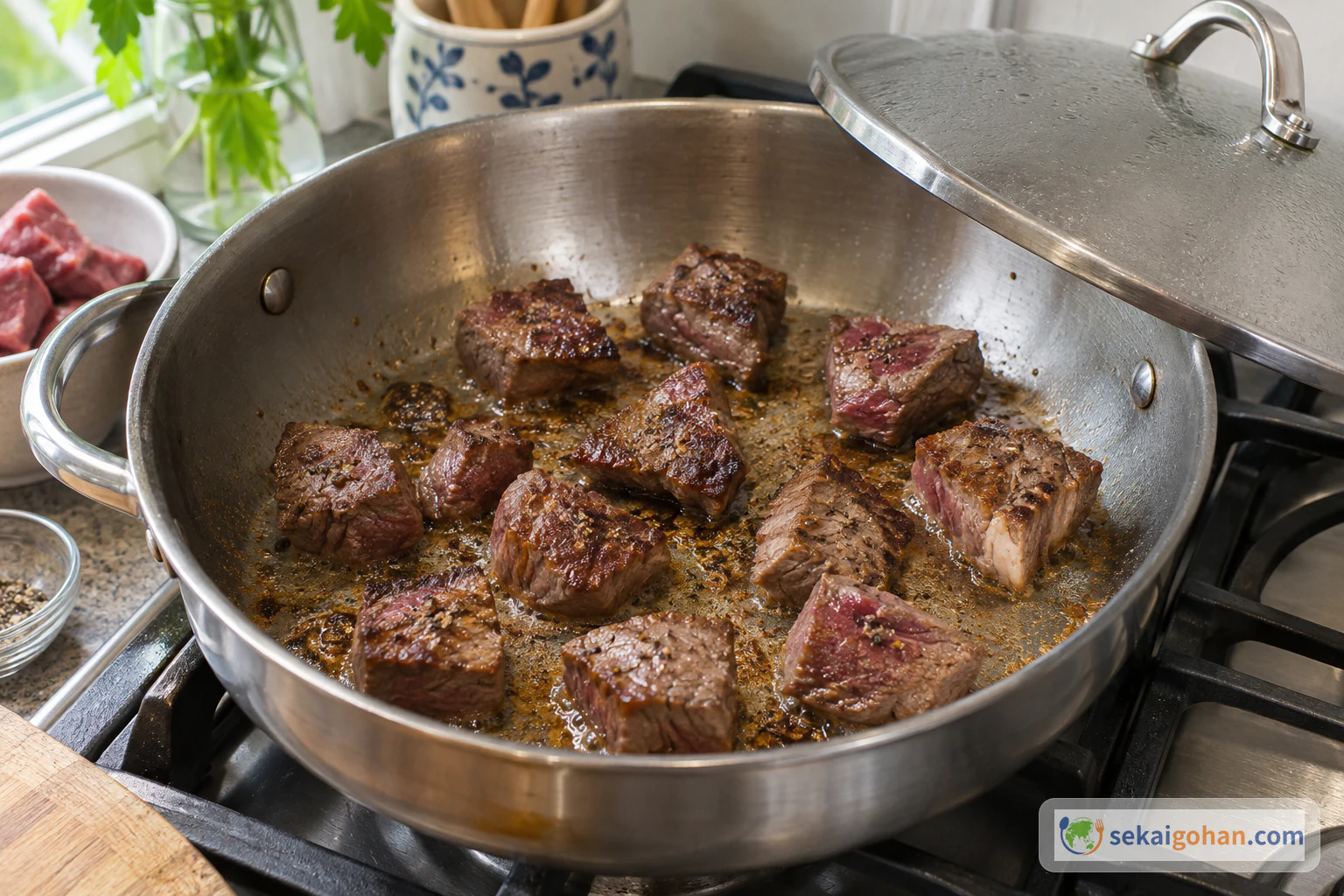
Season and sear the beef

Cubes of beef shank browning in a large sauté pan with space between the pieces
Leave gaps between the cubes; crowded meat steams and stays grey

Pat the beef cubes dry and season them with 1 tsp salt and the black pepper. Heat 1 tbsp ghee or oil in the large sauté pan over high heat. Sear the beef in several batches, leaving space between pieces, about 1 minute per side. Lift each batch out once every side is well browned.

Hot fat

The fat is on high heat for searing. Dry the beef well so it does not spit, and lay each piece in moving away from you.

STEP 33 / 9

Soften the onion and add the spices

STEP 3

Lower the heat to medium and add the remaining 3 tbsp ghee or oil with the onion. Cook for 5 to 7 minutes, until the onion is soft and starting to colour. Add the garlic, bell peppers, chilies if using and ½ tsp salt. Stir in the smoked paprika, cumin and tomato paste.

STEP 44 / 9

Deglaze with milk and start the simmer

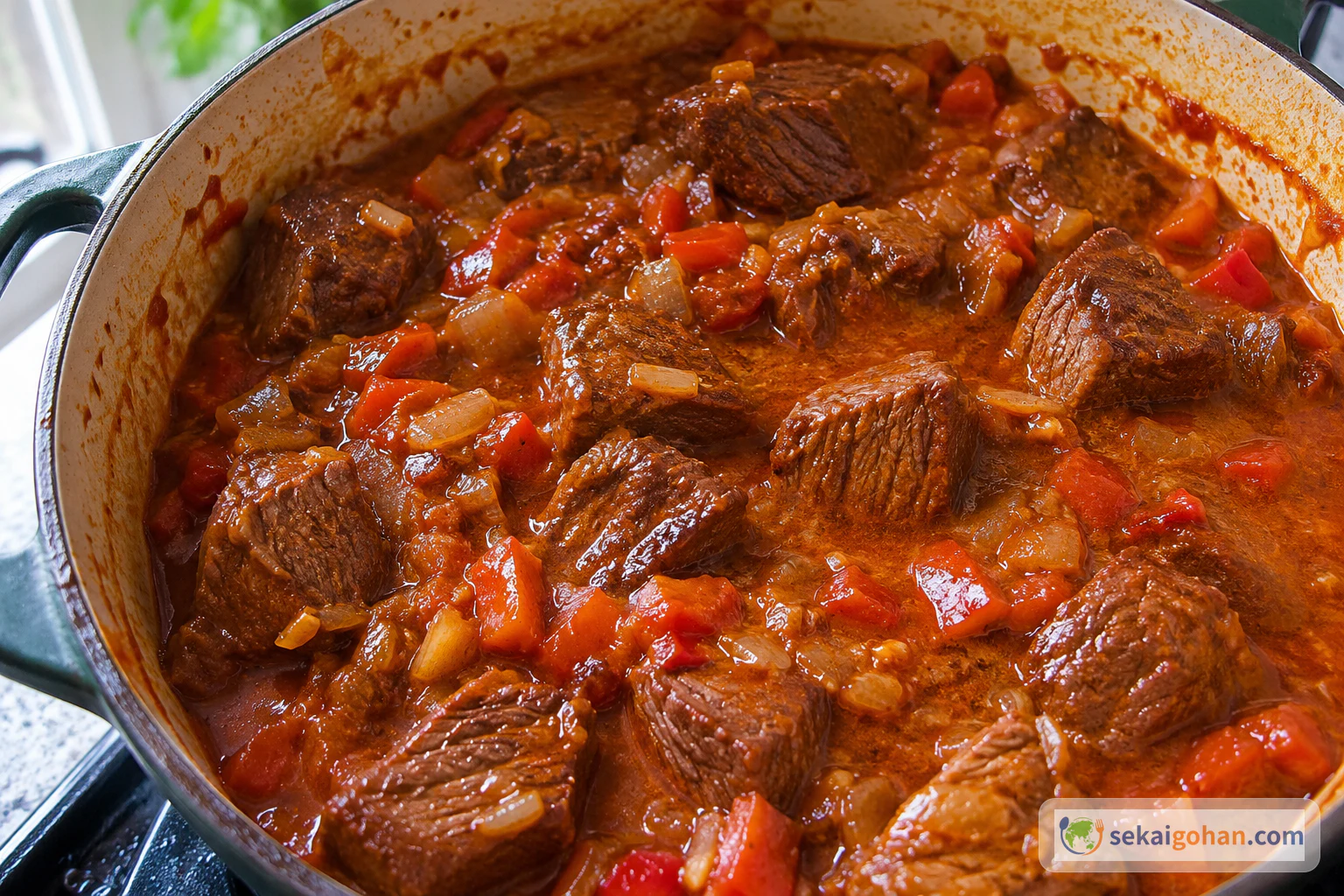
Seared beef cubes among softened vegetables in a glossy, deep reddish-brown reduced sauce
When the milk is nearly gone, the sauce turns glossy and clings to the meat

Return the beef to the pan along with any juices on the plate and stir it through. Pour in the milk and scrape up the browned bits on the bottom. Cook over medium heat for 13 to 15 minutes, until the milk has almost completely cooked off and the stew turns a deep sienna, reddish-brown. Add 3 cups (750 ml) water, lower the heat, set the lid slightly ajar and simmer for 1 hour 30 minutes. The surface should barely tremble the whole time.

Wait for the colour

Wait for the milk to almost disappear before the water goes in. Cooked down this far, it gives the stew its deep colour and rich body. Added water too early leaves a pale stew that tastes of boiled milk.

STEP 55 / 9

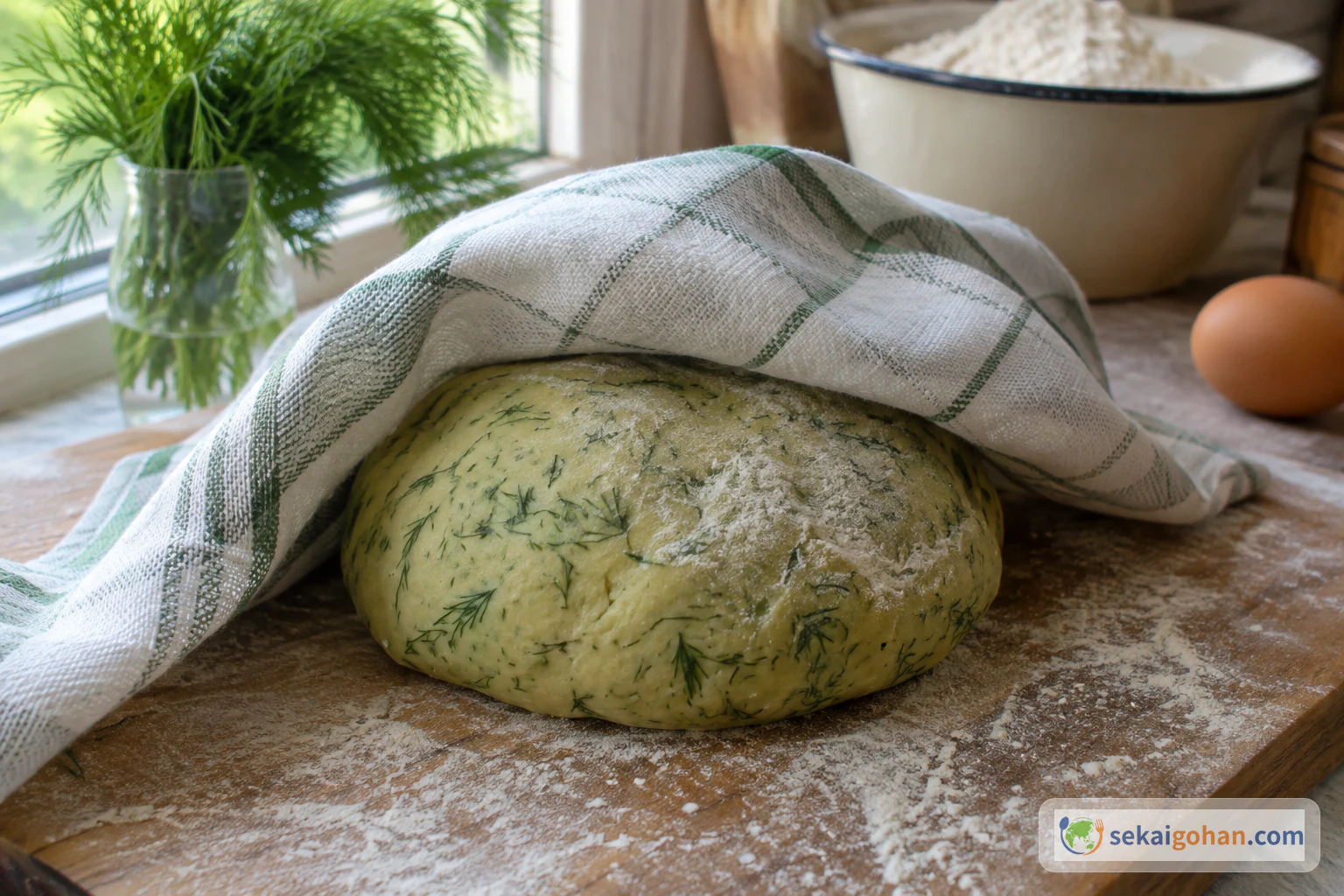
Mix and rest the dough

A green-flecked dough ball resting under a cloth on a floured board
Keep the cloth over the ball so the surface does not dry and crack

Beat the egg into the scant ½ cup (100 ml) of dill water. Sift the flour and ½ tsp salt into the bowl of a stand mixer fitted with a dough hook. With the mixer on low, pour in the egg mixture a little at a time, then mix on medium for 5 to 7 minutes. Shape it into a ball, cover it and let it rest for 1 hour. Before resting, the dough is fairly firm but workable.

Firm dough, full rest

A firm dough rolls thin without tearing, and the full hour's rest is what lets it relax enough to reach 1/16 inch. If you have no stand mixer, knead by hand until it reaches the same fairly firm, workable feel.

STEP 66 / 9

Roll and cut the noodles

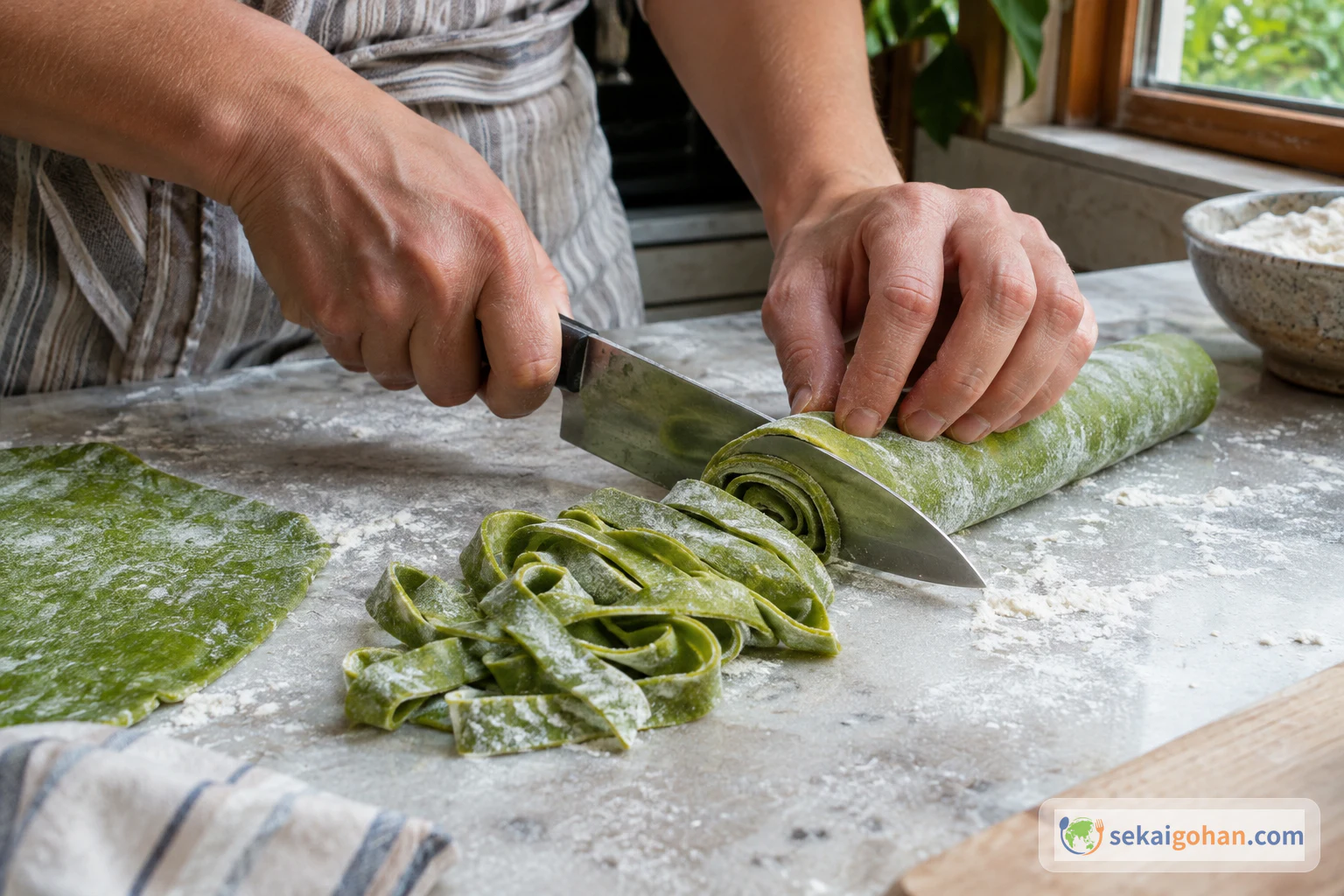
A thin green dough sheet rolled into a snug log and sliced into wide ribbons on a floured counter
Shake each slice loose right after cutting, before the coils settle and stick

Dust a baking sheet with flour. Cut the dough into four pieces and keep three covered. Roll one out by hand or with a pasta machine into a rectangle about 1/16 inch (1.5 mm) thick, dust it with flour, and roll it up tightly along its length into a log. Slice it into 1-inch (2.5 cm) ribbons for wide noodles or ¼-inch (6 mm) strips for thin ones, unroll them onto the sheet and dust with flour, then repeat with the other pieces. The cut noodles should lie separate, each one lightly floured.

Roll it snug

Roll the sheet into a snug log with flour between the layers. A loose roll squashes under the knife, and unfloured layers glue together.

STEP 77 / 9

Add the tomatoes and simmer again

STEP 7

When the stew has simmered for 1 hour 30 minutes, stir in the tomatoes and 1 cup (250 ml) water. Cover the pan and simmer for 1 hour. Keep the heat low enough that the liquid only murmurs.

STEP 88 / 9

Finish with potatoes and carrots

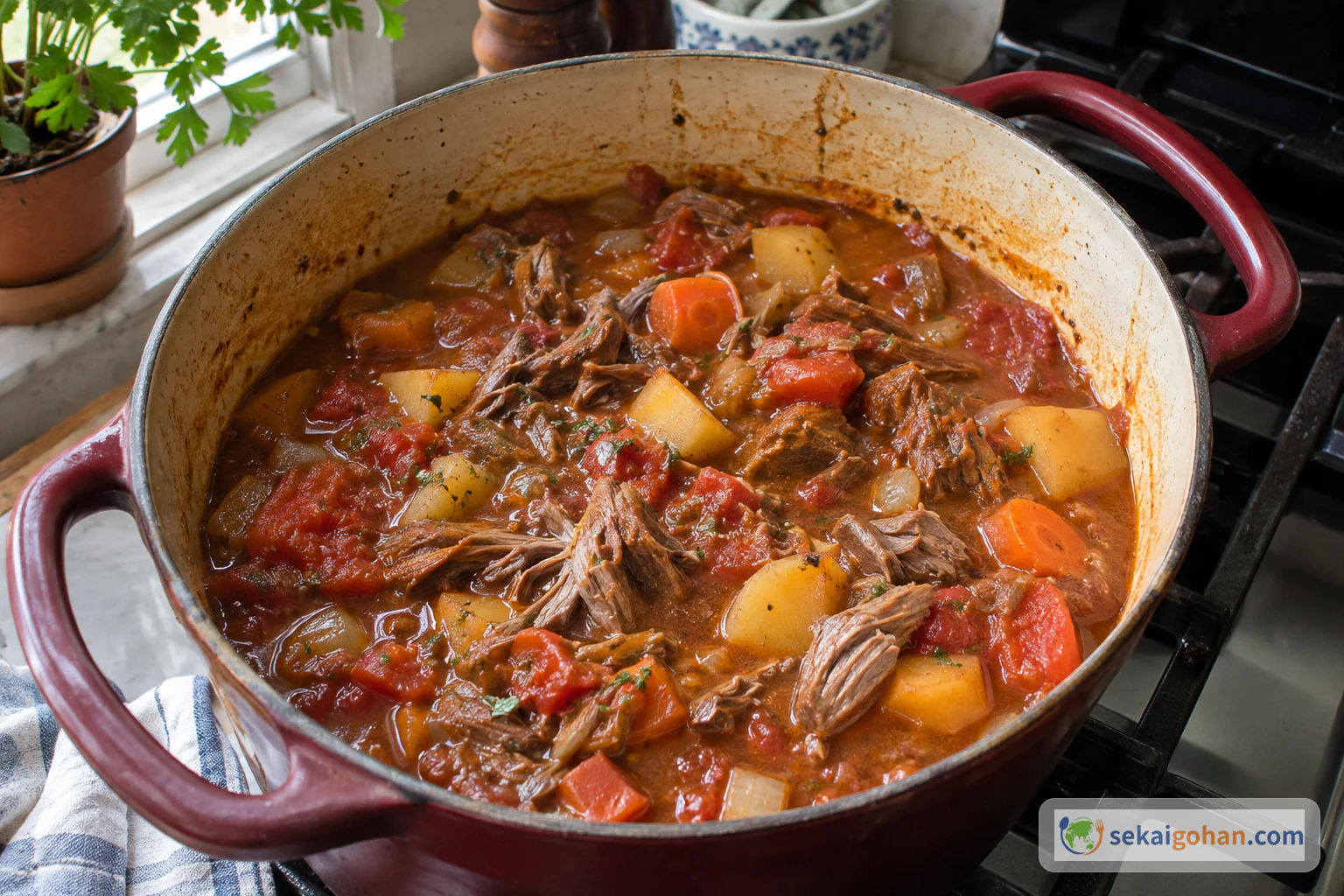
An uncovered stew pot with tomatoes, potato and carrot cubes and tender beef falling apart
With the lid off, the sauce thickens enough to coat the vegetables

Add the potatoes and carrots and leave the lid off. Simmer for about 30 minutes, so some of the liquid cooks away while the vegetables cook. Taste the sauce and adjust the salt if needed. It is ready when the beef falls apart and a skewer slides into a potato and a carrot cube with no resistance.

STEP 99 / 9

Boil the noodles and serve at once

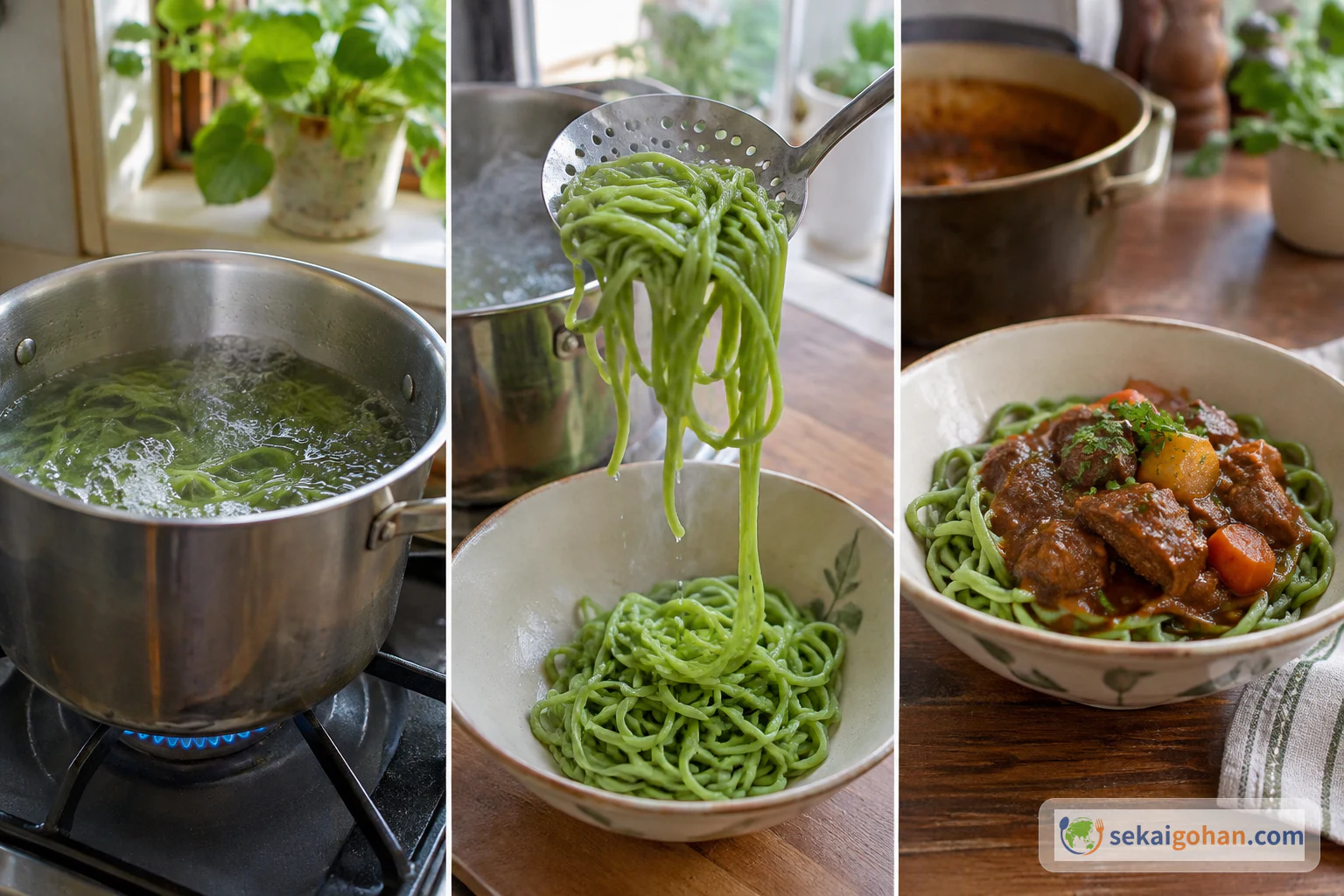
Green noodles boiling, lifted with a slotted spoon into a shallow bowl, then served topped with stew
Lift each batch straight into the bowls so the noodles stay loose and steaming

Bring a large pot of salted water to a boil. Shake the excess flour off the noodles and boil them in several batches for 2 to 3 minutes. Lift them out with a slotted spoon and let the water drain off. Put them straight into bowls and spoon the stew over them, then add yogurt and fresh dill. The noodles are done when they are tender all the way through.

0 / 0
Ingredients

Ingredients

1 / 1

Ingredients

Ingredient Amount Role
Fresh dill (укроп) 1 cup (75 g), plus more to garnish Steeped into water to colour and scent the noodles
Water, for the dill scant 1 cup (200 ml) Blended with the dill; a scant ½ cup (100 ml) of the strained liquid goes into the dough
Egg 1 Binds the dough
Plain flour (00 if you have it) 2¼ cups (300 g), plus more for dusting The noodle dough
Fine salt, for the dough ½ tsp Seasons the noodles
Salt, for the noodle water as needed Seasons the noodles as they boil
Beef shank, cut in cubes 1 lb 2 oz (500 g) Simmers until it falls apart
Fine salt, for the stew 1 tsp for the beef, ½ tsp with the vegetables Seasons the meat and the base separately
Black pepper 1 tsp Seasons the beef before searing
Ghee or olive oil 4 tbsp (1 tbsp to sear, 3 tbsp for the vegetables) Browns the meat and softens the onion
Onion, thinly sliced into half-moons 1 Sweet base of the stew
Garlic, minced 2 cloves Aroma
Bell peppers, cut in ¾-inch (2 cm) pieces 7 oz (200 g) Sweetness and colour
Hot chilies, seeded and minced (optional) 1–2 Heat
Smoked paprika, hot or sweet ½ tsp Smoke and red colour
Ground cumin ½ tsp Earthy warmth
Tomato paste 2 tbsp Depth and colour
Milk 1 cup (250 ml) Deglazes the pan and cooks down into the stew's colour and richness
Tomatoes, roughly chopped 7 oz (200 g) Body and acidity in the long simmer
Waxy potatoes, cut in ¾-inch (2 cm) cubes 10½ oz (300 g) Hold their shape in the stew
Carrots, cut in ¾-inch (2 cm) cubes 7 oz (200 g) Sweetness
Water, for the stew 3 cups (750 ml), then 1 cup (250 ml) Simmering liquid
Plain yogurt to serve Cool, sour topping
0 / 0

The blender turns a heap of fresh dill and water into a liquid so green it looks lit from inside, and the kitchen fills with the smell of a summer garden. That liquid goes into the dough, and the noodles come out of the pot the same startling green. In Khiva and across the Khorezm region of Uzbekistan, those noodles go into a bowl, a beef stew cooked down with milk until it turns deep reddish-brown goes on top, and a spoonful of cool, sour white yogurt finishes it. Each forkful brings the herb, the slow, savoury meat and the sharp dairy together at once.

Khiva's Green Noodles

Shivit oshi is also written shivit osh, and it goes by a second name, Khorezm lagman. That name places it within the wider family of Uzbek noodle dishes while marking it as the one from the far west of the country, from the region around Khiva. Its colour sets it apart at a glance: the green comes from dill steeped in water and worked into the dough. It sits among the dishes Uzbekistan presents as its own, alongside plov, samsa, lagman and tukhum barak.

It is mainly a summer dish, the bowl people make when dill is at its best. The meat and vegetable topping is sometimes called vaju, and the white sour-milk layer on top matters as much as the noodles under it.

Where it began

Where shivit oshi was first made is not settled. In Khiva it is called an old local dish whose beginnings no one can trace. Another account says it appeared roughly 100 to 150 years ago, and that in the early twentieth century it was a dish for weddings and for honoured guests. A third story credits Rajab Sattarov, a cook from Khiva, with carrying it to Tashkent when he moved there in 1958 and making it known in the capital. None of these rules out the others, and the dish keeps its home address in Khorezm either way. For more of the country's food, see Uzbekistan.

What goes on top

In Khorezm the topping is katyk, a soured milk, or suzma, a thicker strained one. Both bring a cold, clean sourness against the hot stew. Households also differ on the dough: some knead chopped dill straight into the flour, others use dill water, and the number of eggs varies.

Cold on top, never stirred in

Katyk is spooned on cold, at the very end, and left sitting on the stew rather than stirred through. Each bite then carries the hot stew and the cool soured milk side by side, which is the whole contrast of the bowl.


Ingredients
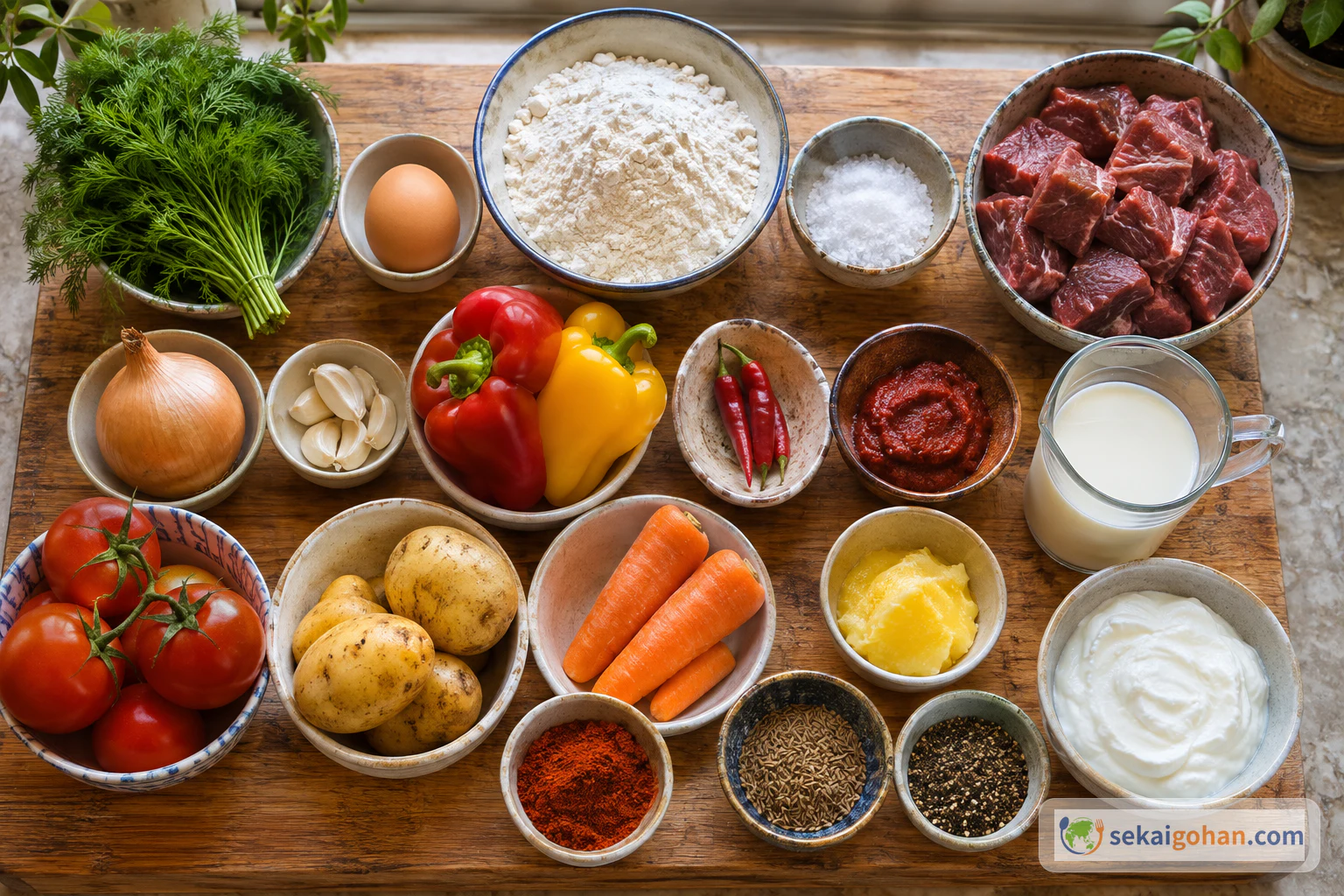
All the ingredients for shivit oshi laid out in small bowls on a wooden board
Weigh the dill rather than packing a cup by eye: 75 g fills a surprising amount of space
Allergen information

This dish contains wheat (flour), egg (the dough) and milk (the milk in the stew, the yogurt, and ghee if you use it). Olive oil in place of ghee removes one dairy source, but the milk and yogurt remain.

Equipment

  • Blender
  • Fine strainer and a bowl
  • Large lidded sauté pan
  • Stand mixer with a dough hook
  • Rolling pin or pasta machine
  • Sharp knife
  • Baking sheet for the cut noodles
  • Large pot for boiling the noodles
  • Slotted spoon or spider
  • Skewer for testing the vegetables

Choosing and Substituting

Three things make this taste like Khorezm: the scent of dill in the noodles, the deep colour and richness the milk gives the stew, and the sourness of the topping. Hold on to those and the rest is flexible.

Dill is the shopping challenge. Seventy-five grams is far more than one small supermarket clamshell, so buy several, or look for large bunches at farmers' markets and Middle Eastern, Russian or Central Asian grocers, where dill is sold generously. Weigh it; the colour depends on the full amount.

Flour: ordinary plain or all-purpose flour works, and 00 flour is a good choice if you have it. Bread flour can make the noodles tougher, so leave it on the shelf.

Fat: ghee and olive oil both work. Ghee gives a rounder, buttery base; olive oil is lighter and easier to find.

Beef shank suits the long simmer and turns tender enough to fall apart.

Chilies: jalapeños or similar fresh hot chilies. Heat varies a lot between chilies, so adjust the number to the ones in your hand, or leave them out.

Potatoes: choose a waxy variety so the cubes stay whole after half an hour in the stew. Floury potatoes break down and cloud the sauce.

Yogurt: plain yogurt from the shop is the topping here. Katyk and suzma are Central Asian soured-milk products with their own tastes and textures, and ordinary or Greek-style yogurt is a different thing from either. If you find katyk at a Central Asian grocer, use it cold on top.


Method

Start with the dill water, since it needs at least an hour to steep. While it sits, sear the beef and build the stew; once the water goes in, the stew simmers for an hour and a half on its own. Use that time to mix the dough, rest it, then roll and cut the noodles. The stew then gets tomatoes for an hour and vegetables for half an hour, and the noodles boil at the last minute so they go straight from the pot into the bowls.

Cook through

The beef simmers until it falls apart, and the egg noodles boil until tender all the way through. Do not serve either one underdone.

When It Goes Wrong

What you see Why What to do
The stew is pale and tastes of milk The water went in before the milk cooked off Next time, cook the milk until it has almost completely cooked off and the stew is deep reddish-brown before adding water
The dough tears or springs back when rolled It has not rested long enough Cover it again and give it the rest of its hour before rolling
The noodles clump into a gummy mass Too much loose flour on them, or too many in the pot at once Shake off the excess flour and boil in batches in plenty of salted water
The potatoes turn to mush Floury potatoes, or added too early Use waxy potatoes and add them only for the final 30 minutes
The stew is too salty or greasy The salt or fat went in twice The 1 tsp salt goes on the beef and ½ tsp with the vegetables; 1 tbsp fat sears, 3 tbsp cook the onion. Measure each one only once
The noodles are pale with little dill scent The dill was short of weight or steeped too briefly Use the full 75 g and steep at least 1 hour before straining

Serving and Variations

A spoon lifting green noodles with beef stew and yogurt from the bowl, fresh dill beside it
Dig down through the yogurt so each spoonful carries noodles, stew and sourness together

Serve shivit oshi the moment the noodles leave the water, while the stew is steaming and the yogurt is still cold. Put out a plate of extra fresh dill so everyone can add more, and bring the yogurt to the table so people can add another spoonful halfway through. This is a summer bowl, the dish to make when dill is in full season, and it is made for sharing from one pot.

Wide or thin noodles

Cut at 1 inch (2.5 cm), the noodles are broad and soft, and they carry big pieces of beef and vegetable on every forkful. Cut at ¼ inch (6 mm), they are closer to ordinary noodles and wind up easily in a spoon of sauce.

Ghee or olive oil

Ghee makes the stew rounder and richer, which suits the milk in the sauce. Olive oil gives a lighter, cleaner stew and lets the dill come forward.

Katyk instead of yogurt

If you can buy katyk, spoon it on cold and leave it sitting on top. Kept separate from the hot stew, it gives the contrast the dish is known for in Khorezm.

Frequently Asked Questions

Can I make the dough without egg?

There is an egg-free version in which chopped dill is kneaded straight into flour and water. It is a different dough with its own proportions and a flecked look rather than an even green. For noodles as smooth and evenly coloured as these, keep the egg and the dill water.

Why does a beef stew have milk in it?

The milk lifts the browned bits from the bottom of the pan after the beef is seared. Cooked down almost to nothing, it leaves behind the stew's deep reddish-brown colour and its rich, rounded body. That colour is one of the things that makes the stew taste of Khorezm, so keep the milk.

How spicy is shivit oshi?

It is gently spiced. The chilies are optional, and the smoked paprika can be hot or sweet, so you set the heat yourself. With no chilies and sweet paprika the stew is mild, smoky and savoury, and the cool yogurt takes the edge off whatever heat you add.
Sources

  • Anna Ansari, "Shivit Oshi: Khivan Green Noodles with Beef Stew," from Silk Roads, The Splendid Table (American Public Media). Ingredients, amounts, dill water, dough, shaping, boiling and simmering times; the dish as an old dish of Khiva whose origins cannot be traced. https://www.splendidtable.org/story/2025/10/03/shivit-oshi-khivan-green-noodles-with-beef-stew
  • Uzbekistan Tourism Committee, "Shivit osh," Uzbekistan Travel. The name Khorezm lagman, the dish's dill noodles with a white sour-milk sauce and vaju, its place as a summer dish, and Rajab Sattarov's move from Khiva to Tashkent in 1958. https://uzbekistan.travel/en/o/shivit-osh/
  • Gastro-Guide (Borjomi), "Shivit Oshi (Khorezmian dill pasta with beef stew and katyk)," chef Ilhom Khudoberganov. The egg-free dough with chopped dill, and katyk served cold on top without stirring it in. https://gastroguide.borjomi.com/en/recipes/shivit-oshi-1
  • Afisha.uz, "От укропа до ЮНЕСКО: все о хорезмском блюде шивит оши." The account of the dish appearing 100 to 150 years ago, its role at weddings and for guests in the early twentieth century, the dill-juice colour, katyk or suzma as a topping, and summer eating. https://www.afisha.uz/ru/tourism/2025/06/05/shivit-osh
  • Uzbekistan Tourism Committee, news item 203330, gov.uz. Shivit oshi listed with plov, samsa, lagman and tukhum barak among Uzbekistan's signature dishes. https://gov.uz/en/uzbektourism/news/view/203330