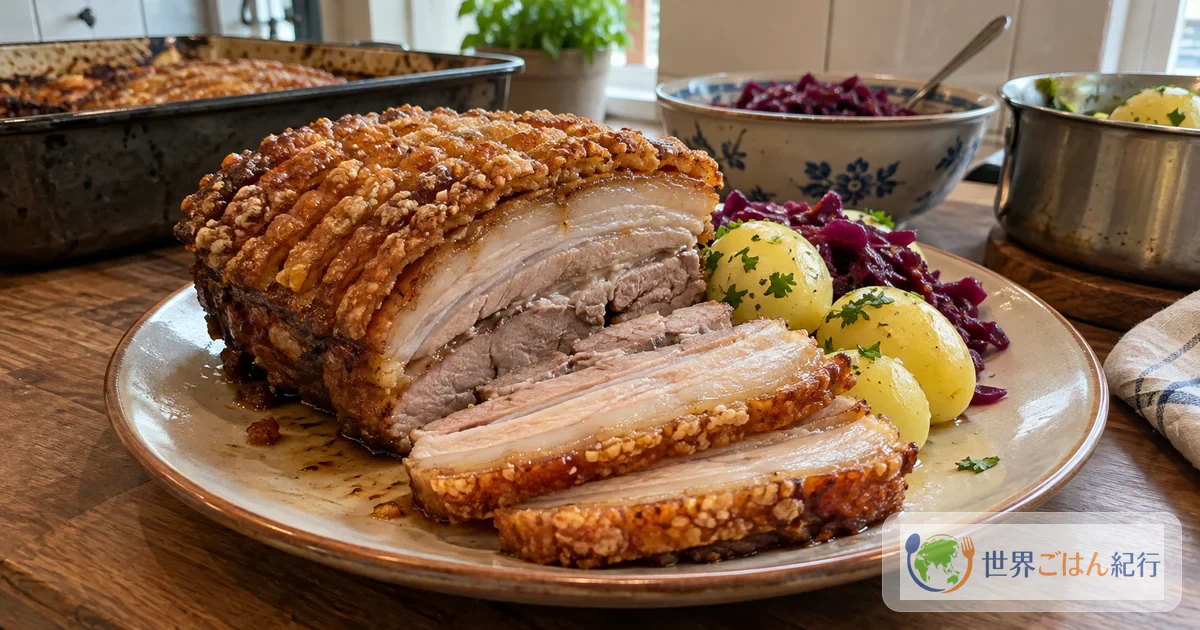
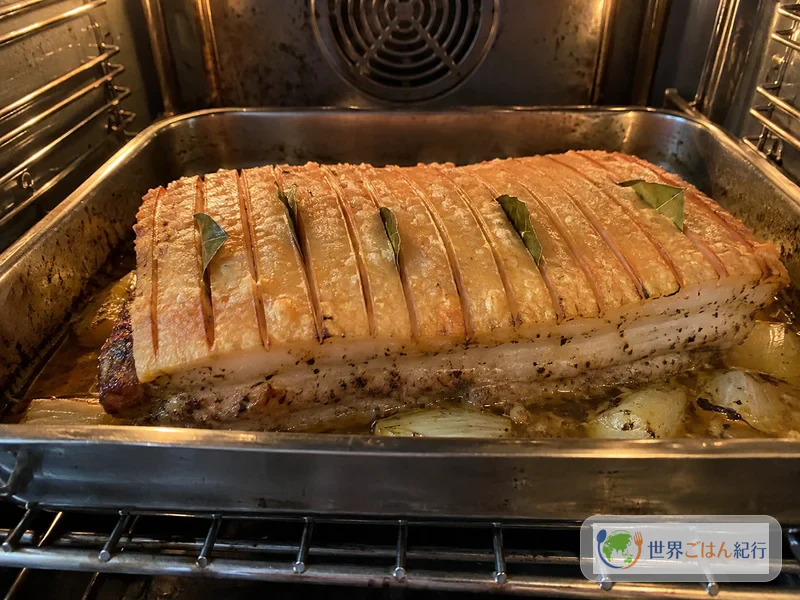
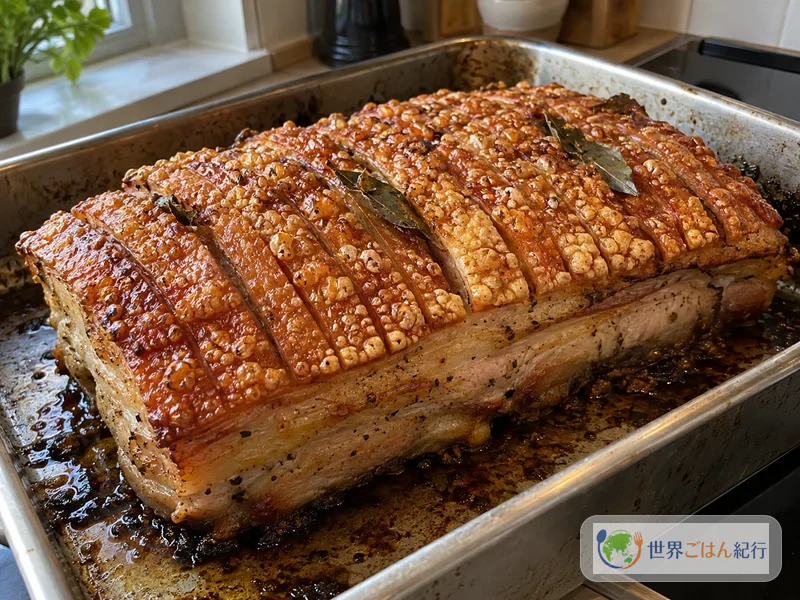
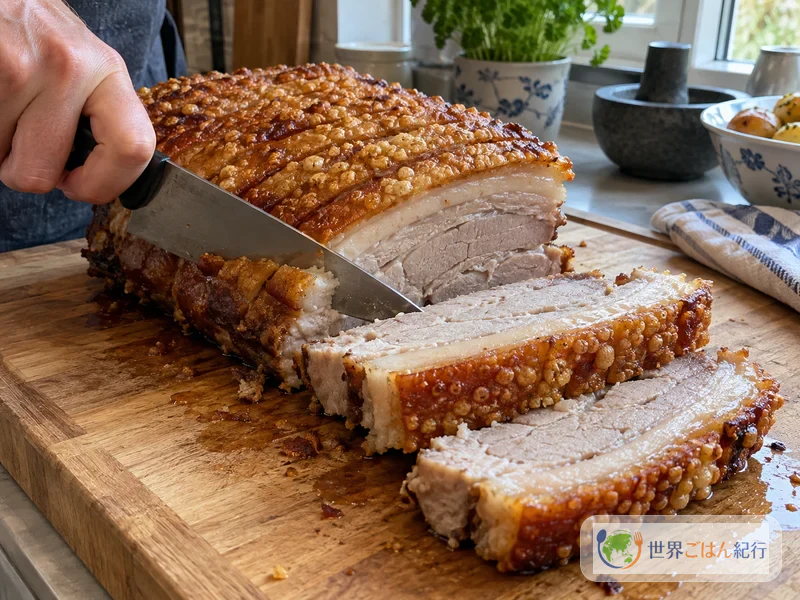
On the evening of December 24, the smell of pork fat roasting and the fragrance of bay leaf and clove drift from kitchens in Danish homes. Open the oven door and the pork skin has cracked into fine fissures, puffed and golden, and when a knife goes in there is a dry "crack." Flæskesteg is Denmark's roast pork cooked with the skin on. It has been roasted for generations as the centerpiece of the Christmas Eve table.
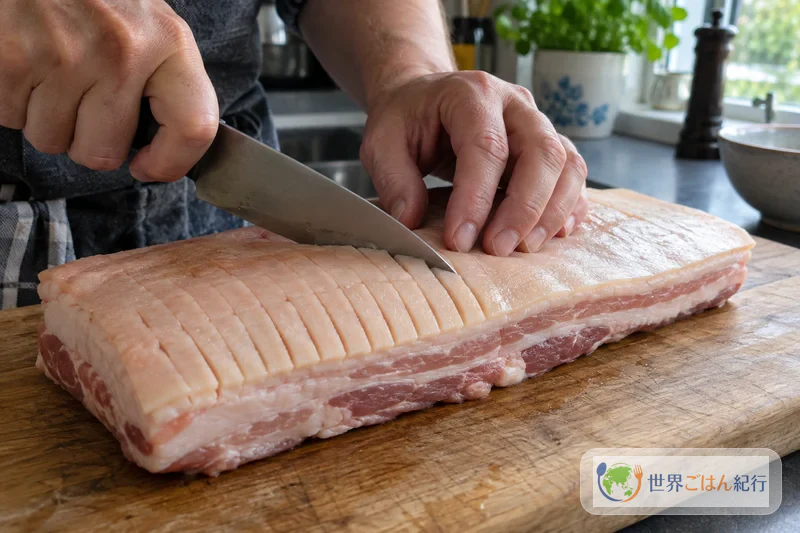
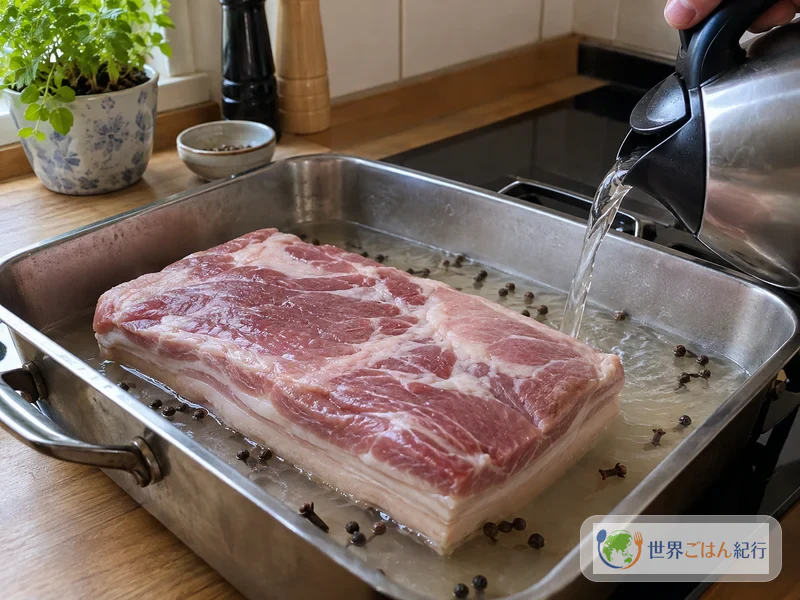
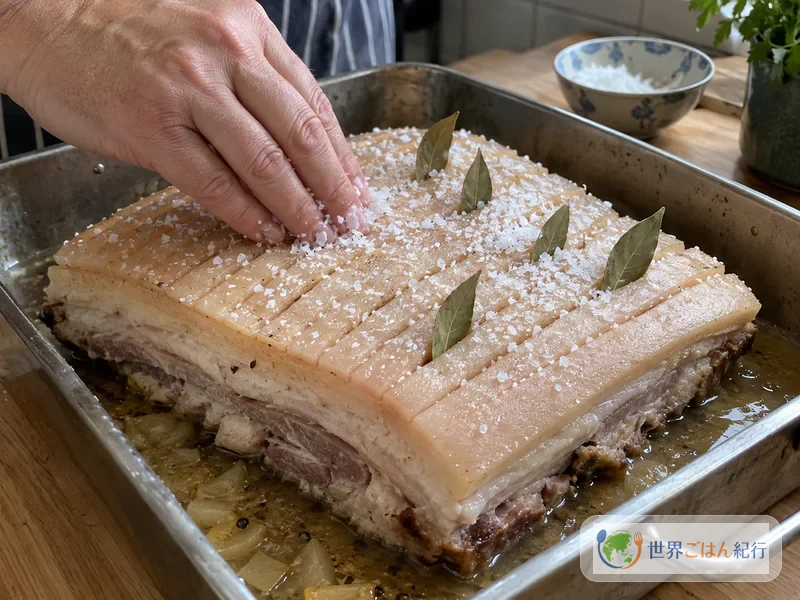
Everything about this dish depends on how crisp you can make the skin. You score it and rub in salt, start by baking it skin side down in hot water, and after turning it over, puff it up all at once at high heat. The steps themselves are simple, but whether you do the scoring of the skin and the salt carefully changes the result completely.
December 24, when pork skin crackles in a Danish oven
Danes have eaten pork for centuries, but oven-roasted pork became common in homes only after wood-fired household ovens spread in the 1860s. Many Danes still consider the recipe in Frk. Jensen's cookbook, published in 1901, the "traditional way." Roasting with the skin on has been an essential condition of this dish since it first spread.
Why pork at Christmas? The Danish English-language news site The Local points to its ties to 19th-century farming. Pig farmers preserved meat in brine and had to eat it before it became too salty. And because pigs were slaughtered in November, pork came to be on the Christmas feast. Meanwhile, in wealthy 19th-century homes, following German and French Christmas customs, goose and later duck came to be treated as a higher-status meat than pork.
Many Danish homes today serve "both" duck and flæskesteg on Christmas Eve. According to The Local, about three in four people eat duck on December 24 and about 60% eat pork. Rather than choosing one, putting two meats on the table is the Danish way.
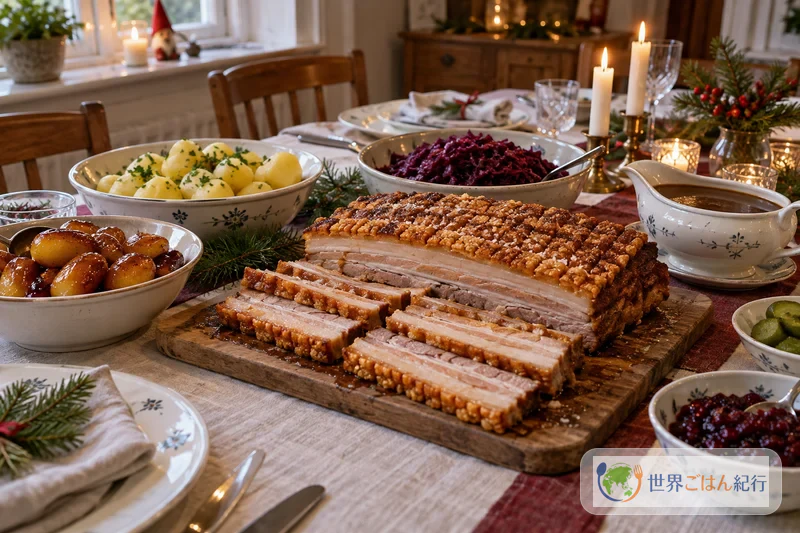
A fixed cast fills the table. Boiled potatoes, and potatoes glazed brown with sugar and butter (brunede kartofler). Red cabbage (rødkål), boiled or braised. Gravy made from the pan juices. And after the meal, risalamande, a cold rice pudding mixed with chopped almonds, vanilla, and whipped cream, eaten with cherry sauce.
Ingredients (serves 4)
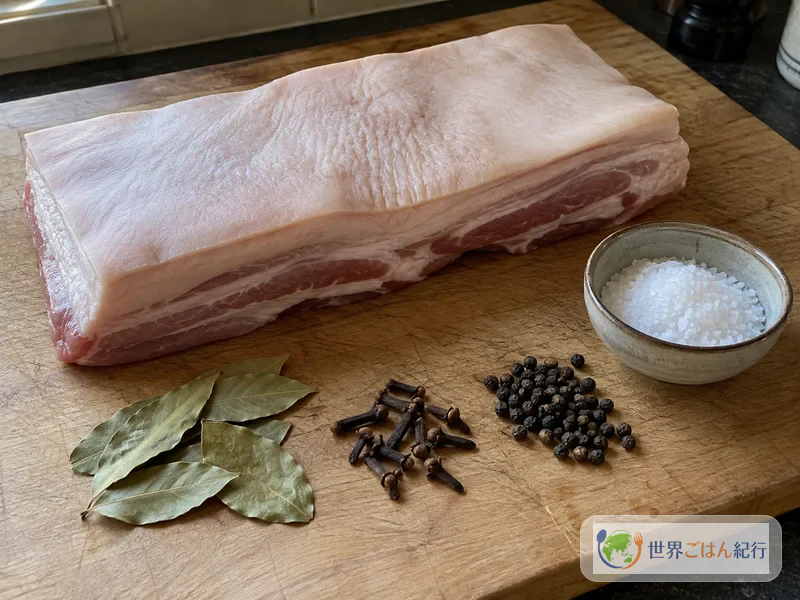
Skin-on pork belly is not always on the shelf at an ordinary supermarket, since much of the pork belly sold there has had the skin removed. Look for it at a butcher or specialty meat shop, or online, often frozen. In Denmark the loin-side kamsteg is also popular, but skin-on belly is usually easier to find and, being fattier, is less likely to dry out when roasted.
Move frozen skin-on pork to the refrigerator and thaw it slowly. The Danish meat company Danish Crown recommends thawing roasting joints in the refrigerator over 2–4 days. The drier the surface of the skin, the crisper it bakes, so after thawing, pat it thoroughly dry with paper towels.
How to make flæskesteg
Prep takes about 20 minutes. Baking is 20 minutes skin side down, 50 minutes after turning over, 10–20 minutes to puff the skin at the end, and 15 minutes of rest. The oven is assumed to be convection. For an electric oven without convection, raise the temperature at each stage by 10–20 °C and adjust the time while watching the color.
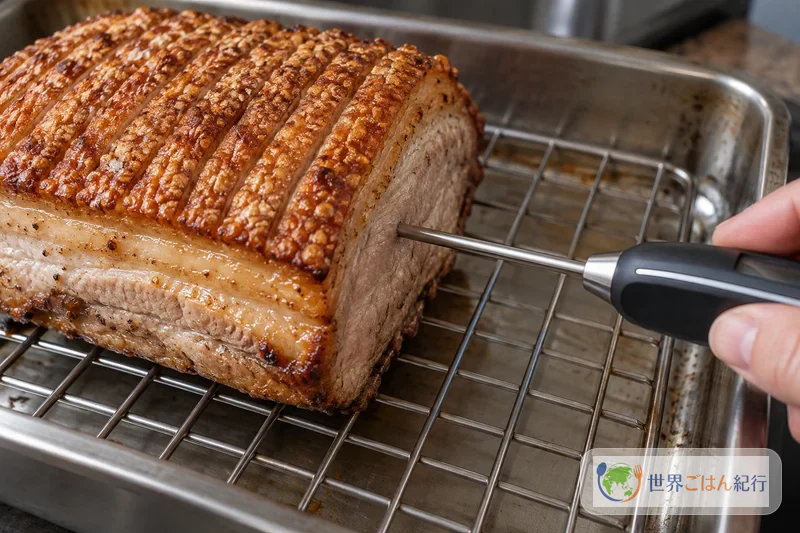
Heat pork to 75 °C at the center for at least 1 minute. Even fresh pork, if not heated through, can cause food poisoning or hepatitis E virus infection. Some Danish recipes finish pork loin at a center temperature of 65 °C, but when cooking at home, treat 75 °C for at least 1 minute as the guide and check with a thermometer.
At the final 230 °C, pork fat splatters onto the roasting pan and tends to smoke. When opening the oven door, keep your face back and use heavy oven mitts. Be careful of burns from the hot pan juices you transfer.
If the skin will not puff no matter what, another method is to broil it for a few minutes under the oven's grill (top heat) function. But it goes from golden to burnt black in seconds, so watch it closely at the oven door.
With red cabbage and glossy potatoes
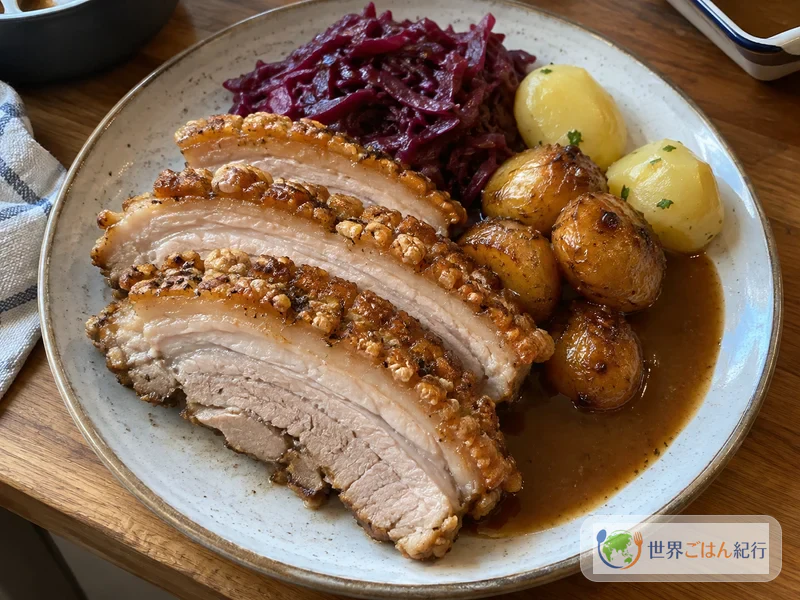
Arrange the carved flæskesteg on the plate with the skin up. The classic sides are sweet-sour braised red cabbage and two kinds of potatoes: boiled potatoes and brunede kartofler, glazed brown with sugar and butter. In Denmark many homes use canned small boiled potatoes to toss in caramel, and jarred or canned red cabbage is often used too. Warming a jar of imported red cabbage easily brings the table together.
Skim the fat from the surface of the pan juices you set aside, move them to a pot, and thicken with flour for gravy. Pan juices carrying the aroma of pepper and bay leaf are salty and meaty enough.
If any is left the next day, slice it thin and set it on rye bread as Denmark's open-faced sandwich, smørrebrød. Cold flæskesteg with red cabbage, prunes, orange, and pickled cucumber is the classic combination. Served warm in a bun, it is also sold at Danish hot dog stands.
Two cuts: ribbenssteg and kamsteg
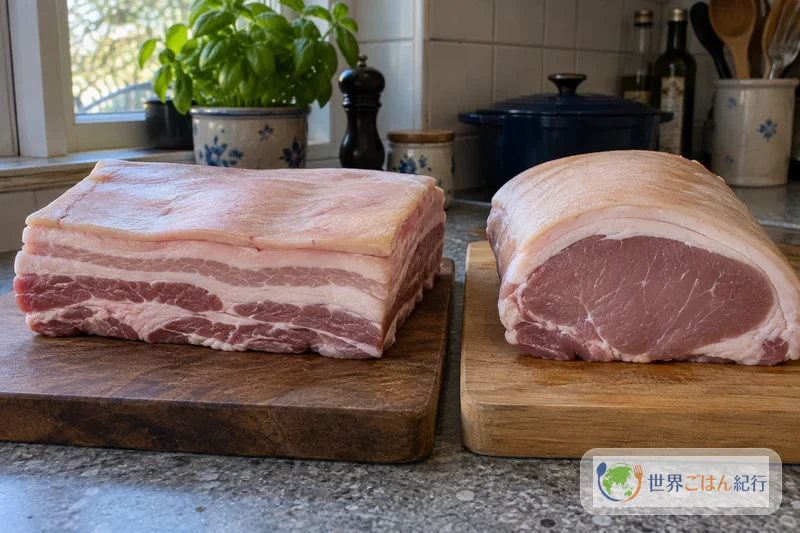
Flæskesteg in Denmark is not a specific cut but the name of the dish, "roast pork baked with the skin on." According to Danish Crown, there are two popular cuts. One is kamsteg (loin), with more lean meat on the back side, and the other is ribbenssteg (belly), with layers of lean meat and fat. Ribbenssteg, being fattier, is said to dry out less even when overcooked.
The guide internal temperature for doneness also differs by cut: in the company's guide, 65 °C for kamsteg and 75 °C for ribbenssteg. When cooking at home, heating the center to 75 °C for at least 1 minute is the standard for either cut. With fatty belly, it stays moist even when baked to that temperature.
In a recipe from Aamanns, a restaurant in Copenhagen, Denmark's capital, baking times are divided by cut: about 2 hours 15 minutes for a roasting shoulder and about 1 hour 45 minutes for loin. Even for the same flæskesteg, how it cooks varies considerably with cut and size.
Frequently asked questions
What if I cannot get skin-on pork?
With skinless pork belly block you can still make fragrant roast pork by the same steps. But you will not get the crisp skin that is the star of this dish. Skin-on belly is easiest to find at butchers or online.
The skin did not get crisp. What was the cause?
Common causes are scores that were too shallow so the salt did not go deep, a damp skin surface, and too little temperature at the finish. Pat the skin dry before baking and raise the finish to 230 °C. For spots that still will not puff, broil briefly under the grill function without taking your eyes off it.
Should I add cloves?
You can make it without them. In Danish recipes too, cloves are sometimes given as "can be omitted." Bay leaf alone gives enough aroma.
Can I make it ahead?
The skin is crispest on the day it is baked. Let leftover meat cool, refrigerate it, and finish it soon. Slice it cold for open-faced sandwiches, or if reheating, heat it until it is hot all the way through.
Sources
- Danish Crown, "Den ultimative guide til flæskesteg." Accessed and checked 22 October 2026. https://www.danishcrown.com/media/geueuy5n/denultimativeguidetilflaeskesteg.pdf
- Aamanns, "Den sprødeste flæskesteg." Accessed and checked 22 October 2026. https://aamanns.dk/wp-content/uploads/2019/12/Opskrift_Flæskesteg.pdf
- Michael Barrett, The Local Denmark, "Why do Danes eat duck and pork for Christmas?" 21 December 2017. Accessed and checked 22 October 2026. https://www.thelocal.dk/20171221/why-do-danes-eat-duck-and-pork-for-christmas
- Wikipedia, "Flæskesteg." Accessed and checked 22 October 2026. https://en.wikipedia.org/wiki/Fl%C3%A6skesteg
- Bunkyo City (Japan), "Serving and selling pork for raw consumption is now prohibited" (in Japanese). Accessed and checked 22 October 2026. https://www.city.bunkyo.lg.jp/b026/p002888.html