France

Cassoulet: Southwest French White Bean Stew with Pork and Sausage

Cassoulet from Languedoc in southwest France, made at home: how to cook white beans without breaking them, layer pork and sausage, and build the crust in the oven, plus how Castelnaudary, Toulouse and Carcassonne differ, meat swaps, storage and fixes.

This recipe was translated from the Japanese original by the Sekai Gohan editorial team. Read the original (Japanese)

  • Prep12 hr 45 min
  • Cook4 hr 30 min
  • Total17 hr 15 min
  • Serves4 servings
  • LevelIntermediate

Southwest French cassoulet of white beans stewed with pork, sausage and chicken, with a toasty golden crust on top

Break the crust, and the steam rises slowly from the beans

Pull the wide pot out of the oven and the beans on top have dried to a pale golden brown, with little bubbles of fat popping here and there. Slide in a spoon and white beans and their liquid rise up from under the crust, bringing pork fat, spiced sausage and herbs together in one aroma. Cassoulet is a dish about exactly this: a browned top and a thick, rich liquid in which the beans stay whole.

It is known as a dish of Occitanie in southwest France, tied to the names of Castelnaudary, Toulouse and Carcassonne. White beans are the star everywhere, but the meats and sausages change from town to town. Rather than trying to copy one town's pot exactly, it is easier to understand the local differences first and then rethink what each ingredient you can buy needs to do.

Soak the dried beans the night before and parboil them the next day. Brown the pork, chicken and coarse sausage, layer them with the beans, and let the oven slowly reduce the liquid. Finish the top at a high temperature, and break the dried crust just once to return some liquid. Follow this order and you avoid the two classic failures: beans still hard while the meat is overcooked, and a top that burns while the bottom stays watery. The rule to keep is simple: soften the beans first, and don't let the top dry out too much while it bakes.

The land of Languedoc, layered in one pot

There are several theories about the name and origin of cassoulet. A well-known story says that during a siege in the Hundred Years' War, townspeople pooled their remaining food in one pot, but even French tourism materials explain that this legend is hard to prove as the true origin. What can be said for certain is that long-simmered dishes of beans, pork or duck and sausage are still very much alive in the food culture and tourism of Languedoc.
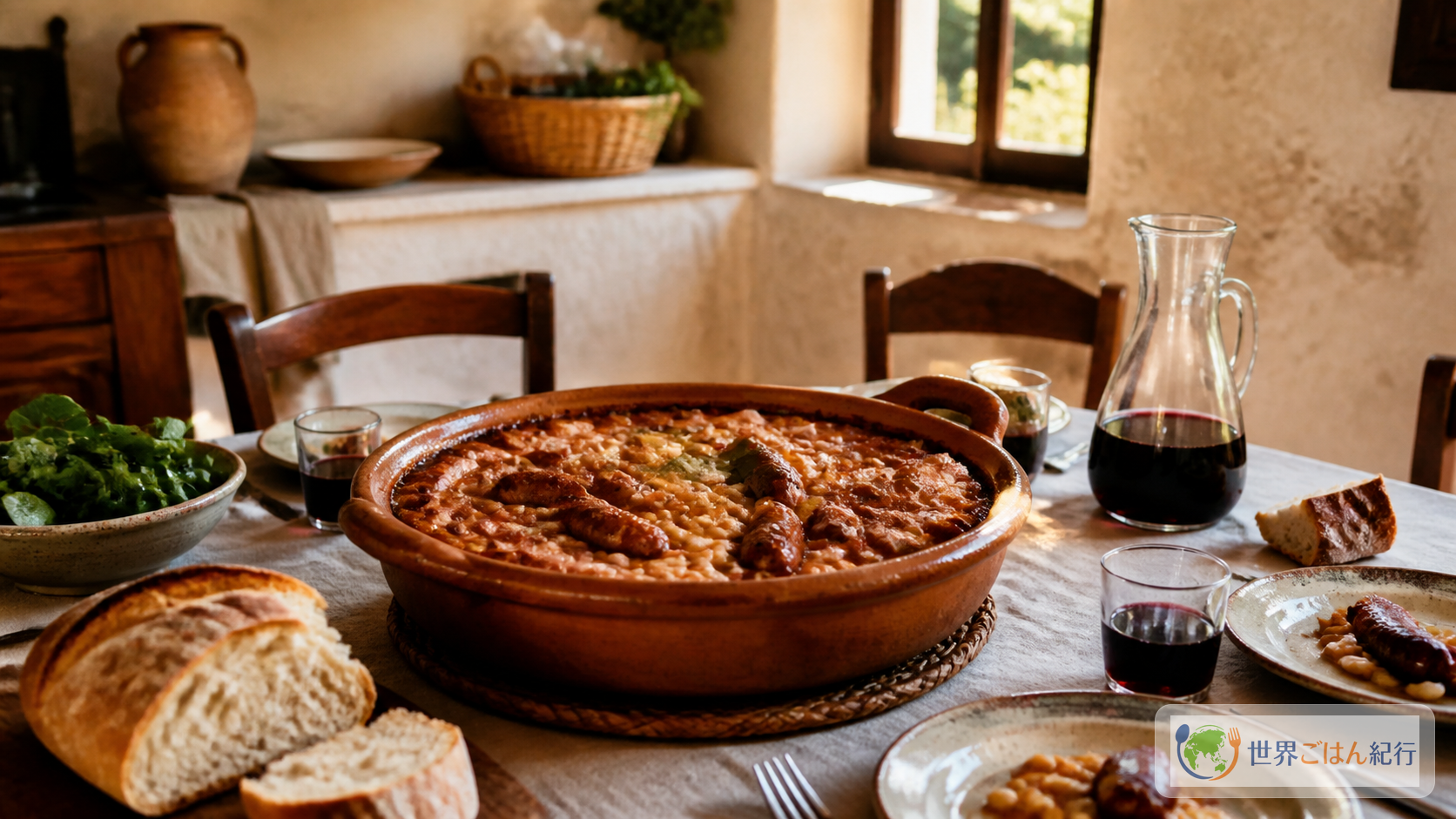
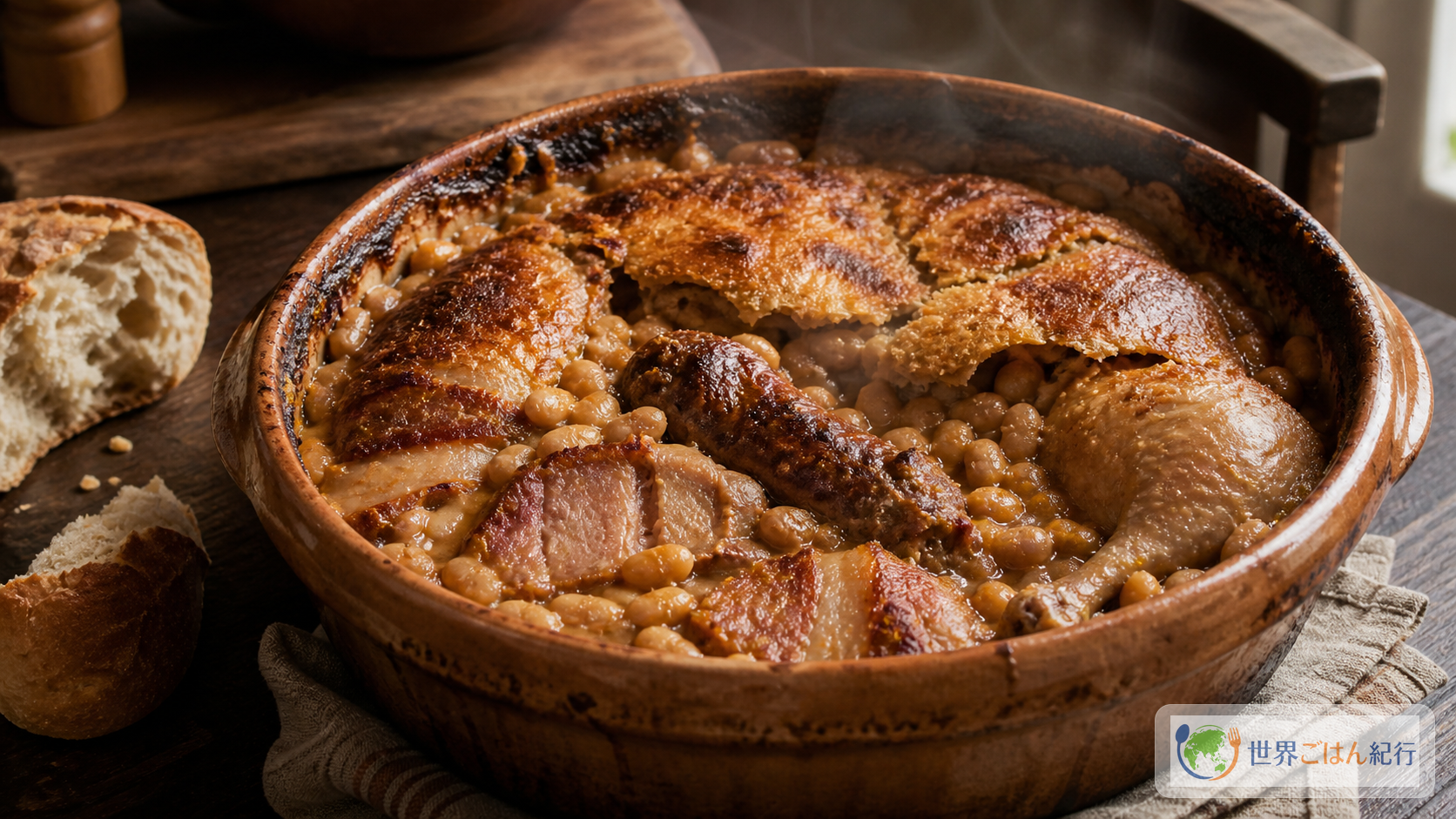
A terracotta cassole of cassoulet on a Languedoc table, surrounded by country bread and dishes
Cassoulet brings beans, preserved meat, sausage and local earthenware to one table

The vessel for this dish is the cassole, an earthenware pot made around Castelnaudary. It has a wide base that narrows slightly toward the rim, which holds the liquid while letting the top brown. Carcassonne tourism materials describe the cassole's terracotta as a vessel that spreads heat evenly. You don't need to hunt down the same pot: a heavy-bottomed, ovenproof pot in which the beans fit in about two layers gets you close to the same heat.

In Castelnaudary, the best-known version centers on white beans, pork and sausage. The local tourist office presents the town as the world destination for cassoulet, and its annual festival gathers producers, cooks, potters and winemakers. A pot of preserved foods eaten together grew from a home lunch into a dish that links the town's industries and its festival.

The white beans have a terroir too. Materials from around Carcassonne introduce the bean called lingot, grown in the Lauragais, as a cassoulet ingredient. Some recipes use Tarbais beans from Tarbes, and simply changing the bean variety and origin changes the thickness of the liquid, how the skins hold up and the texture in the mouth. Using a smaller white bean such as great northern or navy beans isn't just a cheap shortcut; it's a substitution that keeps the role of the bean: a dried white bean that is rehydrated and cooked without splitting its skin.

Three towns, three sets of ingredients

Place What stands out in the dish How to read the flavor at home
Castelnaudary Pork, sausage and white beans, baked in a cassole Center it on the sweetness of the beans and pork fat; don't overload with meat
Toulouse Often described with Toulouse sausage and preserved duck Layer the meatiness of the sausage with the aroma of duck fat
Carcassonne Pork and duck, and in traditional versions sometimes partridge Don't chase game birds; use bone-in meat to give the liquid body

These differences aren't a contest over the right answer. They show that the name cassoulet holds local beans, sausage made nearby, meat that keeps, and the region's earthenware all at once. In a home kitchen, preserved duck makes the aroma deeper, while chicken thighs make the meat flavor lighter. Which you choose changes how heavy the same pot of beans feels at the table.

If you want to compare dishes that simmer beans and preserved meats in one pot, look at garbure (in Japanese), the thick cabbage and root vegetable soup of southwest France, and fabada (in Japanese), the northern Spanish dish built on chorizo and white beans. Cassoulet isn't simply halfway between them; its center of gravity is baking the top while keeping the bean liquid underneath.

Ingredients, and the flavor anchors to protect
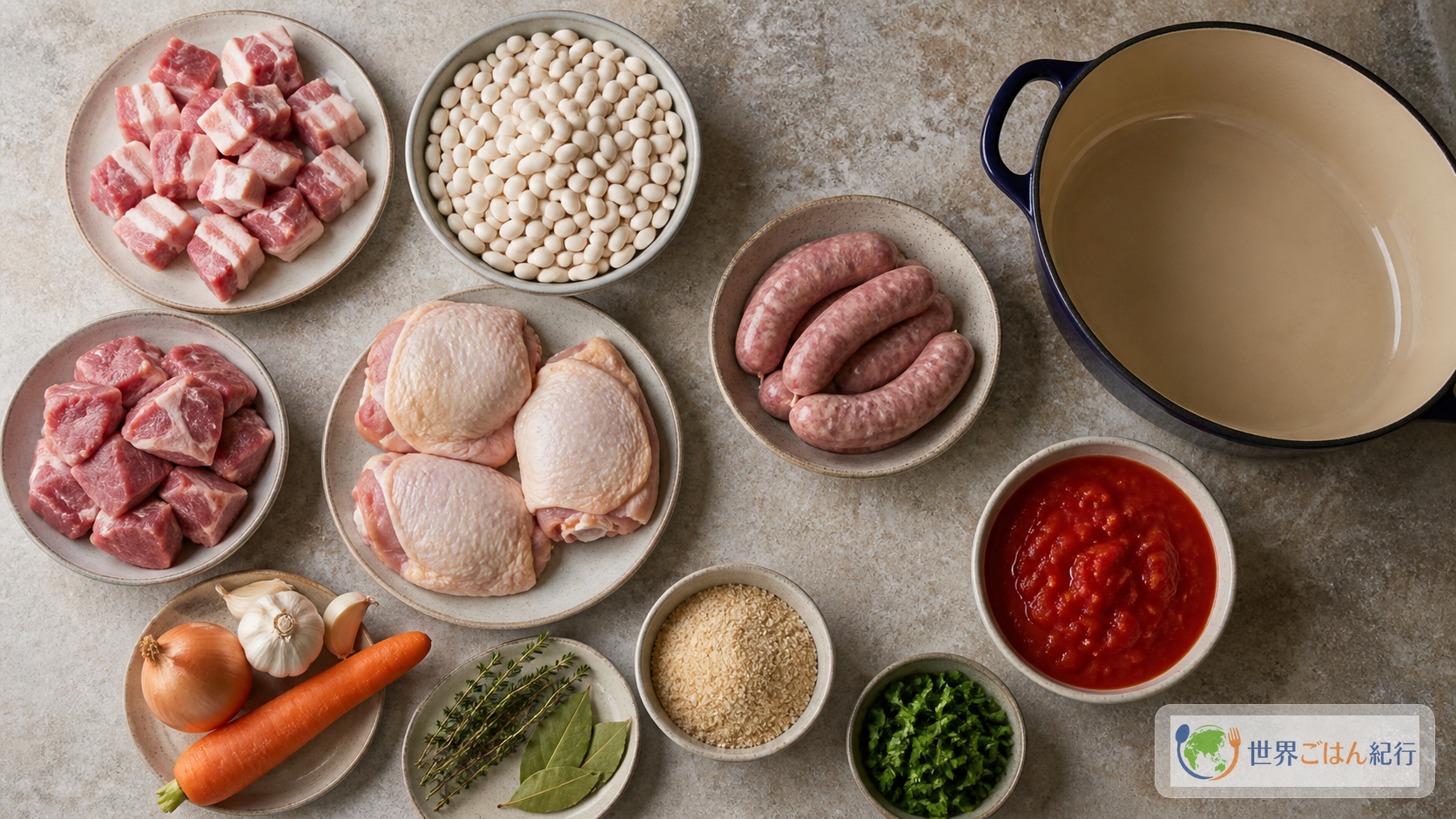
Ingredients for cassoulet: dried white beans, pork, sausage, chicken thighs, aromatics, herbs and a heavy pot on the counter
Weigh the beans and meat separately, and set aside what gets browned and what gets simmered

This serves 4. It's a main course, so bread and a simple green salad on the side are plenty. Using dried beans means 8–12 hours of soaking plus time to parboil. For a weekend cook, soaking the beans Friday night and cooking on Saturday morning makes an easy rhythm.

Ingredients (serves 4)

Ingredient Amount Role & substitutes
Dried white beans (small white beans such as great northern or navy) 300 g Stands in for lingot or Tarbais beans. Cannellini also work. About 10.5 oz
Pork belly (one piece) 250 g Skinless is fine. Cut into 3 cm (1¼ in) cubes
Pork shoulder (one piece) 200 g The leaner cut. Cut into 3 cm cubes
Bone-in chicken legs 2 (about 500 g) A home version without preserved duck. Cut each in two at the joint
Coarse fresh pork sausage 300 g Cut into 6–8 cm pieces. Use raw, uncooked sausage
Onion 1 (200 g) 1 cm dice. The base of sweetness
Carrot 1 (150 g) 1 cm dice. Adds sweetness to the liquid
Garlic 4 cloves (20 g) Crushed. Don't let it burn
Diced tomatoes 200 g Some regional and family versions leave it out. Keep the amount modest so it isn't too acidic
Bay leaves 2 Dried is fine
Thyme 3 sprigs You can add 2 parsley stems
Unsalted chicken or pork stock 700 ml Used together with the reserved bean cooking liquid; add just enough to barely cover the top. About 3 cups
Breadcrumbs 30 g For browning the top. Use rice-flour breadcrumbs if avoiding wheat
Flat-leaf parsley 10 g Finely chopped. Mixed with the breadcrumbs
Olive oil or unsalted lard 1 tbsp For browning the meat. You can also use fat rendered from the pork belly
Salt About 7 g total Adjust at the end, after tasting for the salt in the sausage and stock
Black pepper 1/2 tsp Coarsely ground

Weigh the beans dry: 300 g. They grow heavier overnight as they absorb water, so don't re-weigh them after soaking. Sausages vary in saltiness, so season only the pork with 2 g of salt at first, and add the rest after tasting the liquid.

If you can get traditional preserved duck (confit), use 2 legs in place of the bone-in chicken. Since it's already cooked, don't simmer it from the start; tuck it between the beans just before the final bake. If the duck is very fatty, skip the oil in the pot and bake it skin-side up so only the top crisps. The chicken version is milder in aroma, but the pork belly and sausage still give fat and salt to the liquid, so it keeps its weight as a bean dish.

Dried beans or canned

If you can't find small white beans nearby, or you want the same bean size every time, it's worth keeping a stock of dried beans from a well-stocked grocer or online. Canned beans are ready to use, but you can't return their cooking liquid to the pot during baking, and their skins break more easily. With dried beans, you save the parboiling liquid and add it back a little at a time when the oven reduces the pot.

This recipe uses 300 g for 4 servings, so seal the rest and keep it in a cool, dark place for your next bean dish.

Look at the base of the pot, not just its volume

If the beans and meat are stacked too high, only the top dries out while liquid stays at the bottom. For 4 servings, an ovenproof heavy pot about 22 cm (8½ in) across inside is easy to work with. If you already have a Dutch oven or earthenware pot of that kind, there's no need to buy another. Consider a cast-iron pot only if all you have is a thin pot that heats too fast at the bottom.

When choosing a pot, check its oven-safe temperature, the lid material, the inside diameter and its weight. A heavy pot holds heat well, but it's hard work to lift in and out and to wash, so make sure you can lift it safely from the shelf.

Method: keep the beans whole and grow the crust

Before the pot goes into the oven, check that its handles and lid can take high heat. Even cast-iron pots sometimes have plastic knobs; check the manufacturer's heat limit first. Save about 500 ml of the bean cooking liquid so you can add it to dry spots during the final bake.
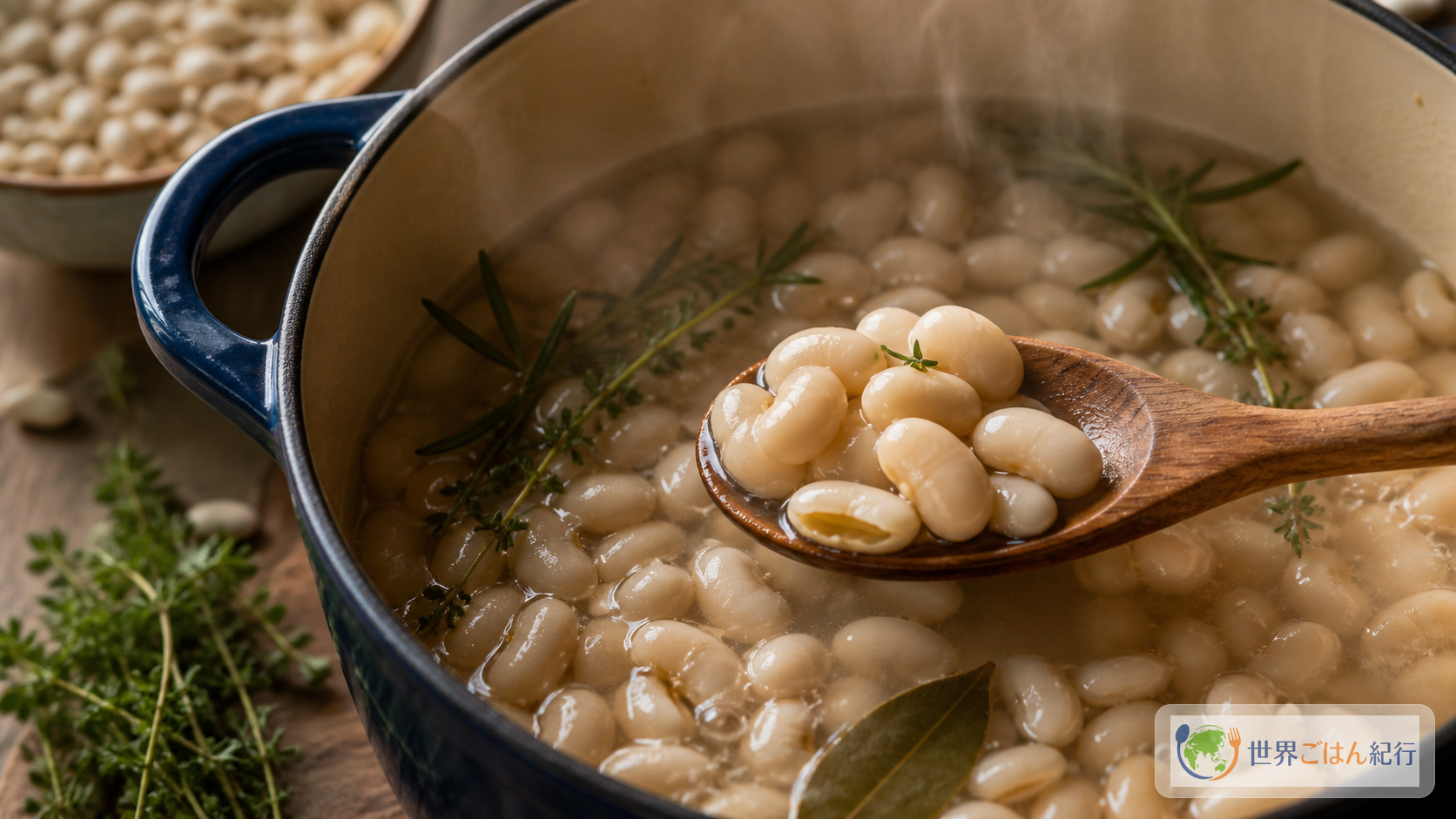
  1. Soak the beans, then parboil until the center is just a little firm

    Soak 8–12 hr, parboil 60–75 min

    Rinse 300 g dried beans twice, then soak in 3 times their volume of water (about 900 ml / scant 4 cups). In warm weather, soak them in the refrigerator; after 8 hours, split one bean and look at the center. Once the beans have swelled and the wrinkles in the skins have smoothed out, drain and move them to a pot. Add fresh water to 4 cm (1½ in) above the beans, bring to a boil, skim the foam and turn the heat to low.

    After 60 minutes, taste a bean. Stop when the outside is soft and the very center keeps the faintest bite. If you cook them until they turn powdery when pressed with a finger, they'll break apart during baking. Don't throw out the cooking liquid: without adding salt, set aside at least 500 ml.

    Soaked white beans simmering gently in a pot, checked so the skins don't burst
    Stop parboiling while the centers still give slight resistance, and save the liquid
  2. Brown the meat, then the aromatics

    25 min, medium to medium-high heat on the stove

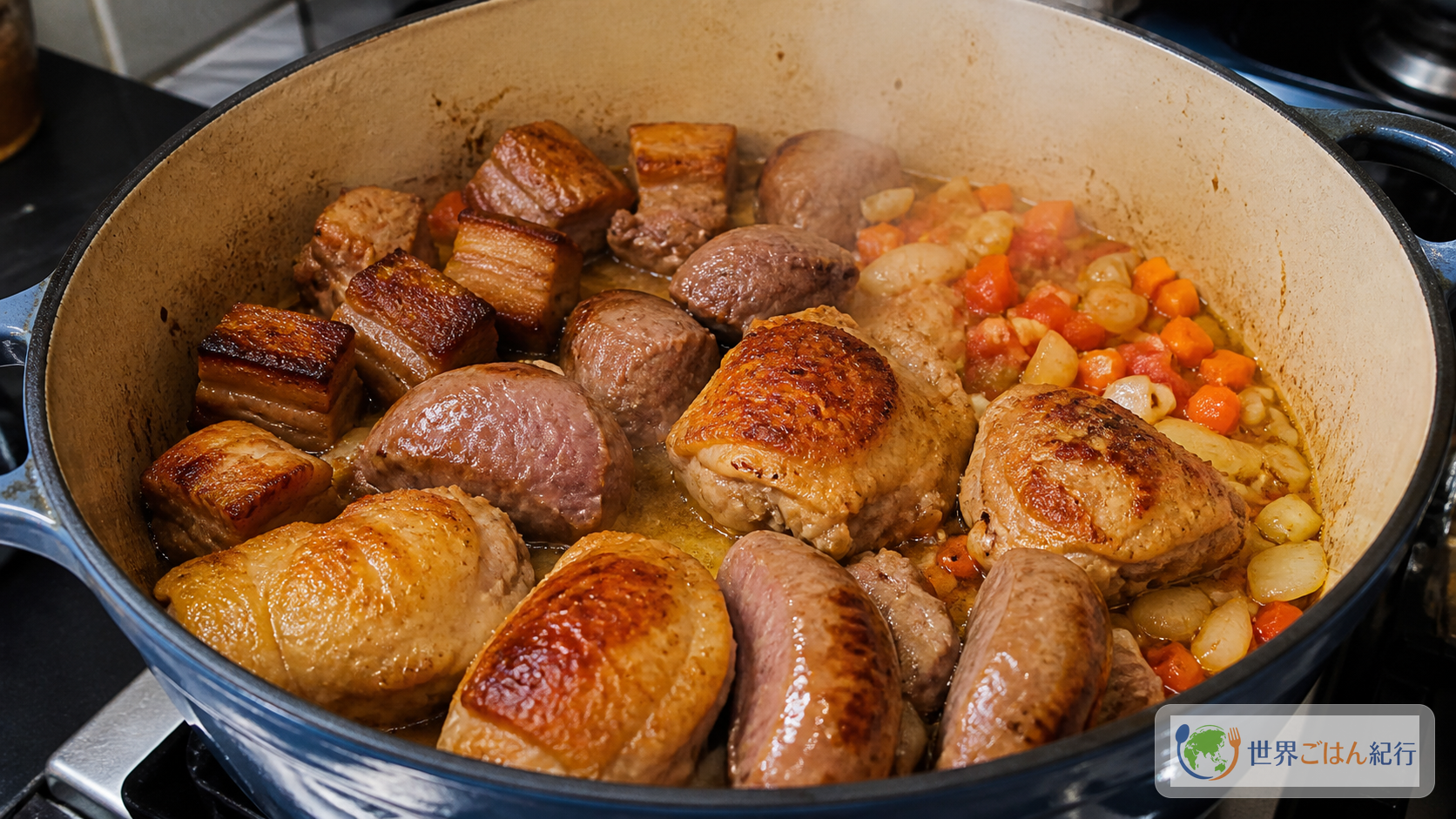
    Pat the pork belly and shoulder dry with paper towels and season with 2 g salt and the black pepper. Heat the oil in the pot over medium-high heat and brown the pork without crowding, 2–3 minutes per side, until the surfaces are brown. Remove, then brown the chicken skin-side down for 4 minutes and the other side for 2 minutes. This step doesn't cook the meat through, so don't taste raw meat, and use a separate plate and tongs for the browned pieces.

    In the same pot, brown the sausage on the outside for 2–3 minutes, then add the onion and carrot. Cook for 5 minutes until the onion is translucent, add the garlic and stir for just 30 seconds until fragrant. Pour in the diced tomatoes, scrape up the browned bits with a wooden spoon and simmer for 2 minutes. Forcing dark reddish-black burnt bits into the sauce makes it bitter, so remove any hard burnt pieces.

    The cues: the meat releases from the bottom of the pot on its own, and the aromatics lose their moisture and move as one mass under the wooden spoon. When a thin film of clear fat remains in the pot and the tomatoes have blended in without separating into thin liquid, move on to layering.

    Browning pork, chicken thighs and sausage in a heavy pot, then adding aromatics and tomatoes
    Brown the meat, then cook the aromatics and dissolve the browned bits with tomato
  3. Layer the beans and meat and bake low

    90 min at 160°C, 60 min at 140°C

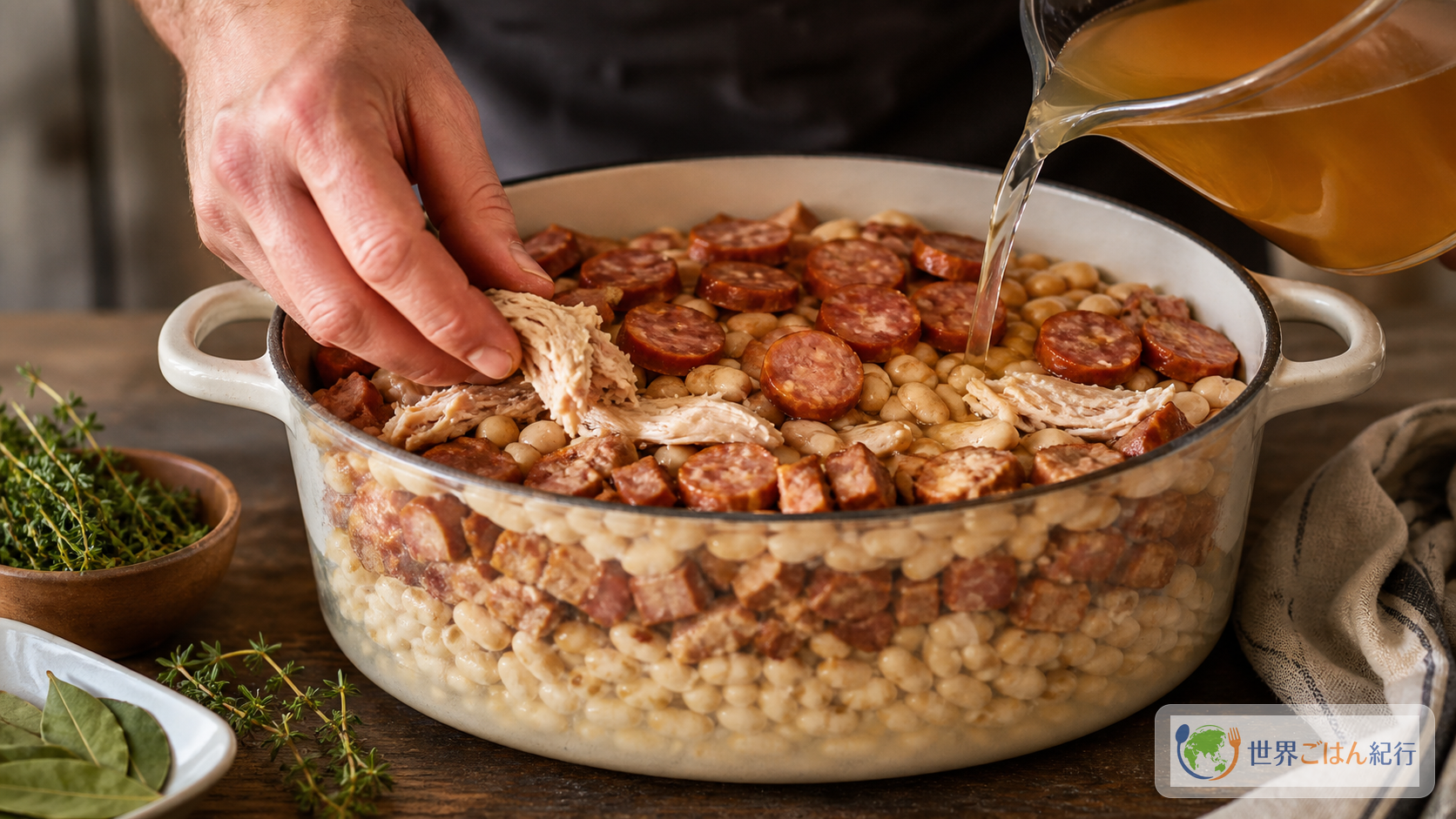
    Preheat the oven to 160°C (320°F). Spread half the parboiled beans in the bottom of the pot, arrange the pork, chicken and sausage on top, and cover with the remaining beans. Add the onion and carrot with their juices, the bay leaves and thyme, then pour in stock combined with the bean cooking liquid until the beans are just barely covered. Too much liquid and the crust won't form, so aim for no more than 5 mm (¼ in) above the beans.

    Bake uncovered at 160°C for 90 minutes. At 40 minutes, turn the pot once to switch sides. If the top is dry and only the edges are bubbling, add 50 ml of the reserved bean liquid. After 90 minutes, taste a bean; if the center is still hard, lower the oven to 140°C (285°F) and continue for 60 minutes. Move on when the bean skins have lost their shine and the meat has reached 75°C (167°F) at the center for at least 1 minute.

    Beans, meat and sausage layered in the pot, with liquid poured just to the surface of the beans
    Alternate beans and meat, and don't drown the top in liquid
  4. Brown the top, rest, then serve

    20–25 min at 220°C, rest 15 min

    Take the pot out of the oven and remove the bay leaves and thyme. If the top looks wet, scatter the breadcrumbs mixed with chopped parsley thinly over it. Return the pot to the oven, now at 220°C (425°F), and bake 20–25 minutes, until the top is golden brown and the liquid at the edges is bubbling.

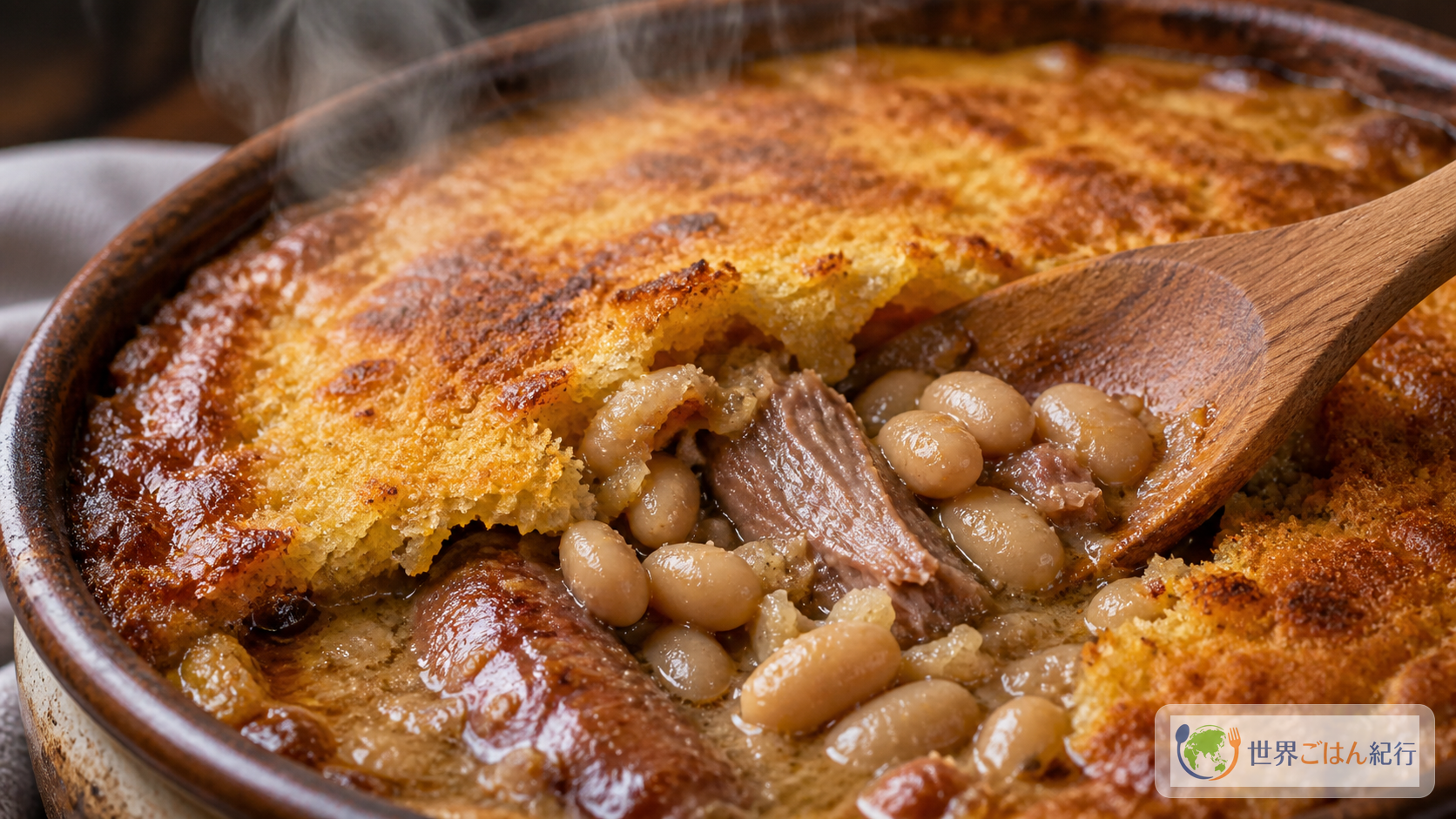
    If partway through only the top dries out and cracks, and the beans look powdery, break the cracked area once with the back of a spoon and pour in 50–100 ml of bean cooking liquid. Break the crust once, only when it has dried, and return liquid — that's the guide. Stirring again and again breaks the beans and makes the liquid heavy. A pale golden top and small bubbles running in from the edges mean it's done.

    A finished crust cracks thinly when you tap it lightly with the back of a spoon, and the beans underneath stay whole, coated in liquid. If the liquid at the edges doesn't run like water but clings thinly to the beans, it hasn't dried out too much.

    Don't stir the cassoulet straight out of the oven; let it rest for 15 minutes. Lift out the chicken, check that it's cooked through all the way to the bone, and cut it into easy pieces. Scoop beans, liquid and meat from the bottom and serve, leaving a little of the crust on each portion.

    Breaking the crust of a finished cassoulet once with a spoon to show the bean liquid and meat
    Rest it with a pale golden top, bubbling edges and liquid still under the crust

When the beans are hard, the liquid too thin, or the top burns

Cassoulet is easier to rescue by fixing moisture and heat before adding more flavor. Before you stir the pot hard, check a bean, the top and the liquid at the bottom separately.

The bean centers are hard

If the beans were already hard after parboiling, don't try to make up for it by raising the oven temperature. Add 150 ml of hot bean cooking liquid, cover, and extend at 140°C in 30-minute increments. Brown the top only after the centers are soft. Old beans don't rehydrate well even after soaking and may need 90 minutes or more of parboiling.

Only the bottom has burned

Take the pot out of the oven and, without stirring the burnt bottom, move just the beans and meat above it to another pot. If the burnt smell hasn't carried over, add 100 ml of warmed bean liquid and return to a 140°C oven for 20 minutes. Scraping the burnt layer off with a wooden spoon and mixing it in spreads the bitterness, so discard the bottom.

Too much liquid, and no crust forms

If the beans haven't broken down, bake uncovered at 160°C for another 20–30 minutes. Rather than covering the top with a thick layer of breadcrumbs, reduce the liquid a little first and then scatter them thinly; more of the bean aroma survives. Even if there's time before you eat, don't cook off all the moisture; leave a little liquid at the edges.

Only the top turned black

Thinly remove the black parts and pour 50 ml of hot bean liquid in from the edge of the pot. Next time, cut 10 minutes from the 220°C stage and move the pot from the lower rack to the middle. The bitterness of black char can't be taken out of the meat and beans, so don't judge doneness by how dark the crust is.

At the table, scoop the hot beans with bread

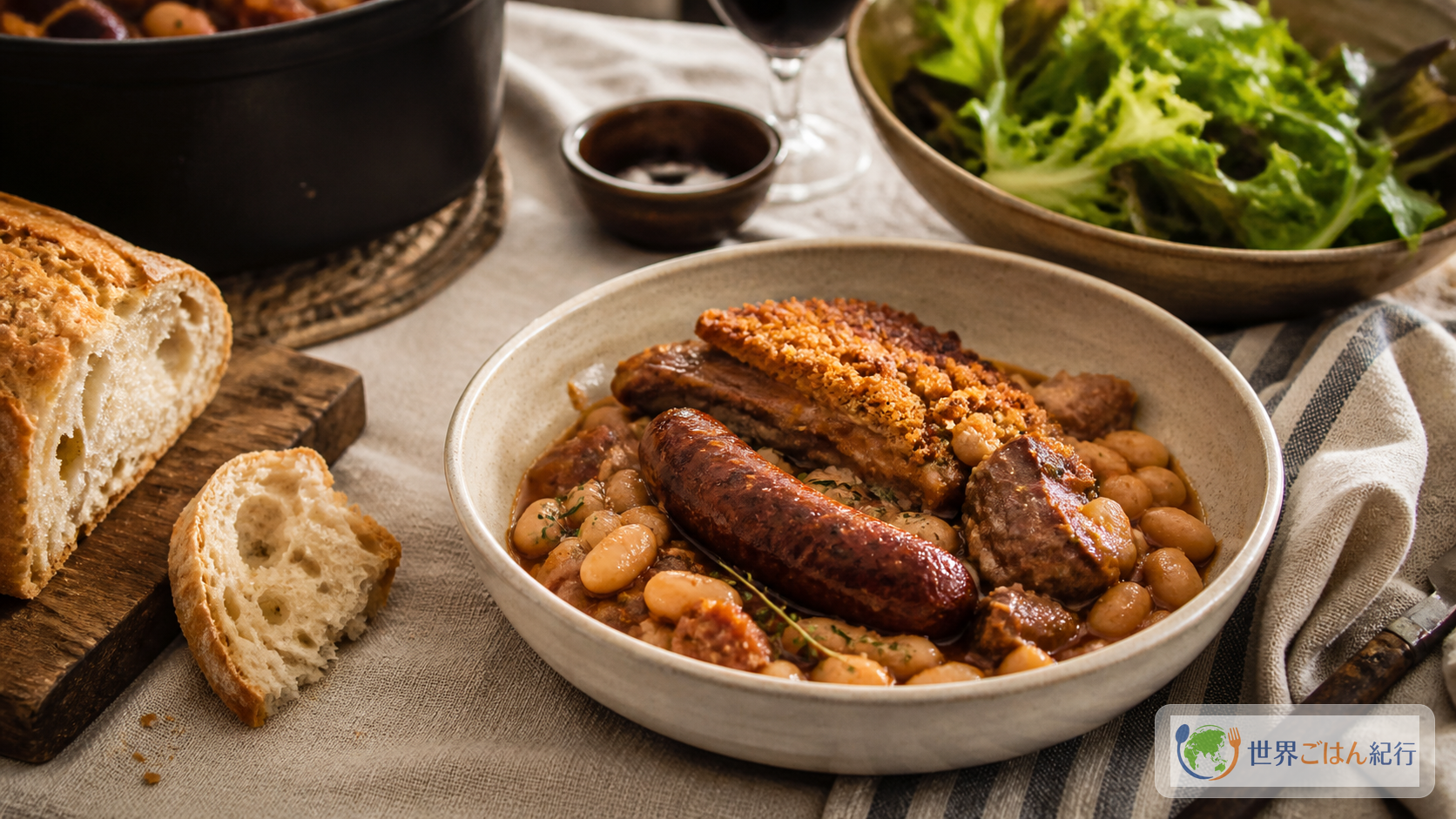
Freshly baked cassoulet in a wide dish, with country bread and greens on a southwest French table
Serve beans and meat on one plate and catch the liquid with bread

Right after resting, the gap in temperature between the crust and the liquid at the bottom is small, and the sweetness of the beans comes through clearly. Lightly toast country bread or a baguette and use it to scoop up the liquid. Instead of mixing bread into the pot from the start, set it beside the plate so you can enjoy the crust and the soft beans separately.

Occitanie tourism materials describe a table that pairs cassoulet with Languedoc red wine and country bread. A small side of tangy greens or unsweetened pickles keeps the pork fat and rich beans from becoming too much. Rather than adding more spice, putting something sour on a separate plate to reset your palate between bites makes the meal less tiring to eat.

Cassoulet tastes more settled the next day. Once it has cooled slightly, divide it into shallow containers and refrigerate; at home, aim to eat it within 2 days. Don't leave it at room temperature for long, and reheat only what you'll eat, in a pot or heatproof dish, until hot all the way through. Japan's Ministry of Health, Labour and Welfare advises dividing make-ahead food into shallow containers to cool it quickly and reheating it thoroughly to the center. To freeze, freeze single portions before the crust stage, then after thawing add a little liquid and bake the top.

Allergy and food-safety notes

This dish contains white beans, so anyone with a bean or legume allergy should not eat it. Sausage, breadcrumbs and stock may contain wheat, dairy and ingredients other than pork. Check the labels, and even when making the chicken version, don't share cooking tools or serving tongs.

Frequently asked questions

Can I use canned white beans?

Yes. In place of 300 g dried beans, use 700–800 g drained canned beans. Skip the parboiling step and use unsalted stock instead of bean cooking liquid. Since the beans are already soft, shorten the 160°C bake to 60 minutes and check only the surface without stirring the beans. If the liquid isn't thick enough, mash just 3 tbsp of beans and stir them back in.

Does skipping the duck take it away from the real thing?

Even in Castelnaudary, Toulouse and Carcassonne, the combination of meats isn't fixed. Preserved duck adds fat and a cured aroma, but in this recipe the bone-in chicken thighs do the job of giving meaty stock to the beans. Make it with chicken first, then with duck, and the difference in aroma is easy to compare.

Can I bake it in an earthenware pot or a regular pot?

An oven-safe earthenware pot works. Vessels that don't handle sudden temperature changes should go into the oven cold and heat up with it, following the manufacturer's instructions. Don't put a stovetop-only pot in the oven; simmer the beans and meat in it, then move everything to a baking dish to brown just the top. If you simmer for a long time in a thin-bottomed pot, keep the heat low and add bean liquid before the bottom dries out.

Should the crust be broken many times?

Breaking the crust repeatedly and pushing the liquid back up is often described as part of cassoulet. For a one-day home version, though, breaking it once when the top dries out is enough. The more you stir the beans, the more the crust falls apart and the beans at the bottom get crushed. Decide by looking at the pale golden color, the bubbling edges and the shape of the beans together.

What should I watch for when reheating leftovers?

Take only what you'll eat into a shallow container and heat until hot to the center. If it has lost moisture, add unsalted stock or bean liquid 2 tbsp at a time, and cover before the top burns. To re-brown the top the next day, uncover only for the last 10–15 minutes. Don't cool and reheat it repeatedly; finish the portion you've taken in one sitting.

From the night you soak the beans to the smell of pork rising from the pot and the sound of the crust breaking, cassoulet is a dish where you eat the time it took. Once you know how the meats differ from place to place, swapping duck for chicken or using a different white bean becomes not a compromise but a choice of roles. Soften the bean centers, keep the liquid, and dry only the top at the end. Hold to those three and you can bring the feel of a southwest French pot to your own table.

Sources