Kartoffelsalat: Potato Slices That Drink In Warm Broth
Keep the potato slices whole, let them soak up hot broth and vinegar, and round the sharpness with oil. This is not a cold salad bound with mayonnaise.
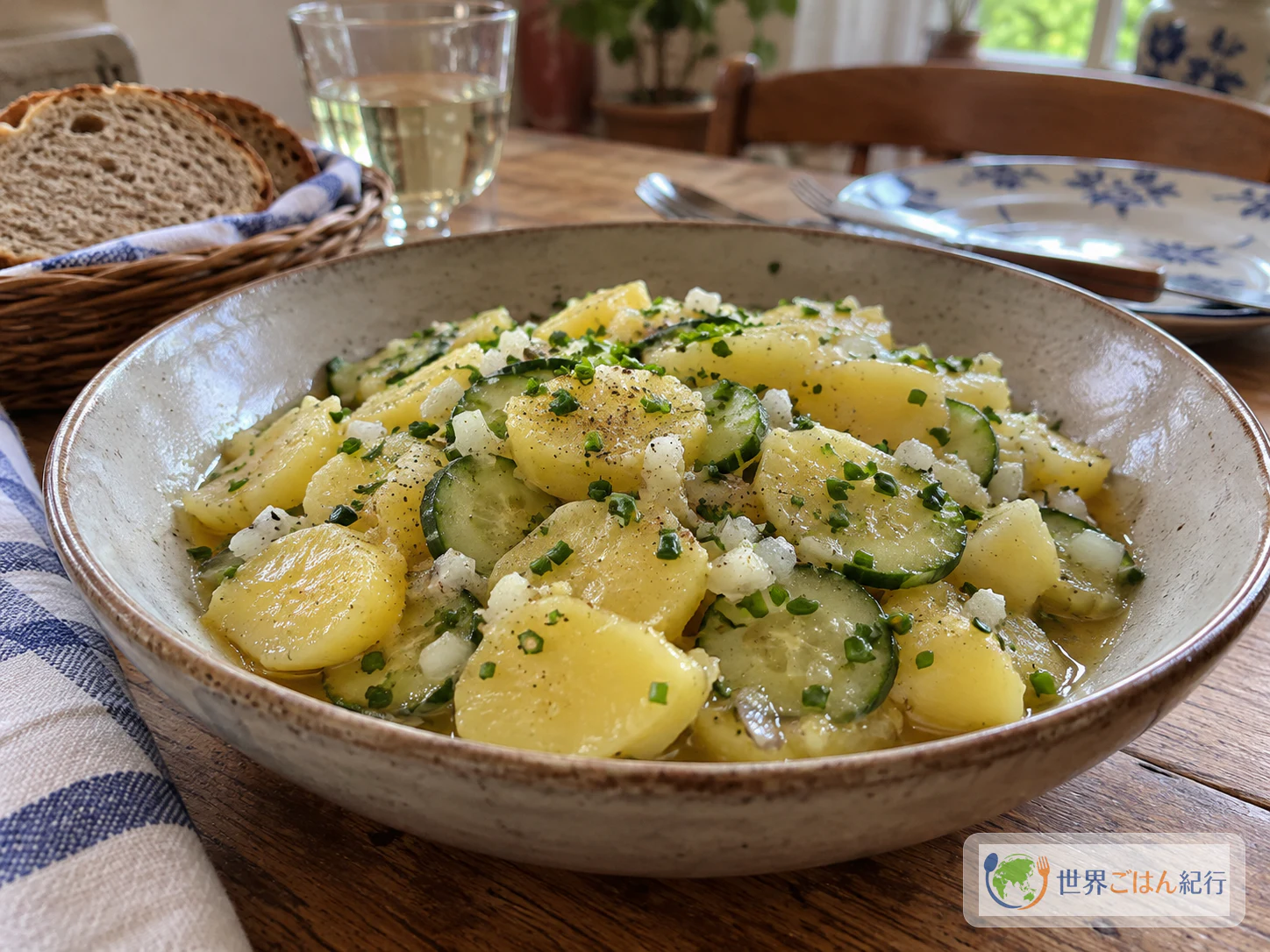
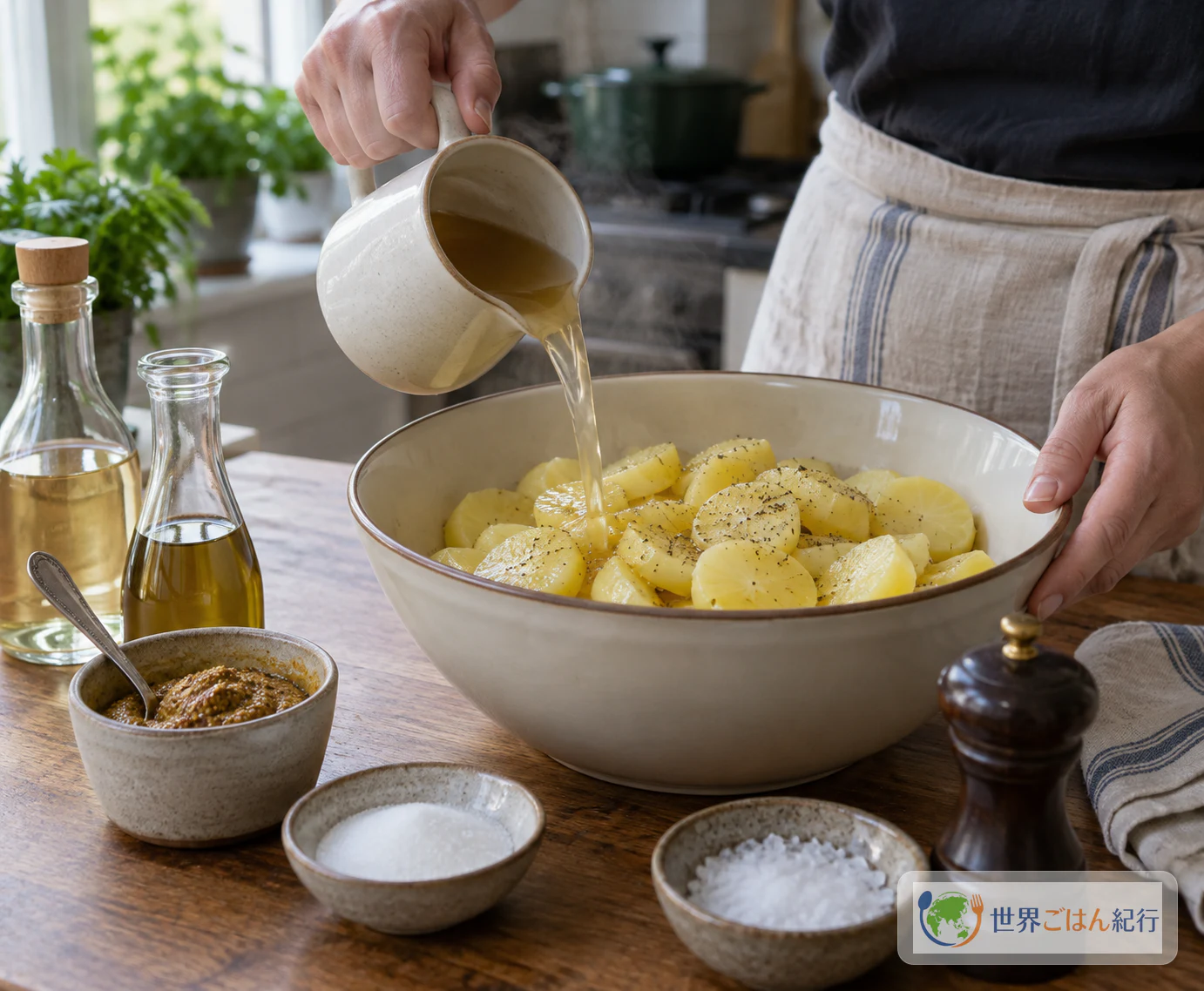
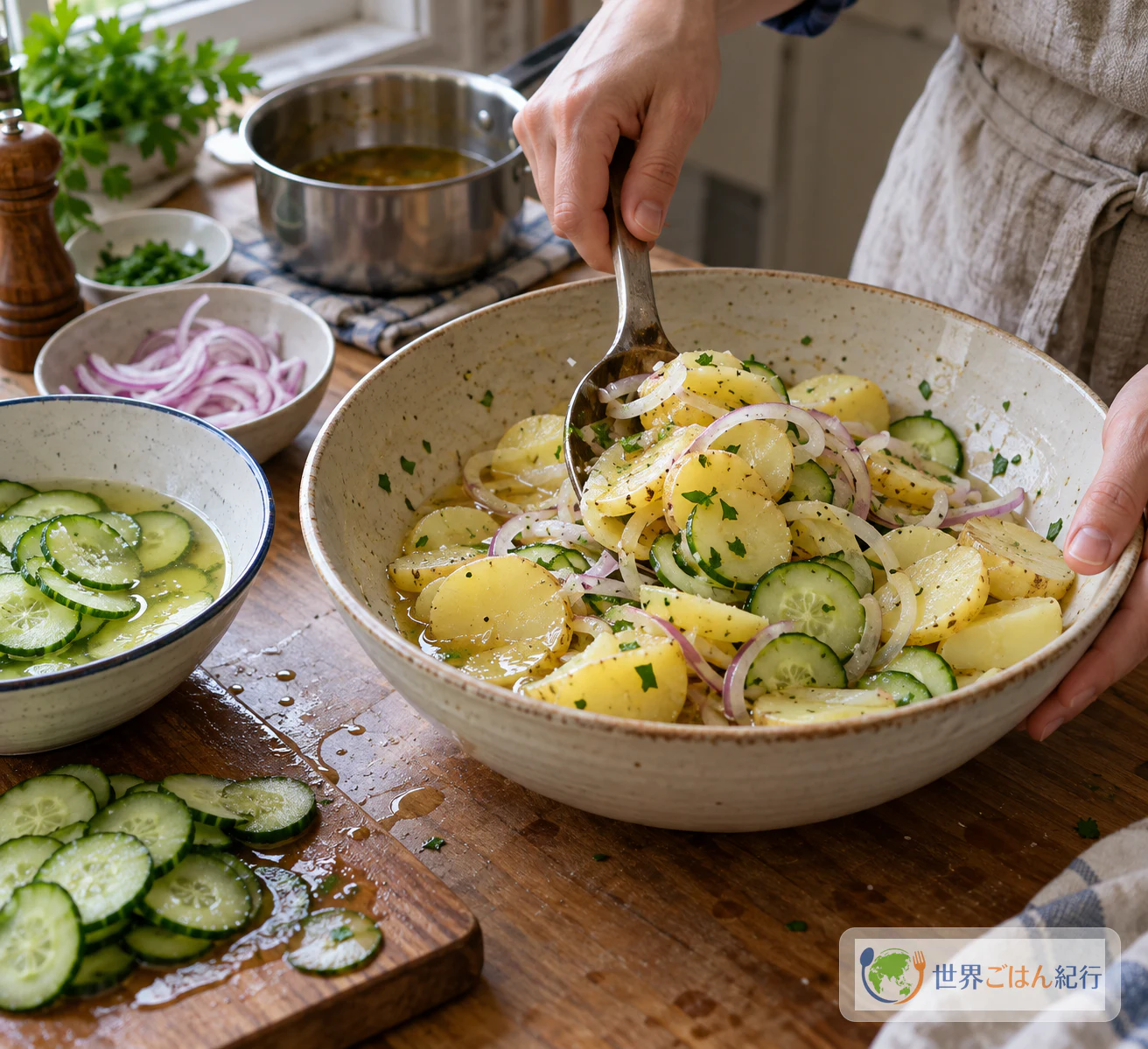
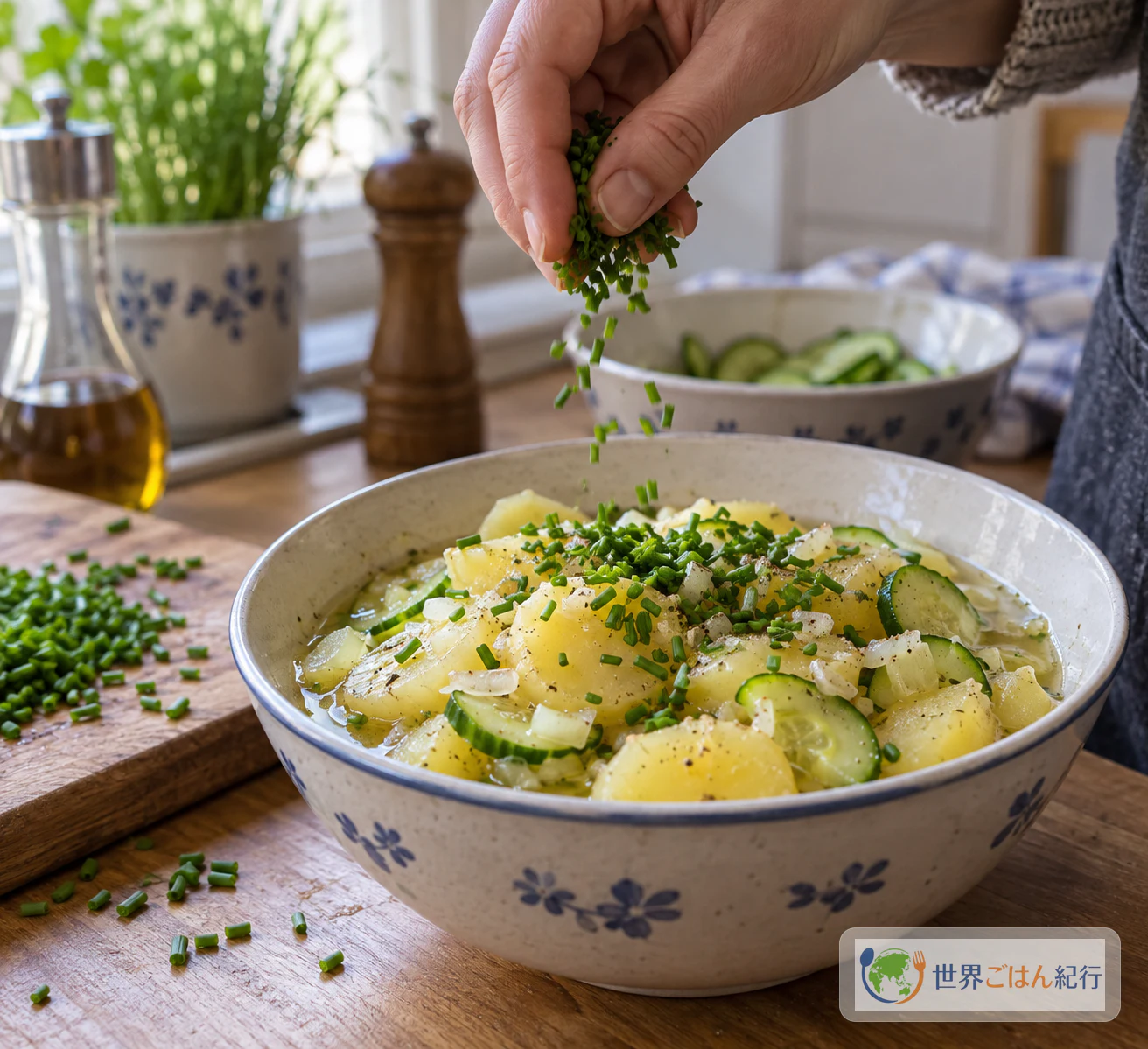
Hot broth is poured over a bowl of freshly sliced boiled potatoes, and the cut surfaces take in the liquid and begin to shine. Vinegar brings a clean sourness, a little oil softens it, and thin slices of cucumber and fresh chives go in at the end. This is the picture of Kartoffelsalat in its broth-dressed southern German form.
Many people outside Germany picture "German potato salad" as one fixed dish. In fact, the name Kartoffelsalat (Kartoffel, potato, plus Salat, salad) does not point to a single national recipe. A widely used shorthand contrasts the mayonnaise-dressed salads associated with the north with the broth, vinegar and oil salads of the south, and even within one region, families make it their own way.
This article follows one specific recipe: the Kartoffelsalat presented by Michaela Hager on Bavarian Broadcasting's Wir in Bayern, described there as a Bavarian or Swabian salad dressed with broth and made without mayonnaise. It is one cook's version, not the one true German recipe, and its ingredients and amounts are kept exactly as published.
Kartoffelsalat Is Not One Recipe: North and South, Region and Household
The same name covers more than one salad. The travel guide Germany Travel (turismoalemania.com) explains that there is no single national Kartoffelsalat. In broad strokes, the north is known for mayonnaise-based versions, while the south dresses its potatoes with broth, vinegar and oil. The same guide also stresses that recipes differ from family to family within a region, and that the south has its own words for the dish, such as Erdäpfelsalat, along with Härdöpfelsalat in Swabian and Swiss usage.
Treat the north–south split as a rough guide rather than a border line. The point that matters in your kitchen is the direction of the flavor: instead of the cold richness of an emulsified mayonnaise dressing, this style lets warm broth and vinegar soak into the potatoes, with oil adding roundness.
The recipe below keeps cucumber, chives, sugar and sharp mustard alongside the broth, vinegar and oil, because that is how Michaela Hager's version is built. Other southern recipes leave some of these out, as the variations section shows.
Ingredients (as published, for 2 kg of potatoes)
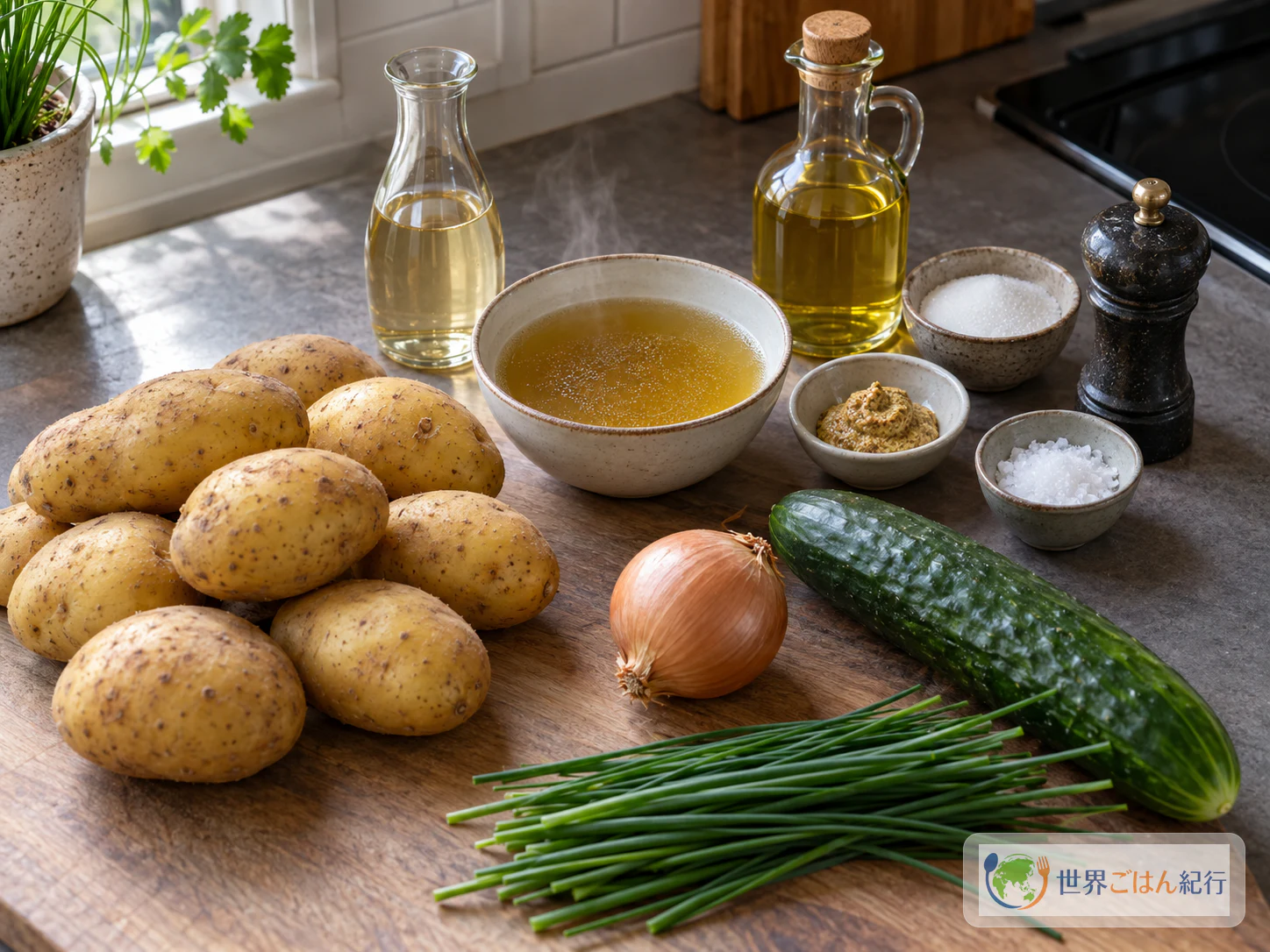
These amounts make one batch with 2 kg of potatoes. "EL" is the German abbreviation for a tablespoon. The volumes 1/8 l and 1/16 l are shown in milliliters as a straight conversion.
This salad contains mustard. Store-bought broths and bouillon vary by product and may contain wheat, soy, milk, celery or other allergens; check the label of the one you use. Tafelspitz broth and beef broth are meat-based; vegetable broth is another option.
Equipment
- A large pot for boiling the potatoes
- A knife and cutting board
- A large mixing bowl
- A small bowl for salting the cucumber
- A broad spoon or spatula for folding
- A clean cloth or heat-resistant gloves for handling hot potatoes
Choosing Broth, Vinegar, Potatoes and Herbs
Broth. The recipe calls for hot broth from Tafelspitz, the Austrian and Bavarian boiled beef dish. If you don't have it, Michaela Hager says vegetable or beef broth works in its place. Beef broth brings meatier depth; vegetable broth keeps the salad free of animal products. Many prepared broths are already salted, so taste yours before seasoning and start the salt at the low end of the range.
White wine vinegar. The recipe recommends white wine vinegar at 5% acidity and describes a 10% vinegar as too sharp. If you can't find white wine vinegar, another vinegar can stand in, but its acidity and aroma will not be the same. Check the acidity on the label, and do not swap a stronger vinegar in at the same amount.
Potatoes. A firmer, less floury potato is easier to keep in whole slices; very floury potatoes are more likely to break up when you mix in the dressing.
Oil. No type is specified. A neutral salad oil keeps the flavor close to the original; olive oil will noticeably change the aroma.
Mustard. Look for a prepared mustard labeled sharp or hot (scharf). Very differently flavored mustards will shift the balance of the dressing.
Chives. If fresh chives are hard to find, the green tops of scallions can stand in, though the aroma is different.
Method: Boil, Slice, Dress, Then Add Cucumber and Chives
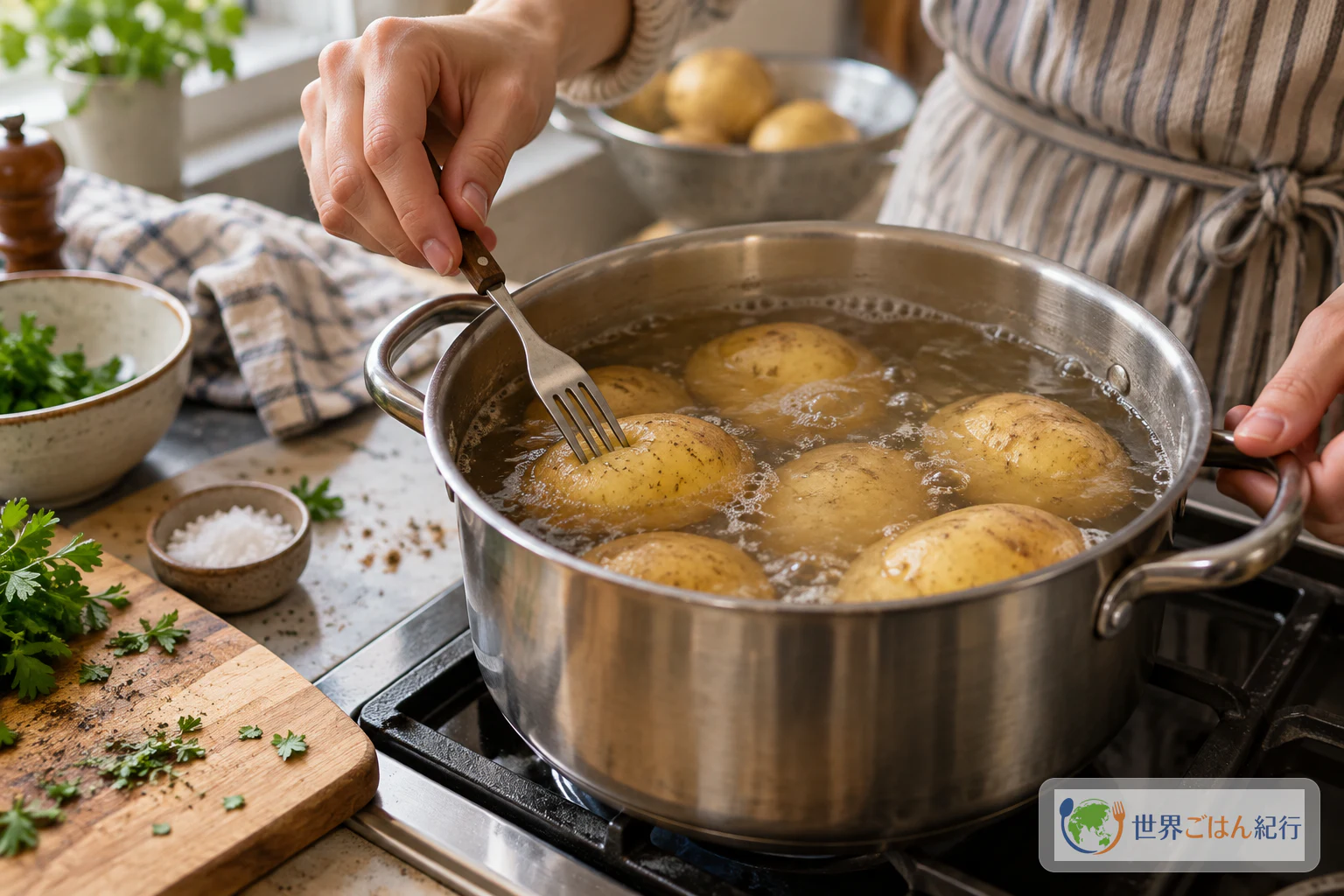
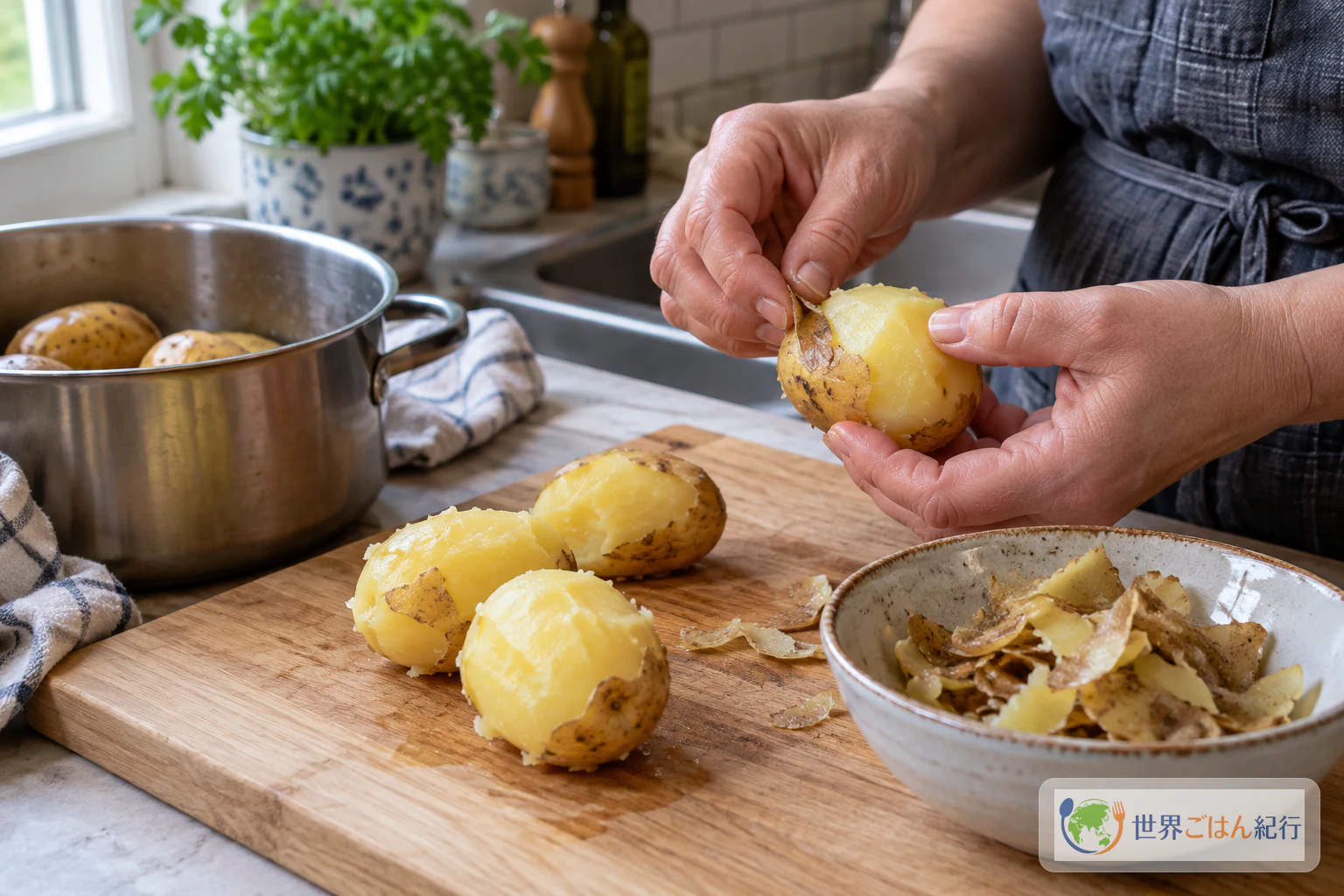
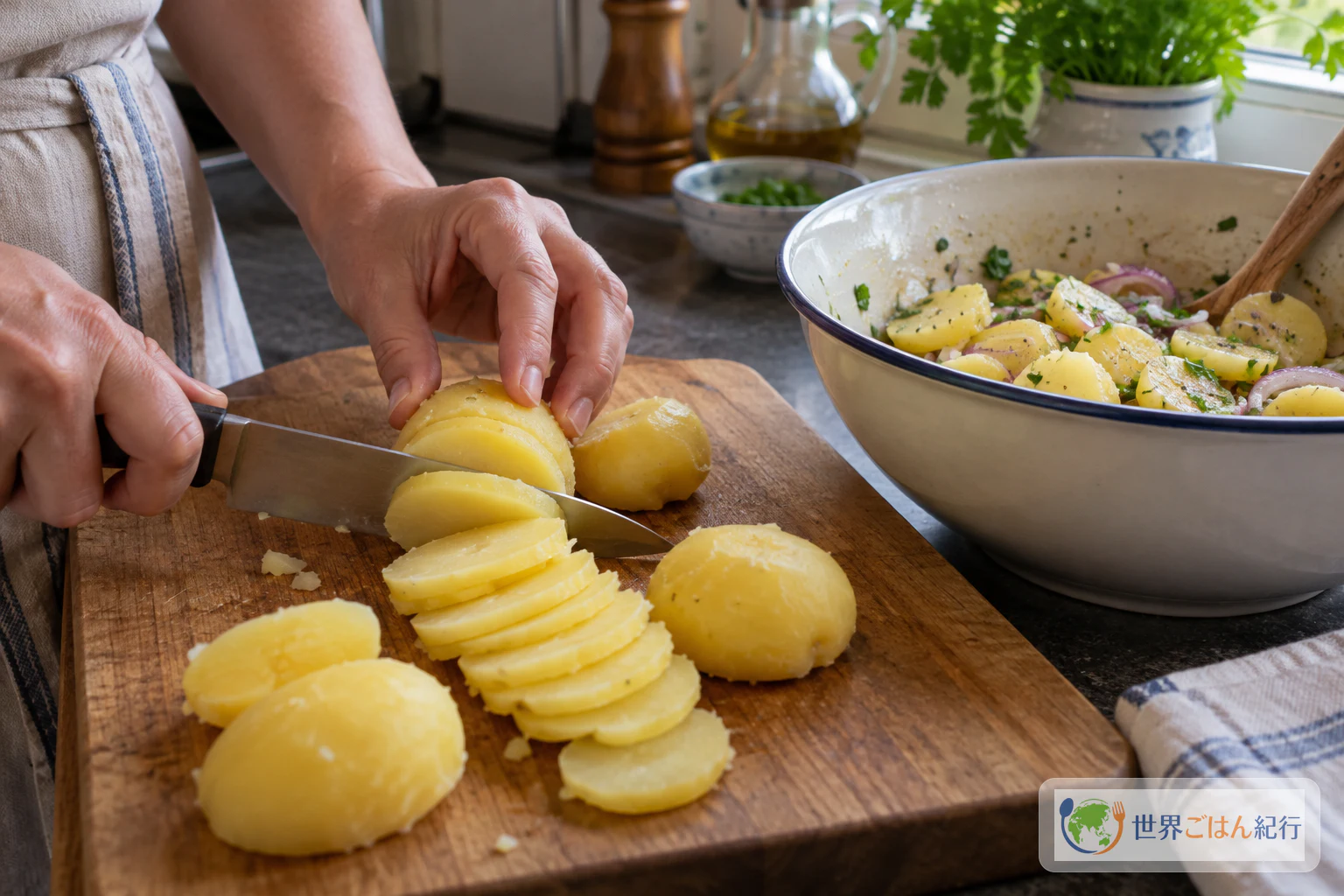
Judge by the state of the potatoes rather than the clock. Seasoning can be adjusted at the end within the listed ranges.
Fixing Common Problems
| Problem | Possible causes | What to do |
|---|---|---|
| Potatoes break apart | Floury potatoes, overcooking, uneven slices, mixing too hard | Fold from the bottom with a broad spoon instead of stirring. Next time, stop boiling while the potatoes still hold together, and consider a firmer potato |
| The salad is watery | Liquid from the broth and cucumber | Start at the lower end of the 400–500 ml broth range and add more only if the potatoes absorb it. The published range remains the reference |
| The sourness is too sharp | Vinegar stronger than 5% | Check the acidity on the label. The recipe recommends 5% and calls 10% too sharp; don't use a stronger vinegar at the same amount |
| Too salty | Salty broth on top of the full salt amount | Start the salt at the low end and remember that some of it goes to the cucumber. Taste the broth before you begin |
Food safety. The source gives no storage guidance, so no keeping time is given here. Even without mayonnaise, this salad contains cooked potatoes, cut raw vegetables and, if you use it, meat-based broth, so don't leave it standing at room temperature.
Variations: Related Salads Kept Separate
Each of these is a different recipe. Don't mix their amounts with the one above.
- Michaela Hager's version (this recipe). Broth, white wine vinegar and oil, with cucumber, chives, sugar and sharp mustard.
- Albstadt's Swabian version. Albstadt Tourismus presents a Swabian Kartoffelsalat dressed with vinegar and oil and describes the ideal texture as schlonzig, a moist, loose consistency. Its recipe uses 1 kg of salad potatoes, onion, 2 EL vinegar, 1 Tasse (cup) of hot broth, salt, pepper and 2–3 EL oil; the warm sliced potatoes are mixed gently and left to rest warm. That recipe also notes that the hot broth softens the onion's sharpness and helps dissolve and distribute the seasoning. Its "Tasse" has no stated volume, so it is not converted or combined with the recipe above.
- Northern mayonnaise style. A different style built on mayonnaise. It is mentioned here only for contrast and is not part of this recipe.
- Beef broth or vegetable broth. Both are options in the original recipe. Beef broth gives a meatier savoriness; vegetable broth keeps it free of animal products.
- Other vinegars. Possible when white wine vinegar is unavailable, but acidity and aroma differ. Check the label rather than swapping one for one.
At the Table: A Side for Sausages, Schnitzel and Roasts
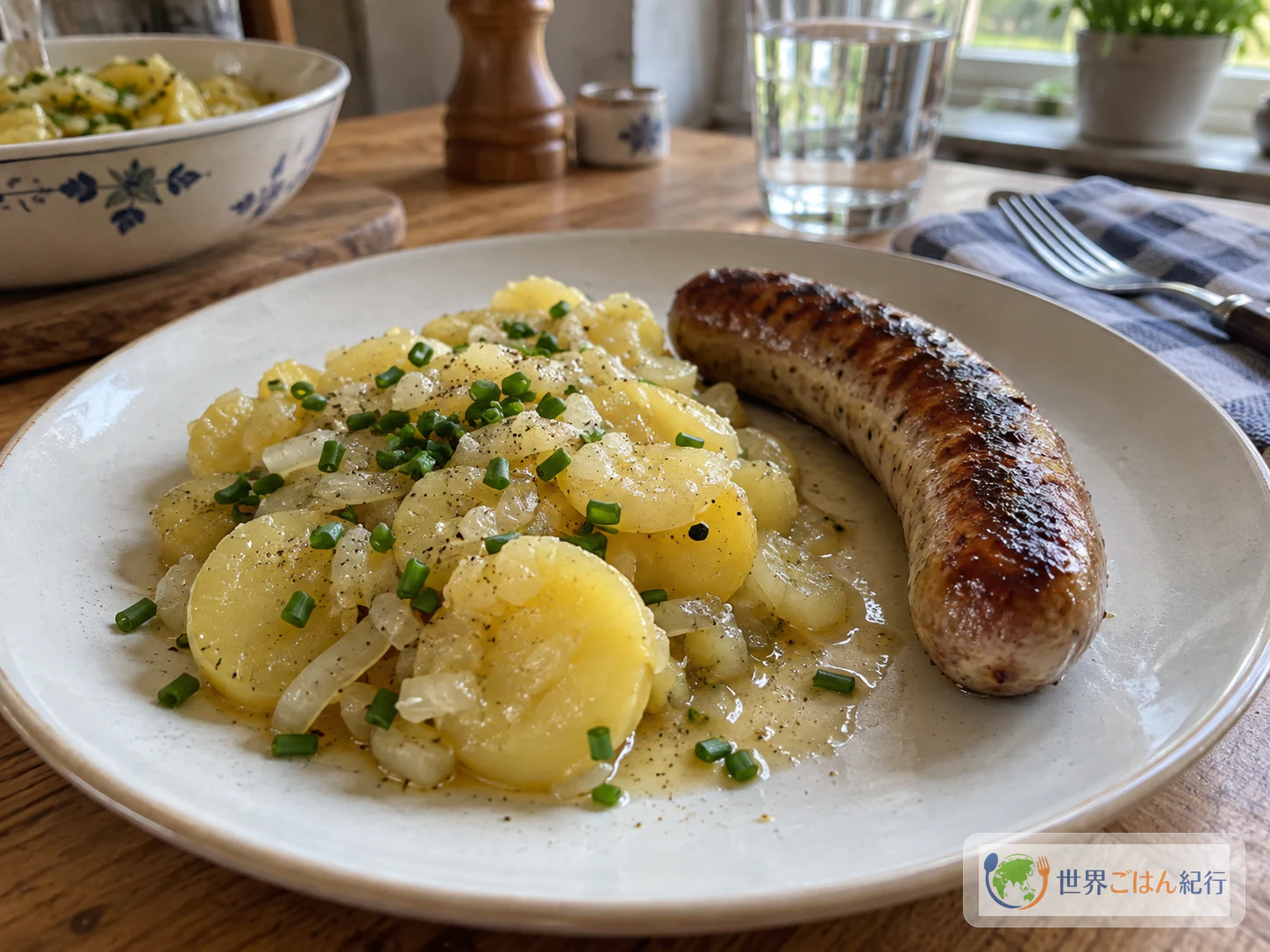
According to Germany Travel, Kartoffelsalat is commonly eaten alongside sausages, schnitzel and roasted meats. The same guide mentions that some families serve it with sausages on Christmas Eve, as a side that can be made ahead. That is one household custom among many, not something every German family does.
When you cook this away from Germany, the ingredients themselves are mostly ordinary supermarket items. What needs a little attention is the broth (its salt and allergens), the vinegar (its acidity) and the mustard (a sharp style). Get those three right and the character of the dish holds: potatoes soaked with warm, tangy broth rather than coated in a creamy dressing.
Frequently Asked Questions
Is Kartoffelsalat made the same way all over Germany?
No. There is no single national recipe. Mayonnaise styles are associated with the north and broth, vinegar and oil styles with the south, and recipes also vary between families in the same region.
Do I need mayonnaise?
Not for this recipe. Michaela Hager's version is dressed with broth, vinegar and oil and contains no mayonnaise. Mayonnaise-based salads are a different style.
Do I have to mix the potatoes while they are piping hot?
In this recipe, the potatoes are boiled, peeled and allowed to cool slightly, then sliced and seasoned. It is the broth that goes in hot. The recipe doesn't call for mixing the potatoes as hot as possible.
What if I don't have Tafelspitz broth?
The original recipe says vegetable or beef broth can be used instead. Check its saltiness before adding the salt.
How many people does this serve?
The source does not say. The amounts are for a batch made with 2 kg of potatoes; no serving count is given here.
How long does it keep?
The source gives no storage guidance, so no keeping time is given here. Don't leave the salad out at room temperature.
Sources
- BR Fernsehen / Wir in Bayern (Michaela Hager), "Ein Kartoffelsalat zum Verlieben." The adopted recipe's ingredients, amounts and method; the advice to salt the cucumber and add its liquid to the salad; the recommendation of 5% white wine vinegar; and the substitution of vegetable or beef broth for Tafelspitz broth. https://www.br.de/br-fernsehen/sendungen/wir-in-bayern/rezepte/kartoffelsalat-bayerischer-schwaebischer-michaela-hager-100.html
- Albstadt Tourismus (recipe credited to Kochen und Backen, Luise Haarer), "Schwäbischer Kartoffelsalat." The Swabian vinegar-and-oil version, the texture word schlonzig, and that recipe's ingredients and description of hot broth with the onion; used for regional comparison only. https://www.albstadt-tourismus.de/leckeres-von-der-alb/kartoffelsalat
- Germany Travel (turismoalemania.com, a travel guide), "Kartoffelsalat: what it is, history and how to eat it." The absence of a single national recipe, the contrast between northern mayonnaise and southern broth, vinegar and oil styles, family variation, regional names, and serving customs. https://www.turismoalemania.com/en/food-in-germany/kartoffelsalat