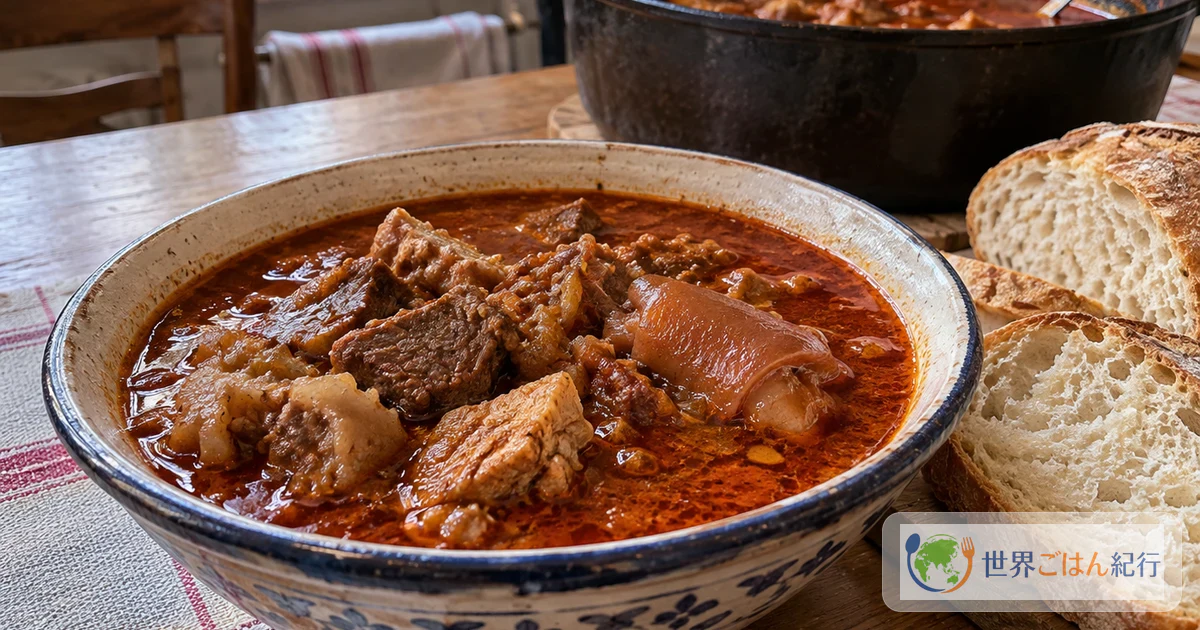
A clear beef broth rises from the pot: a Stuttgart table
When you set beef over low heat, at first there is a slightly gamy smell. You skim the scum, lower the heat, and by the time the potatoes and spätzle go in, that smell has turned into the round scent of broth. Gaisburger Marsch is known as a regional dish of Swabia in southwestern Germany, especially of Stuttgart: a clear stew of beef, potatoes, and spätzle.
The name means "the march of Gaisburg." It is said to come from the Gaisburg district of Stuttgart, and there are stories that soldiers or cadets walked over to eat it, and others that families carried a single bowl of food. Whichever story you prefer, the dish itself is quite practical. Beef broth, filling potatoes, noodles of flour and egg, and browned onions at the end. That combination pulls a cold-weather meal together in one bowl.
In a home kitchen, the hard part is not the beef but the spätzle. If you can find dried or refrigerated spätzle, you can use them, but they are often not available nearby. This article also shows how to make the home version, dropped through a colander or a slotted spoon. What you must keep is this: do not make the broth too cloudy, do not cook the potatoes to pieces, and put the browned onions on separately at the end.
Among beef stews, French pot-au-feu (in Japanese) leans toward eating the meat and vegetables separately, and garbure leans toward the heft of beans and cabbage. Gaisburger Marsch adds noodles to that, so it is closer to "a staple dish wearing the face of a soup" than a soup.
Gaisburger comes from Gaisburg in Stuttgart, and Marsch means "march." You will also see it written as Gaisburger Marsch stew. Locally it is sometimes spoken of as "Verheiratete" ("the married ones"), a dish in which the potatoes and spätzle share the same bowl.
Ingredients: prepare the broth, potatoes, and spätzle separately

This serves 4. You can make it with beef shank alone, but a little bone-in cut or beef bone sets the flavor of the soup faster. On a day you cannot find bones, raise the beef shank to 600 g and cut the water to 1.6 L.
This dish uses wheat, egg, beef, and milk. The beef is simmered for a long time over low heat, but check that the center of the removed meat is hot and the fibers pull apart. When serving to young children, older adults, pregnant women, or anyone in a weak state of health, avoid any pink in the meat and reheat thoroughly before serving.
Shopping notes
Gaisburger Marsch is not a dish where you collect unusual spices. What you buy is beef, potatoes, eggs, flour, and aromatic vegetables. What is worth considering to buy online is a heavy pot that keeps the broth still, a thermometer that lets you adjust low heat by temperature, and a pressure cooker for days you want to shorten the first simmer of the beef. A spätzle maker is convenient, but do not treat it as essential the first time. A colander with fairly large holes, a slotted spoon, or a flat cutting board and the back of a knife are enough.
In a thin pot, even if you think the heat is low, only the bottom takes strong heat and the soup clouds easily. For 4 servings, a pot of 4 L or more, preferably a heavy one, is easier to handle.
Beef broth clears more easily if you keep a small trembling at around 90 to 95 degrees C. A heavy pot loses heat less suddenly, and after you drop to low heat it is easier to read the movement on the surface.
Simmering the beef over a long stretch of low heat in a pot that holds heat makes this easier even on a weekday. Simmer the bones and aromatics slowly, strain, and then combine with potatoes and spätzle, and you can finish without breaking up the noodles or potatoes.
What to keep and what you may swap in a home kitchen
Gaisburger Marsch changes in flavor by how it is put together, not by how luxurious the ingredients are. Soup made from simmered beef, potatoes, spätzle, browned onions. With those four, you come very close to the local direction.
Another dish that turns the same beef broth into the first plate of a celebration, rather than a main of noodles and potatoes, is northern Germany's Hochzeitssuppe (in Japanese). Meatballs, an egg custard, and white asparagus are each cooked separately, so it connects well when you want to keep learning how to handle a clear broth.
| What to keep | Realistic choice | Caution when substituting |
|---|---|---|
| Beef broth | Beef shank, chuck, bone-in stewing meat | Thin-sliced meat alone makes a weak broth. Choose block meat |
| Potatoes | A waxy variety | Floury potatoes break up easily, so cut larger |
| Spätzle | Homemade, imported dried, short egg noodles | Macaroni is edible but moves toward a different dish |
| Browned onions | Thinly sliced onions cooked in butter | Store-bought fried onions smell strongly of oil, so use a little |
| Aromatics | Leek, celery, carrot | Celeriac is closer to local if you have it. Ordinary celery is fine |
On a day you use dried spätzle, boil them 1 minute less than the package says. They go into hot soup later, so softening them from the start leaves them heavy in the bowl. If you make them by hand, it is more home-style not to make the shapes too even, and the soup clings better.
If you want to take the same batter in the direction of cheese, southern Germany's Käsespätzle is the next doorway. Make the batter a little firmer than for spätzle that go in soup, and link it with the cooking water and the cheese, and the springiness of the short noodles stays.
For the meat, choose cuts that give flavor over a long simmer rather than expensive steak cuts. Packages sold in supermarkets as "for curry and stew" can mix cuts, so if possible look for labels such as beef shank, chuck, or stewing block. If you use a very fatty cut, skimming about 1 tbsp of the white fat from the surface after chilling makes it easier to eat the next day.
Common failures and how to fix them
The soup is cloudy
The usual causes are boiling hard from the start, stirring the scum back in, or adding the potatoes during the broth stage. Skim the scum after lowering to low heat, and cook the potatoes in the strained soup. Cloudy soup does not taste bad. On a day you want it clear, strain it once more through a colander lined with paper towels.
The beef is tough
The simmering time is not enough. Beef shank and chuck can still be tough at 60 minutes. Keep the water level up and extend by 15 minutes at a time at 90 to 95 degrees C. If you try to shorten it with high heat, only the outside shrinks and toughens.
The spätzle clump into balls
The batter is too stiff, the water is too weak, or you stirred the pot too soon. Add water until the batter falls heavily, and keep the water at a small boil. Leave it alone for about 10 seconds right after dropping, and loosen it with chopsticks or a fork once the surface has set.
The potatoes break up
Floury potatoes or new potatoes cut small break up easily. Cut waxy potatoes into pieces of 3 cm or larger, or if you use floury ones, add them for the last 10 minutes. If they break up a little, the soup gets a natural body, so it is not a failure.
The flavor is blurry
This happens when you are afraid of salt and use too little, or when you leave out the browned onions. At the end add salt 1/4 tsp at a time, and top the bowl with chives and onions. Heavy pepper moves it toward a different dish, so first adjust with salt and the aroma of the onions.
How to eat it, storage, and the next day

To follow the local way, combine the spätzle and potatoes in the bowl and top with browned onions and chives. Bread is not essential, but it goes well for finishing the soup to the end. For sides, a salad of leafy greens with some acidity or light pickles suits it better than a heavy meat dish. If you want to pair a sweet-and-sour cabbage side from southern Germany, Bayrisch Kraut is a good match.
For storage, the basic rule is to keep the soup and the spätzle separate. Cool the soup and fillings in a shallow container and refrigerate within 2 hours. Refrigerated, it keeps 2 days; frozen, about 1 month. Spätzle keep 2 days in the refrigerator, but stored in the soup they swell and get heavy. The next day, warm the soup over low heat, and when it steams through the center, add the spätzle and warm 1 minute.
Leftover soup is also easy to eat with a little short pasta or pearl barley added. But since the dish already has both potatoes and noodles, adding rice the next day makes it heavy. For lunch, more filling, fewer noodles, and a turn of black pepper is just right.
FAQ
Can I make it without a spätzle maker?
Yes. You can substitute a colander with fairly large holes, a slotted spoon, or spreading the batter thin on a cutting board and dropping it little by little into the water with the back of a knife. Rather than a neat shape, aim for a similar thickness so they cook evenly.
How should I change things if I use dried spätzle?
Boil dried spätzle 1 minute less than the package says and combine them with the soup in the bowl. If you simmer them in the pot, they absorb liquid and cloud the soup. Some products are salted, so adjust the salt in the soup at the end.
Can I use pork instead of beef?
You can, but it moves away from the beef-broth character of Gaisburger Marsch. If you use pork shoulder, strengthen the bay leaf and black pepper a little and skim the fat after simmering. For the first time, beef shank or chuck makes it easier to grasp the outline of the dish.
May I add a bouillon cube?
You can, but adding it from the start tends to flatten the flavor. After simmering with beef and aromatics, only if it still tastes thin, use up to 1/2 tsp of granulated bouillon. Add salt first, put on the browned onions, and then decide.
Are potatoes and noodles together too heavy?
It is meant to be a staple as well, so this is right. On a day you want it lighter, reduce the spätzle to 60 g per person and use more soup and beef. As a main for dinner, go easy on bread and add a salad.
Is there anything to watch for when making it for children?
Go easy on the nutmeg and black pepper, and cut the beef small. The soup is hot, so let it cool a little after putting it in the bowl. Stop the browned onions before bitterness appears and serve them on a separate dish so the amount is easy to adjust.
Sources
- Schmeck den Süden: Verheiratete oder Gaisburger Marsch mit Kalbstafelspitz - Checked the structure of beef, bones, root vegetables, potatoes, boiled spätzle, browned onions, and chives.
- REWE: Gaisburger Marsch - Checked quantities and cooking times for a home version using beef shank and bones, aromatics, potatoes, and spätzle.
- Küchengötter: Gaisburger Marsch - Checked its place as a Baden-Württemberg dish and the combination of beef and spätzle.
- TasteAtlas: Gaisburger Marsch - Checked the overview as a dish of the Stuttgart area and the description of beef soup and vegetables.
- Gaisburger Marsch - Wikipedia - Checked the stories told about the origin of the name and the connection to Gaisburg in Stuttgart.