A Sunday Table Dish: Beef Rolls That Open onto Bacon and Pickles
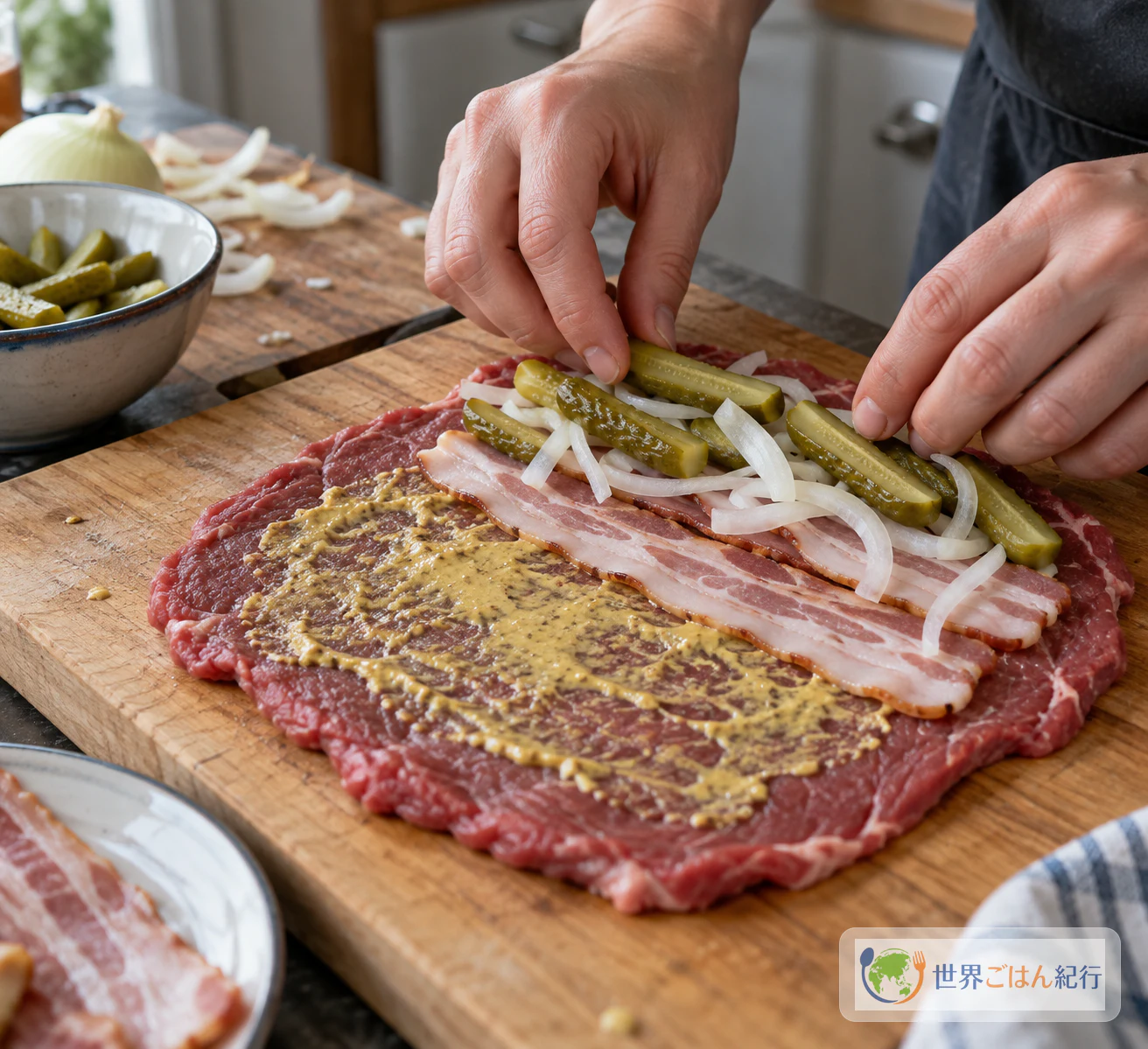
A thin slice of beef wrapped around mustard, bacon, onion and sour little pickles, browned, then braised covered until a skewer slides in without resistance. The sauce comes from the same pot.
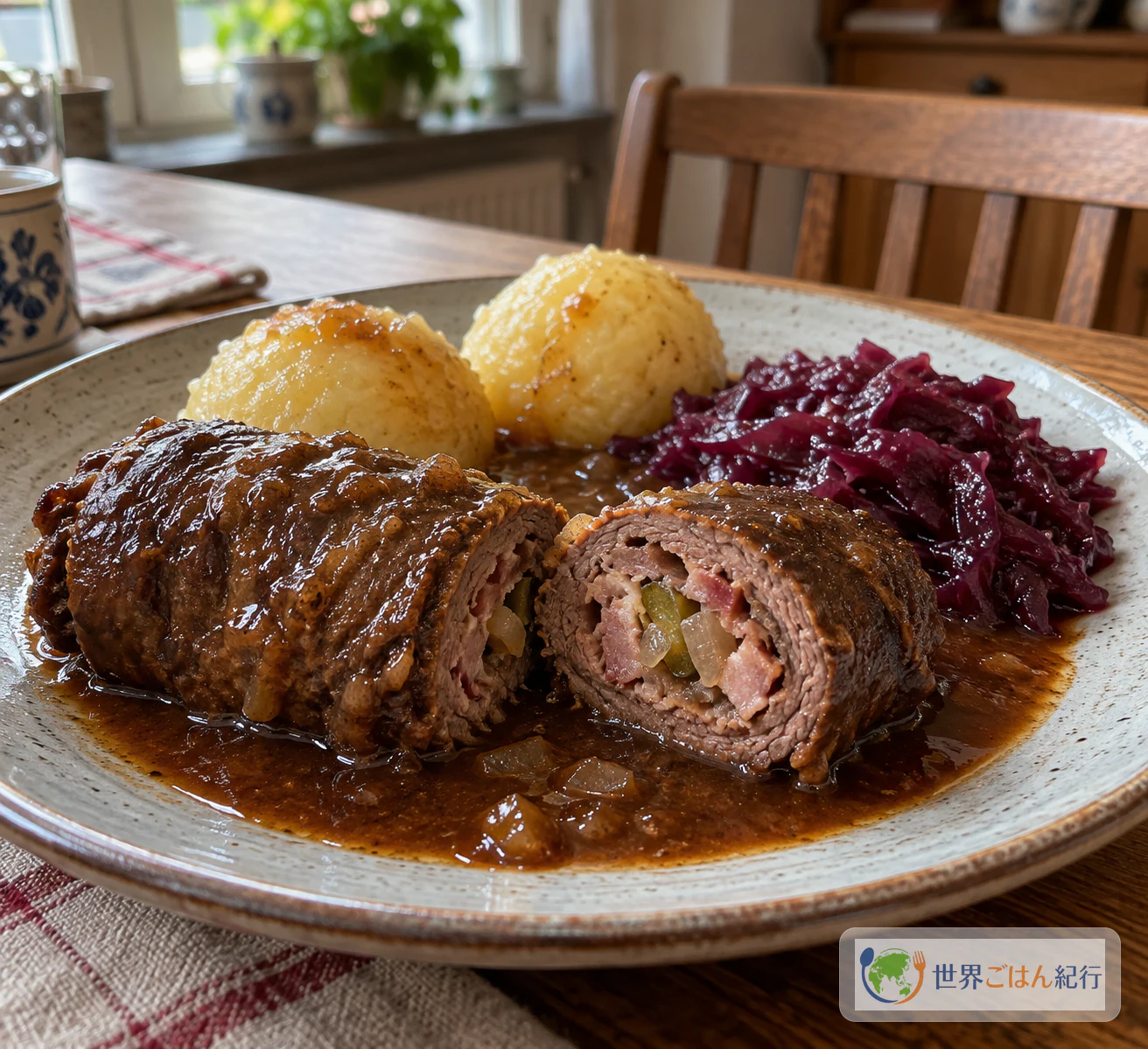
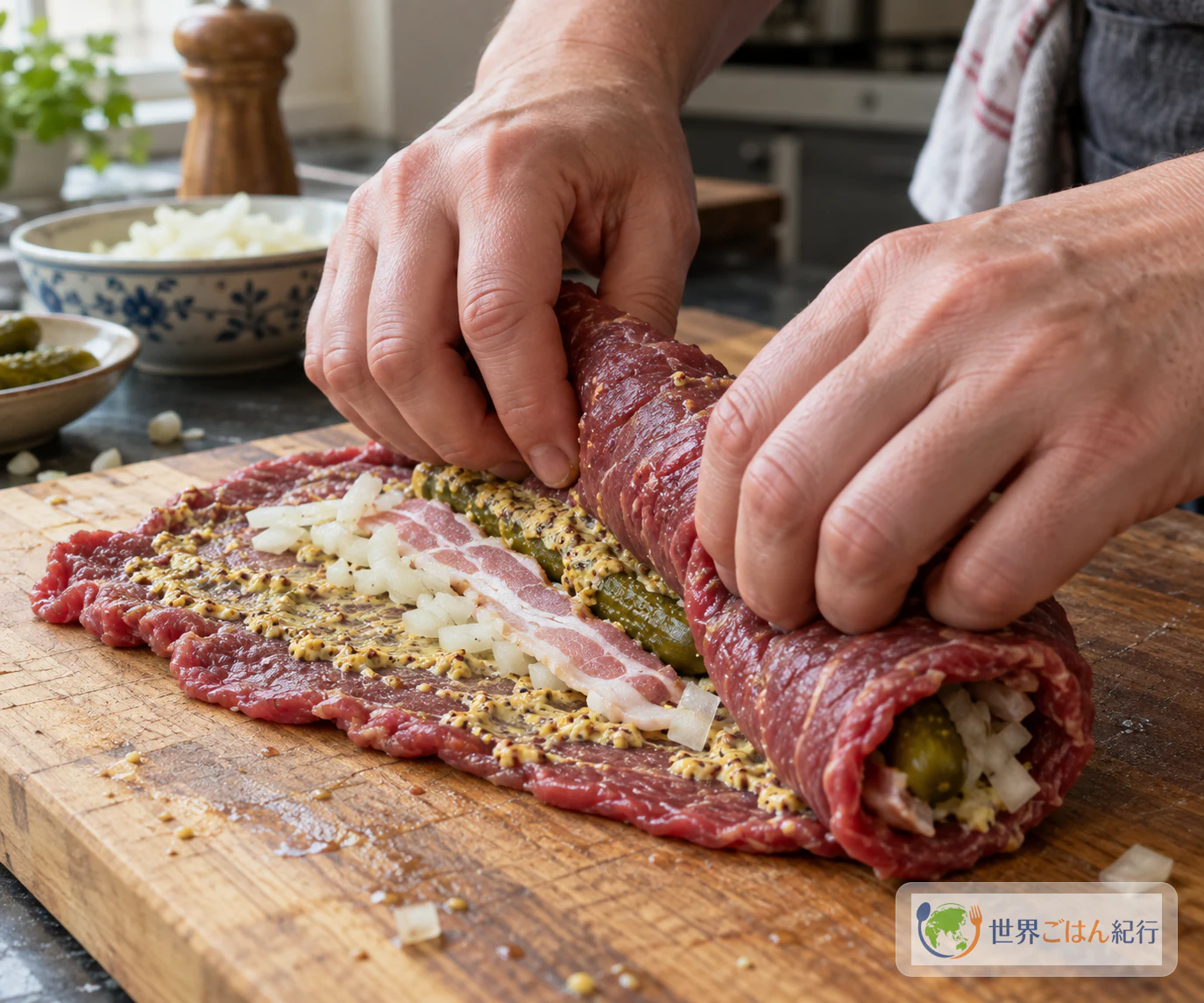
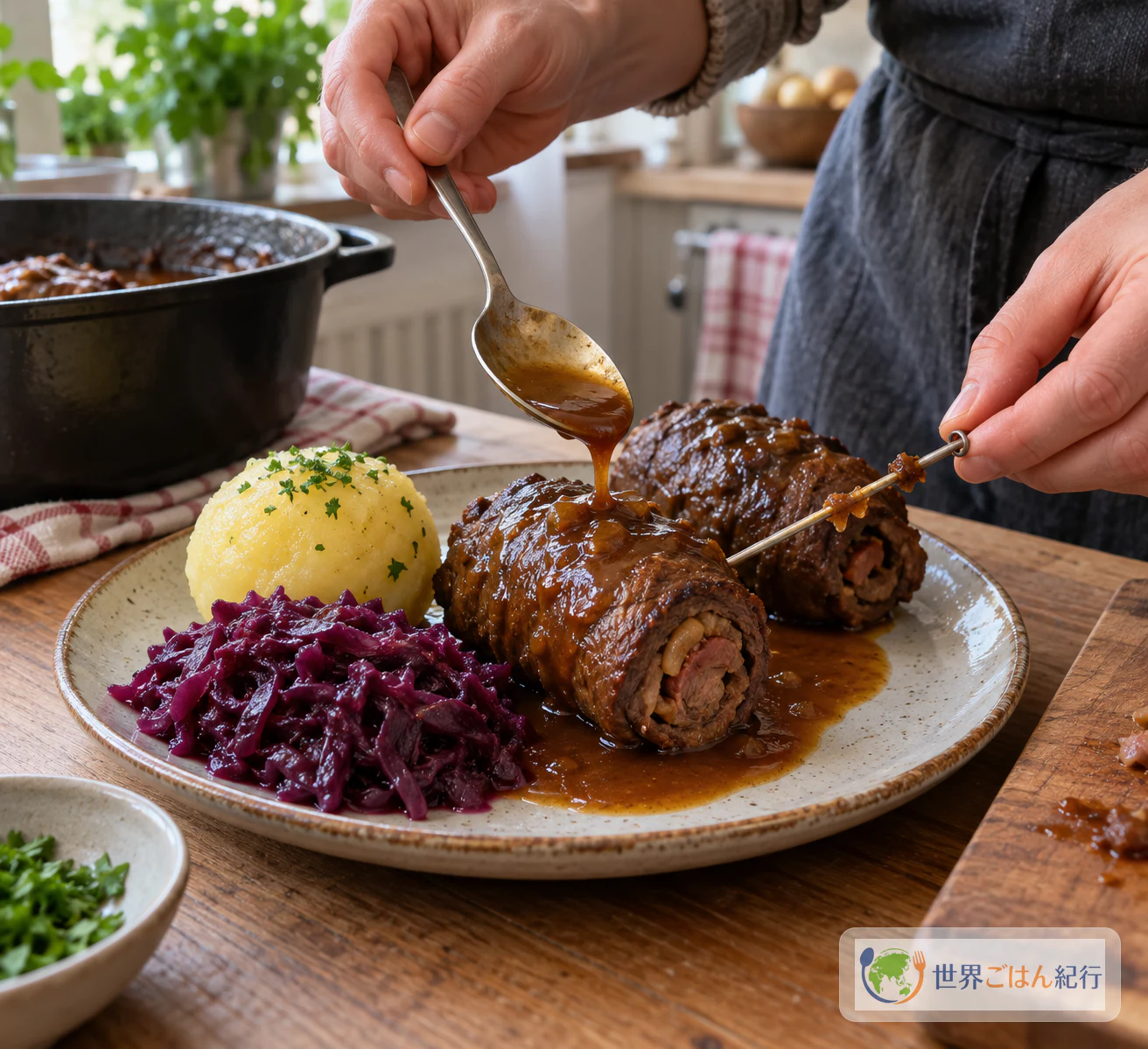
In Franconia, rouladen are a dish people know from Sunday and holiday meals, at the family table and in regional restaurants. They take time. The beef is flattened, layered with filling and rolled, then browned and left to braise slowly with root vegetables and red wine. When you cut one open at the table, the spiral of bacon, onion and pickle shows in the middle, and the dark sauce runs into it.
Rinderroulade (plural Rinderrouladen) is the beef version of this rolled dish. This article follows one classic 4-serving recipe from the German food magazine essen & trinken from start to finish, and places it alongside regional examples from Franconia and Saxony. The tricky parts for a home cook are usually getting large enough slices of beef, rolling them so they hold, and knowing when the braise is truly done. Each of those gets its own attention below.
What Rinderroulade Is: A Rolled Dish and an Early Record
Rinderroulade is beef that is filled, rolled and braised. The Franconian regional association Genussregion Oberfranken connects the word Roulade to the French rouler, "to roll." "Rind" means beef, which separates this dish from Kohlroulade, the German cabbage roll, which is wrapped in cabbage leaves rather than meat.
The same Franconian source points to an early written record: a "Rollade" in Johann Albrecht Grunauer's cookbook of 1733. That version filled beef with bacon, boiled ox tongue and pistachios and cooked it in a wine sauce, a very different filling from the one common today. The source itself notes that how the dish developed after that is not documented, so the 1733 recipe is best read as an interesting early glimpse, not as the direct ancestor of the modern roll.
Franconia and Saxony: Household and Regional Differences
Fillings vary from household to household. In Franconia, the classic filling described today is bacon, onion and sour cucumber pickle, and the rolls are served with dumplings and red cabbage.
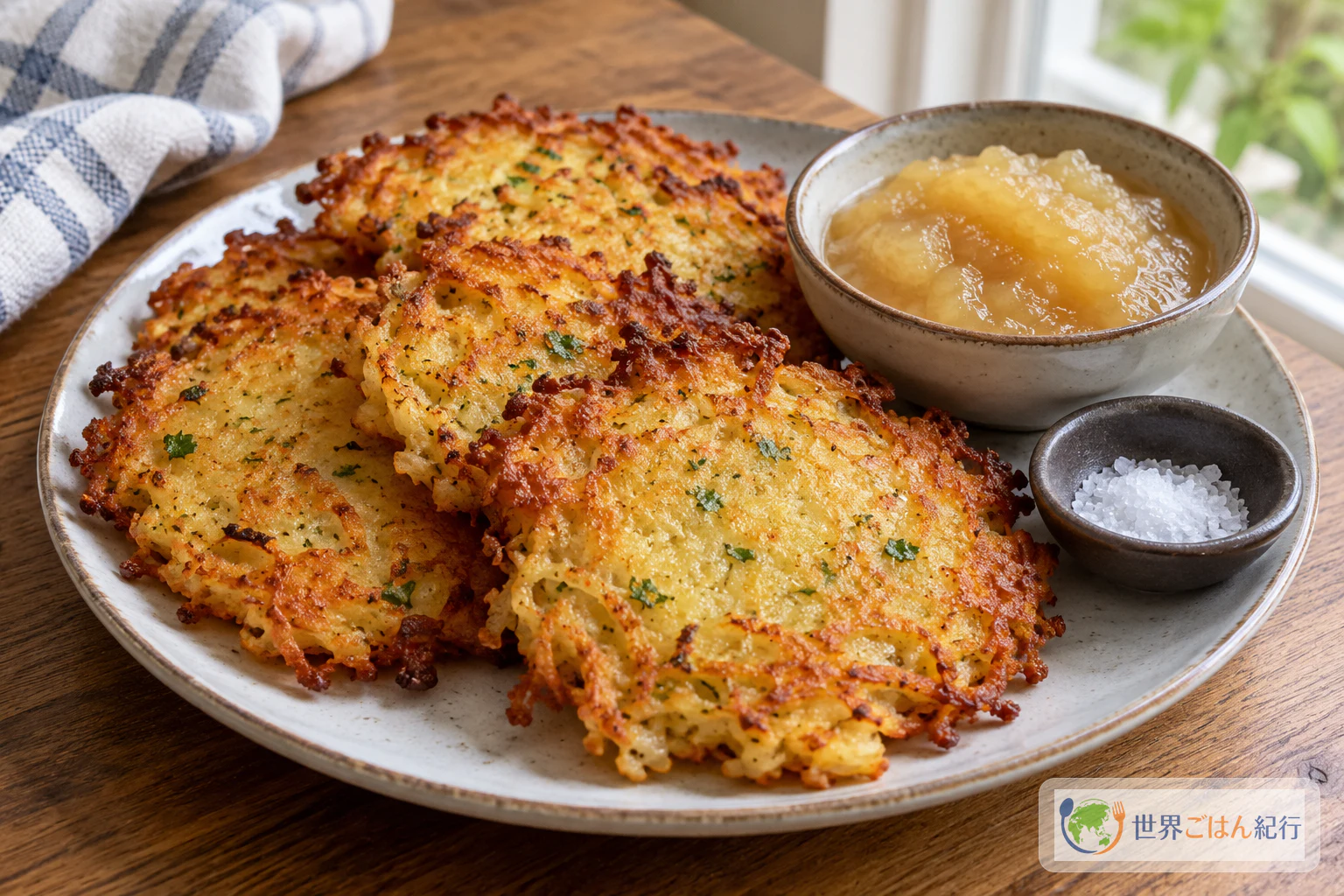
The Saxony tourism board has published one restaurant's version from Schloßbräu in Crimmitschau. It uses Bautzener Senf (a mustard from Bautzen), cucumber, onion and smoked bacon, and suggests serving the rolls with Kürbisklitscher, potato pancakes made with pumpkin. This is one restaurant's dish, not a rule for all of Saxony or all of Germany.
Rather than mixing these versions, this article uses the essen & trinken recipe as a single, consistent set of amounts and steps: cornichons, white onion, bacon and medium-hot mustard inside, and a red wine sauce with carrot, celeriac, leek and onion. If you'd like to explore other dishes from the same country, see more German recipes.
Choosing the Beef, Pickles, Bacon and Starch
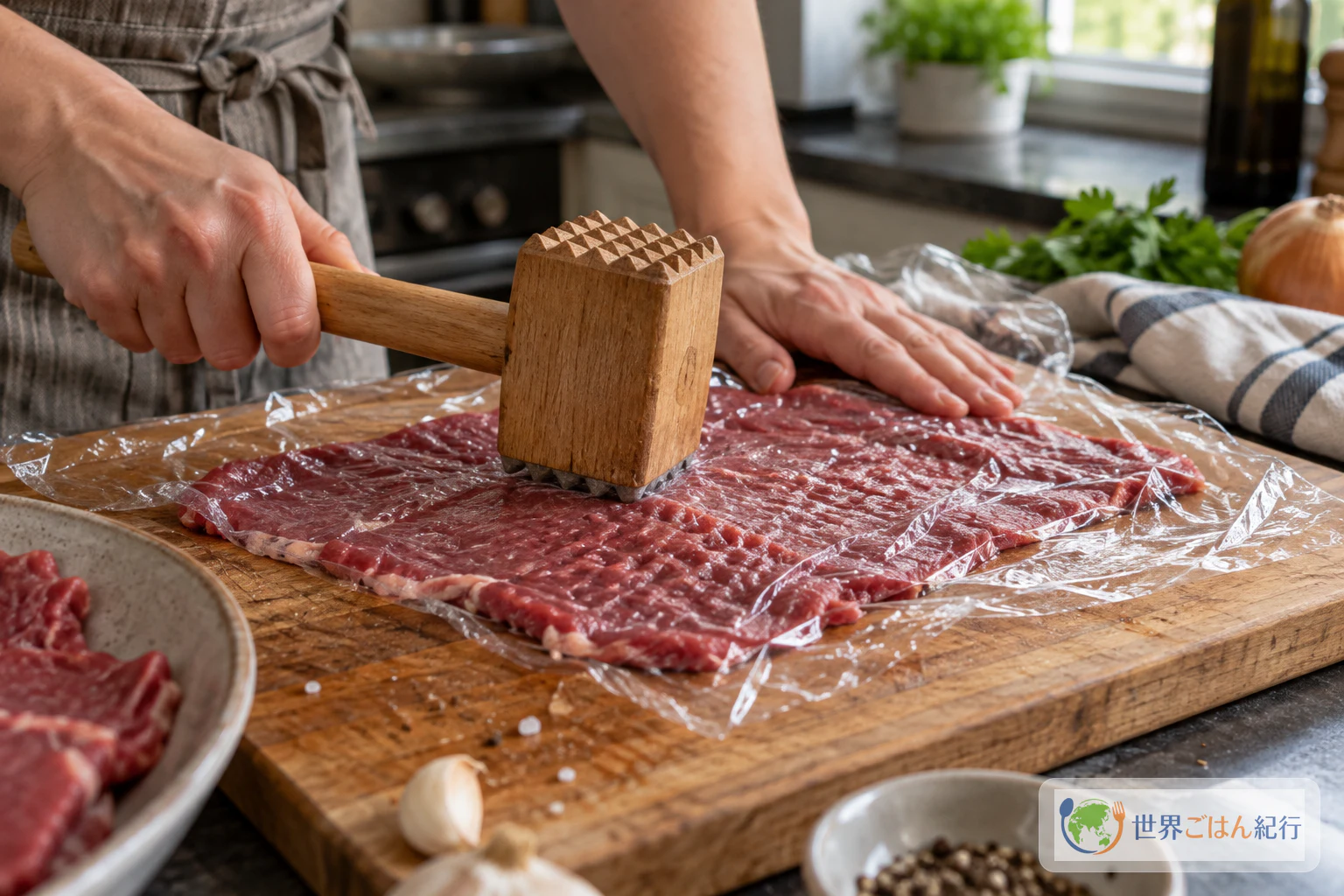
The beef needs to be large and thin. essen & trinken names Oberschale (topside) as the suitable cut, with Unterschale (silverside) or Hüfte (rump) also usable. Ordinary thin-sliced beef is often too narrow to roll around a filling, so it helps to ask a butcher for large, thin slices meant for rolling and braising. If you overlap smaller slices to make up the size, keep in mind that the result won't be quite the same as a single slice of the original cut. The recipe does not give a specific thickness; you flatten the meat until it can be rolled without tearing.
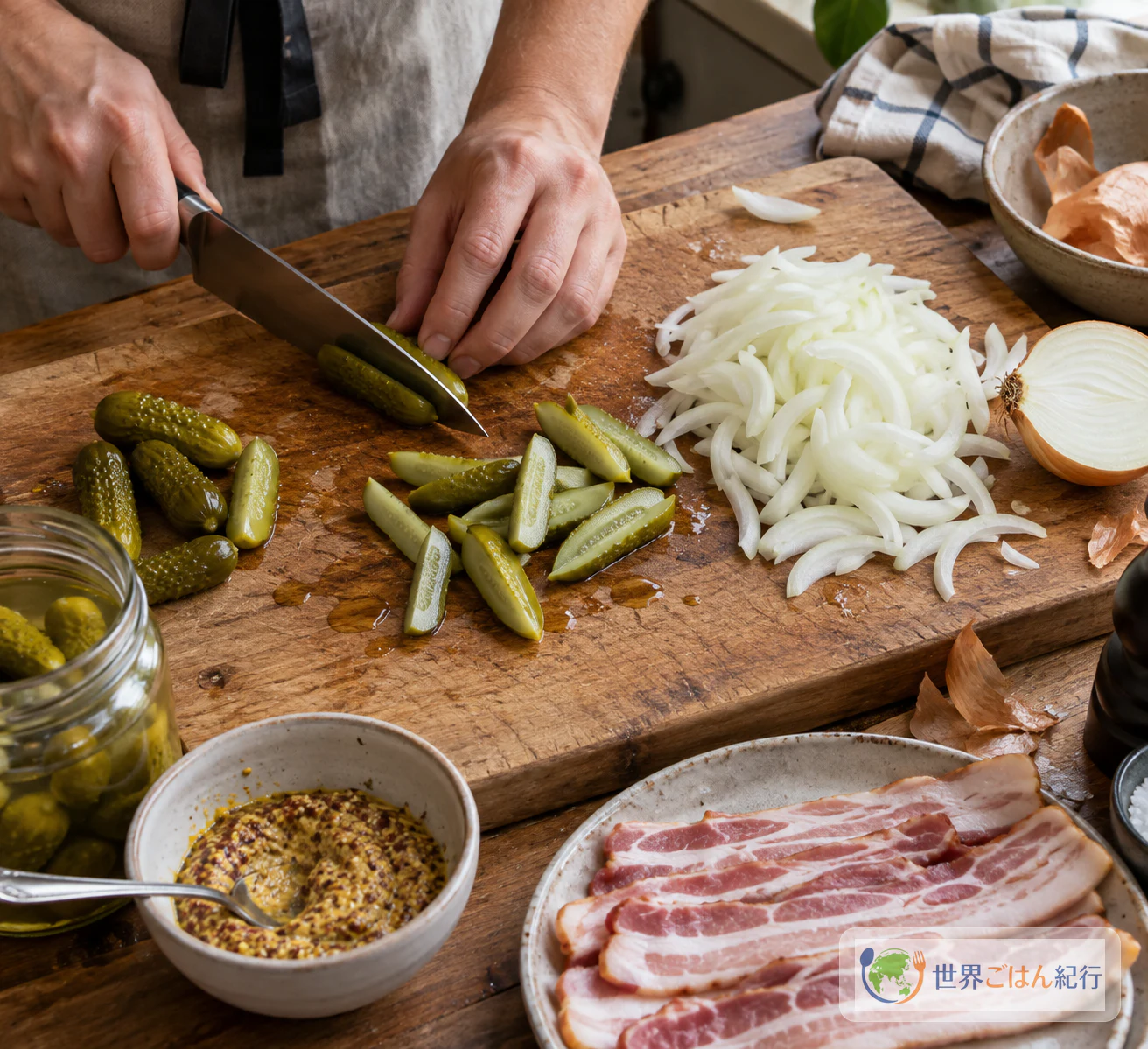
Cornichons are small, sour pickles. Sweet pickles change both the acidity and the sweetness of the filling, so choose a sour type if you can.
Bacon differs by product. Smokiness and saltiness vary, which affects how much salt you use later. Taste the sauce before seasoning it.
Mustard: the recipe calls for medium-hot mustard. Other mustards change the heat and the acidity.
Starch: the German recipe says Speisestärke, which simply means food starch and does not name the plant it comes from. This version chooses cornstarch. Potato starch is a different product and is not guaranteed to give the same thickness or texture at the same amount.
Sauce vegetables: celeriac (celery root) is not the same as celery stalks. If you can't find it and leave it out, that is a change from the recipe, and the aroma of the sauce changes. The same goes for replacing leek with a different kind of onion.
Ingredients (4 servings, 4 rolls)
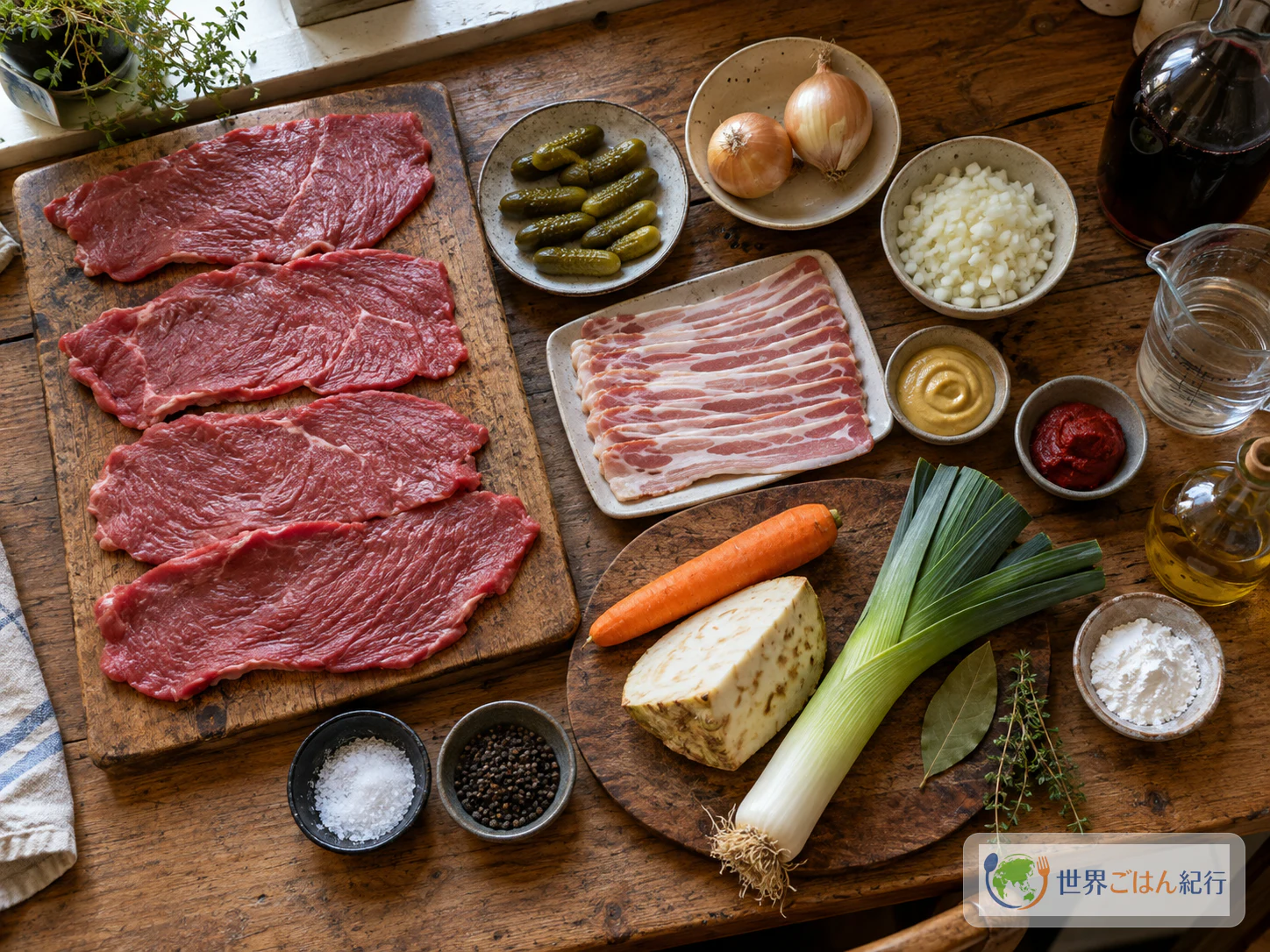
Salt and pepper are to taste. Note that there are two separate onion entries: whole onions for the filling and diced onion for the sauce.
The dumplings and red cabbage are optional accompaniments shown in the photos; the roulade recipe itself does not depend on them, and their own preparation is not part of this recipe.
This dish contains beef, pork (bacon), mustard and wine. Check the labels on bacon, mustard, pickles and any prepared sides for allergen information.
Equipment
- Plastic wrap or kitchen film and a meat mallet, for flattening the beef
- Cutting boards and a knife (keep raw meat apart from other foods)
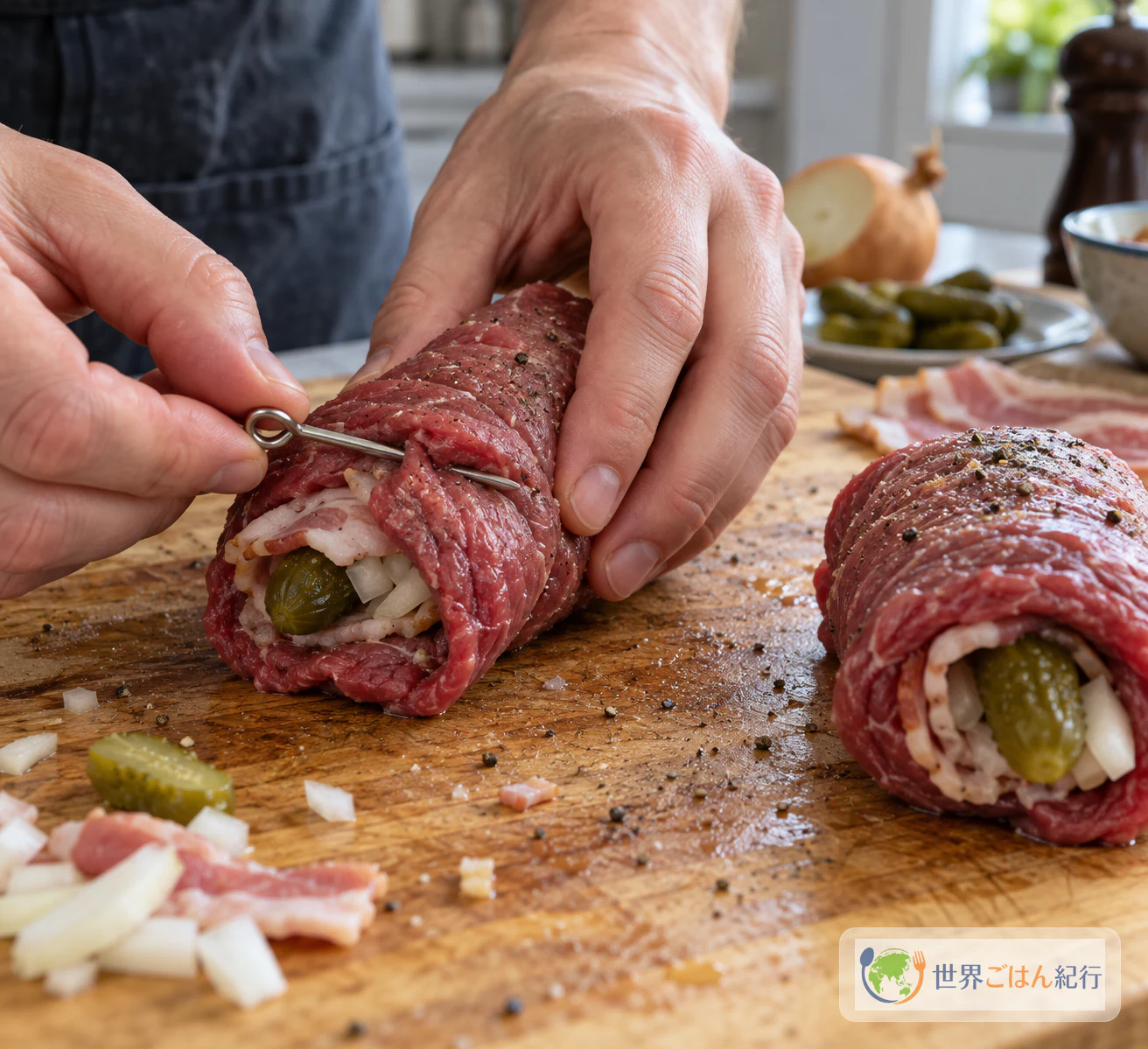
- Roulade pins (Rouladennadeln) or kitchen twine, for securing the rolls
- A heavy, oven-safe pot with a lid; check that the lid and handles can also take 180°C
- A sieve and a spoon for pressing the vegetables
- A skewer, for checking tenderness
Method: Roll, Brown, Braise, Finish the Sauce
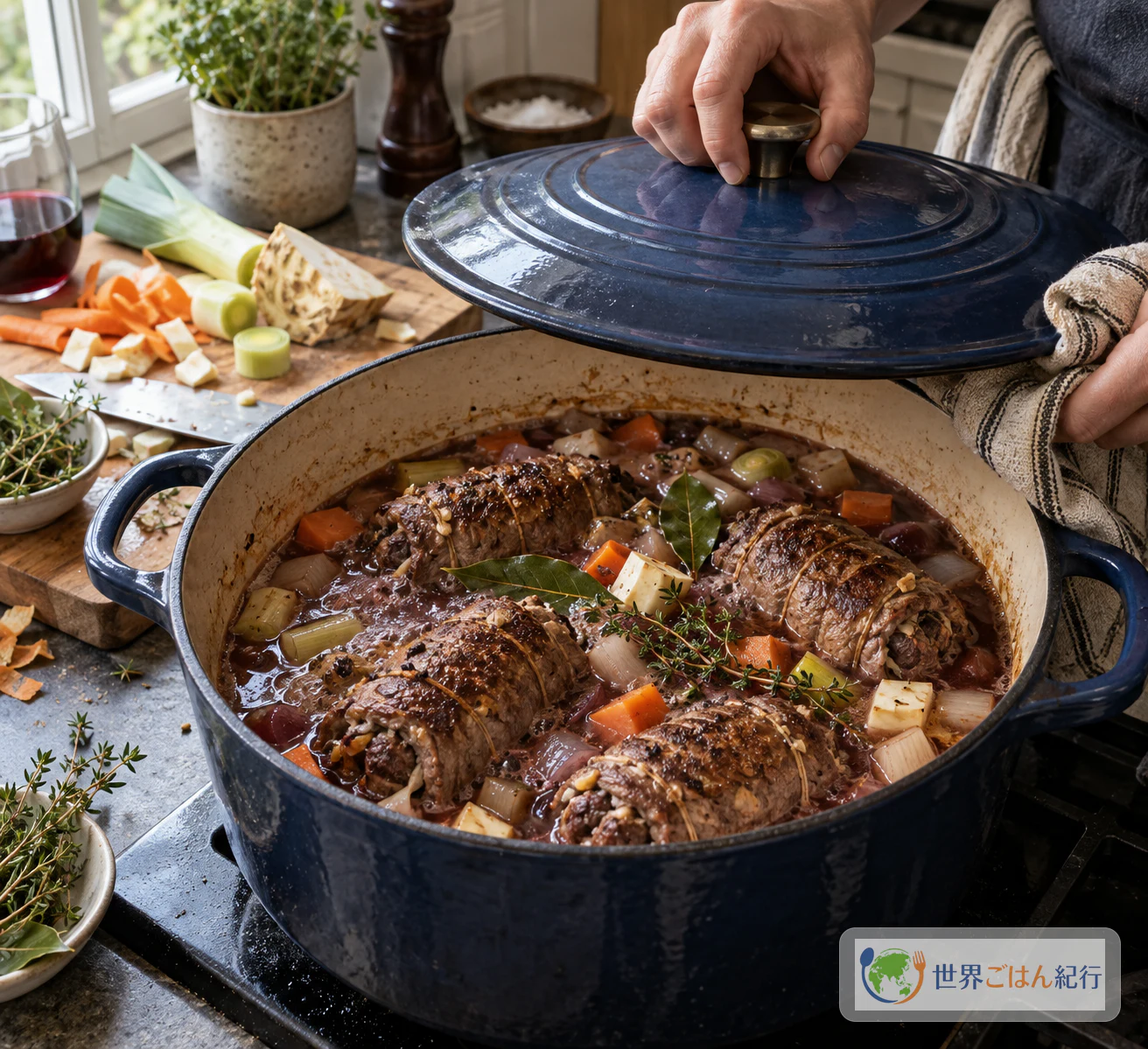
The oven time is a range, not a promise. Pot, oven and the thickness of the meat all change it. Judge tenderness by how easily a skewer goes in.
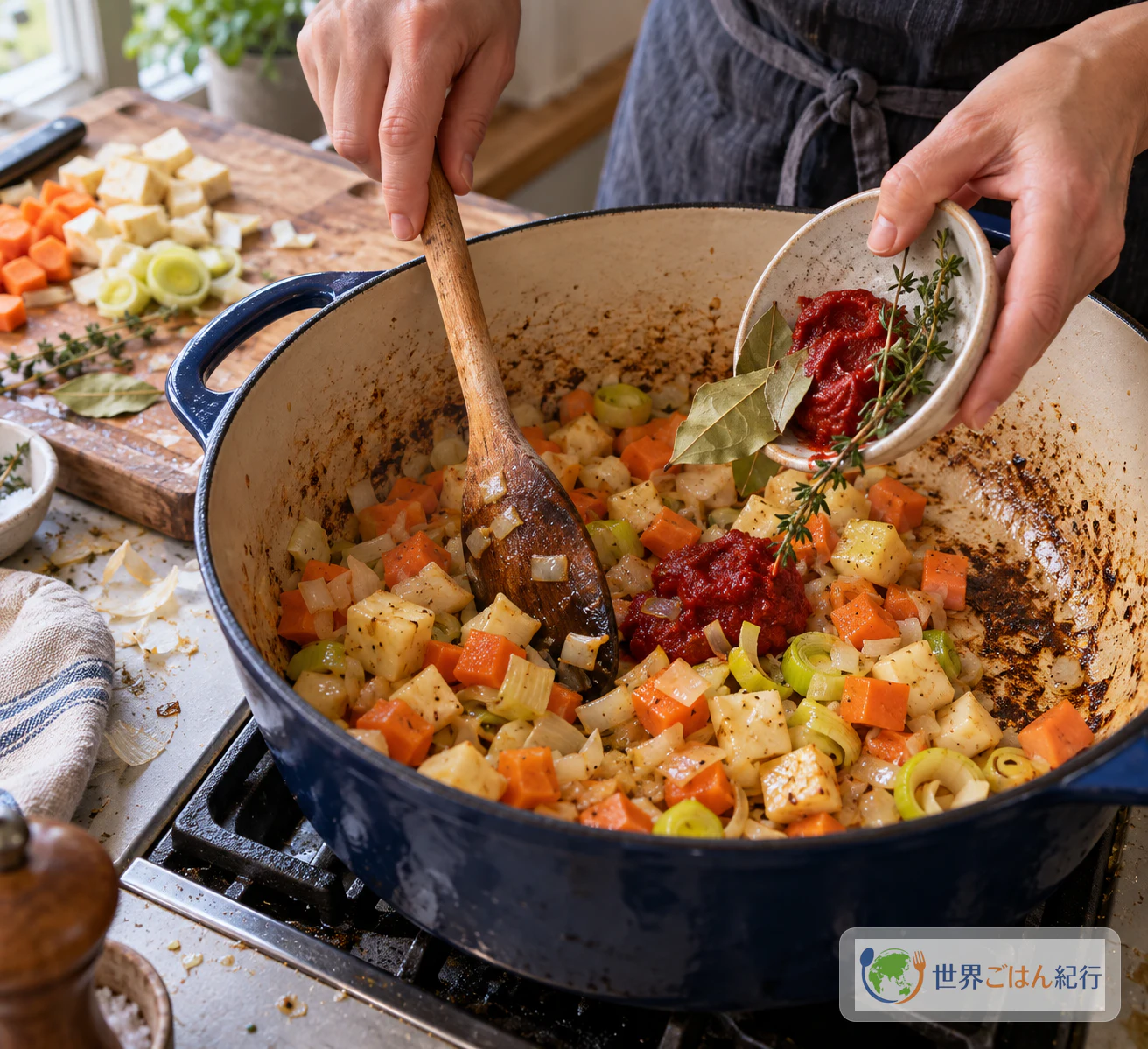
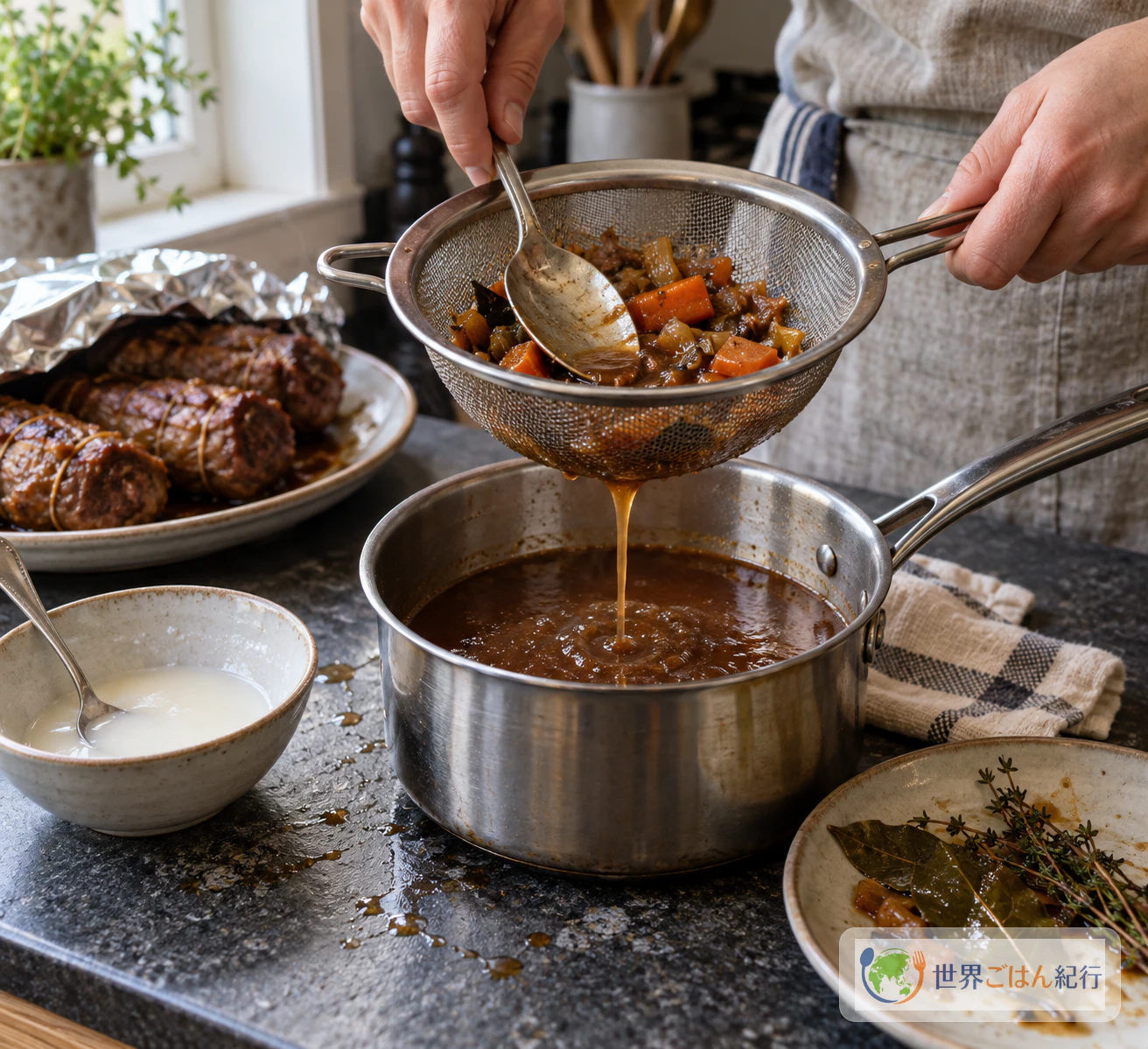
Steps 1 to 6 build and brown the rolls. Steps 7 and 8 carry the browned bits from the pot into the braise, and steps 9 and 10 turn the braising liquid into the sauce.
The essen & trinken article mentions 65°C as a temperature guide for the meat. That is the publication's own guide, not an official safety standard. A skewer sliding in easily tells you about tenderness; it is not proof that the food has been heated sufficiently, and neither is a change in color. As a separate check, a general home-cooking guideline from Japan's Ministry of Health, Labour and Welfare is to heat food until the center reaches 75°C for at least 1 minute. Keep raw meat, and the tools and hands that touched it, away from foods that will be eaten without further cooking.
Fixing Tough Meat, Loose Rolls and Sauce Problems
| Problem | Likely cause | What to do |
|---|---|---|
| The roll comes undone | Filling spread to the edges; sides not folded in | Keep the filling toward the wide end, fold in the long sides before rolling, and pin across the seam |
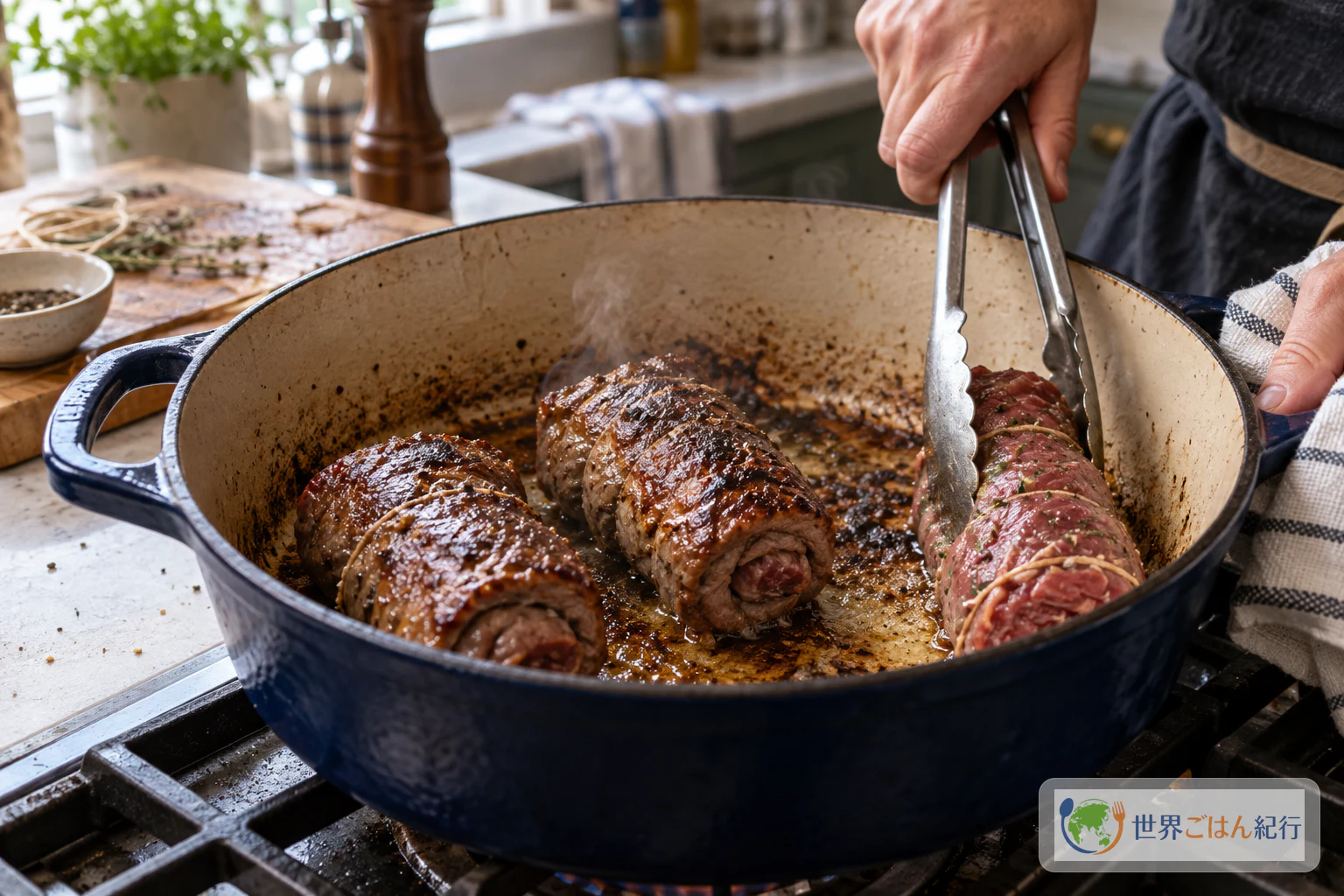
| Little browning | Pot too crowded | Brown in batches, depending on pot size |
| Bitter-tasting sauce | Browned bits on the bottom scorched | Brown over heat that colors the meat without blackening the pot |
| Meat still tough after 90–120 minutes | Not braised long enough, the main cause named by essen & trinken | Keep braising, covered, and check with a skewer. The time range is a guide, not a fixed limit |
| Liquid running low during a long braise | Extended cooking time | Check the liquid level when you turn the rolls and when you extend the braise |
| Sauce too thick | Reduced too far, or too much starch | Add starch dissolved in cold water gradually rather than all at once |
| Sauce too thin | Not reduced enough | Simmer it a little longer before adding the starch, then thicken as needed |
Storage and Reheating
According to essen & trinken, finished rouladen keep with their sauce in an airtight container for 2 to 3 days in the refrigerator, or up to 3 months in the freezer. These are the publication's guidelines, and they depend on conditions in your own kitchen, so they are not a guarantee.
As general home guidance from Japan's Ministry of Health, Labour and Welfare: divide leftovers into shallow containers so they cool quickly before refrigerating, and reheat to 75°C or above (liquids such as soups until they boil). Thaw frozen rouladen in the refrigerator, then reheat them in a pot together with their sauce until everything is thoroughly hot.
Five Ways to Adjust It at Home
The first three ideas are changes to the essen & trinken recipe, not part of it. The last two are serving examples from regional sources.
- Milder acidity: use fewer cornichons than the original 8 for a gentler sourness.
- A different mustard: swapping the medium-hot mustard changes the heat and acidity. It won't be the same as the German original.
- Without alcohol: replace the red wine with beef stock or water. The sauce will have a different aroma and less acidity.
- The Franconian way: serve with dumplings and red cabbage, as described by Genussregion Oberfranken.
- The Crimmitschau example: serve with Kürbisklitscher, the pumpkin potato pancakes suggested in the Saxony tourism board's restaurant feature.
Frequently Asked Questions
Which cut of beef should I use?
essen & trinken names Oberschale (topside) as suitable, with Unterschale (silverside) or Hüfte (rump) as alternatives. Ask a butcher for large, thin slices meant for rolling and braising if regular thin slices are too narrow.
Why is my roulade tough?
The main cause essen & trinken names is too short a braise. Rather than stopping at 90 minutes, check with a skewer and keep braising, covered, until it slides in without resistance, watching the liquid level.
Can I make it ahead?
Yes. According to essen & trinken, finished rouladen keep with their sauce in an airtight container for 2 to 3 days in the refrigerator, or up to 3 months frozen. Reheat in the sauce until everything is thoroughly hot.
What can I use instead of cornichons?
Choose small, sour pickles. Sweet pickles change the flavor of the filling, so if you use them, expect a sweeter, different result.
What do I serve with it?
Potatoes, dumplings, red cabbage and Spätzle are all typical choices. In Franconia, dumplings and red cabbage are a classic pairing, and one restaurant in Crimmitschau, Saxony, serves Kürbisklitscher, potato pancakes with pumpkin.
Sources
- essen & trinken / Deutsche Medien-Manufaktur, "Rinderrouladen – klassisches Rezept." The 4-serving recipe used here: ingredients and amounts, rolling, browning, sautéing the vegetables, the covered oven braise at 180°C (fan 160°C) for 90–120 minutes, suitable cuts of beef, checking tenderness, toughness from under-braising, typical side dishes, and refrigerator and freezer storage guidelines. https://www.essen-und-trinken.de/rezepte/klassische-rinderroulade-das-beste-rezept-12067572.html
- Genussregion Oberfranken e.V., "Rouladen nach fränkischer Art." Rouladen as filled, rolled and braised meat; their place at Sunday and holiday meals in families and regional restaurants; the link between Roulade and rouler; the 1733 "Rollade" in Johann Albrecht Grunauer's cookbook, with later development undocumented; the Franconian filling of bacon, onion and sour cucumber; and serving with dumplings and red cabbage. https://www.genussregion-oberfranken.de/spezialitaeten/rouladen-nach-fraenkischer-art/
- Tourismus Marketing Gesellschaft Sachsen mbH, "Rezept für Rinderrouladen, ein typisch sächsisches Gericht." The rouladen of Schloßbräu in Crimmitschau, with Bautzener Senf, cucumber, onion and smoked bacon, served with Kürbisklitscher. One restaurant's example, used here for regional comparison only. https://www.sachsen-tourismus.de/blog/rezept-rinderrouladen
- Ministry of Health, Labour and Welfare (Japan), "Six points for preventing food poisoning at home." General home guidelines: heating to 75°C at the center for at least 1 minute, dividing leftovers into shallow containers, reheating to 75°C or above (soups until boiling), and preventing cross-contamination between raw meat and ready-to-eat food. https://www.mhlw.go.jp/stf/seisakunitsuite/bunya/kenkou_iryou/shokuhin/syokuchu/01_00006.html