An ice cream you slice before you spoon
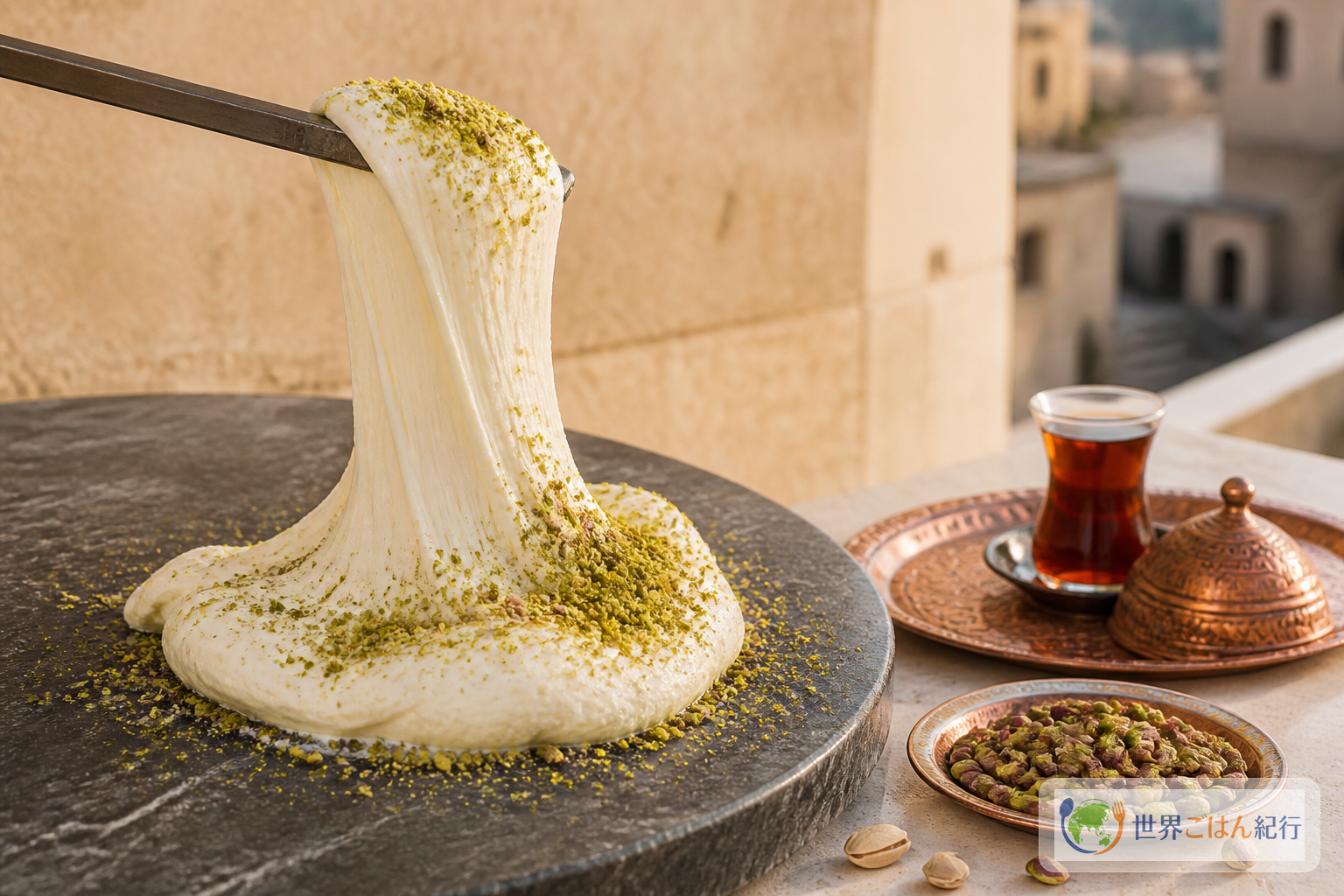
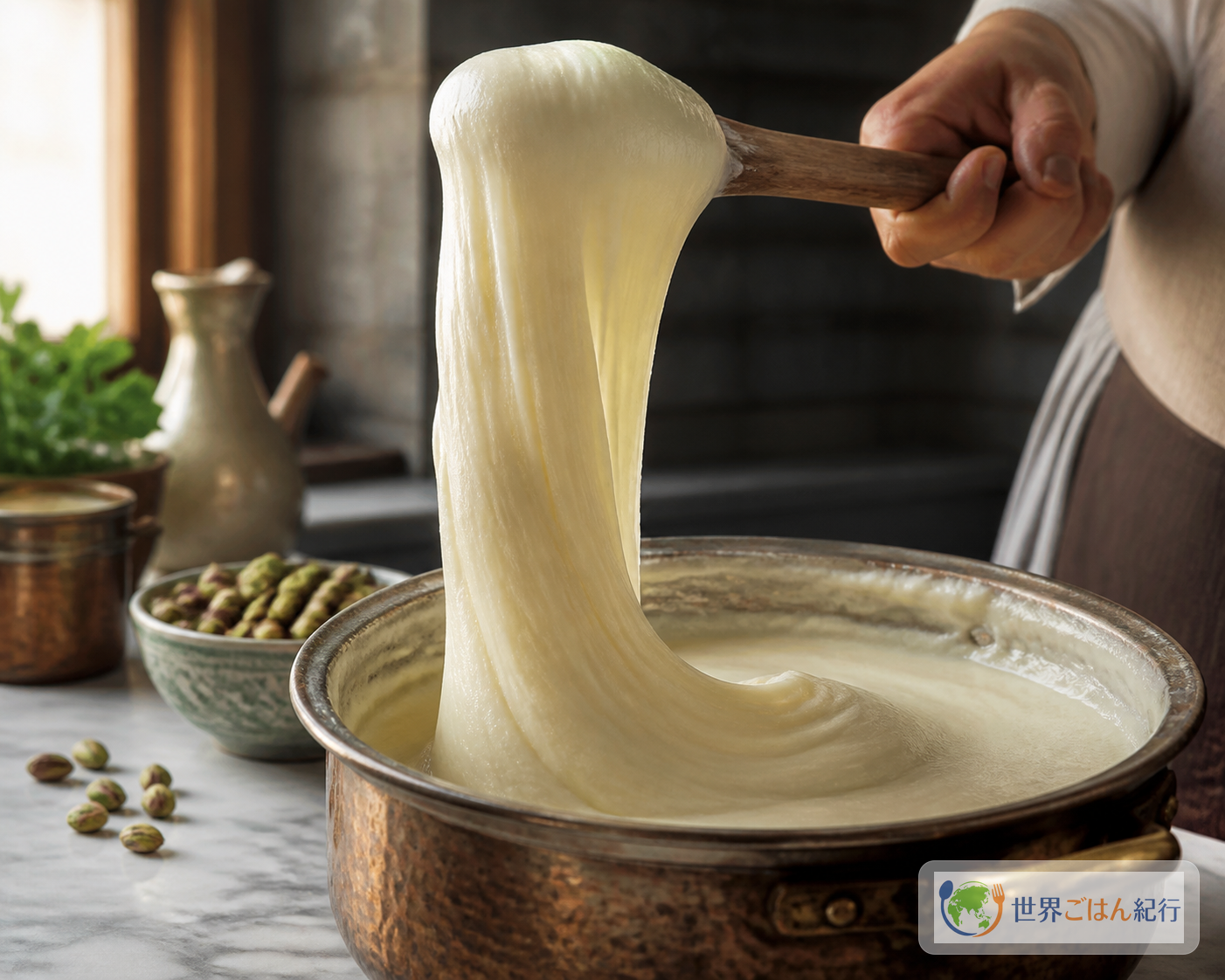
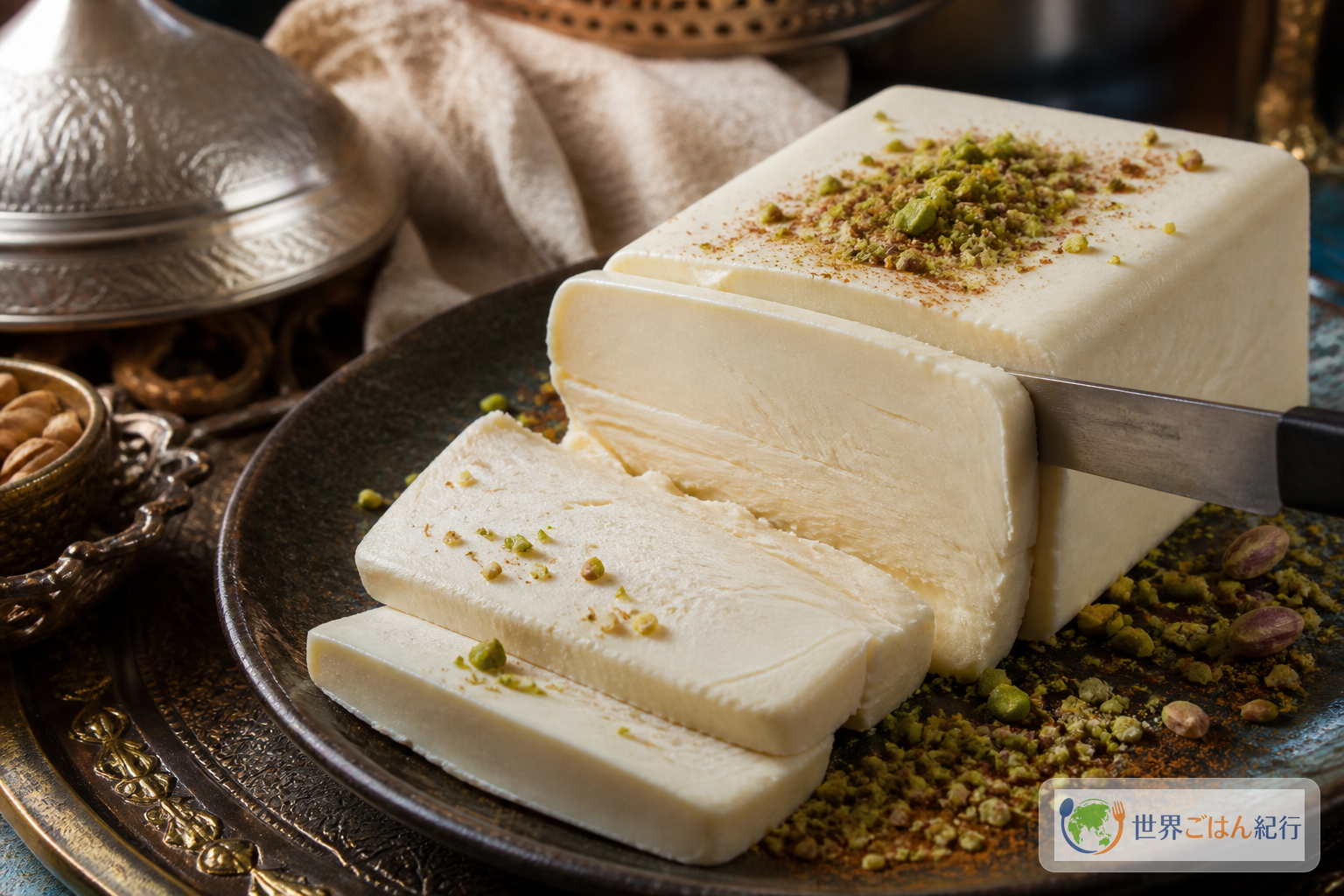
Take it out of the freezer and a spoon won't go straight in. Cut it with a knife, and the white block doesn't crumble; it stretches slowly as it parts. Turkish dondurma isn't an ice cream you enjoy only for the cold. It's a dessert whose firmness and chew you check with your eyes before it ever reaches your mouth.
The dondurma of Kahramanmaraş has long been built on goat's milk, sugar and salep. Salep is a flour made from the tubers of orchids, and it gives thickness and stretch. Mastic (mastic resin) adds, even in tiny amounts, an aroma reminiscent of pine resin that keeps the sweetness of cold milk from going flat.
The hard part in a home kitchen isn't gathering more ingredients; it's keeping the powder from clumping, not overcooking the base, and building the chew before it cools. Without the huge chilled vats and long metal paddles of Turkey, you can still get to a density you can slice with a knife by breaking the work into stages with a shallow pan and a whisk.
What we make here is not a reproduction of the Maraş specifications but a home version using cow's milk and cream. It keeps the idea behind the goat's-milk aroma and the strong elasticity that comes from artisans working the pot again and again, while adjusting for what you can buy and how much freezer space you have.
Right after it's done, a spoon leaves a deep mark, and it doesn't run even after 5 minutes at room temperature. Success is a smooth cut face when you slice it 3 cm (1 1/4 in) thick, and a few centimeters of stretch when you lift a piece. If it drips like liquid, it isn't frozen enough; if it cracks and crumbles, it wasn't churned enough.
This recipe uses milk, cream and pistachios. Some salep-based mixes contain milk, egg, soy, wheat and other allergens, so check the ingredient list. Mastic is a flavoring derived from tree resin. If you have a nut allergy, leave out the pistachios; if you react to dairy, don't use this recipe.
Maraş food culture, from mountain milk to street-corner selling
Dondurma is the general Turkish word for ice cream, but the stretchy kind is associated with Kahramanmaraş and the Maraş dondurması that bears its name. Official local descriptions name the milk of goats grazing on the plants of the Ahır Mountains, and salep obtained from the tubers of wild orchids, as the region's ingredients.
The Kahramanmaraş provincial description introduces a method in which salep is added to milk and sugar, the mixture is rested, and then chilled. As for its origins, there is also a story that dense ice cream was born when leftover salep was added to a pot of milk and sugar. This is best read as a locally told origin story, not treated like a historical document proving how all dondurma was invented.
How it's eaten has its own regional scenery. In Maraş, the fact that the dense ice cream can be cut into pieces or hung on a rod is itself the mark of its texture. At stands and shops in Istanbul, vendors are known for twirling the cone on a long metal rod and pulling it back just as you think it's been handed over. That prank-like show is part of a selling culture that shows off a chew that doesn't fall.
| Place | What stands out at the table or counter | How to translate it at home |
|---|---|---|
| Kahramanmaraş | Goat's milk, salep, a dense texture that melts slowly | Separate each ingredient's role and put density first |
| Istanbul | Street-stand showmanship, twirling the cone on a long rod and pulling it back | Show off the stretch, then slice it with a knife to eat |
| Home kitchen | Cow's milk, cream, a household freezer | Protect the chew and sliceability rather than chasing an exact flavor |
Salep's thickness is different from the heaviness of just adding starch. Regional product materials explain that the glucomannan in salep contributes to its thickness and slow melting. Substituting cornstarch will get you as far as a frozen dessert, but the stretch is weaker and the result is closer to a rich milk gelato.
Ingredients (serves 4)
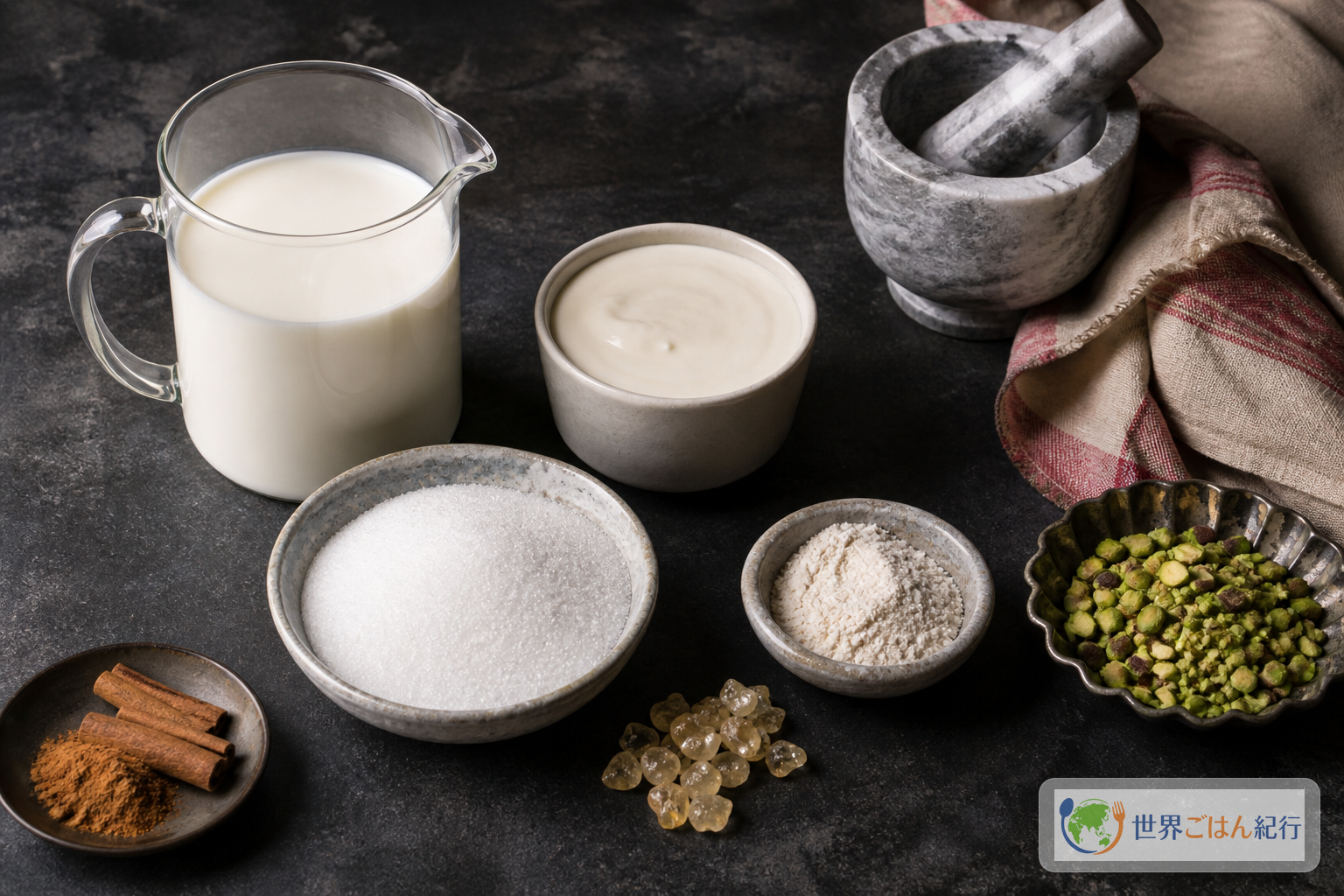
When shopping for salep, choose a powder or mix sold as food, with the ingredients and manufacturer clearly listed, not the tubers themselves. In Turkey, wild orchid harvesting has affected plant populations, so it's safest to avoid products that advertise wild harvesting, or small packets whose use and origin you can't read. If you can't confirm all three — cultivated source, legal supply chain and food labeling — switch to the cornstarch version.
Salep-based mixes vary by product and may contain added sugar and flavorings. Don't add all 120 g sugar from the start; read the label and subtract the sweetener. Even with pure powder, strength varies by product, so it's safer to start small and adjust. If you add mastic as whole tears, the aroma concentrates in one spot and you get a bitter, resinous bite.
Choosing a tool for the mastic
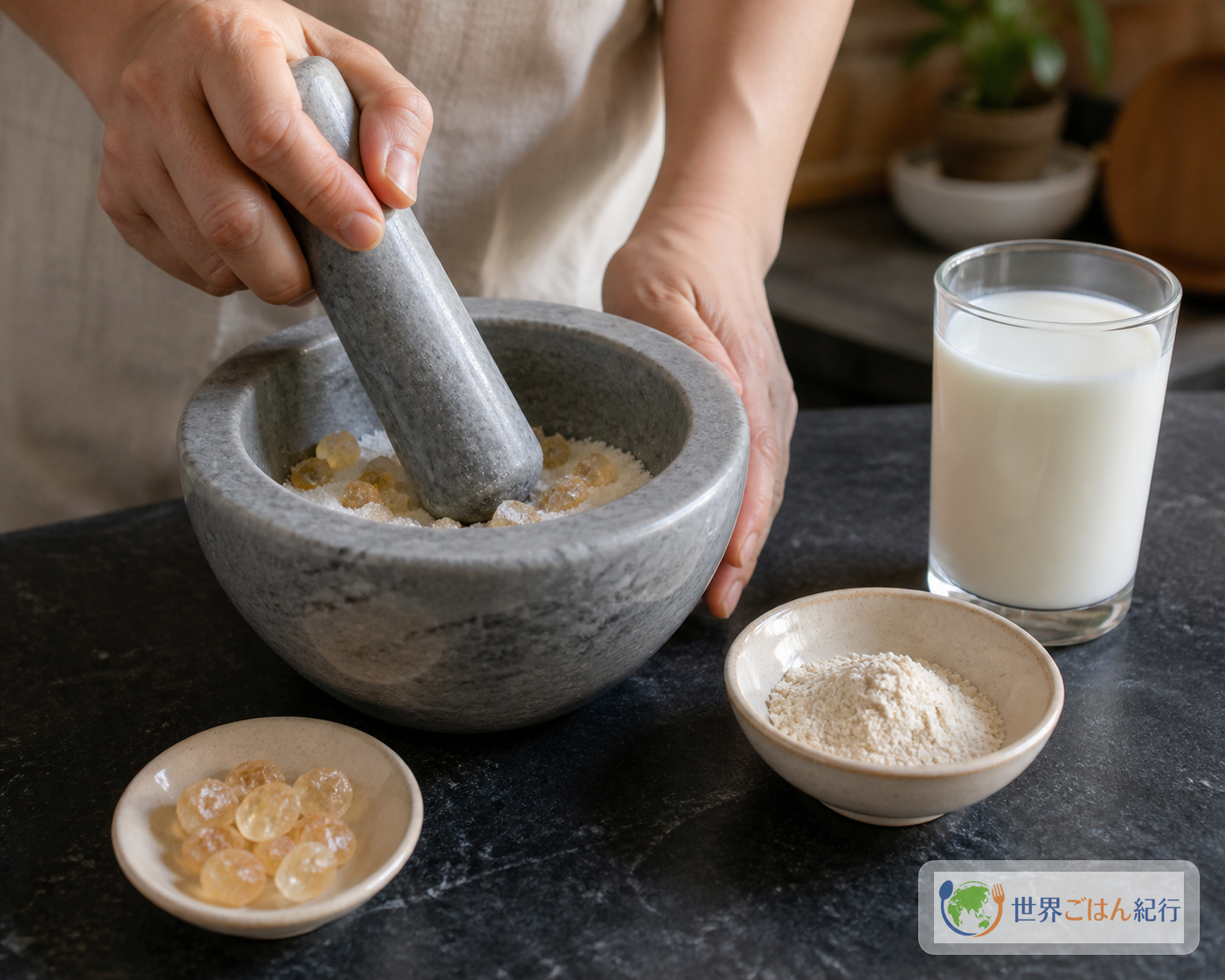
Mastic doesn't turn into a fine powder even when frozen, but if you press it in a mortar with a little sugar, the tears break into fine bits that disperse through the milk. You can also chop it with a knife or use a grinder reserved for spices. If you're only trying dondurma once, or already own a mortar of any kind, there's no need to buy one.
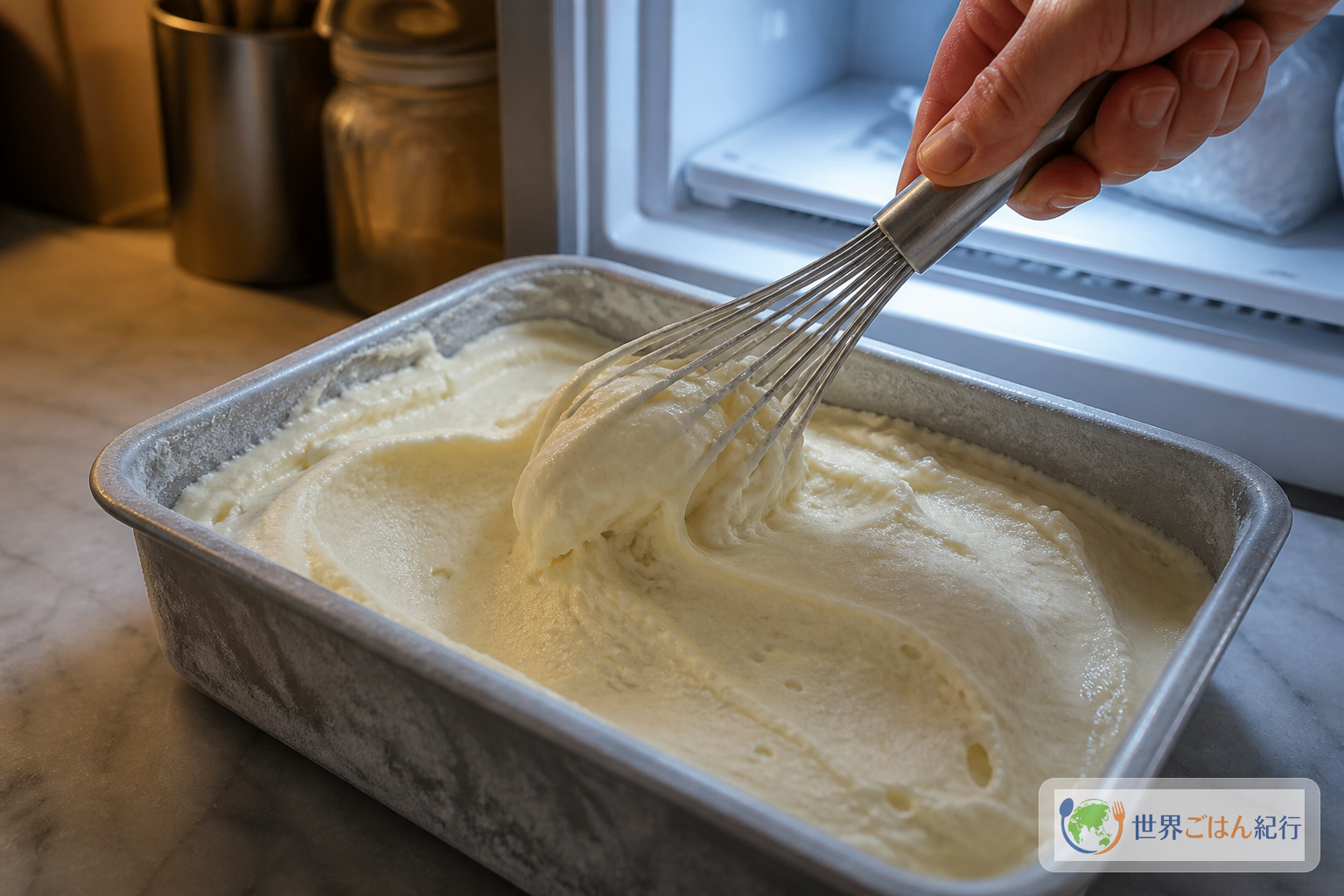
If you're stirring by hand, set a timer for every 30 minutes and each time pull the parts that freeze first, at the corners and edges of the pan, into the center. Too few stirs make larger ice crystals and make it harder to get that stretchy texture.
Heat and chilling that keep the chew
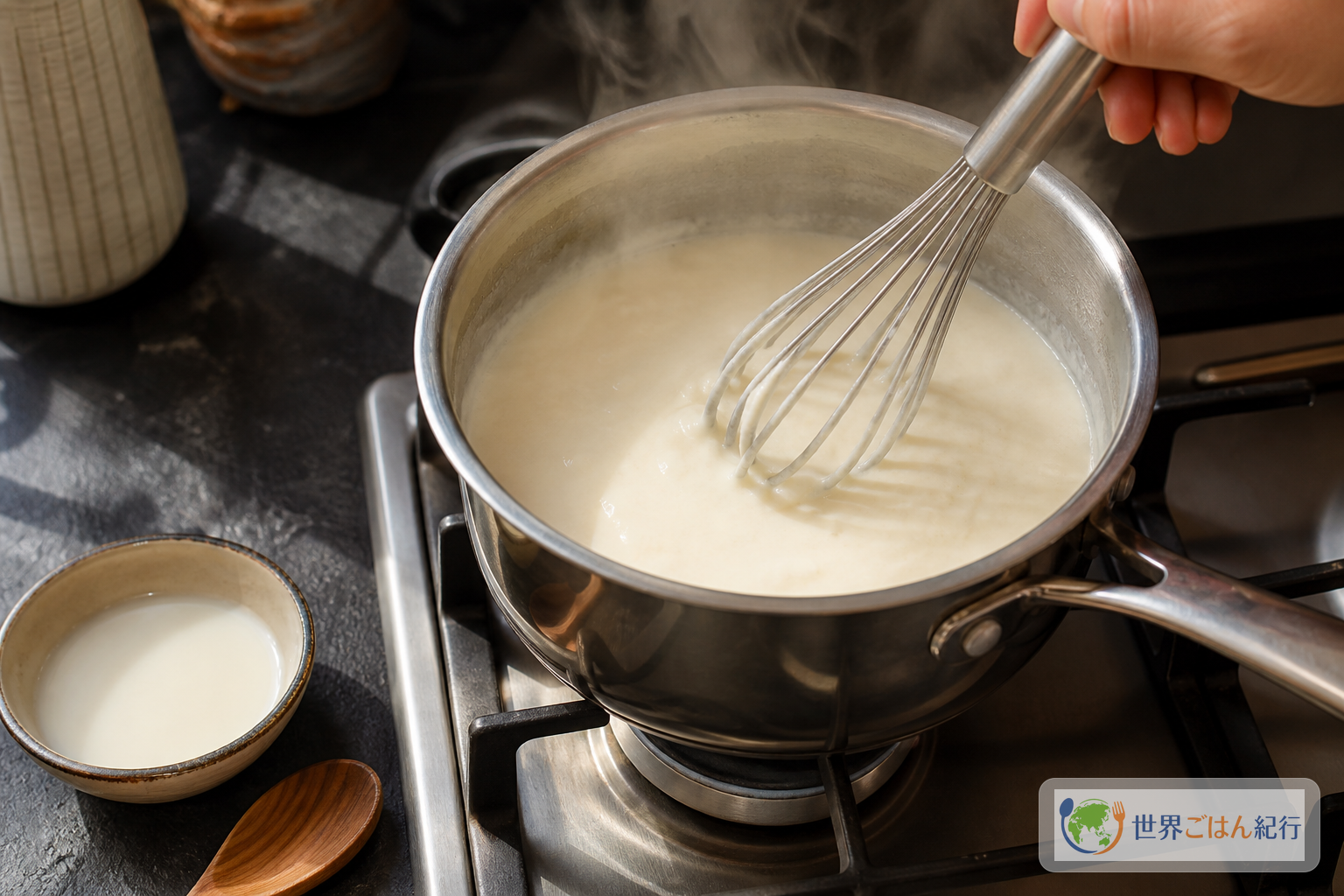
Disperse the salep in cold liquid before it goes into the pot. Sprinkling the powder straight into hot milk gelatinizes only the outside, forming small lumps that stay grainy no matter how much you churn afterward. Dissolving it first in 100 ml of cold milk isn't about adding more ingredients; it gets moisture to every grain of powder first.
If the bottom of the pot scorches, don't scrape it; pour only the top portion into another pot. Stirring in the scorched part spreads bitterness through the whole batch. If the transferred base is thin, return it to low heat in 5-minute rounds; if it's too thick, add warm milk 1 tbsp at a time. Adding milk after freezing creates more ice crystals, so any correction belongs at the heating stage.
Mastic's aroma recalls pine resin, conifers and dried herbs. Even 1 g lingers in the milky aftertaste, so don't increase it on your first try. If the aroma is too strong, serve it with chopped pistachios and cinnamon to soften the finish. Adding sugar afterward won't hide the resin, so next time halve it or leave it out.
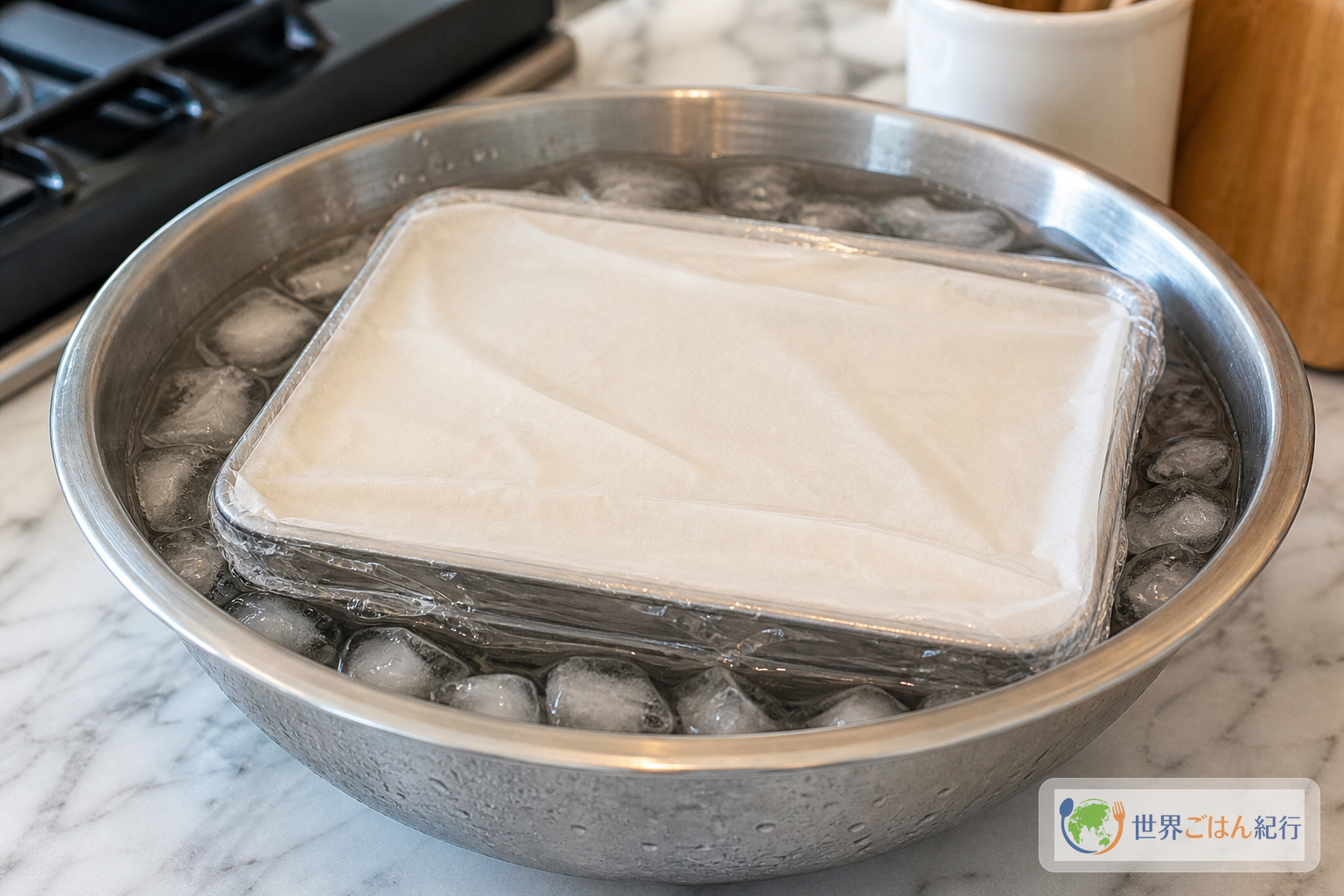
Your freezer's performance changes the result. A shallow pan chills through to the center easily, while a deep container freezes at the edges first. Without a machine, spreading the base about 3 cm (1 1/4 in) thick and pulling the white frozen edges back to the center every 30 minutes is the single biggest thing you can do at home.
Swaps at home: what to keep close to Maraş and what to let go
In the official Maraş descriptions and regional product materials, the combination of goat's milk, salep and sugar is treated as the core of the product. SBS's home recipe, on the other hand, uses milk, cream and a salep mix, works it in a pot for a long time and then freezes it. For a home version, deciding which differences to keep, rather than matching every raw ingredient, makes the texture easier to predict.
| Don't change | OK to change at home | What changes |
|---|---|---|
| Dissolve salep in cold liquid | Choose pure powder or a labeled mix | A mix makes sweetness and thickness easier to predict, but products vary |
| Crush only a little mastic | Tears, powder, or none | Leaving it out softens the aroma, but salep is still what drives the stretch |
| Build thickness over low heat | The ratio of milk to cream | Less cream makes it lighter and more prone to ice crystals |
| Churn repeatedly during freezing | Use an ice cream maker | A machine evens out the air and ice crystals more easily |
| Add a few pistachios | Swap in unsalted chopped almonds | The aroma and texture change, but you keep the crunch on top |
Harvesting and drying wild orchid tubers to make your own salep is a different matter altogether from sourcing ingredients for home cooking. Turkish public agencies are working on cultivated supply and management. Don't choose an unlabeled powder just because it's cheap; confirm that it's sold as food and made from cultivated or legally sourced material. If you can't confirm that, use 12 g cornstarch in place of salep and accept the result as a rich milk ice cream rather than a stretchy one.
Variations: keep the texture, change the aroma
Mix pistachios into the ice cream
Of the 30 g unsalted pistachios, add 15 g just before the last churning is done. Adding them before it freezes solid keeps the nuts from sinking, so every bite has a little crunch. Use the rest for serving, adding toastiness without more sweetness.
Leave out the mastic and let the milk come forward
If you don't care for the resinous aroma, leave out the mastic. Vanilla makes it more approachable, but it isn't a substitute for the Turkish mastic flavor. As long as you keep the salep and the freeze-churning, the aroma changes but the sliceable texture holds up well.
Milk gelato–style with cornstarch
When you can't find salep, dissolve 12 g cornstarch in 100 ml milk and heat it the same way. The stretch when you lift it from the pot will be weak, though, and after freezing it will be a texture better scooped than sliced. Rather than calling it dondurma, serving it as a homemade milk gelato makes the difference in texture easier to explain.
Fuller aroma with goat's milk
Swap the 500 ml milk for 500 ml goat's milk and keep the 170 ml cream as is. People who aren't used to it may find the aroma strong, so you can make it with cow's milk first and replace only part of it next time. Switching to goat's milk doesn't mean you need more salep or a longer cooking time.
Serve in a cone instead of slicing
To recreate the street-stand show, there's no need to toss it on a long rod or twirl cones next to hot water. Let the block sit at room temperature for 5 minutes, press it out with a small spoon and pack it into a cone. As long as the chew is there, even a home dish brings out the fun and the slight difficulty of eating dondurma.
Storage and how to rescue mistakes
Press plastic wrap onto the surface of the finished ice cream, put it in an airtight container and freeze. A freezer at -18°C (0°F) or below and a refrigerator at 4°C (40°F) or below are the official guidelines for keeping food cold. At home, treat 1 week as the quality guideline before aroma and texture fade; don't refreeze repeatedly, and cut out only what you'll eat. The 1-week figure is a home quality guideline and does not replace the use-by or safety dates of commercial products.
| Problem | Likely cause | What to do |
|---|---|---|
| Lumps of salep remain | Added directly to hot liquid | Before it cools, pass it through a fine-mesh strainer and stir over low heat for 5 min. Once frozen, it can't be fully fixed |
| Runny after freezing | Underheated, or not frozen long enough | Before freezing, return it to low heat in 5-minute rounds. After freezing, extend the freezing time by 2 hours |
| Large ice crystals | Deep container, long gaps between stirring | Don't half-thaw it; next time use a shallow pan and stir every 30 min |
| Scorched bottom | Heat too high, too long between stirs | Don't scrape; transfer only the top portion to another pot, and start over if it tastes bitter |
| Mastic tastes medicinal | Too much, or tears left whole | Serve with pistachios; next time use half or leave it out |
| Too hard to slice | Cut right out of the freezer | Add 2 minutes at room temperature at a time, warm the knife and wipe it dry before cutting |
If the base is thin before freezing, you can return it to the pot before it goes into the freezer. Adding milk or cream after it's frozen, on the other hand, creates more ice crystals as it thaws and refreezes. Think of it this way: mistakes you can rescue belong to the heating stage, and the only thing to adjust at slicing time is the time at room temperature. That keeps the texture intact.
FAQ
Are a salep-based mix and pure salep powder the same?
Don't use them in the same amounts. A mix may contain sugar, flavorings, dairy and more, so the amount to use and the sweetness differ from pure powder. Follow the package label and subtract what it contains from the 120 g sugar. It's safer not to use a powder whose ingredients you can't read.
Can I make it without mastic?
Yes. Mastic is mainly about aroma; it isn't as central to the texture as salep. Without it, the milky sweetness comes through straight, but you won't get the pine-resin aftertaste. If you add vanilla, treat it as a different flavor.
Will it stretch without an ice cream maker?
You can get the stretchy texture, but more ice crystals may remain than with a machine. Spread it in a shallow pan and stir from the edges to the center every 30 minutes, 4–5 times. If you freeze it overnight without churning at all, it may slice, but it will feel coarse on the tongue.
Without goat's milk, is it not the real taste?
The milky aroma will differ from the Maraş product. Cow's milk and cream are easy to work with at home and make it easier to control fat content and freezing conditions. The realistic order is to nail the texture first, then switch to goat's milk and compare the aroma.
If I swap salep for cornstarch, is it still dondurma?
As a home substitute it's fine, but the stretch and slow melting will be weaker. Rather than holding on to the name, prioritize describing it accurately; calling it "milk gelato–style" keeps the people eating it from expecting something it isn't.
A dish that connects to the Turkish table
Dondurma isn't just a sweet that closes the meal. Set a small slice after the bitterness of Turkish tea or a light, salty snack, and the milky sweetness and resinous finish slowly unfold. Served after lahmacun (in Japanese), Turkey's thin flatbread topped with minced meat, its coolness balances the toasty meat and the tangy salad.
If you want a sweeter table, rather than lining it up next to Cyprus's cheese bread flaouna (in Japanese) or the syrup-soaked baklava (in Japanese), choose just one of them. Dondurma has a distinctive aroma and texture, so piling on sweets buries the mastic finish. Brew the tea strong and scatter just a few pistachios, and you have a small homemade dessert, different from the street-corner cone.
In short: keep the reason it stretches inside your freezer
The fun of dondurma is that it's cold yet sliceable, and that the chew comes not just from adding a powder but from the order of heating and churning. Choose a labeled, food-grade salep, crush a small amount of mastic, and slowly develop the powder you dissolved in cold milk over low heat.
Let the overnight-frozen block sit at room temperature for just 5 minutes; if the cut face is smooth when you slice it, the texture you saw at a Turkish street stand is there in your home freezer. If you can't find salep, don't force the name; let it land deliciously as a milk gelato.
Sources
- Kahramanmaraş Valiliği「Kahramanmaraş Dondurması」 https://www.kahramanmaras.gov.tr/kahramanmaras-dondurmasi Accessed and checked August 21, 2026
- SBS Food「Turkish ice-cream (dondurma)」 https://www.sbs.com.au/food/recipe/turkish-ice-cream-dondurma/m62x9tmdi Accessed and checked August 21, 2026
- DOĞAKA / Kalkınma Kütüphanesi「TR63 Yöresel Ürünler İngilizce Kataloğu」pp.54–55 https://www.kalkinmakutuphanesi.gov.tr/assets/upload/dosyalar/tr63-yoresel-urunler-ingilizce-katalogu.pdf Accessed and checked August 21, 2026
- GoTürkiye「The Sweet Happy Ever After」 https://goturkiye.com/istanbul/the-sweet-happy-ever-after Accessed and checked August 21, 2026
- Atlas Obscura「How to Order Dondurma, Turkey’s Stretchy Ice Cream」 https://www.atlasobscura.com/articles/dondurma-stretchy-ice-cream-vendor-watch Accessed and checked August 21, 2026
- Orman Genel Müdürlüğü「Türkiye’de Salep Üretiminde Yeni Dönem Başlıyor」 https://www.ogm.gov.tr/tr/haberler/turkiyede-salep-uretiminde-yeni-donem-basliyor Accessed and checked August 21, 2026
- Royal Botanic Gardens, Kew「Orchis anatolica — General Information」 https://powo.science.kew.org/taxon/urn%3Alsid%3Aipni.org%3Anames%3A648356-1/general-information Accessed and checked August 21, 2026
- FoodSafety.gov「Cold Food Storage Charts」 https://www.foodsafety.gov/food-safety-charts/cold-food-storage-charts Accessed and checked August 21, 2026