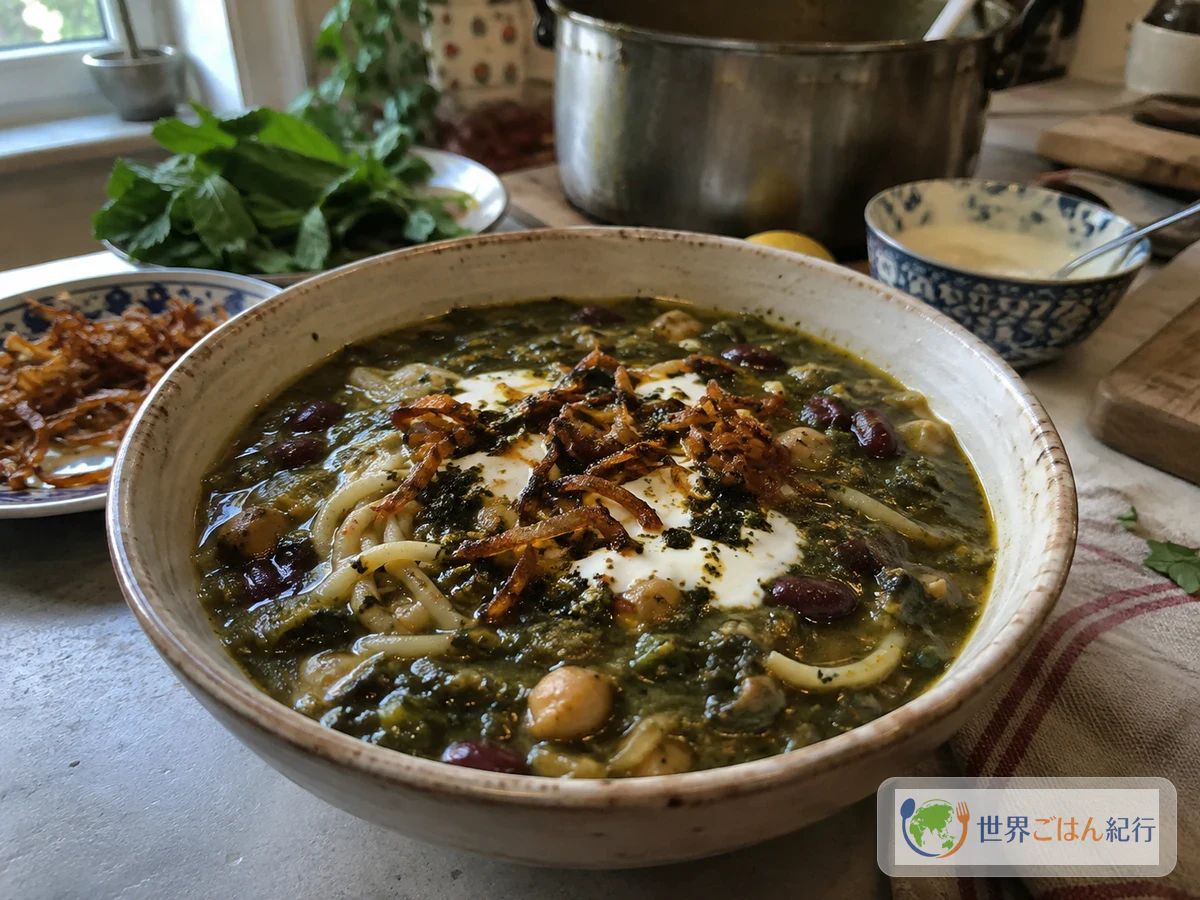
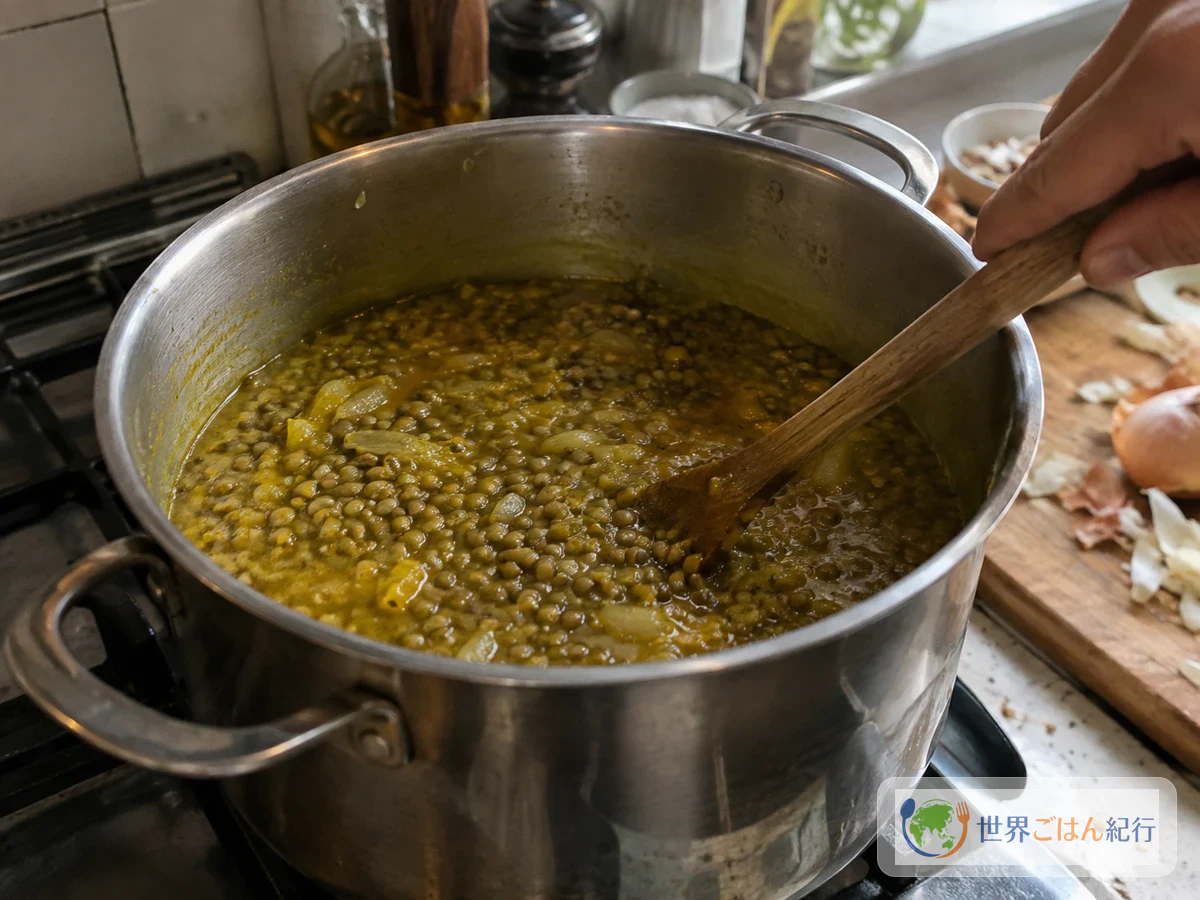
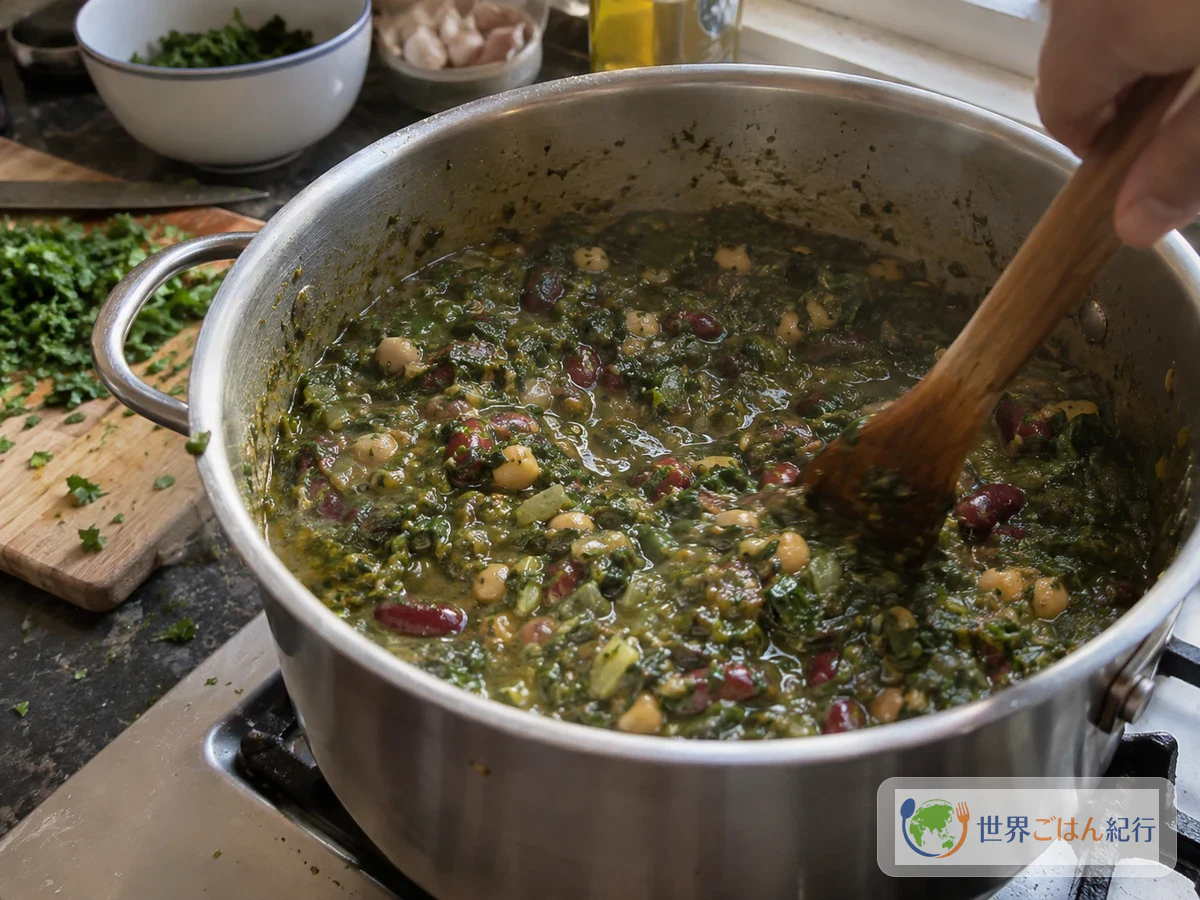
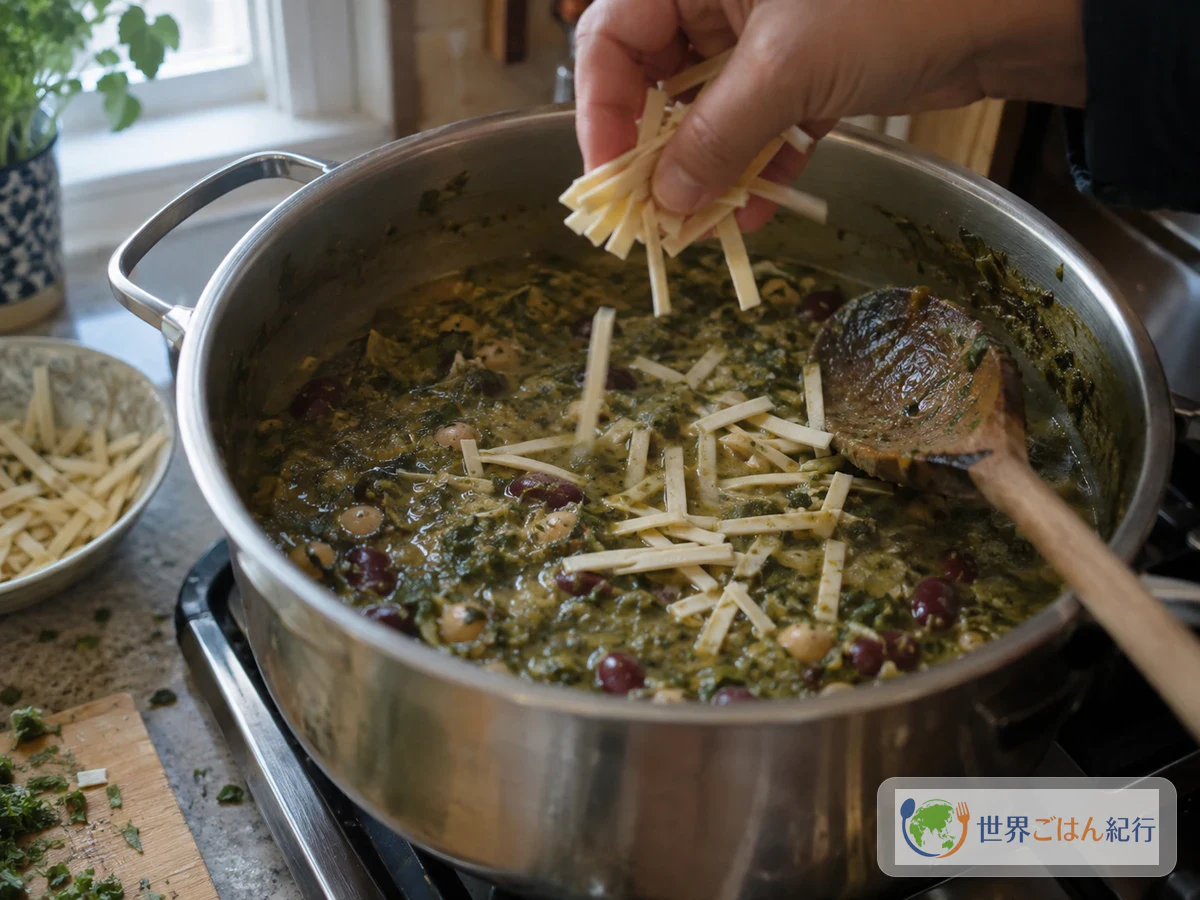
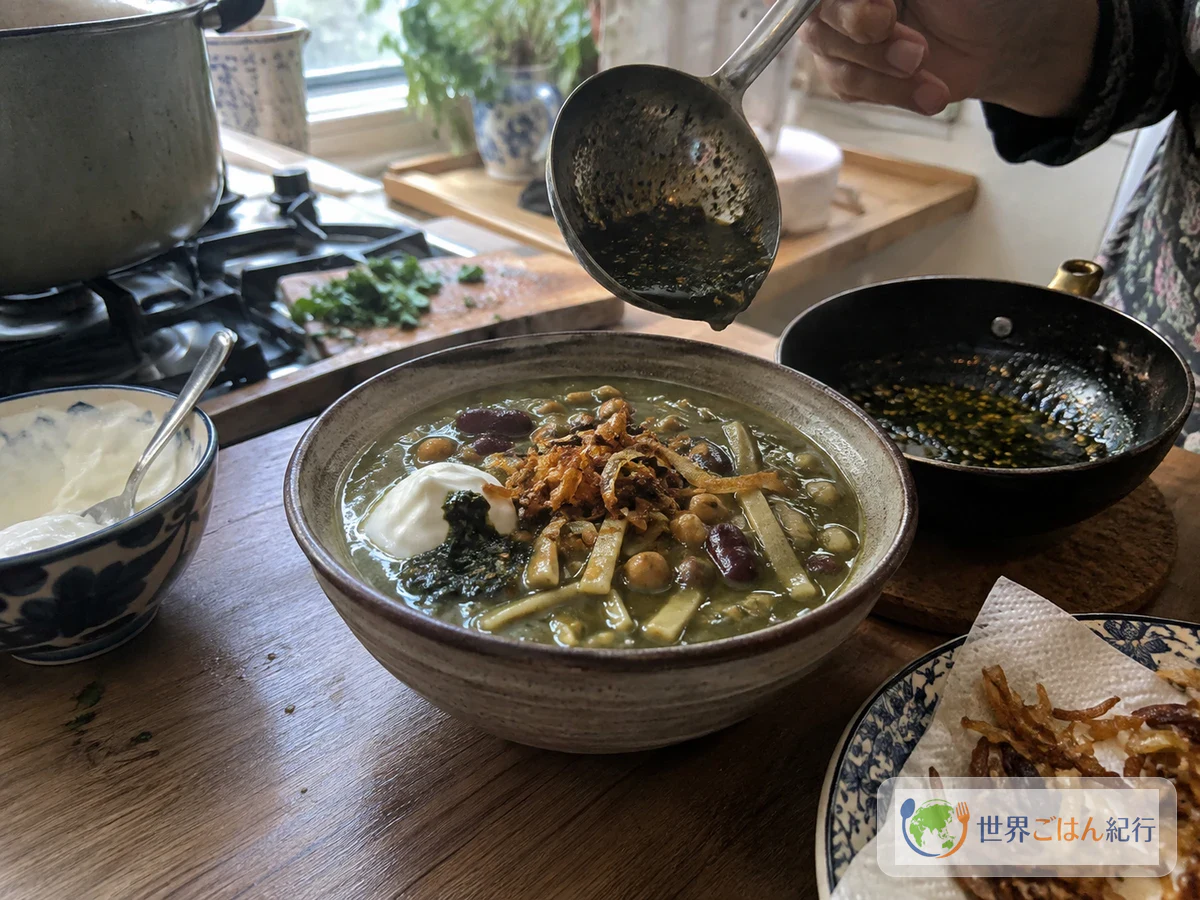
Ladle a dense green soup into a bowl, lay fried onion on top, pour over dried mint warmed in oil until fragrant, and finish with a spoonful of white, tangy dairy. It is a way of layering aroma in the bowl that you see in Iranian homes. Ash-e reshteh (آش رشته / Ash-e Reshteh) is a thick soup of beans, greens and noodles. Beans, greens and herbs, plus wheat noodles, make a pot of deep green.
This article gives you a 4-serving recipe for a home kitchen. Prep takes 20 minutes and cooking about 80, so roughly 100 minutes in all. Because it uses canned beans, there is no soaking. The result is nothing like a clear noodle broth: beans and greens come together in a soup thick enough to run slowly off the ladle. If you can't find the dedicated noodles, 120 g of dried udon works, and the dairy is 100 g of thick unsweetened yogurt. It will not taste exactly like the original dish, though. And the noodles go in last; that is the order of work in this pot.
A green pot at the New Year table
Nowruz is the Iranian New Year, celebrated around the spring equinox. The date on the Western calendar is not the same every year. Ayeh Manfre describes her own family's customs: Chaharshanbe Suri, the fire festival before the new year, and Sizdah Bedar, spent outdoors on the 13th day of the new year, where ash-e reshteh is what they eat. That is her family's story, and customs differ between households and regions; not every Iranian does this. Still, picture a big pot at the center of a crowd gathered outdoors and you can see the face of this dish: a pot for New Year gatherings.
A spring celebration dish might make you imagine something showy, but ash-e reshteh is also presented as a thick soup to eat hot in the cold season. Plenty of herbs are simmered in, so the pot turns deep green. Beans and noodles share the pot, so even though it is a soup, one bowl is a solid meal. Being a celebration dish and filling an ordinary hunger sit together easily in this pot. It suits the scene of cupping a steaming bowl in both hands better than any talk of nutrition or health benefits.
"Reshteh" is the noodle that goes into this dish. In Latin letters it appears as Ash-e Reshteh, Aash-e Reshteh and other spellings; in Persian it is written آش رشته. "Ash" is explained as a word for a thick soup. The exact etymology and any ancient origin are not clear.
A bowl on a mountain road north of Tehran
Cook Hami Sharafi presents this dish as a family travel memory. On the way from Tehran to northern Iran, before the long tunnel on Kandovan Road, there was a small eatery serving ash-e reshteh where the family stopped, as she writes. The mountain air is cold, and the warmth of the bowl you are handed must have felt even better. A warm bowl at a roadside eatery suggests that the dish is loved not only on festival days but also as food to warm travelers on the road.
There is no single fixed recipe for this pot. In the home recipes I checked, the mix of chickpeas, red kidney beans, pinto beans and white beans differs, and so does the combination of spinach, parsley, cilantro, chives or scallions. Hami's recipe includes optional marrow bones, Ayeh's includes vegetable broth, and whether meat is used varies from one cooked example to another. Proportions are not fixed by province; it is closer to the truth to say that every household has its own beans and greens.
Hami Sharafi writes that her mother preferred to serve vinegar rather than kashk. This is simply one family's preference. If you serve the dairy on the side, each person can adjust the sourness in their own bowl. Note that using vinegar does not make every ingredient allergy-friendly.
Noodles, herbs and the white finish
Reshteh is a flat wheat noodle for soup. If you look for the dedicated product, choose one labeled for ash. It is different from the reshteh used in rice dishes, so don't mix them up. In this base recipe, 120 g of dried udon is snapped into thirds. Fresh boiled udon has a different water content and method, so it cannot replace it at the same weight. 120 g of linguine also works. With either dried noodle, start by checking the time on the package, then simmer in the soup until tender through the center.
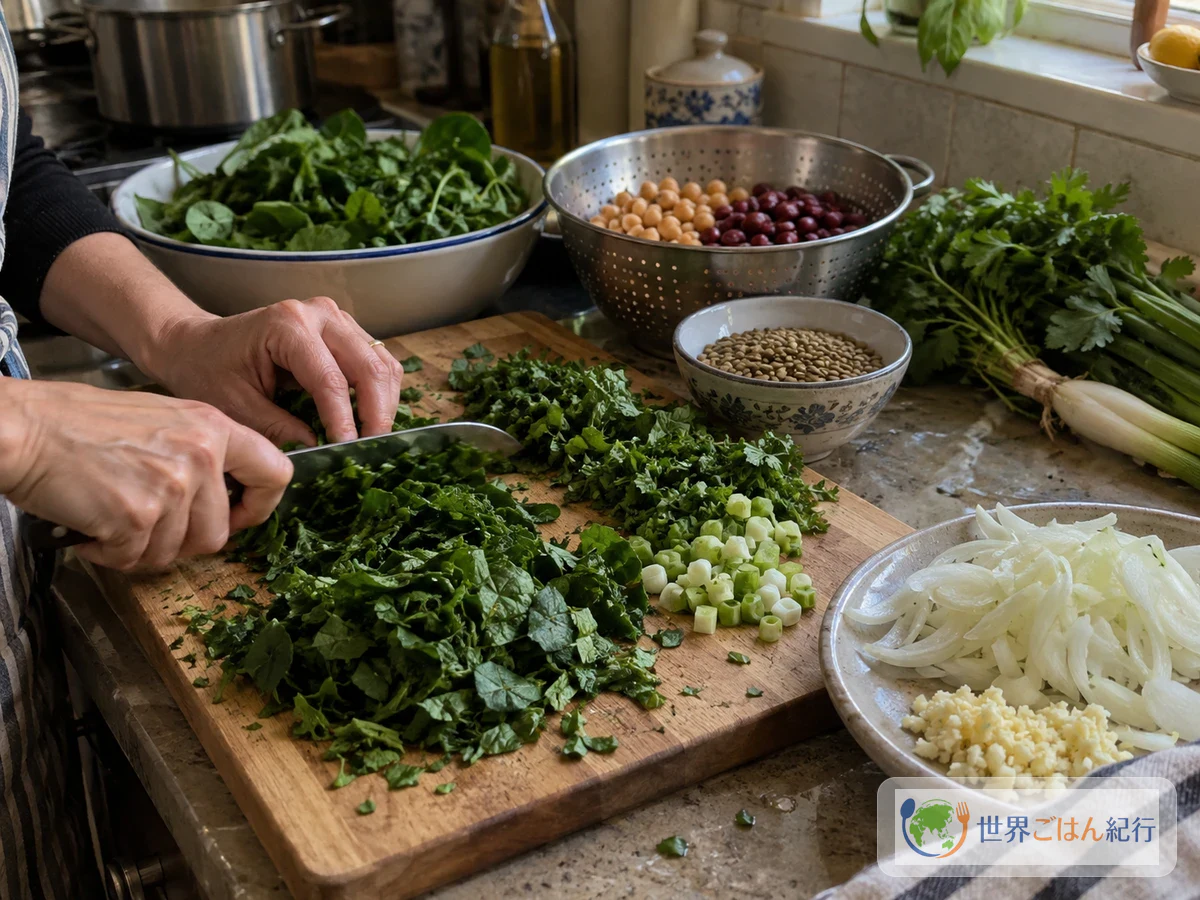
The quantity of greens is the key. Use 200 g spinach, 60 g parsley, 60 g cilantro and 30 g scallions, 350 g in total. Spinach is weighed as leaves and tender stems; parsley and cilantro are weighed without tough stems. Only with 350 g of greens and herbs in total do you get that deep green. A few leaves as a garnish won't reproduce the amount of herbs. If you dislike cilantro, you can replace its 60 g with 30 g parsley and 30 g spinach, but the kind of aroma changes.
Kashk, used for the white finish, comes from fermented dairy, is salty and sour, and is sold in several forms such as liquid or dried. It is not the same thing as unsweetened yogurt. In the base recipe, 100 g of thick unsweetened yogurt and 10 ml of lemon juice are served separately so everyone can adjust sourness in their own bowl. If you switch to kashk, start with 50 g of the liquid kind. Follow the package for salt, heating and storage. As a substitute, no single weight or amount of salt can be set for every product.
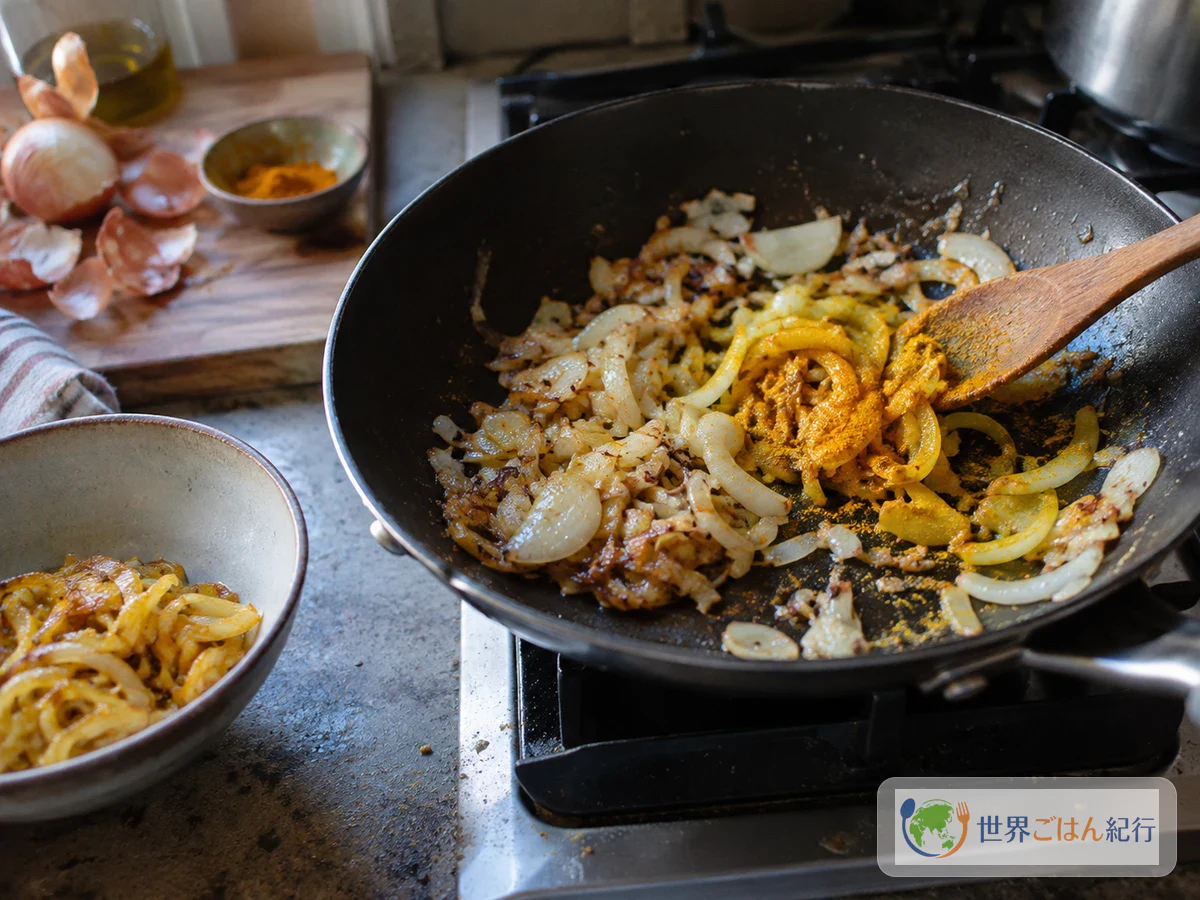
The dried ingredients you may need to buy each have a job. For the lentils, choose whole green or brown lentils, which keep their texture and give the broth body. Hulled red lentils break down easily and won't give the same texture. Turmeric is warmed briefly in the onion oil. Dried mint is warmed in oil to release its aroma and poured on at the end; fresh mint alone cannot give the strong scent of dried leaves or the oil-warmed state. Look for lentils, dried mint and kashk at Middle Eastern or international grocers, or online.
In the base recipe, the dried noodles contain wheat, and the yogurt and kashk contain dairy. If you have a dairy allergy, skip the dairy and use the lemon juice served on the side a little at a time. Lactose intolerance and milk allergy are not the same thing. Check the ingredient and allergen labels on imported noodles, dairy products and processed beans. Also, don't use dried kidney beans with the same cooking time as canned beans.
Ingredients (serves 4)
Use a heavy pot of 3 L or more and start with 1200 ml of water; add more later depending on the depth of the pot and how much the noodles absorb. The 100 g of beans is the drained weight, not the gross weight of the can. Measure beans by drained weight. The base recipe is the unsweetened yogurt version; kashk is treated as a separate option.
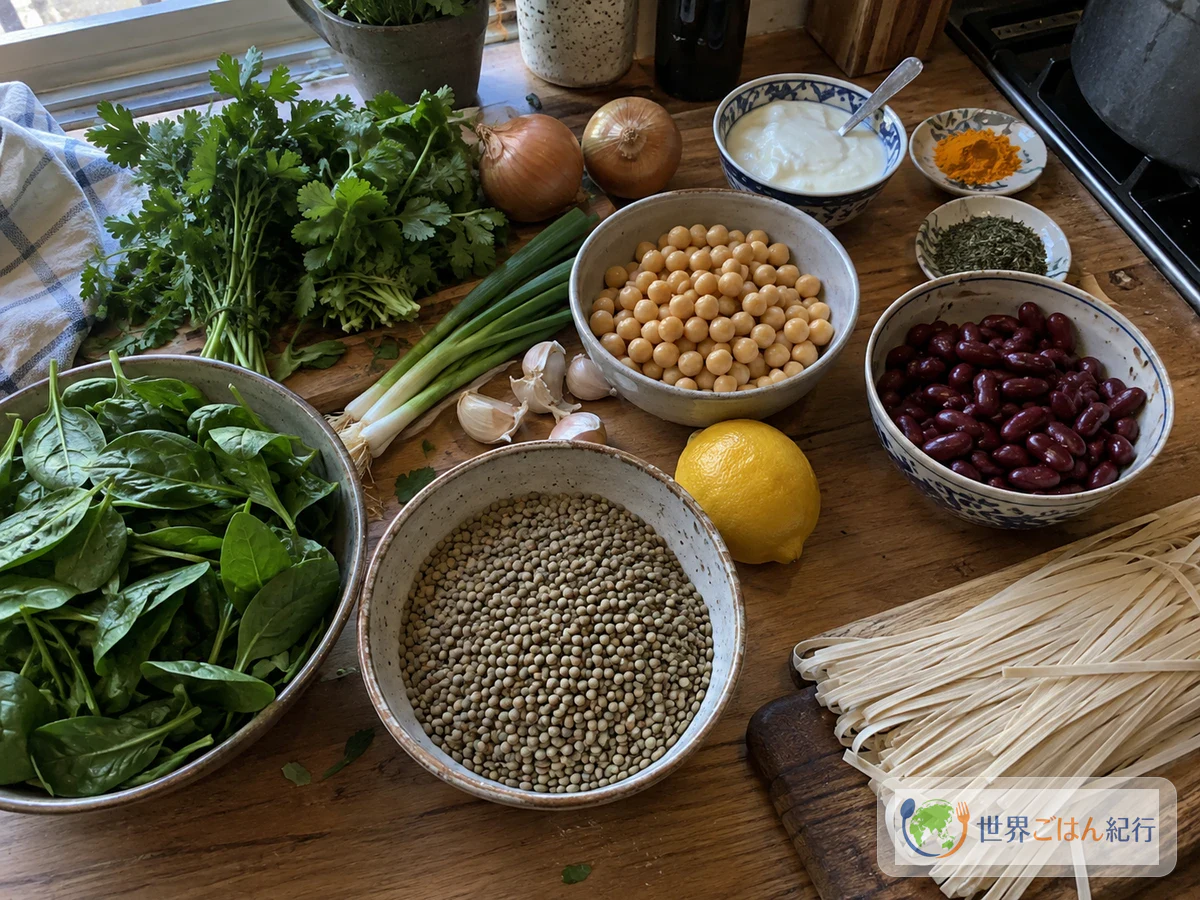
Keep 100–300 ml of hot water ready on the side, and after adding the noodles, add 100 ml of hot water at a time. If you pour in all of it at the start, the soup will be thin for the amount of beans. Then if you try to thicken it again by simmering the noodles longer, the noodles fall apart.
Method
There are six steps. Set aside onion and garlic for the finish as you go, and warm the mint separately at the end. Don't forget to save some onion for the finish. The 20 minutes of prep and about 80 minutes of cooking are a guide; the package time of the noodles and the softness of the lentils matter more than the clock.
Once the noodles are in, they absorb liquid, and the soup thickens further as it cools. If you are making some ahead, keep the dairy separate. If you keep stirring hard while separating the noodles, both beans and noodles break. Stir gently, lifting from the bottom, and aim for tender through the center, never clumped.
Dried mint releases its aroma in 20–30 seconds. Don't leave it on the warm pan; move it to a heatproof container right away. Never fry it until black. If the mint oil is burnt and bitter, don't put it in the soup; make a small new batch.
Fixing soup that is too thick or too thin
A bowl that has cooled, or the pot the next day, gets thicker. That is fine as long as the solids hold together, but it is another matter if it becomes a mass that doesn't move when a spatula goes in. If the noodles and beans are tender enough, don't stretch out the cooking; the quick fix is to add hot water when it's too thick. Add 100 ml of hot water at a time and heat everything evenly.
| Problem | Fix | Next time |
|---|---|---|
| Almost no liquid, set solid | Add 100 ml hot water at a time and stir over low heat | Check thickness after the noodles absorb and before serving |
| Thin before the noodles go in | Remove the lid and simmer 5–10 minutes over low heat, then add the noodles | Don't add all the adjusting water at the start |
| Still thin after the noodles | Scoop out 2 tbsp of beans, mash them, return to the pot and warm 3 minutes | Don't try to thicken by simmering the noodles longer |
| Too salty | Add unsalted hot water 100 ml at a time. Stop adding dairy or salt | Salt after the noodles are cooked and you've tasted the saltiness of the dairy |
| Scorched bottom | Don't stir; move only the unburnt top part to another pot. Once the bitterness has spread, it can't be undone | Use low heat and a heavy pot, and stir from the bottom regularly |
| Bitter mint oil | Don't put it in the pot; make it again | Move it to a container right after 20–30 seconds of heating |
The same thinking applies to sourness. Serve the 10 ml of lemon juice for 4 servings on the side and don't pour it all into the pot at once. Sourness is added bowl by bowl. For a bowl that tastes too sour, add a little unsweetened yogurt, only if the person can eat dairy. Hiding it by adding sugar to the whole pot is not what we do.
Five ways to vary the same pot
Swapping beans and serving vinegar on the side appear in home recipes by local cooks. The specific substitution amounts in the table below, however, are suggestions for home kitchens and not traditional proportions of any region. The basic rule is to swap canned beans at the same weight.
| Variation | What changes for 4 servings | What it changes |
|---|---|---|
| White bean version | 100 g red kidney beans to 100 g canned white beans | Color and the mouthfeel of the beans change |
| Less-cilantro version | 60 g cilantro to 30 g parsley and 30 g spinach | The amount of greens stays the same; the distinctive aroma is softer |
| Linguine version | 120 g dried udon to 120 g linguine | Keeps the flat noodle shape. Check the package time |
| No-dairy version | Leave out 100 g yogurt, serve 10 ml lemon juice on the side | Less milky richness; the greens and beans come forward |
| Frozen spinach version | 200 g fresh spinach to 200 g frozen | Less washing and cutting. Follow the package for heating and thawing |
If kashk and dried mint are left over in your kitchen, try kashk-e bademjan, made with eggplant (in Japanese). If you get curious about another herb-heavy stew, take a look at ghormeh sabzi too (in Japanese). Neither is the same dish in flavor or ingredients. They pair well with ash-e reshteh in that the finish is served on the side.
- Kashk-e bademjan, with kashk and mint oil (in Japanese)
- Ghormeh sabzi, a stew of simmered herbs (in Japanese)
Storage and reheating
If a big pot is left over, divide what you won't eat into shallow containers and refrigerate promptly. Don't wait several hours for the whole pot to cool at room temperature. As a guide, refrigerate at 4 °C (40 °F) or below within 2 hours, or within 1 hour if the room is above 32 °C (90 °F). The US government site FoodSafety.gov gives 3 to 4 days for refrigerated soup. If you cannot guarantee the temperature or handling at home, eat it sooner. Start by dividing into shallow containers.
| Method | Guide | When reheating |
|---|---|---|
| Refrigerator | Within 3–4 days at 4 °C or below | Put only what you'll eat in a pot. Add a little water and heat thoroughly and evenly |
| Freezer | At -18 °C or below, quality guide 2–3 months | Thaw in the refrigerator and reheat. Noodles tend to get soft |
| Dairy finish | Store separately from the soup and follow the product label | Add just before eating |
The noodles keep absorbing liquid while stored. When reheating, start with 30–50 ml of water per serving and add more if needed. This is a suggestion from this article. If keeping leftovers is the main goal, divide the portion to eat now from the portion to store at step 4, and add noodles to the stored portion on the day you eat it. Set aside before adding the noodles, and divide the noodle amount between the two portions as well.
Do not thaw frozen soup by leaving it out at room temperature for a long time; thaw it in the refrigerator. If reheating in a microwave, stir partway and check that the center reaches 74 °C (165 °F) or higher. On the stove, stir the whole pot and heat it thoroughly. Storage days alone do not guarantee safety. Do not eat anything that has been stored outside these conditions or that seems off.
FAQ
Can I make it with dried udon?
Yes, dried udon works. As a stand-in for reshteh, the base recipe snaps 120 g into thirds. It won't taste or feel exactly like reshteh, though. The salt in the noodles leaches into the broth, so add salt a little at a time at the end.
Can I make it without kashk?
Yes. Serve 100 g thick unsweetened yogurt and 10 ml lemon juice on the side. Use plain, unsweetened yogurt. It can't fully reproduce the fermented aroma and saltiness that kashk has.
Is it spicy?
The base recipe contains no chile. The stars are the bite of 1/4 tsp black pepper and the aromas of mint and turmeric. If you want more heat, add it only to your own finished bowl, rather than to the whole pot for the whole family.
Do I soak the lentils first?
In this base recipe, 80 g of washed, dried green or brown lentils go straight in and simmer for 20–30 minutes. If the product says to soak, follow that. Dried kidney beans and chickpeas need separate preparation and thorough cooking. Don't substitute them using the canned-bean steps.
My yogurt separated.
The rule is to serve it on the side in the bowl and not boil it in the pot. We can't say separated yogurt can be fully returned to its original state. If the visible bits bother you, next time stir in a little warm soup first to loosen the yogurt before using it.
Can I make it the day before?
Yes. Make the soup through step 4 (the beans and greens), divide it safely into containers and refrigerate, then heat it thoroughly the next day before adding the noodles. The next day, add the noodles afterward; that is the method. Soup stored with the noodles in it is also edible, but the noodles get soft and absorb liquid. It is not certain that taste or texture will be better.
Nutrition estimate
One serving of the unsweetened yogurt version, with the whole pot divided into 4, is roughly 410 kcal, 17 g protein, 14 g fat and 57 g carbohydrate. This is a rough estimate from the amounts of beans, noodles and oil, not a measured value. It varies with the type of noodles and dairy you buy and how you portion it. The same numbers do not apply to the kashk version or the no-dairy version. Please treat it as a rough figure for the pot divided into 4.
Because a bowl with beans and noodles is a meal on its own, this is enough for dinner. If you serve bread or rice with it, the starch is added. Adjust how much you eat by how much you ladle. These nutrition numbers cannot promise disease prevention, improvement or weight change.
Sources
- Hami Sharafi — Ash-e Reshteh - Persian Noodle, Herb and Bean Pottage (accessed and checked 3 October 2026)
- Cooking With Ayeh — Ash Reshteh (Persian Noodle Soup) (accessed and checked 3 October 2026)
- Cooking With Samira — Ash Reshteh Recipe (Persian Noodle Soup) (accessed and checked 3 October 2026)
- FoodSafety.gov — Cold Food Storage Chart (accessed and checked 3 October 2026)
- FoodSafety.gov — 4 Steps to Food Safety (accessed and checked 3 October 2026)