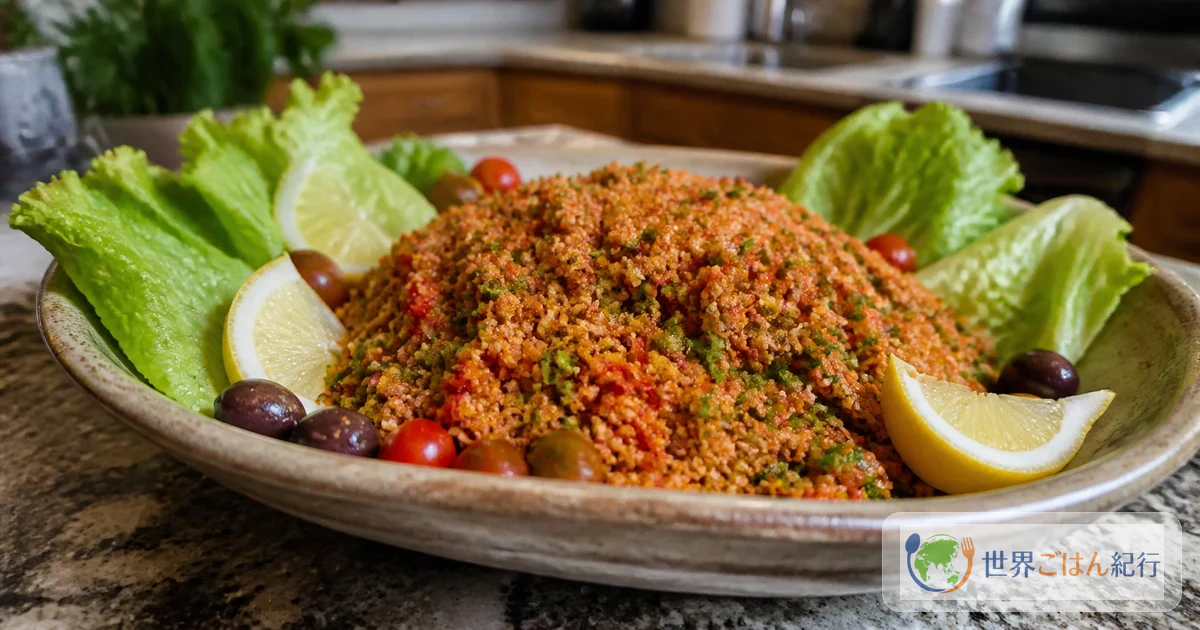
A morning of scooping warm beans with bread
The sound of chickpeas knocking in the pot shifts from strong bubbling at the start of cooking to a small tremble under the lid. Turn off the heat and combine lemon and garlic, and the earthiness of cumin lays over the sweet aroma of the beans, giving the lightness of a morning plate.
Balila (بليلة, balila) is a warm dish of tender chickpeas eaten with garlic, lemon, cumin, and olive oil. "Hummus Balila," the name used by Lebanese cooks and in introductions to home cooking, keeps a coarse texture you can scoop with bread, and is served at breakfast or as meze. The word hummus here is less the name of a paste than the Arabic word for chickpeas. The Tasty Mediterraneo recipe also describes it as a dish that pairs chickpeas, kept warm, with Lebanese bread and vegetables.
This dish does not get better the smoother you make the beans. They crush when pressed with a spoon, yet round grains remain on the plate. Find that boundary and you have balila, different from Lebanese hummus (in Japanese) and different from a bean salad.
The recipe centers on the Hummus Balila presented in Lebanon. Even under the same name, in Hejaz balila is loved as a street dish served in a bowl, with cucumber, onion, sauces, and spices added. Knowing that difference lets you decide for yourself whether to buy tahini, whether to add sumac, and how to fit it into a breakfast at home.
The same name, but not the same plate
Tying the dish to a single country misses what is interesting about balila. In a dish entry, balila is introduced as Levantine cuisine, while its origin is given as Hejaz and it is categorized as a hot meze. Meanwhile, the same name in Egypt refers to a different dish, in which wheat that is not cracked is combined with milk, nuts, and raisins. Even with the same name, do not mix them up as regional variations of a bean dish.

The Lebanese Hummus Balila is basically dried chickpeas cooked tender and seasoned with garlic, lemon, salt, cumin, and olive oil. Hadia's Lebanese Cuisine presents it as a breakfast eaten with Arabic bread, with the beans lightly crushed to a coarse state rather than made into a paste. Whether tahini or ghee is added varies by household and recipe, so the main ingredients here are beans and an aromatic dressing, and tahini is treated as an option.
Hejazi balila has a different rhythm of time. An Arab News report from the scene describes it in the Al-Balad district of Jeddah as a dish combining boiled chickpeas with cucumber, onion, and various sauces and spices. A Saudi Gazette feature records people gathering at stalls on Qabel Street on Ramadan nights, and beans passed down in families being carried to the shops. This is not a source describing the Lebanese breakfast as it is. But it shows that balila has a way of being eaten that includes not only the pot at home but also bread, pickles, and handing it over at street stalls.
| Name and region | Axis of flavor and texture | At the table |
|---|---|---|
| Lebanese Hummus Balila | Garlic, lemon, cumin, olive oil. Beans coarsely crushed | Breakfast, light lunch, meze. Served with pita and raw vegetables |
| Hejazi Balila | Boiled beans layered with cucumber, onion, sauces, and spices | Jeddah street stalls, Ramadan nights, takeaway |
| Egyptian Balila | A sweet dish with wheat, milk, nuts, and raisins | A different dish from chickpea balila |
If you make it at home, first make the Lebanese-style warm beans on one plate. On days you want to add a Hejazi mood, put pickles, thinly sliced onion, and a little chili sauce on a separate plate to finish. Not mixing it all into the pot lets each person adjust the sourness and heat.
If you use tahini, thin it with water and drizzle it thinly. Tahini is not an essential ingredient in this dish, so there is no need to buy a large container just for one plate of chickpeas. If you will also make hummus, falafel (in Japanese), or sauces for roasted vegetables, choose the size and number of jars after checking how much you will use.
Ingredients (serves 4)

This serves 4, soaking the beans the day before and finishing a warm plate the next day. Served in small portions as a side dish, it comes to about 6 servings.
What makes the biggest difference in flavor is the softness of the beans and the order in which acid is added. Canned beans save time but do not give the sweetness of the cooking liquid that dried beans do. On days you use dried beans, set aside just 60 ml of the cooking liquid without discarding it.
This uses tahini, which contains sesame, and pita, which contains wheat. If you choose a product containing soy or nuts as a substitute, check its label. Chickpeas are a legume, so serve a small amount to people unused to eating them, and stop eating if you feel unwell.
Sumac is an ingredient that adds a small amount of dry, fruity sourness different from the sourness of lemon. For balila alone, the dish works without it. If you will also use it in roasted vegetables, hummus, and salads, there is a reason to buy it.
If your sumac contains salt, do not put all 4 g of salt in the recipe in from the start; decide on the seasoning after combining the beans and the dressing. Check the net contents and ingredients on the label before choosing.
Method: cook the beans soft to the center
If you stop the heat watching only the timer, the result varies with the age of the beans and the thickness of the pot. Press a bean between your fingers each time and check that it crushes to the center.
Bringing back beans that are hard or too wet

With balila it is easier to eat by restoring the state of the beans than by adding more seasoning. Add lemon to beans whose centers are still hard and only the sourness stays on the surface. Conversely, adding cooking liquid to beans that have cooked apart makes it run too much to scoop with bread.
| Symptom | Cause | How to fix |
|---|---|---|
| Center is hard | Not soaked enough, old beans, heat too low | Add 150 ml water and cook another 15 minutes at a time over low heat |
| Skins stay in the mouth | Boiled too hard, old beans | Lower to low heat, skim the floating skins, and add 10 minutes |
| Too liquid | Too much cooking liquid, too little crushed | Crush 4 tbsp more beans and drive off moisture for 2 minutes over low heat |
| Sourness is sharp | Too much lemon, too little salt | Add 2 tsp tahini and 1 tbsp cooking liquid, and adjust the salt slightly |
| Cumin is weak | The aroma has faded, the beans have cooled | Add 0.5 g cumin and warm just 1 minute over low heat |
For cumin, decide the amount by whether the aroma remains rather than whether it is in the dish. Increase it all at once and bitterness comes out, so add 0.5 g at a time. If you will be buying more, a 65 g jar is easy to keep. For balila alone, the cumin you already have is enough. For people who will also make other Middle Eastern dishes, there is a reason to buy it to keep a consistent standard of aroma.
On days you use canned beans, put 480 g beans and 150 ml water in a small pot and warm for 10 minutes over low heat. Once pressing a bean shows the center is warm and the surface is not dry, you can start from step 4 of the dried-bean method. Putting in all of the canning liquid makes the salt and moisture hard to read, so discard it first and add only as much water as needed.
Back to the breakfast plate
Balila as presented in Lebanon shows its form when you put bread and vegetables on the same table and scoop a little at a time, rather than eating the chickpeas alone. Tasty Mediterraneo presents eating it with Lebanese bread, cucumber, radish, mint, parsley, onion, and tomato. A food-culture source from the American University of Beirut also lists balila as one of the breakfast dishes, organized as chickpeas, garlic, cumin, and olive oil.
Put warm balila beside cold hummus and baba ghanoush and the textures of the same beans and vegetables do not overlap. It also combines easily with sour tabbouleh. Rather than a small dish beside white rice, placing it near grilled chicken or fish, soup, and flatbread makes a menu where lemon and cumin are put to use.
| When you eat it | What to serve with it | Preparation |
|---|---|---|
| Breakfast | Pita, tomato, cucumber, olives, mint | Cook the beans the day before and warm them with the dressing in the morning |
| Meze | Hummus, baba ghanoush, tabbouleh, pickles | Set the warm beans beside the cold dishes |
| Light dinner | Grilled chicken, grilled fish, soup | Serve a small amount as a sour side dish |
| Hejazi mood | Pickles, thinly sliced onion, hot sauce | Serve the sauce on the side and let each person adjust |
Tahini has the role of binding the beans when they are placed on bread. However, this amount uses only 60 g, so a large set is a burden to buy. In a household that makes hummus or tahini sauce several times a month, choose after checking the breakdown of a 900 g size and the number of jars. If you make balila just once, using a little white sesame paste or leaving out tahini is the less strained choice.
Storage and frequently asked questions

Right after it is made, the steam from the beans and the cumin are at their peak. To store it, cool the mixed beans and dressing slightly, put them in a clean airtight container, and refrigerate. Take 3 days in the refrigerator as a guide, and reheat only what you will eat until hot in the center.
Which is better, dried or canned beans?
Dried beans have the advantage of the sweetness when cooked soft to the center and a slightly thickened cooking liquid you can use. On days you have little time, canned beans work too, but do not toss them right out of the can; warm them with 150 ml water for 10 minutes over low heat. Choose canned if you are trying just one plate, and dried if you want to get close in texture too.
I seasoned the beans while they were still hard
Before adding more acid, return the beans and 150 ml water to the pot. Heat 15 minutes over low heat and check the center of a bean with your fingers. Once soft, return the dressing, and if there is too much liquid, crush some of the beans to adjust.
Should I add tahini?
It is not essential. Without tahini, increase the finishing olive oil by 15 ml and reduce the cooking liquid by 1 tbsp. It becomes a light plate where the flavor of the beans and the lemon come forward. With tahini, it is easier to put on pita and holds together better even when it cools.
What should I change when eating with children?
Reduce the garlic to 5 g and serve sumac and chili sauce only on the adults' plates. Start the lemon juice at 20 ml and add after checking the sourness. Crush the beans to about half rather than a third, and it is easier to put on bread.
How many days does it keep?
Take 3 days in the refrigerator as a guide, and heat it to the center in a pot or the microwave before eating. If it dries out, add cooking liquid or water 1 tbsp at a time. If there is an off smell, a bulging container, or a change in sourness, discard it without eating.
Sources
- Hadia Zebib, "Balila, Hummus Balila" (published 2025-10-22): https://hadiaslebanesecuisine.com/blog/?p=16639 (accessed and checked 2026-07-28)
- Margarita Ribot, "Hummus balila" (published 2018-01-09): https://www.tastymediterraneo.com/hummus-balila/ (accessed and checked 2026-07-28)
- Wikipedia contributors, "Balila (dish)": https://en.wikipedia.org/wiki/Balila_%28dish%29 (accessed and checked 2026-07-28)
- Arab News, "Balila dish keeps alive a Hijazi tradition in Al-Balad" (published 2013-07-21): https://www.arabnews.com/news/458692 (accessed and checked 2026-07-28)
- Saudi Gazette, "Famous for its food vendors, Jeddah's Qabel St. continues Ramadan tradition" (published 2012-07-28): https://saudigazette.com.sa/article/10519 (accessed and checked 2026-07-28)
- American University of Beirut, "Canaanite Dishes and their Ingredients" (Table 5 in the PDF): https://scholarworks.aub.edu.lb/server/api/core/bitstreams/f968d3c6-4655-4759-bc80-1919811648ff/content (accessed and checked 2026-07-28)