A dish that starts with the sound of chopping parsley
When your knife goes into a cutting board covered with parsley, the dry leaves jump in tiny pieces and a green scent rises. Next to it, fine bulgur is soaking up lemon juice. It's tempting to cut the tomatoes first and toss them into the bowl, but rush here and red juice pools at the bottom.
Tabbouleh is not a salad that's done once you mix everything together. Dry the leaves, don't overdo the grain, and set the acidity at the end. Keep to those three things, and the green of the parsley, the sharpness of the lemon and the sweetness of the tomato each stand out while still sharing one plate.
Lebanese-style tabbouleh is not a grain salad built around bulgur but a cold starter centered on parsley. It has more leaves than many recipes you'll come across, and the bulgur is kept to just enough to tie flavor and texture together. Adding more bulgur "because I like the grain" looks easier, but the moment you do, the parsley's aroma steps back and it becomes a different salad.

At the local table, lettuce becomes the spoon
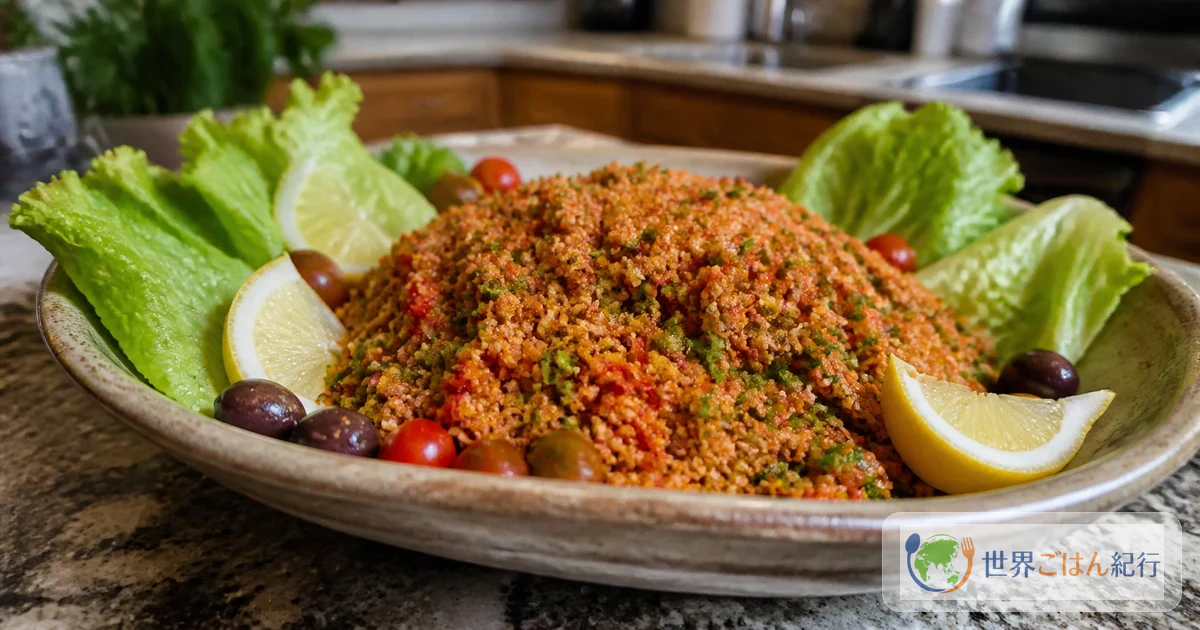
Tabbouleh takes its place in the circle of small dishes called meze on Lebanese and Syrian tables. When hummus, grilled meat, falafel and bread are laid out, tabbouleh's acidity cuts through the richness of oil and beans and makes room for the next bite.
Lebanese recipes also describe scooping it up with romaine or cabbage leaves. Skipping the spoon is not a gimmick. The crunch of the leaf goes into your mouth together with the tang of the tabbouleh, and it's easy to help yourself from a meze plate that's often eaten almost standing up. Once you know this way of eating it, it's easier to think of tabbouleh as a dish set in the middle of several plates rather than one that lives in a big bowl on its own.
It's hard to pin this dish's origin to a single date or person. Arab America presents tabbouleh as a dish tied to the mountains of Lebanon and Syria and explains the name through a word related to "seasoning." The same region has related dishes made with grains and herbs, such as Armenian eetch, Turkish kısır and Cypriot tambouli.
Names and the amount of grain probably vary because households and regions have different ingredients and different occasions for eating it. So rather than declaring "only this is correct," deciding that parsley is the star of this particular plate is the surer way to get the flavor right.
Settle the balance of green and acidity before adding more grain
What decides the flavor of tabbouleh is not the amount of bulgur but how dry the chopped leaves are and the acidity of the lemon.
For parsley, watch dryness and cut width, not quantity
Flat-leaf (Italian) parsley has flat leaves that hold dressing well once chopped. You can use ordinary curly parsley too, but remove the thick stems, wash the leaves without piling them up, and get the water off. If you chop them while they're still wet, you can't tell whether water is coming from the leaves or is left over from washing.
Pressing them with paper towels is fine, but spreading them out for a few minutes and chopping once the surface feels dry keeps the flavor from blurring. Aim for about 2–3 mm, and chop with a knife, not a food processor. If a machine cuts them too fine, the leaves get crushed and the salad loses its lightness.
Choose "fine" bulgur
Bulgur is wheat that has been cooked, dried and cracked. When you soften it in lemon juice instead of simmering it in water, as here, fine-grain bulgur is the right choice. Coarse grains take longer to soften and can end up soft outside with a hard center.
Couscous may look similar, but it's a different ingredient; substituting it in the same amount changes the grain's chew and how it holds acidity. On a day without bulgur, leaving out the grain and making a parsley and tomato salad is more natural than forcing in a different grain. You can avoid wheat with quinoa, but use it boiled, cooled and drained. That's a home-kitchen rework of tabbouleh's texture, not the same thing as the bulgur version.
Tomato and lemon change with when you mix them
Even when tomatoes are fully ripe, choose ones with firm flesh. Soft tomatoes cut into large pieces fall apart while mixing, and their juice dilutes the dressing. Cutting them into 5 mm dice and lightly removing the jelly keeps their red color and sweetness while limiting the liquid.
Divide the lemon juice into one portion for soaking the bulgur at the start and one for coating the leaves at the end. If you pour it all in at once, only the bulgur turns sour and the parsley's aroma can't keep up.
Ingredients (serves 4)
Lebanese seven spice varies in blend from product to product and home to home. Just because you don't have it doesn't mean you need to add the same amount of allspice. Allspice is a substitute that brings notes reminiscent of cinnamon, clove and nutmeg in one jar, but it isn't seven spice itself.
Some households add cucumber, but it isn't part of this basic recipe. If you add it, cut about 50 g into 5 mm dice, remove the seedy part and pat dry.
If you have a wheat allergy or need to avoid gluten, don't use bulgur.
If you switch to quinoa, watch for cross-contact when using the same utensils or storage containers, and put product labels and your own dietary restrictions first.
After washing the parsley and mint, remove the water with a salad spinner or paper towels, then spread them out so the surface dries.
Wringing them hard in a towel damages the leaves, so just press gently.

Choose fine bulgur by grain size
The one ingredient worth seeking out for this dish is fine bulgur, not ordinary flour or rice. Even products sold simply as "bulgur" differ in grain size, so check the package for labels such as "fine". If the grain size isn't stated, check the product specifications before you buy.
As a guide: it should be fine-grained, come in an amount you can use up at home, and you need to be able to eat wheat. If coarse bulgur is all you can find, don't buy it for this soaking method; use it for another dish or choose a cooking method suited to its size.
A small substitute for days without seven spice
If you're going to use allspice, consider first whether you'll use it for things other than tabbouleh. This recipe needs only a small amount, about 1/8, and buying a large jar for this alone can leave you with spice you never finish.
If you also plan to use it in meatballs or stews and don't have Lebanese seven spice, ground allspice is a reasonable option. On the other hand, if you're making tabbouleh just once, it's simpler to skip the spice and let the lemon and mint lead.
If no liquid shows at the bottom of the bowl and only a little oil drips when you lift the leaves, move on to tasting.
If the acidity is sharp, rest it for 5 minutes before adding more oil. As the acidity moves into the bulgur and tomatoes, it can taste rounder.
Fixing a watery salad, and storage
Tomatoes aren't the only reason tabbouleh turns watery. Water left on washed leaves, liquid from bulgur that hasn't fully absorbed it, and moisture from cut scallions all gather at the bottom little by little.
If water appears before serving, don't stir everything up again; lift the leaves and grains off the top with a slotted spoon. Even if it tastes bland, don't add salt or oil right away. Taste the drier top portion, and if needed, bring it back with 5 ml lemon juice and a pinch of salt. Next time, review in this order: spread the parsley out to dry, drain the tomatoes in a strainer, and don't add all the dressing up front.
To store it, refrigerate it in a clean airtight container and finish it by the next day. If you want to keep the texture, store the parsley, soaked bulgur, cut tomatoes and dressing separately and combine just before eating. Because it uses raw vegetables, don't leave it at room temperature for long.
Knowing regional differences, and adapting at home
Knowing which parts vary by region and household shows you what to keep even when you substitute.
| What to change | Home-kitchen option | Flavor to keep |
|---|---|---|
| Parsley | Use curly parsley, mostly the leaves | Keep more leaves than bulgur |
| Scallions | Switch to red onion | Take out the bite and don't let the water back in |
| Sumac | Omit it | Adjust the lemon's acidity at the end |
| Bulgur | Switch to quinoa | Cool the boiled grains and treat it as a different dish |
| Cucumber | Add about 50 g | Remove the seeds and pat dry |
Whether tabbouleh includes cucumber varies from household to household. If you want to keep to the traditional standard, leave it out; if you want more vegetable crunch on a hot day, add a little.
Don't swap in couscous just because "it's also a Middle Eastern grain." It's wheat that has already been cooked, and it absorbs liquid differently from fine bulgur soaked in lemon juice. If you can't use bulgur, boil quinoa, cool it completely and drain it in a strainer before adding. In that case the grain tends to stand out, so don't reduce the parsley.
Not center stage, but part of the meze circle
You can serve a big pile of tabbouleh on its own, but taking the Lebanese table as a guide, pairing small amounts with several other dishes makes its role clearer. Scoop it up by hand with lettuce, and let the lemon's acidity take on the sesame richness of hummus, the toasty beans of falafel and the fat of grilled meat.
Set beside Lebanese hummus (in Japanese) or Lebanese falafel (in Japanese), tabbouleh isn't a substitute for a main dish but a plate that resets the flavors of the whole table.
If you serve pita, it's fine to put tabbouleh on the bread. If you run short of lettuce leaves, tear the bread into small pieces and scoop with those. As long as the leaves stay firm until just before eating, it keeps a light crunch, unlike a salad with dressing pooling at the bottom of the bowl.


Frequently asked questions

Q. How fine should the bulgur be?
Look for labels such as "fine." If coarse bulgur is all you have, follow the package's soaking instructions and don't force it into this recipe's lemon-juice-only soak.
Q. What can I use if I can't find bulgur?
You can make it without bulgur or switch to quinoa that's been boiled and cooled. Couscous may look similar but changes the texture, so don't treat it as a one-for-one swap.
Q. Can I use parsley stems?
The thin stems of flat-leaf parsley can be finely chopped along with the leaves. Remove tough stems and thick parts, and if they're noticeable in the mouth, use only the leaves.
Q. Can I add cucumber?
As a home variation, yes. But it releases water easily, so keep it to about 50 g and remove the seedy part before adding.
Q. Can I make it the day before?
If you want the best aroma and crunch at serving time, refrigerate the leaves, tomatoes and dressing separately. Once mixed, refrigerate it and finish it by the next day.
Q. Can people with a wheat allergy eat it?
Bulgur is wheat, so not as is. If you switch to quinoa, check the ingredient and cross-contact labels, and put dietary restrictions first.
Q. Is allspice the same as seven spice?
No. Allspice is a substitute that nudges the aroma in a similar direction; it doesn't reproduce a seven-spice blend. If you'll only use it once, leave it out and focus on adjusting the lemon and mint.
Sources
- Mama's Lebanese Kitchen, “Authentic Lebanese Tabbouleh Recipe.” mamaslebanesekitchen.com (checked October 22, 2026)
- Zaatar and Zaytoun, “Lebanese Tabbouleh Recipe.” zaatarandzaytoun.com (checked October 22, 2026)
- Simply Lebanese, “Tabbouleh.” simplyleb.com (checked October 22, 2026)
- Tasting Table, “10 Mistakes Everyone Makes With Tabbouleh.” tastingtable.com (checked October 22, 2026)
- Arab America, “A History of the Origin of Tabbouleh: Lebanon's National Food.” arabamerica.com (checked October 22, 2026)