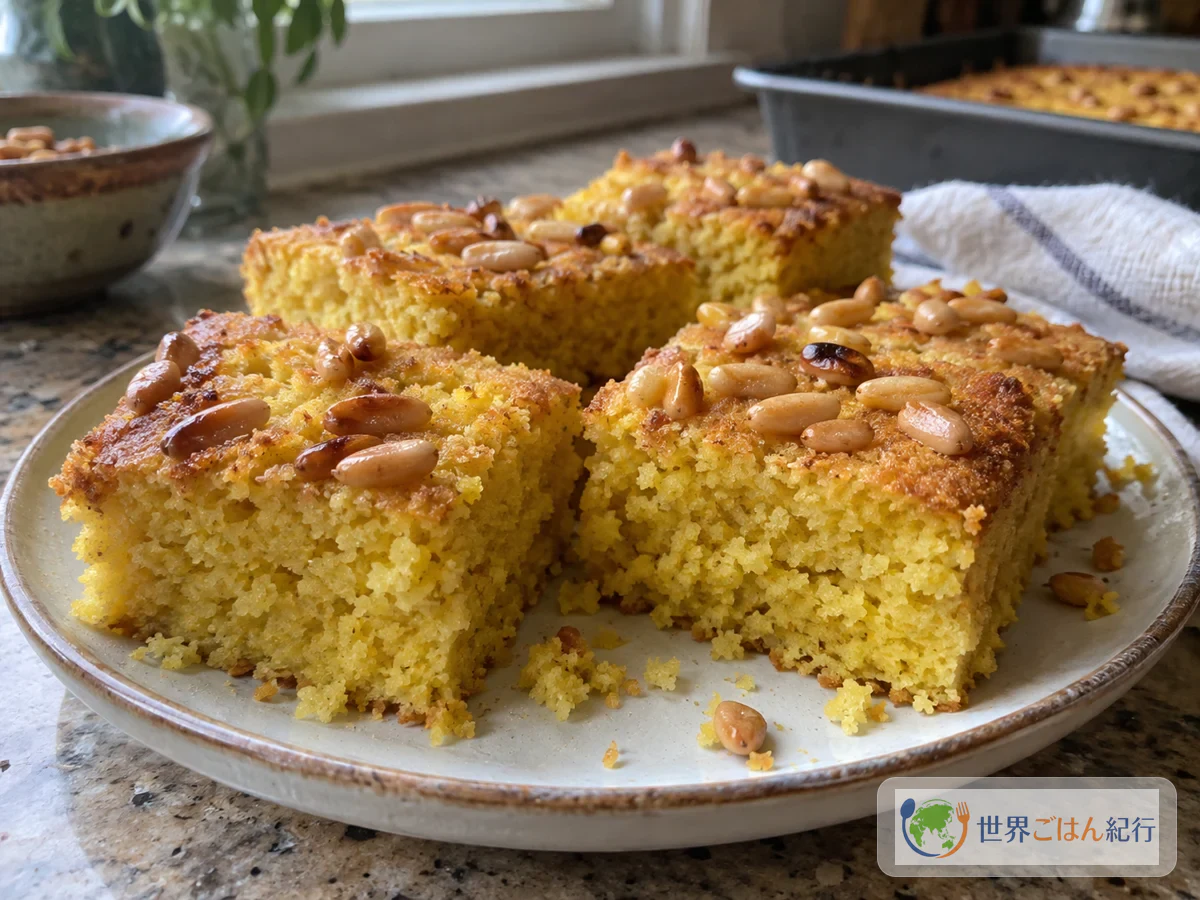
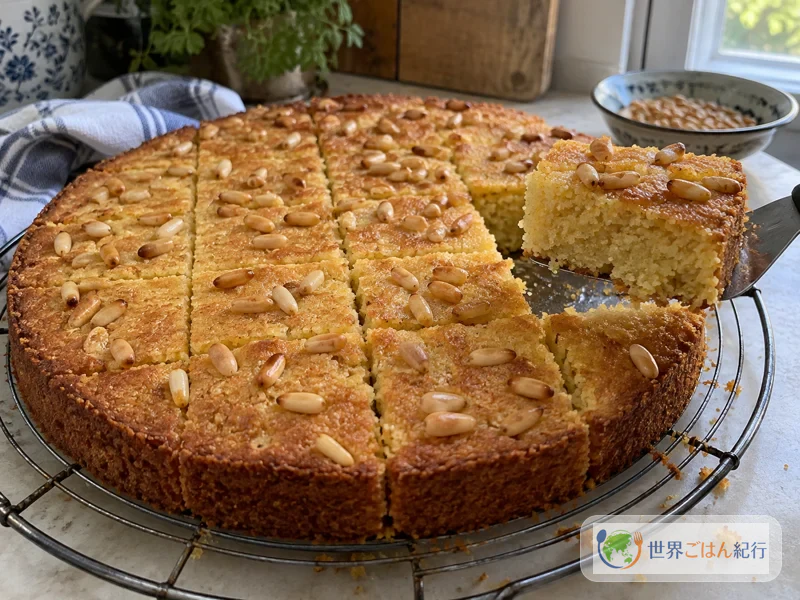
Picture a family tea hour. As you cut a baked cake into squares, a bright yellow shows at the cut edge. Pine nuts are scattered on top, and a steaming pot of tea sits beside it. Sfouf, a favorite in Lebanese homes, suits exactly this scene.
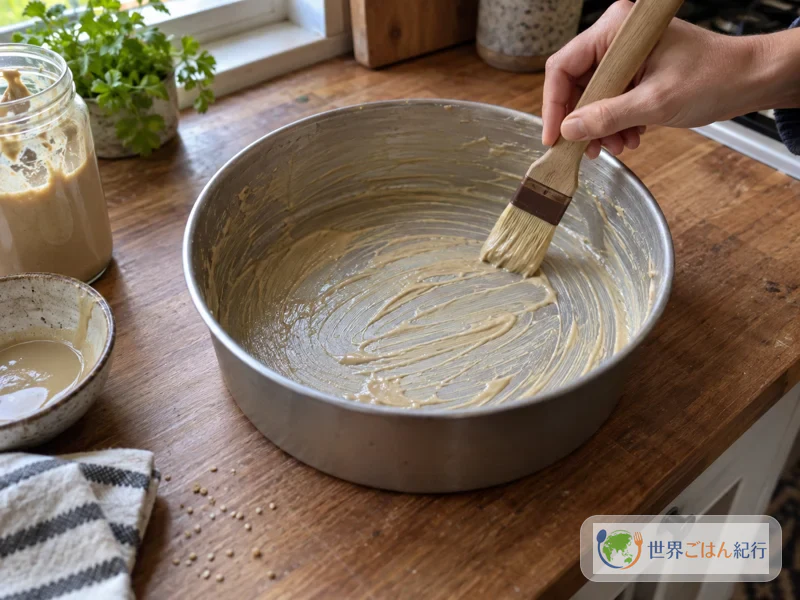
It uses no eggs. It is made from semolina, flour, milk and oil. The yellow of turmeric becomes the color of the batter itself, and the tahini brushed on the bottom and sides of the pan turns into a nutty flavor as it bakes.
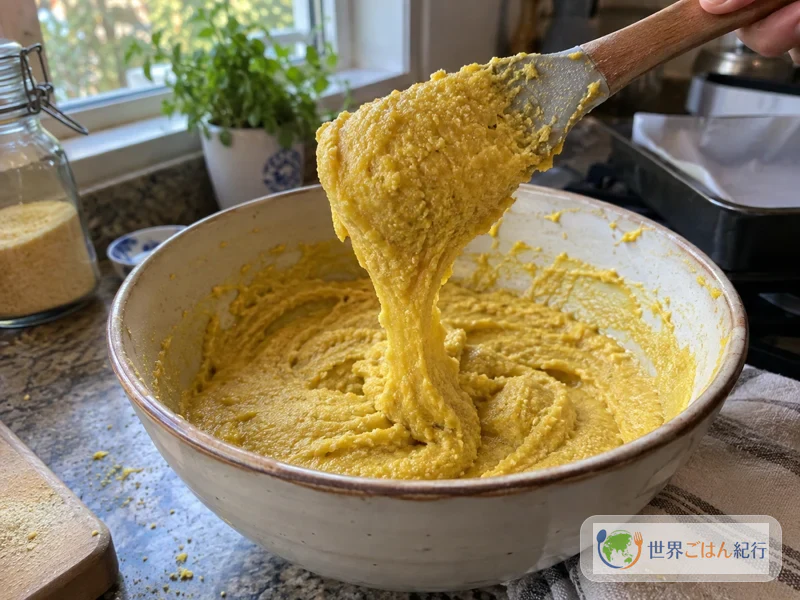
Unlike a sponge cake, there is no step of whipping eggs or butter. You simply mix dry and liquid and bake. The texture is crumbly with the grain of the semolina left in, and it does not aim for the softness of a sponge that rises on egg foam. Because it is a bake with no whipped eggs, it is easy to start without fuss.
To make it, have fine semolina and tahini ready. In a 26 cm round pan it serves 12; prep takes 15 minutes, baking 30–35 minutes and cooling about 50 minutes, about 1 hour 40 minutes in all.
A Home Table for the Day Guests Come
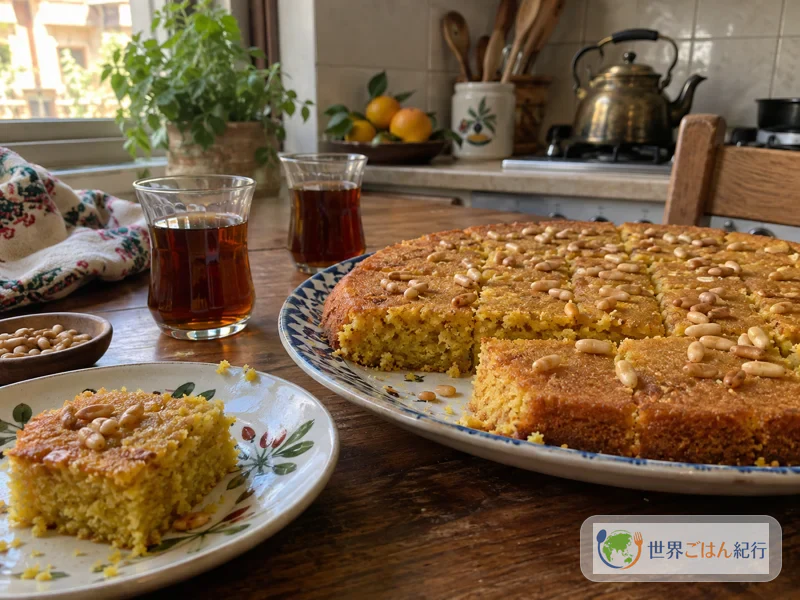
Yumna Jawad, who writes about Lebanese food, describes sfouf as the sweet her mother would bake when unexpected guests arrived. This is the author's own family memory. No cream is needed: bake it and cut it. Served with tea or coffee, it is hospitality enough.
Baked at once in a large pan, it can be cut into squares or diamonds to suit the number of people gathered. The flexibility of that cutting is probably why it is easy to share at home.
The name Sfouf is given as meaning "rows" or "lines" in Arabic. That fits the way squares and diamonds are cut in lines. Remember it as the name for cutting into rows and cutting becomes a little more fun. In English it is also spelled Sfouf or Sfoof. The name does not mean "yellow."
We could not confirm when, by whom, or in which town this cake was born, so we do not assert an origin. What can be said is the context of life: it has been cut and served as a home tea cake, for guests, wherever people gather.
Even with the same name, sfouf differs by household and recipe: the ratio of semolina to flour, whether anise is used, whether milk is used. The next section looks at those differences.
More Than Yellow: Household Differences in Flour and Aroma
The mix of semolina and flour is 3 to 1 in some recipes and nearly 1 to 1 in others. The flour ratio also varies by household. Here we bake from Dina Kohl's gram-based recipe, with 200 g semolina and 175 g flour.
We want to keep the grain of the semolina, but adding flour helps it hold together. Replacing all the flour changes both how it absorbs liquid and the texture.
Aroma also varies by household. Some homes add ground anise seed, some do not. Turmeric supplies the yellow and a gentle, earthy scent. The basic amount is 1/2 tsp of ground anise seed. Start with a little anise, and leave it out if you dislike the sweet aroma. It is a different ingredient from star anise, so do not replace it with the same amount of star anise.
There is also a brown sfouf. Sfouf bi Debes is a differently formulated cake using carob syrup. taniabakes, which presents Lebanese cooking, gives a dairy-free, egg-free example that is also enjoyed during Lent before Easter. But you cannot make it by simply swapping the sugar in the yellow base for the same amount of syrup, because the liquid quantity and the flour mix differ. We do not extend this to claims about health benefits.
Gathering Flour and Sesame Paste
Fine semolina is a flour made from durum wheat. Check the label to see whether it says "fine." It is different from the coarse, large-grained type. Under the generic name semolina, look in the baking section or online. We have not confirmed the stock or price of any particular shop. Only fine semolina is worth arranging early. Milk, sugar, vegetable oil and flour are available in ordinary grocery sections.
For the flour in the original recipe, the first choice is 175 g all-purpose flour. Cake or pastry flour in 175 g also works, but its properties are not the same as the original flour, so the result may change. Replacing the whole amount with pastry flour is not made the basic recipe. Weigh the flour. Converting to cups tends to introduce error. We have no result from actually testing the pastry-flour substitution.
Tahini is sesame paste, and here it is not mixed into the batter but brushed onto the bottom and sides of the pan. As tahini for the pan, an alternative is unsweetened, unsalted white sesame paste in the same volume. But roast level changes the aroma, so it will not be identical to the local ingredient. If the oil has separated, stir it in the jar until uniform before measuring.
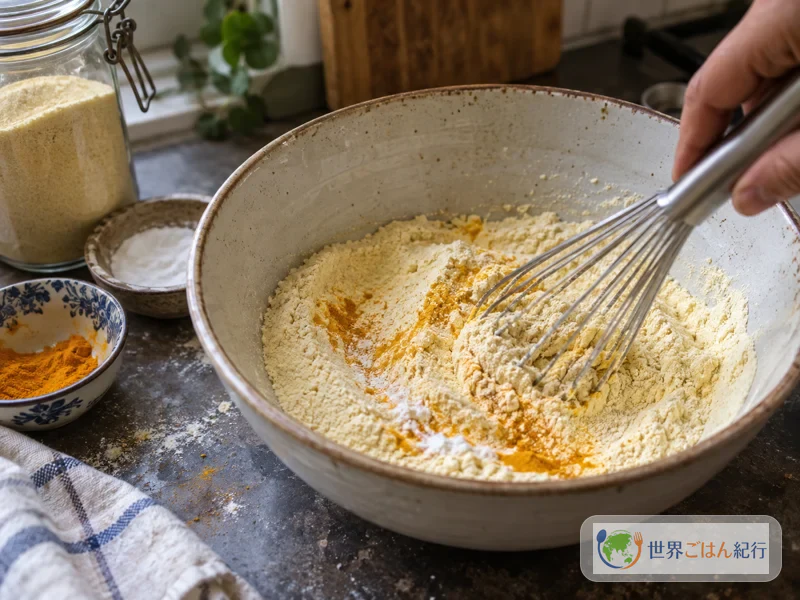
In the spice aisle, look for ground turmeric on its own. Curry powder contains several spices, so it will not give the same aroma. The basic amount is 1 1/2 tsp. Even if you want a deeper yellow, do not increase it by much.
Do not let the words "eggless" reassure you into missing other allergens. This formula contains wheat, milk, sesame and pine nuts. If you substitute almonds or soy milk, check the labels for additional allergens. For someone with a food allergy, do not judge it safe merely because it has no egg; check ingredients, shared equipment and product labels.
Ingredients (26 cm round pan, serves 12)
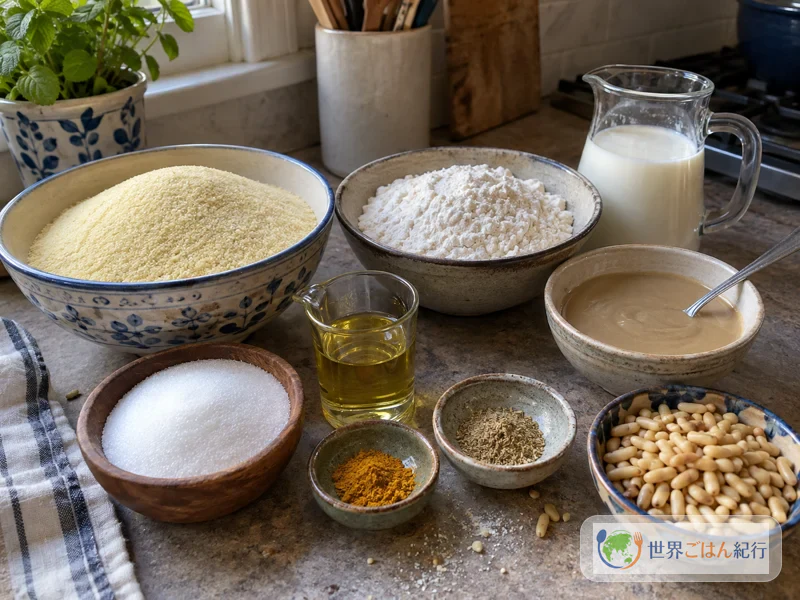
One round pan 26 cm across makes 12 servings. Use a cake pan at least 4 cm deep. The table below gives the quantities for one 26 cm round pan. A 23 cm square pan, with a similar inside-bottom area, can also stand in, but this is an editorial suggestion converted from area. Check doneness with a skewer in the center. If you put the whole batter in a 20 cm square pan, it becomes thick and the center may not bake in the same time.
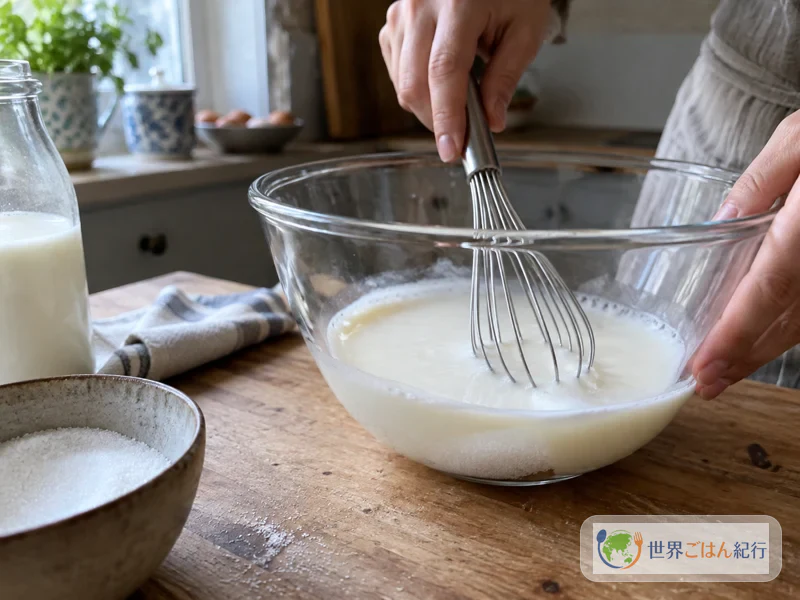
Even without eggs, this basic formula includes milk. Because it is an eggless batter that uses milk, it is not a dairy-free sweet. Sugar affects not just sweetness but texture. For your first bake, measure the basic amount exactly, and adjust sweetness by the size of the pieces and by pairing with unsweetened tea.
Method
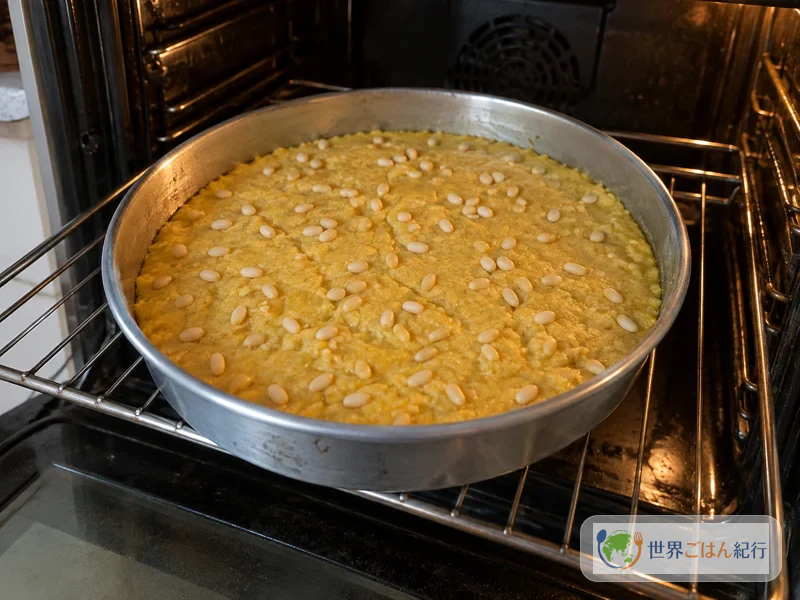
Work takes about 15 minutes, baking is 30–35 minutes at 180°C and cooling about 50 minutes. Preheat the oven while you work. The temperature assumes a regular conventional (top and bottom) setting. Ovens have quirks, so do not stop at the time of 30–35 minutes at 180°C; check with a skewer in the center.
Even if the pine nuts have colored nicely, the center is not necessarily cooked through. Check the center of the batter and the surface separately. An extra broil only to add color is not part of the basic method. Put the state of the skewer before color.
If the edge sticks to the pan even after cooling, slide a thin spatula around the side to release it. Do not tear it away by force. If unsure, cut in the pan and lift out one piece at a time. Any uncoated spots of tahini are an improvement point for the next bake.
When taking the pan from the oven, use dry oven mitts and do not hold the hot pan with bare hands. Do the cutting only after both pan and cake have cooled, in a stable place.
When It Does Not Cut Crumbly, or the Yellow Is Too Strong
If the mouthfeel is dry or hard, overbaking or measuring too much flour may be involved. The cause cannot be narrowed to one. Next time, weigh the flour without fail, check with a skewer from 30 minutes of baking, and stop mixing when the lumps of flour are gone. A cake that has dried out after baking cannot be returned to raw batter. In that case, eat it with tea or coffee and review the baking time for next time.
If it crumbles while warm, check again after it has cooled completely. The crumbling typical of semolina is different from the moist batter in the center. Checking the texture after it cools makes the difference easier to see. If you find the center underbaked right after taking it out, return it to the same 180°C and add 3–5 minutes at a time, piercing with a skewer each time. Do not set aside for storage an underbaked cake that has cooled and sat for a while.
If the yellow is too strong or the aroma harsh, review the amount of turmeric. More turmeric can make the aroma and bitterness stronger. The 1 1/2 tsp here is level spoonfuls. If you dislike the anise aroma, leave it out next time. Do not try to cover the aroma after baking with sugar or cream. Do not substitute curry powder, and do not replace baking powder with baking soda.
Changing the Aroma, for Tea Time
The basic way is to serve it as is with tea or coffee, without layering syrup or cream. One slice with nothing on it, a sweet cake with an unsweetened drink. This is one suggestion, not a claim of a particular benefit or of a custom common throughout the region.
| What to change | How | Difference in texture and aroma |
|---|---|---|
| Go lighter on anise | Omit the 1/2 tsp anise seed | Turmeric and sesame scents come to the front |
| Sesame topping | Replace 30 g pine nuts with 1 tbsp white sesame | No big-nut crunch; a fine nuttiness instead |
| Finish with almonds | Replace 30 g pine nuts with 30 g raw sliced almonds | Flat nuts bake on the surface. Watch the color |
| No milk | Replace 250 ml milk with 250 ml unsweetened plant milk | The type of drink changes flavor and bake |
| Odorless oil | Use 100 ml canola oil for the 100 ml neutral oil | Less oil aroma, so the spices and sesame stand out |
If you have leftover semolina, you can use it for layali lubnan, a cold two-layer dessert. The same flour can make a cold dessert too.
If you want to try a filled sweet, there is maamoul. Its method and quantities are different from sfouf.
Storage and FAQ
Can I make it ahead?
Basically, eat it the day you bake it. Cool the rest, seal it and refrigerate at 0–5°C, and eat within 48 hours in the fridge. This guideline adopts the general safety guidance for cooked food from the UK Food Standards Agency. Refrigerate within 1–2 hours of cooking. If it is large and slow to cool, divide into portions to cool.
Can I freeze it?
Wrap cooled pieces one at a time in plastic wrap or similar and put them in an airtight container or freezer bag. Write the date, and we suggest finishing within 2 months as a quality guide. Wrap one slice at a time and freeze, and you can take out only what you eat. Thaw in the refrigerator and eat within 24 hours once fully thawed. Two months is a quality guide, not a guaranteed safety period.
Can I make it without tahini?
One option is the same amount of unsweetened, unsalted white sesame paste. The aroma may differ from tahini. If you want to avoid sesame, you can also brush the pan lightly with oil, but it will not give the nuttiness of sesame. When allergies are a concern, check the other ingredients and equipment too.
Can I replace all the semolina with flour?
Replacing the whole amount at the same weight is not recommended for the basic recipe. Absorption and texture change. The author of Wheel of Baking, who compared the substitution, reports a dense, doughy result. This is a limited result from the individual author who tried it, not something our editors measured.
Is it spicy? Can children eat it?
The formula uses no chili. The earthy aroma of turmeric and the sweet aroma of anise, though, divide tastes. Do not treat the absence of eggs as a guarantee of safety for children or people with allergies. Wheat, milk, sesame and nuts need checking.
48 hours in the refrigerator is a conservative guide for cooked food in general. It is not the result of microbiological testing of this cake itself. Also, do not apply storage for one week at room temperature as is to a hot kitchen. Do not eat anything that did not meet the storage conditions or that shows any change.
Nutrition Guide
For the whole basic formula divided into 12 portions, one serving is about 272 kcal, 5 g protein, 11 g fat and 39 g carbohydrates. This is an estimate from standard ingredient values, not a measured value. It changes with ingredient brands and with nut or milk substitutions.
Sources
- Dina Kohl — SFOUF (SEMOLINA CAKE WITH TURMERIC) — gram-based basic formula, 26 cm pan, baking at 180°C, flour ratio and household differences. Accessed and checked 4 October 2026.
- Yumna Jawad — Sfouf (Turmeric Cake) — family memory of serving guests, the name, tahini, how to tell when it is done. Accessed and checked 4 October 2026.
- Mariam Ezzeddine — Sfouf (Lebanese Turmeric Cake) — with or without anise, nuts and sesame, drinks, freezing guide. Accessed and checked 4 October 2026.
- Tanya — How to make Sfouf (Lebanese Turmeric Cake) — the role of semolina, flour substitution comparison, mixing and cutting. Accessed and checked 4 October 2026.
- taniabakes — Sfouf bi Debes (Carob Molasses Cake) — a different formula using carob, and the Lent context. Accessed and checked 4 October 2026.
- UK Food Standards Agency — How to chill, freeze and defrost food safely — general cooling, refrigeration, freezing and defrosting of cooked food. Accessed and checked 4 October 2026.