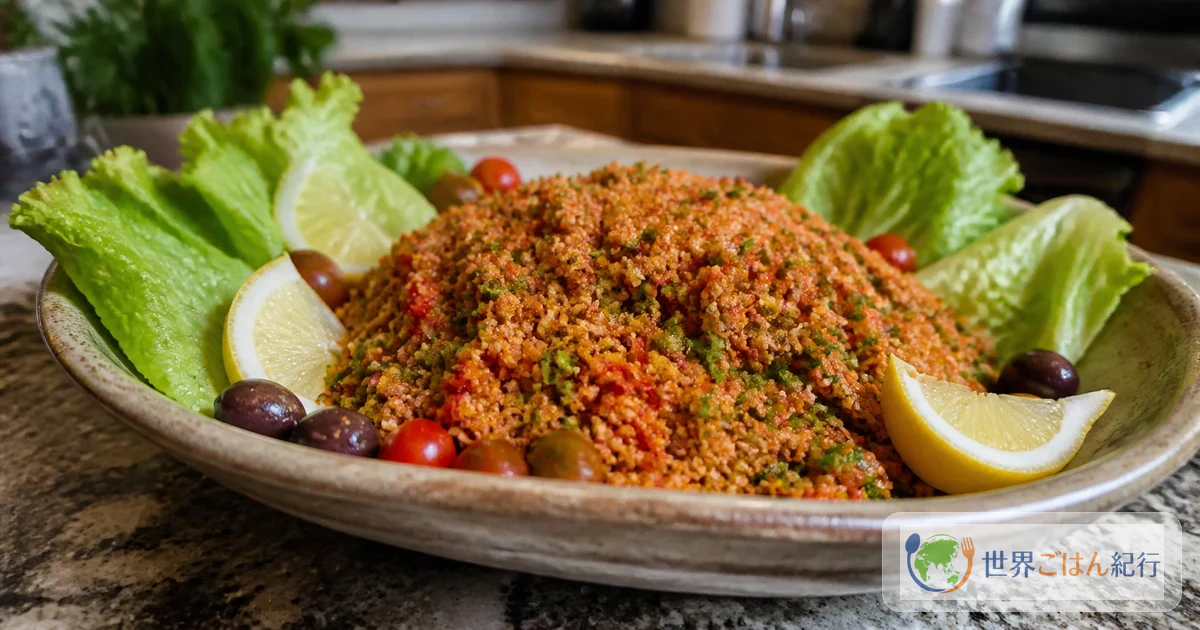
Roast the peppers until the skins blacken, and their sweetness stays on the plate
As red bell peppers roast, their skins puff up and the juices that drip onto the sheet pan turn a little syrupy. Peel off the blackened skin and the flesh gives off a sweet aroma; layer onto that the toastiness of dry-toasted walnuts and the deep tang of pomegranate molasses. Scoop some up with warm pita, and little bits of walnut break apart inside the red paste.
Muhammara (محمرة) is a red dip that comes from Aleppo in northern Syria. According to the Food Heritage Foundation, it spread to tables across the Levant, Lebanon included, and its name comes from the Arabic for "made red." Because it is a dish that has crossed borders, the roasted-pepper version is not the only right answer.
What makes or breaks it in a home kitchen is not adding more ingredients but managing moisture and texture. Blend the peppers without draining their juices and the dip runs off the bread; blend the walnuts too long and they release oil and turn heavy. Push the pomegranate molasses past 2 tbsp and its fruity sourness drowns out the sweetness of the peppers.
This recipe brings roasted red peppers, walnuts and breadcrumbs together into a coarse paste. If you have Aleppo pepper, you get its dry, fruity heat; if it's hard to find, smoked paprika and ground red chili keep the heat while swapping in a different aroma. The three things to protect are the sweetness of well-charred peppers, the texture of the walnuts, and the tang of pomegranate.
Ingredients (serves 4)

This makes enough for 4 people as an appetizer. Spread on bread it serves 4; as a dip for vegetables alone it stretches to about 6. Some Syrian sources add tahini, but this version leaves it out to keep the walnut flavor up front. The first time, don't add extra ingredients; taste for the balance of sourness and coarseness.
This recipe contains walnuts and wheat. If you have a walnut allergy, swapping in another nut changes both the flavor and the safety profile considerably. Don't force a substitute; make a marinated roasted red pepper dish instead. To avoid wheat, use 40 g of gluten-free breadcrumbs. For allergy-friendly products, check every label for ingredients and shared-facility statements.
Pomegranate molasses brings a fruity acidity that tightens the sweetness of the peppers and keeps the walnut oil from feeling heavy. You can make the dip with lemon juice and dark brown sugar, but the deep, distinctive pomegranate flavor won't be there. If you plan to cook more West Asian food, a bottle is worth buying; if you're only trying it once, the substitute is fine. Look for it at Middle Eastern grocery stores or online.
Smoked paprika is not Aleppo pepper. Instead of Aleppo pepper's dry fruitiness, smoke comes to the front. Rather than hunting from store to store for Aleppo pepper, think of smoked paprika as the one jar you buy for this substitution. If you already have paprika and ground red chili, you can skip it.
Don't throw away the juices from the roasted peppers. If the paste turns out too stiff, you can add them 1 tsp at a time to adjust it. Adding them all at the start makes the dip runny, so use them a little at a time.
Cooking tips: add when it's loose, hold back when it's heavy

Muhammara is not meant to be a uniform cream like hummus. It's easiest to use as a coarse paste that stays on the surface of the bread, with a walnut bit here and there. If oil seeps out around the edges, the peppers carry too much moisture: stir in 2 tsp breadcrumbs and wait 10 minutes in the refrigerator. If it's crumbly, add lemon juice or olive oil 1 tsp at a time. Correcting by the tablespoon makes it impossible to bring the sweetness of the peppers and the acidity back into balance.
Blend too long and the walnuts release oil, making the paste heavy. With a mortar and a knife, there's no need to buy a machine for this dish. Chop the walnuts to about 5 mm (1/4 inch), chop the peppers finely with a knife, then mix in a bowl, and you decide the texture yourself.
Variations: turning leftovers into the next meal

Spread about 3 tbsp on warm pita and layer on cucumber, radish and parsley; the vegetables balance the richness of the muhammara. In the mezze described in Syrian food-culture sources, it's not just dips: flatbread, salads, pickles, olives and more are set out in small dishes. Rather than making it a sauce for a meat dish that stands on its own, setting it out alongside small amounts of things with different acidity and saltiness lets you enjoy the sweetness of the peppers longer.
On days you want less heat, leave out the ground chili and cut the smoked paprika to 1/2 tsp. If only some people at the table like it spicy, add Aleppo pepper or ground chili to their portions so the whole batch doesn't get hot. Since the recipe uses no eggs or dairy, swapping the breadcrumbs for plant-based or gluten-free ones makes it easy to fit different dietary needs.
A recipe from a Syrian contributor published by UNHCR Canada cooks tomatoes, onions, red pepper paste, cinnamon and pomegranate molasses together and lets the mixture cool before eating. It has more moisture than the roasted-pepper version and ends up closer to a sauce. Don't treat it as a fallback when this recipe goes wrong; try it as another family's version.
When serving it next to grilled white fish or chicken, loosen it slightly with just 1 tsp lemon juice. To make a pasta sauce, add 1 tsp olive oil before thinning it with pasta water. Thinned with water alone, the walnut bits tend to feel gritty. Besides spreading leftovers on bread, adding 1 tsp at a time alongside roasted vegetables keeps the same flavor from feeling repetitive.
Food culture: how Aleppo's red dip made its way onto the mezze table

The Food Heritage Foundation describes muhammara as a red dip that originated in Aleppo, Syria. The name comes from the Arabic for "made red," and the dish spread to tables across the Levant, Lebanon included. Because it has long been eaten as an appetizer, a dip and a spread for bread, it's closer to reality to ask which region's or family's version you're recreating than to judge right and wrong by a single ingredient.
The Metro South Health Syrian food and cultural profile notes that eating patterns vary by region, religion and social group. It describes holiday mezze with dips, salads, flatbread and pickles, and barbecues also served with bread and dips. Muhammara plays a role closer to the one it has on Syrian tables when it's set out as something to scoop with bread and trade bites with other small dishes, rather than as a sauce that makes up a meal on its own.
The same source also lists a version made with red peppers, breadcrumbs, walnuts, garlic, tahini, pomegranate molasses, cumin and chili. Meanwhile, "Muhammara with Walnut," a recipe from a Syrian contributor in UNHCR Canada's Tastes from Home, cooks 5 tomatoes and 3 onions with red pepper paste, pomegranate molasses, cinnamon and more, then combines the cooled mixture with walnuts. Its ingredients and cooking differ from this roasted-pepper recipe, and it turns out moister and softer. Knowing it as another family's version, not a fallback for a failed batch, keeps your idea of the recipe from becoming too narrow.
In a home kitchen, deciding on the texture first makes choosing ingredients easy. The roasted-pepper version is a thick paste that stays put on bread; the cooked-tomato version is a soft dip served alongside food for scooping. Pomegranate molasses adds fruity acidity in a single ingredient, while lemon juice and dark brown sugar let you adjust sourness and sweetness separately. Rather than trying to replicate the deep fruitiness a substitute loses, it's more practical to choose the consistency you want on the table with what you have on hand.
To add another dish to the same mezze spread, smooth hummus (in Japanese), baba ghanoush (in Japanese) made with roasted eggplant, or herb-forward tabbouleh (in Japanese) all go well. Share red muhammara, white hummus and a green herb salad with flatbread, and the aroma and acidity change with every bite instead of eating the same dip over and over.
Frequently asked questions

Can I use regular vinegar instead of pomegranate molasses?
Rice vinegar alone makes the sourness stand out too sharply. Mixing 1 tbsp lemon juice with 1 tsp dark brown sugar gets you closer. The substitute version tastes lighter, so you can increase the walnuts slightly to 130 g.
Can I use jarred red peppers?
Yes. Use 300 g of roasted peppers patted thoroughly dry. Avoid pickled peppers in vinegar, though, since they change the flavor. The smoky aroma is weaker than when you roast them yourself, so use 1 tsp smoked paprika.
Can I swap the walnuts for almonds?
Assuming no allergy, you can still make the dish, but you lose the bitterness and richness that make muhammara what it is. If safety of the substitute is your priority, making marinated roasted peppers is safer than switching to another nut.
How many days does it keep?
Don't wait for it to cool down; transfer it to a clean, shallow container and refrigerate within 2 hours. For best flavor, eat it within 3 days, counting the day you make it. Spoon out only what you'll eat into a separate dish, and don't let bread or vegetables that have touched it go back into the rest. Frozen, the peppers and oil tend to separate after thawing, so it's easier to make small batches.
It turned watery. Can I fix it without starting over?
Add breadcrumbs 2 tsp at a time and chill for 10 minutes. If it still runs, finely chop about 10 g walnuts and mix them in. Cooking it to evaporate the moisture dulls the aroma of the peppers, so adjust by chilling first.
Sources
- Food Heritage Foundation, "Muhammara" (origin, spread across the Levant, basic ingredients and ways of eating; accessed and checked August 21, 2026)
- UNHCR Canada, Tastes from Home, "Muhammara with Walnut" (a different Syrian contributor's version with tomatoes and onions; accessed and checked August 21, 2026)
- Metro South Health, "Syrian food and cultural profile" (regional variation, mezze and barbecue tables, an ingredient list including tahini; accessed and checked August 21, 2026)
- Saveur, "Red Pepper and Walnut Dip (Muhammara)" (ingredients, roasting and texture of the roasted-pepper version; accessed and checked August 21, 2026)
- FoodSafety.gov, "People at Risk of Food Poisoning" (general guidance on moving leftovers to shallow containers and refrigerating within 2 hours; accessed and checked August 21, 2026)