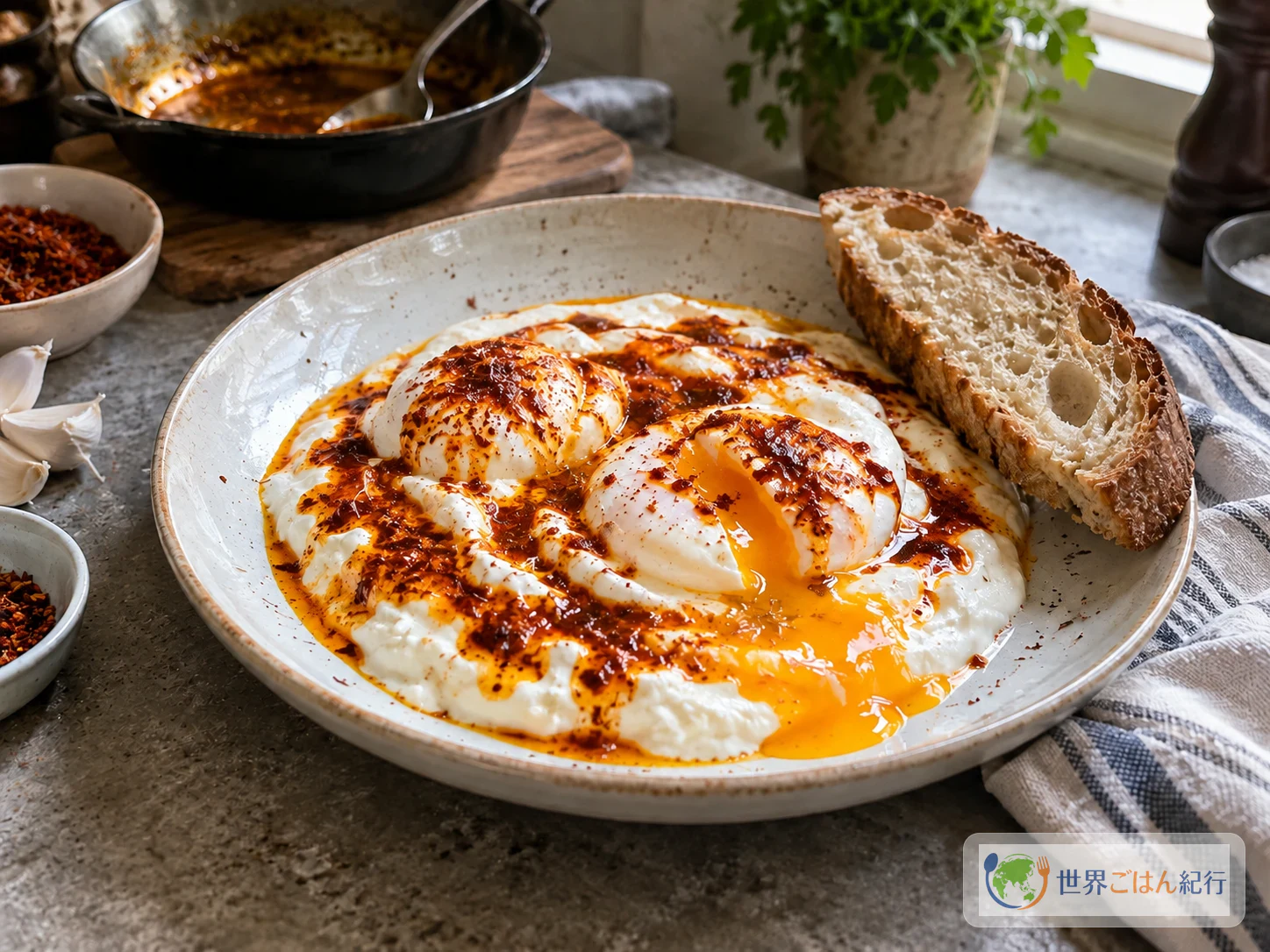
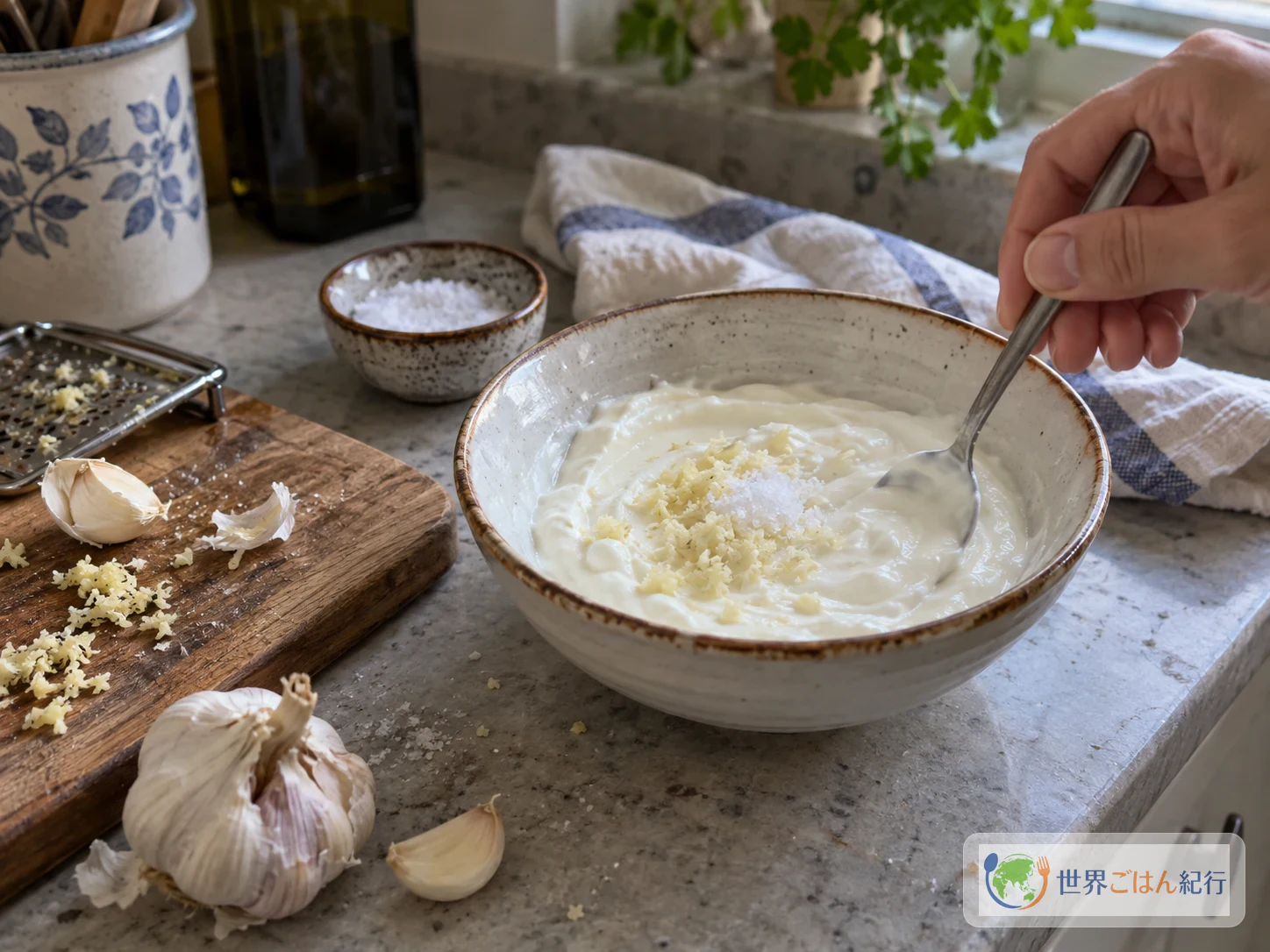


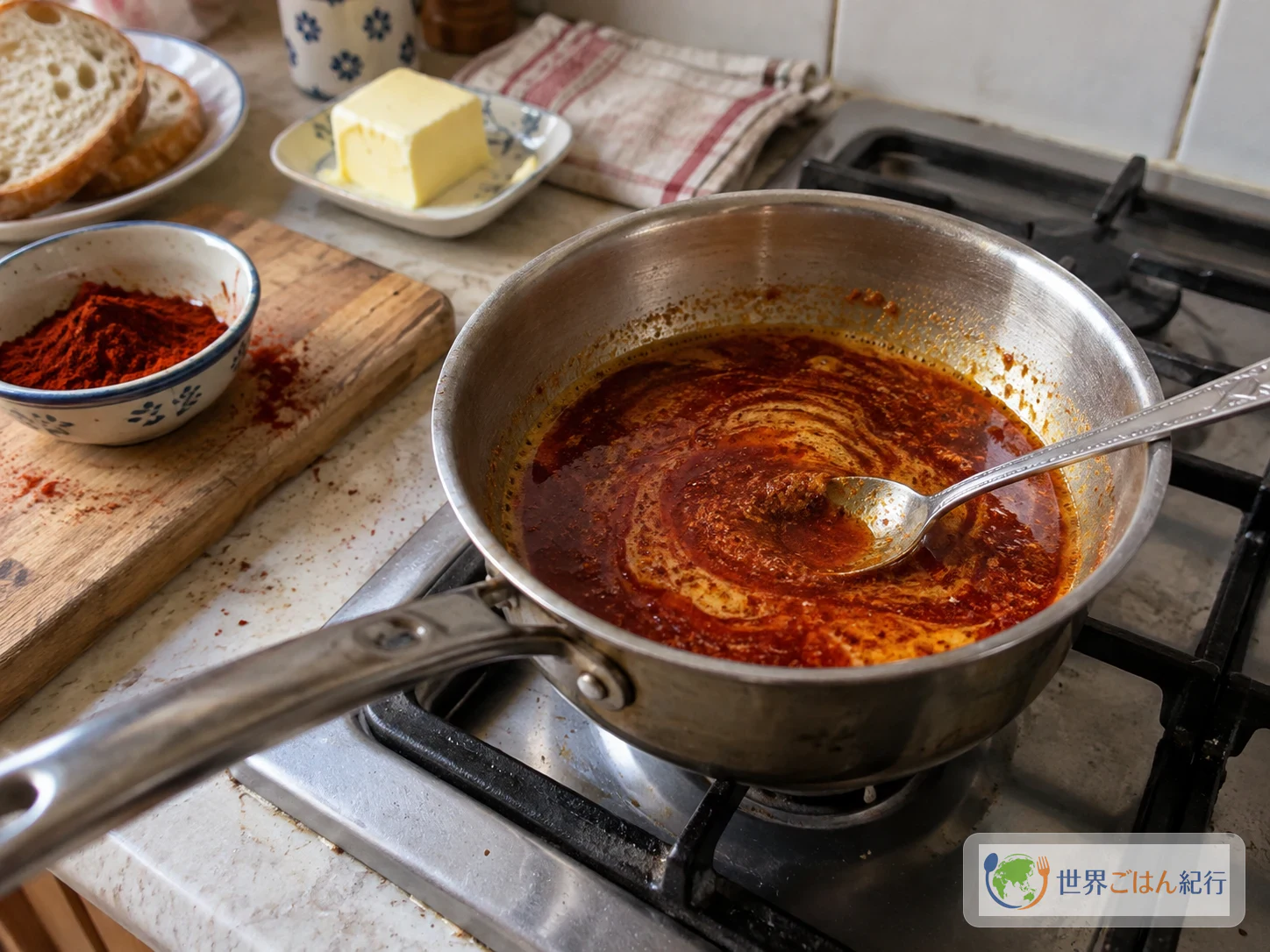
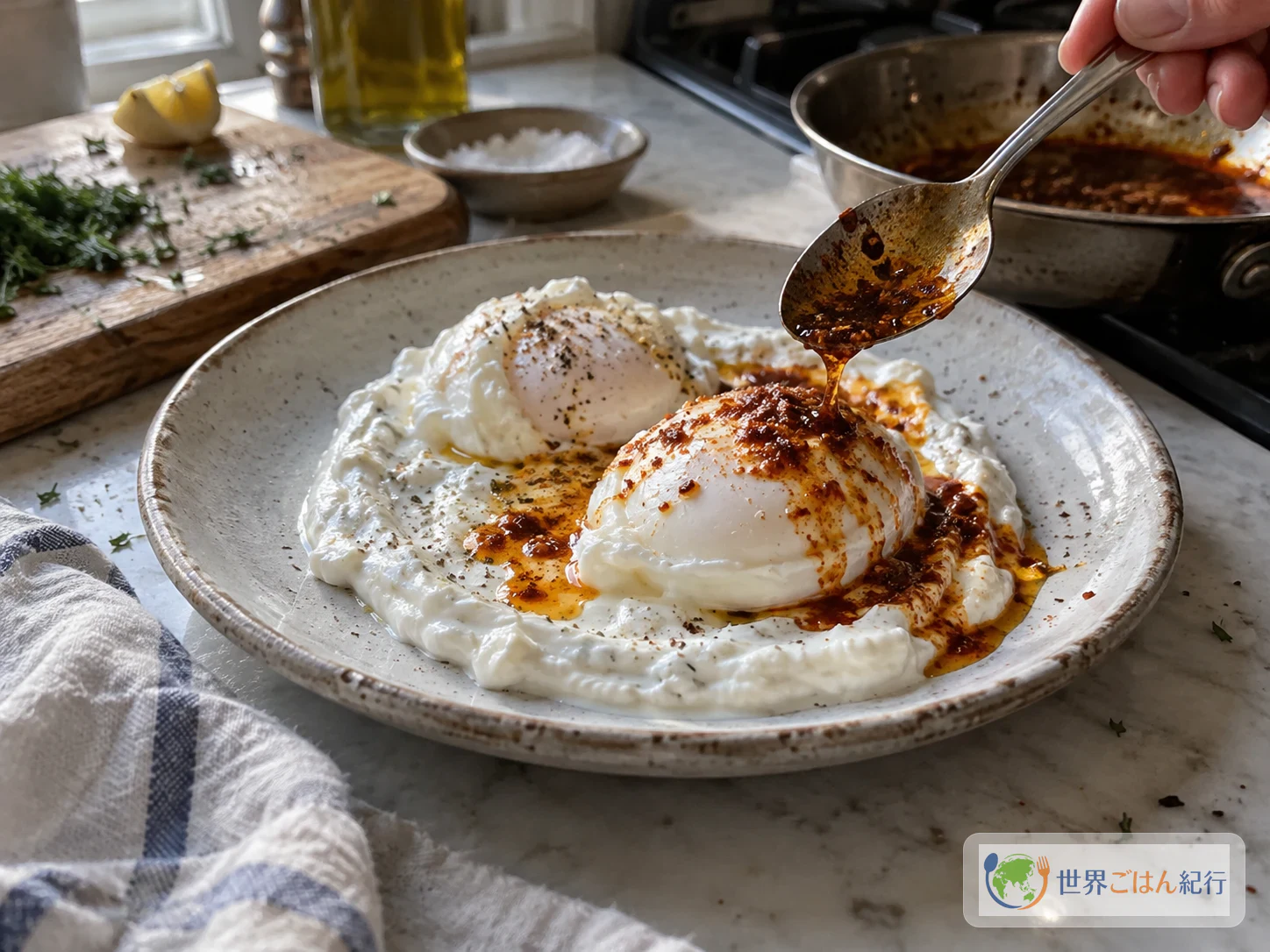
On the breakfast table sits a plate spread white with garlicky yogurt. Eggs rest on top, and butter tinted with a red spice is spooned over them. Beside it is toasted bread. Tear off a piece, press it against the egg white, pick up yogurt and red oil with it, and carry it to your mouth: scooping with bread is the whole point of this dish.
The dish is called çılbır (Çılbır). It layers poached egg, yogurt, and fat infused with spice, and the yogurt here is not a sweet dessert. Salted and mixed with garlic, it is used like a sauce.
It is an easy dish to bring into any breakfast. For 2 servings you need 4 eggs and 200 g of thick plain yogurt, and about 30 minutes of work. That time is a guide built around the steps for home cooking, not a measured figure. The basic recipe uses mild paprika, so it cannot fully reproduce the aroma and heat of the chili flakes used in Turkey. The difficult part is poaching the eggs, and the method below deals with three problems: scattered whites, poaching water getting onto the plate, and scorching the butter. Enjoy the contrast between the cold garlic yogurt and the hot butter. The time given for a soft set is not a guarantee of safety, so options for cooking the eggs through are covered in the caution box later.
A white plate for breakfast also shows up at lunch and dinner
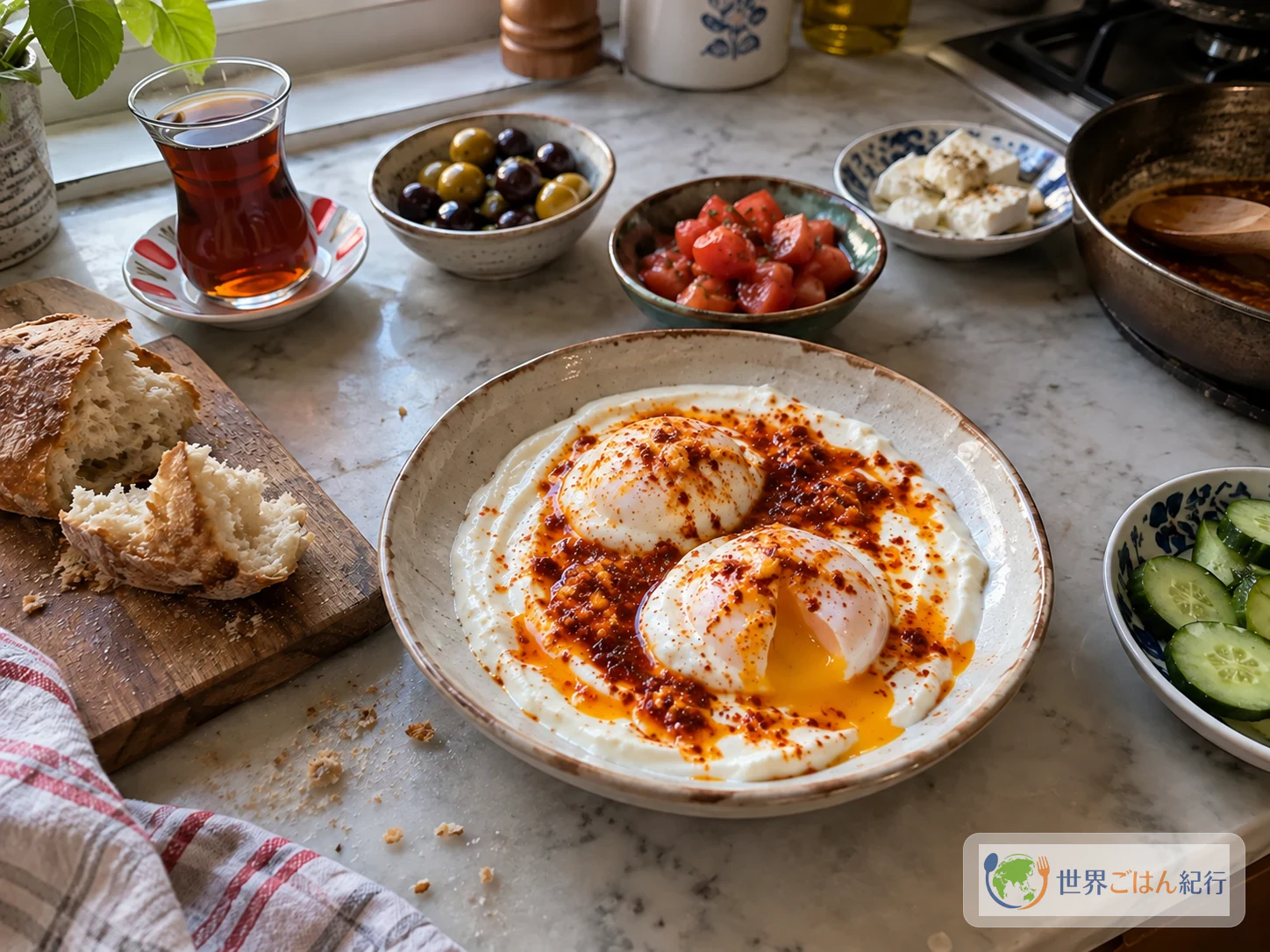
Turkish breakfast has a style of laying out called serpme kahvaltı. Many small plates are spread across the table, and everyone picks slowly from shared dishes. Çılbır is one of the egg dishes presented in that breakfast of many small plates. It is not eaten every morning in every household across the country, but this form, eggs over yogurt with red butter, lets you taste warm egg and cold yogurt together. Add bread and you can finish every bit of sauce left on the plate.
You might think it is strictly a breakfast dish, but a dish description from Turkey's Ministry of Culture and Tourism also gives examples of eating it at lunch or dinner on warm days with pilaf and a green salad. So it is also eaten at lunch and dinner. The ministry's proportions are 6 eggs to 330 g of yogurt, with olive oil as the fat. In other words, red butter is not the only right answer, and the look of the table changes with the time of day and what you serve beside it. If you try it at home, you could build it as bread in the morning and a salad or a small portion of rice at lunch. This is not a custom across all of Turkey; it is only this article's suggestion.
GoTürkiye (a Turkish tourism site) describes this dish as one favored by the Ottoman sultans. That is only a tourism source's description; the inventor, the year it began, and any particular sultan could not be confirmed.
Plating and fat vary by region: in Isparta the yogurt goes over the eggs
Plating and fat differ by region. In the recipe from the Isparta provincial culture and tourism directorate, you use 5 eggs, 1 bowl of mashed strained yogurt, and 2 tablespoons of fat made from fried kaymak. Kaymak is a rich dairy cream, and here its fat is used. After letting the cooked eggs cool a little, you pour the yogurt over the eggs, which is the reverse of the order we imagine of "eggs on yogurt." Garlic and chili do not appear in the ingredient list of this regional source, but the absence of a mention is not evidence that the region does not use them.
Looking at it this way, what they share is eggs cooked in water with yogurt, while the fat and the order of layering differ from place to place. In the recipe by Istanbul cook Vidar Bergum, garlic is optional. Garlic is also your choice, so adjust to taste. It matters not to merge regional features into a single "authentic form."
The proportions in this article build on that cook's 4 eggs and 200 g of yogurt, adjusted for home cooking. It uses 1/2 clove of garlic, 30 g of butter, and 2 tsp of paprika.
The original spelling is Çılbır. In English recipe titles it is also called Turkish eggs. Though it is also a Turkish breakfast, it differs in ingredients and method from menemen, in which eggs are mixed into tomatoes and peppers, and the texture of the egg is completely different.
Ingredients (serves 2)
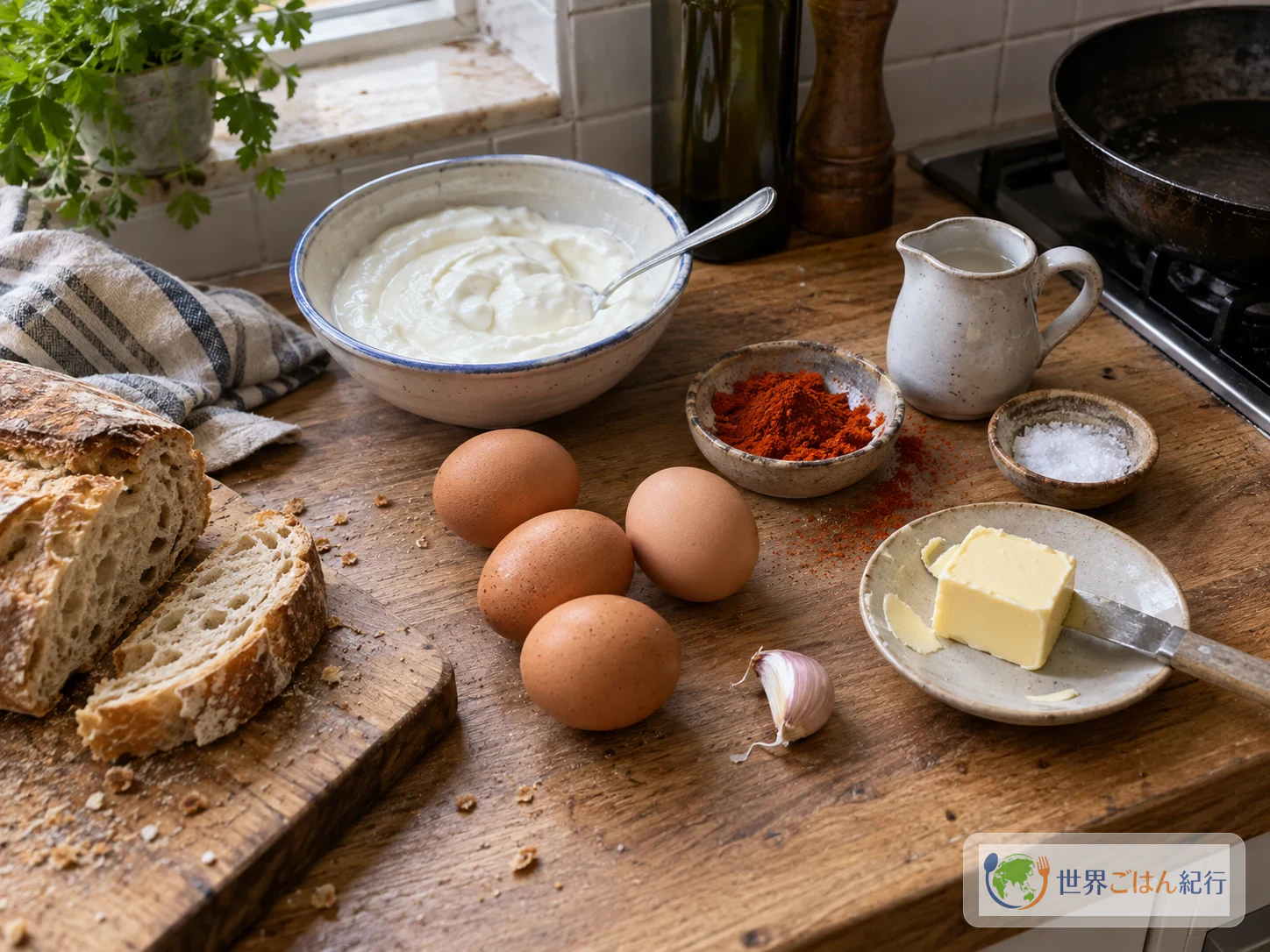
The amounts are for 2 servings with bread: 2 eggs and 100 g of yogurt per person. Keep raw eggs refrigerated and check the date and labeling before use. Choose a thick unsweetened plain yogurt. Greek yogurt or strained yogurt suits it. A sweetened or drinkable yogurt gives neither the same flavor nor the same thickness.
If you use ordinary unsweetened yogurt, line a clean strainer with food-safe paper and strain it in the refrigerator. Do not go by a set time; weigh it so you have 200 g after straining. This step is not included in the 30 minutes of cooking time. The thickness to aim for is one where the trail of a spoon does not fill back in with liquid right away, and where the yogurt can hold an egg set on it. Putting the drained liquid back makes it watery.
This dish uses eggs and dairy, and the bread contains wheat. Check the allergen labeling on the packaging. Even if you switch the fat, the milk in the yogurt remains, and choosing wheat-free bread does not remove the egg and dairy.
Making the red sauce from supermarket spices
The pul biber used in Turkish cooking is red chili flakes. Vidar Bergum recommends Aleppo pepper and says that plain paprika or smoked paprika can also stand in if you cannot get it. The base ingredient here is mild paprika powder. It makes a vividly red sauce, but not the heat, grain, or aroma that chili flakes bring.
When shopping, look for it under the name ground paprika powder. It is different from fresh bell peppers, hot chili powder, or blended seasonings like curry powder, so check the ingredients and heat level on the label. A good thing about this recipe is that color and heat are adjusted separately. Smoked paprika adds a smoky aroma, so even at the same 2 tsp the aroma changes. If you cannot find it nearby, you can look for the powder online.
If you can get pul biber, you can replace the 2 tsp of paprika with 2 tsp of pul biber. But heat and saltiness vary by product, so do not add the ground chili flakes or an extra 1 g of salt, and proceed by tasting.
Method
The order is: prepare the yogurt and plates first, then get the water ready and poach the eggs, and finally make the sauce quickly and plate. It is an order that keeps the poached eggs from waiting. Eggs are poached one at a time, so 4 eggs take about 12 to 16 minutes. The 3 to 4 minutes for a soft set is a guide to texture; it changes with the egg size, its temperature, and the state of the water, and it is not a time that guarantees prevention of food poisoning. Do not keep the water at a boil, which is the shortcut to a tidy white.
When the whites scatter, first suspect the movement of the water. If it is rolling, lower the heat. For the next egg, do not drop it from high above the pot; slide it from the dish close to the surface. Chasing scattered whites and stirring only breaks the shape further. Wait for the surface to go still before poaching the next one. This is a trick for texture and looks, a separate matter from hygiene precautions.
To avoid a watery plate, drain the poaching water well. After lifting an egg with the spoon, hold it for a few seconds to drain, and pour out the water that gathered in the receiving dish before setting the egg on the yogurt. Draining the whites and straining the yogurt are separate steps. Reducing a plate that has already thinned after plating changes the texture of the egg and yogurt, so adjust next time through how long you strain the yogurt.
A soft-cooked egg does not bring the risk of salmonella and the like to zero. Even a fresh, uncracked egg is not a guarantee of safety. The FDA (the U.S. Food and Drug Administration) recommends cooking eggs until both white and yolk are firm. For children, older adults, pregnant women, and people with weakened immune systems, cook the yolk through. Also follow the date and the storage and cooking instructions on the egg packaging. The vinegar is there to help the whites hold together; vinegar in the poaching water does not prevent food poisoning.
Five combinations to change with the table
From here on these are suggestions for home cooks and are not presented as traditional regional versions. The base of 4 eggs and 200 g of yogurt stays, and we move the aroma, the heat, and the time of day. Garlic can be left out, which makes it an easy dish for those who dislike it. Handling a milk allergy and switching the fat are separate matters, so do not confuse them.
| Change | Amount changed for 2 servings | Effect on taste and serving |
|---|---|---|
| No garlic | Leave out 1/2 clove of garlic | Centers on the sourness of the yogurt and the aroma of butter |
| A little heat | Add 1/8 tsp of ground chili flakes | Adds heat while keeping the color of paprika |
| Adding smoke | Replace 2 tsp paprika with 2 tsp smoked paprika | The red color gets a smoky aroma |
| Finish lightly with olive oil | Replace 30 g of butter with 30 ml of olive oil | Less milky aroma, but the milk in the yogurt remains |
| Make it a lunch combination | In place of 100 g of bread, 200 g of cooked rice and 100 g of leaf salad | Rice and salad turn it into a light main. In Turkey there are examples served with pilaf and salad |
It is the fun of this dish that its character shifts from morning to noon with what you serve alongside. To compare it with another Turkish egg dish, try how to make menemen as well. It mixes eggs into tomatoes and peppers, and both the way it is cooked and the ingredient that brings the sourness differ from çılbır. If you want a grain with lunch, read the ingredients and method in how to make bulgur pilavi. We do not mix grains that are not written there into this recipe.
Frequently asked questions
Can I make it with sweetened yogurt?
Choose unsweetened plain. Sweetened types change the flavor when combined with salt, garlic, and red fat, and runny types have trouble supporting the egg. If you cannot get an unsweetened thick one, strain ordinary yogurt in the refrigerator and weigh out 200 g.
Can I make it not spicy?
The basic recipe is 2 tsp of mild paprika, and without the ground chili flakes no strong chili heat is added. Heat differs by product, so check the label. The heat differs from pul biber or chili powder. If you cook the yolk through, for example for children, follow the notes for that as well.
Is it a failure if the yolk of the poached egg sets?
A yolk that has set still tastes good. Break the egg into small pieces, combine with the yogurt and sauce, and scoop it with bread. The texture is different from a runny yolk, but a soft set is not the only success. You can enjoy it even with the yolk cooked through. A firm yolk and a scorched sauce are separate matters. Make a bitter sauce again.
Can I make it ahead or freeze it?
For this home recipe I recommend poaching the eggs just before eating and plating. I do not recommend freezing or reheating an assembled dish with soft eggs. Refrigerate the yogurt following the label of the original product. The FDA indicates that cooked egg dishes should not be left at room temperature for more than 2 hours, or for more than 1 hour in an environment above 32°C (90°F), but that does not mean it is fine to leave it up to that limit. I also cannot promise, without measurement, that any particular number of storage days is safe.
What should I prioritize for egg safety?
Keep eggs refrigerated, check they are uncracked, and wash hands and utensils that touched raw eggs. Then cook until both white and yolk are firm. The 3 to 4 minutes for a soft set is a guide to texture, not a safety standard. For pregnant women, older adults, children, and people with weakened immune systems, use thoroughly cooked eggs and eat right after it is finished.
Nutrition estimate
For the whole 2 servings including bread, the rough figures are about 964 kcal, protein 54.6 g, fat 58.5 g, and carbohydrates 59.8 g. They were calculated from the Japanese Ministry of Education (MEXT) food composition database, with eggs at 200 g edible portion in total, bread as 100 g of sandwich bread, and paprika powder at 4 g. For the yogurt, I used the per-100 g figures from the manufacturer's label for an unsweetened Greek yogurt: 99 kcal, protein 10.2 g, fat 4.3 g, carbohydrates 4.9 g. The poaching water, the vinegar, and the optional ground chili flakes are not included. The figures vary with the yogurt product, how well it is strained, the type of bread, and egg size, and they are not measured values.
Sources
- Republic of Türkiye Ministry of Culture and Tourism, "Poached Egg With Yogurt" — how to poach the eggs, the olive oil proportions, eating it at lunch and dinner. Accessed and checked: 13 October 2026.
- Kültür Portalı, "Çılbır (Çilbir) - Isparta" — ingredients, plating, and dairy-derived fat in Isparta. Accessed and checked: 13 October 2026.
- GoTürkiye, "5 Turkish Breakfast Dishes to Try" — breakfast culture, çılbır, and the mention of the court. Accessed and checked: 13 October 2026.
- Vidar Bergum, "Turkish eggs with yoghurt and chili butter (Çılbır)" — egg and yogurt proportions, the paprika substitute, the garlic option. Accessed and checked: 13 October 2026.
- U.S. Food and Drug Administration (FDA), "What You Need to Know About Egg Safety" — cooking eggs thoroughly, handwashing, refrigeration, and cautions on leaving them at room temperature. Accessed and checked: 13 October 2026.