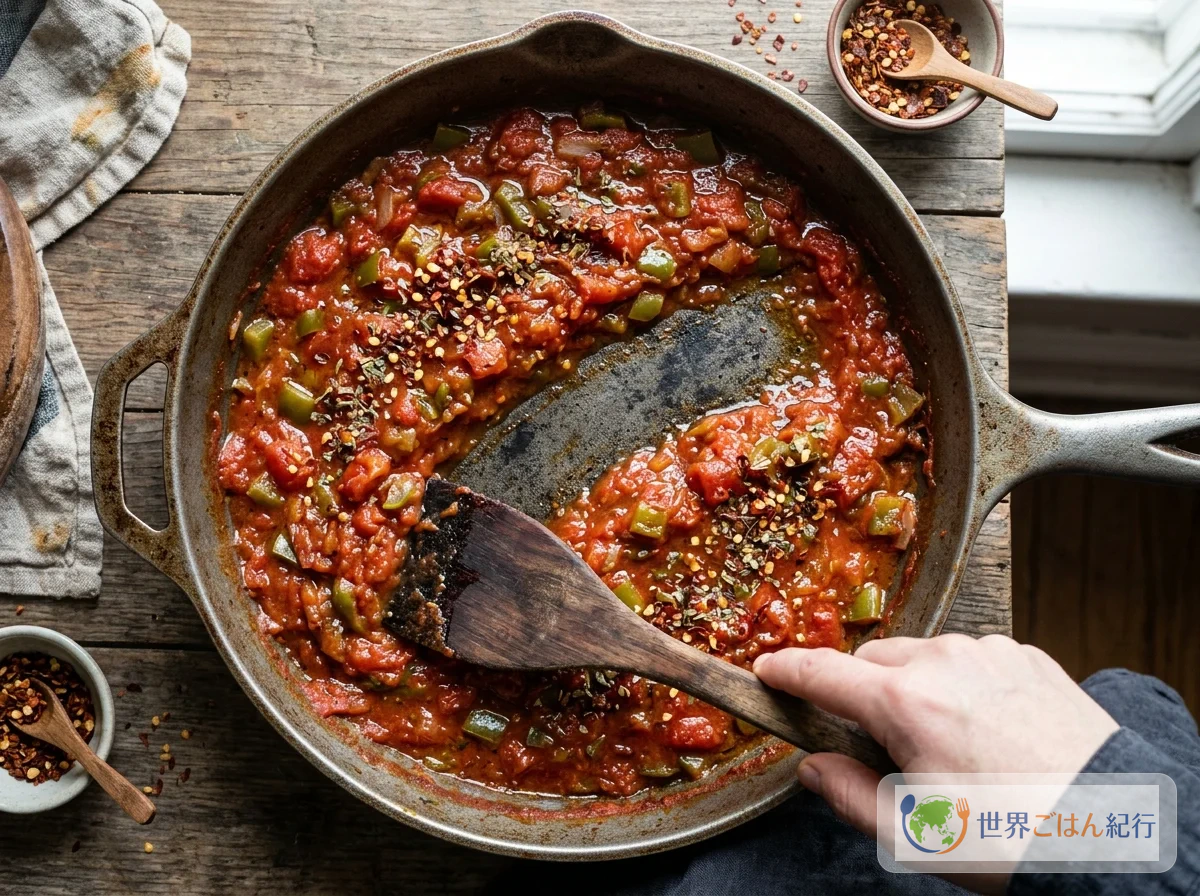

At the center of the morning table, the sahan is still sizzling
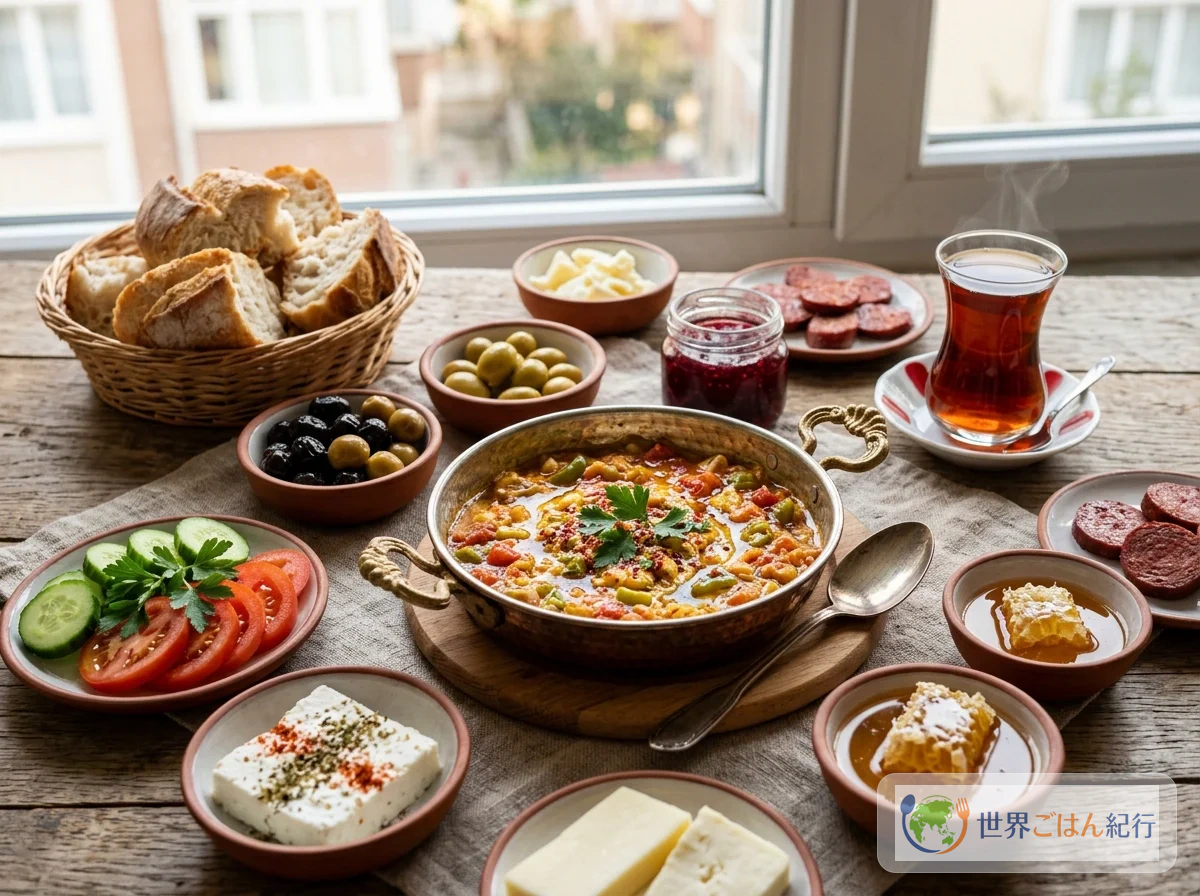
On a Turkish breakfast table, a small pan fresh from the fire sits in the middle, surrounded by plates of bread and olives. It is a shallow pan with two handles, called a sahan. Menemen is often brought to the table in the sahan itself. In the residual heat the eggs at the edge are still crackling faintly, the green scent of pepper rises over the red of the tomato, and the smell of butter and olive oil settles lightly over it. Everyone tears off fresh bread and scoops straight from the pan.
This breakfast is something to gather around slowly on a weekend. Among plates of egg dishes and salad, börek and gözleme, and simit, menemen takes its seat in the middle as a steaming dish.
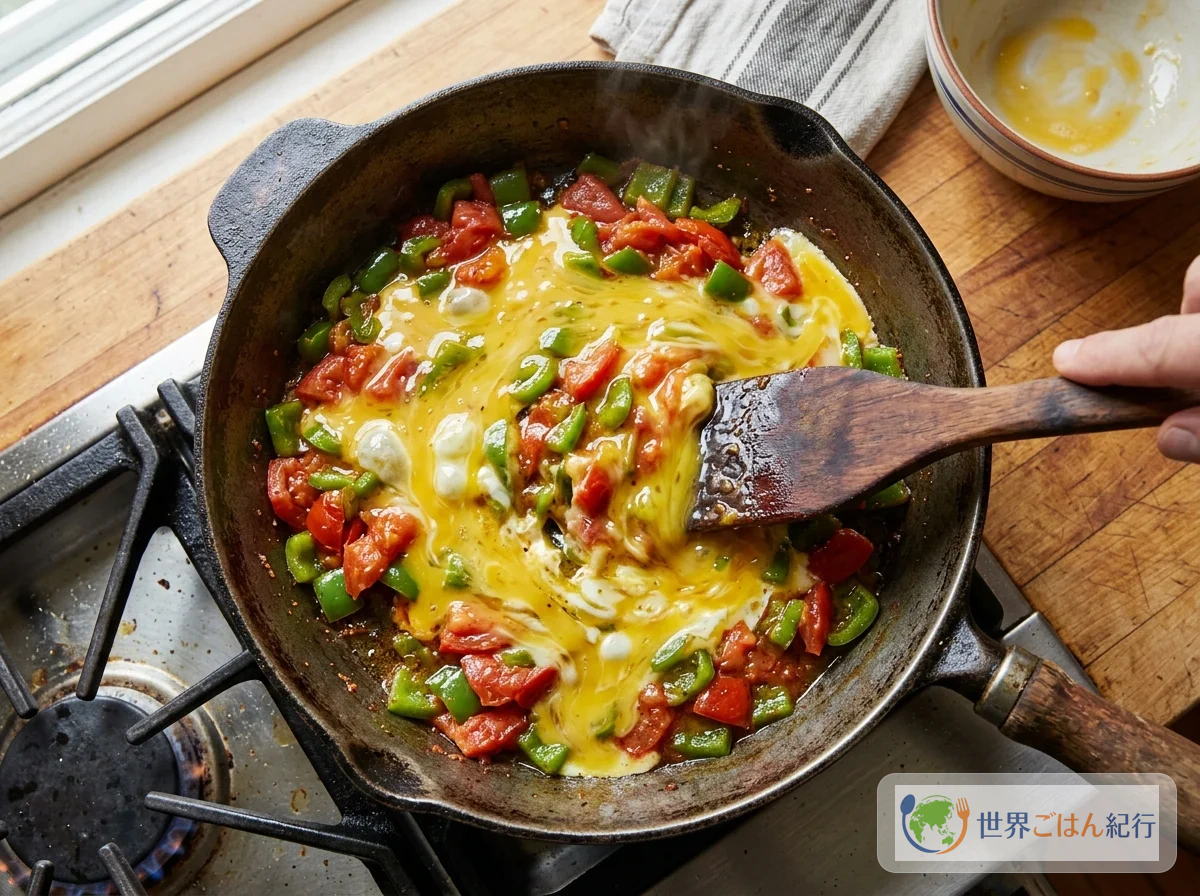
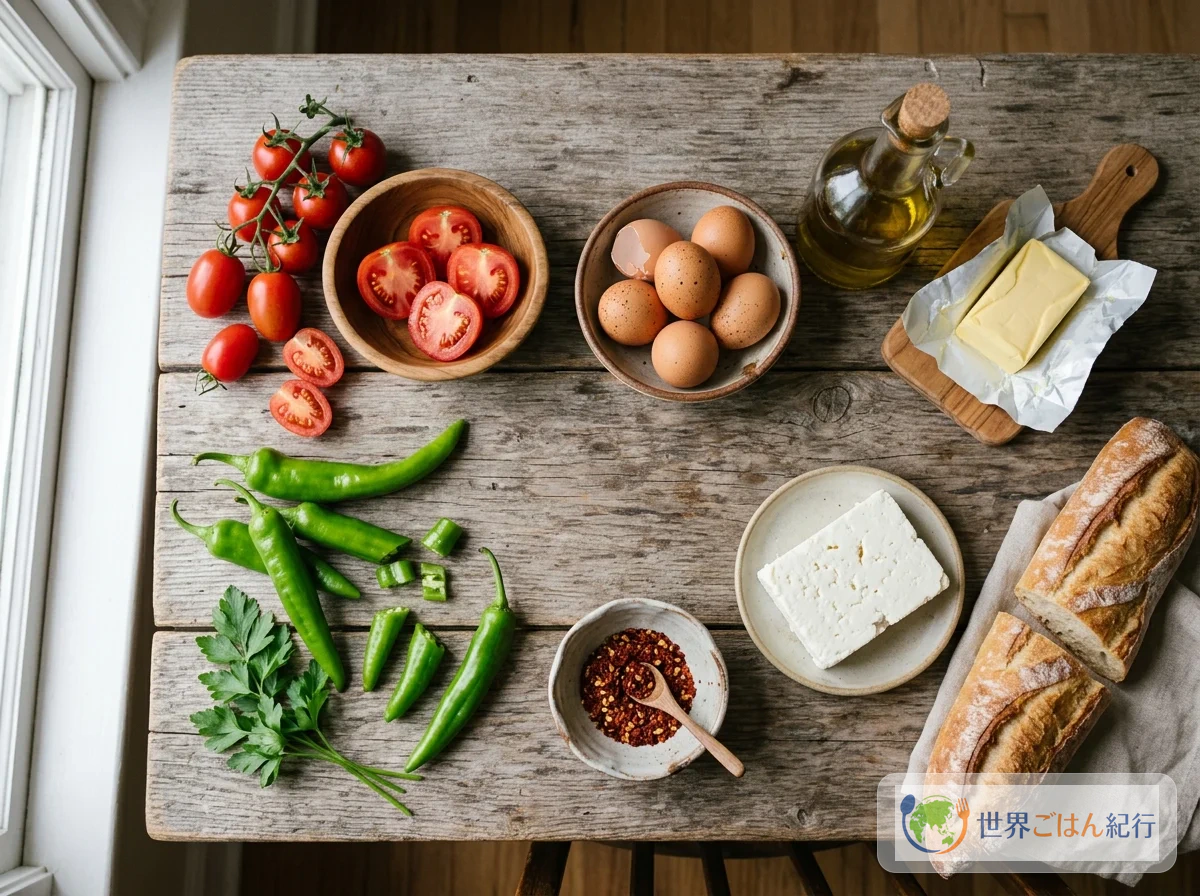
Eggs, tomatoes, green peppers and olive oil are the base, and you adjust with black pepper, red pepper flakes and oregano. You cook down the tomatoes and peppers, add eggs and stir them gently until just set. Hands-on time in a home kitchen is about 15 minutes. There are only two places to trip: drive off the tomato's moisture first, and finish the eggs with residual heat. It looks a lot like a Japanese stir-fry of egg and tomato, but the green aroma of the pepper, the red aroma of the chili, and eating it by scooping with bread make it a completely different dish.
The name comes from Menemen, a small town in İzmir province in western Turkey. Its Turkish spelling is Menemen. Some households call it "melemen," and a Habertürk columnist wrote that his grandmother called it "melemen" and didn't put in onion.
Note that şakşuka, a spelling close to shakshuka, is a different dish in Turkey and has no eggs. The names are only similar, so don't confuse them.
History: a New World vegetable and one town
Eggs and onions have been eaten in the Old World since ancient times. Tomatoes and chili-type peppers, however, are crops of the Americas, and the combination of ingredients that makes up menemen today came together fairly late in Ottoman history. Tomatoes first appear in palace records in the 1690s, as a green variety called "kavata." Red and green tomatoes become prominent in palace accounts only in the early 19th century. Peppers, too, began to be widely used in elite kitchens in the 19th century. Seen that way, the stories that tie menemen to the palaces of the 15th–16th centuries are hard to defend historically.
So who made it, and when? Unfortunately there is no record of an inventor, and no story can be asserted.
There are a few accounts of its origin that are considered promising. By one, Muslims who moved from Crete in the 1923 Greek–Turkish population exchange settled in the town of Menemen. They made a simple dish of wild greens, eggs and olive oil, later replaced the meat in a local tomato stew with eggs, and finally added peppers, giving the dish its present form. It is said to have spread beyond the town from the 1930s. This is not established history, just one of several explanations. Putting eggs in place of meat may feel a little like how, in a Japanese household, a dish of egg-set simmered ingredients can stand in for meat.
A word on its neighbors. Menemen is close in lineage to shakshuka (a word of Arabic origin associated with North Africa, meaning "a mixture"), French piperade, Hungarian lecsó and satarash from Serbia and elsewhere. The dividing line is how the egg is treated. Menemen mixes the eggs into the sauce and scrambles them; shakshuka keeps the shape of the egg. Turkey also has çılbır, a dish of eggs and yogurt, but it uses no tomato. If you are curious about keeping the egg whole, try shakshuka (in Japanese) or chakchouka (in Japanese).
Onion or not: tables that vary by household and province
When menemen comes up, the onion question always follows. It has been argued for a long time, but there is a tendency to include onion when it is eaten as a main dish and for many households to leave it out at breakfast.
In 2018, the Turkish gourmet Vedat Milor ran a Twitter poll on "menemen with or without onion." It drew 437,657 votes. The onion side won narrowly, but with just 50.6%, and the matter was not settled. The debate came up again the next year when an American newspaper published a recipe with onion. The cook Saniye Anne is on the side that flatly says it isn't menemen without onion.
The Turkish Ministry of Culture and Tourism's Kültür Portalı lists "kuru biberli menemen" (menemen with dried peppers) from Isparta province. It uses onion, boiled dried sivri peppers, tomatoes and eggs, and finishes the eggs firm or soft-set. The quantities are for 4–6 servings: a plateful of dried peppers, 4 tomatoes, 3 medium onions, 4 tbsp oil and 4 eggs.
On the other hand, Habertürk reports that "çakallı menemeni" from Samsun province is listed in a form with no onion. With both appearing on official sites, it is no wonder the debate never settles.
The differences are not only about onion. Some households beat the eggs first and add them, others crack them straight into the pan. A Habertürk columnist asked whether it might be possible to leave the yolks whole as in shakshuka, and wrote that having no fixed answer is itself a characteristic of Turkish cooking. Tomatoes are often finely diced, but grated, pureed or combinations of those also exist. The differences are summarized in a table.
| Difference | Example in Turkey | Replacement at home |
|---|---|---|
| Onion | Some houses include it, some don't. Often included for a main dish | If you add it, thinly slice new onion or ordinary onion |
| Cheese | White cheese (beyaz peynir) or kaşar just before the end | Feta, or mozzarella or melting cheese |
| Cured meat | Sucuk (dry spiced sausage), added after the peppers have softened. Pastırma (spice-crusted dried beef) goes in at the same time as the eggs | Chorizo, bacon, prosciutto |
| Adding the eggs | Beaten first / cracked straight into the pan | Either works. Beating them cooks them more evenly |
| Chili | Red pepper flakes; the Isparta version uses dried peppers in place of green peppers | Coarse Korean chili flakes, shishito peppers, green peppers |
Feta, melting cheese, chorizo and coarse Korean chili flakes are probably the most available in a Japanese kitchen. So we suggest starting without onion, cracking the eggs in and stirring them in the pan, in the basic form. From the second time, you can bring it closer to your taste with onion or cheese. Onion adds sweetness and moisture, so allow longer for reducing the tomatoes. White cheese is salty, so on days you add cheese, cut the salt first.
Ingredients (serves 4)
This is an amount for a single 24 cm (9 1/2 in) frying pan, for 4 servings. 6 eggs is a generous amount that gives a quite loose finish. For a breakfast with bread, that is just right for four. Choose ripe, fleshy tomatoes. You can make it with canned whole tomatoes too.
Because this dish is finished soft-set, when serving infants, older adults, pregnant women or anyone unwell, cook the eggs until set through the center. Use fresh eggs, cook them as soon as you crack them and don't leave them standing. There is no substitute for people with an egg allergy; substituting tofu makes a different dish.
The step of cooking down the tomatoes tends to splatter, and the pan handle gets hot. Have an oven mitt ready for reassurance.
Shopping notes
Tomatoes, peppers, eggs, butter, feta and a baguette are all available from a neighborhood supermarket. What is worth looking for further afield is coarse chili close to pul biber, which gets across the red aroma through pepper flakes, plus paprika powder and oregano. The range of heat differs by product, so check whether it is labeled hot or mild. Aleppo-type chili is milder, and Wikipedia also says "Aleppo pepper is sometimes added." But the realistic order is to start with coarse Korean chili and ordinary paprika powder, and look for the specialty product only if it feels lacking.
What supports the red oil and color of menemen is the sweet aroma of paprika more than the heat of chili. For households that dislike heat, or for children, use 1/2 tsp paprika powder in place of pepper flakes. If you buy it, check that it is a mild, non-hot type, and that the amount per use, 1/2 tsp, is covered by the container size. If you already have paprika powder at home, there is no need to buy more. A smoked type is too strong for menemen's light aroma, so choose the ordinary sweet kind.
Locally it is made in a sahan (a shallow two-handled pan) and taken straight to the table. At home, a 20–24 cm (8–9 1/2 in) frying pan or a small ovenproof pot is enough. Carry it to the table on a trivet, and it comes much closer to the atmosphere there.
Method
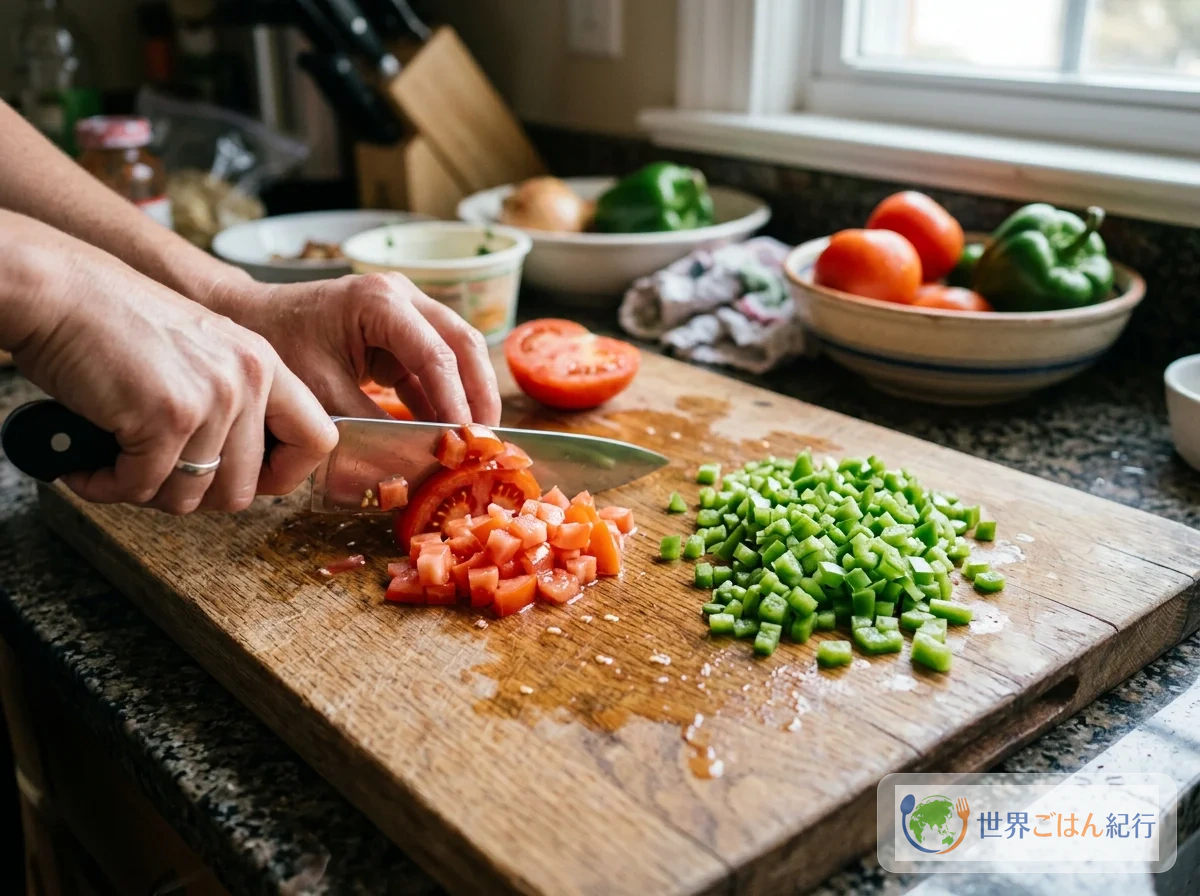
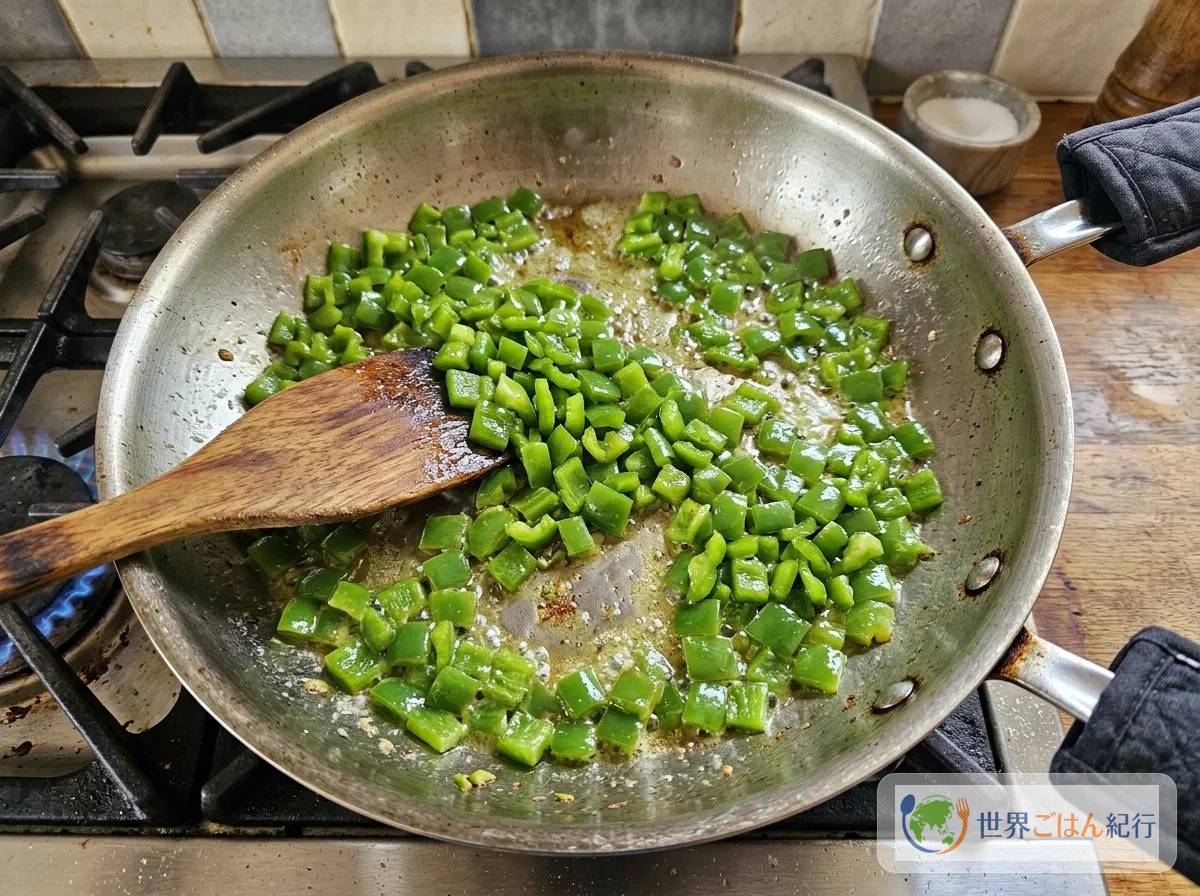
About 15 minutes in all. Chopping takes 5 minutes, sautéing the peppers 3, cooking down the tomatoes 7–8, and stirring the eggs until set 1–2. Heat is medium by default, and medium-low after the eggs go in. This assumes a 24 cm (9 1/2 in) frying pan. The watchword for the finish is: finish the eggs after turning off the heat.
If you serve in the pan, the heat of the pan keeps the eggs setting. The trick is to turn off the heat while it is still loose, while the eggs in the pan still have a gloss. If you move it to plates, the residual heat is small, so it's fine to cook another 30 seconds. For anyone who dislikes runny eggs, and for children, cook until set through the center.
How to eat it with bread
The classic is to tear fresh bread and scoop straight from the pan. The job of catching the hot juices falls to the bread, not a plate. Scooping the red oil with bread lets the bread soak up the aroma of tomato and butter and makes the best bite. Özlem's Turkish Table says that with crisp bread and garlic yogurt it also makes a light dinner or a full lunch.
In Japan a baguette, country bread, toast or pita all go well. It's also eaten over rice, and a little soy sauce brings it closer to a Japanese-style egg over rice. To set it out as breakfast, add olives, sliced cucumber and tomato, cheese and tea (çay), and the atmosphere of a Turkish breakfast table comes through strongly.
Five variations
- Sucuk style: Cut 60 g chorizo into 5 mm (1/4 in) slices, add once the peppers have softened and cook 1 minute. The spice aroma moves into the oil, and the red oil you scoop with bread gets one level deeper.
- Cheese version: Tear 50 g feta and place it on 1 minute before the eggs set. It adds saltiness, so reduce the salt to 1/3 tsp.
- Onion version: Slice 75 g onion thinly and cook it for 2 minutes before the peppers. It adds sweetness and moisture, so cook the tomatoes down 1 minute longer.
- Mushroom version: Slice 80 g button mushrooms and cook them with the peppers. Wikipedia also lists variations using mushrooms or ground lamb.
- Spinach version: Özlem's Turkish Table writes that spinach goes well too. Chop 50 g spinach, add it just before the eggs and stop at 30 seconds.
Rescuing a failure
Menemen is a dish of heat control more than quantities. Failures concentrate on the moment you turn off the heat and on judging moisture. The table below separates cause and fix for each.
| Failure | Cause | Fix |
|---|---|---|
| Red liquid pools at the bottom of the plate | Eggs added before the tomatoes were cooked down enough | Lower to low heat and stir from the bottom for 30 seconds to 1 minute to drive off moisture. If it doesn't recover, catch it with the bread |
| The eggs set into crumbles | Stirred too much, or heat too high | Take it off the heat and mix in 5 g butter to soften it. Next time turn off the heat 30 seconds earlier |
| The flavor is vague | Not enough salt, or weak chili aroma | Add a pinch of salt and 1/4 tsp pepper flakes and stir for just 10 seconds |
| The peppers are bitter | Cooked too long | Shorten the sauté to 2 minutes. It can't be recovered, so fix it with the heat next time |
Storage and making ahead
Finished menemen is best eaten the same day. It is a soft-set state where the eggs have cooked, so even refrigerated, it weeps water by the next day and the texture suffers. If you do refrigerate it, cool it, put it in an airtight container, eat it the next day, and reheat so it is hot through the center. Freezing breaks down the texture of the eggs and isn't suitable.
What suits making ahead is the cooked-down tomato and pepper before the eggs go in. It keeps about 2 days refrigerated, so reheat it just before eating and add the eggs, and you can make it in 10 minutes in the morning.
FAQ
Q1. Should I add onion?
There is no right answer; even in the 2018 poll the onion side was 50.6% and it was not settled. Onion adds sweetness and bulk, so it suits a main dish or dinner. For the first time, try the basic form without onion, where the aroma of the tomato is easier to taste.
Q2. How is it different from shakshuka?
It is how the egg is treated. Menemen mixes the eggs into the sauce; shakshuka places eggs on top and keeps their shape. They are close in lineage, and the taste changes with spices such as harissa and cumin.
Q3. What can I use if I don't have pepper flakes?
Coarse Korean chili flakes work in the same amount. Ichimi is hot, so start at 1/4 tsp. If you dislike heat, use 1/2 tsp paprika powder, adding only color and aroma.
Q4. Can I serve it to children?
Leave out the pepper flakes and use green peppers instead of shishito to avoid heat. Cook the eggs until set through the center. Don't serve it to infants or to anyone with an egg allergy.
Q5. Can I make it ahead?
The easiest way is to make the cooked-down tomato before the eggs go in. Once finished, eat it by the next day, and in a microwave heat it at 600 W for 30 seconds at a time, watching it.
Sources
- Wikipedia. "Menemen (food)." https://en.wikipedia.org/wiki/Menemen_(food) (accessed 2026-09-30. To check spelling, the various theories of origin and an overview of methods)
- T.C. Kültür ve Turizm Bakanlığı Kültür Portalı. "Kuru Biberli Menemen - Isparta." https://www.kulturportali.gov.tr/turkiye/isparta/neyenir/kuru-biberli-menemen (accessed 2026-09-30)
- Habertürk. "Menemen soğanlı mı olur soğansız mı? Tartışma ABD'ye sıçradı." 2019-03-07. https://www.haberturk.com/menemen-soganli-mi-olur-sogansiz-mi-tartisma-abd-ye-sicradi-2395984 (accessed 2026-09-30)
- Yeni Ankara. "Osmanlı padişahları menemen yiyebilir miydi? Domates, biber, yumurta ve soğan Anadolu'ya ne zaman geldi?" 2026-09-14. https://www.yeniankara.com.tr/guncel/osmanli-padisahlari-menemen-yiyebilir-miydi-domates-biber-yumurta-ve-sogan-anadoluya-ne-zaman-geldi-182742 (accessed 2026-09-30)
- Ozlem's Turkish Table. "Turkish Style Scrambled Eggs with Tomato, Pepper, Feta; Menemen." 2010-07-29. https://ozlemsturkishtable.com/2010/07/tomato-pepper-feta-cheese-scrambled-egg-menemen/ (accessed 2026-09-30)
- Sabri Ülker Vakfı. "Menemen Tarifi." https://www.sabriulkerfoundation.org/tr/projelerimiz/yemekte-denge-mutfagi/menemen (accessed 2026-09-30)