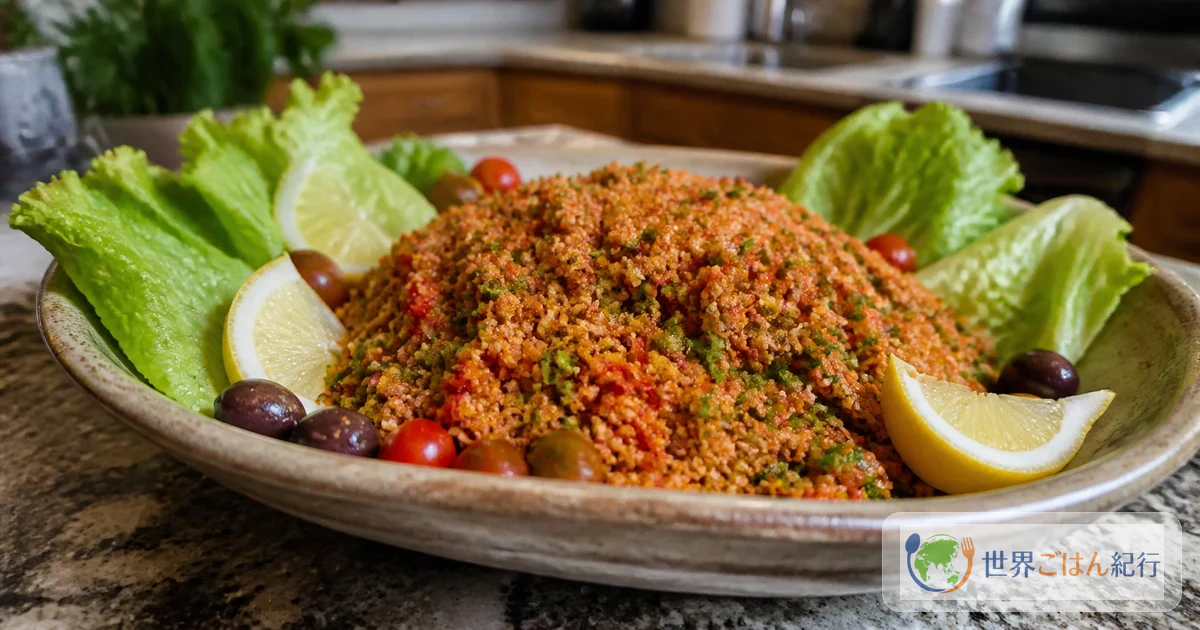
Chopping something red and fragrant
As you chop tomatoes, red juice spreads across the cutting board. Add green chili, onion, parsley, sumac and pomegranate molasses, and it stops being a plain tomato salad and starts to resemble that hot, tangy red dish in the little bowls at a kebab shop. Ezme (also acılı ezme) is a finely chopped salad that turns up again and again on the Turkish meze table.
In the name, acılı means "spicy," and ezme is used for something crushed or finely minced. As a dish, it is tomatoes, peppers, onion and parsley chopped small and brought together with pomegranate molasses, lemon, sumac, a chili flake in the style of pul biber, and olive oil. Think of it as close to a salsa, but what makes it Turkish is how the sourness is built. Instead of brightening it with lemon alone, you layer the sweet-tart fruit of pomegranate with the dry tang of sumac.
The Kültür Portalı of Turkey's Ministry of Culture and Tourism describes Adana-style acılı ezme made with tomatoes, scallions, parsley, biber salçası (pepper paste), garlic, sivri biber (long green peppers), mint, red chili, lemon juice or nar ekşisi (pomegranate molasses), and olive oil. This recipe keeps that backbone of ingredients while swapping in vegetables and seasonings that are easy to find.
Ezme shines next to meat and bread rather than on its own. It lightens the richness of köfte (in Japanese), and spooned onto lahmacun (in Japanese) it brings out the toasty crust. It is also good with skewered meats like cağ kebabı (in Japanese), and with a bean side dish such as piyaz (in Japanese). In a home kitchen, try it beside grilled meat, roast chicken or salt-grilled mackerel; it changes the feel of the whole plate.
What makes ezme taste like ezme
On paper, ezme looks simple. In practice, it is easy to end up with something watery, something that is only hot, or something sweet like ketchup. The things to protect: draining off some of the tomato juice, chopping finely, and not relying on lemon alone for acidity.
The Mediterranean Dish describes ezme as a finely chopped Turkish tomato dish somewhere between a spread, a salad and a dip, building the flavor with biber salçası, tomato paste and lemon. LinsFood separates the hand-chopped method, which keeps texture, from the food-processor method, and explains that handling the tomatoes separately keeps the mixture from turning into a sauce. Give Recipe also takes the more traditional hand-chopped route, mincing the vegetables and tying them together with a separately mixed dressing.
Turkish sivri biber and kapya biber aren't always easy to find. Instead, combine shishito peppers, green bell pepper, red bell pepper and a hot green chili. It doesn't all need to be fiery. Adjust the heat at the end with chili flakes so the green aroma of the vegetables and the tartness of the pomegranate still come through.
| Role | Closer to Turkey | Practical substitute | Swaps to avoid |
|---|---|---|---|
| Red vegetables | Ripe tomatoes, kapya biber | Ripe tomatoes, red bell pepper | Sweetening it with ketchup alone |
| Green aroma | Sivri biber, parsley | Shishito peppers, green bell pepper, flat-leaf parsley | Lots of cucumber |
| Acidity | Nar ekşisi, sumac, lemon | Pomegranate molasses, sumac, lemon | Sharpening it with vinegar alone |
| Heat | Pul biber, hot biber salçası | Coarse chili flakes, a little cayenne | Curry powder |
Ingredients (serves 4)
This makes 4 servings as a small side dish, or 6 as a starter. Served alongside meat, this amount is enough for about 400 g of grilled meat.

The recipe itself is mostly vegetables, olive oil and spices. Store-bought red pepper paste and pomegranate molasses may be made in facilities that also handle wheat, nuts, sesame or soy, depending on the brand. You can always add more chili at the end, but you can't take heat out once it's in. The first time you make it for a family, seed the green chili and start with 1/4 tsp of chili flakes.
Ingredients worth seeking out

Tomatoes, onion, parsley and lemon from any supermarket are fine. The ingredients worth seeking out at a Middle Eastern grocery or online are pomegranate molasses and sumac, and if you chop a lot, a small food processor helps. The closest thing to the red pepper paste is Turkish biber salçası, but a mix of tomato paste, paprika and a little chili is enough to give ezme its shape.
Pomegranate molasses is the shortcut to ezme's sweet-tart flavor. Its sweetness isn't sugary; it carries fruit acidity and a slight astringency that cut through the fat of grilled meat.
Sumac adds a dry sourness that is different from lemon. Beyond ezme, you can toss it with sliced onion to serve alongside meat dishes.
Hand-chopping is the main method here, but on a weeknight with a lot of vegetables to mince, a small food processor is useful. Don't let it run; stop after short pulses.
Instructions
Ezme involves no cooking, but it tastes sharper when you don't rush the sequence. Drain, chop fine, mix the acid first, then rest. In that order, the juice won't spread across the plate when you serve it, and it is easy to scoop up with bread.
1. Drain the tomatoes
Time: 8 min
No heat. Cut 400 g tomatoes in half crosswise and gently remove the seedy centers with your fingers. Dice the flesh into roughly 5 mm (1/4 in) pieces, put it in a strainer and sprinkle with 1/4 tsp salt. Once the salt coats the pieces evenly and the surface looks slightly moist, let it sit for 5 minutes. When about 2–3 tbsp of red juice has dripped out, that's enough. Pressing on it pushes out the sweet flesh too, so let only what drips naturally drain away.

2. Finely chop the vegetables and parsley
Time: 12 min
No heat. Chop 80 g red bell pepper, 60 g shishito peppers or green bell pepper, 8 g green chili, 80 g onion and 5 g garlic into a rough 2–3 mm mince. Strip the tough stems from 25 g parsley and chop the leaves finely. If using a food processor, pulse everything except the tomatoes in 1-second bursts, only 8–10 times, and stop while there is still texture. If it turns to paste, the texture disappears and only the heat comes forward.

3. Mix the red sauce
Time: 5 min
No heat. In a large bowl, combine 1 tbsp tomato paste, 2 tsp red pepper paste, 1 1/2 tbsp pomegranate molasses, 1 tbsp lemon juice, 2 tbsp olive oil, 1 tsp sumac, 1/2 tsp chili flakes, 1/2 tsp dried mint and 1/2 tsp salt. Stir for 1 minute with a small spoon, scraping the bottom, until it turns a glossy reddish brown and falls from the spoon in a thick ribbon without the oil separating. For a milder version, halve the chili.

4. Combine the vegetables and sauce
Time: 5 min
No heat. Add the drained 5 mm tomato pieces, the 2–3 mm chopped vegetables and the finely chopped parsley to the bowl of sauce. Fold from the bottom about 20 times with a spoon, until the red sauce coats everything evenly. When it's done, no clear water should be pooling at the bottom of the bowl and the vegetables should look glossy. Taste: if it needs more acid, add 1 tsp lemon juice; if it needs more heat, add a pinch of chili.

5. Rest and adjust the juices
Time: 20 min
No heat. Chill the mixed ezme in the refrigerator for 20 minutes. The salt and acid settle into the vegetables and the aromas round out. Just before serving, tip it into a strainer for only 30 seconds, then return about 1 tbsp of the red juice that collects underneath. Return all of it and it turns watery; discard all of it and the acidity fades. You're aiming for juice that clings lightly to the pieces without running across the plate when you scoop it with bread.

6. Spread thin and finish
Time: 3 min
No heat. Spread the ezme in a shallow dish about 1.5 cm (5/8 in) thick and make loose grooves with the back of a spoon. Drizzle with the remaining 1 tbsp olive oil, sprinkle with 1/4 tsp black pepper, and add a pinch more sumac if you like. A thin layer is easier to scoop with bread than a mound in the center, and the oil and acidity are spread more evenly.

How to keep it from getting watery
The flavor of ezme depends on how much liquid you keep. Drain the tomatoes completely and you have a dry mince of vegetables. Don't drain them at all and a red soup pools in the bottom of the dish. What you want is juice clinging to the pieces.
| Problem | Cause | Fix |
|---|---|---|
| Red liquid spreads across the plate | Tomato seeds and juice went in as is | Drain in a strainer for 30 seconds and return just 1 tbsp of juice |
| Hot but flat | More chili, not enough acid and oil | Add 1 tsp pomegranate molasses and 2 tsp olive oil |
| Sweet like ketchup | Too much tomato paste and sweet pepper paste | Sharpen with 1 tsp lemon juice, a little sumac and a pinch of salt |
| Tastes grassy and raw | Bell pepper chopped too large, raw garlic too strong | Chop finer and extend the rest by 10 minutes |
| It turned into a paste | The food processor ran too long | Next time, handle the tomatoes separately and stop at 1-second pulses |
Ripe summer tomatoes are ideal, but you can make it in winter too. Winter tomatoes have less aroma, so mixing in half cherry tomatoes adds sweetness. Using only cherry tomatoes, though, means a lot of skin, which feels tough once chopped. A half-and-half mix of medium and cherry tomatoes is the easiest to work with.
Substitutes
If you can't find red pepper paste, don't keep hunting for a lookalike; adjust with tomato paste and paprika. In place of 2 tsp red pepper paste, mix 2 tsp tomato paste, 1 tsp paprika and a pinch of chili flakes. The aroma is a little lighter, but you still get red depth.
Pul biber is a red pepper flake used widely in Turkey. You can get close by combining small amounts of Aleppo pepper, Korean coarse chili flakes (gochugaru) and ground red chili. A full teaspoon of ground chili alone makes the heat harsh, so stick to 1/2 tsp coarse chili flakes the first time. If you want more heat, it's safer to add it at the table to individual portions.
Without sumac, add 1 tsp more lemon juice and grate in a tiny bit of lemon zest. Lemon gives a brighter aroma than sumac's dry sourness, though. If you want that kebab-shop small-plate character next to grilled meat, sumac is worth trying at least once.
How to serve it

Ezme is less the star of the table than the thing that connects everything. Take a bite of freshly grilled meat, scoop up a little ezme with bread, calm the heat with yogurt sauce. That's how it works best. If you're building a Turkish-style menu, these combinations are easy:
| Occasion | Serve with | What ezme does |
|---|---|---|
| Grilling meat | Köfte, cağ kebabı, grilled chicken | Cuts the fat with acidity |
| Bread-centered meal | Lahmacun, pita, baguette | Adds heat and juiciness to the bread |
| Bean dishes on the table | Piyaz, lentil soup | Breaks up heaviness with acidity |
| Weeknight dinner | Grilled fish, grilled eggplant, boiled eggs | Adds a red relish to simple plates |
Make kebab sauce alongside it, and the spicy red and the white yogurt give everyone an escape route at the table. If some people don't like heat, don't make a watered-down mild ezme; instead, put out more yogurt sauce, lemon and bread.
Storage and making ahead
Ezme is best eaten by the next day, refrigerated. Put it in a clean container, drizzle about 1 tsp olive oil over the surface, cover and store. It releases liquid overnight, so stir it before serving and drain for 30 seconds in a strainer if needed. If the aroma has faded, add 1 tsp lemon juice, a little sumac and 1 tsp olive oil to bring it back.
It's not suited to keeping for 3 days or more. The acidity makes it look like a preserve, but it is mainly chopped raw vegetables. Especially in summer, don't leave it out at room temperature for long; move only what you'll eat into a serving bowl. Leftover ezme is handy mixed into grilled chicken, boiled eggs, tuna or bean salad the next day.
FAQ
Q1. Can I make it entirely in a food processor?
Yes. But if the tomatoes spin with the other vegetables for long, they quickly turn into red juice. If you use one, pulse everything except the tomatoes first in short bursts, then either pulse the tomatoes in for just 2–3 times or chop them by knife. A little texture is more ezme-like.
Q2. Can I make it without pomegranate molasses?
Yes. As a stopgap, add 2 tsp more lemon juice and just 1/3 tsp sugar. You won't get the fruity tartness and astringency of pomegranate molasses, though. The difference is most noticeable when it's served with grilled meat.
Q3. Can I make a non-spicy ezme?
Yes. Seed the green chili and reduce the chili flakes to 1/4 tsp. Keep the sumac, lemon and pomegranate molasses. Even without heat, the acidity holds it together as a meze rather than just chopped tomatoes.
Q4. Can I add cucumber?
You can in a home salad, but it drifts a bit from classic ezme. Cucumber is watery, and over time it thins out the bottom of the dish. If you add it, seed it, cut it into 5 mm dice and mix in a small amount right before eating.
In short
Ezme doesn't require a full set of Turkish ingredients. What matters is watching the tomato juice, chopping the vegetables finely, and building depth with pomegranate molasses and sumac rather than lemon alone. Do that, and the same tomatoes and onions become a Turkish small plate you'll want next to grilled meat.
To go further, try köfte (in Japanese) as a meat main, lahmacun (in Japanese) as a thin flatbread, and piyaz (in Japanese) as a bean side, and you'll see where ezme earns its place. With one red dish on the table, a meal of bread and meat stays interesting to the last bite.
Sources
- T.C. Kültür ve Turizm Bakanlığı Kültür Portalı, "Acılı Ezme - Adana." (accessed June 2, 2026)
- The Mediterranean Dish, "Spicy Turkish Ezme." (accessed June 2, 2026)
- LinsFood, "Acılı Ezme (Spicy Turkish Tomato and Pepper Salad)." (accessed June 2, 2026)
- Give Recipe, "Ezme Recipe (Turkish Acili Ezme)." (accessed June 2, 2026)
- Turkish Style Cooking, "Acili Ezme Recipe." (accessed June 2, 2026)