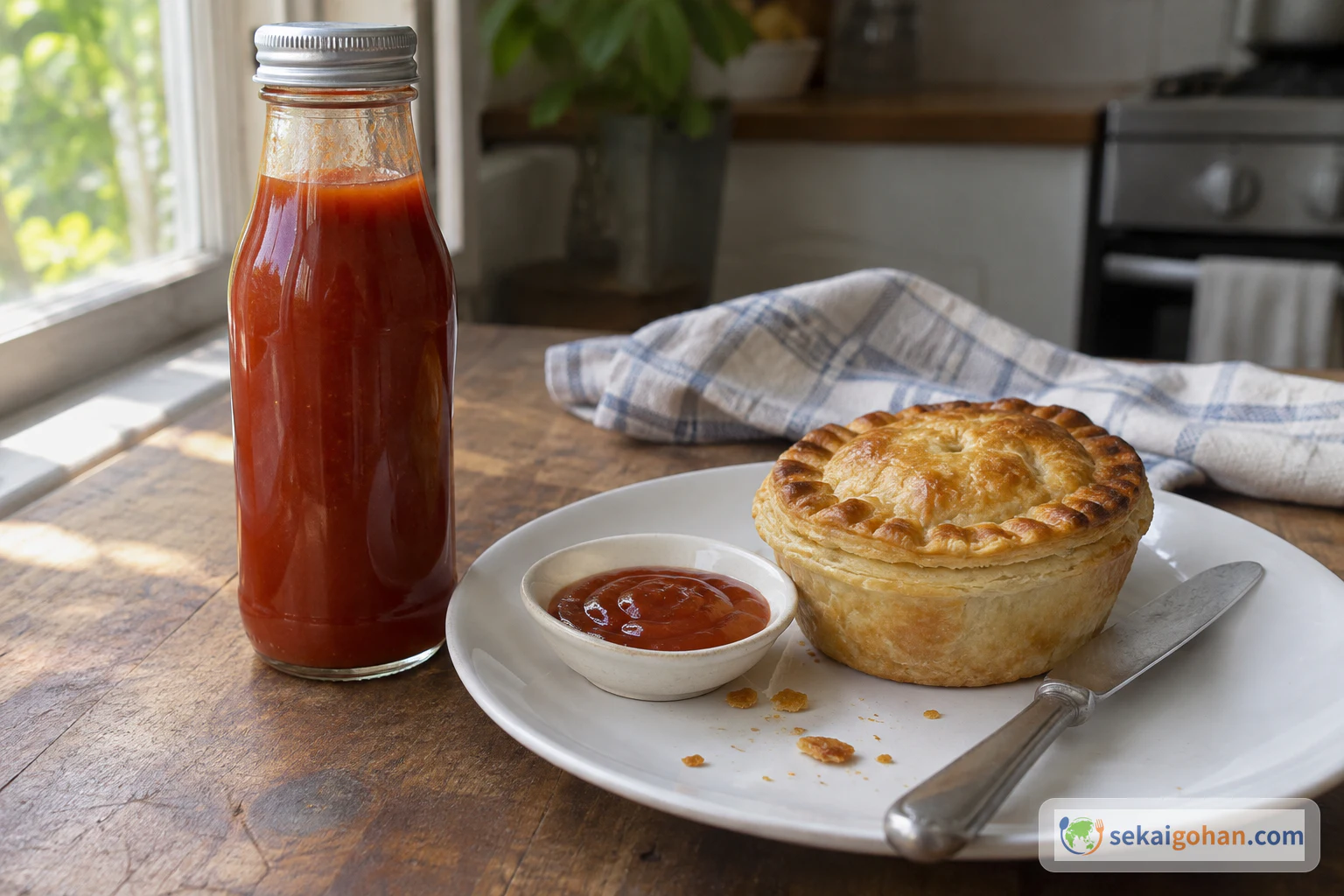
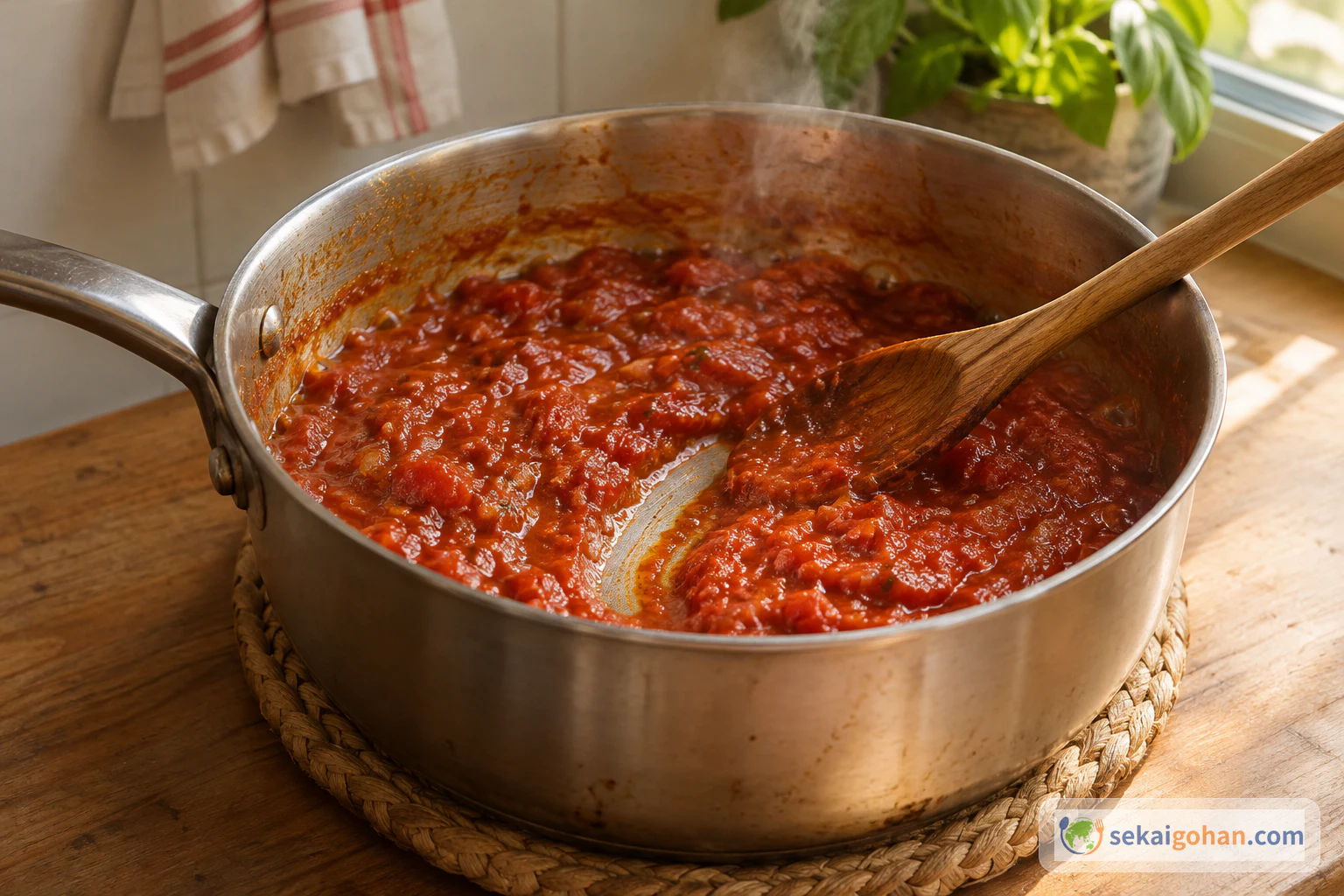
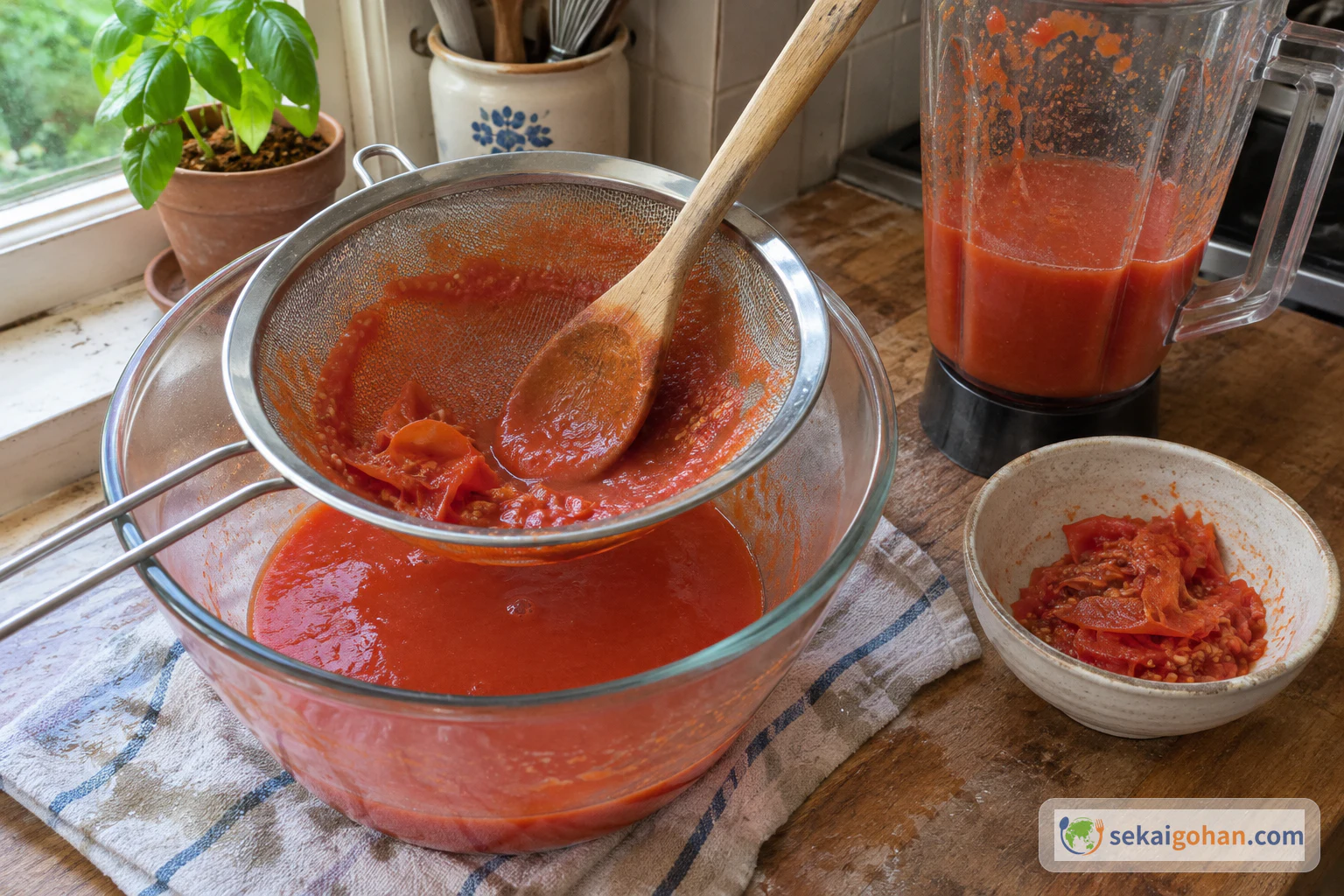
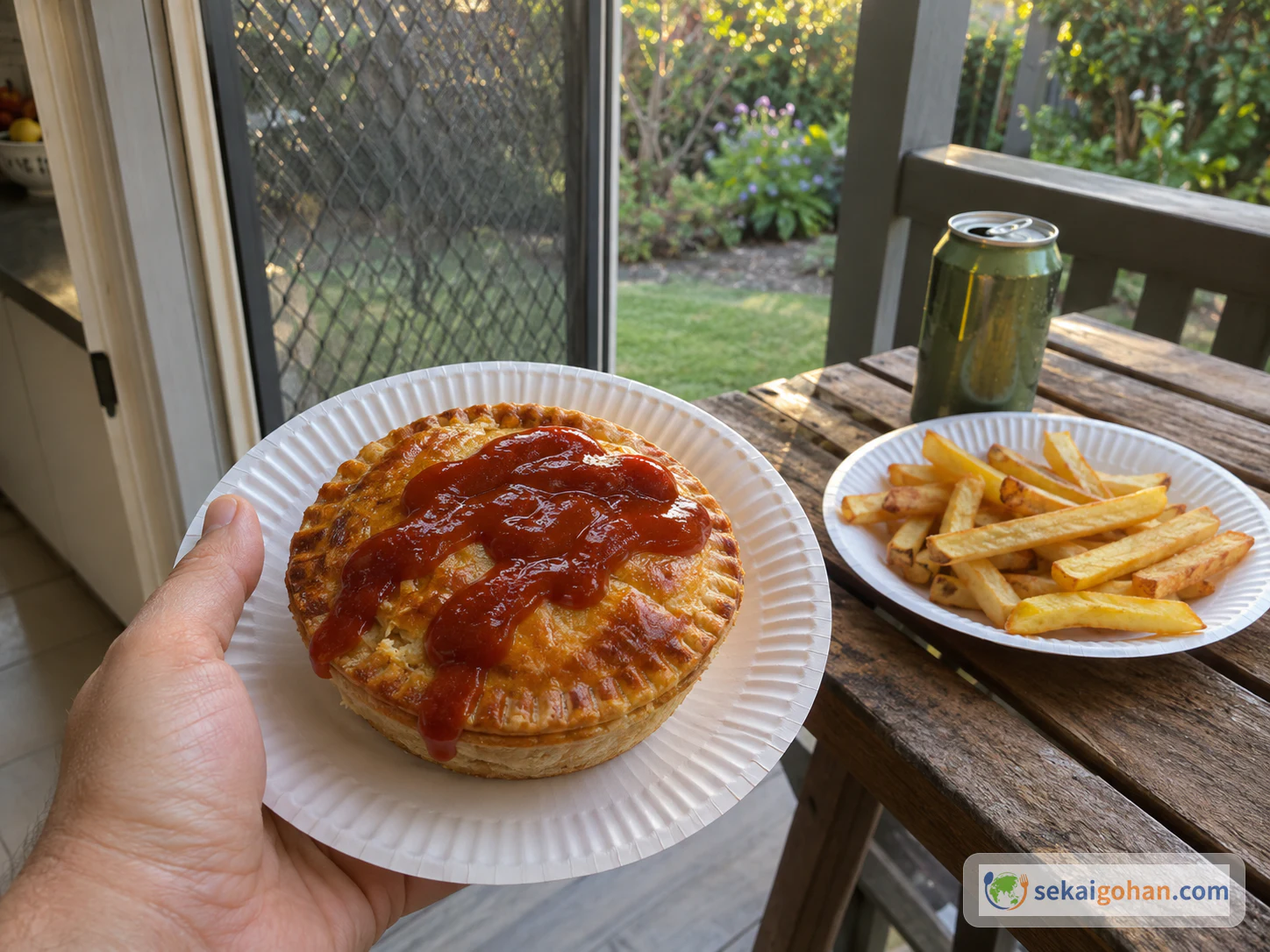
At the football, the pie comes on a paper plate, too hot to bite, and the bottle of red sauce goes over the flaky lid before anything else happens. The same sauce gets squeezed onto sausages at a backyard barbecue and pooled beside a pile of hot chips, and by the end of the meal there is red on everyone's fingers. Australians call it tomato sauce, sometimes ketchup, and they mean the same bottle. The homemade kind is cooked from ripe egg tomatoes with onion, ginger, ground coriander, brown sugar and two wine vinegars, then pushed through a fine sieve until it pours glossy and brick-red. It tastes sweet first, then sharp, with a warm spice that stays on the tongue after the pastry is gone.
Tomato Sauce, Ketchup and the Meat Pie
One bottle, two names
Ask for ketchup in an Australian milk bar and you will get the same thing as if you asked for tomato sauce. Australia has no legal standard for either name, so the two words are used interchangeably on labels and at the counter. The United States does have one: there, "catsup, ketchup or catchup" is a defined food made from tomato concentrate or tomato liquid, with vinegar, sugars, spices, flavourings, onion and garlic as optional ingredients, strained to remove skins, seeds and coarse bits. The same word carries a different set of promises depending on which country printed the label.
Where the word itself came from is not settled in every detail. It is usually traced to the Hokkien kôe-chiap, a salted-fish condiment, and the Malay kecap, a kind of soy sauce. The word travelled along 17th-century trade routes, was written down in English by 1682, and for a long time named all sorts of preserved condiments before tomatoes took it over.
Sweet, sharp and the numbers
One Australian food manufacturer explains the difference this way: ketchup is sweeter and thicker, and traditional Australian tomato sauce is sharper and runnier. Measured labels do not always line up with that. In a tasting of 22 bottled sauces, many contained 20% sugar or more, one supermarket's own ketchup came in at nearly 30%, and the lowest sat at 4.3 g per 100 g. Well-known bottles labelled tomato sauce reached around 23 g per 100 g. The gap between brands is bigger than the gap between the two names, and the two ketchups in that tasting were also among the thickest.
A bottle from a Carlton backyard
The bottle on the pie stall has a long factory story behind it. A small fruit-preserving business started in a backyard in Carlton, Melbourne, in 1895, and first made tomato sauce in 1899. By 1905 it had a factory in Richmond, Victoria, and by 1931 it employed more than 1,000 people and made about a hundred products. In the early 1930s it was sending sauce to New Zealand, South Africa, Britain and Sweden.
Then came decades of changing hands. The business was sold in 1963 to Lever & Kitchen, later part of Unilever, passed to Stuart Alexander in 2003 and to Gourmet Food Holdings in 2006, and went into administration in 2012. Its last Sydney factory closed in March 2013. Sabrands Australia then took on the brand and kept making the sauce in Victoria, so the name on the shelf survived even though the old factories did not.
Next to the pie
The meat pie and the sauce belong together the way chips and salt do. "As Australian as a meat pie" is a compliment now, but around the turn of the 20th century "meat pie" was an insult for a second-rate boxer, racehorse or bookmaker, and a cheap western film was a "meat pie western". During the Second World War, guidance for American soldiers explained the pie as the Australian answer to the hot dog. A pie at the footy is still a rite of passage, and the sauce goes on top. For more of the country's everyday food, see the Australia country page.
A meat pie is nicknamed a "dog's eye". In Japan, ketchup grew up in a different kitchen: commercial production started there in 1908, a 100 g aluminium tube arrived in 1958, and it went into Western-style dishes like napolitan spaghetti and omurice rather than beside fried food and pastry.
Ingredients
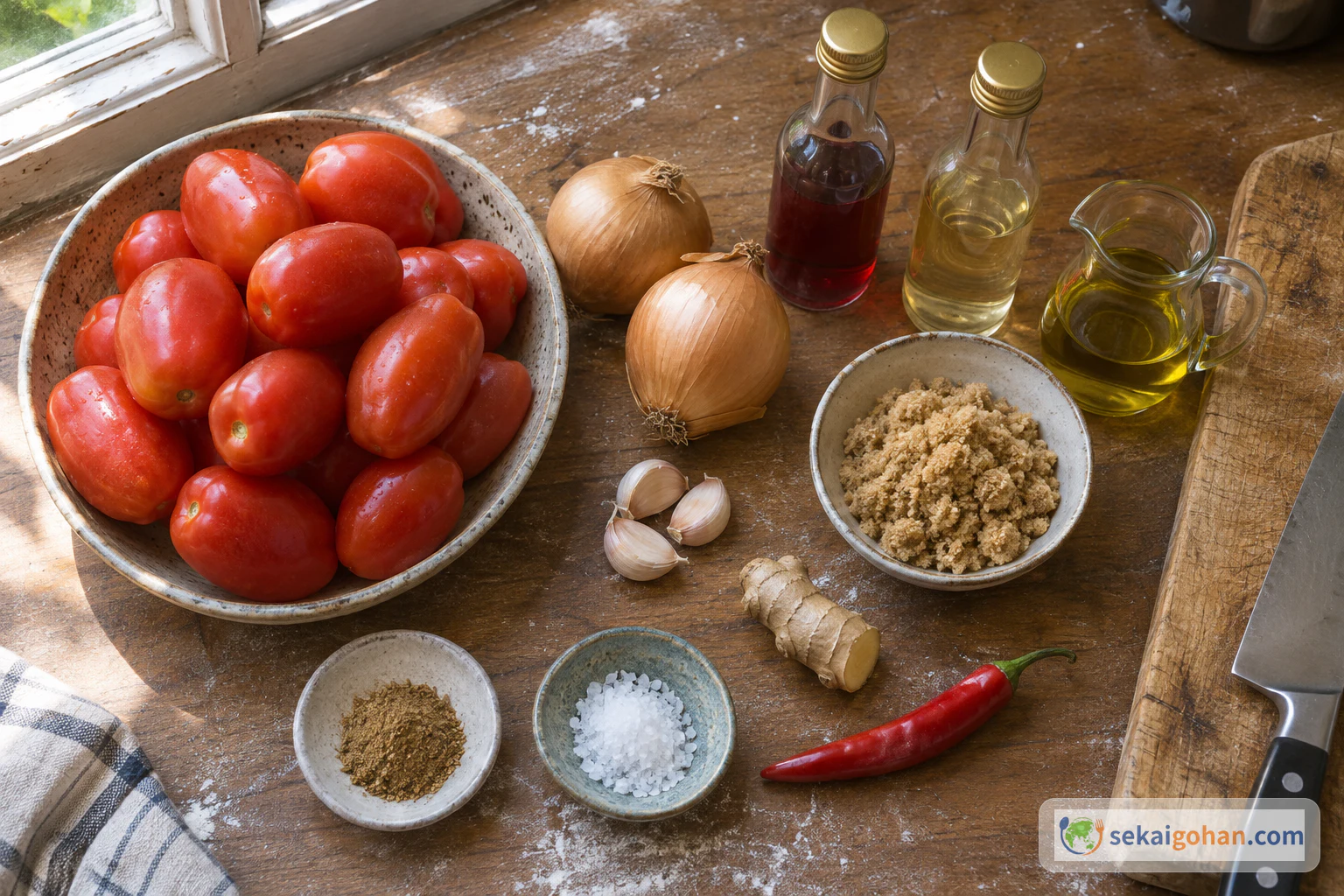
The sauce is a balance of sugar against vinegar against tomato. Weigh the 1 kg of tomatoes and the 110 g of sugar on a kitchen scale rather than counting tomatoes or trusting a loosely filled cup, and the finished sauce comes out the same every time.
The sauce contains no wheat, dairy, egg or nuts, and no gluten. Wine vinegars can contain sulphites, so anyone sensitive to sulphites, or to the preservatives in bottled sauces, should check the vinegar label. The meat pie it is served with is wheat pastry.
Equipment
- Heavy-based saucepan
- Wooden spoon
- Blender or food processor
- Fine-mesh sieve
- Large heatproof bowl
- Small funnel
- Glass jars or bottles with tight-sealing lids
- Kitchen scale
- Measuring cups and spoons
Choosing and Substituting
Egg-shaped tomatoes decide the texture. Roma or Italian-type tomatoes have firm flesh and less juice, so they cook down to a thick sauce in the simmering time. Large round tomatoes work when they are fully ripe, but they carry more water and need longer uncovered on the heat before the sauce thickens.
The rest of the list is mostly supermarket shopping, with a few honest swaps:
| Swap | What changes |
|---|---|
| Rice bran or another neutral oil for olive oil | The green, fruity note of olive oil disappears |
| Yellow onions for brown onions | Almost no change; new-season onions are wetter and take longer to soften |
| Unrefined cane sugar for light brown sugar | Darker colour and a more caramel taste |
| White sugar for light brown sugar | Less depth and a flatter sweetness |
| White wine vinegar for the red wine vinegar | Paler sauce, less of the slightly tannic edge |
| Rice or apple cider vinegar for white wine vinegar | Rice vinegar is softer, cider vinegar fruitier; check the acidity on the label and only swap one vinegar for another of the same strength |
| Ground cumin for ground coriander | A louder, earthier spice that shifts the sauce toward a different flavour |
| A dried red chilli, seeded, for the fresh chilli | Heat varies a lot between chillies, so start small |
Grated ginger from a tube carries extra water and additives and tastes duller than fresh. Use a fresh knob for the warmth that keeps the sugar in check.
Method
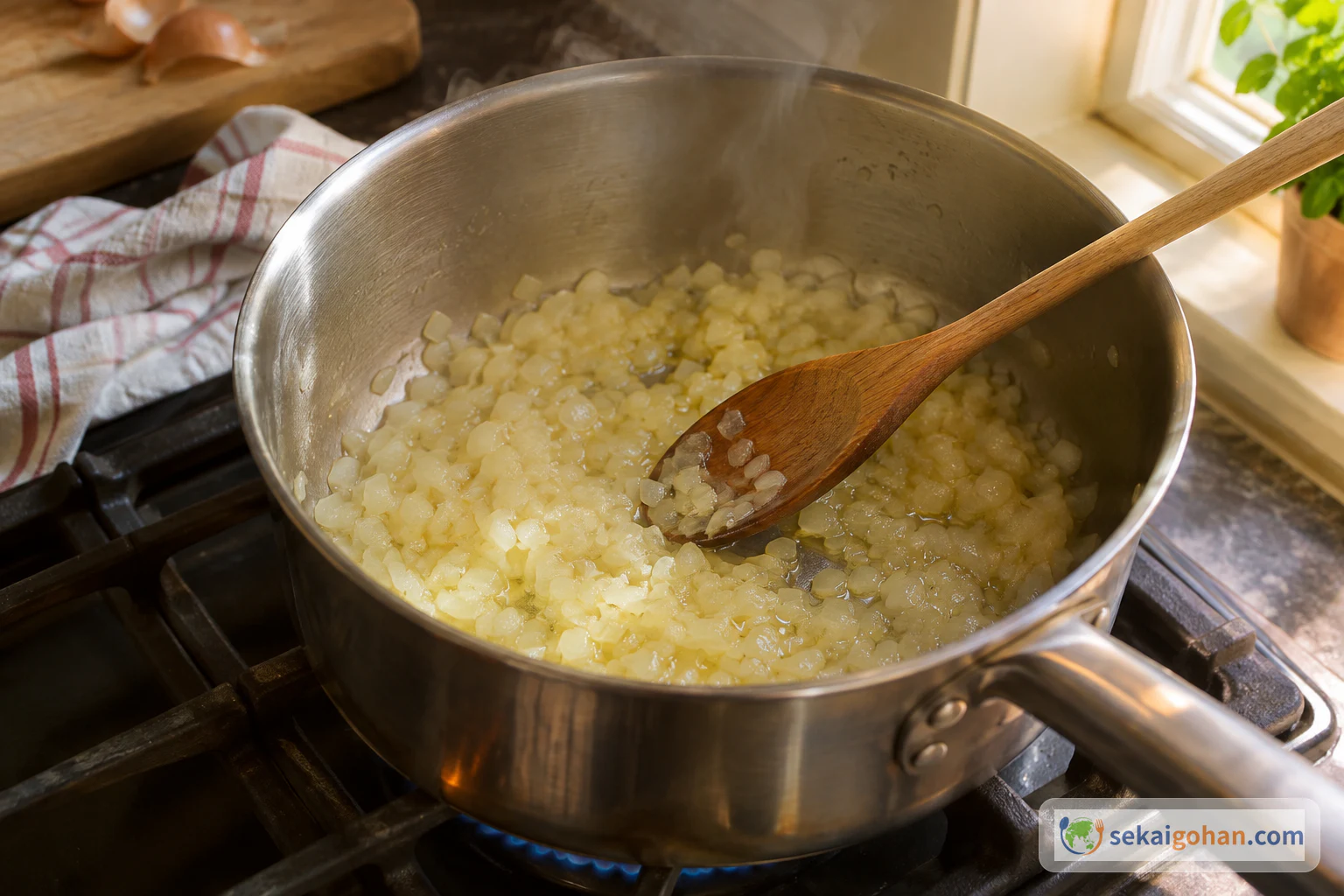
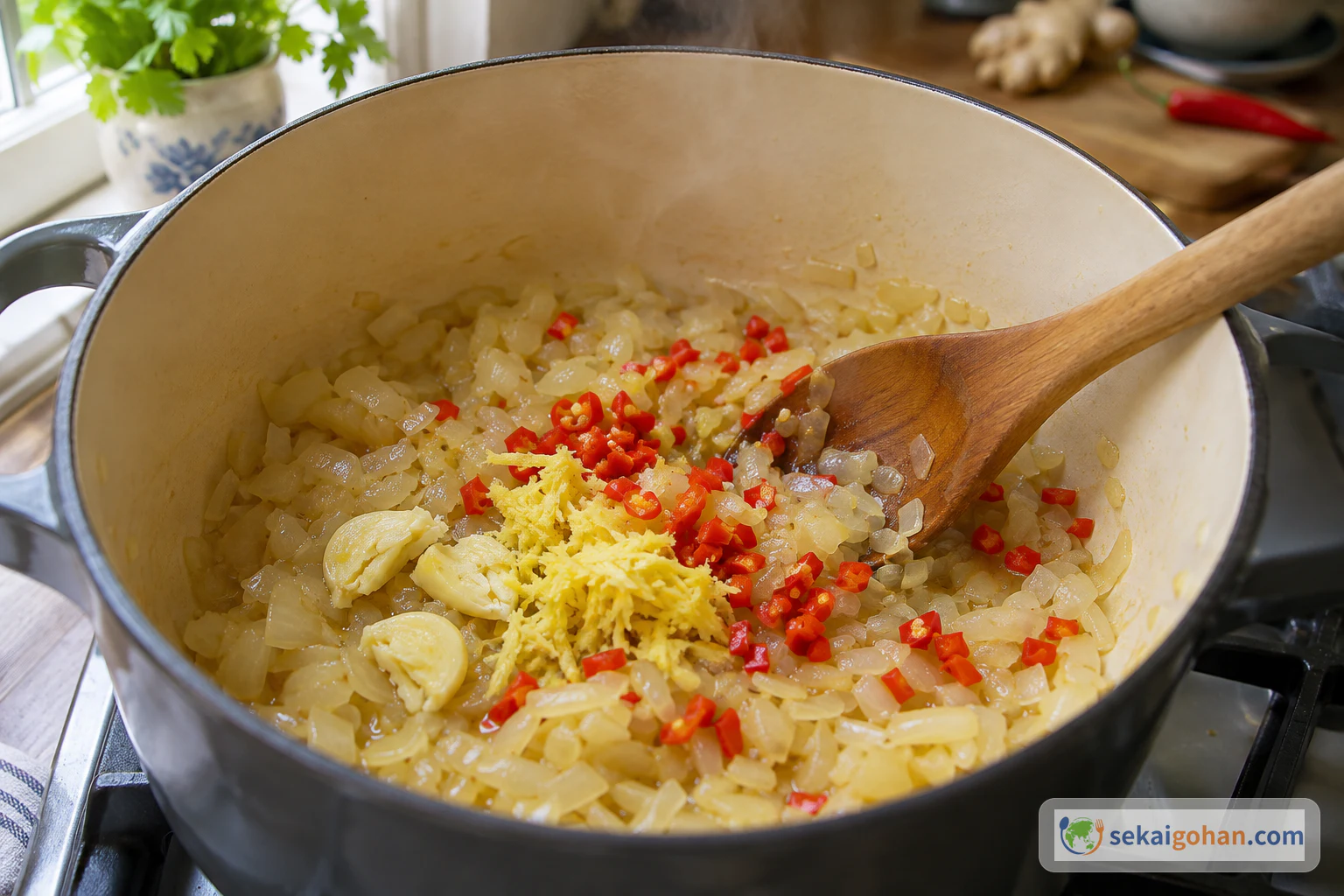
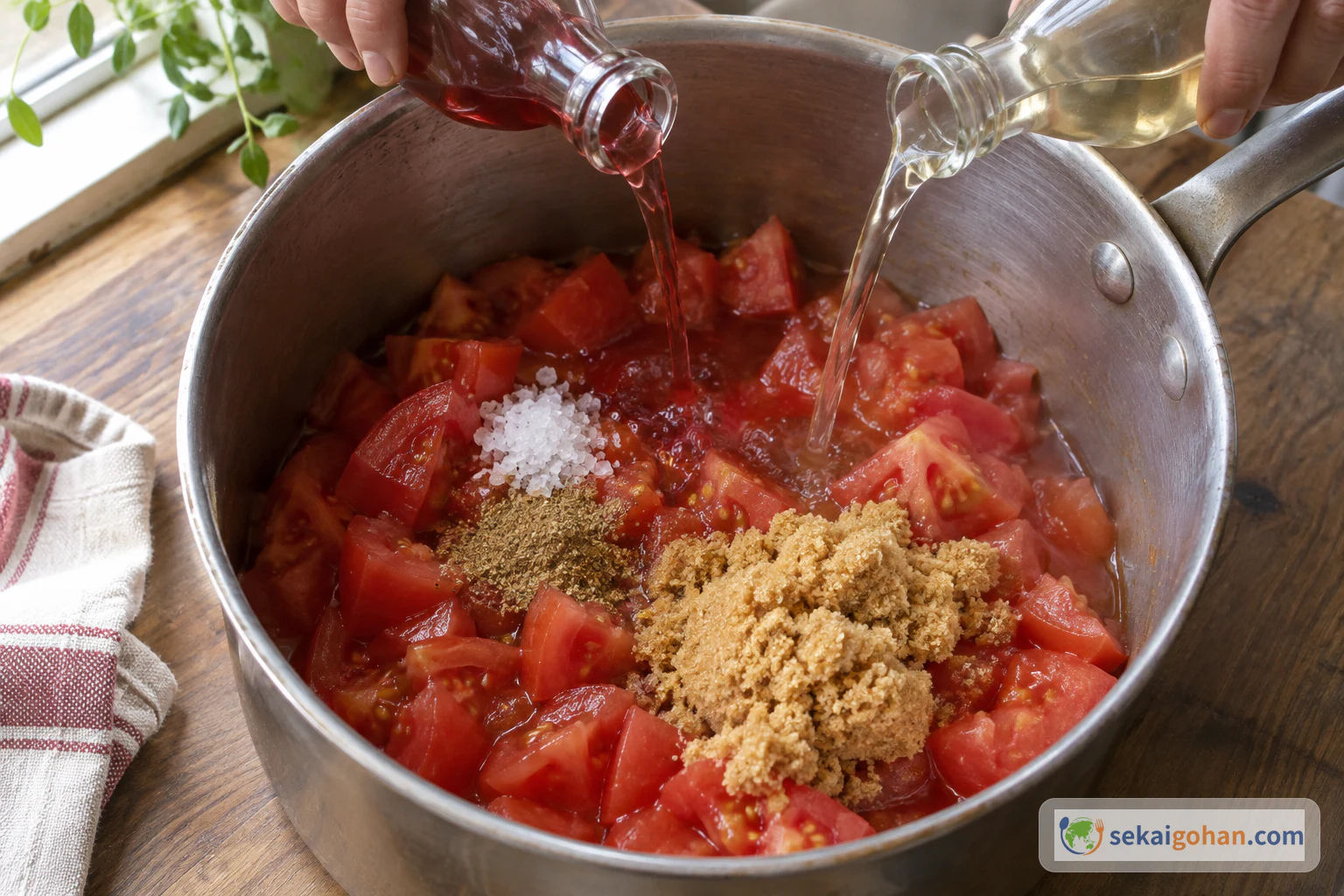
Chop everything and clean the jars before the pan goes on, because the end of the recipe moves quickly: the sauce goes back to the boil and straight into hot jars. The long hands-off stretch is the 40-minute uncovered simmer, when you only need to scrape the base now and then. After that comes a 15-minute rest, the blending and the sieve, which is the messiest part and the one that makes the sauce smooth.
When It Goes Wrong
| What you see | Why | What to do |
|---|---|---|
| The sauce stays runny | Watery tomatoes, often large round ones, or too short a simmer | Simmer longer with the lid off until the spoon trail holds; add more sugar only as a last resort |
| Too sharp | A strong vinegar, or the sauce cooked down too far | Add sugar a teaspoon at a time; never dilute the vinegar with water, which weakens the acid that helps the sauce keep |
| Too sweet | The sugar outweighs the acid of your tomatoes | Add a little more vinegar; keep changes small so the balance of the recipe stays intact |
| Grainy on the tongue | The sieve was too coarse | Strain again through a fine mesh, pressing with a wooden spoon |
| Brown rather than red | Onion or garlic coloured in the pan, or the sauce reduced too hard | Next time keep the heat moderate in steps 2 and 3; the colour also darkens a little as the sauce sits |
| A layer separates in the fridge | Fibres settle as the sauce stands | Shake or stir before serving |
Serving, Variations and Storage
At the table
Squeeze it over a meat pie, straight onto the lid. Put a bowl of it beside hot chips and fried fish, next to the salt and vinegar, and spoon it over grilled snags (sausages) with a slice of white bread. It is just as good with sausage rolls, steak sandwiches and corned beef fritters, anything hot, fried or wrapped in pastry.

Variations
Each of these is its own recipe. Cook it as written rather than mixing its amounts into the one above.
- Clove and apple, the old-fashioned style. Cook 3.3 lb (1.5 kg) tomatoes, 2 brown onions, 1 green apple, 3 garlic cloves, ½ cup sugar, 2 tsp black pepper, 6 cloves, 1½ cups white vinegar, 1 tsp mixed spice and 1 tbsp salt for 2 hours, mash, then cook for another hour. The apple and cloves give a darker, spicier sauce closer to a chutney.
- The big country batch. Cook 13.2 lb (6 kg) tomatoes, 2.2 lb (1 kg) onions, about 2 cups (500 ml) spiced malt vinegar, 3½ oz (100 g) sugar, 1 oz (30 g) garlic, 1 oz (30 g) ginger, 2 oz (60 g) salt and about 2 tsp cayenne or chilli for 2 hours and mash. Then add 3.3 lb (1.5 kg) more sugar and about 3 cups (750 ml) more vinegar and cook until thick. The batch halves well.
- Quick passata sauce. Simmer about 3 cups (700 ml) passata with 2 tbsp tomato paste, ¼ cup apple cider vinegar, 1 tbsp brown sugar, 1 tbsp olive oil, ½ tsp each onion powder and garlic powder, 1 tsp paprika, ¼ tsp allspice, 1 bay leaf, ½ tsp salt and pepper, in two stages of 15 and 20 minutes. It is far less sweet and done in well under an hour. It keeps up to 3 weeks in the refrigerator, or 6 months frozen in ice-cube trays.
- Heat. Leave the chilli out for a mild sauce, or use a dried red chilli with its seeds for more bite. Nothing else in the recipe needs to change.
Storage
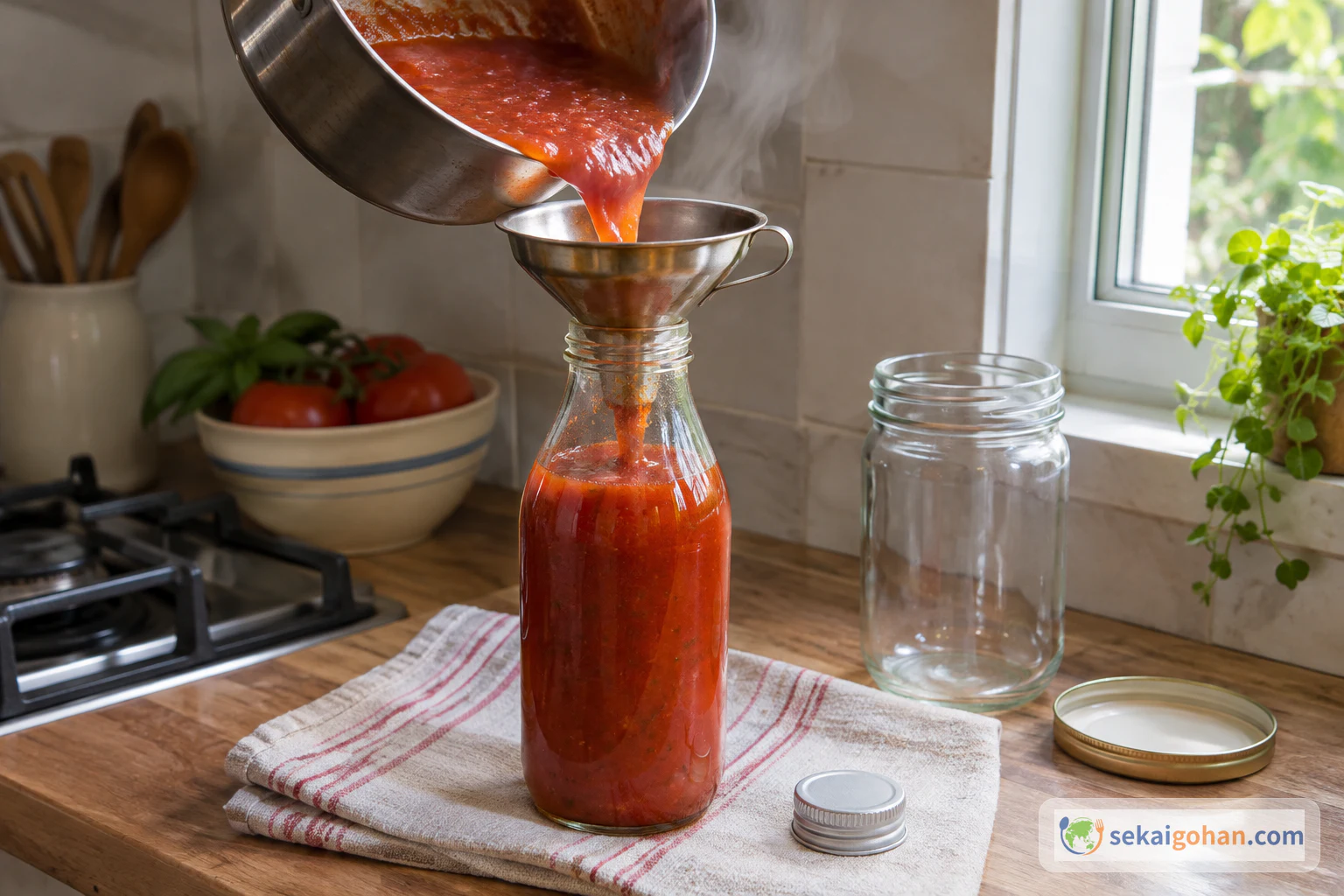
Seal the sauce hot in sterilised jars, let the jars cool, label them and keep them in the refrigerator. Once a jar is open, take sauce out only with a clean spoon, keep it chilled and use it soon. If a lid bulges, the jar spurts when opened, or you see mould, foam or smell anything off, throw it out without tasting.
This sauce is not made for the pantry shelf. Botulism bacteria grow in moist, low-acid food at 40–120°F (4–49°C) with very little oxygen. Foods at pH 4.6 or below count as acid foods, and tomatoes can sit just above that line, which is why tested canning recipes add lemon juice, citric acid or vinegar. Low-acid foods need pressure canning at 240–250°F (116–121°C), and acid foods need a timed boiling-water bath. To keep tomato sauce at room temperature, follow a tested home-canning ketchup recipe from start to finish, with its own ingredients and its own processing time. Never borrow the processing time alone for this mix.
Frequently Asked Questions
Can I use canned tomatoes?
Canned tomatoes differ in how much liquid and solid they hold, so there is no straight swap for the 1 kg of fresh egg tomatoes. On a day without good fresh tomatoes, make the quick passata sauce instead. It is built around passata from the start and needs no sieve.
Will round salad tomatoes work?
Yes, as long as they are fully ripe. They hold more water than egg tomatoes, so the sauce takes longer to thicken. Keep simmering with the lid off and go by the spoon trail, not the clock.
What jars should I use?
Use glass jars or bottles that can go into boiling water, with lids that seal tightly. A bottle with a narrow neck makes squeezing onto a pie easier, and a funnel makes filling it clean. Avoid enamel containers, because the acid in the sauce can damage them.
Can I make it less sweet or milder for children?
The chilli is optional, so leaving it out gives a mild sauce with the rest of the recipe unchanged. For less sweetness, take the sugar down only a little and keep the sauce in the refrigerator. Sugar and vinegar hold each other in balance, so large cuts change the sauce a lot.