Fish and Roots Layered in a Coconut Broth
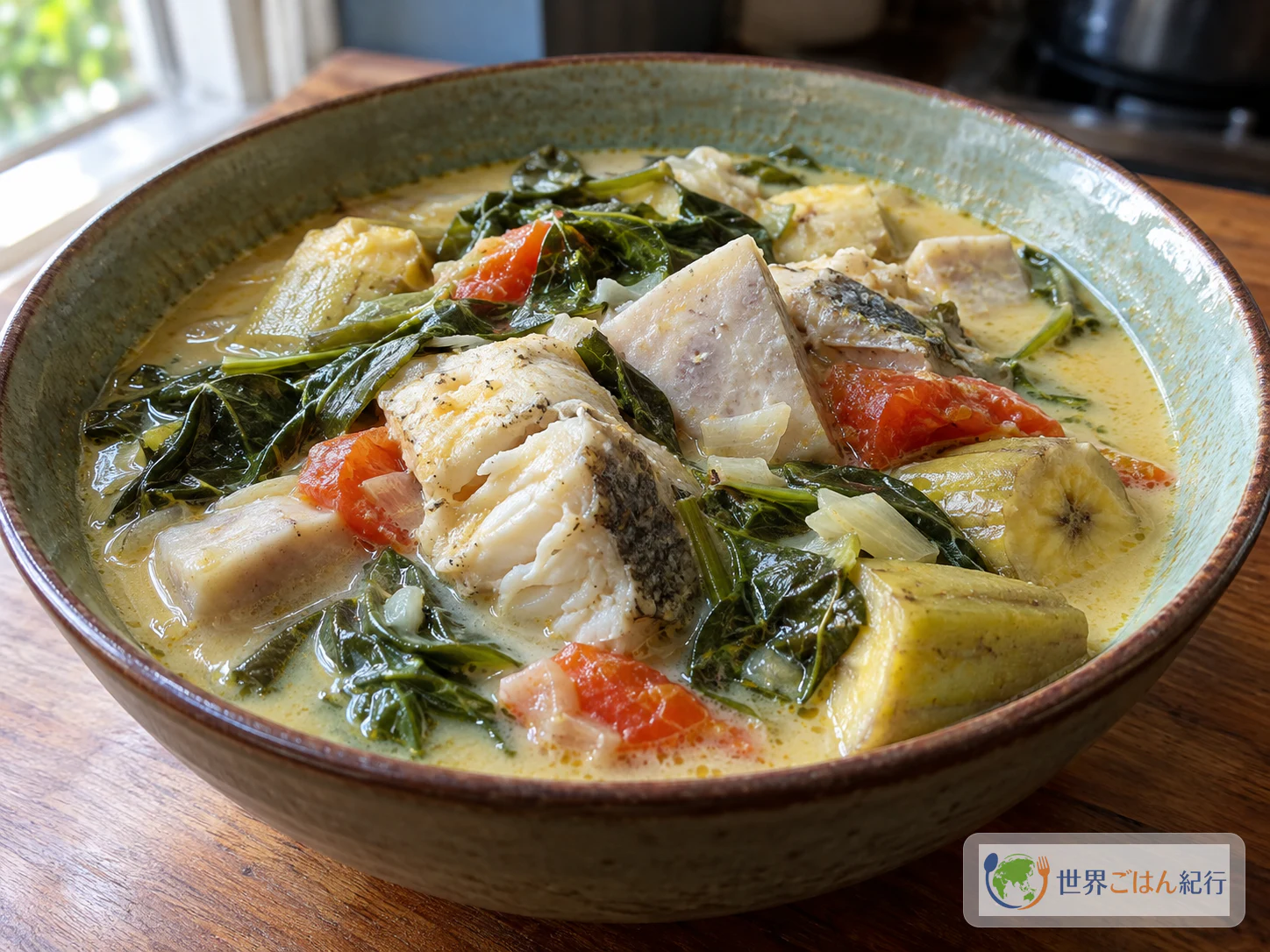
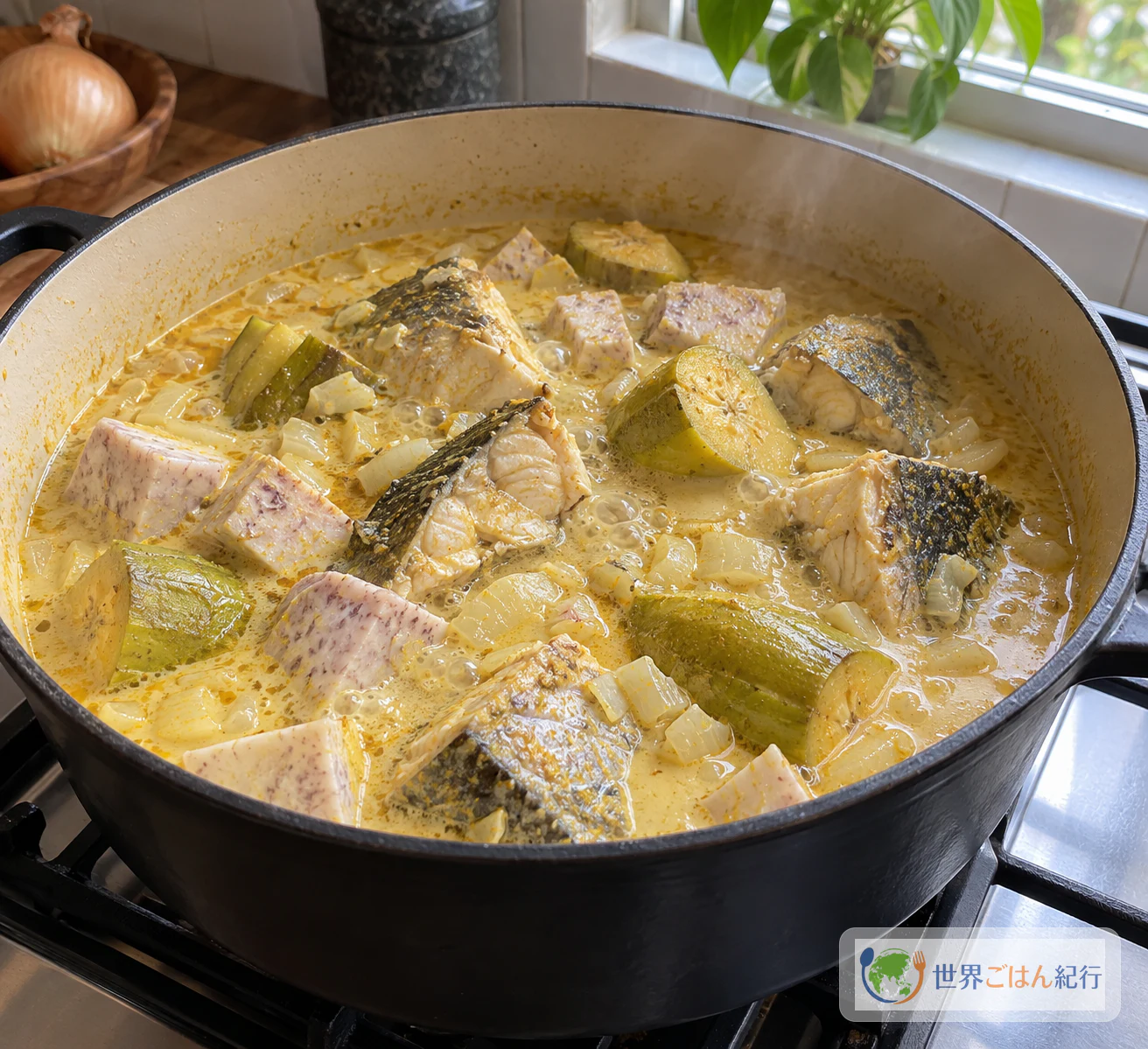
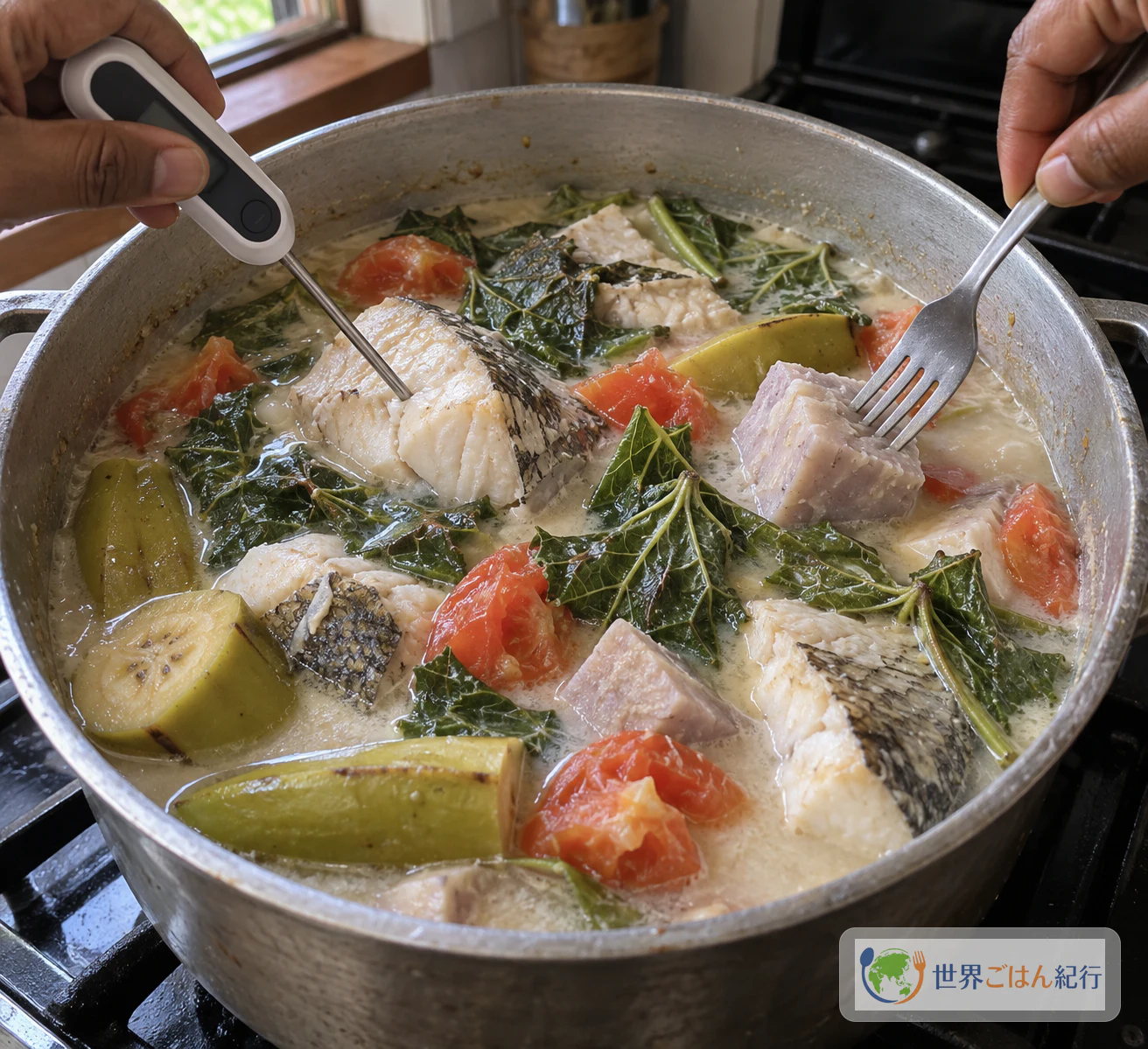
Fish and starchy roots cooked through in one pot, coconut cream and a little curry powder to round the broth, and slippery cabbage and tomato added only at the very end. Check the fish and the roots separately before you serve.
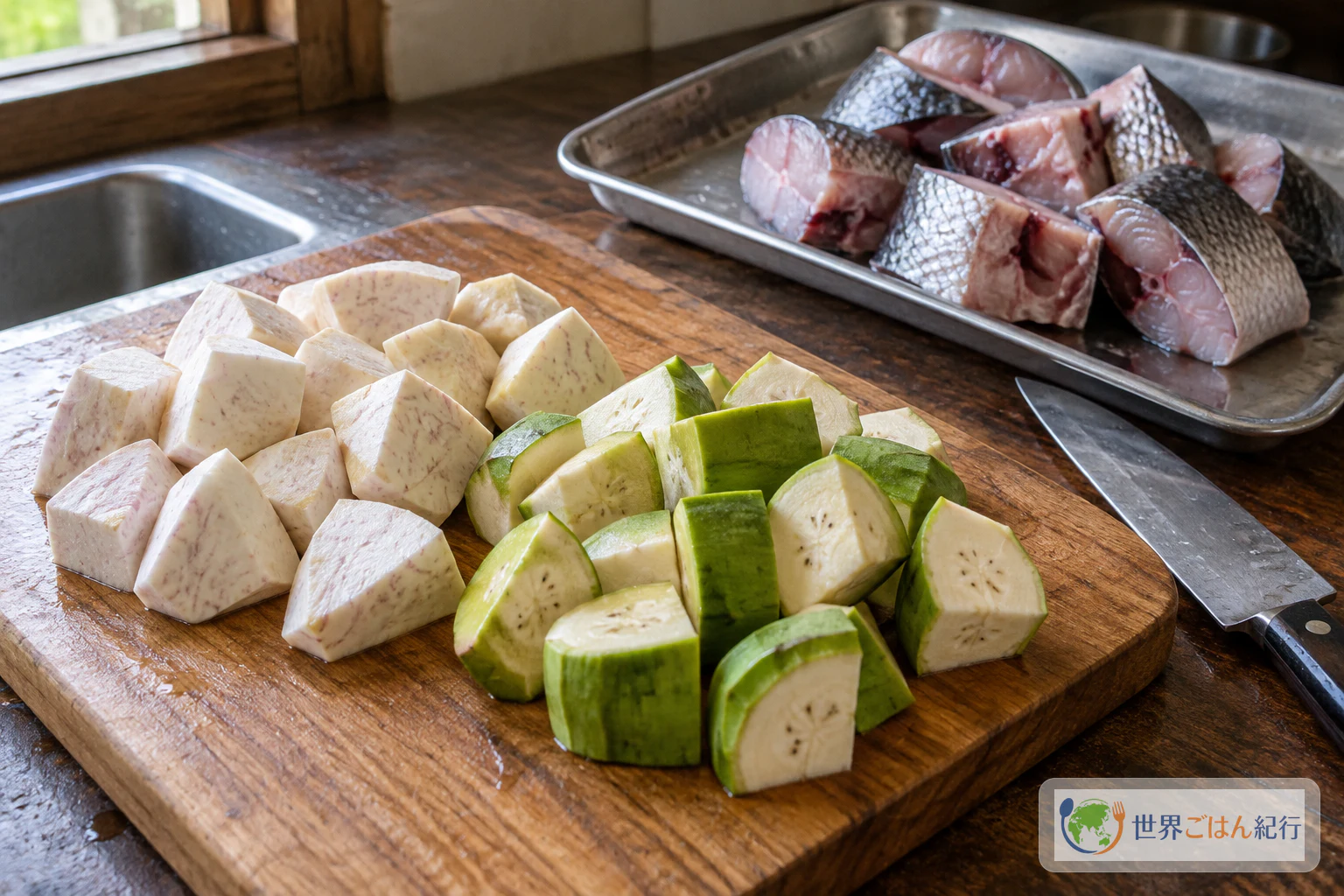
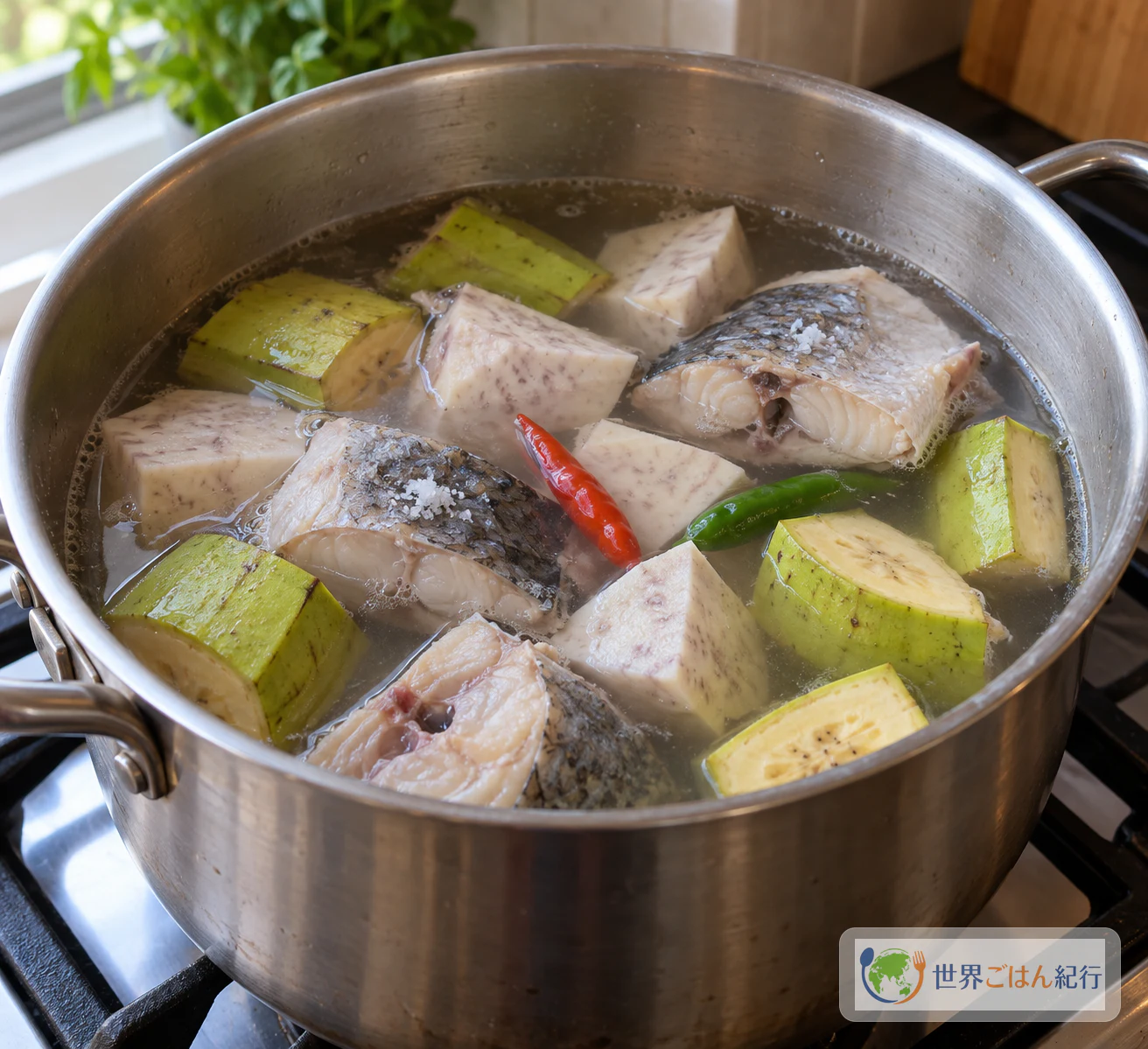
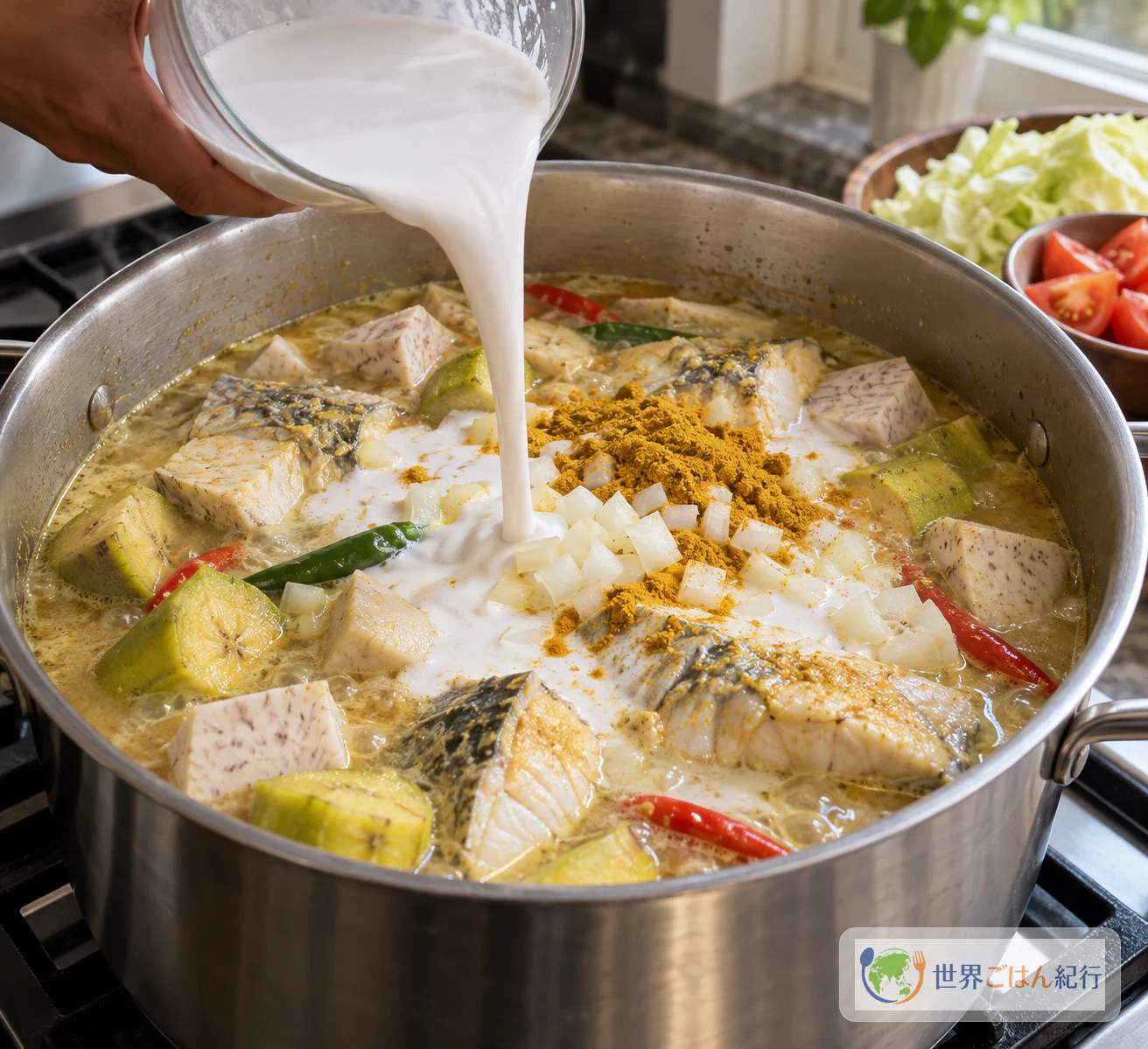
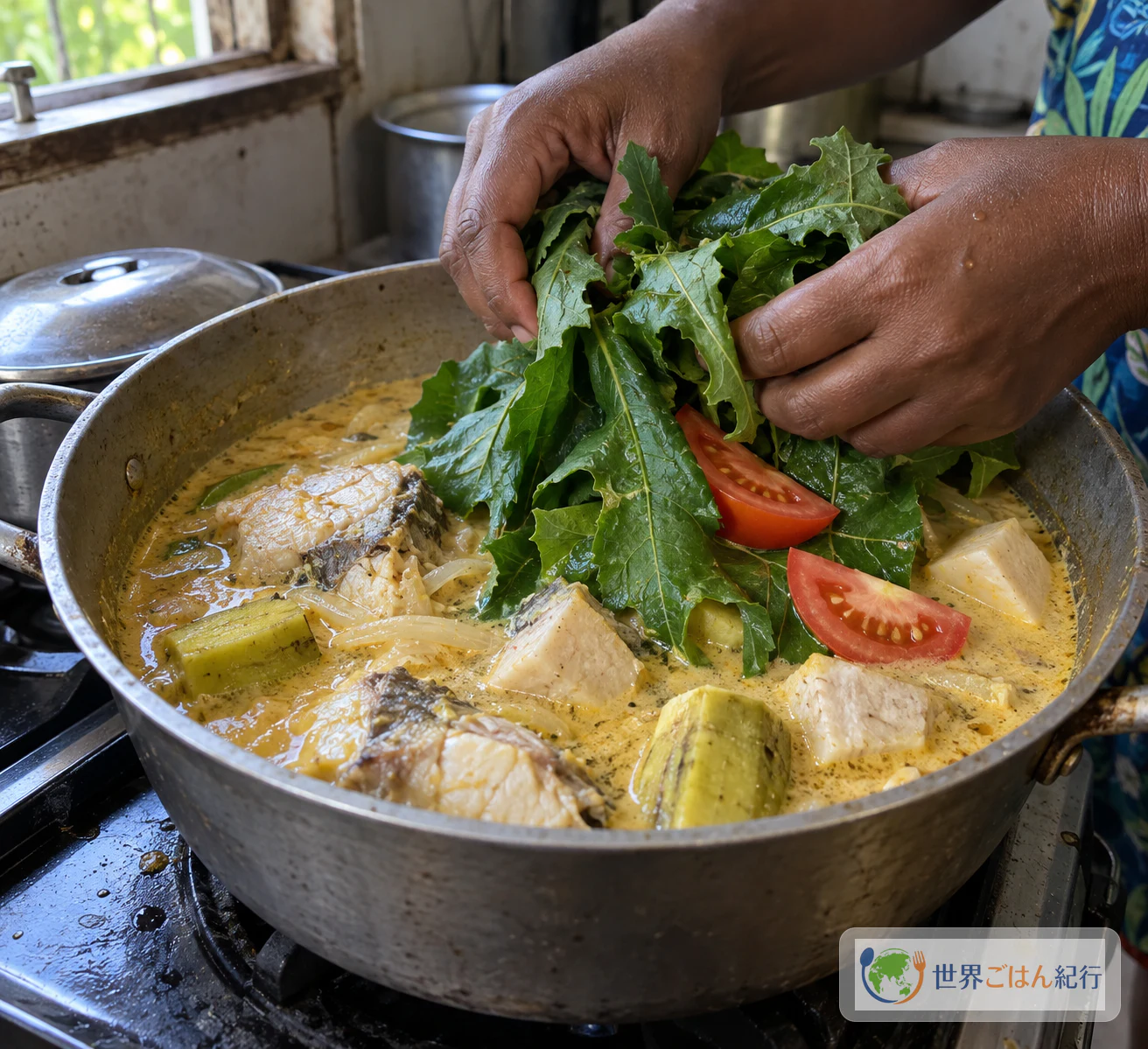
Pieces of fish, taro and green cooking banana sit in a pot of water with a pinch of salt and two chillies. Later, coconut cream, curry powder and chopped onion go in, and the broth turns pale and rich. In the final five minutes, a bundle of slippery cabbage leaves and two tomatoes are laid on top and folded into the pot. That is the whole shape of this dish, and it comes straight from the order of a recipe printed in a Solomon Islands recipe book.
The recipe appears in English as Fish and Vegetable Curry Soup in Local Vegetable Food: Kaikai Recipes in Solomon Islands. Its ingredient list is short and concrete: two fish, two medium taro, two green bananas, one onion, coconut cream, salt, chillies, curry powder, a bundle of slippery cabbage and two tomatoes. It does not use oil, does not fry the onion first, and does not add ginger or lime.
Three ingredients tend to make cooks outside the Pacific hesitate: taro, green cooking banana and slippery cabbage. This article keeps the book's version intact, then separates out what you can substitute and what changes when you do. The substitutions are editorial suggestions, not part of the original recipe.
This article follows the published recipe and has not been test-cooked for this site. The book gives no fish size or weight, no yield, no cup volume, no amount of water and no cooking times, so none are given here. Judge each stage by the state of the ingredients.
One Fish Dish from the Solomon Islands
This is one recorded version of a fish and coconut dish, not the single national recipe. A general overview of Solomon Islands cuisine from the Commonwealth Portal mentions fish, root crops, coconut and leafy vegetables, and describes fish simmered with coconut milk and local vegetables. It also notes that similar dishes across the Pacific vary by region and by what ingredients are available, and it speaks of shared meals and feasts in general terms. That overview does not tie this particular pot to any one occasion, so it is presented here simply as a home dish.
The recipe book itself was edited by staff of the Solomon Islands Ministry of Health and the Ministry of Agriculture and Livestock and published in November 2009; the PDF is distributed by Kastom Gaden. The recipe page, printed page 41, states that it is excerpted from a 1977 book by Eva Wagapu. Honiara appears as the place of publication in the book's bibliographic details. That tells you where the book was published, not where the dish began or which household cooks it.
The English name "Fish and Vegetable Curry Soup" is the only name the book gives. A name for the dish in a local language has not been confirmed, so none is offered here.
A different version, kept separate
Other recipes for fish with slippery cabbage exist. One published online by Spin the Globe uses reef fish, kumara, slippery cabbage (or aibika, or spinach), coconut cream, onion or shallot, ginger, tomatoes, chili and lime, adds the greens near the end and finishes with lime. It shares the coconut cream, the leaves added late and the tomato, but it is a different recipe. Its ingredients are not mixed into this one: no kumara, ginger or lime here.
| Point | This recipe (recipe book) | The separate online version |
|---|---|---|
| Starch | Taro and green cooking banana | Kumara |
| Aromatics | Onion, chilli, curry powder | Onion or shallot, ginger, chili |
| Leaves | Slippery cabbage | Slippery cabbage, aibika or spinach |
| Finish | Leaves and tomato in the last 5 minutes | Greens near the end, finished with lime |
Ingredients (from the recipe book)
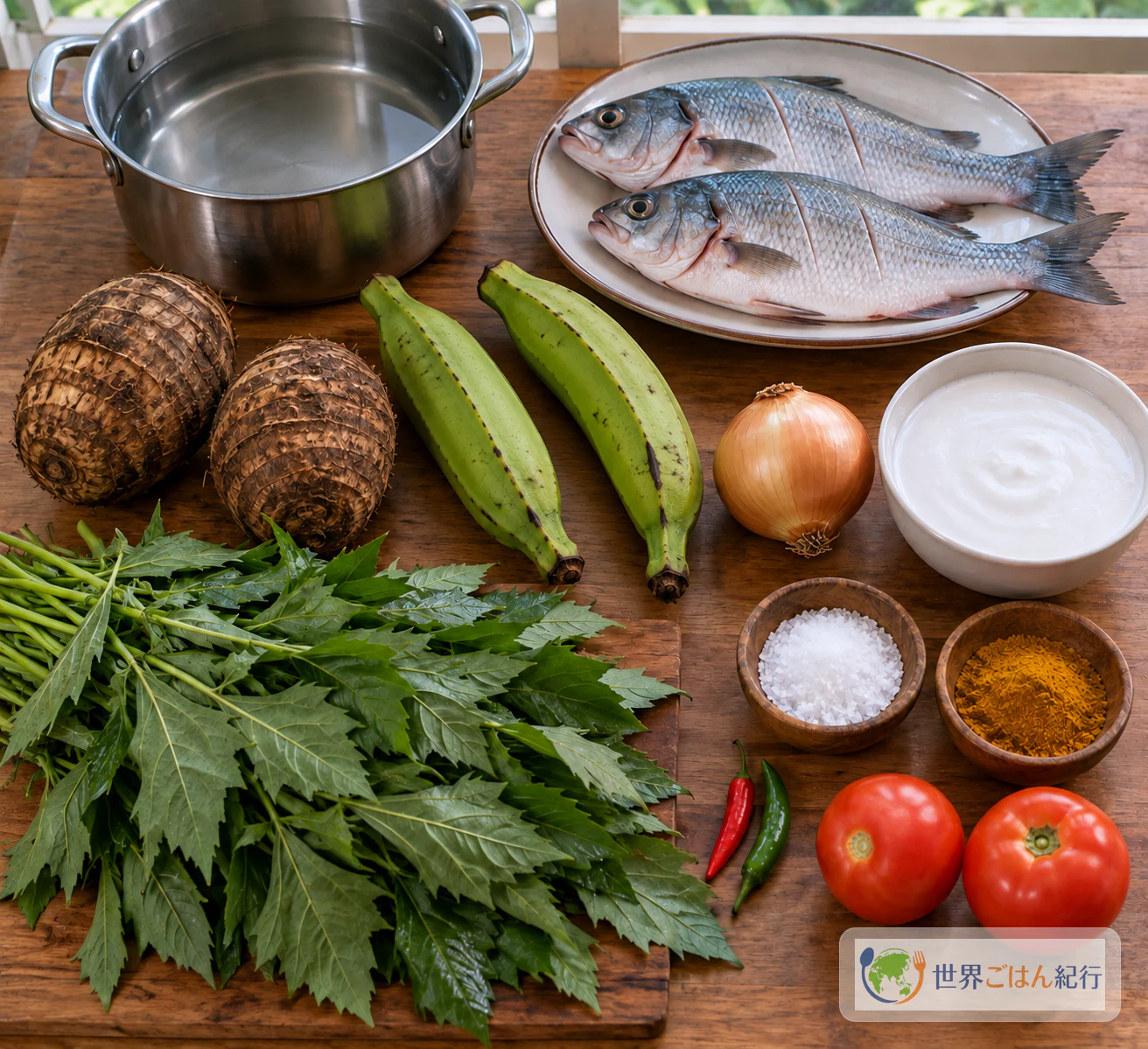
The amounts below are exactly as the book prints them. Fish size, the weight of the leaf bundle, the size of the onion and tomatoes, and the number of servings are not stated, so they are not estimated here.
For this site's measuring, 1 cup is taken as 240 ml and 1 tsp as 5 ml. That is an editorial setting for home kitchens, not a claim about the size of cup the book used. The water has no number: use just enough to cover the fish, taro and banana.
Fish and coconut are both common allergens. Check the ingredient labels of your coconut cream and your curry powder, since spice blends and canned products can contain other components. Never taste raw fish while you cook.
Equipment
- A pot large enough to hold the fish, taro and banana covered with water
- A knife
- A cutting board for the taro and banana, and a separate board or work area for raw fish
- A digital probe thermometer
- A fork for testing the taro and banana
- A clean plate or bowl and clean utensils, in case you lift the fish out (see step 5)
Choosing and Substituting Ingredients
Coconut cream. Use prepared coconut cream. Choosing an unsweetened cooking coconut cream is an editorial choice; the book simply says coconut cream. Pressing cream from fresh coconut is not part of this method.
Fish. The book says only "2 fish". A mild white fish is a practical editorial suggestion, not a species from the source. Whatever you choose, thicker pieces take longer to cook through than thin ones.
Taro. Use taro root. Smaller taro such as satoimo can stand in, but it is not the same ingredient and is noticeably more slippery when cooked. Taro varieties also differ from one another, so softening time is not fixed.
Green banana. This means an unripe cooking banana, green and firm. Do not use ripe, sweet eating bananas. Potato can stand in if you cannot find green banana, but its aroma and texture are different, and the dish will taste different.
Chilli. The book does not say what kind or size, so the heat is not predictable. If you want less heat, serving the chillies on the side instead of cooking them in is a change from the original, and worth knowing as one.
Slippery cabbage is not cabbage
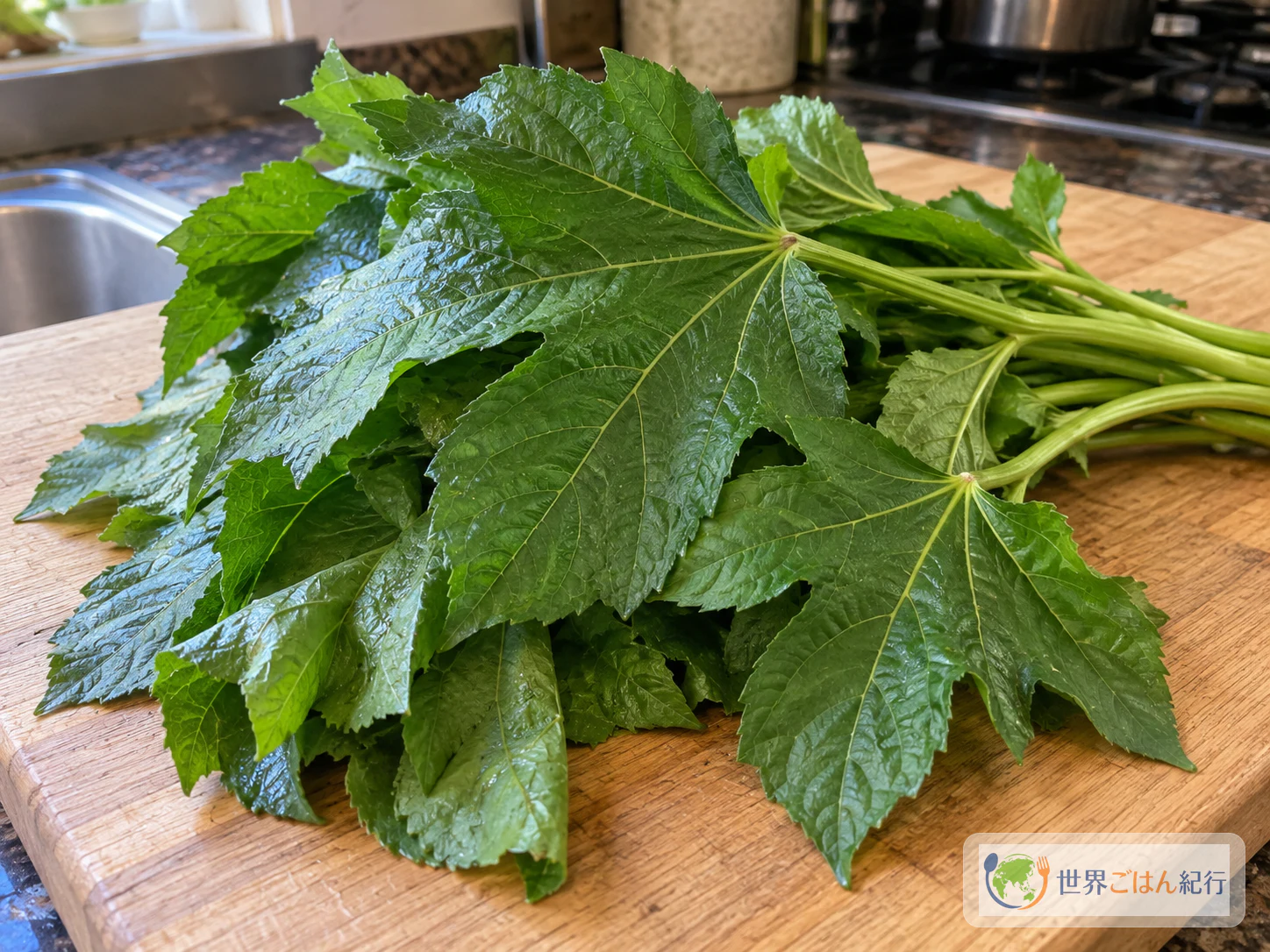
Despite the name, slippery cabbage is not a head of cabbage. A 2004 workshop report on sliperi kabis by Kastom Gaden Association, the Department of Agriculture and Livestock and PestNet identifies slippery cabbage, called sliperi kabis in Solomon Islands Pidgin, as Abelmoschus manihot. The same report records workshop participants in Malaita describing cooking the leaves with coconut milk.
That botanical identification does not prove that leaves sold under a similar name in your country are the same edible type. Buy leaves sold clearly as a cultivated food crop. Do not forage wild plants or use ornamental plants. Slippery cabbage is also not the same as ordinary head cabbage, spinach or taro leaves.
If you cannot find it, spinach is a possible substitute; the separate online version mentioned above lists spinach as an option. Spinach is a different leaf, with a different texture and without the same slipperiness, so treat it as an adaptation.
Method: Fish and Roots First, Leaves Last
The book gives no times except the final five minutes. Move from one step to the next by looking at the ingredients, and check the fish and the roots separately at the end.
At the Table
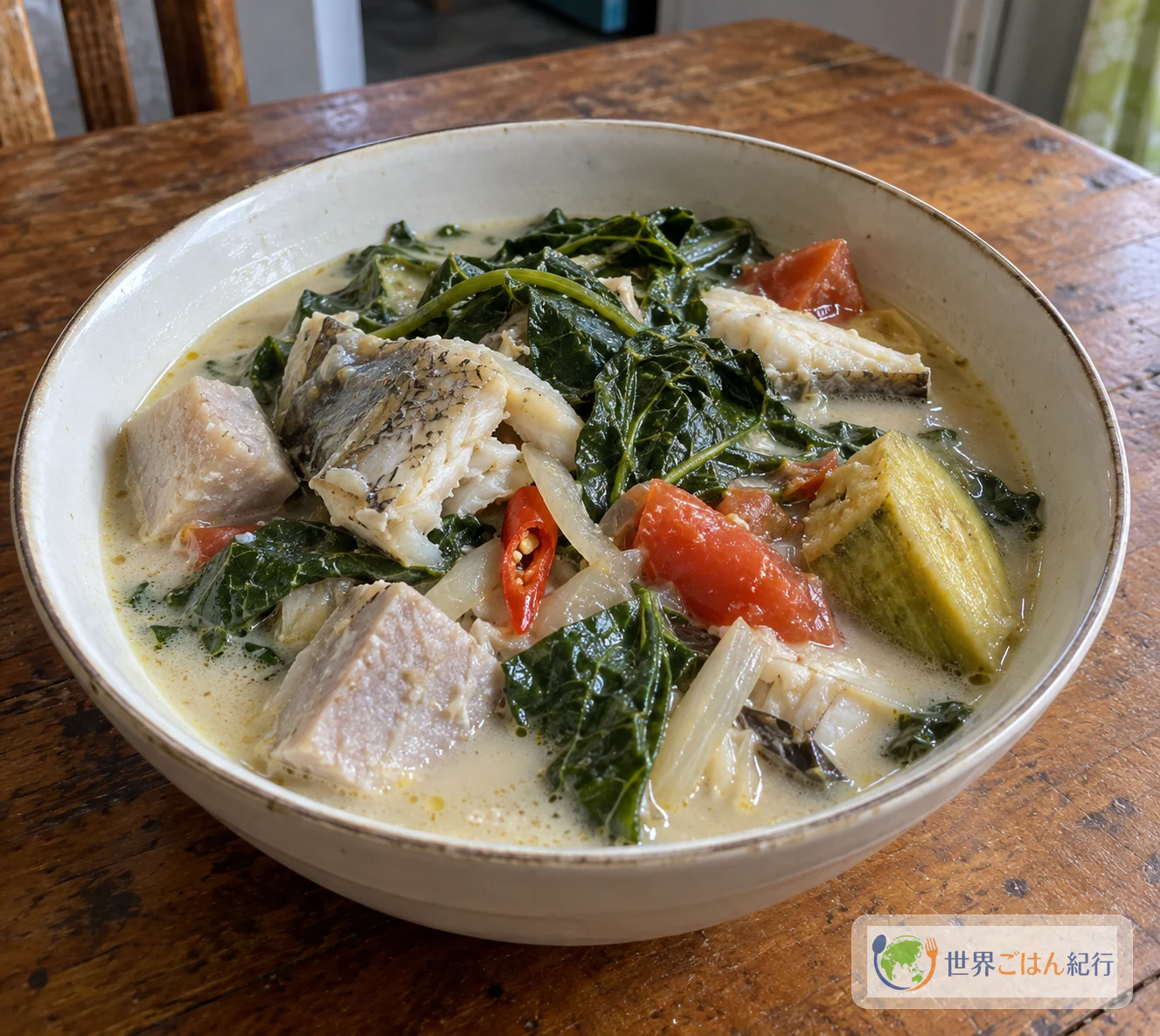
The book gives no accompaniment for this dish. The taro and green banana already make it a starchy, filling bowl, so it can be served on its own. If you want rice alongside, treat that as a modern choice of your own, not as part of the recipe.
Ladle so that each bowl gets fish, a piece of taro, a piece of banana, some leaves and tomato, with plenty of broth. Watch for whole chillies and the heat they bring.
Troubleshooting
These are editorial suggestions. The recipe book itself only gives the ingredients and order.
| Problem | What may be happening | What to try |
|---|---|---|
| The fish falls apart | Pieces cut very small, a hard boil, or a lot of stirring | Keep the simmer gentle after the coconut cream goes in, and fold rather than stir. Next time cut the fish into larger pieces |
| The taro or banana is still firm | Pieces larger than the fish, or a firmer taro | Keep simmering and test again. If the fish is already done, lift it onto a clean plate with clean utensils and return it later |
| The broth seems thin | The book gives no reduction time | Simmer a little longer at a gentle heat, without a hard boil. Next time keep the starting water to just covering the ingredients |
| The broth seems thick | The starch from the roots has thickened it | Fold gently; adjust to taste. The book gives no target thickness |
| The leaves are dull and soft | They went in too early | Add the leaves only for the last 5 minutes |
| The dish tastes sweet | Ripe eating bananas were used | Use firm green cooking bananas next time |
| Too spicy | Strong chillies | Next time, serve the chillies on the side. This changes the original |
Variations
All of these are editorial adaptations and change the dish.
- Fish fillets instead of whole fish. A mild fish fillet available near you is fine. It is not a species from the source, and its thickness changes how long it takes to cook through.
- Potato instead of green banana. Easier to find, with a different aroma and texture.
- Satoimo instead of taro. Smaller and noticeably more slippery when cooked.
- Spinach instead of slippery cabbage. A different leaf, listed as an option in the separate online version. Add it at the same final stage.
- Chillies on the side. For a milder pot, at the cost of following the original.
Leftovers
Use general household food-safety guidance from Japan's Ministry of Health, Labour and Welfare: divide leftovers into shallow, small portions and cool them quickly. When reheating, heat thoroughly, with about 75°C as a guide. The sources give no storage period for this dish, so none is given here.
Related Pacific Dishes
Several Pacific dishes also pair coconut with fish, leaves or taro, but they are built differently. Tonga's lu pulu and Samoa's palusami wrap their fillings in leaves, while this dish is simmered in an open pot. Fiji's kokoda uses raw fish with citrus; in this dish, the fish is fully cooked in the pot.
Frequently Asked Questions
How is this different from kokoda?
Kokoda from Fiji is a raw fish dish dressed with citrus. This Solomon Islands dish simmers the fish in water and coconut cream until it is cooked through, along with taro and green banana.
What is the dish called in a local language?
The recipe book only names it in English, as Fish and Vegetable Curry Soup, and a local-language name has not been confirmed. The leaf, though, has a Pidgin name: slippery cabbage is sliperi kabis.
How much is "2 cups" of coconut cream?
The book does not say what size of cup it used. This site reads 1 cup as 240 ml for home measuring, which is an editorial choice, not a statement about the original.
How many people does it serve?
The book does not give a yield, and the fish are not given a size or weight, so no serving count is given here.
How spicy is it?
That depends on your chillies. The book only says 2 chillies, without type or size. If you are unsure, serving them on the side is a reasonable change.
Can I use ordinary cabbage for slippery cabbage?
No. Slippery cabbage is Abelmoschus manihot, a leafy green, not head cabbage. If you cannot find it, spinach is a possible substitute, with a different texture.
How long does it keep?
The sources give no storage period. Divide leftovers into shallow, small portions, cool them quickly, and reheat thoroughly, with about 75°C as a guide.
Sources
- Solomon Islands Ministry of Health and Ministry of Agriculture & Livestock (editors), Local Vegetable Food: Kaikai Recipes in Solomon Islands, November 2009; hosted by Kastom Gaden. The Fish and Vegetable Curry Soup ingredients, amounts and order, including the last five minutes for slippery cabbage and tomato, and the note that the recipe is excerpted from Eva Wagapu's 1977 book. https://kastomgaden.org/wp-content/uploads/2010/06/Local-Vegetable-Food_Kaikai_Recipes-in-Solomon-Islands.pdf
- Commonwealth Portal, "Cuisine (Solomon Islands)." General overview of fish, root crops, coconut and leafy vegetables, fish simmered with coconut milk and local vegetables, regional variation and shared meals. https://www.commonwealthportal.org/country/solomon-islands/cultural-insights/cuisine/
- Spin the Globe, "Fish with Slippery Cabbage & Kumara, a Honiara, Solomon Islands recipe." A separate recipe version used only for comparison of ingredients and order. https://spintheglobeofficial.com/recipe/solomon-islands-fish-slippery-cabbage
- Kastom Gaden Association / Department of Agriculture and Livestock / PestNet, "Workshop on Sliperi Kabis at Gwou'ulu," Mission Report 3b, January 2004. Identification of slippery cabbage (sliperi kabis) as Abelmoschus manihot, and workshop participants' description of cooking the leaves with coconut milk. https://www.pestnet.org/project_files/Linking%20Farmers%20(WB)/PestNet%20Mission%203b%20Gwou%E2%80%99ulu%20(Sliperi%20kabis).pdf
- FoodSafety.gov, "Cook to a Safe Minimum Internal Temperature." Fish cooked to 63°C (145°F), or until opaque and separating easily with a fork. https://www.foodsafety.gov/food-safety-charts/safe-minimum-internal-temperatures
- Ministry of Health, Labour and Welfare (Japan), "家庭での食中毒予防" (Preventing food poisoning at home). General household guidance on heating to the center at 75°C for at least 1 minute, preventing cross-contamination, cooling leftovers quickly in shallow portions, and reheating to about 75°C. https://www.mhlw.go.jp/stf/seisakunitsuite/bunya/kenkou_iryou/shokuhin/syokuchu/01_00008.html