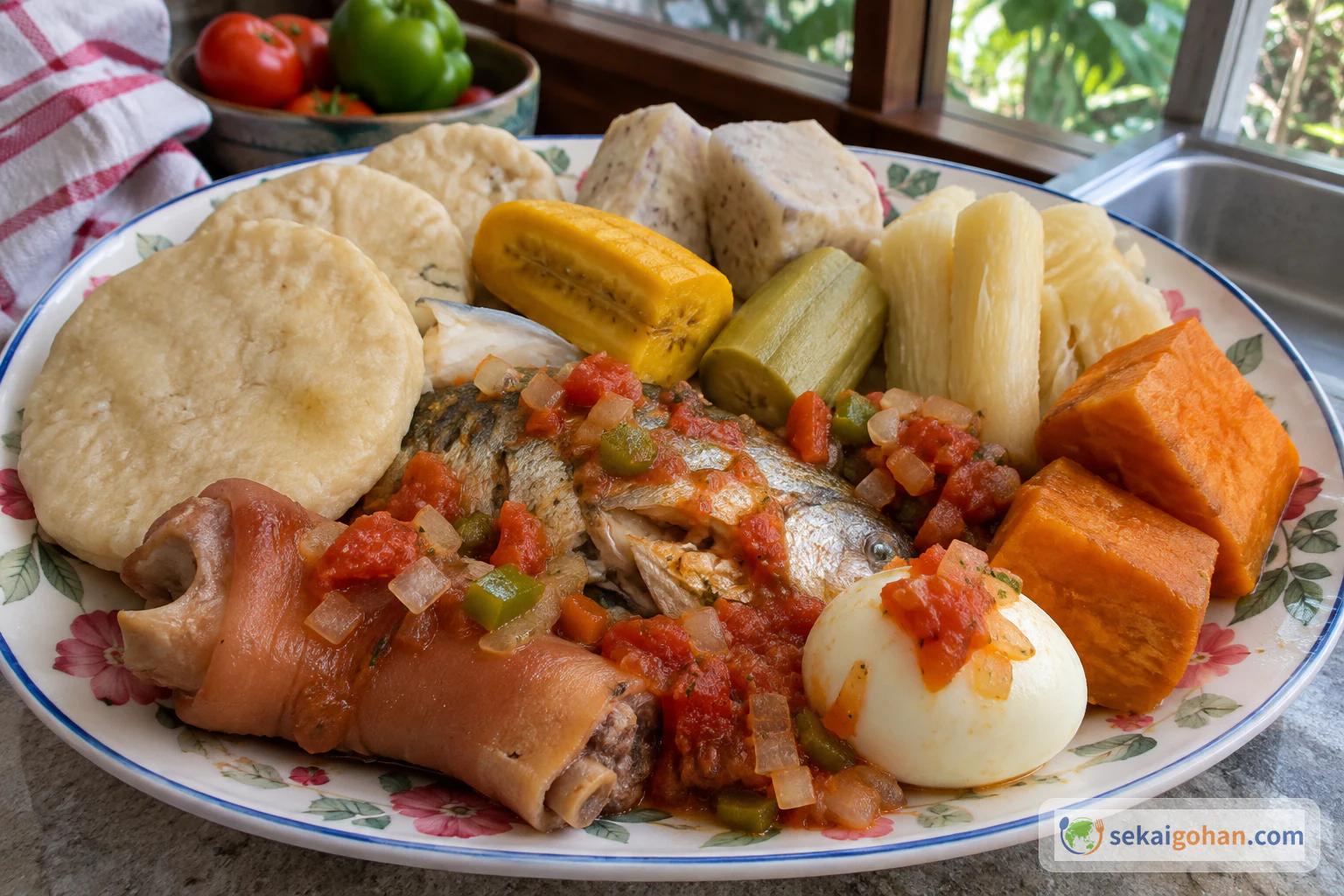
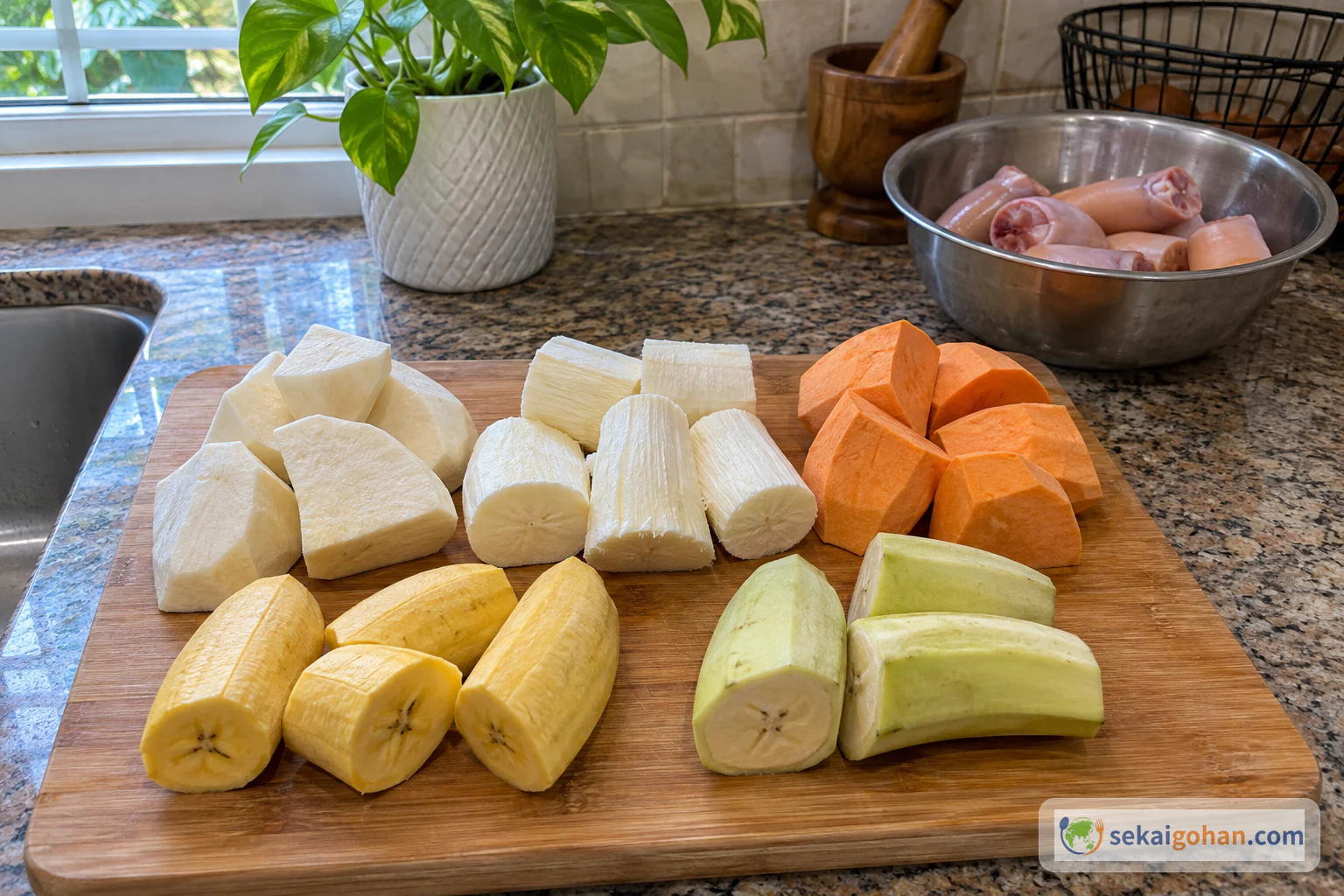
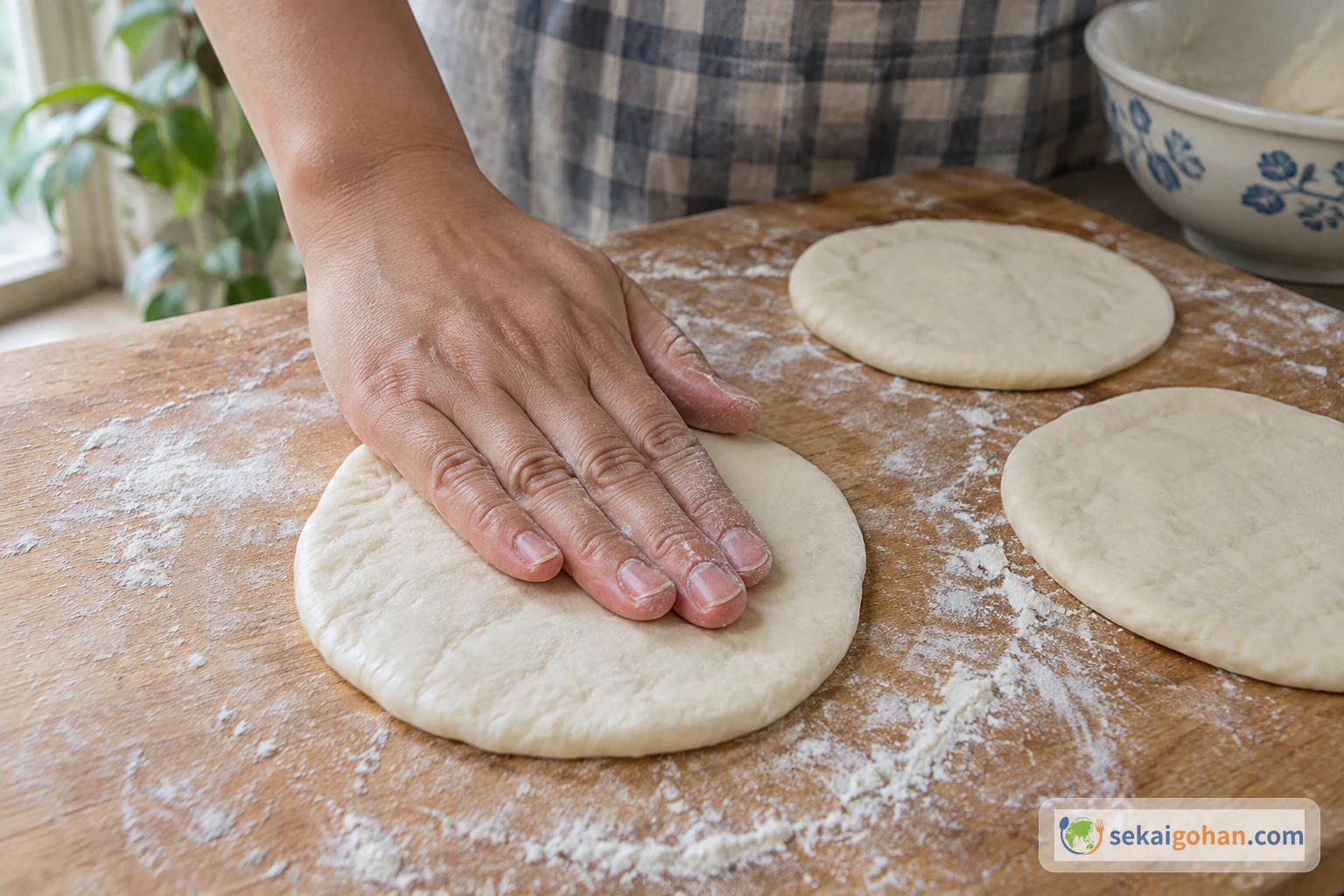
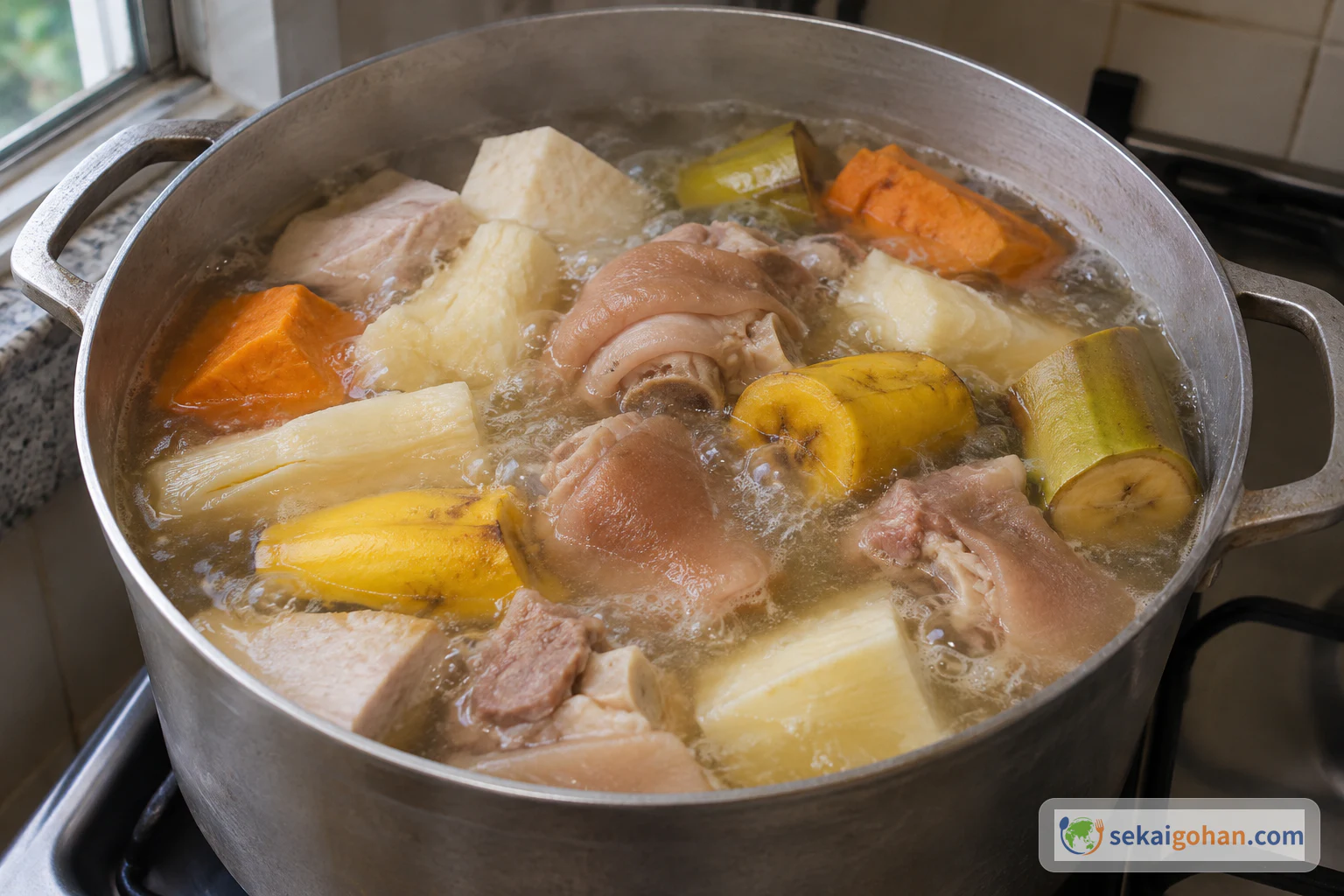
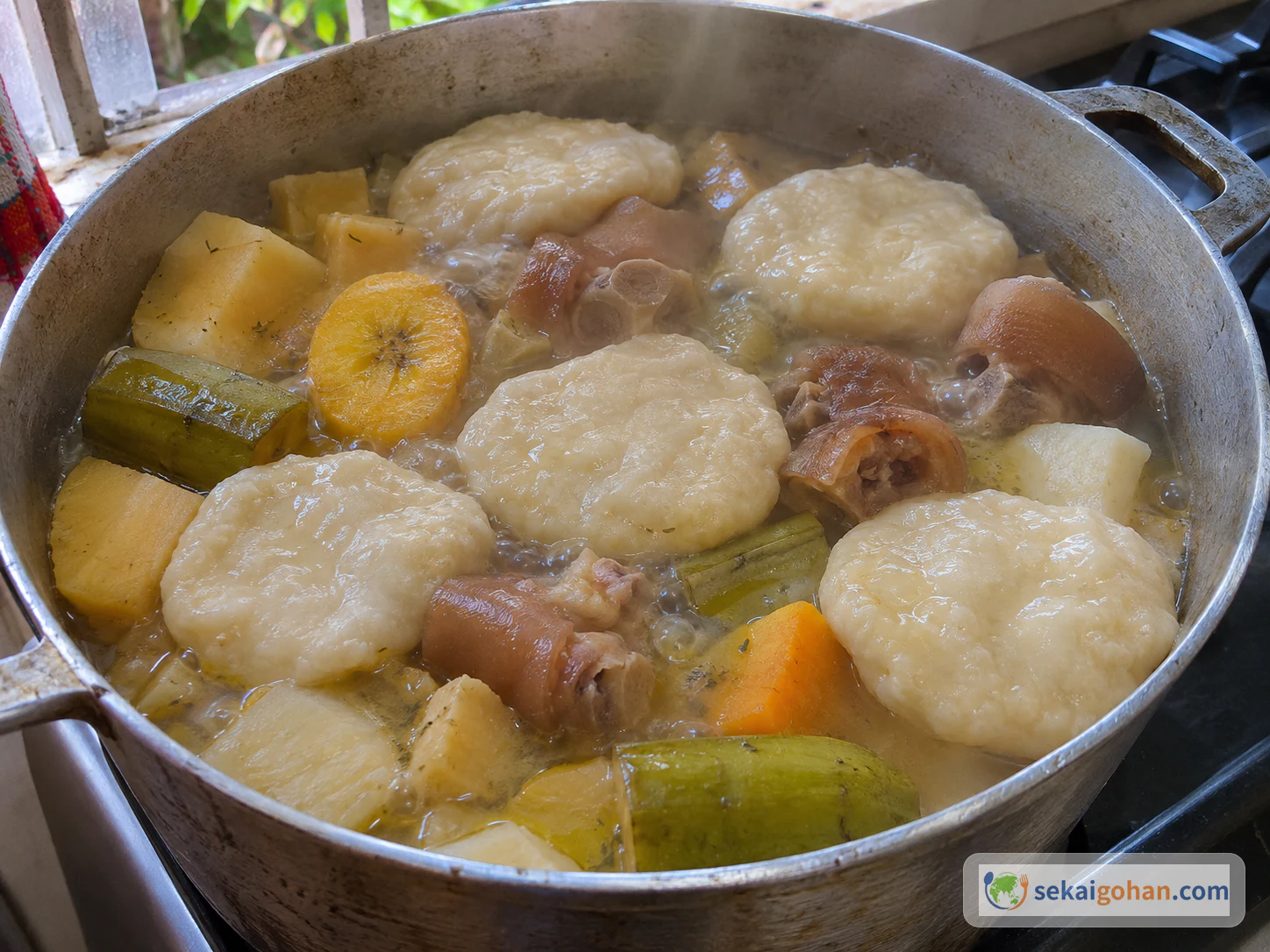
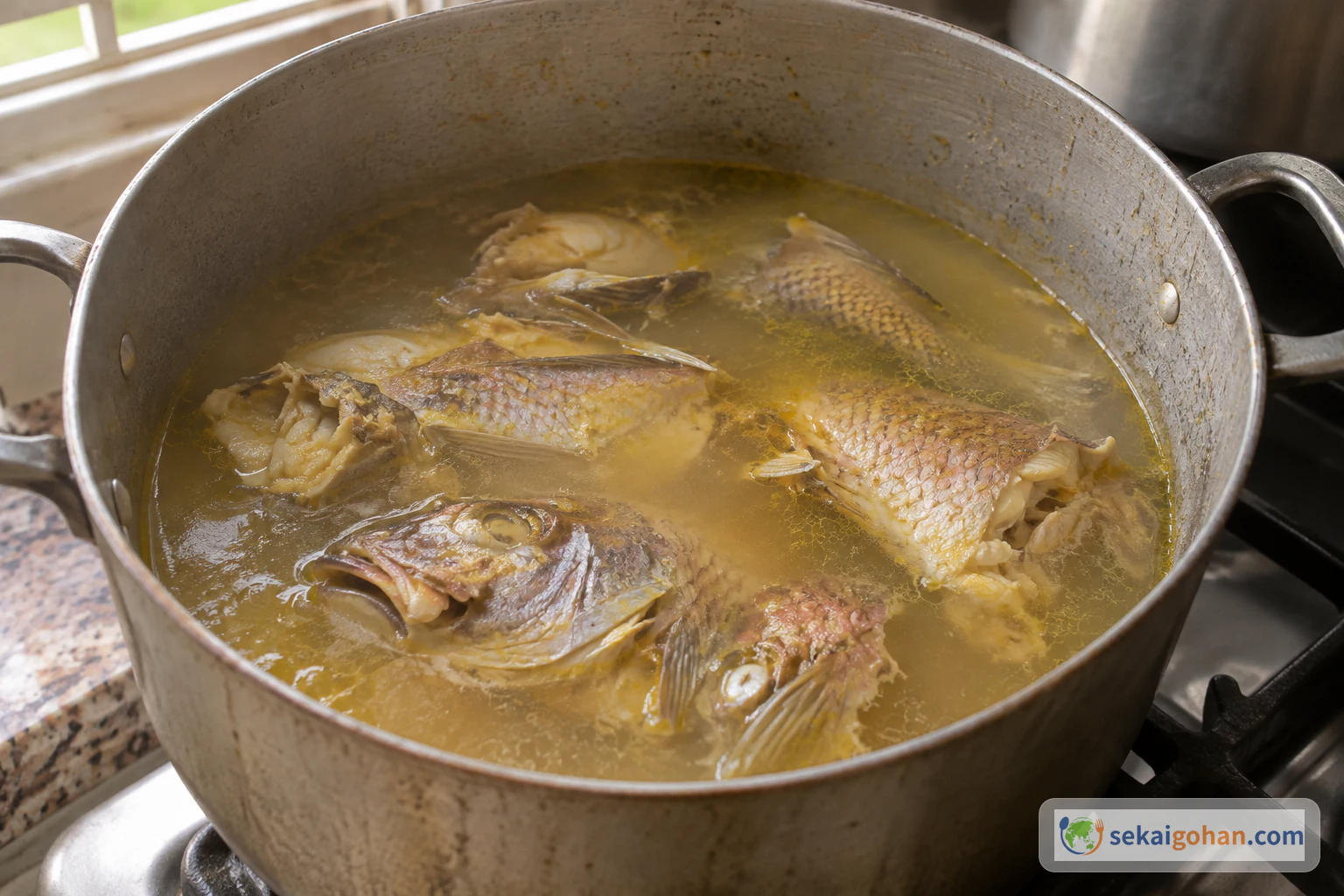
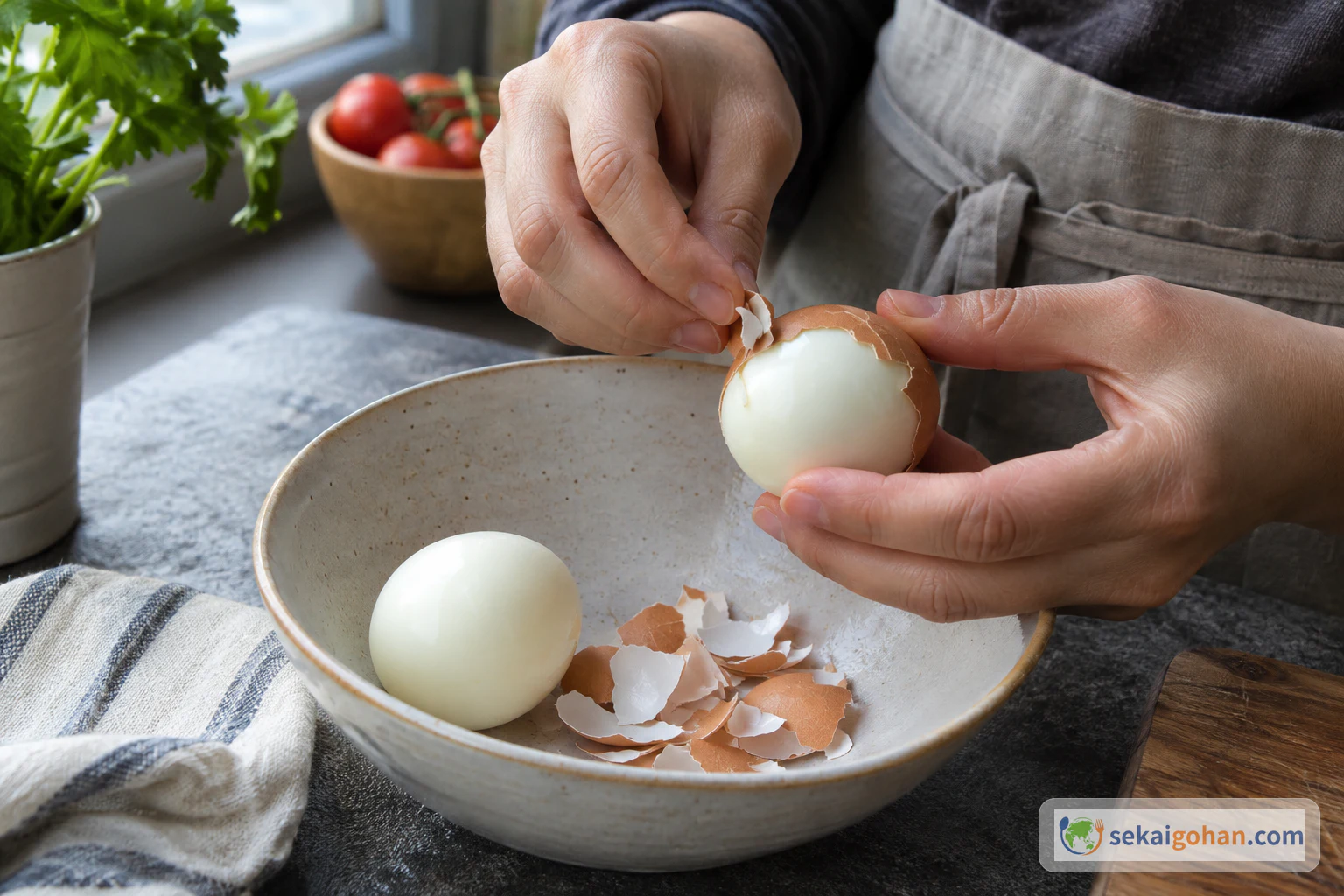
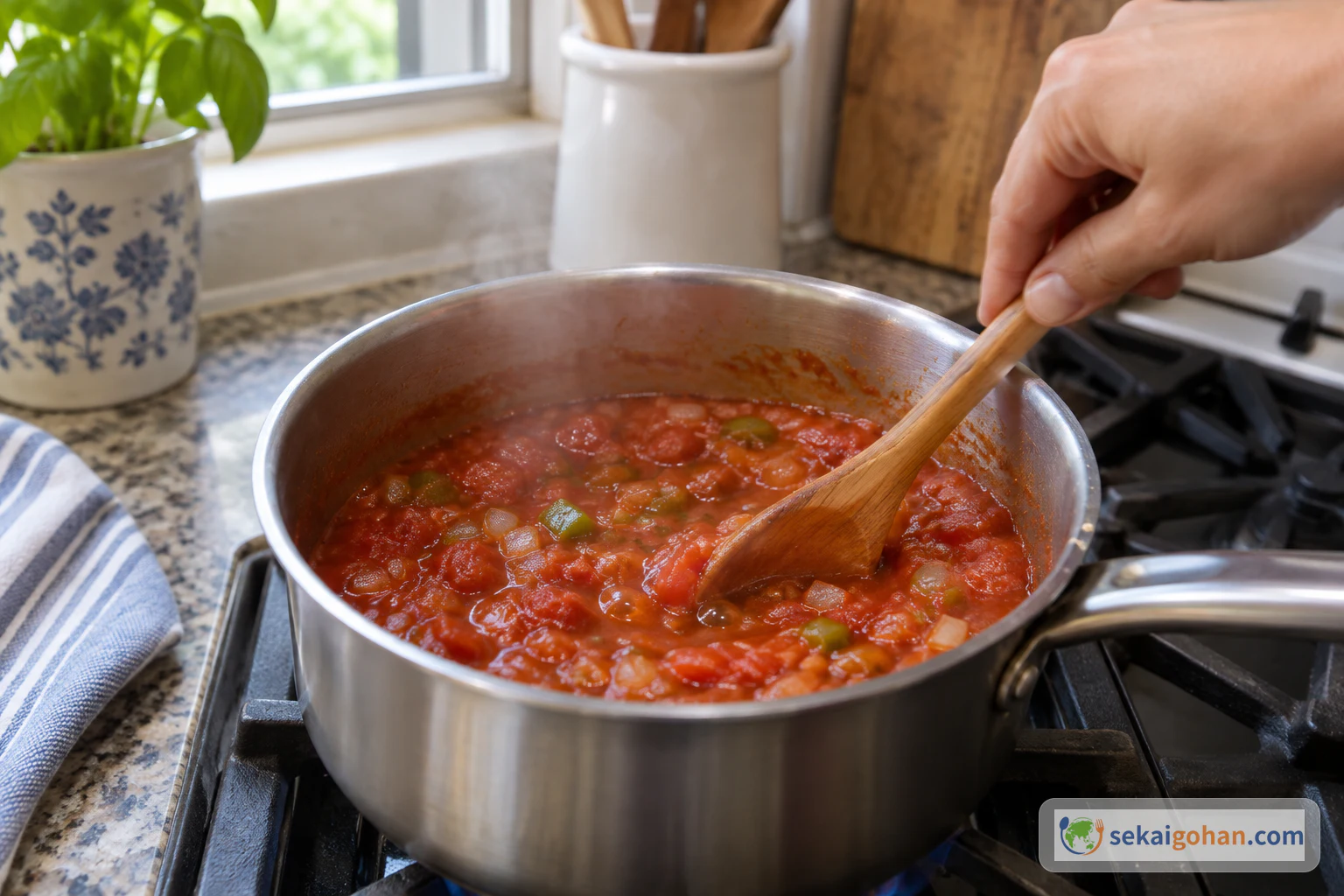
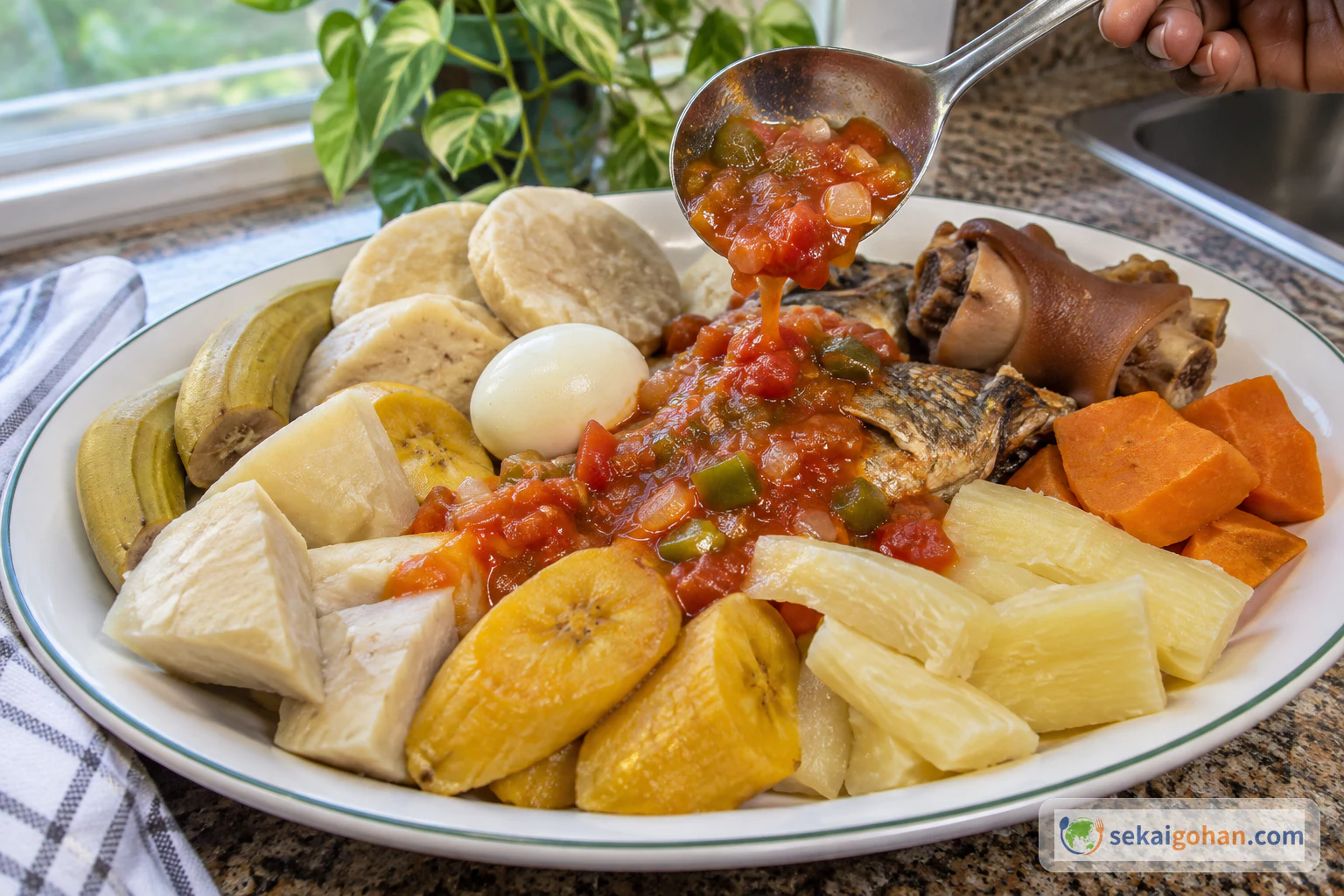
The big pot has been rolling for a while when the flat flour cakes go in, laid right on top of the yam and cassava so they cook in the steam and the bubbling water underneath. A few minutes later everything comes out onto one platter: pale chunks of root, orange sweet potato, soft golden plantain, green banana, the cakes, pieces of pig tail. The fish goes into the same cooking water last, the eggs are peeled, and a chunky red sauce of tomato, onion and green pepper is spooned over the lot. That is bile up, a Kriol dish from Belize, and it eats as a plate of clean, starchy, gently salty things brought together by a bright tomato sauce.
Boiled, Drained and Sauced: How Bile Up Sits at the Belizean Table
Bile up belongs to the Kriol (Creole) kitchen of Belize, and it is a lunch dish. The idea is simple and generous. Everything is boiled, lifted out and arranged on the plate, then dressed with the sauce. People dip pieces of root and cake into a spicy, fresh tomato sauce, so the sauce does the seasoning that the plain boiled food leaves open.
The heart of the plate is what Belizeans call ground food, the roots and tubers pulled from the earth: yam, cassava, sweet potato, with ripe plantain and green banana beside them. That way of eating starch comes from African food traditions, and Caribbean seasoning was layered on top of it. The flour boil cakes add a soft, bready bite. Fish and boiled pig tail bring salt and richness, and hard-boiled egg is set on top. Bile up is especially popular in the south of the country, and some call it Belize's national dish, though where and when it took this shape is not settled.
One pot, many households
Every household tunes the plate. Some cook fish only, some only pig tail, some both; salt pork stands in for pig tail in plenty of kitchens. Green banana is left out when there is none to hand. At the table, the fish is sometimes steamed or fried rather than boiled. What stays constant is the drained platter and the tomato sauce. Bile up is no soup, and coconut plays no required part. That sets it apart from Jamaica's run down, where fish is simmered in coconut, and from the stewed dishes elsewhere on a Belizean table.
Both spellings are used. "Bile up" follows the Kriol way of saying it, and "boil up" is the everyday English form. In Belize it is counted as a Kriol cultural dish, and searching under either name brings up the same platter. Belizean bile up is a different dish from the boil-up eaten in New Zealand.
Ingredients
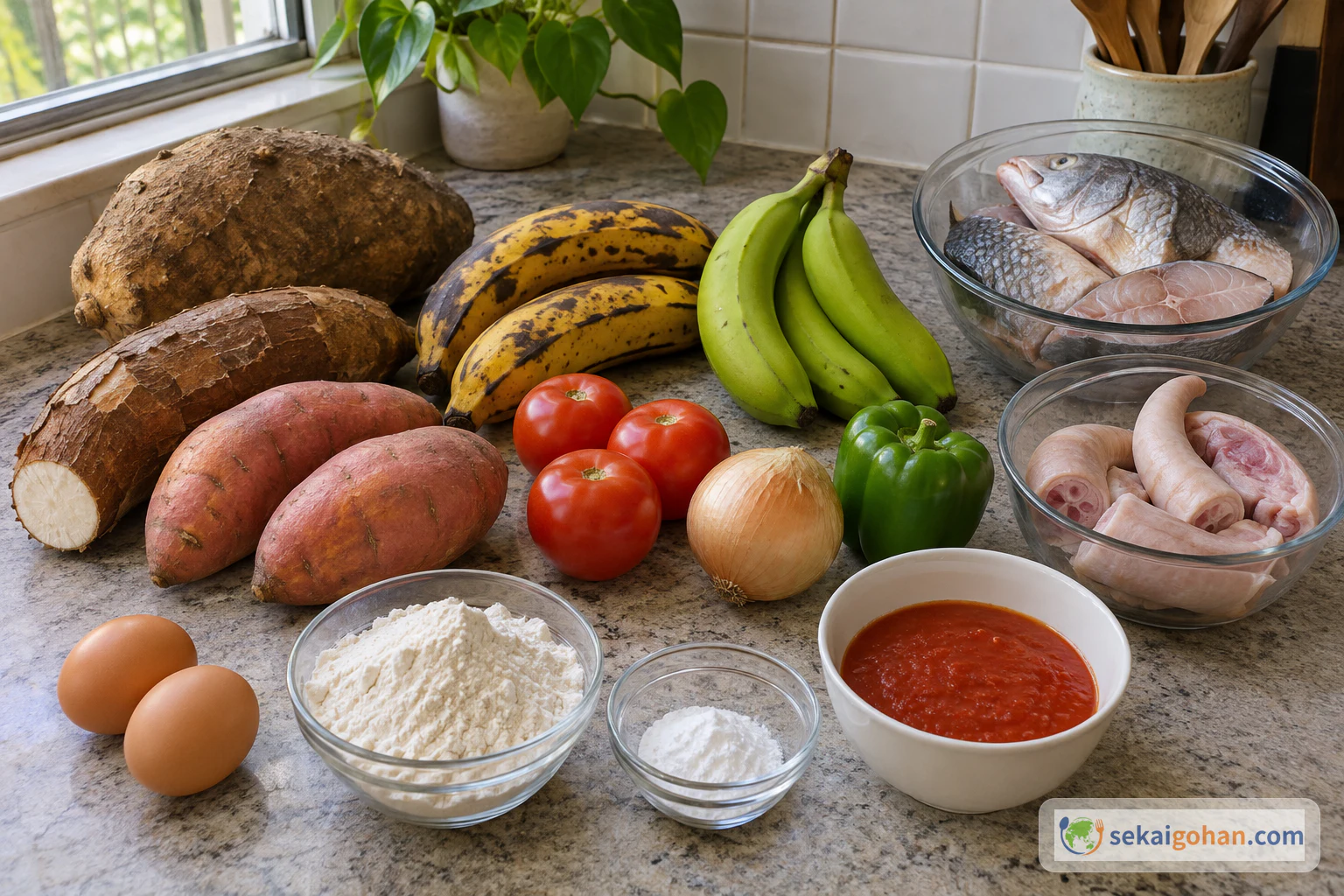
Pig tail and salt pork carry a lot of salt into the pot, and the fish cooks in that same water. Hold back on salting the sauce until you have tasted a piece of pork, then season the sauce to balance the plate.
This dish contains wheat (boil cakes), egg and fish. Check the ingredient label on canned or bottled tomato sauce for anything else.
Equipment
- Large, deep pot for the roots, cakes and fish
- Small pot for the eggs
- Saucepan or skillet for the sauce
- Slotted spoon or skimmer
- Two cutting boards, one kept for raw fish and pork
- Mixing bowl
- Wooden spoon
- Large serving platter
What to Buy and What to Swap
Most of the plate comes from an ordinary supermarket: sweet potatoes, tomatoes, onion, green pepper, eggs, flour. The roots and bananas are where a trip to a Caribbean, Latin or Asian grocer pays off. Frozen cassava from an Asian grocer is the easy route. Look for yam there too, fresh or frozen.
| Ingredient | Where or what to buy | What a swap changes |
|---|---|---|
| Yam | Caribbean or African grocer, fresh or frozen | Japanese nagaimo is a different plant; it turns sticky and slippery where yam stays dense and floury |
| Cassava | Frozen cassava, Asian grocer | Keep it if you can; nothing else gives the same firm chew |
| Ripe plantain | Plantains with black-speckled skins | Ripe cooking bananas work, but they are sweeter and fall apart faster, so add them later |
| Green banana | Unripe green bananas | Leave them out if you cannot find them; the plate loses one firm, mild starch |
| Pig tail | Butcher or Caribbean grocer | Salt pork is a common stand-in; pig's trotters give a different taste and more fat |
| Fish | Firm white fish, fillets or bone-in | Bone-in pieces hold together better in the water |
What keeps the plate tasting Belizean is the drained ground food with tomato sauce. You can let go of the green banana, the pork or the fish and still have bile up. Coconut milk and extra oil are not part of it.
Method
Start with the cutting, then make the dough so it is ready when the roots are nearly done. The hands-off stretch comes while the big pot boils; use it to hard-boil the eggs in their small pot and make the sauce in another pan. The order that matters is fixed: roots and pork first, boil cakes for the last few minutes, fish last in the water they leave behind.
The fish is the most fragile thing on the plate. Cooking it alone in water already flavored by the roots and pork seasons it, and with nothing jostling it there, it comes out whole.
Cook the pig tail and the fish all the way through to the center. Keep raw fish and pork on their own board and wash hands and knives after handling them. Lift food out of boiling water with a slotted spoon, not by tipping the pot.
When It Goes Wrong
| What you see | Why | What to do |
|---|---|---|
| Boil cakes are gummy inside | They went in too late, or they are too thick | Leave them on the roots a few more minutes; press the next batch flatter |
| Dough is sticky and won't hold a shape | Too much water went in at once | Work in a little more flour; next time add water a splash at a time |
| Fish falls apart | It was stirred, or cooked with the roots | Cook it alone at a gentle simmer and lift it out with a slotted spoon |
| Plantain is mushy while cassava is still hard | Ripe plantain softens much faster than the roots | Lift the plantain out early and keep it warm on the platter |
| Plate tastes too salty | The pork salted the water and the fish | Season the sauce lightly and serve more of the unsalted roots and cakes |
| Platter sits in a puddle | The pieces were not drained | Tip off the water before adding the sauce |
Serving, Variations and Leftovers
Bile up is a whole lunch on one platter, set in the middle of the table so everyone takes the roots they like and dips them into the sauce. Put extra sauce in a bowl alongside; the plain roots and cakes soak it up fast.
Variations
- Fish only, or pork only. Leaving out the pig tail makes a lighter, cleaner plate; leaving out the fish makes it richer and saltier.
- Salt pork for pig tail. You get the same salty backbone with less gelatin and a meatier bite.
- Steamed or fried fish. Cooking the fish separately instead of in the root water gives a crisp or delicate contrast to the soft roots, and the water stays only for the starches.
Leftovers
Cool the leftovers, then refrigerate them promptly in a covered container.
Frequently asked questions
What kind of fish should I use?
Use a firm white fish. Bone-in pieces hold together best in the water and add flavor to it; fillets work if you handle them gently. Lean on what is fresh at your fish counter.
Do boil cakes need sugar or yeast?
No. Boil cakes are flour, baking powder and water, with nothing else. The baking powder gives them a soft, slightly airy crumb, and their plainness is the point: they carry the sauce.
How hot should the sauce be?
The sauce is fresh and can carry some heat, and how much is up to the table. Keep the base of tomato, onion and green pepper as it is. Bring the heat up gradually and taste as you go, so it never covers the sweetness of the plantain.