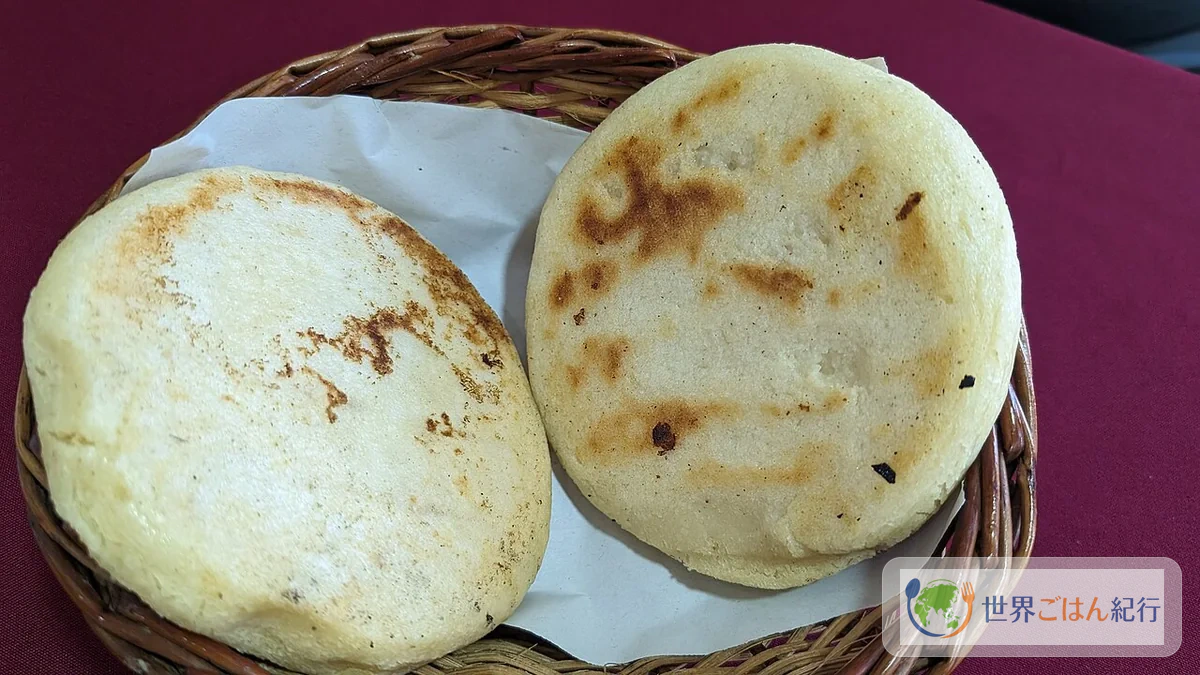
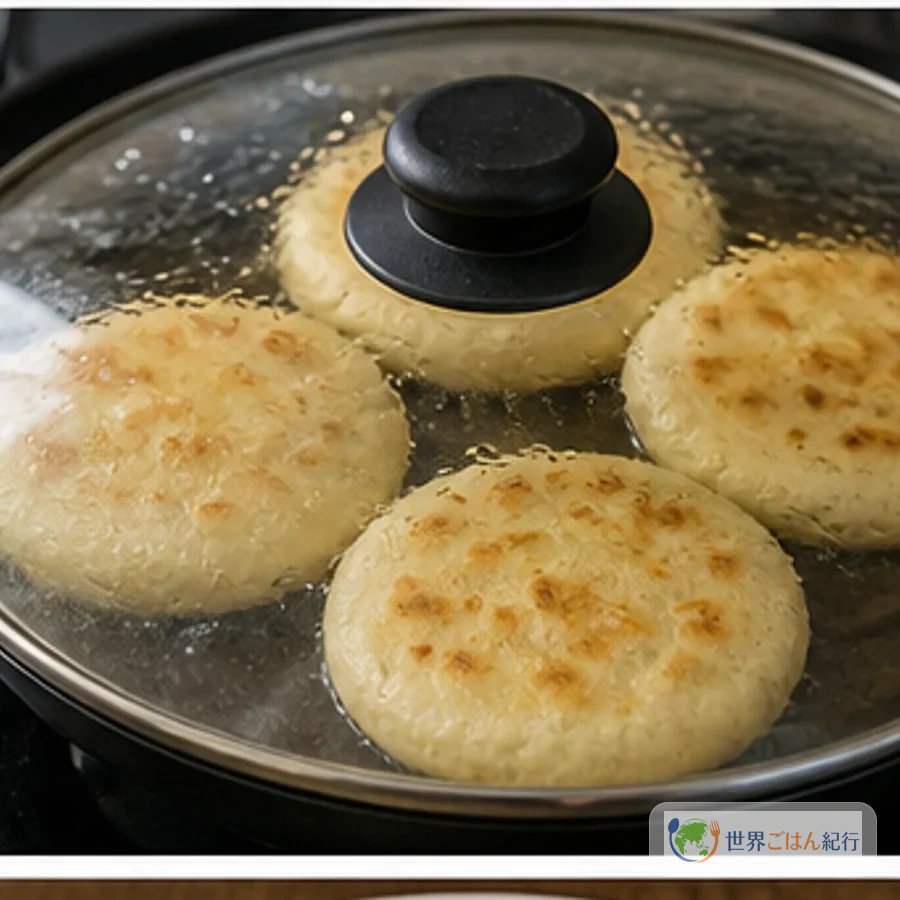
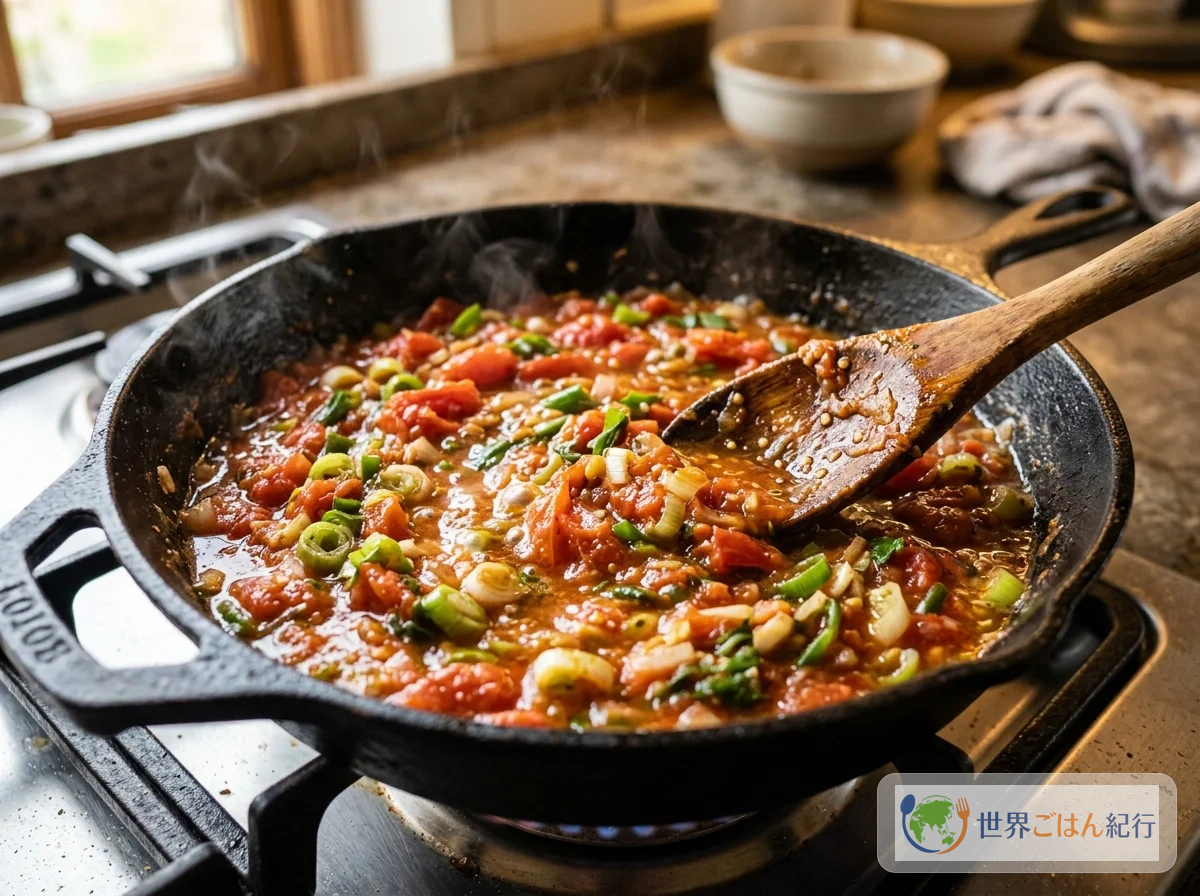
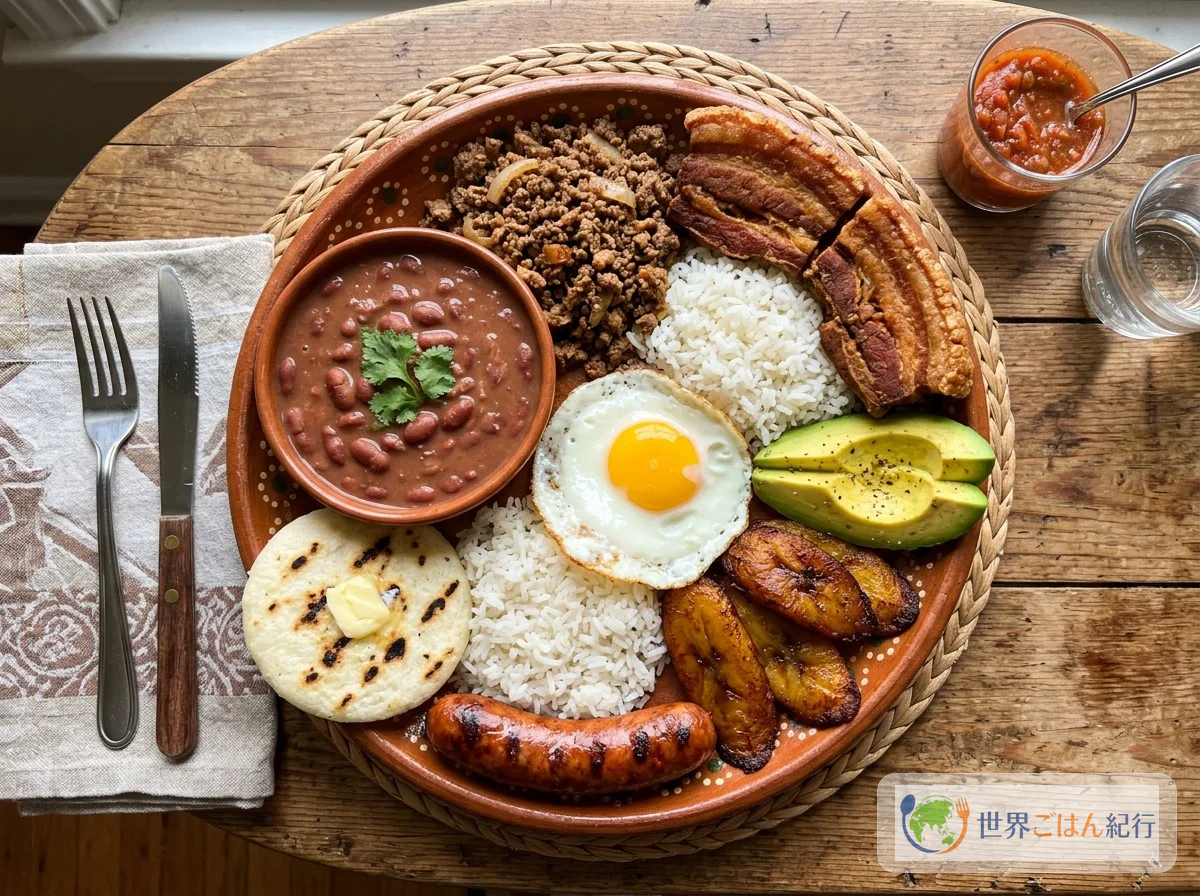
A thin arepa topped with tomato and scallion hogao
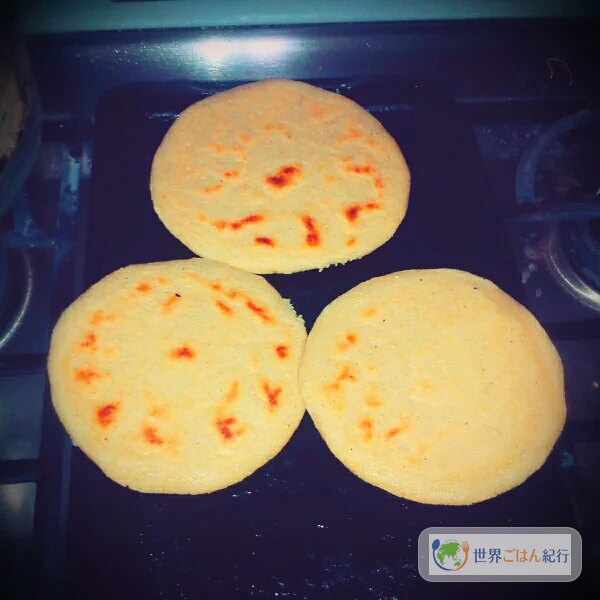
When white dough is cooked on a griddle, fine browned spots appear on the surface and it develops a springiness that pushes back against your finger. Put a little hogao on the broken-open arepa, and the sourness of tomato and the sweetness of scallion layer over the toasty fragrance of corn.
The Colombian arepa is not only a dish stuffed with fillings to make a one-plate meal. It is served thin at breakfast, with eggs or cheese, or set beside beans and meat dishes. This recipe makes 8 small discs from white masarepa, browns the surface, then covers the pan to warm the center through.
What to protect is the precooked flour, the thinness, and a heat that is not too strong. Substituting ordinary cornmeal changes how the dough holds together and how it cooks, so check the flour label in the ingredient list first.
What the arepa does on a Colombian table
The arepa is a corn staple eaten in both Colombia and Venezuela. That it crosses a border does not mean there is a single correct version. Even within Colombia, the grain used, thickness, filling, cooking method and time of day it is eaten differ from region to region.
Colombia's Ministry of Culture treats traditional cuisine not only as ingredients but as intangible culture that includes knowledge, technique, table customs and regional memory. Because the skills of grinding, kneading and cooking corn have been handed down in homes and regions, you cannot say that the same ingredients make the same dish.
Recent surveys also record a great variety of arepas in the country, said to number from several hundred to over a thousand, and efforts to preserve regional cooking continue. Factory-made precooked flour helps people reproduce the dish at home, but it also pulls the differences in local corn and grinding toward one texture. When cooking elsewhere, rather than treating the use of a dedicated flour as "exactly authentic," it is easier to judge by using the flour's properties and bringing the thinness and accompaniments closer to a Colombian table.
Colombian arepas change by region
| Region or name (examples) | Tendency of dough and shape | Place at the table |
|---|---|---|
| Around Antioquia, the Paisa region | Many thin arepas of white or yellow corn, sometimes eaten with just salt or butter | Breakfast or a snack, a side for bean and meat dishes |
| Around Boyacá | Some regional recipes put cheese, dairy, eggs or sweetness into the dough | A snack or home sweet that keeps the aroma of corn |
| Caribbean coast | Besides corn, fried versions and ones enclosing an egg are known | At street stalls or breakfast, wrapped around a filling to make one dish |
| Around Santander | Records combine yellow corn with pork fat or pork rind | Eaten on its own as a griddled item, and as part of regional dishes |
| Amazon, Orinoco and others | Some staples use grains or roots other than corn, changing with local ingredients | A staple that keeps well, eaten with local dishes |
Even under the same name "arepa," a white dough cooked thin and eaten with only salt and one with cheese or meat kneaded into it have different ingredient lists and different occasions. This hogao version takes the thin arepa seen around Antioquia as its axis and pairs it with a sauce that is easy to make in a home kitchen. It does not aim for the same result as the arepa de huevo of the Caribbean coast or the cheese-filled Venezuelan style, even though they look alike.
Ingredients (serves 4, 8 small arepas)
Choose masarepa whose bag says "pre-cooked," "precooked" or "harina de maíz precocida." Ordinary cornmeal, dried corn flour, Mexican masa harina and flour for tortillas differ in grain size and pretreatment, so they cannot be used with these proportions. White flour gives a pale color when cooked; yellow masarepa gives a stronger aroma and color.
If you cannot find flour with this labeling nearby and want this texture, it is less trouble to get one bag of the dedicated flour than to compromise by mixing substitutes. Look in Latin American grocers or online, and check that it is white precooked corn flour and that the package is 1 kg. Prices and stock change, so choose only if the label fits your purchase conditions.
Hogao is a savory sauce used on Colombian tables, made by sautéing tomato and scallion in oil and simmering it down. It is not a sauce built around heat, so if you want spiciness, serve ají or chili alongside at the moment of eating. Putting a lot of chili in from the start narrows your room to adjust for both the arepa and the bean dishes.
If you cannot get the white fresh cheese used in Colombia, mozzarella, cottage cheese or a low-salt feta will work. Press watery cheese lightly with paper towels just before serving.
The basic dough comes from corn, but imported flours differ by product in their production lines and allergen labeling. If you serve cheese, butter and eggs, the dish contains milk and egg. If you dislike the cumin in the hogao, start with 1/4 tsp, and if you add heat, check the ingredient labels as well.
How Colombian to make it in your own kitchen
Separating the parts that are easy to reproduce from those that cannot bring local ingredients lets you keep the axis of the flavor without claiming a "perfect recreation of the original."
| What to protect | Judgment elsewhere |
|---|---|
| Dough flour | Prefer precooked masarepa. White or yellow is a matter of taste, but use white if you serve it as a white arepa |
| Thickness | At 9 cm across and 1.0–1.2 cm thick, it holds the hogao and the heat reaches the center easily |
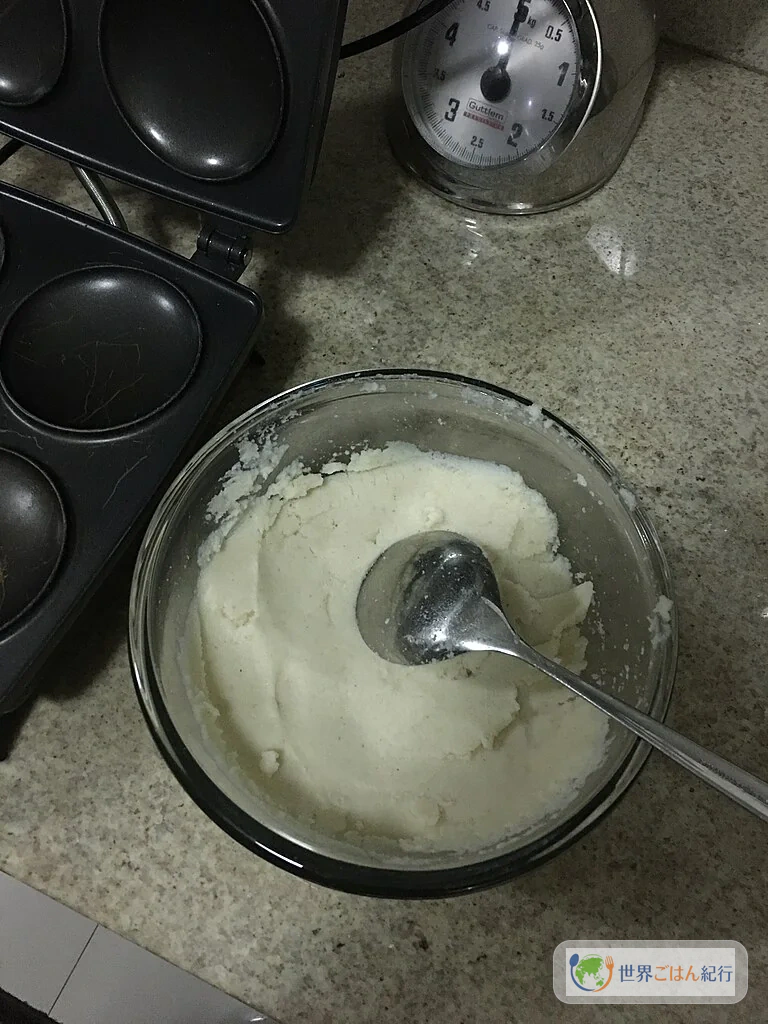
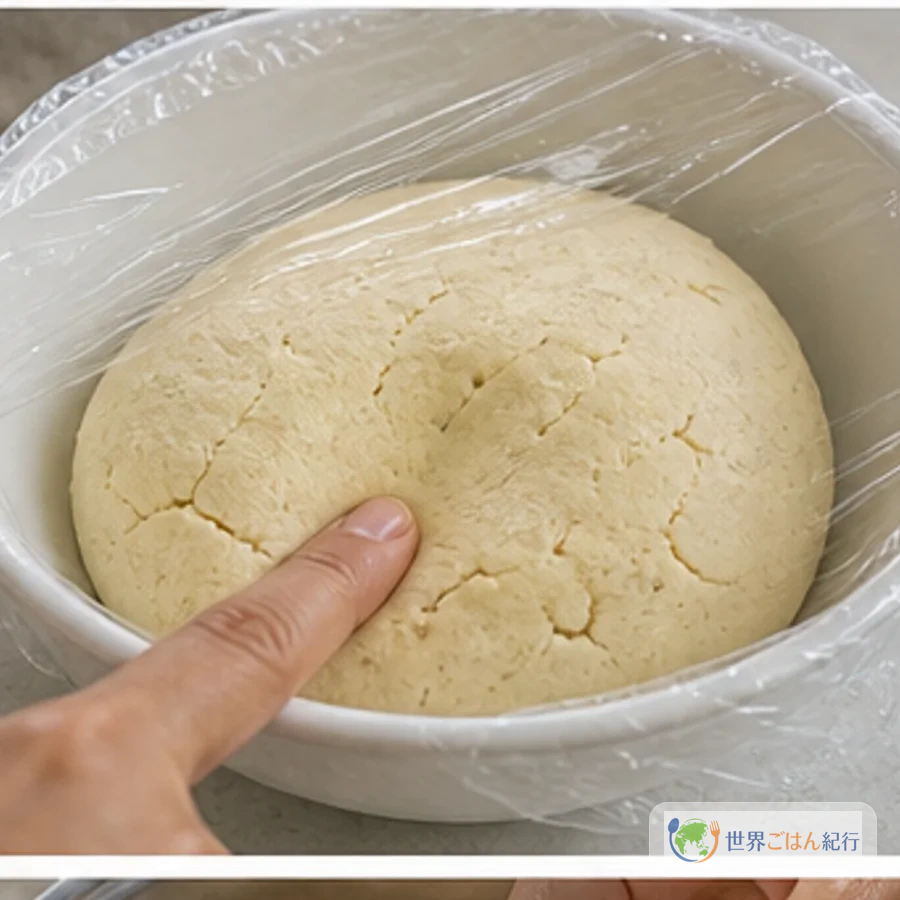
| Moisture | Make the dough until the floury look is gone and a finger dent springs back slowly. Do not cook it stiff |
| Hogao | Simmer scallion and tomato in oil to a thickness where the spoon track briefly stays visible |
| Cheese | In place of queso fresco, choose a white cheese that is not too salty |
| How to eat | Serve hogao, egg and avocado in small amounts, in a flavor that can sit beside beans and meat dishes |
Make the dough thick and stuff it, and it begins to resemble the Venezuelan arepa in substance. If you want a thin Colombian accompaniment, it is easier to adjust cooking time and the amount of hogao by not making it thick from the start. Stuffed Venezuelan arepas put the filling first, like reina pepiada, while for Colombian beans and stews it helps to think of the arepa as a side to a big-platter dish such as bandeja paisa (in Japanese).
Using the aroma of hogao
Rather than boiling off all of the tomato's acidity into a heavy sauce, stopping where the scallion aroma remains makes the hogao easier to match with the arepa. As it cools the moisture settles a little, so do not cook it until fully stiff in the pan. If it spreads out watery after plating, return it to the pan and add 2 minutes at a time over low heat.
Cumin is fragrant even at 1/2 tsp. Used in large amounts it comes in front of the tomato, so keep to the quantity the first time and adjust from the next. If you already have cumin, you need not buy more. If you also plan to use it in bean dishes and sautéed meats and can finish a bottle after opening, a small jar is worth having. At purchase, check that it is ground cumin and that the only ingredient is cumin.
If you want to add heat to the hogao, rather than adding more chili during the simmer, serve a small amount of ají or chili sauce at the table, which makes it easier to share with children and people who do not like spice. It differs in how it builds heat from the dishes that use ají amarillo, such as ajiaco bogotano, so do not swap them as the same sauce.
Common problems and how to fix them
The edges of the dough crack
Either there is not enough water or the dough was rested too briefly after mixing. Work 1 tsp water into the cracked spots, knead the whole for 30 seconds and rest for 5 minutes. Merely pressing the cracks closed with your hand lets them open again during cooking. If, on the other hand, you add too much water at once and it turns loose, add 2 tsp masarepa at a time and check the firmness after 5 minutes.
The surface burns but the center is floury
The heat is too high or the thickness is over 1.2 cm. Once browned, lower to medium-low, cover and warm each side for 4 minutes. Extend by 3 minutes per side on low heat until the white floury streak in the center is gone when broken open. Scraping off a blackened surface does not fix the center, so keep the browning light from the start.
The hogao is watery
It is being plated while the tomato still holds a lot of water. Take the sauce off the arepa, return it to the pan and simmer 2 to 3 minutes on low. Reduce it to a thickness where the spoon track stays briefly, and adjust the salt last. Add water only when the bottom of the pan is about to scorch.
I only have ordinary cornmeal
Rather than trying to make the same dough from it, it is safer to get masarepa and then cook. Adding boiling water to ordinary meal does not give the cohesion of precooked masarepa. If you make a cornmeal bread as a different dish, do not label it as a substitute for arepas.
Storage and serving
Store the arepas and hogao separately. Let cooked arepas cool, wrap them one by one and refrigerate, aiming to finish them by the next day. For longer, wrap and freeze, and use them within about 2 weeks before the texture declines. Keep hogao refrigerated in an airtight container, and move only the portion you will reheat into a small pot.
To reheat, put the refrigerated arepa in a dry skillet and cook 2 to 3 minutes per side on low heat. When the surface is dry and the center warm, add butter and hogao afterward. Thawing frozen ones in the refrigerator before cooking makes only the outside less likely to harden.
For breakfast add egg and avocado, for lunch set it beside beans or a stew. If you cut back the cheese and have only hogao, it is easier to taste the corn. Leftover hogao can go into a garnish for ajiaco bogotano or a sauce for grilled chicken.
FAQ
Is an arepa paisa different from an ordinary arepa?
"Arepa" is a large family name, and once a region, filling or cooking method is attached it is called by something else. The thin arepa of the Paisa region is sometimes eaten with only salt or butter, but thickness and accompaniments change from home to home and shop to shop. Do not take this combination of thin griddled dough and hogao as the single model for all of Colombia.
Is hogao a spicy sauce?
Basically it is a sauce of tomato, scallion, oil, salt and spices simmered together, and chili heat is not its center. Only those who want heat add ají or chili at the table. When separating a version for children and for adults, this method saves you from splitting the pot in two.
What cheese should I use?
A low-salt queso fresco type suits it. Elsewhere, mozzarella, cottage cheese or a feta with the salt reduced are easy to use, and if you use a melting cheese, let it only soften slightly on the surface in the heat of the arepa. Stuffing it with a large amount of stretchy cheese moves it from a thin accompaniment toward a filled bread.
May I add sugar or milk to the dough?
Some regional and home recipes add dairy or sweetness, but this hogao version does not. Sugar makes it brown faster, and milk changes the moisture and the tendency to scorch. If you want to go in a sweet direction, think of the cheese-filled, slightly sweet arepa of the Boyacá area as a separate formula.
Can the arepa be a staple on its own?
Yes. With egg, avocado and cheese it becomes a breakfast plate, and with beans or a meat stew it can be lunch. If you only put hogao on it, think of it as a snack or side; when you want more volume, adding eggs or beans keeps the cooked result better than making the dough thicker.
What if I have a corn or dairy allergy?
The dough uses corn flour, so people who must avoid corn cannot eat it. Cheese, butter and eggs are optional, but if used they contain milk and egg. Check the production-line labeling of imported flour before buying, and if you are concerned about cross-contact from shared utensils, prepare separate ones.
Sources
- Colombian Ministry of Culture, "Cocinas tradicionales" (accessed and checked 2026-08-12)
- Colombian Ministry of Culture, "Inventario de recetas de cocinas tradicionales colombianas" (accessed and checked 2026-08-12)
- Colombian Ministry of Culture, "Memoria Viva. Cocinas Tradicionales" (published 2018, accessed and checked 2026-08-12)
- El País, "Un investigador recorre Colombia para documentar 200 tipos de arepas y preservar su diversidad" (published 2026-05-01, accessed and checked 2026-08-12)
- El País, "Arepas" (published 2024-08-29, accessed and checked 2026-08-12)
- Boyacá Department, "Ramiriquí se prepara para vivir el XXVI Festival Internacional del Maíz, el Sorbo y la Arepa" (published 2026-06-24, accessed and checked 2026-08-12)
- P.A.N., "Traditional Venezuelan Arepa" (accessed and checked 2026-08-12)
- RedCol, "La arepa: un patrimonio alimentario de Colombia" (published 2022, accessed and checked 2026-08-12)